Turn back the clock to early 2021, when vaccines to contain COVID were reducing the palpable danger of being among other people, and it was reasonable to expect that the “new normal” would look pretty much like what came before.
San Francisco’s Union Square shows how naive such hopes were. The question is what comes next. And, honestly, it’s hard to think that anyone really knows what that answer will be.
This reality is being driven home right now by something that might seem separate — Nordstrom’s announcement that it will close its mammoth department store atop Westfield San Francisco Centre at Fifth and Market streets. But the vertical mall that opened in 1988 and expanded in 2006 redefined the map of San Francisco’s retail core, to the point that Union Square — once a term reserved for the plaza bounded by Geary, Powell, Post and Stockton streets — became synonymous with the downtown’s retail zone.
More than that, Union Square conjured images of a cosmopolitan concentration of shops and hotels and theaters and restaurants — an urban experience that the suburbs can’t match.
That’s not the case these days. Except in a negative sense.
More for you
- T-Mobile joins downtown S.F. exodus, vacating flagship location near Union Square
- Westfield mall blamed ‘rampant criminal activity’ for Nordstrom closing in S.F. Here’s what the data says
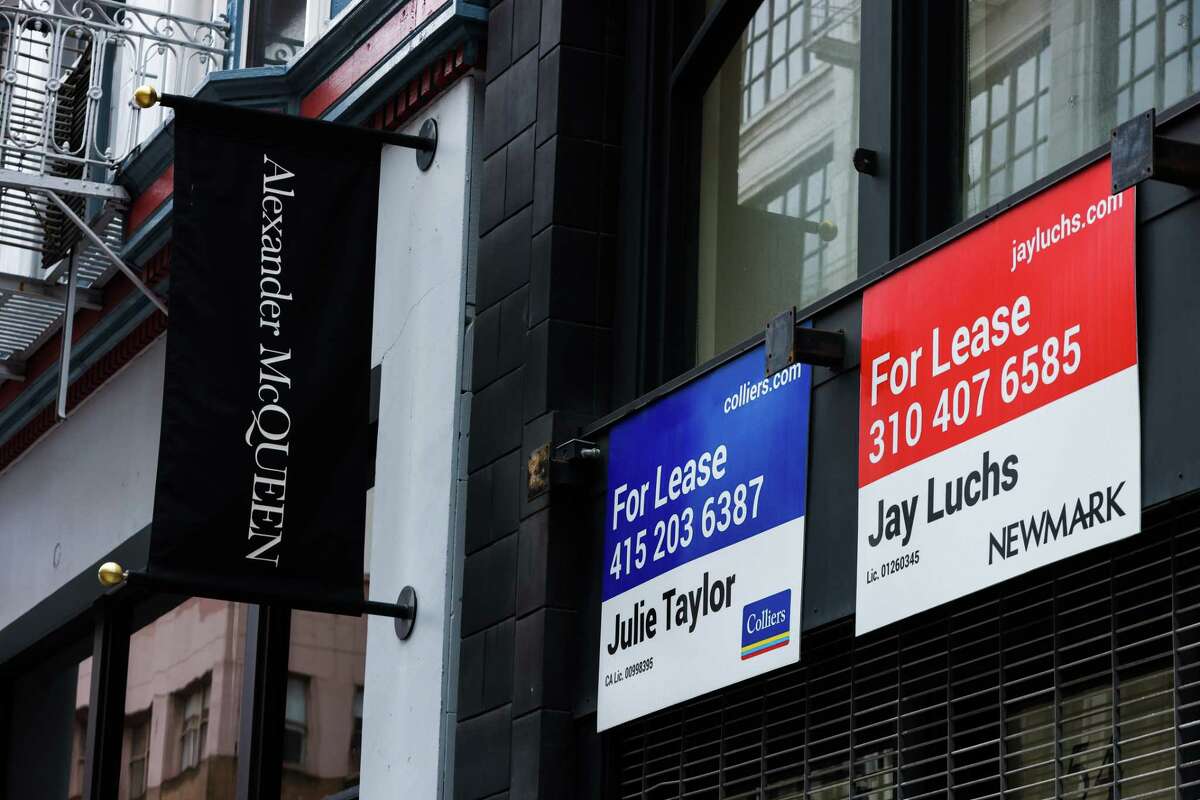
The retail vacancies that have flourished during the past three years were glaring: Look no further than the juxtaposition of a crudely boarded-up storefront between the rarefied boutiques of Alexander McQueen and Dolce & Gabbana fashion lines on the first block of Geary Street.
Other empty storefronts have artful “For lease” signs covering their windows, some adding “luxury retail” or “San Francisco’s next flagship” as a nudge to would-be tenants. But it’s hard to imagine how, for instance, the half-dozen large storefronts on Powell Street between Ellis and Geary suddenly find new retail tenants.
This goes double for Westfield’s tall crate of chains and brands, where Nordstrom alone fills nearly 7 acres of space.
The higher you go, the balance between functioning shops and vacant storefronts tips in the latter direction. The one newish retailer that jumps out is on the fourth floor: Joy Reserve, which opened late in 2021 and bills itself as “the nation’s first cannabis showroom.”
Picturing these spaces filling back up smoothly, bust to boom, is hard to imagine given all the larger retail trends that accelerated exponentially during the pandemic, such as shopping online. And what on earth would one do with Nordstrom’s space — a five-story near-windowless box, reached by curving escalators, one of those design flourishes that are cool once and then just slow you down?
The ideas already are percolating in the media, just like every time they have during the past two years when another huge space in downtown San Francisco has been emptied out or put on the market. In this case, entertainment venues and higher education. For other buildings it is housing, or lab space. And let’s not forget pop-up retail.
Those are all good ideas, when applied smartly in certain locations. But they’re not blanket cures. There aren’t an infinite number of institutions, artists and entrepreneurs to fill the ever-larger number of empty office and retail spaces.
Nor will the tourists and convention travelers who have fueled more and more of the district’s economy magically reappear, as if it were 2018 all over again.
This is where, ideally, I’d propose a methodical approach to plugging the holes and forging ahead. Lay out a blueprint for a recovery that also reinvents how Union Square and its surroundings can serve city residents and visitors in fresh, more relevant ways.
Problem is, that blueprint doesn’t exist. There’s no obvious set of solutions, because what San Francisco faces — and other large older American cities — is different than anything that has come before.
But, despite this, spending several hours in Union Square last week gave me hope. Because the spark is still there. The empty storefronts are bleak, absolutely, but they’re often in atmospheric buildings that have lived multiple lives and endured a variety of economic and social storms.
There’s also an overlap of communities and cultures, windows into distinct worlds.
During the morning, sitting in Union Square’s central plaza at a round blue table with comfortable metal chairs, I watched a walking tour gather underneath the Dewey Monument and then stroll toward the landscape of early 20th century buildings. Later, cutting down Maiden Lane to Grant Avenue, I shared the block with a half-dozen San Francisco State students filming a scene for one’s senior thesis.
Off Grant, go down Harlan Place and there’s Harlan Records, a vinyl bar that opened last year. The scene early Wednesday evening was low-key but lively, comfortably full.
All three of these stops offer the hint of possibility, the sense that you’re part of daily life in a living city.
What San Francisco has in its favor is a physical setting that few cities can match, coupled with the promise of individual freedom that has drawn waves of smart, creative people who didn’t see that option in the places they hailed from.
And, yes, it has a bona fide downtown, including that concentration of shops, hotels and attractions called Union Square.
A district where, at best, the richness of tradition and the air of expectation intertwine. San Franciscans have taken this for granted in recent years. The challenge now is to craft a future where recovery and reinvention are linked — and in the best possible way.
Reach John King: jking@sfchronicle.com; Twitter: @johnkingsfchron
Written By John King
John King is The Chronicle’s urban design critic, a post that ranges from parklets to sea level rise and the back-story of local icons. One is the subject of “Portal: San Francisco’s Ferry Building and the Reinvention of American Cities,” John’s book being published this November by W.W. Norton. A two-time Pulitzer Prize finalist who joined The Chronicle in 1992, he also is an honorary member of the American Society of Landscape Architects.

 ©2023 Hearst Communications, Inc.