- By Adam Shanks | Examiner staff writer |
- Jun 29, 2023 Updated 18 hrs ago (SFExaminer.com)
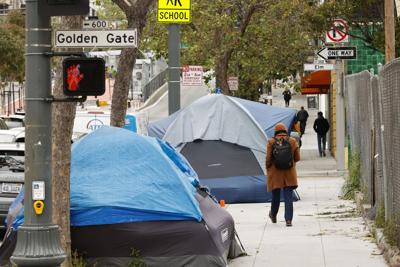
A sweeping study published by San Francisco researchers last week analyzed the primary causes of homelessness in California and made a series of recommendations for solving the state’s most vexing problem.
But it’s unlikely to end the ceaseless debates in San Francisco over how The City should address its enduring struggles to rein in homelessness, treat people with mental health disorders, or combat addiction.
Led by Dr. Margot Kushel at the UCSF Benioff Homelessness and Housing Initiative, the study collected information from thousands of people experiencing homelessness across eight representative regions in California, including the Bay Area.
San Francisco Supervisor Rafael Mandelman, who has taken a leading role in The City’s evolving homelessness policy, called the UCSF study a “political document” tailored to meet its authors’ preconceived notions.
“I think it has to be accepted for what it is, which is a lot of interviews with unhoused people across the state,” San Francisco Supervisor Rafael Mandelman told The Examiner. “It’s not focusing on San Francisco; it’s a statewide survey of info by unhoused people about their own circumstances and how they got where they are and what they’ve experienced.”
Kushel, in an email to The Examiner, stressed that the study intended not only learn about the causes and conditions of homelessness but assess the barriers to ending it.
“Like all studies, we have to state our aims up front,” Kushel said.
The study surveyed 3,200 participants, including 325 who were interviewed in-depth. The majority were unsheltered — meaning they sleep outside — as are most homeless people in California.
“Because one of our goals at the outset was to look at solutions to homelessness (people in shelters are homeless, so by definition, being in a shelter doesn’t solve homelessness), we spent effort on understanding barriers to housing,” Kushel explained.
The study found that despite rumblings that California is a de facto destination for the nation’s homeless, most are from this state. A primary reason for this is the state’s high cost of housing, which makes it likely that a person will become homeless – and will struggle to regain housing once unhoused.
The study expressly advocated for policies to reduce obstacles to housing and touched on themes deeply familiar to San Franciscans.
San Francisco has long found itself embroiled in a debate over whether or not it should pour resources into affordable and permanent housing — a policy endorsed by the UCSF study — or fund the expansion of temporary emergency shelter.
A central question with which city leaders wrestle is whether San Francisco should make itself a model for state and national policies for which it advocates — namely, by investing in housing. Or, should The City acknowledge its limits and aim to quickly and efficiently mitigate unsheltered homelessness by expanding shelter?
Those questions played out in a recent budget committee meeting as Mandelman and Supervisor Hillary Ronen debated the best path forward.
Ronen decried the negative attention San Francisco receives but said in the committee meeting that “the problems are not unique to San Francisco.”
“What we are dealing with … is the emergency of poverty, and we don’t call it poverty, but that’s at the root cause of all of the issues,” Ronen said.
Ronen acknowledged The City could do things better, but said it’s a “balancing act.”
“How do you address the root causes so that we’re not dealing with this problem forever, versus how much do you address the symptoms … of poverty so that it’s not life and death situation for people today,” Ronen said. “The root of these problems are not with the way that we govern in San Francisco.”
She pointed to Mayor London Breed’s recent proposal to pull funding earmarked for young adult and family housing to fund the expansion of temporary shelter.
“Do you take money from youth and family homelessness to deal with the more visible adult homelessness in the street, or do you end family and youth homelessness so that they don’t become the adult homeless tomorrow?” Ronen asked.
The City, she added, never commits to a strategy.
Mandelman said Ronen isn’t wrong but that he and Ronen are trying to “address different problems.”
Mandelman argues that while the study’s proposed solutions to homelessness might work on the state level, they aren’t necessarily a prescription for San Francisco.
Instead, Mandelman argues that The City should implore the state and federal government to tackle systemic issues, while it invests in solutions “that address our San Francisco problems in particular,” such as the proliferation of encampments.
The City spends a significant portion of its budget — which totaled $14 billion last year — on a broad array of homeless services.
San Francisco’s Department of Homelessness and Supportive Housing had a $672 million budget last year, and Mayor London Breed’s proposed budget this year called for the department to receive $690 million. A bit more than half funds permanent housing efforts, while slightly less than a quarter is earmarked for shelter and crisis intervention.
“If you’re Hillary Ronen, you advocate to model at local level to try to pressure them into following along,” Mandelman said, adding that his preference is to do “some of that,” in San Francisco, but work more directly to address locally the “most problematic manifestations” of inadequate state and federal policy.
“Maybe that looks like an increased police presence, and breaking up drug rings, and displacing open air drug markets,” Mandelman said.
Mandelman believes The City should rapidly expand the amount of temporary, emergency shelter it offers to the homeless, breaking up open-air drug markets, and more readily compelling people into mental health treatment.
An expansion of shelter would theoretically allow The City to begin enforcing sweeps against homeless encampments. The City is currently barred from carrying out sweeps, in part because of the massive deficit of shelter beds it has compared to its homeless population.
And while the study implores the government to “facilitate swift exits from homelessness” and notes that many respondents struggle to find shelter, Mandelman highlighted how it does not expressly advocate for shelter as a solution.
The study states that 90% of its respondents reported spending at least one night unsheltered in the last six months, and 41% said they had attempted to access a shelter but were unable.
Kushel does not deny the importance of shelter and hopes her work can guide how shelter should be implemented. The study found that most people in shelters were “generally pleased” with their experience, but those unsheltered had wide-ranging concerns like curfews, requirements to vacate during the day, and COVID-related health risks.
“And basically all, whether in shelter or not in shelter, wanted housing,” Kushel added.
People in shelters were more likely to receive help in obtaining housing, while unsheltered people were more likely to view such services as ineffective.
Still, “we found (as have others) near unanimous desire for permanent housing,” Kushel said. “Our findings suggest the significant challenges that California faces, with its extreme shortage of housing for extremely low-income households, to end this crisis, and suggest concrete steps that could get us to the goal we all share, of ending homelessness.”
But that might be too big a task for San Francisco to tackle on its own, Mandelman argues.
The City is embarking on a state-mandated plan to make housing more readily available by building more than 80,000 new homes by 2031. Its new five-year strategic plan on homelessness calls for the addition of 3,250 new units of permanent supportive housing.
But as of the most recent homeless count in 2022, more than 4,000 people were living on the street. Investments in expanding permanent supportive housing have been successful, Mandelman acknowledges, and “we are improving people’s lives.”
“By that measure, it is working,” Mandelman said. “By the measure of, are San Franciscans feeling the benefit of their buck? Absolutely not.”