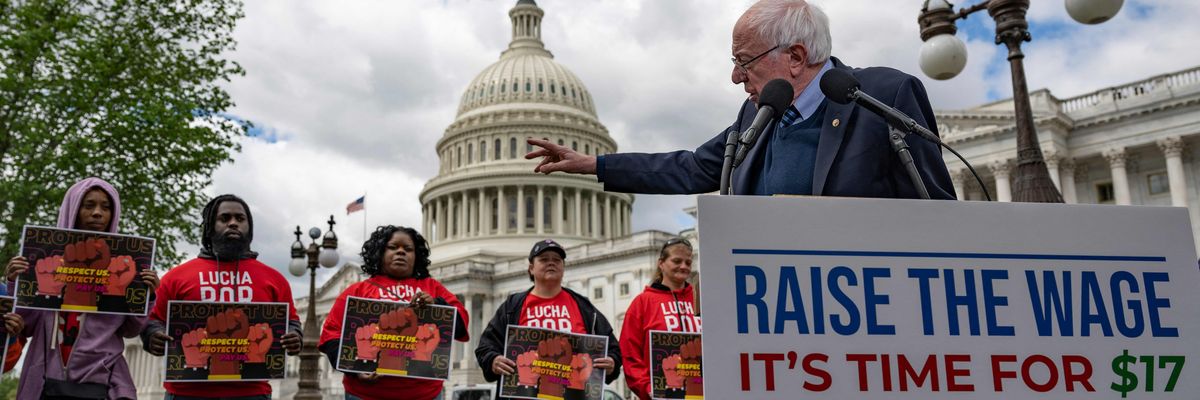
U.S. Sen. Bernie Sanders (I-Vt.) speaks during a press conference with labor leaders and service workers on May 4, 2023 in Washington, D.C.
(Photo: Jim Watson/AFP via Getty Images)
“Raising the federal wage floor is the single most efficient, effective—and wildly popular—bipartisan tool we have to deliver economic stability to working people,” said one supporter of the legislation.
Jul 25, 2023 (CommonDreams.org)
Economic justice advocates applauded Tuesday as U.S. Sen. Bernie Sanders and Congressman Bobby Scott formally introduced the Raise the Wage Act of 2023, which would increase the federal hourly minimum wage from $7.25 to $17 by 2028.
The legislation was first announced in May but the lawmakers finally unveiled the bill text a day after the 14th anniversary of the last time the national wage floor was lifted. In the years since 2009, the Fight for $15 movement has pressured several U.S. state and local governments to boost wages, but Republicans and some Democrats in Congress have blocked similar federal efforts.
“The $7.25 an hour federal minimum wage is a starvation wage. It must be raised to a living wage—at least $17 an hour,” Sanders (I-Vt.), who chairs the Senate Committee on Health, Education, Labor, and Pensions, said in a statement. “In the year 2023, a job should lift you out of poverty, not keep you in it.”
“At a time of massive income and wealth inequality and record-breaking corporate profits, we can no longer tolerate millions of workers being unable to feed their families because they are working for totally inadequate wages. Congress can no longer ignore the needs of the working class of this country. The time to act is now.”
A low minimum wage hurts all underpaid workers, but disproportionately harms workers of color bc they're overrepresented in the underpaid workforce. The #RaiseTheWage Act would lift the federal wage floor to $17 by 2028, benefiting 28 mil workers, incl. 14 mil workers of color.…
— National Employment Law Project (@NelpNews) July 25, 2023
Scott (D-Va.) declared that “no person working full-time in America should be living in poverty. The Raise the Wage Act will increase the pay and standard of living for nearly 28 million workers across this country.”
That works out to about a fifth of the U.S. workforce, according to the Economic Policy Institute—which also found in an analysis published Tuesday that the bill “would provide an additional $86 billion annually in wages for the country’s lowest-paid workers, with the average affected worker who works year-round receiving an extra $3,100 per year.”
Scott, ranking member of the House Committee on Education and the Workforce, stressed that “raising the minimum wage is good for workers, good for business, and good for the economy. When we put money in the pockets of American workers, they will spend that money in their communities.”
At a Tuesday press conference to promote the bill, Scott was joined by House Minority Leader Hakeem Jeffries (D-N.Y.), Congressional Progressive Caucus Chair Pramila Jayapal (D-Wash.), Labor Caucus Co-Chair Donald Norcross (D-N.J.), Well-Paid Maids owner Aaron Seyedian, and Frances Holmes, who makes $13 an hour working a seasonal job at a baseball stadium St. Louis, Missouri.
“I’ve been in the Fight for $15 for a decade and I’m here to plead with Congress, the senators, people that vote, just anybody that’ll hear our story,” said Holmes, explaining her difficulty paying for rent, utilities, and food for her family. “Workers like me, we need your help.”
"If the minimum wage was $17, I wouldn't have to scrape for enough money to get diapers, keep food on the table, and even just stay in our home. We are facing eviction right now and I am stressed because I am due to have my baby in October. #RaiseTheWage
— Stand Up KC (@standup_kc) July 25, 2023
-Milly Hobbs @Arbys https://t.co/DTDlc6ZJ8L pic.twitter.com/f2t3WJTno9
Along with hiking the federal minimum wage over five years, the bill would phase out the subminimum wage for tipped workers, teens, and people with disabilities, and tie future increases to median wage growth. In addition to Sanders and Scott, the legislation is co-sponsored by 146 House members and 29 senators.
The bill is also backed by dozens of groups, including the AFL-CIO, Business for a Fair Minimum Wage, Demand Progress, Indivisible, Leadership Conference on Civil and Human Rights, National Employment Law Project, National Network to End Domestic Violence, One Fair Wage, Oxfam America, Patriotic Millionaires, Service Employees International Union, and United for Respect.
“Raising the federal wage floor is the single most efficient, effective—and wildly popular—bipartisan tool we have to deliver economic stability to working people,” said Patriotic Millionaires chair Morris Pearl, a former managing director at BlackRock.
“Moreover, doing so will strengthen and expand the economic base for businesses across the country,” Pearl added. “To preserve American democratic capitalism, we must raise the wage floor substantially and close its gaping holes. This piece of legislation is a step in the right direction.”
Our work is licensed under Creative Commons (CC BY-NC-ND 3.0). Feel free to republish and share widely.
Jessica Corbett is a senior editor and staff writer for Common Dreams.