July 21, 2023 (SFChronicle.com)
If nothing else, the ongoing travails of San Francisco are driving home a point that many residents in recent decades have resisted or ignored: Downtown matters.
Not only does the world east of Van Ness Avenue generate money for services throughout the city, it shapes how San Francisco is viewed around the world. And when the drumbeat of bad press is unrelenting, as it has been for the past 18 months, every neighborhood suffers collateral damage.
“We are going through an educational process, if you will,” said Dean Macris, the city’s planning director in the 1980s. “You can’t have a healthy functioning city without a central area that is productive and creates vitality.”
The onslaught has been so persistent and pervasive — “San Francisco hogs limelight for wrong reasons,” a China Daily headline proclaimed this month — that even the most boosterish politicians are forced to confront it, sometimes in creative ways.
This was the case late last month when elected officials turned an innocuous event celebrating plans for a public park near Salesforce Transit Center that won’t start construction for another 18 months into a civic pep rally.
“What other city on the planet would attract international attention because a Whole Foods and a Nordstroms close?” asked state Sen. Scott Weiner, referring to two high-profile members of San Francisco’s ongoing retail exodus. “No one else! That’s because we’re the best city on the planet, they’re all jealous of us, and they love to kick us when we’re down.”
The problems cited by naysayers are legitimate, no question, from the deadly scourge of fentanyl in and around the Tenderloin to the threat of annual City Hall budget deficits climbing past $1 billion by 2026, due in part to the sinking value of downtown towers.
But not all of San Francisco is on the ropes, as anyone who has lingered in Hayes Valley or North Beach during the past year knows well. The extravagant Presidio Tunnel Tops is thronged on weekends. Clement Street in the Richmond district is an upbeat scene.
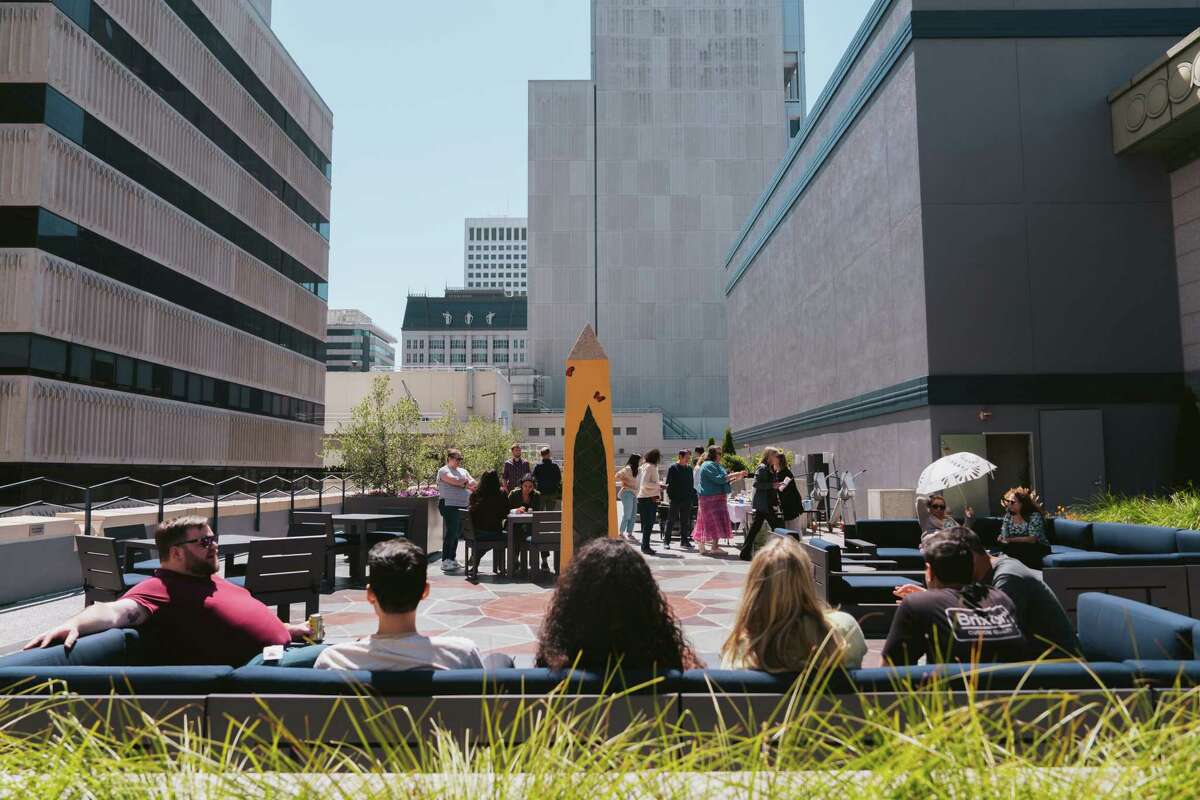
Even within the Financial District there’s sign of renewed life. Visit the recently reopened public rooftop terrace at 343 Sansome Street, or take in the one-two punch of a Blue Bottle Coffee and the upscale Treasury bar facing each other across the historic lobby of 200 Bush St., both doing good business on a recent afternoon.
These spots, however, lie outside the core of visible decay. The ones that media observers use to reduce a city of 49 square miles to a handful of lurid set pieces, such as Union Square’s empty storefronts, or the open dealing of stolen goods in the United Nations Plaza.
Neighborhoods west of Van Ness Avenue or south of Mission Creek might as well not even exist.
It’s this imbalance that shows how the fates of downtown and the neighborhoods are intertwined — a seemingly obvious notion that runs counter to much of the city’s discourse for a half-century or more.
The idea that downtown San Francisco was some alien other, a generic counterpoint to the essential city, dates back to at least the 1960s and the rise of grassroots political activism. The Financial District — in particular the developers erecting high-rises and the corporations inhabiting them — was viewed as an evil force to be contained, so much so that in 1971, a ballot initiative sought to restrict all new buildings in the city to six stories or less.
“Once there was a San Francisco that was light and pastel, hilly, open and inviting,” was the opening page of a coloring book distributed by opponents during the quixotic anti-highrise campaign. Two pages later, cue ominous music, comes the plot twist: “Then rich men built tall buildings and San Francisco began to look stiff and forbidding like any other American city.”
That proposition — hatched by dress designer and San Francisco native Alvin Duskin — lost handily. But the same decade saw a successful quest by progressives and their allies to elect members of the Board of Supervisors from geographic districts rather than the city at large.
“It comes down to one issue — the neighborhoods versus the people who gave us BART” and other projects intended to boost the city’s status as a regional center, argued Harvey Milk in 1977, the same year he was elected as the supervisor from the Castro in the first district elections.
Similar rhetoric played a role in 1986’s Proposition M, which limited the amount of annual commercial development to about the size of one Transamerica Pyramid. In the words of one ballot handbook argument, “San Franciscans must decide if San Francisco belongs to them or to the downtown speculators who are mining it.”
Simplistic or not, such rhetoric resonated in a city that always has been distrustful of central authority.
“There was a belief set that downtown was the Great Satan,” said Rudy Nothenberg, who came to City Hall as the budget director for George Moscone and later served 10 years as city manager. “I don’t know to what extent this was political theater, but they (neighborhood activists) were good at it and they continued doing it.”
Macris and his efforts to manage downtown growth — preserving older buildings while finding space for new towers, for instance — were frequent targets.
“The left controlled the narrative, and there was a genuine hostility about business — ‘these are just fat cats in it for the dollar,’” said Macris, who returned to City Hall as planning director under then-Mayor Gavin Newsom. “A lot of people genuinely care about the city, and they bought into the notion.”
That view of downtown as a place apart is something that Woody LaBounty grew up with in the Richmond District.
“This was a very parochial city — you did everything in your particular sphere,” recalled LaBounty, 57, who still lives in the neighborhood and recently became president of the preservation group San Francisco Heritage. “People looked at it as a destination, or something to fight with.”
These days, downtown office vacancy rates hover around 30%. Storefronts large and small wear “for lease” signs. Whole buildings are being offered for sublease by tech firms whose ascendency triggered a fresh wave of hostility toward corporate forces.
This is why Mayor London Breed’s various initiatives to revitalize downtown have received little pushback from supervisors, including tax breaks for companies who move workers there. The board also joined with her on legislation to make it easier to convert office buildings into apartments or condominiums.
There’s a strong argument to be made that such efforts, in the long run, could create a more sustainable and even neighborhood-like downtown. Similarly, any signs of recovery in the coming year could fuel larger national stories that maybe, just maybe, there’s life after dystopia.
“People might be feeling different about downtown these days,” suggested LaBounty. “It was always seen as the bully. Now it’s down on the mat.”
Reach John King: jking@sfchronicle.com; Twitter: @johnkingsfchron
Written By John King
John King is The Chronicle’s urban design critic and a two-time Pulitzer Prize finalist who joined the staff in 1992. His book “Portal: San Francisco’s Ferry Building and the Reinvention of American Cities” will be published by W.W. Norton in November.

 ©2023 Hearst Communications, Inc.