With the academic aspect of their work now over, California reparations advocates are just coming to grips with the impact the last two years have had on their lives.
July 30, 2023 (SFChronicle.com)
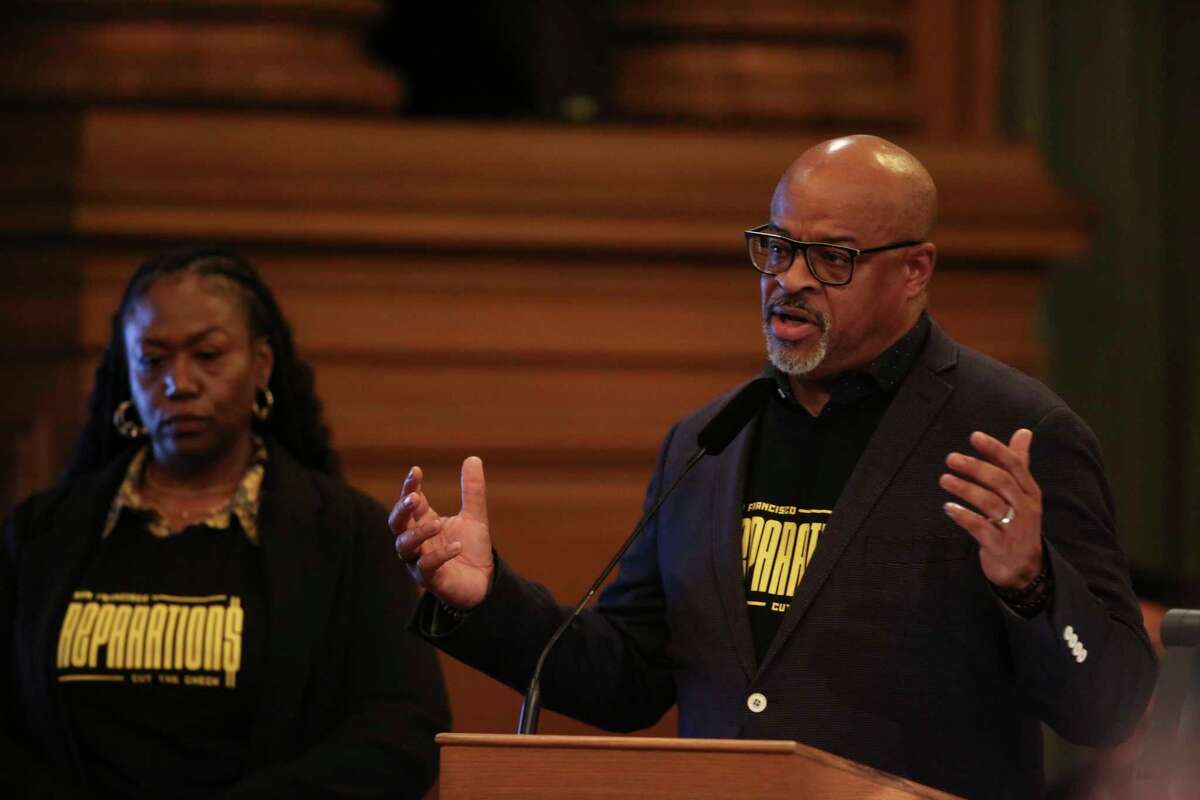
When Black folks testified before the state’s reparations task force about the long-term financial disadvantages they have faced because of slavery’s legacy in California, Assembly Member Reggie Jones-Sawyer of Los Angeles said he could close his eyes and “almost see that person’s enslaved ancestor standing beside them, guiding their souls.”
He called the time he spent studying reparations over the last two years a “life-changing” experience.
Jones-Sawyer wasn’t the only person among the nine members of the state task force and the 15 on San Francisco’s African American Reparations Advisory Committee to feel this way.
These 24 scholars, community leaders and elected officials were tasked with studying slavery’s legacy in California and developing reparations proposals. Along their journey, they’ve heard harrowing stories that bolster the case for reparations. At the same time, their efforts have been met with racism, threats of violence and a coordinated right-wing disinformation campaign that portrays them as only interested in sowing discord by dredging up America’s disgraceful past.
“I think we were all a bit naive heading into the process,” he said. “When you’re getting hit by people who are against reparations and you’re getting hit by people who are for reparations and you’re right in the middle, trying to do the right thing, it’s really hard.”
For the past two years, members of both committees were unwavering in their commitment to the reparations cause. Within the last month, both groups published huge reports that included hundreds of reparations recommendations — the first of their kind in California.
The toll this process had on them was profound.
Some advocates told me sleepless nights and intense stress became their constant companions as they navigated the complexities of reparations.
Tiffany Carter, a San Francisco native who volunteered to serve on the San Francisco committee, told me the stories of discrimination in housing, education and employment that she heard from the city’s Black elders still haunt her. These stories were coming from people she grew up around or with whom she shared a family connection.
“I’m not an activist. I’m a chef. I run my own business. I wanted to be a part of this process because I want to create a better future for Black people in the city,” Carter said. “But I wasn’t used to this kind of experience. … You don’t just forget these stories or the pain in people’s voices when you hear it so often for two years.”
During their joint efforts, the AARAC and the state task force had more than 40 public meetings, heard from more than 200 witnesses and listened to more than 100 hours of public comments. The groups created more than 200 reparations recommendations that both state lawmakers and legislators in San Francisco will consider in coming months.
“We were wading into deep and infested waters to research the harms the Black community still experiences, and in many ways during this research we were being retraumatized by it all,” San Francisco’s AARAC chair, Eric McDonnell, told me.
Like Carter, McDonnell hasn’t been able to shake the troubling testimony he heard during the committee’s meetings during the last two years. He said in addition to the stories shared during public meetings, others were shared with him privately.
One such story came from an older Black woman from San Francisco who told him she lost her home during urban renewal, which occurred between the 1950s and 1970s. Because the city compensated her with a paltry sum, she endured financial struggles for decades. Her family has yet to recover, McDonnell said.
“You know these stories exist, you know they’re out there but there’s a specific kind of pain that comes from hearing them from the people still experiencing them,” McDonnell said.
Intensifying the emotional toll of studying reparations is the sense of responsibility that Black advocates feel about the concept, Tinisch Hollins, who is on the AARAC, told me. Hollins is an organizer who speaks often to Black residents about what they need, and that connection comes with its own unique pressures.
“You want to improve the future for your own people,” Hollins said. “They see what you’re working on … so you’re constantly working to get it right, to create the best future possible and make sure that everyone benefits.”
Yet, the emotional toll of studying reparations isn’t limited to the weight of hearing about historical atrocities or simply getting the recommendations right. It extends to the reactions of a society that often prefers to forget or deny the legacy of slavery.
San Francisco’s committee received so many racist responses from the public that members of the Board of Supervisors spoke out against the backlash during a meeting in March. Multiple supervisors, including Rafael Mandelman and board President Aaron Peskin, noted how many of the remarks came from residents of this supposedly progressive city.
Jones-Sawyer said his office has been inundated during the past two years with messages threatening his staff and members of the state task force. These reactions, he said, can make reparations advocates fear for their personal safety but it can’t stop their work.
Jones-Sawyer said when the backlash felt overwhelming, he thought about his late uncle, Jefferson Thomas. Thomas was one of the “Little Rock Nine,” the group of students who fearlessly integrated Central High School in Arkansas in 1957.
“I would remind myself in those moments what he went through,” Jones-Sawyer said. “If you put things in context, you realize it’s tough and you’re experiencing a lot of mental anguish and trauma, but there are people who advanced us, whose shoulders we stand on, that went through a lot more.”
While submerged daily in past atrocities committed against Black people in California, state task force member and San Francisco attorney Don Tamaki wrestled with something more: a sense of not belonging.
Tamaki, who is Japanese American, has successfully worked on reparations for Japanese Americans following their forced incarceration during World War II. His parents were among the nearly 8,000 Bay Area residents forced into a San Bruno detention facility after Pearl Harbor was bombed in December 1941.
Tamaki is well-qualified to serve on the state task force, but even he admitted that researching the brutal scope of anti-Black racism in the state, which he said often had him “internally screaming and crying” during meetings, made him question his place among other Black reparations advocates.
“From the beginning, as the only non-Black member of the task force, I wondered if I was the right person to be there. It’s something I thought about and stressed about often,” Tamaki said. “I realized early on that I really needed to earn my place among the task force members.”
Self-care has been crucial for Tamaki and the others, whether it was keeping a journal, going on a nature walk, or spending more time with friends and family. Stepping away from intense subject matter helped many of them sustain the emotional stamina needed to move a taxing reparations process forward.
Hollins told me her self-care involved connecting more with nature, and “finding ways to create spaces for Black people to find joy in San Francisco” through her nonprofit SF Black Wall Street, which works to improve the economic mobility of Black residents.
McDonnell said he turned to “a spiritual path to help me navigate this work.”
Jovan Scott-Lewis, a task force member and UC Berkeley geography professor, told me via email the end result of his reparations work is part of his self-care journey. It “was in that work that I found my method of coping with all the trauma that was being shared with us. It was by making sure that we advocated for the fullest possible sense of repair through our policy recommendations and compensation models.”
As the topic of reparations continues to gain traction in California, it is crucial we acknowledge and support those who bear the emotional toll of this vital work. Only then can we hope to move toward a future defined by healing, justice and true equality for all.
Reach Justin Phillips: jphillips@sfchronicle.co
Written By Justin Phillips
Justin Phillips joined The San Francisco Chronicle in November 2016 as a food writer. He previously served as the City, Industry, and Gaming reporter for the American Press in Lake Charles, Louisiana. In 2019, Justin also began writing a weekly column for The Chronicle’s Datebook section that focused on Black culture in the Bay Area. In 2020, Justin helped launch Extra Spicy, a food and culture podcast he co-hosts with restaurant critic Soleil Ho. Following its first season, the podcast was named one of the best podcasts in America by the Atlantic. In February, Justin left the food team to become a full-time columnist for The Chronicle. His columns focus on race and inequality in the Bay Area, while also placing a spotlight on the experiences of marginalized communities in the region.

 ©2023 Hearst Communications, Inc.