- By Marcus White | Examiner staff writer |
- Sep 12, 2023 Updated 17 hrs ago (SFExaminer.com)
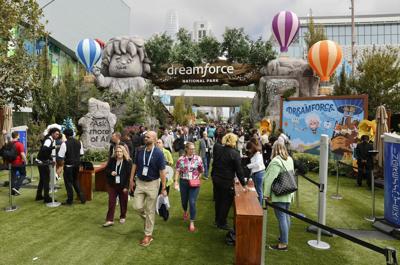
Before Dreamforce descended upon San Francisco this week, Rodney Fong said, and even before a number of high-profile companies ordered workers to return to the offices a week ago, he wanted to document a familiar feeling downtown as he stopped for coffee on Montgomery Street.
“There were so many people on the sidewalk, and cars, and scooters and bicycles coming to the office, that I actually stopped, put down my coffee and took a video of the intersection,” said Fong, the president and CEO of the San Francisco Chamber of Commerce, as he recalled the last morning of August. “It warmed my heart to see the intersection filled … and it was reminiscent of pre-COVID days.”
The arrival of Dreamforce — Salesforce’s annual San Francisco gathering, The City’s largest yearly convention — and the return of workers to their San Francisco offices on a hybrid basis this month have given businesses in and around downtown a dose of optimism as the area continues to contend with the coronavirus pandemic’s unprecedented economic impact.
Salesforce has said it expects as many as 35,000 attendees at its conference this week, which the company has dubbed “the biggest AI event in the world.” And a number of companies with offices in The City — including Lyft, Meta and Unity — directed employees to start working at least three days a week in person after Labor Day.
Fong said the majority of the chamber’s 65-member board of directors were spending three days a week in the office at the start of the summer. Between Aug. 31 and Sept. 6, Kastle Systems pegged San Francisco’s highest single-day office occupancy rate at 48%. Last September, office attendance hovered around 40%.
But Andy Chun, owner of Schroder’s on Front Street, said there is “no magic bullet” because “the landscape has permanently changed” for workers around The City and across the country. Chun said Fridays used to be the 130-year-old German restaurant’s biggest day of the week before the pandemic. Now, he said, Friday events such as Schroder’s Oktoberfest block party later this week are the only times the end of the traditional workweek looks like it did before the coronavirus.
“Let’s be honest about what the pandemic did: It essentially took probably 10, 15, 20 years worth of work trends and just compacted it into one or two years,” said Chun, a San Francisco resident since 2000. “Were things always moving toward hybrid? Absolutely. Was it all going to happen at one time, where all of a sudden half the population or more of the people who were coming downtown just disappeared overnight? That’s pretty much unprecedented.”
Leaders in The City are cognizant of this, championing events and legislation aiming to lessen downtown’s reliance on office space, much of which remains vacant. San Francisco’s overall office vacancy rate was at 31.6% through the end of June, according to CBRE, a commercial real estate services and investment firm.
Laurie Thomas, executive director of the Golden Gate Restaurant Association, said a reimagining of the area is still essential moving forward, noting that many downtown restaurants can’t cover their rising expenses if they’re only busy three days a week.
“We need to activate the hell out of the downtown on Friday nights, on Saturdays, on the weekends,” Thomas said. “We need to leverage concerts. We need to leverage arts. We need to leverage food events. And we need to have The City be a welcoming place for tourism.”
San Francisco is hosting Dreamforce amid concerns about crime, drug use and homelessness. Salesforce CEO Marc Benioff said last month that the company could pull the convention out of The City next year because of those issues, which will remain in the spotlight when San Francisco hosts dozens of heads of state, including President Joe Biden, at the Asia Pacific Economic Cooperation summit in November.
Thomas and Fong said there is a lot of collaboration between The City’s business groups, with the Chamber of Commerce president noting that they’re not asking how to bring downtown “back,” but to “do it better.” Chun noted that, in Schroeder’s century-plus in San Francisco, the restaurant has stayed open through two pandemics, two World Wars and a handful of financial crises. He said he thinks better days are ahead, and he wants to see it through.
“We’ve got to be very honest about the problems that we face in The City and kind of come together to fix those things, while at the same time be huge ambassadors and cheerleaders for The City to push back against this national narrative that this place is just a wasteland,” Chun said. “I don’t feel unsafe coming down here, but my businesses have been broken into. Both can be true. I love this town, I love San Francisco, and I know it’s gonna come back bigger than ever.”