Oct. 10, 2023 (SFChronicle.com)
Back in the early pandemic — remember “hot vax summer”? — people worried about downtown San Francisco were counting on small-scale moves like parklets and pop-ups to bring life back to ghostly streets.
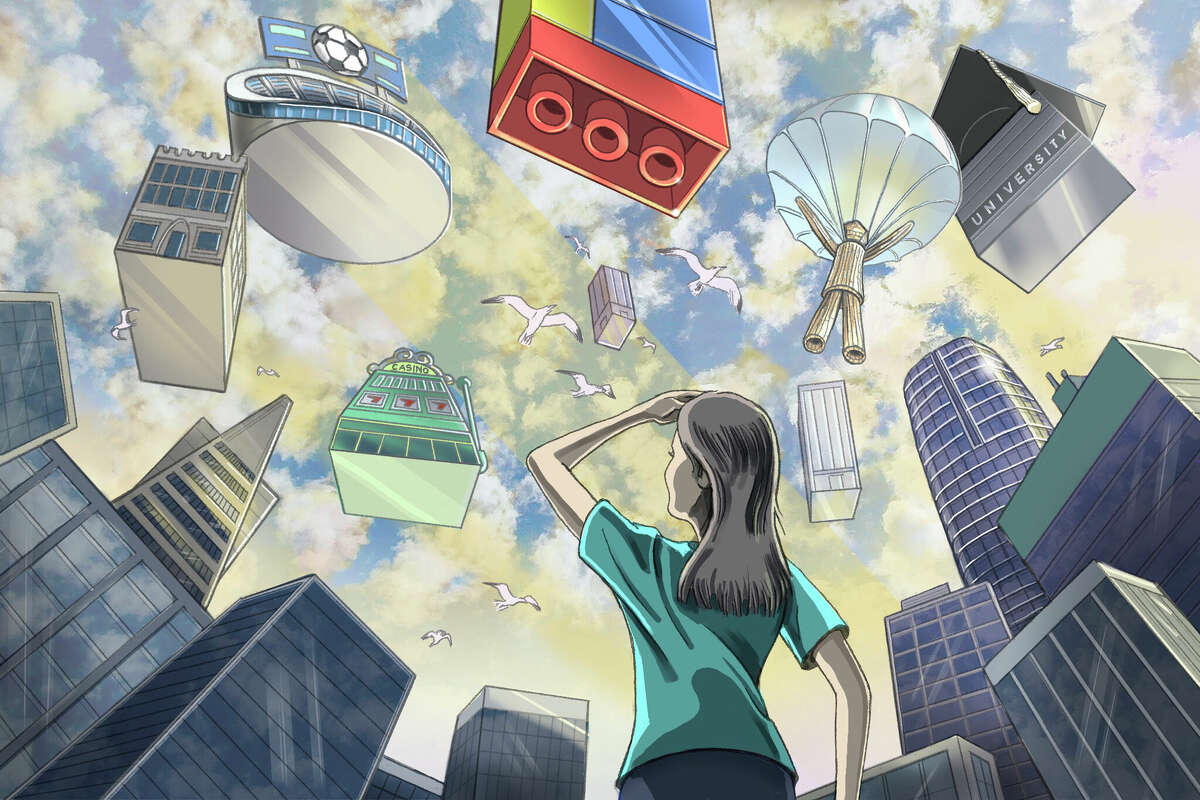
These days, it’s soccer stadiums and universities. Heck, toss in a casino while we’re at it.
You get the idea: Small-scale moves have given way to Big Ideas, magic bullets that theoretically will vaporize that 34% vacancy rate in office space. Or reverse the retail exodus that includes Nordstrom abandoning its department store atop Westfield San Francisco Centre — around the same time that Westfield handed off the mammoth 6.4-acre mall to its lenders.
Even the small moves are bulking up. The Vacant to Vibrant effort begun last week by SF New Deal and the city’s Office of Economic and Workforce Development bundles 10 pop-ups into a coordinated quest for buzz.
The question, of course, is whether these supposed saviors actually make sense. Once the news cycle passes or the novelty fades, are they likely to happen? If they did, would they have any impact?
What follows is a look at five urbanistic moon shots, why they turn heads and why perhaps we should look twice. Plus an idea of my own — because once you start down the road of Big Ideas, it’s difficult to stop.
A SOCCER STADIUM!
The idea: This trial balloon has soared the highest because Mayor London Breed has, at least twice, touted the potential virtues of tearing down no-longer-Westfield mall and replacing it with a 25,000-seat arena intended to hold professional soccer, major concerts and who knows what else.
Officially, this is a what-if, not a formal plan. But with the city’s biggest design firm (Gensler) doing conceptual studies, there’s genuine interest at City Hall.
The upside: All those sports fans and music lovers would bring energy to Union Square sidewalks, correct?
Reality check: We’re talking at least five years of demolition and construction, and the project’s ecological footprint would be Godzilla-like. There still are dozens of mall tenants, including a blue-chip Bloomingdale’s.
No soccer team is on board. Music promoters and concertgoers seem happy with Chase Center. The last thing Mid-Market needs is a daytime dead zone on its eastern flank.
Other than that? No problem!
A LEGOLAND!
The idea: Assuming that wrecking crews don’t level the mall, there’s still an empty Nordstrom to fill. Enter local architect Mark Hogan of OpenScope Studio, who, in August, suggested that at least one floor be converted into an urban outpost of the ginormous theme parks filled with all things Lego. The one Legoland now on the West Coast, near San Diego, packs a resort hotel and more than 60 attractions into 120 acres.
The upside: What’s not to love about ascending the mall’s curving escalator to gawk upward at a Salesforce Tower rendered in Legos? “It seems so logical, the idea of having an attraction for families downtown,” Hogan said in a phone interview this month. “I was downtown a lot this summer, and there were plenty of tourists, but they were looking for things to do.”
SFNext is Chronicle coverage devoted to the city’s most vexing problems.
To become involved: Send feedback, ideas and suggestions to sfnext@SFChronicle.com
He points out the advantages — above the Powell Street BART station, across from the cable car turnaround (speaking of tourists) and relatively inexpensive. Instead of spending $1 billion-plus on a stadium, “work out a lease deal for the space, get some (financial) help from the city, everybody could win.”
Reality check: With the “centre” in the hands of creditors, it’s difficult to know if anyone is making long-range decisions for the mall, Hogan admits. And are the lords of Legoland interested? “It’s not something we’re exploring at this time,” I was informed by a friendly spokesperson for Merlin Entertainments, which operates Legoland parks and also has a Legoland Discovery Center at Great Mall in Milpitas. “But I’ll keep you posted if something arises!”
A UNIVERSITY!
The idea: Smart people across the political spectrum have touted the potential of adding a major university to downtown’s heart, turning empty buildings and related spaces into the likes of classrooms, labs and dorms. Think something akin to Emerson College in Boston, with its collection of old and new buildings that together hold 5,000 students along Boston Common.
Boosters include Breed and City Attorney David Chiu: The duo sent a letter to Richard Leib, chair of the University of California’s Board of Regents, saying that downtown San Francisco is “uniquely able to house a mixed-use UC campus.”
The upside: When they’re not spending hours poring through philosophy books or pondering mathematical equations, college students like to — surprise! — have fun. Get out and about. See and be seen. Operators of cafes and vintage clothing shops would take note, and the rest is history.
“Just imagine Market Street being the campus walk from department to department, and from dorm to dorm,” one college dean mused to the Chronicle this summer.
Reality check: Anything at this scale is a long-term solution, rather than a short-term shot in the civic arm. The other catch? Public institutions like the University of California already have plenty on their plates. Though, according to a UC spokesperson, “the Office of the President has been tasked with exploring the suggestions. … That work is underway and there is no further update to provide at this time.”
A CASINO!
The idea: As Las Vegas boosters can attest, free-spending patrons are suckers for the chance to pull a lever and make a fortune. Meanwhile, the subterranean level of Salesforce Transit Center — a concrete shell intended for high-speed rail and Caltrain service — sits empty. So why not merge the former into the latter?
That’s the idea tossed into the pot this summer by Stanford Horn, a former executive at Coldwell Banker who predicted that filling the void until construction begins would have a civic payoff equal to Powerball.
The upside: Ka-ching! Filling the gargantuan basement with slot machines and roulette wheels could create “a giant prosperity machine bringing tens of thousands of people and employees downtown every day, 24 days, 365 days a year,” Horn wrote in the San Francisco Business Times, thus spinning off “Restaurants, bars, spas, salons, and a cornucopia of thriving retailers and shops.”
The Get Involved calendar
Search for public meetings on top San Francisco issues so you can add your voice.
Calendar Submit an event More coverage
Reality check: “I did see the article, and I got a little chuckle. But nobody has followed up with a leasing request,” said Adam Van de Water, executive director of the Transbay Joint Powers Authority, which operates the transit center.
Besides, it’s not as if gambling is legal in San Francisco, or if the space is ready to use once you dim the lights and put red velvet on the walls. Readying the space for daily use would cost “in the tens of millions,” Van de Water estimates. Nor could dealers keep dealing until the first trains pull in — no sure thing — at the end of 2032. The $6.7 billion rail extension project is scheduled to start construction by 2026; the work proceeds north from Mission Bay, but access to the basement is required throughout.
A BURNING MAN PARK!
The idea: Downtown and the Financial District need to be thought of holistically, argues longtime neighborhood activist John Elberling, but an easy step in the meantime is to tap into the vibrant Embarcadero scene. This means adding attractions to such moribund spaces as Sue Bierman Park, an aimless 4-acre lawn that replaced long-gone freeway ramps. For instance? Import existing work by Burning Man artists to turn Sue Bierman Park into a Brobdingnagian sculpture garden.
The upside: There’s a lot to be said for spectacle with a local angle (the Black Rock Arts Foundation is based in Oakland). Overscaled flair not only would catch the eye from afar, it could offset the grim landscape of blank walls now framing the space. Besides, the kids who frequent the lively playground at the park’s edge would go nuts. They’d love it!
“Start with the strengths you have, and deploy them,” Elberling said this month. “Burning Man is internationally renowned. It would be a real attraction.”
Reality check: Building on the Embarcadero’s popularity is smart — the people keep coming. The idea of an exuberant artscape has a visceral appeal. But it’s hard to see how the energy would spill into the Financial District, rather than just add another attraction to the promenade.
A SATELLITE MUSEUM!
The idea: This one’s from me: The city’s de Young museum and Legion of Honor together own roughly 145,000 works, relatively few of which are on display at any one time. Meanwhile, the striking 4-story, cubelike edifice at Montgomery and California streets that once housed the Bank of America’s main banking hall sits vacant. Why not fill the monumental void with paintings and sculptures that otherwise are tucked away in storage?
The upside: Not only is this a chance for the city to showcase art in the heart of the Financial District, I’m guessing the scale of the offerings would pull in both visitors and residents to a neighborhood that sorely needs to diversify. Unlike the “real” museums in Golden Gate Park and Lands End, this one is an easy stroll from transit-friendly Market Street. For patrons who need to drive, parking downtown is plentiful these days.
Reality check: According to a spokesperson for the Fine Arts Museum of San Francisco, “opening a third space for collection display would require very substantial investment from the city to cover costs of security, climate control, staffing, etc.”
Fair enough. That said, power brokers from Marc Benioff on down have proclaimed the need to bring new activities to the city’s economic core. Here’s your chance!
Reach John King: jking@sfchronicle.com; Twitter: @johnkingsfchron
Written By John King
John King is The Chronicle’s urban design critic and a two-time Pulitzer Prize finalist who joined the staff in 1992. His book “Portal: San Francisco’s Ferry Building and the Reinvention of American Cities” will be published by W.W. Norton in November.

 ©2023 Hearst Communications, Inc.