Developers and their wealthy clients will never have enough.

Jan 19 (craig-axford.medium.com)
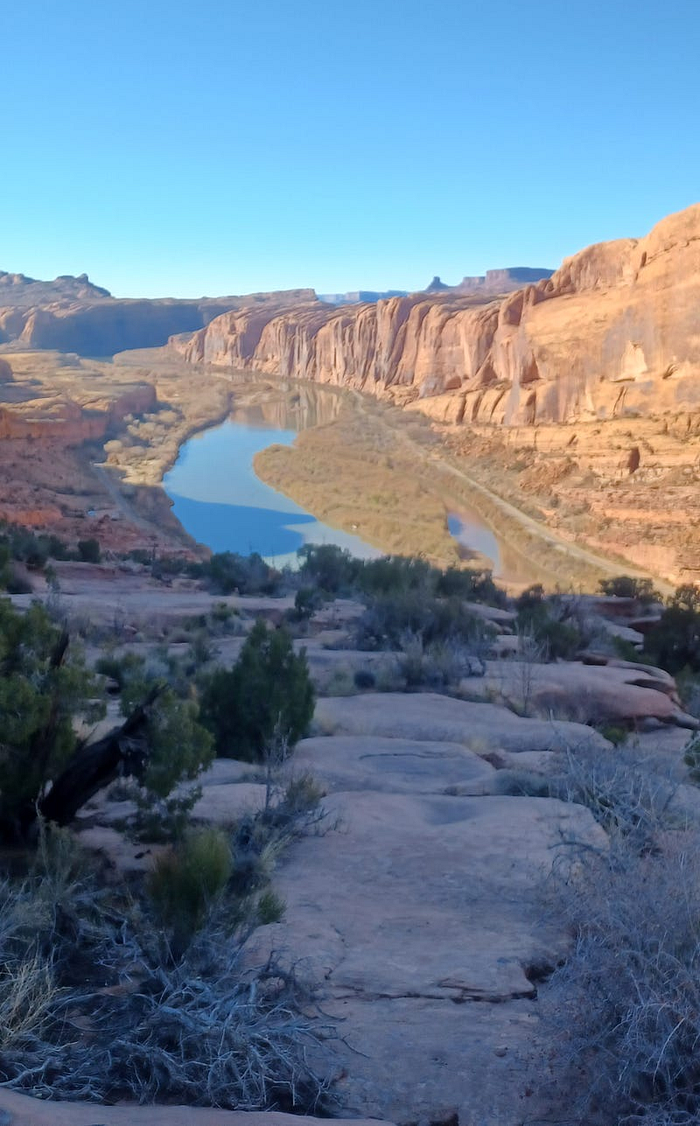
The late environmental writer Edward Abbey saw it coming. “If industrial man continues to multiply his numbers and expand his operations,” Abbey proclaimed in his environmental classic, Desert Solitaire: A Season in the Wilderness, “he will succeed in his apparent intention, to seal himself off from the natural and isolate himself within a synthetic prison of his own making.”
Of course, developers never portray their projects as “synthetic prisons.” That’s especially true of developers with aspirations to build in places that attract people largely because of their natural beauty.
Moab, Utah is just such a place. It was here that Abbey found the inspiration for his book while serving as a seasonal ranger at what was then Arches National Monument. And it is here that companies with grand schemes like to put words like “preservation” in their company name, even if their intent is to forever alter the landscape in a canyon whose only human inhabitants, with very few exceptions, are visiting campers.
Kane Creek Preservation and Development, LLC is just such a corporation. In a Moab Times Independent 2021 article describing their initial proposal, the developers say they are “really trying to do the right thing” with the 180 acres of land they recently acquired. To prove it, they said they would be limiting themselves to 30 to 50 houses on land that could accommodate up to 2,000, and they would include an innovation center for electric 4-wheel drive development and Colorado River research. Also, they would get rid of any invasive plant species on the property. Of course, all of this will require a sewage treatment plant because the development is located too far from town for sewage service, and most of this is being built in a floodplain, but we are not to worry.
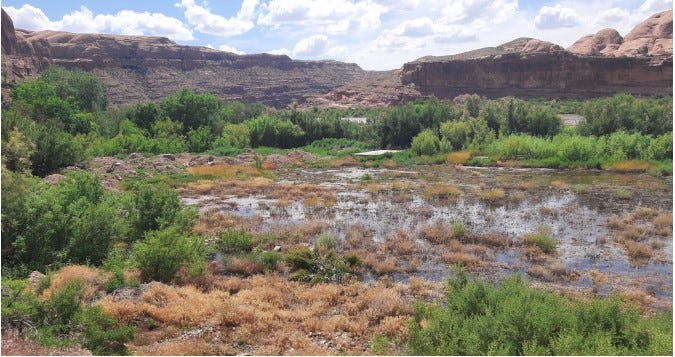
By 2022, The Moab Sun News was reporting that the project had gone from 30 to 50 homes to 500. By this time, the developers wanted a new special improvement district established for the project, and they wanted the majority of its trustees to be the developers or their representatives. A skeptical county commission voted itself as trustees, only to have the state legislature fashion narrowly tailored legislation the following year that put the developers in charge of the development district, leaving no elected officials on the board.
This is a story as old as the West, at least since European settlers first showed up on the scene. Promises are made, treaties are signed, but these only hold as long as there’s no money to be made by breaking them. And of course, the schemes companies come up with always come with the promise of jobs, and in this case a little housing. Unfortunately, few locals are going to be able to afford the homes. They will likely be used primarily as second homes or vacation rentals. As for the jobs, most of them will only last as long as it takes to complete the project.
Moab is a place familiar with booms and busts. First it was ranching, then it was uranium mining, now it’s tourism. Each has left its own kind of scars. Through it all, the population of the county’s year-round inhabitants hasn’t changed all that much. According to the US Census Bureau, as of April 1, 2022 there were 9,769 people living in Grand County, Utah year-round. Twelve years before that it was 9,225. It was just under 7,000 in 1970. Growth spurts tend to number in the hundreds, not thousands, and they don’t usually last long. There have been declines as well, often dramatic ones, during the region’s slow march toward 10,000.
Rural desert communities like Moab are particularly vulnerable to even slight change. Like the desert plants clinging to life in windswept patches of sandy soil, they grow very slowly when they grow at all. Many did not make it and are now ghost towns, or practically so. That’s because deserts are fragile hostile places masquerading as enduring rugged ones.
It is indeed difficult to imagine what could possibly damage a place that is adapted to less than ten inches a year of precipitation, frequently bakes for weeks at a time in 100° plus heat, and is inhabited by lots of sharp plants. After all, if such a place can survive what nature dishes out, what could we possibly do to it that could have much impact? A lot, as it turns out.
“Growth for the sake of growth is”, Edward Abbey famously said, “the ideology of the cancer cell.” It is an ideology that does not ask what should be done, relying instead solely upon the question of whether a thing can be done and, if so, whether or not it would be profitable. Land that is not being put to use by humans is often seen as not being used at all, or at best as not being put to its best use. Animals and plants have only marketing value in this philosophy, if they have any.
The latest land use controversy in Moab will not be the last. Kane Creek Preservation and Development, LLC has tried to assuage its critics by promising to include a native plant garden that will help “restore” native vegetation to the area. According to its latest advertisement in the January 11, 2023 edition of the Moab Times-Independent, it plans to go slow, building only about 30–35 homes a year for about ten to fifteen years and it will not likely exceed 500 homes when all is said and done (a dramatic departure from their original plans). In addition, they again remind us its sewage treatment plant will utilize the latest technology.
They have never, to my knowledge, acknowledged that the narrow road up the canyon leading to their property will eventually need to be widened to accommodate increasing traffic as they approach 500 homes and finish their plans for 70,000 square feet of business space. This road is quite literally lined with Indigenous rock art which will be put at even greater risk of vandalism and disturbance as this expansion takes place. Popular peaceful camping spots on public lands along the road will be subject to even more noise and automobile pollution as well.
All these actual and potential impacts aside, the question of what should be done to preserve our wild areas is, as always, ultimately a question of values: wildlife habitat vs. homes for the wealthy in a canyon that offers priceless views from every million-dollar patio; more peace and quiet or less; a starry night unpolluted by light vs. 500 more porch lights obliterating a few hundred more stars; the bank account vs. the soul. Moab and small communities like it around the world will always be places where these values clash — microcosms of debate over global questions. I, for one, know on which side of that debate I stand.
REFERENCES
Abbey, E. Desert Solitaire: A Season in the Wilderness (New York: Ballantine Books, 11th Edition, 1983)
Abbey, E. A Voice Crying in the Wilderness (New York: St. Martin’s Press, 1990)

Written by Craig Axford
M.A. in Environment and Management and undergraduate degrees in Anthropology & Environmental Studies. Living in Moab, Utah. A generalist, not a specialist.