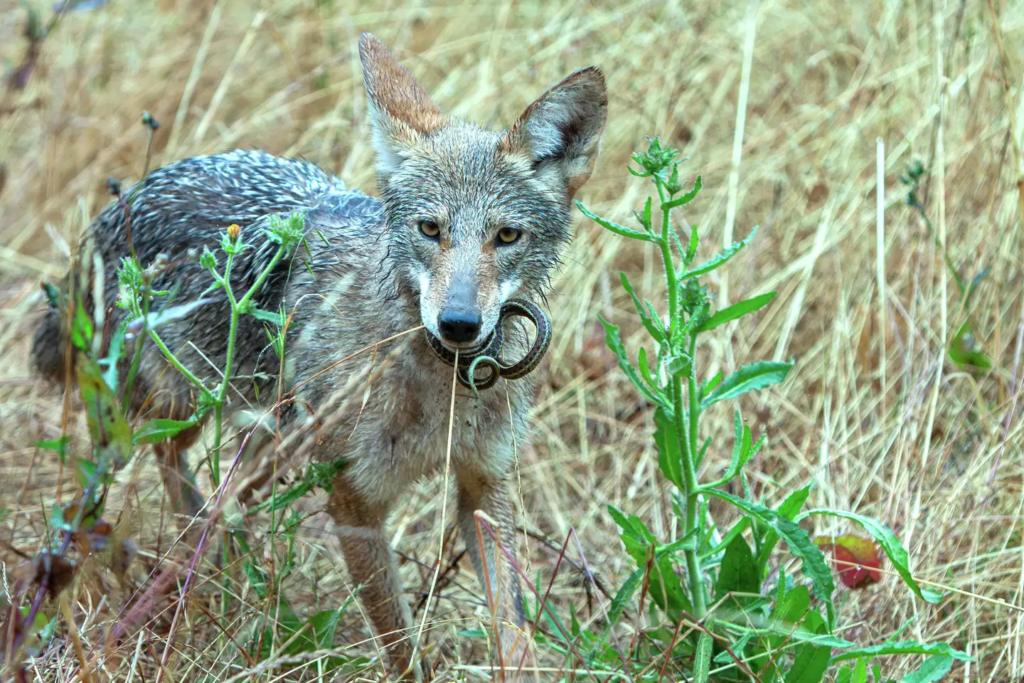
A coyote moves through tall grass with a snake in its jaws. Photo by Janet Kessler
By Amanda Bartlett March 10, 2024 (SFGate.com)
On a foggy morning just after 7 a.m., Tali Caspi sat behind the wheel of a golf cart and drove across the manicured hills of the San Francisco Golf Club, searching for evidence.
Dew clung to the greenery, and save for a couple of red-tailed hawks soaring through the sky, there wasn’t a soul in sight. Armed with Google Maps and a fanny pack, the UC Davis Ph.D. student zoomed along the fairway until she found a thicket of bushes. She put the cart in park, stepped out and knelt down in the wet grass, scrutinizing the lumpy brown object that lay before her. It was exactly what she had been looking for: coyote poop.
She jotted down the information in her field notebook: where she had found the scat and what time of day it was. Then, she slid on a pair of white rubber gloves and retrieved a little tube filled with ethanol from her fanny pack, taking off a piece of the scat and shoving it into the tube with a wooden applicator stick to help preserve the DNA. She labeled and sealed it, and set off to find more.
Caspi’s notes from that day spare no detail. Some of the found samples were “full of cherry plum pits and berries” while others were “twisted in shape and full of hair.” One had just been deposited by a coyote she saw darting across the course and was mottled with tiny bones. There were traces of orange peel and aluminum foil, and one in particular was overflowing with peanuts.

Caspi has spent two years of her mornings like this, traversing over 621 miles throughout San Francisco — crisscrossing popular neighborhoods, scouring cemeteries and soccer fields, even breaking her foot during one hike up Bernal Hill — on her quest to find out what urban coyotes living in the city are actually eating.
“I feel like there’s not a park, not a trail that I haven’t been on,” Caspi, who conducts her research through UC Davis’ mammalian ecology and conservation unit, told SFGATE. “I have them all memorized like the back of my hand at this point. And I can tell you, truly every green space that you can think of in the city has coyotes. San Francisco is totally saturated.”
The animals are native to California, and after years of no sightings, they recolonized San Francisco in the early 2000s, when they began building dens again after police ended the practice of killing them as they ventured into the city. Since then, their numbers have grown considerably. San Francisco Animal Care and Control estimates that there are about 100 individuals living in the city, with each mating pair establishing their own 1-to-2-square-mile territory, ranging from the Presidio and Golden Gate Park to Lands End, Coit Tower and McLaren Park. Some even took up residence at a solar panel project in the Sunset. “These are really adaptable creatures,” Caspi said.

Yet, as more and more sightings of coyotes were reported, concerns rose surrounding the animals and the potential threat they posed for young children and pets. Caspi, whose primary interest was in studying how people and urban wildlife coexist, happened to be in the right place at the right time when she reached out to the Presidio Trust and the San Francisco Recreation and Park Department regarding possible research for her Ph.D. in 2019.
“They were like, ‘Oh, we’ve been waiting for you,’” Caspi said. “‘We have growing issues with coyotes in the city.’ They had some data, but no one had the time or funds or ability to really analyze it.”
With help from Janet Kessler — also known as the “Coyote Lady,” who has been documenting the city’s coyote population for the last 16 years — she made it her mission to raise awareness about the often-misunderstood animals, studying their behavior and social dynamics but also learning more about their eating habits: how they vary by location and are influenced by an urban environment, as well as how those habits change for each individual animal over the course of its life.

Caspi’s been able to figure this out by not only gathering stool samples from live coyotes, but also collecting the tips of whiskers from roadkill specimens and sending them off to a lab for further analysis. More information regarding the precise breakdown won’t be available until later this year. But the findings she’s discovered so far are groundbreaking, and could even change the way people think about and study coyotes in the future.
One of the most surprising takeaways? The canines are scarfing down much more human food than previously thought.
“I’ve found a whole bunch of weird stuff,” Caspi said. “I’ve found chocolate. I’ve found mango. I’ve found grapes. But the biggest, most frequent offender is chicken.”
It’s worth noting the coyotes’ taste for poultry could be coming from a lot of different sources, like dog kibble, or discarded McNuggets that they’re fishing out of people’s garbage. The DNA metabarcoding process Caspi uses can only determine the type of food or prey remains that are present, not necessarily where they’re coming from. However, human handouts are a worsening issue that SFACC has been attempting to mitigate for years, and Caspi herself has witnessed people leaving out entire rotisserie chickens, tortillas and several pounds of ground meat for coyotes.

The motivation for this is unclear. When coyotes shed their coats in the summer, they can take on a scraggly appearance, causing many people to think they’re malnourished. Others want to “befriend” or take photos of them, and some even seem to hope that if they give them food, the coyotes won’t go after their pets, Deb Campbell, a spokesperson for SFACC, told SFGATE. You should never feed a coyote: It’s illegal and punishable by jail time or a fine of up to $1,000, and people are encouraged to call SFACC at 415-554-9400 if they see someone doing it, she said. It’s a problem that hurts everyone, especially the naturally skittish coyotes, which start to lose their fear of humans, become more emboldened to approach them and regularly visit neighborhoods they come to associate with treats.
“There’s a big misconception people have that if they see them wandering around the city, they must be starving and need our help,” Caspi said. “But they don’t — and trust me, they’re definitely not starving.”
ADVERTISEMENT
Article continues below this ad
Swaths of San Francisco residents are unintentionally catering to coyotes by feeding their pets outside and not removing uneaten traces of food, forgetting to secure their trash and recycling and not cleaning up the seed around bird feeders or fallen fruit from trees in their front yards, Campbell said.

And it shows in Caspi’s research, which has demonstrated that coyotes’ diets are rich in other foods like pork, fish and soybeans easily scavenged from a dense urban landscape. That’s not to say they’re not very capable hunters — coyotes also frequently seek out natural prey like squirrels, gophers and raccoons. Data collected by Caspi has also proven the animals are even willing to venture out to the coastline for a good meal, as was the case when several of them feasted upon a stranded fin whale that washed up on Fort Funston in 2021.
So far, Caspi has been the most taken aback by the sheer variation in each coyote’s diet. Much like humans, the carnivores have different tastes and preferences, and don’t always eat the same things at the same time. Interestingly enough, Caspi’s research also seems to debunk another common myth: that coyotes are regularly going after people’s pets for their next meal. “I looked for domestic cat DNA in the scats, and I did find it, but not very frequently,” she said. “It is not at all a big part of their diets in San Francisco. Out of around 700 scats, I had a few. A handful.”
It’s worth noting she can’t tell whether the cats that showed up in her research were pets, or strays that were part of a feral colony. Her data also comes with the caveat that she’s unable to turn up any results for domestic dogs because their DNA is too closely related to coyotes’. Yet, Caspi hopes her ongoing research can walk back any misconceptions San Francisco residents have, and said the best way for people to protect their cats is to keep them indoors. It’s better for the environment, she said — cats kill billions of birds and small mammals every year, and can contract toxoplasmosis that transfers to waterways when they defecate outside, infecting other organisms like sea otters.

“If people are really concerned about their cats, at least from the standpoint of cat welfare, indoor cats live longer,” she said. “They’re healthier. It’s a great option.”
Meanwhile, interactions between coyotes and small dogs can still occasionally happen, Caspi said. She recommends keeping dogs on leashes and avoiding den areas, especially during pupping season, which kicks off in late March and continues through the fall, resulting in many hiking trail closures throughout the city. Coyotes are most active at dawn and dusk and at night, and she advised that people avoid taking their furry friends out during those times of day, particularly in the spring, when many fully grown pups are likely to be dispersing.
It’s during this period that people might notice urban coyotes scampering along city streets, or popping up in other unexpected places — notably, observations of this nature skyrocketed when Caspi was doing fieldwork during the onset of the pandemic. But they don’t necessarily mean “nature is healing,” that coyotes are getting pushed out of natural spaces or are taking over the city, she said. They’re just seeking out a new home.
“A coyote can cross the entire city in a night,” she said. “Yearlings or pups get pushed out and need to find their own territories, and they can become transient for a period of time.”
The animals are known to make use of city streets and even railroads, but they won’t stay for long. I told Caspi that I had recently seen a video shared by a friend of mine on Instagram showing a coyote crossing Valencia Street in broad daylight, being narrowly missed by a Muni bus. These types of sightings are common, she said, and can mean a couple of different things: One, that the individual has territory near that area and might have just been roaming around, or two, that it was a transient individual searching for a place to go, or trying to more firmly establish its territory.
“You’ll notice they’re not usually stopping and rolling around and sunning themselves,” she said. “It’s a temporary state. Coyotes need natural spaces, and when they venture into populated areas, it’s because they’re on the move.”
Another theory Caspi frequently hears is that San Francisco’s coyote population is booming. Undoubtedly, there has been some kind of uptick over the last 20 years; individuals die and more pups are born. But the city is more or less full, she said, and because of their territorial nature, there are limits to how much space coyotes will share, limiting the possibility of continuous growth. She suspects this belief came about during the pandemic, as lots of people turned to natural spaces when there wasn’t much else to do.
“I was out collecting data during all of 2020 and those parks were completely full,” said Caspi. “There were people there at times of day they probably weren’t out there before. If anything, I think there was an increase in the proportion of sightings that were reported because of a dramatic shift in human behavior.”
As time goes on, the city’s perception of coyotes continues to be polarizing. There are the residents who love them and want to see them protected, sometimes to their detriment, and those who perceive them as pests at best and a danger to society at worst. But regardless of how people feel about them, they’re here to stay.

“At this point in San Francisco, we’re on to many generations of urban-born individuals,” Caspi said. “The combination of urban expansion and eradication of wolves across the U.S. is kind of what allowed them to expand their historical ranges. They’re opportunists and we’ve created conditions that really, really work for them.”
Essentially, their role as one of the only city-dwelling apex predators with such an expansive diet makes them controversial. But Caspi said it’s important to understand the benefits and ecological services they provide, such as controlling rodent populations, increasing biodiversity and dispersing native plant seeds.
Even so, she frequently encounters residents who argue that they pay taxes and coyotes don’t; that the city is for people. They express a desire for agencies like the California Department of Fish and Wildlife or SFACC to do away with the city’s coyote population by killing them or simply dumping them all in another location.
“They think that will work and it won’t,” she said. “Not only is it prohibitively expensive and, in my opinion, unethical, but also, they’ll come back. They can actually respond to declines in their population by making bigger litters. They will replace themselves.”
The only option people have is to learn how to live with them, Caspi said. And if her research can provide residents with the tools they need to understand what the coyotes in their backyards are doing and eating, she believes the city will be better for it.
“We have to function alongside them, not on top of them,” she said. “San Francisco is a cohesive ecosystem and the coyote is part of it.”
March 10, 2024
Amanda Bartlett is a senior reporter for SFGATE covering culture, history, science and breaking news. Prior to joining the newsroom in 2019, she worked for the Roxie Theater, Noise Pop and Frameline Film Festival. She lives in San Francisco with her rabbit, Cheeto. Send her an email at amanda.bartlett@sfgate.com.