- By Marc Sandalow | Examiner columnist
- Jan 24, 2025 Updated Jan 24, 2025 (SFExaminer.com)
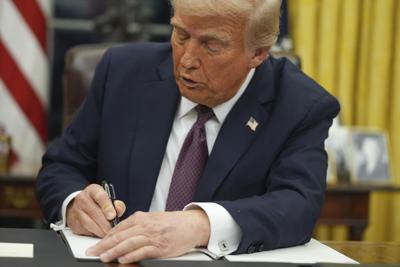
A bit of San Francisco history is helpful to appreciate the depravity of President Donald Trump’s executive order seeking to end birthright citizenship in the U.S., which a federal judge temporarily blocked Thursday.
Roughly 150 years ago, near the corner of Sacramento and Kearny streets, Wong Kim Ark was born to a pair of Chinese immigrants. Neither his timing nor location was enviable. Chinatown in the 1870s was an impoverished, gritty, unsanitary community whose residents were increasingly scapegoated for spreading crime and disease.
While other immigrant communities faced discrimination, the Chinese were subjected to singular scorn, culminating in the passage of the Chinese Exclusion Act of 1882 banning Chinese laborers from entry to the U.S.
Living in a small apartment above their grocery store at 751 Sacramento St., Wong’s family faced poverty and violent pogroms waged by hateful San Franciscans, ultimately driving them back to China when Wong was a teenager.
While in China, he married and had a child before returning to his native San Francisco seeking work. It was his next trip to China — to visit family — that earned him a place in history.
Wong was aware of the ban on Chinese immigrants, so he carried legal documents on his journey establishing his U.S. residency, as well as notarized letters from three prominent neighbors testifying that he was a native San Franciscan.
Nevertheless, when he returned to the Port of San Francisco in the summer of 1895, authorities classified him as Chinese and refused to let him disembark. The U.S. Attorney contended that that “by reason of his race, language, color and dress,” Wong was Chinese.
The first sentence of the Constitution’s 14th Amendment reads: “All persons born or naturalized in the United States, and subject to the jurisdiction thereof, are citizens of the United States.” Yet officials in the 1890s contended that since his parents were “subjects of the Emperor of China,” Wong was not a U.S. citizen.
It is the same logic that underlies Trump’s presidential order.
Wong, kept captive in the Port of San Francisco, blocks from his childhood home, managed to get word to the Chinese Consolidated Benevolent Association — known as the Six Companies — whose lawyers filed suit in a case that eventually made its way to the Supreme Court.
In 1898, by a 6-2 decision, the court ruled in his favor. Supreme Court Justice Horace Gray, writing for the majority, noted that “to hold that the Fourteenth Amendment of the Constitution excludes from citizenship the children, born in the United States, of citizens or subjects of other countries would be to deny citizenship to thousands of persons of English, Scotch, Irish, German, or other European parentage who have always been considered and treated as citizens of the United States.”
It is this court ruling and its legacy that Trump sought to overturn with his executive order Monday.
By Tuesday, 22 states, joined by San Francisco, filed a lawsuit to block enforcement, and by Thursday a federal judge did just that. U.S. District Court Judge John Coughenour, a Ronald Reagan appointee, called Trump’s action “blatantly unconstitutional.” Coughenour said that in his 40 years on the bench, he couldn’t remember a case that was so clear.
It is hard to imagine how Trump believes he can override the Constitution and Supreme Court precedent. It is even harder to imagine why Trump believes the country would be better off by depriving citizenship to the offspring of immigrants — legal or not.
Trump contends that the law encourages pregnant immigrants to enter the country to birth American citizens. He also contends that no other country permits the practice, which he has labeled “birth tourism.”
While there might be immigrants who choose to deliver babies in the U.S., there is no evidence to support his contention that it is a significant factor. And he is flat-out wrong regarding other countries. At least 30 countries have similar birthright laws, including Canada, Mexico, and most of Central and South America.
Depriving citizenship to children of undocumented immigrants would create millions of second-class residents, as presumably their offspring — and their offsprings’ offspring — would also remain illegal. It would also deprive the country of the remarkable contributions made by children of immigrants, who consistently match or outperform their American counterparts in income and education.
San Francisco itself, where more than one-third of its residents are foreign born, is a fine example of how immigrants make this country great. Citizenship is a privilege most Americans take for granted by virtue of where they are born, not by their race, ethnicity or bloodlines.
It’s hard to picture a time in San Francisco’s history when that was in doubt. And it’s even harder to understand why for some, including our president, the doubt remains.
Marc Sandalow is a senior faculty member at the University of California’s Washington Program. He has been writing about California politics from Washington, D.C., for 30 years.