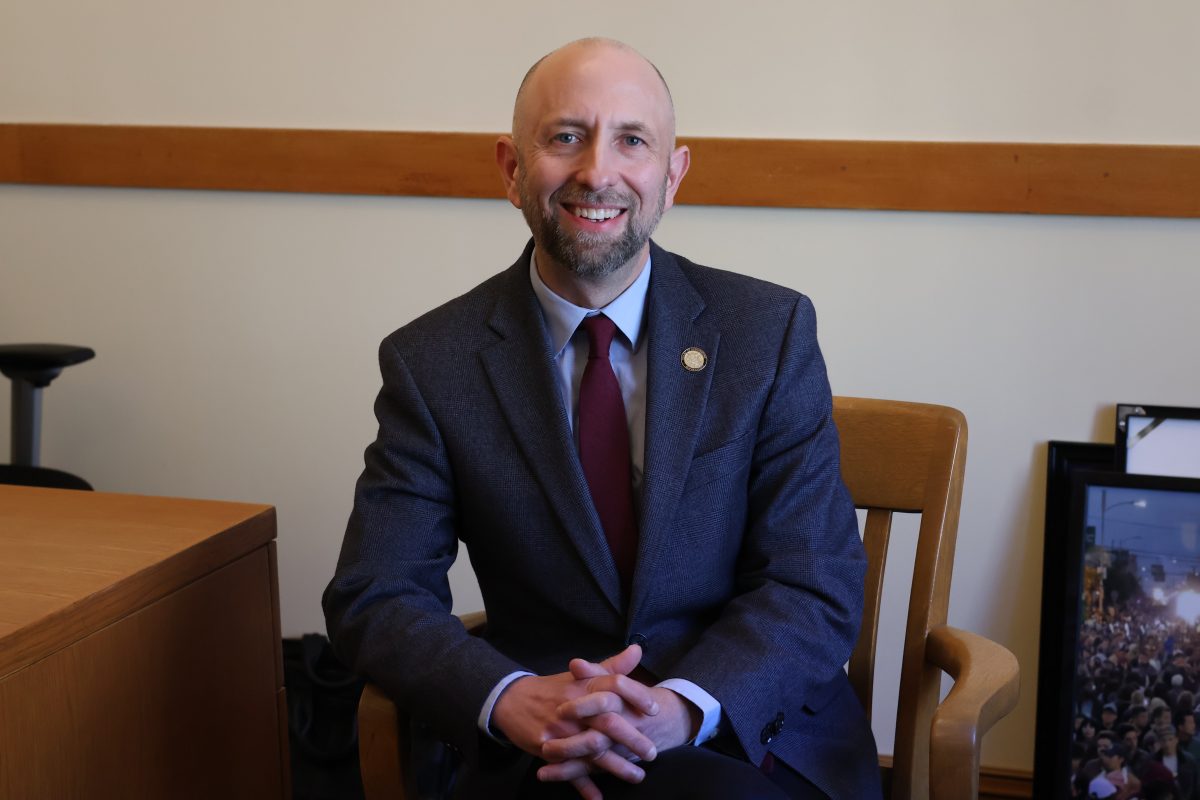
The District 4 supervisor, who is facing the threat of a recall election, spoke about his priorities, and keeping constituents on board.
 by KELLY WALDRON JANUARY 27, 2025 (MissionLocal.org)

Read Mission Local often?
Help grow our newsroom, joining the hundreds of San Franciscans who support us by giving below.
Mission Local is holding intro interviews with incoming and incumbent supervisors, including Joel Engardio, Chyanne Chen, Jackie Fielder and Danny Sauter. You can read those interviews as they are published here.
Mission Local also held exit interviews with elected officials leaving office after the Nov. 5, 2024 election: London Breed, Aaron Peskin, Hillary Ronen, Ahsha Safaí and Dean Preston.
Mission Local sat down with District 4 Supervisor Joel Engardio, who oversees the Sunset District: That’s everything west of 19th Avenue between Golden Gate Park and Sloat Boulevard.

Want the latest on the Mission and San Francisco? Sign up for our free daily newsletter below.Sign up
Engardio came into office in 2022 after a fortuitous redistricting added his block, and surrounding ones, into District 4; he had previously run unsuccessfully for District 7 supervisor in 2016 and 2020.
Engardio, a journalist-turned-politician who is two years into his first term, is now one of the board’s more experienced members. In an hour-long conversation, Engardio spoke to his successes, such as changing zoning restrictions to include six-story corner lots on the Westside and creating vibrant night markets in the Sunset, as well as challenges — namely, the looming threat of a recall.
This interview has been edited and condensed for clarity.
Mission Local: What surprised you, coming into this role?
Joel Engardio: I started out as a journalist in my career in San Francisco and then became a politician. [Engardio worked as a reporter for SF Weekly from 1998 to 2003, and as a columnist for SF Examiner from 2013 to 2019.] In both cases, when you’re a journalist and, certainly, when you’re a candidate for office, you’re always talking about holding the city accountable or about what doesn’t work at City Hall. As a journalist, you shine a light on it and you try to show what’s wrong, maybe offer some solutions. As a candidate, you’re always running against City Hall, saying, “I should be there, because it’s not working and I can make it work.” But once you get here into City Hall, you do see where things aren’t working, but you also see where, in this vast bureaucracy, there are all these little “islands of oasis” where things are working. It does give you hope, because you realize, wow, there’s really smart, competent, talented people doing the best they can trying to fix things.
ML: Do you have any examples of these ‘islands of oasis’?

JE: Well, I think our Department of Emergency Management is run really well. Carmen Chu, our city administrator, is stellar. I don’t want to get too specific, but there’s a lot of bright spots in the bureaucracy that we can encourage and foster and emulate.
ML: You’re two years into your term now. Are you where you expected to be? In terms of what you’re working on, and what you’re dealing with at this stage.
JE: My priorities in running for office were about addressing the needs that I kept hearing from residents: Public safety, education, and small business. In the first two years, we really covered a lot of that: The successful ballot measure to bring algebra back to eighth grade [the measure, Prop. G in March 2024, was a non-binding proposition; SFUSD had already instituted the change] and with public safety, we were able to bring in some retired police officers to walk the beat to free up the other officers to do other things, then creating the night markets has been great because they show that you can do a lot of things regarding public safety without having to hire a police officer. When we had 20,000 people on Irving Street for two night markets this past fall, there were zero reported incidents, because it activated the street and brought people out into the community for a joyous event. They make people feel safe and make people want to be in the community in a public setting. And it just brought people out of their homes and kind of opened up a lot of possibilities for more types of community building. I think that’s key. The more community building we can do, the safer communities can feel.
ML: How did the night markets come about? Did you start that?

JE: My husband was born and raised in Taipei in Taiwan, and we go back every year to visit his family. Taipei has amazing night markets all over the city, multiple night markets and, for the last 10 years that I’ve been going there, we’ve been eating our way through the night market every year. I always thought to myself: Why can’t we have this in San Francisco?
So during that month of December [in 2022], we went back to Taiwan and I took photos of the night markets and I put together this social media thread of photos with a little narrative about what this is, what it looks like in Taipei. It just posed a question: Wouldn’t it be great if we could have this? The response was overwhelming and went viral. Everyone said, “Yes, yes, yes, please!” So we worked on creating the prototype. We had the first ever Sunset night market in my first year that September, and we didn’t know what to expect. We planned for three blocks on Irving Street and 10,000 people showed up and we ran out of food. We didn’t have enough space. I mean, it was a good problem to have.
That started the night market fever that we have in San Francisco, because it showed what was possible, and now, we have night markets in neighborhoods all over the city. People were literally hungry, not just for the food, they were hungry for that experience, that community-building experience that had been lacking, certainly because of the pandemic, but also just the “doom loop” narrative that was really consuming the city. We showed that we can get people out of their houses, be out on the street, have a fun, safe event, and we just took off from there. When we brought the night markets back, we had 20,000 people show up. We doubled, and then, of course, we expanded from three blocks to seven blocks. So it’s exciting to see. I think from here on out, there’s always going to be a night market now in the city. Because how do you go back?
ML: What are your priorities for the next two years?

JE: I think it’s really important to focus on the nonprofits in the Sunset that are doing amazing work to help with youth, families and seniors. Because the Sunset, I don’t think it gets a lot of attention. There’s a lot of needy people who live in the Sunset. You might see a street with rows of single family homes and assume that each house has a small family living in it, but there can be many houses on the street that could have eight, nine, 10 people living in it, and multiple generations. People that have needs, as youths or families or seniors, and we’ve got nonprofits in the Sunset that are working to serve that population. They’re strapped for resources and doing the best they can and they’re doing amazing work. I want to make sure that we’re lifting up that work and supporting it in the way that it needs to be done.
Someone could say that there are other parts of the city that have extreme needs, that maybe we don’t see as much in the Sunset, but there should be parity, in the sense that whatever the need is in the Sunset, it needs to be addressed.
ML: There has been some community pushback in your district regarding an affordable senior housing project on Great Highway. What do you think about that?
JE: This project near the Great Highway is 100 percent affordable housing for low-income seniors and formerly homeless seniors. There’s no more vulnerable population than that, so we really need to step up and provide the housing that is so desperately needed. Self-Help for the Elderly is a widely respected nonprofit that serves seniors and primarily AAPI [Asian-American and Pacific Islander] seniors or seniors who are monolingual or English as a second language. They are going to be the provider at this project and with the services for all the residents. And so, I don’t understand why anyone would be opposed to such a stellar organization providing housing and services for low-income seniors and 100 percent affordable housing. Like, if you’re opposed to that, I mean, then what would you ever be in favor of?

I understand that there’s issues about the building height, but the developers have been trying to take community feedback, and they’ve actually lowered the height on one-third of the building, and then to do so, the other two-thirds of the building had to go up just by one story. So they’re trying to address some of the residents’ concerns about building heights, but at the end of the day, what’s one extra story going to do, versus housing all of these vulnerable seniors?
ML: Are there other sites in the housing pipeline in the Sunset, or other areas where you see potential for more housing or increased density?
JE: I’ve already legislated with the Board of Supervisors to allow for up to six stories on corner lots throughout the Westside.
For those who are familiar with the Sunset, there’s a really popular market called Gus’s Market. It’s in the Outer Sunset, on Noriega and 44th, and it’s a newer building with housing on top of the market. Right next door to it are single-family homes, and I don’t hear anyone complaining about that housing, because of the amenity of that grocery.
The total height there is four stories. And our legislation says, all right, let’s go to six. That’s pretty reasonable, right? And so, six stories, or five stories of housing above some amenity on the ground floor — could be a grocery, a cafe, it could be a senior center, daycare, child daycare, something that the whole neighborhood benefits from — anchors the neighborhood.
And then that building has an elevator. So it’s a place for seniors who may be in a single-family home. As you get older, maybe you don’t want to maintain this large house, or it’s too many stairs to climb or whatnot. So we want to create options for people to stay in their neighborhood, and also a place for young families. I mean, a lot of longtime residents, their kids are born and raised here in San Francisco, they go off to college, and then they can’t come back, right? They can’t afford to find a house to stay in. So we want to create that type of housing on the Westside. And I think six stories on the corners is pretty reasonable because we have to do something. Doing nothing is not an option.
ML: What do you think about the city’s proposed upzoning plan?
JE: We have to build more housing in San Francisco. There’s no way around that, in that the state is mandating it. If we keep resisting and we keep saying no to everything, then the state will just come in and mandate it, and we won’t have a say at all. So why not let us do six stories on the corners, and maybe six to eight stories on the actual transit corridors where the trains run? That’s reasonable. It’s not crazy tall, and it shows that we’re doing what we need to do so the state doesn’t come in and just force it on us.
I think, of course, there’s always going to be people who will be opposed to any change and want to say no to everything, but that’s just not an option, because saying no will just open us up to the state steamrolling us to do whatever the state says.
We’re not building housing to punish people. We’re building housing to benefit existing residents. Because if you’ve lived in San Francisco for a long time, you might have great housing, but your needs and situations change as time goes on, as we get older. So, like, you personally might need another housing option at a certain age. Or you might want to actually see your grandkids on a regular basis and want your adult children and adult grandchildren to be able to stay in the city. So it’s in our interest to build this housing. This housing is really for us. I think when people come to that realization, they’re more open to more housing.
ML: How do you balance pushing through on some of these big projects, which often are contentious, and listening to your constituents’ and balancing different concerns?
JE: I mean, it’s not easy. Sometimes, in these elected positions, we have to represent the residents of the district, but we have to think of the city as a whole. We can’t do just one or just the other, and sometimes we are faced with really tough decisions. And sometimes you have to think about the future. You have to think about what we do today. What is it going to look like 10 years, 20 and 50 years from now? And are we serving the city beyond the moment that we’re in?
You know, I often think about people who were in my position 50 or 60 years ago, when they were planning and building BART. What if, 60 years ago, there was the courage to put BART down Geary and down 19th Avenue and into Marin? There was no political courage to do it and think 60 years later how much we would be benefiting from that, right? All those people who made those decisions all that time ago are not around anymore, but we’re here and we would really be grateful for that political courage. So my hope is that we can do some things today that that our children’s children and our grandchildren’s grandchildren will appreciate.
ML: The example that comes to mind is Proposition K. You know, this is a big project that would have a longstanding impact on the future of the city and make Ocean Beach or Great Highway more of a destination, rather than a highway. But a lot of people aren’t on board with that, and change is difficult. Your constituents overwhelmingly voted against it. Can you win their support back?
JE: On that issue, we should back up a bit, and think about this as a Mother Nature issue, because a section of the Great Highway is literally falling into the ocean because of extreme coastal erosion. So the utility of the Great Highway has been lost because we cannot use it anymore as that direct connection to Daly City. That was the most convenient part of it. That’s going away, regardless of Prop. K. Because of that decision to close the southern part of the Great Highway due to Mother Nature, that opened up the question: Then what to do with the middle section of the Great Highway? And I say middle section, because we always have to remember there’s a northern section that is staying the same. The section that actually connects the Richmond and Sunset districts is staying open to cars 24/7. That’s not touched by Prop. K.
Could it be better having lost its greatest utility? Could it be better as a park? Could it be better for the environment? Could it be actually a boon to the local economy? Those are the questions that we’ve asked people to think about, and that’s what people voted on in November. It passed citywide and it didn’t pass in my district, and so, I’m humbled by those who did not support, and I understand that the biggest concern was traffic and traffic flow and how would people get where they need to go. And so my biggest commitment is to work on that traffic flow, to make sure that people do get where they need to go. I think once people can see the traffic going where it needs to go, maybe people will be more open to looking at the benefits of the park, because I believe the park will bring immense benefit in the near future and certainly the long term future.
ML: Is there anything you wish you had done differently about the process of how that came to be, and the ballot measure?
JE: Well, the issue about what to do with that middle section of Great Highway has been debated and discussed for at least five years. Hotly debated. It had already been on the ballot, right? In 2022, the Great Highway was on a citywide ballot, and folks put it on the ballot to try to try to reopen it to cars 24/7, and that failed. And so, we went back to the ballot to get more voter clarity.
People kept trying to kill the weekend compromise by appealing to the Coastal Commission and filing multiple appeals, and those all failed. So there has been this ongoing, antagonistic process of public discussion and debate and appeals and votes about what to do, and it was not going to resolve itself or go away, because a contingent of people wanted that to be a highway, no matter what, and a contingent of people wanted it to be a park. There were only two ways to solve the situation: By direct action at the ballot box, by all the voters deciding, or 11 members of the Board of Supervisors deciding the fate on our own. You could argue that, either way, people would be upset with the result.
And you know, going to the ballot box, I mean there’s nothing more open, transparent or democratic than every resident or every voter having an equal say, because having it at the ballot box meant that there could be at least five months of robust campaigning for and against, all kinds of public debate. This issue was hashed out to no end, and everyone got to weigh in on it. It wasn’t a blowout. It was 55-45. Each side had had a powerful argument to be made.
ML: So what’s next? What are the kind of immediate next steps for that project and Great Highway?
JE: Well, it passed at the ballot box. So now this section, this middle section of the Great Highway, is under the jurisdiction of Rec and Parks. So they’ll be deciding, you know, what to do with that by turning it into a park. I’m working with Mayor [Daniel] Lurie and SFMTA and other city departments to deal with the traffic mitigation issues. We’re all in agreement that we’re going to have these key traffic improvements in place before anything closes. We’re doing a lot to replace some stop signs with traffic lights, and reconfigure some intersections to make sure traffic can flow better at different pain points along the way, like at 41st and Lincoln, and where the Great Highway and Lincoln intersection is.
ML: Were you surprised about the threat of a recall election?
JE: We have a lot of recall fever now, in San Francisco and the Bay Area. I mentioned this to Joe Eskenazi in his article: I’m the last person to be saying we should not recall people, because I supported two recalls and I worked on the school board recall. [Engardio is referencing the 2022 recalls of then-District Attorney Chesa Boudin and three school board members.]
You know, one could say that for those who supported, say, the school board recall, there were probably a lot of positions and issues and actions that happened. You know, a long list to say that recall had validity. In my case, it’s one policy position. I don’t know if that raises to the level of a recall, but again, I’m not anyone to judge. People have a democratic right to pursue the recall, but I do hear from a lot of Sunset residents who voted no on K, who are telling me they do not support the recall because they feel that they like a lot of other things that I’ve done when it comes to education, public safety, the night markets, you know, very responsive constituent services. Fixing things from trash cans to park benches. So they like all that and they don’t agree on one issue, but they don’t think it should be recalled over one issue.
And of course, I’m up for reelection next year anyway.
ML: I was going to ask, will you run again?
JE: I definitely want to. I’ve done a lot of work, and there’s a lot more to do, and if the voters want to keep me, then I’m going to keep working hard. But, if I’m not recalled, people can just run against me next year, you know? So we’ll have a double dose of democracy in District 4.
ML: Now you’re one of the more experienced members of the board, relatively. What are your first impressions of the new makeup of the board?
JE: Two years ago, I was the newbie. I was the only new member. What was interesting is, as the only new member, me and my staff, we had to kind of just figure it all out on our own. It’s not like there was an orientation session for just a little old me, right? But this time around, I think there were five new supervisors. They had a full orientation: A whole day of training staff, and then another day of training the supervisors. And even on the day of our first meeting where you vote for president, on every desk, there was this little printout, a sheet of instructions on how to vote, “what’s the process?” I was like: “Wow, I wish I had that!”
ML: Did you play a part in the training?
JE: I didn’t, although I thought that actually I might want to go to some of this, maybe I need to see the training myself, but I didn’t need to. The clerk was like, “No, I don’t think you need to. You got it pretty well covered.” So I didn’t miss anything, we’re good. But I was glad my staff — I have some new staff — got to go to the training.
ML: Who’s new on your team?
JE: We’ve got Sammi Ma. We have Sophie Shao. They live on the Westside, and between them, they’re fluent in Cantonese and Mandarin. They do a lot in the community, and so that’s really great.
ML: What are you most excited about for the next two years?
JE: I’m excited to see how we build upon this, our initial night market success. And how do we use the night market as a building or a stepping stone into more community building? And so that’s exciting to see, like to, to think about how it can be transformative and not just be like a one night fun event, but how does it really transform the community and integrate it with the merchants and the non-profits and the families, and as a way to create more joy? Because we need, you know, we need to celebrate the joy that we have in San Francisco, especially given the pandemic years and the years of doom-loop narrative.
ML: What kind of goes into organizing a night market? How do you make it happen?
JE: Everything. It’s like planning a wedding, or a college or high school graduation times a thousand. It’s about working with community partners. I’m blessed to have to be working with the Sunset Chinese Cultural District and the Sunset Mercantile and Into the Streets. We all aligned on the mission of wanting to create joy and build community. It’s not just about food. It’s about the music and the games and things that will attract everyone from toddlers to teenagers. So there’s just so much that goes into it, and it’s so rewarding after all that hard work, when you see it unfold on the street, and you see all these people from all over San Francisco and the Sunset enjoying it.
The other thing is, for each one, you have to try something to kind of take it up a notch, right? For the second night market, I thought, you know, we should have, like, a stinky-tofu-eating contest. Wouldn’t that be fun? Yeah. And that became, like, a whole thing; people in the media were the contestants. That was a big crowd pleaser. Then it was like, now what do you do next? Then somebody had the idea to do a durian-eating contest. We did that, and that was huge. Everyone had fun with that.
ML: So what’s the next thing?
JE: I don’t know!
LATEST NEWS
S.F. government bands together in defense of sanctuary status
Shooting suspect, killed by SFPD, caught in surveillance footage
In District 11, hope and needs go hand-in-hand for new supervisor Chyanne Chen
Support the Mission Local team

We’re a small, independent, nonprofit newsroom that works hard to bring you news you can’t get elsewhere.
KELLY WALDRON
Kelly is Irish and French and grew up in Dublin and Luxembourg. She studied Geography at McGill University and worked at a remote sensing company in Montreal, making maps and analyzing methane data, before turning to journalism. She recently graduated from the Data Journalism program at Columbia Journalism School.More by Kelly Waldron