Six asylum-seekers arrested at S.F. immigration court Thursday.
 by MARGARET KADIFA August 28, 2025 (MissioinLocal.org)

Read Mission Local often?
Help grow our newsroom, joining the hundreds of San Franciscans who support us by giving below.
On Thursday morning, a young woman from Colombia dialed in remotely for her asylum hearing in San Francisco immigration court, using the court’s web-conferencing application.
The judge that day, Patrick O’Brien, wanted her in the courtroom in person. He didn’t mince words.
“Good morning, ma’am,” he said. “You’re supposed to be sitting in a courtroom right now.”

Want the latest on the Mission and San Francisco? Sign up for our free daily newsletter below.Sign up
“Good morning, your honor,” the woman replied, in Spanish through a court interpreter. “Yes, your honor, that’s right.”
“I know that’s right,” O’Brien said. “I’m going to reschedule your hearing for later this morning. I’m going to give you a chance to show up.”
To avoid arrest, some asylum seekers are submitting written requests to the court to appear remotely. The immigration judge decides whether to grant those requests, and other judges in San Francisco grant them regularly.
It was unclear whether the Colombian woman submitted such a request. Regardless, O’Brien rescheduled her 8:30 a.m. hearing for 11:30.
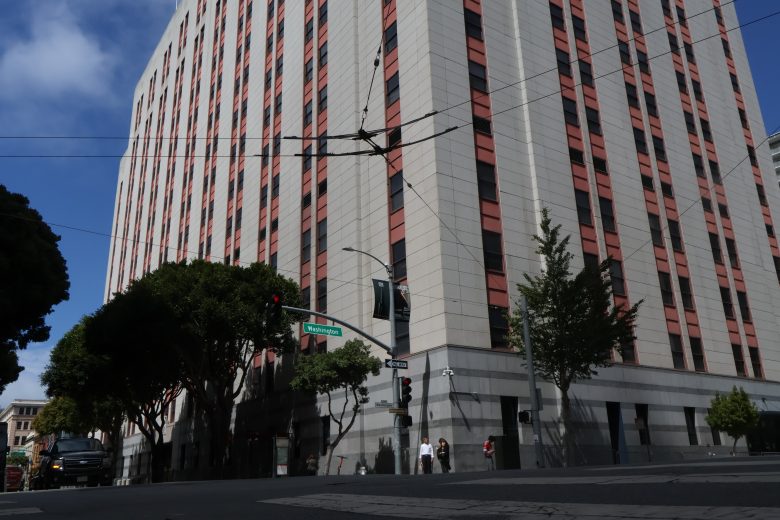
When she arrived in court at 630 Sansome St., her fears were realized: A Department of Homeland Security attorney moved to dismiss her case, a sign of impending arrest even though O’Brien did not grant the motion.
She pleaded with O’Brien. “I have tried as best as I can to follow the laws of this country.”
“All I can do is give you time to respond to the department’s motion,” O’Brien said.
“Please, I cannot go back to my country,” she said. She started to cry. “I cannot go back to my country.” She added: “I am here because I want to do things right.”
“I believe you, ma’am,” O’Brien said. But “there’s only so much I can do for you at this point.”
“Does this mean I won’t be leaving this place anymore?” The woman asked.
O’Brien tried to clarify: “Do you mean this building?”
“Yes.”
“It’s likely you’re going to spend some time here,” O’Brien said. People arrested at immigration court are typically processed in holding cells on the sixth floor of 630 Sansome St., where there is an ICE field office. Then they are transferred to longer-term detention facilities, unless they can secure legal help to get released from detention in another way.
Sure enough, when the woman left the courtroom, Immigration and Customs Enforcement officers were just down the hall, blocking the elevators.
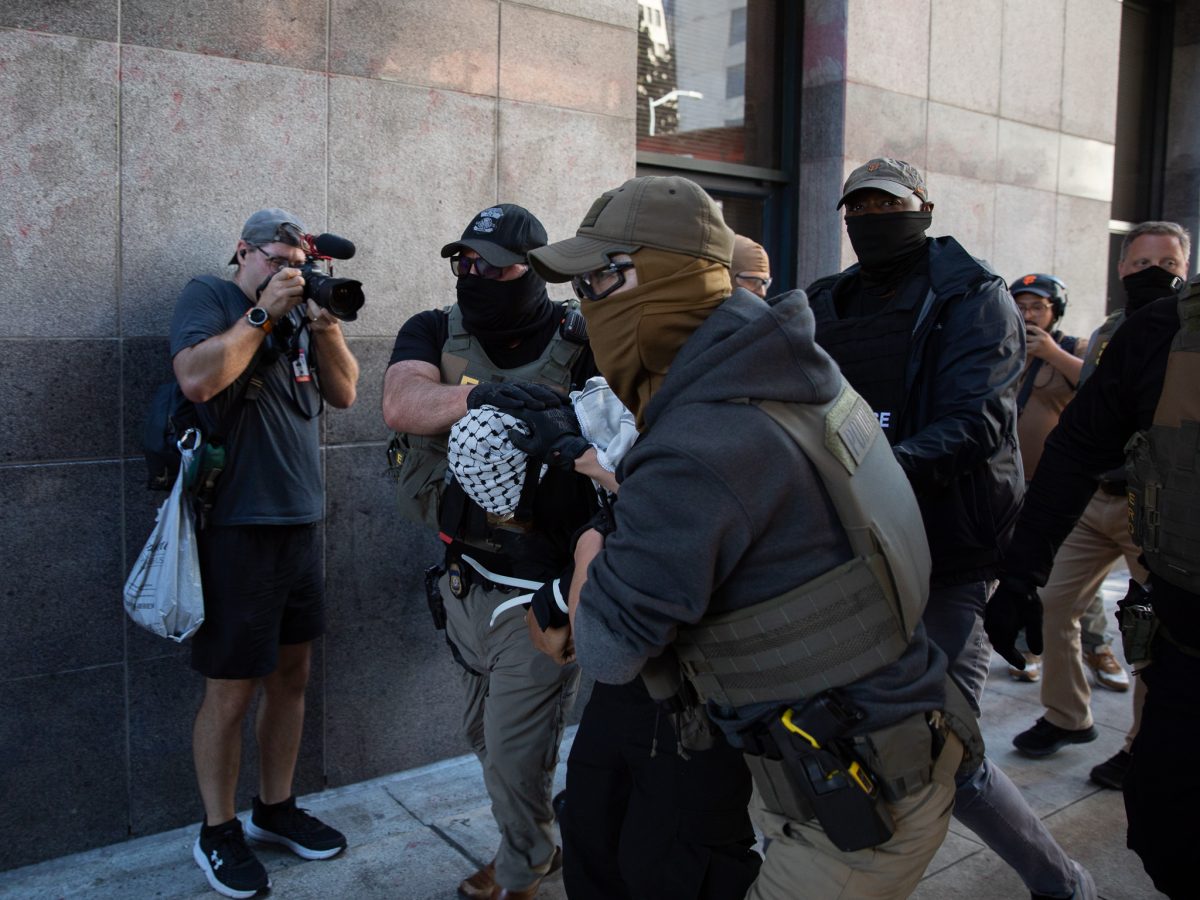
The woman was one of six people arrested by ICE on Thursday morning in what has become a routine maneuver: A DHS attorney moves to dismiss asylum-seekers’ cases, a legal tactic the Trump administration is using to fast-track people out of the country.
The arrests have both confused and terrified people who have a legal right to claim asylum in the United States and are complying with the law by showing up to court.
The Colombian woman’s case was the second time that morning someone had tried to call into court. Just minutes before her call, a man dialed in. When O’Brien asked why he was not there in person, he said: “Because of fear of being arrested. I would like to apologize.”
O’Brien also asked that man to come in person that day. The man never did show up. If asylum-seekers miss a court hearing, they can be deported from the United States as a consequence. Just before noon, O’Brien ordered him removed.
The confusion and fear is evident in court most days. One woman whose case the Trump administration lawyer moved to dismiss had moved to Las Vegas and presumably traveled all the way back to San Francisco for court that morning. She wanted the court to move her court hearings to Nevada.
“Things are going to get complicated for you very quickly,” O’Brien said to the woman. “I’m not sure you’re going to have any hearings in Nevada.”
In two other women’s cases, even though Homeland Security did not move to dismiss either case, a scuffle was audible in the hallway after both walked out.
Mission Local then witnessed ICE officers arresting one of those two women as she cried “abogado, abogado” (lawyer in Spanish). When Mission Local asked the ICE officers why that woman was taken, given that Homeland Security had not moved to dismiss her case, one of the officers said they might have the wrong person.
ICE officers carry sheets of paper with what appear to be black and white photos and the names of the people they are told to arrest after court. Mission Local saw two ICE officers riffling through their papers. “That wasn’t her,” one muttered to the other.
A few minutes later, ICE officers reappeared with the woman who they had taken. They let her go. She smiled back at them, relieved, then bolted toward the elevators.
One by one, as other asylum-seekers left the courtroom, ICE officers checked their papers trying to identify them as they walked by.
One visibly pregnant woman from Haiti avoided arrest, the first person Mission Local has heard of a person being able to leave the courthouse after Homeland Security moved to dismiss their case. It wasn’t clear if it was the temporary protected status, or the fact that the woman was pregnant, that kept her from being detained.
Another woman, just 20, almost made it into an elevator before an officer said to his colleagues: “What about her?” She was quickly taken.
That same morning, in addition to the six people arrested at immigration court, ICE also arrested seven people at an apartment building in SoMa, said Milli Atkinson, an immigration specialist with the Bar Association of San Francisco.
That number of people arrested at once out of a neighborhood in San Francisco is concerning, said State Sen. Scott Wiener.
Unlike in Los Angeles, where ICE officers have regularly raided workplaces, the Bay Area has mostly not seen mass arrests in neighborhoods, though ICE did arrest seven people on Aug. 12 at a house in Oakland.
“So when I saw this video, my heart dropped,” Wiener said, referencing footage of the arrest, “to see secret police thugs in a San Francisco neighborhood, grabbing people from an apartment building.”
“I’m deeply concerned,” Wiener added, “that we’re going to see more masked ICE activity in San Francisco and in the Bay Area.”
MORE ON IMMIGRATION ENFORCEMENT
Trump admin. fires S.F. immigration judge with high asylum rate
Feds charge ICE protester with destroying property, assault in S.F.
ICE pepper sprays protesters and press at S.F. immigration court
Support the Mission Local team

We’re a small, independent, nonprofit newsroom that works hard to bring you news you can’t get elsewhere.
In 2025, we have a lofty goal: 5,000 donors by the end of the year — more than double the number we had last year. We are 20 percent of the way there: Donate today and help us reach our goal!
MARGARET KADIFA
I’m covering immigration. My background includes stints at The Economist in print and podcasting as well as reporting from The Houston Chronicle and elsewhere.More by Margaret Kadifa