By Annie Vainshtein, Abigail Vân Neely, Staff Writers Updated Aug 21, 2026
Gift Article (SFChronicle.com)
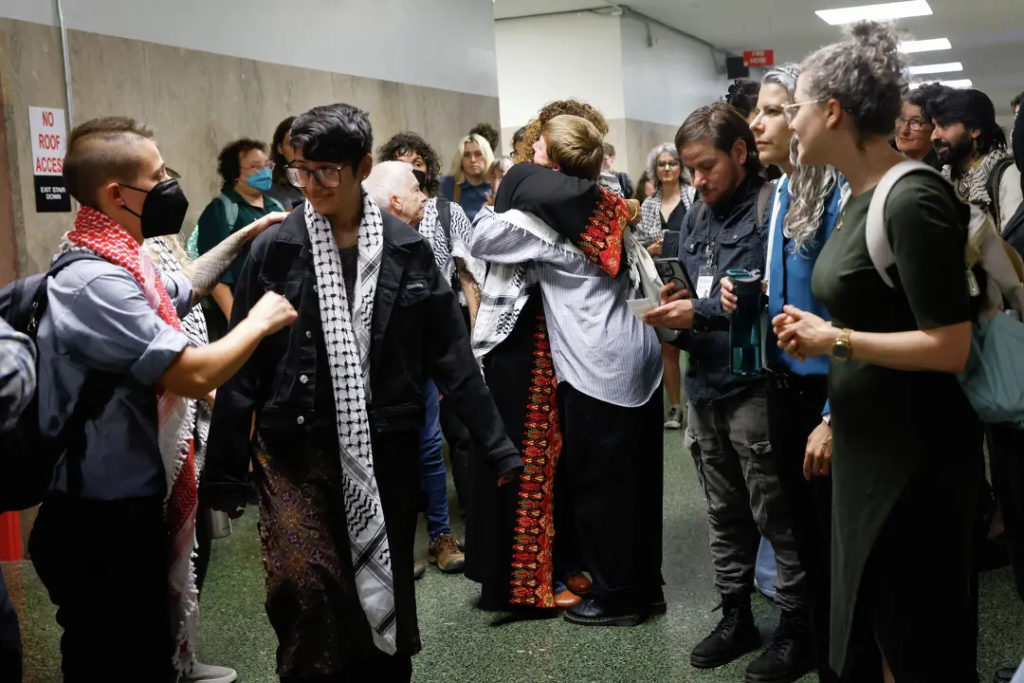
Golden Gate Bridge protester Em Tillotson, center right, gets a hug of support from Nida L, center left, one of the Golden Gate 26, as Golden Gate Bridge protester Bhavika Anandpura, second from left, gets support from Raye Kahn, left, press cooordinator and a Golden Gate 26 misdemeanor co-defendant at the Hall of Justice on Friday. Lea Suzuki/S.F. Chronicle
A San Francisco Superior Court judge on Friday sentenced seven people who shut down the Golden Gate Bridge in 2024 to protest the war in Gaza to 30 days in jail, with credit for time they’ve already served, and six months of probation.
Given the time they’ve already spent in jail, the protesters will likely serve another 11 to 13 days behind bars and will not be retried on charges on which the jury deadlocked.
After a two-month trial, a jury found the demonstrators guilty last month of false imprisonment, obstruction of a thoroughfare and unlawful assembly — all misdemeanors. They were also each fined $1,000 and can opt to spend an additional 13 to 15 days serving on a work program. Their probation begins on Friday, but none will be required to serve their sentence until there is a verdict in their appeals, which their attorneys said they intend to file.
Bhavika Anandpura, Sarah Ferrell, River Allen, Rocky Chau, Conrad de Jesus and Em Tillotson faced up to five years in county jail. Sara Cantor was convicted of an additional misdemeanor count for refusing to disperse, and faced 5 ½ years.
The protesters avoided a maximum sentence of 15 years when the jury deadlocked 10-2 on a felony conspiracy charge, with 10 voting guilty. The jury was also hung 11-1 on a misdemeanor trespassing charge, with the majority voting not guilty. On Friday afternoon, Assistant District Attorney Angela Roze said prosecutors would dismiss the charges “in the interests of justice,” meaning the protesters will not face retrial.
Just before 8 a.m. on April 15, 2024, several cars stopped together on the Golden Gate Bridge. Protesters demanding an end to Israel’s war in Gaza emerged. They stopped traffic for four hours. Some locked themselves together with metal bars, a tactic law enforcement calls the “sleeping dragon.”
District Attorney Brooke Jenkins charged 26 people on the bridge with a host of criminal offenses, saying the demonstration threatened the health and welfare of people traveling across the bridge, including a person with a brain tumor who missed a medical appointment, a mother who had to help her young sons defecate in a bag, nurses who could not get to work, and a woman who now suffers from a fear of heights.
A judge later found insufficient evidence to charge most of the defendants with more serious crimes.
Civil rights activists and defense attorneys called Jenkins’ charges an unreasonably harsh response to protesters fulfilling what they saw as a moral duty to speak out against U.S. military support for Israel.
In a statement, District Attorney Brooke Jenkins said she believed the court’s sentence finally held the defendants accountable for their actions.
“I continue to encourage civil discourse and exercising our rights under the First Amendment, but this serves as a reminder that when such acts become unlawful and compromise public safety that there will have to be consequences,” said Jenkins
Jenkins said her department’s initial hope was that the defendants would be sentenced to a one-year term of probation and 16 actual days in jail, representing one day in jail for each hour that each victim named in the convictions was “trapped on the bridge against their will.”
“We hope that imposing a custodial sentence will hopefully act as a deterrent to future criminal conduct by others considering blockading a bridge,” she said.
Every seat in the courtroom on Friday was filled by family members and supporters of the seven defendants, who were separated from the gallery by plexiglass. Judge Teresa Caffese began the proceedings by reading a letter written by a juror in the trial, who said that while they believed convicting the defendants of the misdemeanor counts was the right decision, they hoped she would weigh her sentencing with fairness and compassion.
“Nothing in the trial suggested they acted out of malice or personal gain,” the juror wrote, saying they believed the defendants were empathetic, well-intentioned people who “cared deeply about the causes they support.”
After reading the letter, Caffese said she believed the defendants’ unequivocal goal was to cause as much disruption as they could on the bridge, regardless of how their conduct would be classified under the law. The defendants, she said, testified that they believed what they were doing was legal, as a matter of conscience.
“Both claims cannot be true. Either laws were violated or they were not,” said Caffese. “History contains countless examples of protests (done) without violating laws.”
Caffese said the defendants, who initially resisted arrest, only agreed to surrender after they learned their vehicles, which were parked on the bridge, would be sawed in half. She claimed they had “made their point” in less than an hour, when they received media coverage, and could have ceased their demonstration at that point. In her preamble, she also described the way Dr. Martin Luther King “willingly accepted” arrest, demonstrating a commitment to his cause and a principle that “civil disobedience carries responsibility.”
After summarizing statements written in support of the defendants, Caffese denied their requests for diversion and emphasized that they were not being sentenced for their beliefs. She denied an attorney’s request for Chau, who cares for his older mother, to serve his custodial time on home detention, but later allowed for him to serve it “non-consecutively.”
She also made an exception for Cantor, the defendant who had faced a lengthier sentence. Cantor, who uses a cane to walk, had allegedly been sent to solitary confinement during her initial days in jail because jail staff saw her cane as a weapon, her attorney said. Caffese allowed Cantor to serve her custodial time in home detention.
Several demonstrators’ attorneys pressed the judge after the sentencing to ask why she was imposing county jail for a non-violent protest involving defendants with clean records, rather than considering less restrictive alternatives, such as electronic monitoring or home detention. At one point, one of them grew increasingly agitated and began to raise her voice at the judge.
“In this courthouse, any misdemeanor that goes down gets the option of (the alternative work program),” said Deputy Public Defender Nuha Abusamra, noting that even offenders with criminal records were often released on home monitoring. “So I’m wondering, what is it other than their political beliefs?”
The judge refused to answer her question directly, saying she had already stated her reason.
During a short recess, Jordan Harger, one of the original “Golden Gate 26,” whose case had been diverted, said they believed the punishment was “abhorrent.”
Any jail time, especially in the county’s jails, was unjust, Harger said. Harger and others rejected the judge’s invocation of Martin Luther King Jr. and believed there was no reason to put someone in jail for “fighting a genocide.”
“My comrades are deeply principled people. And they are very brave people,” Harger said, appearing to cry and shake slightly. “And I know that when they’re in that jail they’ll be sharing their commissary. They will be educating others. They will be caring for other incarcerated people.”
As the hearing came to a close, the defendants and a swarm of their supporters filed out of the courtroom and into the hallway, where they began to rejoice and holler, clapping and dancing in a circle.
Aug 21, 2026|Updated Aug 21, 2026 4:13 p.m.
Reporter
Annie is a reporter for the Chronicle covering breaking news, crime and human-interest stories. She previously wrote for the Chronicle’s Arts & Entertainment section, Datebook. Before joining the Chronicle, she studied journalism at Cal Poly, San Luis Obispo, where she launched a culture column for the campus newspaper, produced radio stories for NPR affiliate KCBX, and worked as a DJ and writer for KCPR, the university’s radio station. Her work has appeared in VICE and Flood Magazine and has been recognized by the California Journalism Awards and the San Francisco Press Club.
How to reach Annie
Email avainshtein@sfchronicle.com.
Public Safety Reporter
Abigail Vân Neely covers crime, criminal justice and breaking news in San Francisco and the East Bay. She previously worked at Mission Local, where she reported on policing, the courts, homelessness, addiction and city government. She has bachelor’s and master’s degrees from Stanford University and lives in San Francisco.
How to reach Abigail
Email Abigail.Neely@sfchronicle.com

 Harold Meyerson


 by
by