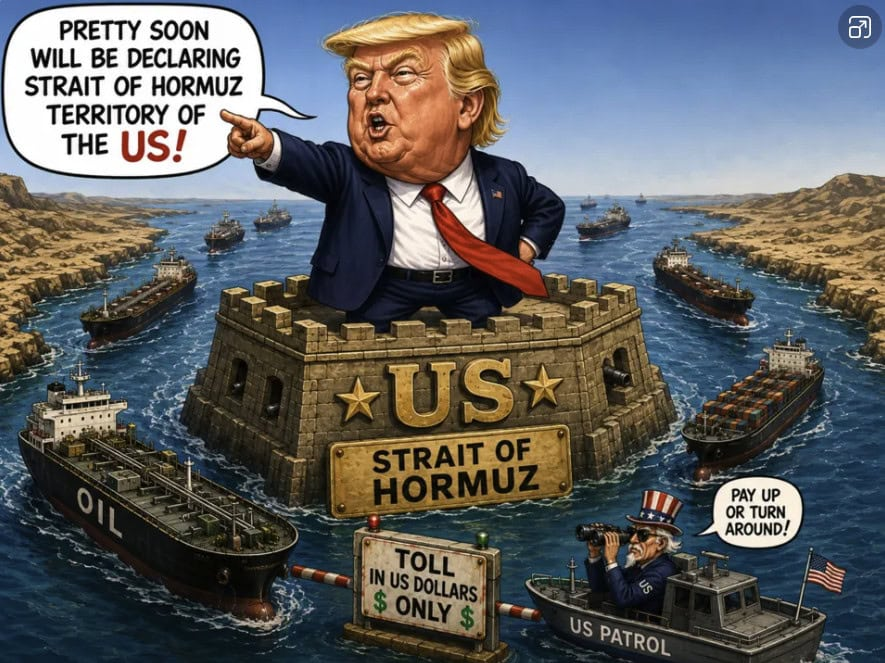
President Donald Trump said he would declare the Strait of Hormuz as a United States territory during a speech on Friday.



President Donald Trump said he would declare the Strait of Hormuz as a United States territory during a speech on Friday.

Aug 15, 2026
Roque Planas, – THe Guardian (U.K.)
Stephan: Trump thinks of himself as a king, and the United States as his personal territory. As this story validates he cares nothing for the wellbeing of America’s National Parks or forests. He can do as he likes with them, and he does, because the country no longer has a functional Congress.

Heavy machinery seen operating in famous Santa Elena Canyon amid outcry over new wall infrastructure in beloved Texas park Credit: Natalie Newman / Guardian
Bulldozers have begun plowing up ground at the mouth of Big Bend national park’s famed Santa Elena Canyon as part of the Trump administration’s multibillion-dollar “smart wall” expansion on the US-Mexico border, according to new footage taken by activists who have been monitoring the site.
Tensions have run high since the Trump administration announced plans to erect new border security infrastructure in the roughly 500-mile Big Bend region of south-west Texas, which includes the Lone Star State’s largest and most-visited national park.
Since last week, activists have shared video footage that appeared to show heavy machinery laying the groundwork for new border infrastructure that US Customs and Border Protection (CBP) did not announce and initially denied was happening. By Thursday, photographer Natalie Newman captured video footage of bulldozers plowing earth at the mouth of the […]
The government conducted expansive surveillance, infiltrated group chats and obtained financial records of organizations never accused of crimes.


By Alan Feuer and Ernesto Londoño
Alan Feuer reported from New York, and Ernesto Londoño from St. Paul, Minn.
Aug. 13, 2026 (NYTimes.com)
Four days after Alex Pretti was fatally shot while filming officers taking part in the Trump administration’s immigration crackdown in Minnesota, the Homeland Security Department quietly opened an investigation at its office in St. Paul.
The target was not the Border Patrol agents who had killed Mr. Pretti, a 37-year-old government nurse, in late January. Instead, it was several left-leaning political organizations — labor unions, a climate change group, socialist collectives — that investigators believed had provided help and money to what they described as the “violent opportunists and agitators” on the street, according to newly released government documents.
As part of their inquiry, the documents show, homeland security officials used an array of invasive tactics during the first half of this year to gather information on many groups and individuals who were never accused of crimes, crossing the line that has traditionally stood between investigating criminal activity and political dissent.
In one instance, officials used administrative subpoenas to obtain more than three years of financial records from the Sunrise Movement, an environmental action group, and a labor union, the Communications Workers of America. That time frame went well beyond the civil unrest in Minnesota, which was prompted by the deployment of thousands of immigration agents to the state during the winter.
In another, investigators scrutinized three years’ worth of wire transfers made by the nation’s biggest health care workers union, the Service Employees International Union, in what they referred to as an inquiry into “domestic terrorist financing.”
The documents further detailed an expansive covert surveillance operation in which undercover agents spied on protesters and organizers at meetings held online, as well as in libraries, parks and churches, taking down not only what they said, but also their names and sometimes license plate numbers. The undercover agents also infiltrated group chats on Signal, listening as activists discussed coming demonstrations and their political opinions.
So far, none of the organizations targeted by the homeland security inquiry, conducted with the U.S. attorney’s office in Minnesota, have faced charges. And yet, as the investigation moved forward, prosecutors showed grand jurors a PowerPoint slide asserting that 18 groups — including the A.F.L.-C.I.O., the country’s largest federation of labor unions — were part of a conspiracy to impede the work of immigration officers in Minnesota.
Ultimately, that supposed conspiracy led in June to the indictment of 15 people accused of interfering with law enforcement agents as members of the far-left movement known as antifa.
The Homeland Security Department did not respond to a message seeking comment. A spokesman for the U.S. attorney’s office in Minnesota declined to answer questions about the investigative tactics.
By its own account, the institutional left in Minnesota, especially the labor movement, played a central role in bringing out hundreds of thousands of people to march in protest of President Trump’s immigration crackdown in the state. But the demonstrations — and corresponding efforts to monitor the movements of Immigration and Customs Enforcement agents — were largely undertaken by ordinary residents, most of whom have said they were committed to peaceful resistance.
“While federal agents repeatedly broke the law, ordinary people exercised their First Amendment rights to protect their neighbors,” said Aru Shiney-Ajay, the executive director of the Sunrise Movement. “The Trump administration is now trying to intimidate individuals and organizations who opposed his agenda.”
Some of the 15 people charged in the so-called antifa case did, in fact, belong to some of the unions and political organizations that faced scrutiny over several months during the spring and winter. But the newly released documents, which were disclosed as part of a motion asking for more details about the criminal inquiry, suggest that investigators used those tenuous connections to take a deep dive into the inner workings of the groups.
Kevin Riach, the lawyer who filed the motion, in Federal District Court in Minnesota, wrote that the homeland security investigation into the interference with federal agents “extended far beyond any potential threat to law enforcement safety.”
“It concluded, with no evidence (but obvious political animus),” he wrote, “that numerous Twin Cities unions and nonprofit organizations were involved in a widespread conspiracy,” adding that “it surveilled and surreptitiously gathered financial records generated by these organizations despite the lack of any connection between those organizations and criminal conduct.”
The investigation in some ways called to mind Cointelpro, the intrusive counterintelligence program that the F.B.I. ran against leftist groups from the 1950s to the 1970s under the leadership of the bureau’s director, J. Edgar Hoover.
The Minnesota surveillance reports in particular documented what largely appeared to be political activity protected by the First Amendment. They showed how undercover agents embedded themselves in a “noise protest” outside a hotel where immigration agents were staying and took down notes at other gatherings as demonstrators brainstormed ideas on how to protest the surge of officers who descended on Minnesota late last year.
Former federal prosecutors questioned why homeland security officials took the lead in a case that would typically be overseen by the F.B.I. Others said that the broad use of subpoenas targeting labor unions and other groups was unusual and concerning, especially if it turns out there was no evidence that the organizations were breaking the law.
“The government’s power to investigate is extraordinary, and with that power comes a responsibility to exercise care and restraint,” said Harry Jacobs, who resigned as the chief of the criminal division at the U.S. attorney’s office in Minnesota in January in protest over the Trump administration’s handling of the killing of Renee Good.
“An investigation should begin with a legitimate basis to suspect criminal conduct, not with a chosen institution or group,” Mr. Jacobs added. “Prosecutors must follow the facts and the law wherever they lead, rather than select a target and work backwards to build a case.”
Several of the groups that were targeted in the inquiry, known as Operation Puppet Master, and in a follow-up investigation called Project Whipple Shield, declined to comment. (Whipple Shield is a reference to the Whipple Building, which served as a hub of the immigration operation.)
When Daniel N. Rosen, the top federal prosecutor in Minnesota, announced the indictment of the 15 purported antifa members two months ago, he chose his words carefully, insisting that the defendants had been charged only because each of them had “violently opposed” federal agents taking part in the Trump administration’s immigration agenda.
“Be assured,” he told reporters, “the Department of Justice and my U.S. attorney’s office has and will distinguish between lawful protest and criminal conduct.”

But what Mr. Rosen did not disclose that day was that the charges filed against the 15 defendants stemmed from a sprawling investigation. Its tentacles had touched the lives of scores of ordinary people — teachers, veterans, union members — who in many instances had gotten together to do little more than discuss monitoring ICE agents or abolishing ICE altogether.
The case in St. Paul, like others against ICE protesters, arose from a sweeping directive issued last year by Mr. Trump known as National Security Presidential Memo 7. The memo ordered a whole-of-government approach to stem what officials have described as a rising tide of left-wing political violence.
But former prosecutors and civil rights lawyers have criticized it for encouraging aggressive investigations and prosecutions of groups and people on the left for activities typically protected by free speech laws.
In drafting their indictment, prosecutors under Mr. Rosen focused on an organization called Direct Action Minnesota, or DAMN, an umbrella group that describes itself as a “decentralized coalition of working-class people engaged in various forms of community defense against the current federal occupation” in Minnesota. Prosecutors said that the group trained its members in how to use shields against law enforcement officers, conduct surveillance, plan events and mount “rapid mass mobilization” against actions by ICE officers.
The indictment details some behavior by protesters with ties to DAMN that clearly seems violent or obstructive.
For example, prosecutors said that on Jan. 23, demonstrators who had gathered at the Whipple Building threw ice blocks at law enforcement vehicles. They also formed a blockade, boxing federal agents into one area near the federal building. Weeks later, prosecutors added, some of the defendants put debris in a road outside the building, trying to block access to it.
But the indictment also notes that the defendants often relied on information gleaned from group chats whose members tracked and monitored vehicles going to and from the Whipple Building — behavior that is not necessarily illegal. Indeed, the federal judge overseeing the case, Katherine M. Menendez, has already issued an order in a separate civil proceeding saying that protesters cannot be arrested simply for following federal agents in their vehicles.
Nonetheless, some groups that organized and ran the group chats were targeted by the surveillance operation and later identified in the prosecutors’ grand jury presentation as being part of the conspiracy to interfere with ICE agents. Other members of the alleged conspiracy were said to include the local chapters of the S.E.I.U. and the Democratic Socialists of America, a state teachers’ union — and even the Grease Pit, a small bike shop in Minneapolis.
In his motion, Mr. Riach described how federal agents took down the license plate numbers of people who attended a training session at a church in Roseville, Minn., and used that information to obtain their names. The agents then searched social media for images of the people, compiling an “intel work-up” that included detailed personal information about them.
“None of these individuals did anything other than engage in protected First Amendment speech in a church meeting room,” Mr. Riach wrote. “Yet now their personal information is memorialized in a D.H.S. dossier.”
Alan Feuer is a reporter for The Times who covers the effects President Trump has had on the courts, the Justice Department and the broader rule of law.
Ernesto Londoño is a Times reporter based in Minnesota, covering news in the Midwest and drug use and counternarcotics policy. He welcomes tips and can be reached at elondono.81 on Signal.
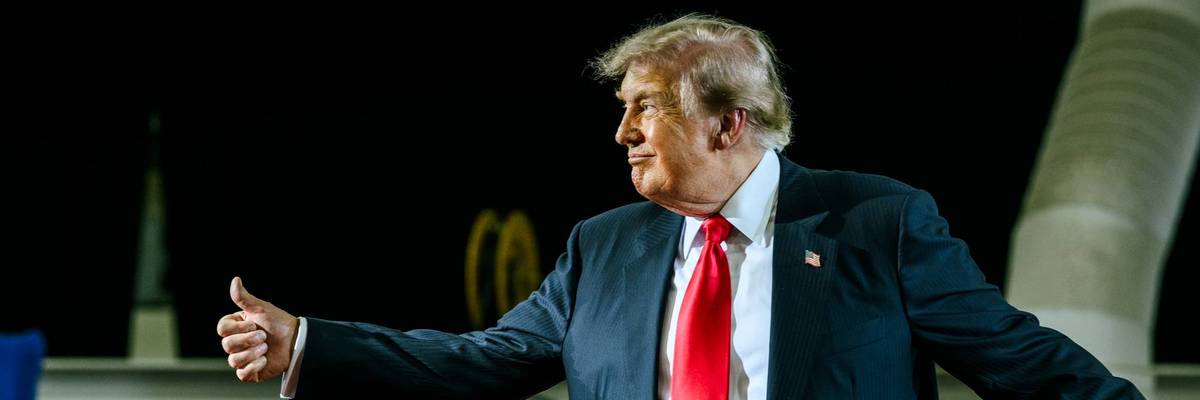
President Donald Trump delivers remarks at the General Motors Proving Ground in Milford, Michigan, on July 27, 2026.
(Photo by Daniel Torok/White House/flickr)
Aug 14, 2026 (CommonDreams.org)
In yet another remark that triggered alarm around the world, President Donald Trump said Friday that he planned to declare the Strait of Hormuz—which Iran has blockaded for much of the past five months over his and Israel’s illegal war—a US territory.
Just two days after the latest inflation figures demonstrated, in the words of one expert, “Trump’s catastrophic mismanagement of our economy,” the president ignored the economic fallout from his war, which led Iran to restrict ship traffic through the strait, driving up fuel prices worldwide.
RECOMMENDED…

“We’re bringing the prices way down,” he told a Long Island crowd. Trump also said that “after we finish defeating Iran, which is being very badly defeated, pretty soon, I’ll be declaring the Hormuz Strait a territory of the United States.”
Some critics responded to clips of the comments on X by mocking Trump—an infamous liar. Congressman Ted Lieu (D-Calif.) quipped, “Awesome! And the Easter Bunny is real.”
Ryan Costello, policy director at the National Iranian American Council, said that “this jingoism rings a bit hollow when most of the US bases near the strait have been essentially abandoned due to danger from Iranian missiles and drones.”
Progressive political commentator Kyle Kulinski declared that “he absolutely needs to be impeached, removed, and locked up. He’s a completely unhinged lunatic, and he’s a sadistic violent menace to the world.”
After high initial claims about lower prices, Trump admitted that gasoline has soared due to his war, but said: “For you to pay a tiny little bit more for your gasoline, just remember, you’re doing it so that a very evil country cannot have a—a country, really it’s the No. 1 state sponsor of terror in the world—we don’t want to have them have a nuclear weapon. So, remember that when you have to pay a little bit more, you’re at $4, it’s OK. I’ll never apologize. I did the right thing.”
Trump’s threat over the strait between the Persian Gulf and the Gulf of Oman came just before a monthlong ceasefire between the US and Iran is set to expire on Monday. A senior White House official told Politico that the situation is “static.”
“It doesn’t matter how close or how far we are,” said the official, who has heard no mention of a potential extension of the ceasefire. “What matters is if Iran wants to come to the table and agree to a deal. Right now, they haven’t done that.”
The Associated Press reported Friday that “the Trump administration appears to be reaching out to a broader swath of countries that might be able to help pressure Tehran,” and Ali Vaez, Iran project director at the International Crisis Group, told the outlet that “everyone is just urging both sides to stop this reckless game of chicken.”
In addition to launching an illegal war on Iran in February, and invading Venezuela in January to abduct its president, Trump has made threats against various other nations during his second term, including Canada, Cuba, Colombia, Greenland, and Mexico. He’s also threatened to seize the Panama Canal and killed hundreds of people by blowing up boats allegedly smuggling drugs.
This article has been updated with additional comment from President Donald Trump and Public Citizen.
Our work is licensed under Creative Commons (CC BY-NC-ND 3.0). Feel free to republish and share widely.
Jessica Corbett is a senior editor and staff writer for Common Dreams.
Wetiko (also spelled windigo or wendigo) is an Algonquian-rooted concept describing an evil, cannibalistic spirit or destructive force driven by insatiable greed, selfish consumption, and a total disconnect from community and nature. In modern psychological and spiritual contexts, it is widely interpreted as a contagious “mind-virus” or collective psychosis that compels humans to act against their own best interests. [1, 2, 3, 4, 5]
Traditional Origin
Modern Psychospiritual Interpretation
In the context of modern capitalism, scholars and activists use wetiko as a conceptual lens to critique systemic exploitation, viewing hyper-accelerated globalized capitalism not just as an economic structure, but as the ultimate institutionalized manifestation of the wetiko “mind-virus.” [1, 2, 3, 4]
When applied to modern market systems, the concept highlights several structural parallels:
Insatiable Growth
Commercial “Cannibalism”
Institutionalized Blindness
The Alternative Vision
Writers like Alnoor Ladha and Paul Levy argue that to fix global crises, we must look beyond policy tweaks. They advocate for: [1, 2]
 By Candice Norwood, The 19th August 12, 2026 (DCReport.org)
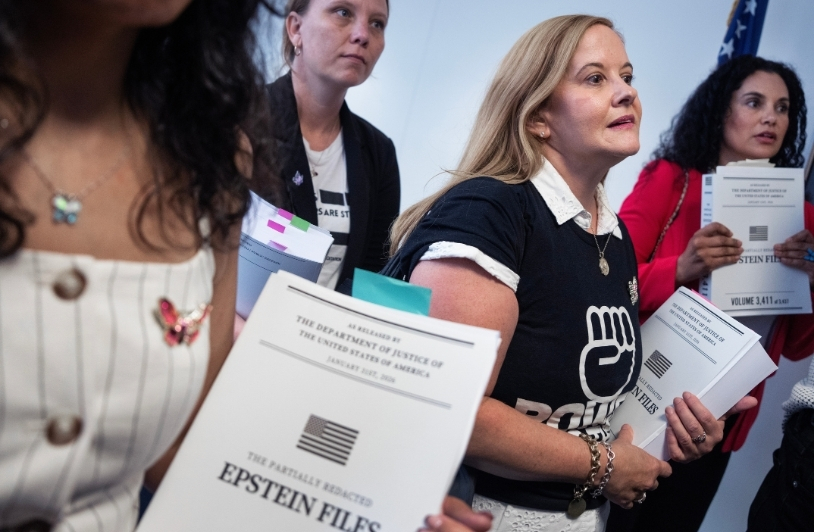
Jeffrey Epstein survivors including Sharlene Rochard (right) and Liz Stein (second from right) attempt to hand a copy of the Epstein files to Sen. John Cornyn, R-Texas, on July 29, 2026. (Tom Williams/CQ-Roll Call/AP Images)

Every minute of every day, Liz Stein has to relive the worst thing that’s ever happened to her. She does it during news interviews and when meeting lawmakers on Capitol Hill to demand justice for herself and other survivors of the late disgraced financier and convicted sex offender Jeffrey Epstein.
And she’s had to do it throughout the attorney general confirmation process for Todd Blanche, a man who rose from being President Donald Trump’s criminal defense lawyer to the top official overseeing the U.S. Department of Justice. Blanche has served as deputy attorney general, the No. 2 at DOJ, since March 2025. He then became acting attorney general in April after Trump fired his predecessor, Pam Bondi, and officially nominated him to oversee the department in June.
Since that time, Stein and her fellow survivors have consistently urged senators to vote against Blanche’s confirmation, arguing that he has shown no urgency or concern with expanding the Epstein investigation. Despite some initial pushback from two Republican members of the Senate Judiciary Committee, Blanche cleared that first hurdle to advance to a full Senate vote, in part by meeting with survivors — something he’d previously declined to do.
Republican Sens. Susan Collins, who is in a tough re-election race in Maine, and Lisa Murkowski of Alaska then announced that they would join Democrats in voting against Blanche, raising the tension heading into the final vote. With last-minute support from GOP Sen. Bill Cassidy of Louisiana, the Senate confirmed Blanche, 50-49, early Saturday morning.
Stein told The 19th that just last year she felt momentum toward accountability growing, driven by public outrage from across the political spectrum and the Epstein survivors’ decision to step into the national spotlight as a unified group calling for transparency. However, Blanche’s confirmation crystalizes another feeling for Stein: “It feels like the DOJ is weaponizing this case for political reasons, and it feels like we’re the pawns being used in that game,” she told The 19th.
That momentum feels stagnant for now, Stein said, but she wants people to know that it won’t be a deterrent. “I think that every attempt the Department of Justice has made to make us go away has not worked,” she said. “We’re not going away.”
The Epstein cloud has hung over the Trump administration since the president began his second term, and included a series of perceived missteps by Bondi that drew criticism from both Democrats and Trump’s base.
In February 2025, Bondi claimed in interviews that her office would be releasing new documents tied to Epstein that would make people feel “sick,” and stated that she had a list of Epstein’s clients sitting on her desk. At a White House meeting the same month, she handed out binders to a group of right-wing social media influencers that contained no new information.
By July 2025, DOJ had released a memo stating it “did not uncover evidence that could predicate an investigation against uncharged third parties.” Trump supporters began to weigh in. Podcaster Joe Rogan, who boasts an average of about 11 million listeners and viewers per episode, accused the administration of “trying to gaslight” the public about how much information it had on the Epstein case.
For Stein, DOJ’s “nothing to see here” attitude has been a constant. In September 2025, the human trafficking specialist and a group of about a dozen other survivors gathered publicly for the first time, standing in front of the U.S. Capitol in Washington, D.C. They called for investigations into Epstein’s associates, no presidential pardons or concessions for Maxwell and a full release of the Epstein files — documents and images capturing his personal relationships, business dealings and crimes.
Survivors advocated for the Epstein Files Transparency Act, which became law in November 2025, and required the department to publish unclassified records and communications related to the investigation and prosecution of Epstein. Between December 2025 and March 2026, the department released hundreds of thousands of documents, photos and videos tied to Epstein.
In the process, DOJ publicly released the names of survivors who wanted their identities concealed, while redacting the names of people associated with Epstein.
Then, the releases stopped.
Behind the scenes, Stein said survivors were “practically begging” for meetings with DOJ officials, “making ourselves available, putting ourselves out there, and saying, like, ‘We want to help you in doing this.’”
“We have tried countless times to engage the DOJ, and they’ve had absolutely no interest,” she said.
That continued after Trump fired Bondi and Blanche took over as acting attorney general, survivors have said in interviews and testimony. On the first day of Blanche’s confirmation hearings on July 15, he told the Senate Judiciary Committee that he could not meet “directly” with survivors. The next day, survivor Dani Bensky questioned that reasoning as part of her testimony before the panel, citing news reports that Blanche met with Maxwell for four hours last year.
The meeting between Blanche and survivors happened later that week, after Republican Sen. Thom Tillis of North Carolina, who is retiring at the end of his current term, said Blanche must first meet with them before he would vote to advance the nominee to the full chamber.
Stein described Blanche’s energy in the meeting as “very dark.” She believes that he was simply checking a box to get a promotion. Survivors wanted to know about the redaction process for the Epstein files and why DOJ had not identified new investigative leads, she said, adding that they did not receive satisfying answers.
“There’s no humanity,” she said. “There was no ability to connect on a human level whatsoever. He was impenetrable as far as having any amount of real compassion or understanding of our experience.”
Leading up to the Senate Judiciary vote, Stein said survivors dropped off stacks of Epstein files that they had marked with potential investigative leads for members of the judiciary committee to look over. They also walked the halls of Congress “desperately” trying to meet with lawmakers. Stein said that they met with representatives for Sen. John Cornyn of Texas — one of the Republican holdouts heading into the Judiciary Committee vote. They did not, however, get a meeting with Tillis.
But Republicans, including Tillis and Cornyn, voted along party lines to advance Blanche’s nomination to a full Senate vote. Collins and Murkowski were the only Republicans to vote against Blanche’s confirmation. In a statement, Collins cited his efforts to shield the Trump family from IRS audits, and comments that he would approve national abortion restrictions. Murkowski noted an “acceleration” of the politicization of the DOJ, which she said includes “sweeping immunity protections granted to the president.” She also took issue with the DOJ handling of the Epstein files and Blanche’s comments to anti-abortion groups.
Reflecting on survivors’ advocacy over the last year, Stein said that “more often than not” they have had productive conversations with members from both parties. As a group, Epstein survivors have accomplished things that felt impossible years ago. Still, Democrats are generally more willing to engage and work with them, she said. While survivors may receive validation and positive feedback from Republican members privately, the lawmakers hesitate to voice those feelings publicly, Stein said, even when many of them have been champions for anti-sex-trafficking legislation.
Stein said she believes this issue — one in which young women and girls were abused by some of the country’s most powerful people — should not be political, but it is. The reality of having to spend her days convincing leaders to take action has an emotional cost, she said.
Moving forward, Stein said the survivors’ strategy is to remain resolute in their mission and goals. They will not back down, she said.
“But we’re human beings,” she added. “Imagine the worst thing that’s ever happened to you, having to confront it every minute or every day, and talk to people about it all the time, and just constantly rehash it. That’s a challenge for anyone.”
This article was originally published by The 19th on August 8, 2026.
“FREEDOM OF THE PRESS IS NOT JUST IMPORTANT TO DEMOCRACY, IT IS DEMOCRACY.” – Walter Cronkite. CLICK HERE to donate in support of our free and independent voice.
Candice Norwood, The 19thCandice Norwood is a breaking news reporter for The 19th. Before The 19th, she was a digital politics reporter for the PBS NewsHour, a staff writer for Governing magazine covering state and local government, and a freelancer for the Bloomberg News White House team.Government officials told The Intercept the War Department’s latest civilian casualty report was “sickening” and a “joke.”

August 11 2026 (therealnews.com)
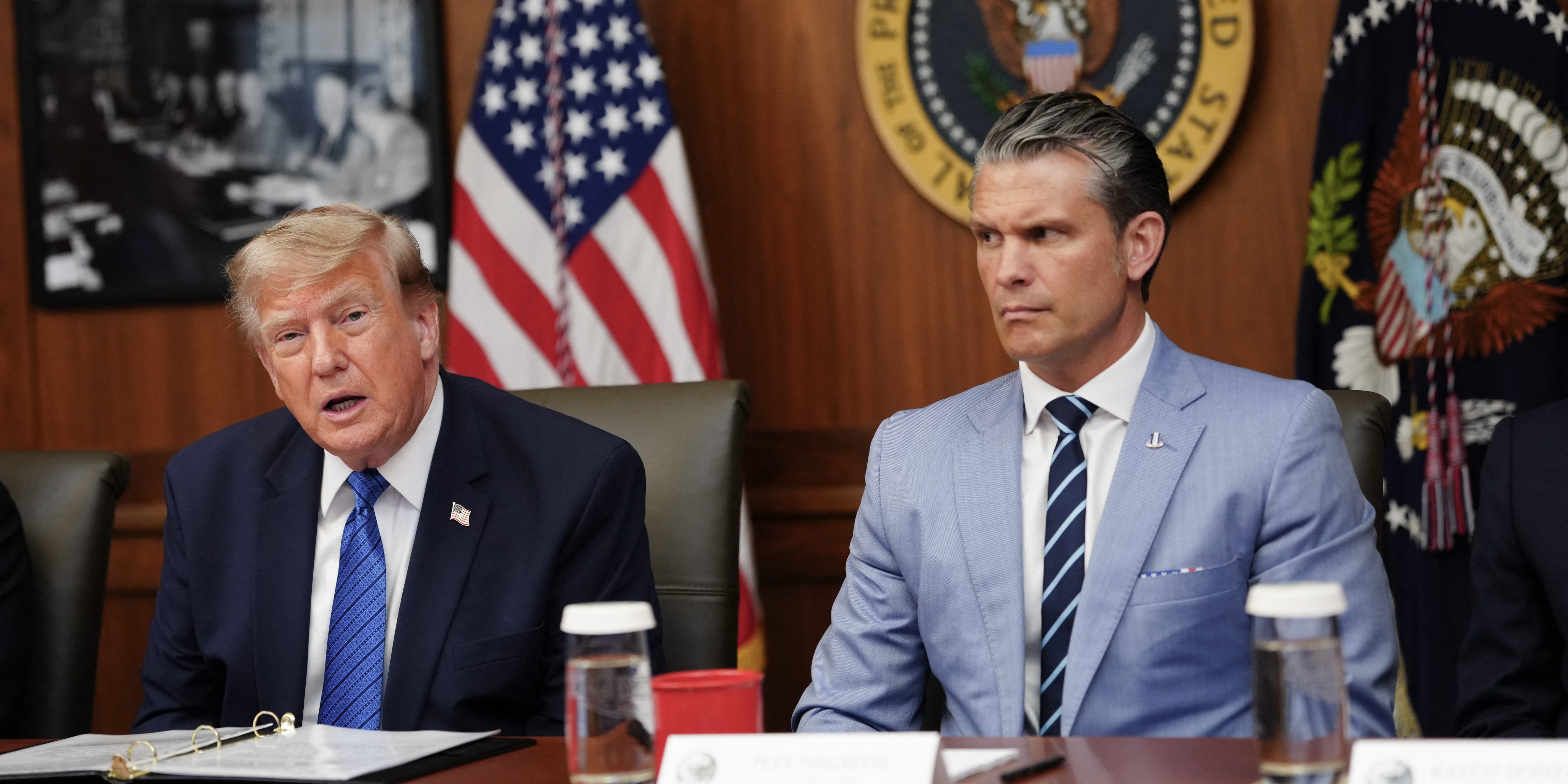
U.S. President Donald Trump speaks alongside Secretary of Defense Pete Hegseth during a Cabinet meeting at Camp David in Maryland, on July 31, 2026. Photo: Aaron Schwartz/AFP via Getty Images
The War Department delivered its unreleased annual report on civilian casualties to members of Congress on Tuesday, two government officials told The Intercept — one of whom called the report “a fucking joke.” The report found that U.S. attacks likely killed or wounded hundreds of civilians.
The other official deemed the report, which covers allegations of civilian harm stemming from military attacks in Iran, Somalia, Yemen, and the campaign of boat strikes in the Caribbean Sea and Pacific Ocean, a “total whitewash.” It’s the latest in a series of recent Pentagon reports that have called attention to U.S. failures to prevent, mitigate, or adequately track civilian harm after self-styled War Secretary Pete Hegseth gutted civilian harm mitigation and response or CHMR programs.
Shockingly, the Pentagon’s review of its 2025 attacks found that no civilians were killed in the Trump administration’s campaign of boat strikes, according to the officials, despite the fact that the U.S. killed more than 120 civilians last year in attacks that experts call extrajudicial killings or outright murder. The Trump administration has asserted repeatedly and without evidence that the boat strike victims, who now number more than 220, were “narcoterrorists.” In a classified briefing last fall, a high-ranking officer on the Pentagon’s Joint Staff said that some of the people killed in the initial September 2, 2025, attack may have been the victims of human trafficking, according to an Intercept investigation.
“They have absolutely no credibility,” the second official told The Intercept about the boat strike claims, adding that the report was “sickening.”
Known as the 1057 report, this year’s accounting of civilian casualties reflects a backlog of incidents from the Trump administration’s strikes against Yemen’s Houthi government in the spring of 2025. The report found that U.S. attacks killed 153 civilians and wounded almost 250 during the campaign of air and naval strikes, codenamed Operation Rough Rider. The second official called these “lowball numbers.” At least 238 civilians were killed and 467 injured, according to the Yemen Data Project.
One attack killed 68 people, the second official said. That attack on an immigrant detention center in Yemen killed and injured dozens of Ethiopian civilians and no combatants and was detailed in a report by Amnesty International shared with The Intercept last year. At the time, U.S. Central Command said it was still “assessing all reports of civilian harm resulting from operations during that time period.”
The Intercept Sues Trump for Selling Premium Access to Truth Social Announcements
Francesca Hong’s “Thanksgiving-Gate” Shows Her Detractors Are Totally Out of Ideas
No, AOC: “Woke” Wasn’t “Crazy” the Way You Say It Was
The 1057 report determined that three incidents “likely” harmed civilians, according to the second official. Another 15 attacks are still under review, he said.
“The idea CENTCOM still has fifteen cases on Yemen to adjudicate doesn’t bode well for the war in Iran,” said the first official. Both officials spoke to The Intercept on the condition of anonymity because they were not authorized to discuss the report.
Under Section 1057 of the 2018 National Defense Authorization Act, the Pentagon is required to provide Congress and the public with data on civilian harm, mitigation steps, and assessments. The officials said the Pentagon had sent the report to members of the Armed Services Committees.
The report does not cover Trump’s ongoing failed war on Iran, which the United States and Israel launched in February, because it includes only military attacks from 2025. The second government official said that the number of incidents of civilian harm to investigate from the current war with Iran will dwarf the number in Yemen. Reports of civilian harm were recorded every day from the beginning of the war on February 28 to the first ceasefire on April 8, according to the U.K.-based air strike monitoring group, Airwars. The World Health organization put the death toll in Iran at 3,375 people — before the ceasefire fell apart last month.
The second official said the backlog would likely carry over several years, referencing the fact that the 10-person civilian harm mitigation team at CENTCOM has been reduced to just one individual. The first official echoed the same concerns. “How will they get through hundreds of cases for Iran if their one civilian harm person still hasn’t finished Yemen?” they asked.
Currently, CENTCOM is clinging to the fiction that the U.S. attack on the Shajarah Tayyebeh elementary school in Minab, Iran, that killed more than 150 people, most of them children, is the lone civilian harm incident of the current war. “There is one active civilian casualty investigation from the 13,629 munitions,” Admiral Brad Cooper, the CENTCOM chief, told members of the Senate Armed Services Committee in May.
The Annual Report on Civilian Casualties in Connection with U.S. Military Operations in 2025 comes after Hegseth’s Pentagon has spent more than a year slashing measures to prevent civilian casualties, including firing the military’s top lawyers, who advise leaders on international laws of armed conflict.
A group of Democratic lawmakers told Hegseth in a July letter that his “gutting civilian harm mitigation and response (CHMR) efforts” has left the Pentagon unable to “comply with the law and its congressionally-mandated CHMR responsibilities.” They added: “The Trump administration — potentially in violation of federal law — has defunded and impeded civilian protection efforts.”
That letter, sent by Sen. Elizabeth Warren, D-Mass., and nine other lawmakers, echoed concerns raised by a War Department inspector general report that described civilian protection efforts as largely “inactive.” The May report by the Pentagon’s top watchdog says cuts to civilian harm mitigation and response efforts have been so severe under Hegseth that the United States cannot adequately protect civilians in conflict zones or track harm when it occurs.
These criticisms were echoed in an another-yet-unreleased official report revealed by The Intercept that found Hegseth’s Pentagon gutted its premier center devoted to preventing civilian casualties in war zones. The War Department’s Civilian Protection Center of Excellence slashed its staff from 40 personnel in January 2025 to just nine by the end of the year, according to the report.
“In the coming months, the Department will submit its annual report regarding casualties resulting from United States military operations during the 2025 calendar year,” a Pentagon official told The Intercept when asked about the U.S. officials’ comments. “We have nothing to preview or announce at the moment.”
IT’S EVEN WORSE THAN WE THOUGHT.
What we’re seeing right now from Donald Trump is a full-on authoritarian takeover of the U.S. government.
This is not hyperbole.
Court orders are being ignored. MAGA loyalists have been put in charge of the military and federal law enforcement agencies. The Department of Government Efficiency has stripped Congress of its power of the purse. News outlets that challenge Trump have been banished or put under investigation.
Yet far too many are still covering Trump’s assault on democracy like politics as usual, with flattering headlines describing Trump as “unconventional,” “testing the boundaries,” and “aggressively flexing power.”
The Intercept has long covered authoritarian governments, billionaire oligarchs, and backsliding democracies around the world. We understand the challenge we face in Trump and the vital importance of press freedom in defending democracy.
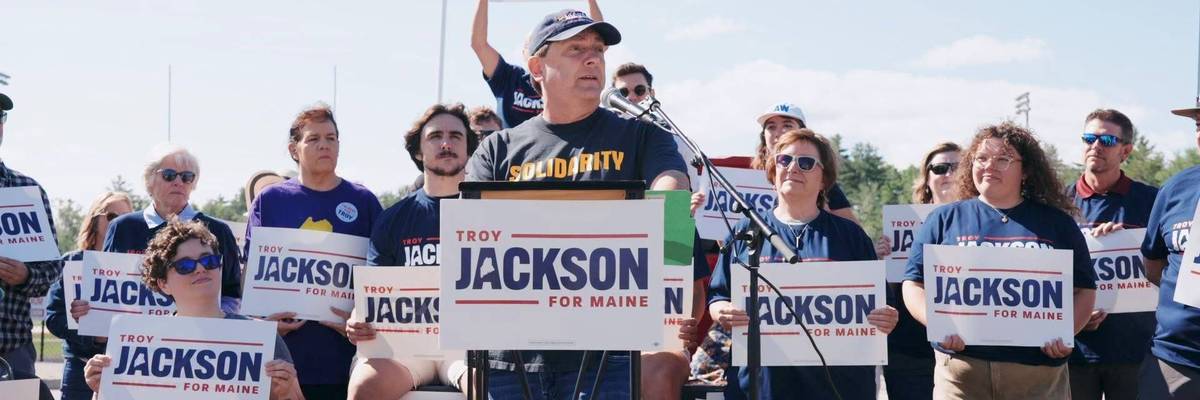
Troy Jackson, the Democratic US Senate candidate for Maine, speaks in a photo shared on Facebook by his campaign on August 11, 2026.
(Photo by Troy Jackson/Facebook)
Aug 13, 2026 (CommonDreams.org)
Troy Jackson, the Maine Democrat running to unseat Republican US Sen. Susan Collins in November, took aim at Elon Musk and other billionaires Wednesday evening for supporting his GOP opponent directly or through a key super political action committee.
“Look, the billionaires in the country know whose side they’re on, and it’s not ours,” Jackson, a former logger and state Senate president, said in a brief video shared on social media, including Musk’s platform X.
RECOMMENDED…
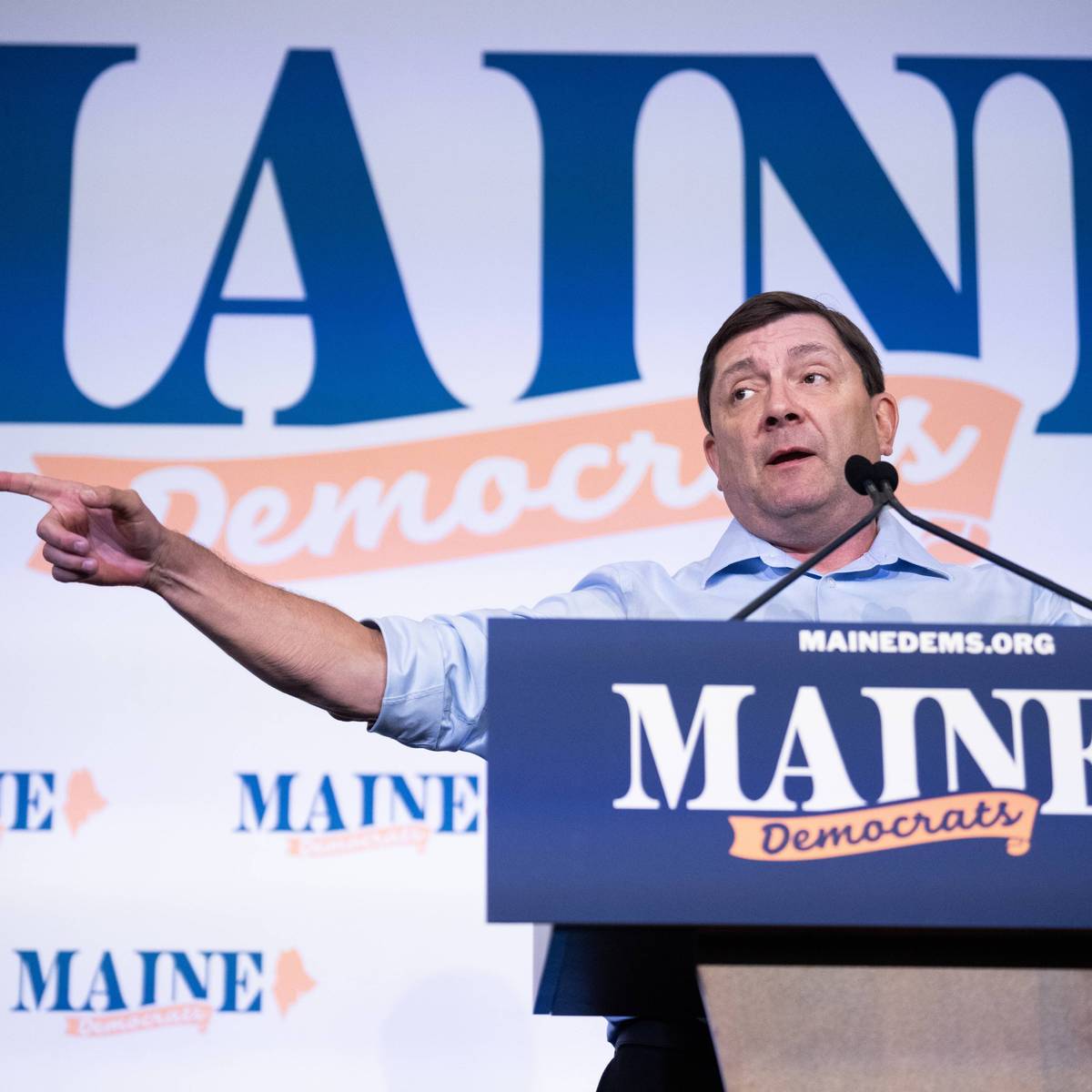
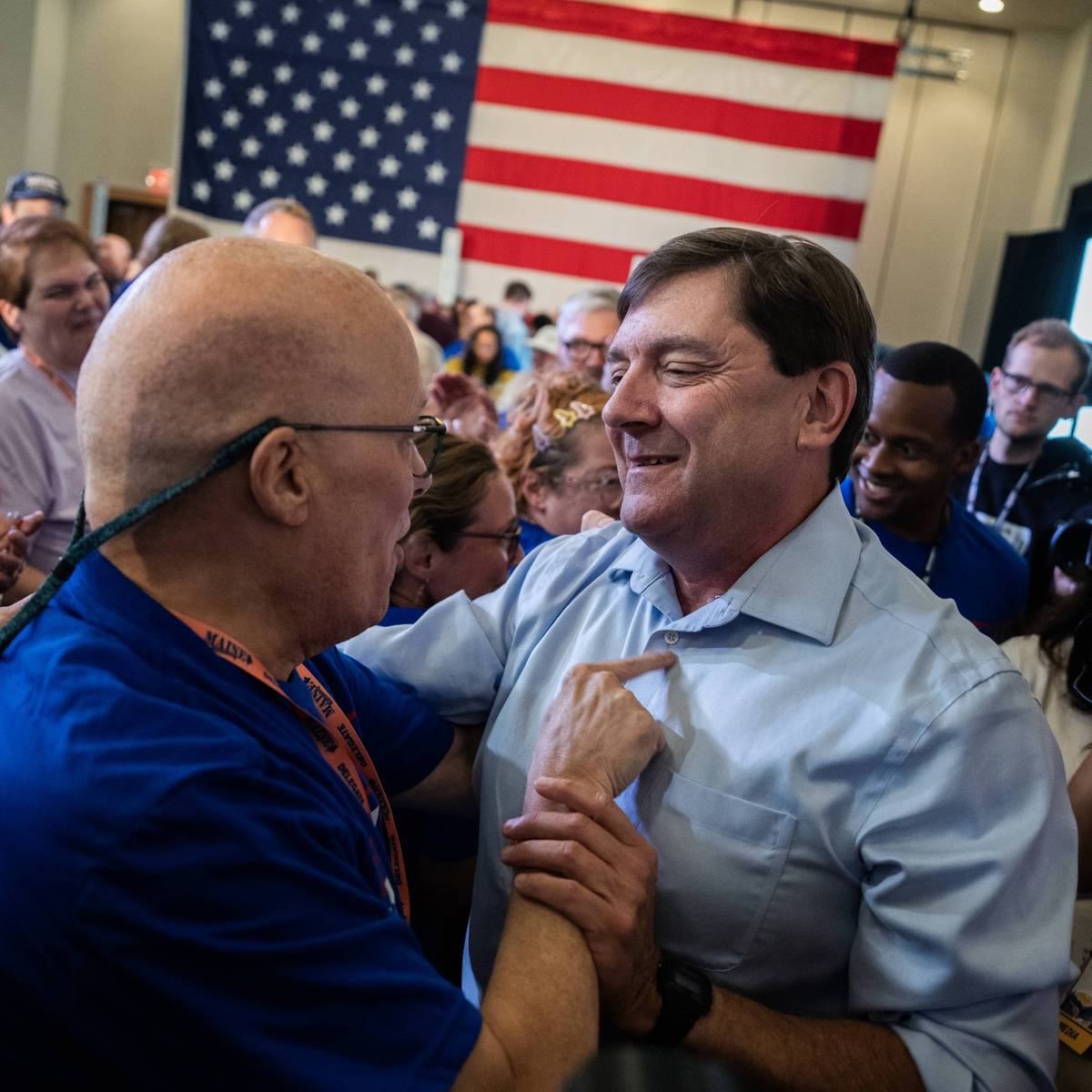
Jackson—chosen as the Democratic nominee via a convention process last month, after primary winner Graham Platner left the race following a rape allegation that he denied—pointed to a $42 million investment in the contest from the Senate Leadership Fund (SLF), whose backers include Musk and various other right-wing megadonors.
“They’re here to prop up Susan Collins because they want her to continue to be a rubber stamp and get their income tax cuts,” Jackson said. “They’re already out with an ad attacking me and my family, to try and make sure that they totally don’t talk about the issues.”
SLF’s 30-second ad, which launched Wednesday, notes his son’s lobbying work and smears Jackson as “another dirty politician.”
According to Jackson: “They’re scared of a movement that goes against the things that they want. They’re scared of a movement that demands Medicare for All, prescription drug coverage, and a government that everyday people can be proud of and know works for them.”
Wednesday isn’t the first time Jackson—who previously ran for governor—has called out billionaires, specifically Musk. After The New York Times reported last month that through his America PAC, Musk intends to spend up to $120 million on a program to help elect Republicans in at least eight states, including Maine, Jackson released a video stressing that the billionaire “doesn’t care about us. Really doesn’t care about Susan. He cares about him.”
“So I would say to you Elon: Maine and really the whole United States doesn’t want your dirty money in our politics,” Jackson continued. “You don’t get to buy the government that you want. This is about all of us coming together and fighting for the government that we deserve, and you’re not in it.”
Musk became the world’s first trillionaire in June, when his company SpaceX made its public market debut, but his current net worth is estimated at over $860 billion, according to the regularly updated Bloomberg and Forbes lists. His trillionaire status came after the early months of the second Trump administration, when Musk was the de facto leader of the Department of Government Efficiency.
Reuters reported Thursday that new data from the American Federation of Labor and Congress of Industrial Organizations shows how Musk’s controversial compensation plans for SpaceX and Tesla are benefiting other chief executives. Fred Redmond, the AFL-CIO’s secretary-treasurer, said that his pay “changes the dynamic when other CEO compensation plans come up, boards use it as a reference.”
The average ratio of CEO to worker pay at S&P 500 companies rose from 285:1 in 2024 to 312:1 last year, excluding Musk’s Tesla compensation. When that is included, the ratio becomes 5,387:1. Redmond told Reuters that “as we talk to our members, they’re pissed off over what’s happening to them, and they feel as though they should be more vocal in terms of calling attention to inequality.”
Our work is licensed under Creative Commons (CC BY-NC-ND 3.0). Feel free to republish and share widely.
Jessica Corbett is a senior editor and staff writer for Common Dreams.