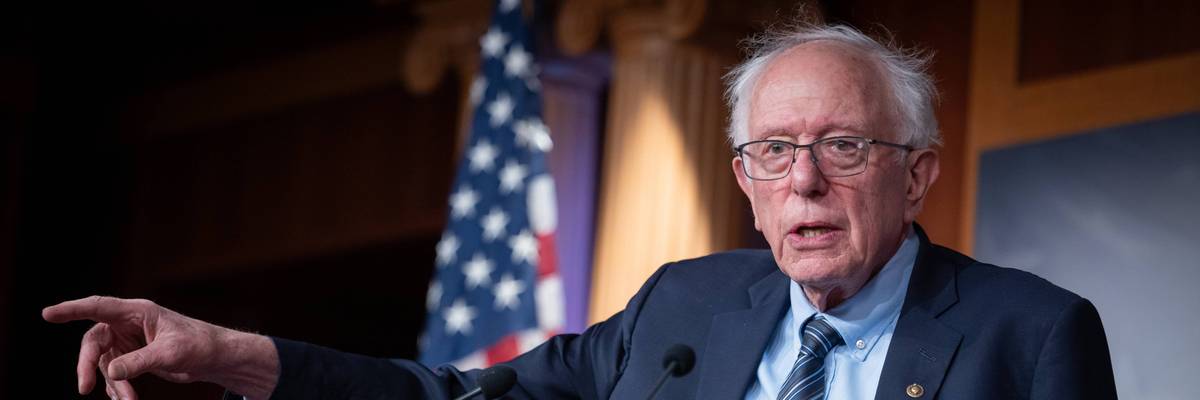
Sen. Bernie Sanders (I-Vt.) speaks at a press conference at the US Capitol in Washington, DC on May 20, 2026.
(Photo by Nathan Posner/Anadolu via Getty Images)
“If the Democratic Party is ever to regain the faith of ordinary Americans it must stand firm on the issue of Social Security,” said Sen. Bernie Sanders.
US Sen. Bernie Sanders on Tuesday warned his Democratic colleagues against supporting bipartisan legislation that would open the door to fast-tracked Social Security cuts under the guise of rescuing the New Deal program from insolvency.
In a Dear Colleague letter, Sanders (I-Vt.) wrote that the best and most popular way to extend the life of Social Security and expand its modest benefits is to lift the payroll tax cap, which currently exempts annual income above $184,500 from taxation. But the senator argued that the Protecting Retirement Opportunities and Maintaining Income Security for Everyone (PROMISE) Act—introduced last month by a bipartisan group of senators—“moves us in exactly the wrong direction.”
“The so-called PROMISE Act would direct four unelected members of the Social Security Advisory Board to produce, in little more than a month, a proposal to make Social Security solvent for the next 50 years—with virtually no transparency, no meaningful public input, and no accountability,” Sanders wrote. “If the Advisory Board reaches an agreement, Congress would be required to vote on their proposal during the lame-duck session after the November elections when Republicans still control the Senate and the House.”
“If the board cannot reach an agreement, the PROMISE Act would allow any member of Congress to force a vote on their own Social Security proposal under expedited procedures without the opportunity to amend it or seek a compromise—also during the lame-duck session,” Sanders continued. “In other words, Members of Congress who have been defeated at the polls or who have chosen to retire could determine the future of Social Security for the next half century.”
The PROMISE Act’s lead sponsors are Sens. Bill Cassidy (R-La.), Dick Durbin (D-Ill.), Thom Tillis (R-NC), Tim Kaine (D-Va.), John Cornyn (R-Texas), Angus King (I-Maine.), and Alan Armstrong (R-Okla.). Five of the bill’s seven sponsors either lost reelection or aren’t running again in 2026.
“In other words, members of Congress who have been defeated at the polls or who have chosen to retire could determine the future of Social Security for the next half century,” Sanders wrote in his letter. “Even more significantly, a political party that was repudiated by the electorate in the midterm elections could determine the fate of Social Security. That would be absurd, anti-democratic, and unacceptable.”
Sanders isn’t alone in warning against the PROMISE Act. A week after the bill’s introduction, the AARP’s executive vice president expressed opposition in a letter to Cassidy and Durbin, writing that “we strongly object to fast-tracking Social Security changes through Congress, as your bill would do.”
Max Richtman, president and CEO of the National Committee to Preserve Social Security and Medicare, echoed Sanders’ concern that the legislation’s changes “would likely occur during a lame-duck session, after the election, when many members are on their way out.”
“Those members could be asked to vote on sweeping changes to Americans’ earned benefits, when they’ll no longer be accountable because they’re leaving office. I think that’s a real problem,” said Richtman. “And I think members of Congress should be 100% responsible for any changes to the Social Security program.”
“We will strengthen and expand Social Security by requiring the wealthiest Americans to finally pay the same percentage of their income into Social Security as tens of millions of working people.”
In early June, Social Security’s Board of Trustees said in its annual report that—in the absence of congressional action—the program will be unable to pay out full benefits by the end of 2032. At that point, the Social Security trust fund “will be sufficient to pay 78% of total scheduled benefits,” the trustees said.
Sanders argued on Tuesday that the solution is straightforward: “strengthen and expand Social Security by requiring the wealthiest Americans to finally pay the same percentage of their income into Social Security as tens of millions of working people do today.”
Last year, Republicans blocked Sanders’ attempt to pass via unanimous consent his legislation to expand Social Security benefits by $2,400 a year per recipient. The expanded benefits would be funded by subjecting all annual income above $250,000 to Social Security payroll taxes.
According to the senator’s office, his legislation would ensure Social Security’s solvency for the next 75 years. Data for Progress polling shows Sanders’ proposal is overwhelmingly popular, with 80% of US voters supporting the measure.
“If the Democratic Party is ever to regain the faith of ordinary Americans it must stand firm on the issue of Social Security,” Sanders wrote on Tuesday. “That means: We will not cut Social Security benefits. We will not raise the retirement age. We will not reduce cost-of-living adjustments. We will not privatize Social Security.”
“We will not support procedural shortcuts that make it easier to reduce earned Social Security benefits behind closed doors while limiting public debate,” Sanders continued. “Instead, we will strengthen and expand Social Security by requiring the wealthiest Americans to finally pay the same percentage of their income into Social Security as tens of millions of working people do today.”
Our work is licensed under Creative Commons (CC BY-NC-ND 3.0). Feel free to republish and share widely.
The campaign supporting Scott Wiener for Congress has launched a new interactive, parody AI chatbot that poses as rival candidate Connie Chan, and mocks her stances and votes on various issues.
The bot, dubbed ConnieChan.ai, just launched this week, as KRON4 reports, and it’s a fairly simple gimmick that resembles chatbots like Claude or ChatGPT, responding to questions or to various suggested prompts about hot-button topics like “Blocking Housing” or “Derailing Public Transit.” The tagline at the top, “Let’s do nothing together.”
Clicking on the public transit prompt, the bot responds with, “I do love a good delay, and I’ve truly made an *impact* on our city’s ability to move people around efficiently.” It then suggests four subtopics, including “Making Buses Slower,” and if you click on that, the AI Connie discusses how she voted to block a proposed bus rapid-transit (BRT) lane on Geary Boulevard, like the one we have on Van Ness.
On the topic of “Silencing Live Music,” the bot points to an SF Standard article and highlights how, three years ago, Chan “tried to sabotage Outside Lands by playing games with its permits,” and also how Chan voted against turning the Castro Theatre into a music venue. (To be fair, many of SF’s progressives stood on the side of the “don’t remove the seats” crowd who feared the theater would never be used to screen movies again.)
If you try to ask a question that is not related to any of the suggested prompts, like about homelessness, the bot just steers you back to the prompts, saying things like, “Homelessness is indeed a pressing issue, but I’m afraid my particular expertise lies in the finer points of obstruction across other domains — I’m simply not equipped to share my record on that one.”
Chan was a well-known “no” vote on banning cars from JFK Drive in Golden Gate Park, and the bot also highlights a dustup, documented on Reddit, over Chan staring at her phone during a public-comment session at the Board of Supervisors on that topic.
The mocking chatbot is being released just as we saw new poll numbers last week (in a poll commissioned by Chan’s campaign) that put Chan just five percentage points behind Wiener.
And the jokey nature of the chatbot stunt has the hallmarks of political consultant Conor Johnston, who was linked to an April stunt involving a minivan that was being parked around town bearing the message, “Where does Saikat live? Saikat lives in Maryland.” That stunt took aim at accused carpetbagging political candidate Saikat Chakrabarti, who lost his primary bid to Chan and Wiener.
Photo via SFist tipster
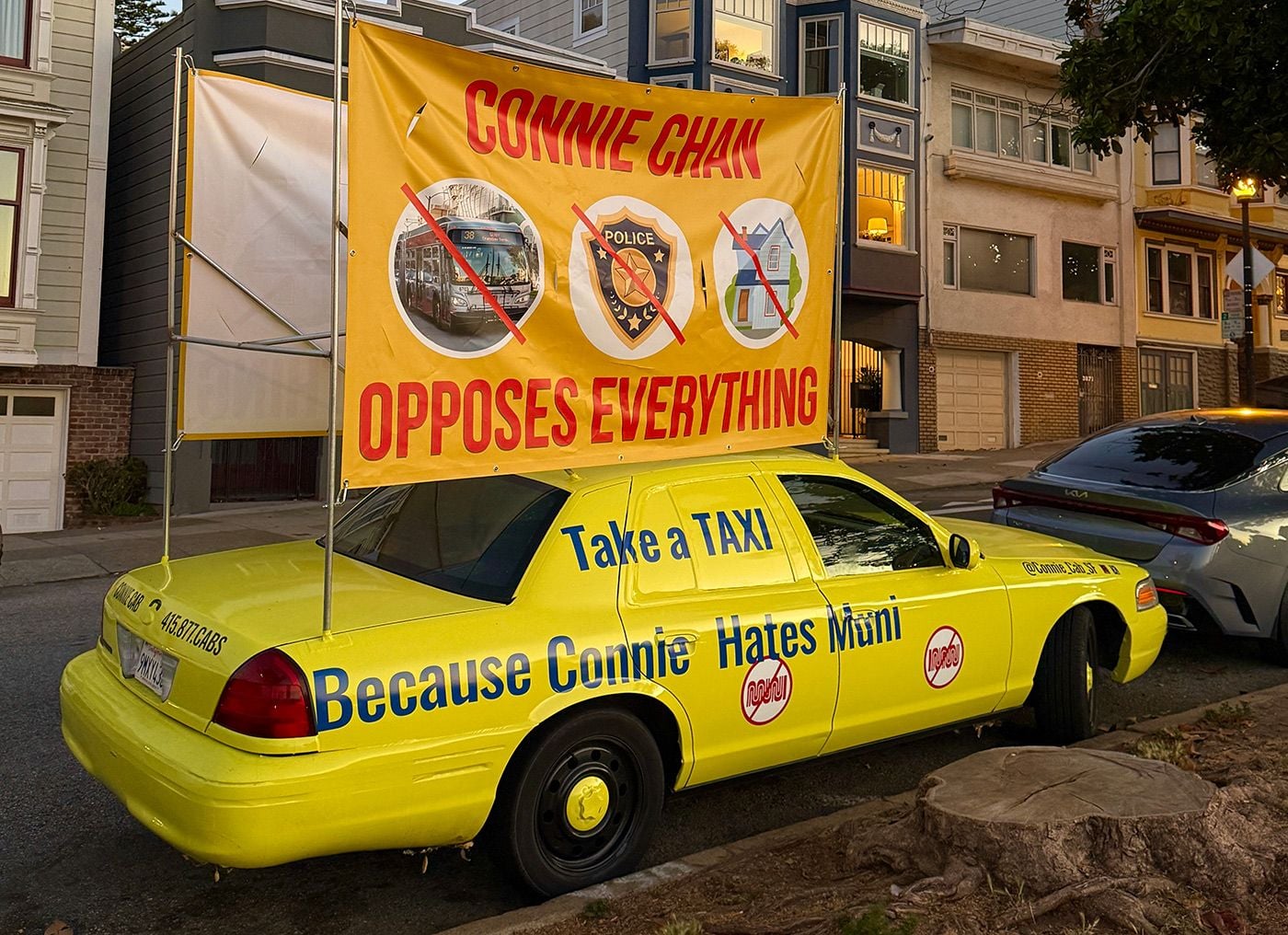
A very similar stunt involving a sedan that looks like a yellow taxicab, with the same sort of banner mounted on its roof, was seen parked next to Dolores Park last week with the message, “Connie Chan Opposes Everything” — essentially the same message being promoted by the AI chatbot.
So, the negative campaigning has begun! And it’s barely August. We’re certainly in for plenty more.
Top image: San Francisco Supervisor and congressional candidate Connie Chan speaks at a “Get Out the Vote” rally on May 29, 2026 in San Francisco, California. U.S. Rep. Nancy Pelosi (D-CA) has endorsed San Francisco Supervisor Connie Chan to fill her seat representing California’s 11th Congressional District. (Photo by Benjamin Fanjoy/Getty Images)
Abdul El-Sayed has won Michigan’s slugfest of a Democratic Senate primary, NBC News projects, clinching the nomination in a close race over Rep. Haley Stevens and establishing a Midwest beachhead for a progressive left on the march this midterm cycle.
El-Sayed overcame a nearly $65 million onslaught of outside money and an establishment that had rallied around Stevens. Popular Gov. Gretchen Whitmer endorsed Stevens late last month — a move seen as a last-ditch effort to stop a rising El-Sayed.
El-Sayed, a former public health official, goes on to face former Rep. Mike Rogers, who claimed the Republican nomination without opposition Tuesday. Their race in November is expected to be one of the most competitive in the country, and it could determine which party controls the Senate.
Whoever wins will succeed Sen. Gary Peters, a Democrat who decided against seeking a third term and endorsed Stevens in the primary.
Republicans have 53 seats in the chamber, and Democrats are going after some red states to flip the four seats they’d need to swing the majority. But Democrats also have to defend seats in several battleground states, including Georgia and Michigan.
President Donald Trump, whose early endorsement of Rogers helped clear the GOP primary for him, won Michigan in 2016 and 2024 and lost to Joe Biden in 2020.
Rogers and national Republicans had signaled that they consider El-Sayed an easier opponent than Stevens. The National Republican Senatorial Committee went so far as to produce a digital ad emphasizing El-Sayed’s progressive credentials and endorsement from Sen. Bernie Sanders, I-Vt. — a move many viewed as an effort to boost him into the general election.
Sanders and Rep. Alexandria Ocasio-Cortez, D-N.Y., barnstormed the state for El-Sayed, whose push for “Medicare for All,” condemnation of money in politics and criticism of Stevens for supporting aid to Israel were central to his campaign. The primary was seen as a test of whether an insurgent populist movement that had scored victories in primaries in blue states like New York and Colorado could take root in a purple battleground in the industrial Midwest.
Like other Democrats who have run to push the party to the left in recent years, El-Sayed accused Israel of committing genocide against Palestinians in Gaza. That’s a particularly relevant position in Michigan, with its large Muslim and Arab American populations.
El-Sayed also frequently blasted Stevens over the money she accepted from corporate PACs and the TV air cover she received from big-spending allies, including more than $30 million from a group affiliated with the American Israel Public Affairs Committee, the powerful pro-Israel group known as AIPAC.
While many of the group’s ads made a positive case for Stevens, some of the messaging attacked El-Sayed. Overall, Stevens and her allies spent nearly nine times as much on advertising as El-Sayed and his allied groups did, according to AdImpact, an ad-tracking firm.
“If you need a $60 million crutch, you probably can’t be elected on your own terms,” El-Sayed said at a debate last week in Detroit.
Stevens, a four-term congresswoman, aligned herself closely with the Democratic establishment, including not only Whitmer and Peters in Michigan, but also Senate Minority Leader Chuck Schumer of New York. And while El-Sayed marshaled support from national figures on the left like Sanders and Ocasio-Cortez, he also scored an endorsement from the United Auto Workers, a major presence in the state given its car-making pedigree.
The closing month of the primary grew increasingly hostile, especially after a third Democrat, state Sen. Mallory McMorrow, dropped out last month. McMorrow had tried to cut a path between Stevens and El-Sayed, running as a compromise candidate who could appeal both to moderates and the progressive left.
But the flood of TV ads in Stevens’ behalf and the energy around El-Sayed’s Sanders-backed campaign left little room for McMorrow, and the differences between the two remaining Democrats became even more pronounced once their mutual rival exited.
Stevens often accused El-Sayed of focusing too much on national politics and not enough on Michigan. The July 24 endorsement from Whitmer, who beat El-Sayed in the 2018 Democratic primary for governor, helped underline Stevens’ argument. So did a recent call El-Sayed held with donors.
On the call, audio of which leaked to NBC News and others, El-Sayed said a victory for him in Michigan could reverberate into 2028 and encourage primary challengers against the likes of Sen. John Fetterman, D-Pa., who has fallen out of favor with the left. He characterized such a move as putting “an ogre on a pike” — rhetoric that some Democrats believed was targeted at Stevens, though El-Sayed had described Fetterman as an “ogre” in the past.
Stevens, who spent the closing days of the race simultaneously shrugging off and leaning into social media snark about her Upper Midwest accent and appearance, used the episode to reinforce her message.
“These folks are making fun of the way I sound,” Stevens said at last week’s debate. “But yet, I sound like the people who need help, who are talking to me about what they need.”
El-Sayed rarely deviated from his core message.
“This is about whether or not you deserve a politics of the people, by the people and for the people,” he said at the debate, “or of the corporations, by the billionaires and for the special interests.”Share
Troy Jackson, the Democratic nominee for US Senate in Maine, speaks after winning the vote his party’s nominating convention in Bangor, Maine on July 25, 2026.
(Tom Williams/CQ-Roll Call, Inc via Getty Images)
Musk reportedly plans to spend at least $100 million to help Sen. Susan Collins and other vulnerable Republicans across the United States.
Troy Jackson, the Democratic nominee for US Senate in Maine, delivered a video response on Sunday to mega-billionaire Elon Musk’s plan to spend at least $100 million to aid Sen. Susan Collins and other Republicans in key races across the country.
The New York Timesreported that Musk, through his America PAC, intends to “spend $100 million to $120 million on a new field program in at least eight states to help elect Republicans in November.” The group, according to the Times, “plans to initially target Senate races in at least five states—Alaska, Iowa, Maine, Michigan, and Ohio—and is having conversations about the contests in North Carolina, Georgia, and Texas.”
“Apparently Elon Musk has gotten off Twitter long enough to realize that he’s got a real problem here in Maine,” Jackson, the former president of Maine’s Senate, said in a one-minute response to the report on America PAC’s spending plans. “The problem is me and you, working to try and get a government that we should have, that we deserve.”
“He wants to have people that are totally beholden to him and [President] Donald Trump making sure that we’re getting tax cuts for billionaires on the back of our healthcare system, on the back of our hospitals,” Jackson continued. “That’s what Elon Musk wants. He doesn’t care about us. Really doesn’t care about Susan. He cares about him. So I would say to you Elon: Maine and really the whole United States doesn’t want your dirty money in our politics. You don’t get to buy the government that you want. This is about all of us coming together and fighting for the government that we deserve, and you’re not in it.”
The Times reported that Musk’s super PAC is “closely coordinating with an ecosystem of outside groups that are preparing field campaigns, including Americans for Prosperity, which is part of the billionaire Koch brothers’ political network, and the Sentinel Action Fund, another conservative organization.”
Musk became the world’s first trillionaire earlier this year with the public market debut of SpaceX, whose subsequent decline in market cap pushed his net worth back down to around $690 billion—still the largest individual fortune in the world.
In the two days following his nomination, Jackson raised $2 million from 58,000 donors, including 30,000 new contributors—a major show of small-dollar support.
“We’re all getting crushed out here. Healthcare, housing, heat,” Jackson says in his first general election campaign ad, which is set to begin airing this week. “We’ve gotta fight back. We’re all hungry for it. Maine is ready for a change.”
Our work is licensed under Creative Commons (CC BY-NC-ND 3.0). Feel free to republish and share widely.
On the night of May 15, 2025, James Comey did something millions of us do every day: he opened Instagram and posted a photo. As is well known by now, it showed seashells on a North Carolina beach, spelling out “86 47.” That photograph is the entire basis for a federal prosecution that’s intended to send him to prison for up to a decade.
What happened next, laid bare in court filings unveiled last week, is why I believe the Comey prosecution will be remembered as one of the most significant First Amendment cases in American history. An American president is trying to imprison a critic for posting a photograph. And to build the absurd case, the government surveilled that critic without a judge’s approval, in a manner its own agents admitted in writing was illegal. The filings answer some questions about what was done to Comey, but they open a far larger one that may not be answered for years: how many other people is this administration illegally watching and preparing to illegally punish?
Here’s what we now know about a case that was already outlandish before an indictment was even issued.
Within hours of that Instagram post, the Secret Service had Comey on the phone. The next morning, Trump went on Fox News and declared that the picture “meant assassination.” By that afternoon, a senior Justice Department official, identified in the filings only as “the number three guy at DOJ,” wanted the Secret Service to ping Comey’s cellphone and track his location in real time.
The Secret Service’s own supervisor put his objection in writing. Pinging the phone “could be done,” he warned, “but it would be a bad idea.” Warrantless emergency tracking requires an imminent threat to life, and “we did not believe that anyone’s life was in immediate danger.” It was, in his words, “legally questionable.” His boss agreed, according to the emails, “but said we might do it anyway.”
And they did. The next day, an agent filled out a form telling Verizon the government faced “an emergency involving danger of death or serious physical injury,” certified that this was “true and correct,” and got Comey’s location data. There was no emergency, and everyone involved seemingly knew it. Agents then tracked Comey electronically and tailed him as he and his wife drove home from North Carolina to Virginia, including as they stopped to visit the grave of their deceased son. All the while, Trump was allegedly following it from Air Force One. The agent in charge traveling with the president emailed that the case was “a hot topic on the plane,” that Trump was “very interested,” and wanted Comey’s interview notes in hand for his six o’clock press conference.
So, to be clear, we found out that the president of the United States was aboard his airplane, personally tracking the surveillance of a private citizen who had posted a photo of four digits. Obvious free speech. Breathtaking abuse of power to punish it.
Then the story gets worse. The Secret Service investigated and found nothing. By November 2025 it had formally closed the matter, concluding there was no risk to the president’s life from James Comey (because of course there wasn’t) and no basis whatsoever for any charges. That should’ve been the end. Until March 23, 2026, ten months after the seashell photo and four months after the professionals had walked away, the FBI suddenly obtained warrants for Comey’s Apple and Google accounts. Those warrants came days before Trump fired his attorney general, and the indictment followed in late April, right as Todd Blanche was angling to replace Pam Bondi. The surveillance did not intensify because a new threat emerged; rather, it appeared to intensify because the political usefulness of nailing Comey increased. The same Todd Blanche whose nomination you helped freeze last week built his audition for attorney general partly on this case.
(By the way, before Comey ever posted, Amazon vendors had sold more than 200,000 products bearing “86 47” or its variants, generating exactly zero federal investigations. The FBI’s own threat database, kept since 2007, also showed no prior instances of “eighty-six” being an assassination threat. Also, a federal judge in Washington recently ruled that protesters’ “86 47” signs are so manifestly, obviously protected speech and not imminent death threats.)
Your average American might shrug all this off. With high prices gobbling up the budgets of working class households, a court case involving a vindictive president feuding with an ex-FBI director who once investigated him sounds like Washington drama, not a kitchen-table concern. But the precedent is not really about Comey. It’s about each of our constitutional rights, the phones in our pockets, and about what we are allowed to say before the government reaches for those devices.
The new details from last week show that the president has given himself the ability to name an enemy, point to that enemy’s free speech, and then wiretap him over it without the approval of any judge. That’s at least three constitutional violations. The First Amendment is supposed to shield the speech. The Fourth is supposed to stand between you and a search like this. And the Fifth and Fourteenth Amendments should safeguard any citizen from being selectively and vindictively prosecuted. Here, all three were simply skipped. And if that can be done to a former FBI director with the best lawyers and a national profile, it can be done to virtually anyone.
I don’t write this as a bystander of course. Trump has publicly accused people like me, John Brennan, James Clapper, Adam Schiff, and even Barack Obama and Joe Biden, of treason. I have to assume some of us are already under surveillance for the audacity of criticizing the sitting president, while he has agents hunt for something—anything—to charge us with as punishment. (They’re welcome to my Instagram, where they’ll find more than just mentions of “86 47” but daily broadsides against Trump’s naked corruption, deficient character, and unfitness for office. I won’t stop no matter what they do.) Ironically, one of those criticisms is that I’ve long warned a second Trump term would turn the intelligence apparatus into an instrument of personal revenge and political spying. Again, the wannabe despot in the Oval Office has proven my point.
So here’s the answer to the question in the headline of this essay. We don’t know how many Americans are being warrantlessly monitored right now, or individually targeted despite their constitutional rights. That is the problem. Comey’s surveillance surfaced only because his prosecution forced these documents into open court. Everything about how this administration treats the people it considers enemies tells me his case is the rule, not the exception, and that there may be far more people they’ve decided to watch than to tip their hand by bringing weak and foolish cases.
The Framers gave us the three, aforementioned safeguards for exactly this moment. The First Amendment so a citizen could mock or provoke his leaders without fear… the warrant requirement, the Fourth, because they had lived under a king who searched his subjects at will… and the Fifth and Fourteenth to keep people from being singled out for revenge because they are out of favor with the powerful. In Comey’s case the government ran past all three, punishing the speech and skipping the warrant and going after a Trump critic just because he was a Trump critic—all in a single move.
We are watching a president test whether those protections still exist for any of us. The courts will decide Comey’s fate sooner or later. But the rest of us have to decide, in the years ahead, whether we make the cost of this abuse of power so high that no one dares to repeat it.
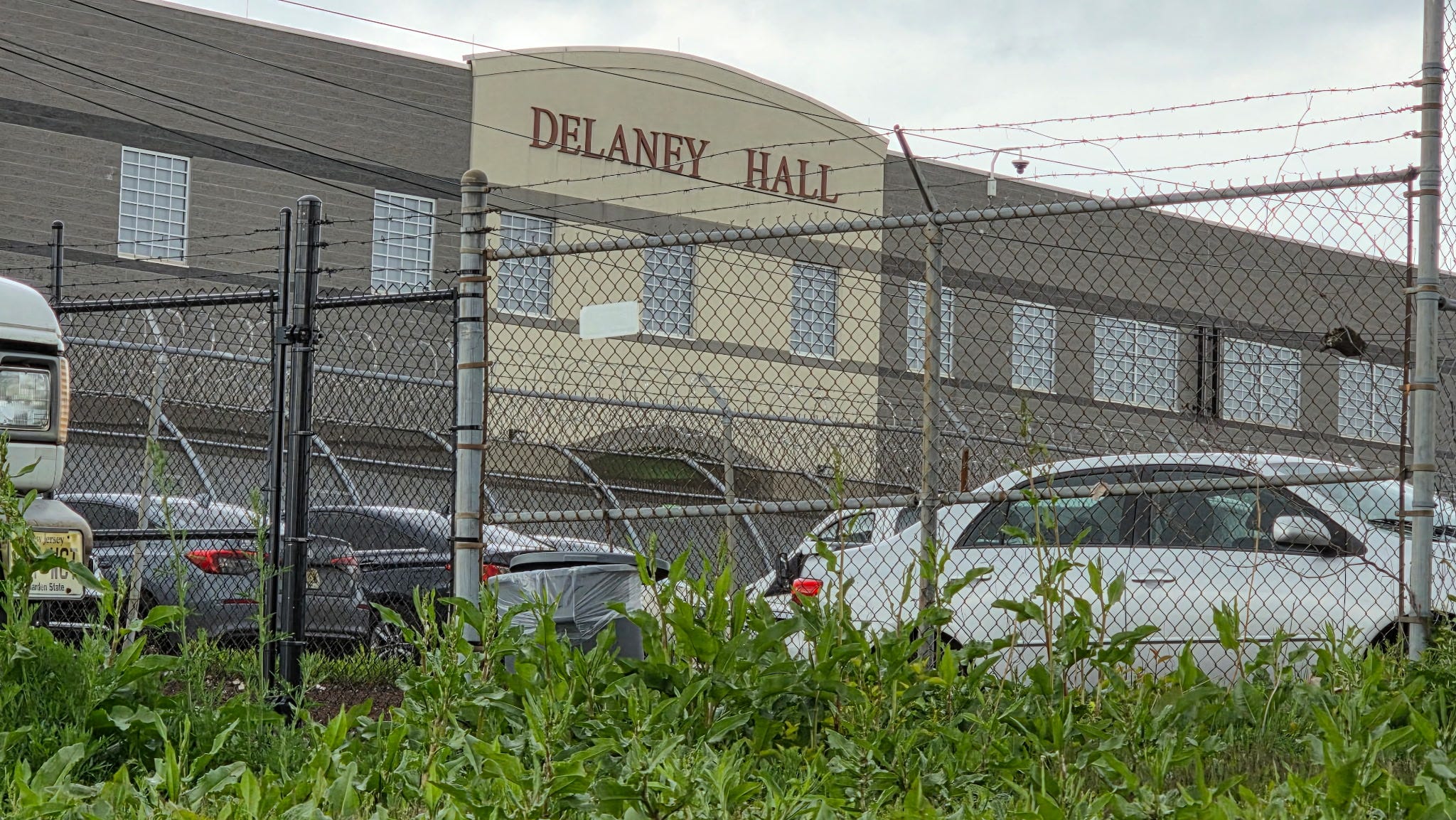
Edwin Jovanny Lopez Cornejo, who had diabetes, high blood pressure, and seizures, died on August 1. We’re told he was deprived medication at Delaney Hall.
WE COVERED THE ENTIRE DELANEY HALL ICE HUNGER STRIKE PROTESTS ON THE GROUND for weeks and have continued covering the crimes being committed inside. Please support this IMPORTANT ON-THE-GROUND REPORTING for as low as $5 a month:
Status Coup has learned that a Delaney Hall ICE prisoner has died, the second prisoner that we know of who has died while being imprisoned inside the for-profit New Jersey ICE prison.
Edwin Jovanny Lopez Cornejo, who we’re told had been in America for 20 years and came here as a child, died on Saturday, August 1. He had a 12-year-old daughter.
Status Coup is working to confirm all the details, but here’s what we know so far:
In a video on social media, his mother, María Cornejo, said he suffered from diabetes, high blood pressure, and seizures. Status Coup is told he was deprived of his medication while inside Delaney Hall— an illegal and inhumane crime that Status Coup has extensively reported ON-THE-GROUND at Delaney Hall as occurring to other prisoners.
“I do not want this to go unpunished,” his mother said. She said he called her on Friday, saying he wasn’t feeling well.
“He said his right hand and face were numb. He told me he was going to be examined, but I don’t know if he actually received care. I also don’t know if he was being given his medication.”
An ambulance took him out of Delaney Hall on August 1, and he was declared dead upon arrival at the hospital.
He was detained on June 18 on his way to work. Shortly before his death, he was denied visitation to see his 12-year-old daughter. His mother revealed she still has not received any communication from the for-profit owner of Delaney Hall, GEO Group, or ICE.
If reports of a death at Delaney Hall are true, my gravest concerns about the conditions medically vulnerable detainees face would be confirmed. We must ensure DHS carries out a full, transparent investigation. Abolishing and replacing ICE is the only way we correct this horror.
10:55 AM · Aug 3, 2026 · 172 Views
We will update this story as we learn more information about this prisoner’s death.
This article appears in the August 2026 issue of The American Prospect magazine.If you’d like to receive our next issue in your mailbox, please subscribe here.
In early 1932, when Republicans still had a Senate majority despite the ravages of the Depression, the Senate Banking and Currency Committee launched an investigation of what caused the Great Crash of 1929. For almost a year, the feeble investigation went nowhere. In the November 1932 election, FDR and the Democrats not only won the White House, they also took back the Senate.
In December, the outgoing Republican chair of the Banking Committee, Sen. Peter Norbeck of South Dakota, decided to give the moribund investigation one last shot. After several candidates for chief counsel turned him down, Norbeck hired a former New York City chief assistant DA named Ferdinand Pecora.
They were a curious couple. In 1932, just 20 years after Theodore Roosevelt’s failed 1912 run for president as a third-party candidate, many leading Republicans still considered themselves Teddy Roosevelt Progressives. Norbeck was one. The crash had devastated South Dakota farmers. Norbeck wanted a serious investigation of the role of bankers.
Pecora had also been a Teddy Roosevelt man. After Roosevelt declined to run again in 1916, Pecora became a progressive Democrat. As chief assistant DA, he became known as the best cross-examiner in New York. When Pecora’s boss, the elected DA, retired in 1929, he proposed that Pecora succeed him. But Pecora was too incorruptible for Tammany Hall, and Democratic Party chiefs vetoed endorsing him. He left government, opened a small law practice, and was bored. When Sen. Norbeck called, Pecora leapt at the opportunity.
It was not just Pecora’s meticulous preparation and photographic memory that made him so effective. It was his sense of theater.
After being named chief counsel in February 1933, Pecora had just a few weeks to prepare and hold hearings before the Democratic Congress took office on March 4 and the committee’s mandate expired. But in that time, Pecora managed to lay bare the maneuvers that had crashed the economy, humiliate several of the nation’s most influential bankers as well as the head of the New York Stock Exchange, and transform the public’s view of finance, radicalizing the menu of necessary reforms. When Democrats took over in March, with FDR’s personal support they broadened the mandate for the investigation and kept Pecora on the job.
Few people have heard of Pecora today. But in early 1933, he was a celebrity. The revelations of what became known as the Pecora Commission were front-page news. He was featured on the cover of Time magazine. In a matter of weeks, public opinion went from being bewildered about what had crashed the economy to accurately blaming the conflicts of interests of the leading bankers.
FERDINAND PECORA WAS BORN in Nicosia, Sicily, the son of a shoemaker. His father, who had no use for the Catholic Church, converted to Episcopalianism. Ferdinand was four years old when the family emigrated to New York in 1886. The family lived in a cold-water basement flat in Manhattan’s Chelesa neighborhood. But young Ferdinand soon became an academic standout. St. Peter’s Episcopal Church, where the family attended, put him in contact with more privileged kids. He graduated from public school as class president and valedictorian. He won a scholarship to attend St. Stephen’s College and attended law school at night.
As assistant DA, his successes included prosecuting more than a hundred Wall Street “bucket shops,” sleazy brokerages that peddled bogus stocks and illegally bet against their clients. Another Pecora prosecution resulted in a prison term for the New York state superintendent of banks, Frank Warder, for taking bribes from the City Trust Company.
In readying congressional hearings that began on February 15, 1933, Pecora used subpoenas to demand detailed bank records. He was a master of the bluff, and managed to get his hands on materials that bank lawyers might well have denied him, including diaries of board of directors meetings. He used these and other records to trip up executives when they gave misleading or evasive testimony.
In Congress, Pecora personally questioned witnesses like oil baron Harry Sinclair (left); the commission bore his name despite his being a mere Senate aide. Credit: AP Photo
Pecora’s strategy was to personalize the abuses that crashed the economy, and he started at the top. His first banker witness was Charles E. Mitchell, chairman and chief executive of National City Bank, today renamed Citibank, then the nation’s largest and most prestigious financial institution. Mitchell, at the pinnacle of the Wall Street establishment and a board member of the New York Federal Reserve, was thought to be untouchable. By the time Pecora was finished with him, Mitchell would resign in disgrace and settle a criminal indictment for tax evasion with a fine of $1 million.
Pecora’s investigation and interrogation revealed that National City Bank and its securities affiliate, the National City Company, engaged in a number of shady maneuvers little different from those of bucket shops. National City Bank employed more than a thousand retail salesmen to peddle securities that the firm underwrote at a handsome markup. When a sketchy stock or bond proved hard to unload, the bank offered salesmen special bonuses for selling it.
It was not just Pecora’s meticulous preparation and photographic memory that made him so effective. It was his sense of theater. Probing National City Bank’s deceptive sales of South American bonds, he subpoenaed Hugh Baker, president of City’s investment affiliate, to read into the record a 1923 memo from the bank’s foreign desk. The memo proved that the bonds City salesmen were pitching were worthless. For example: “Peru has been careless in the fulfillment of contractual obligations,” with “broken pledges” and “flagrant disregard of guarantees.”
Pecora: “On the whole, Mr. Schoepperle’s report … was against financing any Peruvian credits, wasn’t it? … It was considered a bad risk; isn’t that so?”
Baker [squirming]: “I assume that must have been his reason there.”
City also peddled its own stock, which bank executives could buy at reduced prices with no-interest loans. When City’s stock price began collapsing after October 1929, salesmen continued flogging the stock to retail customers in hopes of propping it up. Pecora produced the admission that City had participated in an illegal “stock pool,” in which participants sell the stock back and forth to each other to drive up the price, hoping to attract other investors.
Pecora also revealed that Mitchell had engaged in a sham stock transaction, which resulted in paying no income tax in 1929 despite a salary and bonus of $1.1 million (the equivalent of $21.2 million today). “By the way,” Pecora asked Mitchell, as if offering a casual afterthought, “That sale of this bank stock … in 1929 was made to a member of your family, wasn’t it?” It quickly became public that Mitchell had sold the shares to his wife.
Pecora’s next witnesses were the top executives of J.P. Morgan, including the current chairman and son of the founder, J.P. Morgan Jr., known as Jack. Unlike City, J.P. Morgan was organized as a private bank. As Pecora demonstrated, private banks were not even subject to rudimentary bank examinations. The interrogation of Jack Morgan revealed that his bank had a list of preferred clients, who could buy new stock issues at insider prices, just like today’s IPOs. In the securities legislation that followed, private banks were abolished and J.P. Morgan would be subject to the same regulations as others.
The Prospect in your inbox
Analysis that goes beyond the noise with in-depth, progressive reporting.Sign up
No paywall, no programmatic ads — just the reporting. Unsubscribe anytime. Submitting your email signs you up for The Daily Prospect, Today on TAP, Aftermath, and Weekend Reads.
The questioning of Richard Whitney, president of the New York Stock Exchange, demonstrated that the NYSE also avoided government regulation, and totally failed to police corrupt behavior on the part of its members. Whitney, heavily in debt to cover his own losses, later turned to embezzlement, pilfering funds from the NYSE Gratuity Fund, the New York Yacht Club (where he served as treasurer), and $800,000 from his father-in-law’s estate. He served more than three years at Sing Sing.
Pecora’s hearings not only featured leading financiers. He called many victims to testify, drawing on the thousands of letters that poured into his committee as soon as its hearings were publicized. One small investor, Edgar D. Brown of Pottsville, Pennsylvania, told of how National City Bank salesmen repeatedly talked him out of selling stocks as the market was falling and urged him to buy more stock in their bank. “I am today a pauper,” he said. Testimony like this redoubled popular outrage against Wall Street.
As the Pecora hearings unfolded in early 1933, thousands of banks were failing and millions of depositors lost their life savings. Smaller banks that were still open were limiting withdrawals, and governors were temporarily ordering bank closures. Until Pecora’s investigation, public understanding of the causes of the crash was unfocused. After the Pecora hearings, Wall Street banks were widely and correctly understood to be the prime instrument of the collapse.
In just two weeks, following the first round of Pecora’s hearings, the legislative mood drastically changed. Benjamin Cohen, one of FDR’s closest advisers on financial reform, said that bankers were “so discredited in the public eye that Congress was ready to pass anything.”
The fact that Pecora was an olive-skinned Italian immigrant added to the drama. Most of the bankers he was up against were part of the WASP patrician elite. It reinforced the New Deal narrative of the little guys striking back against the plutocrats.
ROOSEVELT HIMSELF, due to take office on March 4, closely followed the Pecora hearings and was emboldened by them. The laws that Congress passed essentially reverse engineered all the major abuses of the 1920s and made them illegal, informed by the details of just how the corruption worked. The laws included:
The Banking Act of 1933, also known as the Glass-Steagall Act, prohibiting the same institution from performing commercial and investment banking activities, as well as prohibiting banks from lending money to their own executives, and creating the Federal Deposit Insurance Corporation to safeguard personal accounts.
The Securities Act of 1933, for the first time regulating the underwriting and sale of stocks and bonds, prohibiting various conflicts of interest, and requiring extensive disclosures on the part of publicly traded companies.
The Securities Exchange Act of 1934, regulating stock exchanges for the first time, and creating the Securities and Exchange Commission. Until then, the New York Stock Exchange had fended off all attempts at regulation, gave deceptive practices a wide berth, and was a law unto itself.
Later legislation, such as the Public Utility Holding Company Act of 1935, prohibiting pyramid schemes in public utilities, another contributor to the Great Crash, also built on the Pecora investigations. Likewise the Investment Company Act of 1940, which regulates mutual funds.
Professor Joel Seligman, the authoritative historian of the Securities and Exchange Commission, wrote that “effective securities legislation might not have been enacted had Pecora’s revelations not galvanized broad public support for direct regulation of stock markets.” And James M. Landis, who drafted much of the securities legislation, wrote, “We built completely on his work.”
Those reforms kept the financial industry well regulated until the 1980s. In the immediate postwar era, there were no more stock market crashes and very few banking failures. But under Bill Clinton, weakening or repeal of many of FDR’s reforms, including of Glass-Steagall in 1999, and the failure to enforce the ones that remained, invited abuses that were variations on the ones exposed by Pecora. A prime beneficiary, once again, was Citibank. Virtually all of the games that bankers played that created the second crash in 2008 had been prefigured by the Wall Street deceptions of the 1920s that Pecora’s investigation exposed in 1933.
Two of the architects of the deregulation were former Goldman Sachs executive and Clinton senior official Robert Rubin, and his protégé, Larry Summers. After Rubin left government, he became Citibank’s chairman.
Credit: AP Photo
A PERSONAL NOTE: Some 40 years after Pecora’s hearings ended in June 1934, I held a version of Pecora’s job. In the mid-1970s, I served as chief investigator of the Senate Banking Committee under its great progressive chairman, Sen. William Proxmire (D-WI). Though I ran some important investigations, including on bank redlining, Federal Housing Administration frauds, and foreign corporate bribery, there was one crucial difference. Unlike Pecora, I never conducted public interrogations of witnesses. That fell to Sen. Proxmire, who was superb at it. I just did the staff work and prepped the senator.
Pecora, by contrast, was so good that the senators on the committee, hardly shrinking violets, just let him run the show. This was unique in the annals of Congress. The previous great investigation of the “money trust,” under Rep. Arsène Pujo (D-LA) in 1912-1913, is known as the Pujo investigation, though it relied on brilliant staff work by chief counsel Samuel Untermyer. The Pujo hearings helped lay the groundwork for the Federal Reserve Act (1913), the progressive income tax (1913), and the Clayton Antitrust Act (1914). In the Watergate hearings, chief counsel Sam Dash did brilliant work, but the hearings are remembered for the committee chair, Sen. Sam Ervin (D-NC). Other notorious investigators such as Sen. Joe McCarthy’s scurrilous counsel Roy Cohn—a mentor to Donald Trump—played major roles; but in the witch hunt for communists, McCarthy ran the hearings, not Cohn.
The aftermath of the Great Crash played out strikingly differently than what followed the financial collapse of 2008. No senior financial executive went to prison after 2008, and hardly any lost their jobs; and the technocratic reforms of the 2010 Dodd-Frank Act proved inadequate to contain a new cycle of concentration and abuse.
History handed Barack Obama a teachable moment about the corruptions of financial capitalism. But unlike the powerful synergy between Pecora, FDR, and the reforms that followed, the incoming Obama administration was more interested in propping up the giant banks than breaking them up or mobilizing public opinion to support drastic reform. Some of that can be attributed to personnel: When Obama took office, he appointed Summers as his chief of economic policy and another Rubin crony, Tim Geithner, as Treasury secretary. It was as if FDR had appointed Hoover’s team.
The closest equivalent to the Pecora committee was the Congressional Oversight Panel (COP), created by Democrats in 2008 as their price for approving George W. Bush’s bank bailout fund, known as the Troubled Asset Relief Program (TARP). The oversight panel was chaired by Elizabeth Warren and established her as a crusader for reform.
But unlike the Pecora hearings, the COP investigation did not galvanize public opinion. Its deputy chair, Damon Silvers, told me, “We had no subpoena power and no authority to swear in witnesses.” TARP was not permitted to advance money to banks that were insolvent. “Both Treasury and Citi insisted to us that the bank was not insolvent,” Silvers said. “Elizabeth and I knew that they were lying and there was nothing we could do about it.” Citi got $45 billion.
In drastic contrast to Pecora and FDR, the failure of the Obama administration to place the blame squarely where it belonged—on Wall Street—seeded popular grievances that led directly to Donald Trump. When leaders fail to remember Ferdinand Pecora and the critical role of investigative oversight in rallying the public to demand better, we all pay the price.
Before you go.
I hope that you found this article interesting and thought-provoking. The reason we’re able to publish stories like this — free of programmatic ads and never behind a paywall — is because readers like you step up to support our work.
The Prospect doesn’t answer to advertisers or billionaire owners. We answer to you and to our commitment to pursuing the truth, wherever that leads us.
Independent, reader-supported journalism is critical at a time when the free press is under assault.
If you believe this kind of reporting should exist and remain free to read, we hope you’ll consider chipping in. Every contribution, however modest, makes a real difference.
Robert Kuttner is co-founder and co-editor of The American Prospect, and professor at Brandeis University’s Heller School. His latest book is Notes for Next Time: Surviving Tyranny, Redeeming America. Follow Bob at his site, robertkuttner.com, and on Twitter. More by Robert Kuttner
Free and fair elections this November should produce a Democratic wave, mass repudiation of Trump, and the possibility of a new impeachment. With each passing day, it becomes increasingly clear that Trump has only one strategy for averting that fate: stealing the 2026 midterm election. He can’t seem to deliver a speech without returning to his obsession that he actually won the 2020 election, most recently in a prime-time address filled with false evidence of supposed foreign interference.
On January 6, 2021, Trump attempted to stage a coup and he will surely try again. Last time, only the integrity of a handful of Republican officials spared the Republic that fate. Georgia’s secretary of state, Brad Raffensperger, rebuffed Trump’s demand to find exactly 11,780 votes, and Vice President Mike Pence refused to go along with Trump’s scheme, laid out in detail by John Eastman, to refuse to certify the results.
This time, Trump is relying on four possible strategies to steal the election. The survival of our democracy depends on whether each of them can be foiled, and how.
Trump has only one strategy for averting that fate: stealing the 2026 midterm election.
The first is to use executive orders and directives to gain control of voter rolls, which will then be purged using commercial databases that are rife with errors. These demands were spelled out in detail in Trump’s executive order of March 31. The order also required the U.S. Postal Service to deny mail balloting to states that did not comply with Trump directives.
This ploy has been complemented by threats from other Trump officials. Earlier this month, DHS Secretary Markwayne Mullin threatened local election officials with prison time if they did not comply with Trump demands. But as I wrote in this piece, so far the courts have consistently blocked every single Trump effort to take over elections. Just last Saturday, the Court of Appeals for the First Circuit blocked the Trump administration’s effort to move forward with mail-in voting restrictions in 23 states that sued ahead of November’s midterm elections.
Trump’s second strategy is to somehow get Congress to pass his SAVE America Act, which could require proof of citizenship and photo ID for people to register and vote, and otherwise turn control of elections over to the federal executive. Trump has been willing to hold hostage one important legislative objective after another to try to compel Congress to pass this legislation. He has tied its passage to the renewal of a foreign surveillance law that expired last month, and refused to sign a bipartisan housing policy bill. The housing measure went into law without his signature.
The SAVE America Act has passed the House but is dead in the Senate. As Senate Majority Leader John Thune keeps telling Trump, the votes are simply not there. The House stuck a mini-SAVE in a budget bill that can be passed without Democratic votes, but Senate rules may disqualify it and Thune doesn’t want to pass that bill at all, because it would force his vulnerable members to take a series of unpopular votes, as my colleague David Dayen explained.
In the run-up to the November elections, the focus will shift to strategy number three: voter suppression, intimidation, and election disruption, both before and on Election Day. Democratic state attorneys general have been having regular “tabletop” exercises to anticipate Trump tactics and counter them.
What if the FBI showed up to a polling place, demanding election materials or equipment? Suppose federal troops or ICE agents were deployed to intimidate voters or disrupt the election? What if Trump declared a national emergency? Attorneys general have been working with secretaries of state to anticipate and block these and other tactics.
The Prospect in your inbox
Analysis that goes beyond the noise with in-depth, progressive reporting.Sign up
No paywall, no programmatic ads — just the reporting. Unsubscribe anytime. Submitting your email signs you up for The Daily Prospect, Today on TAP, Aftermath, and Weekend Reads.
One valuable memo has just been circulated by Doran Schrantz, the former executive director of the Minnesota ecumenical progressive group ISAIAH, and one of the most savvy on-the-ground organizers in the progressive movement. Her memo, titled “Act Free to Be Free: A State and Local Pro-Democracy Framework,” summarizes all the possible Trump tactics, and strategies for anticipating and countering them.
She calls for “mapping the actual machinery of election administration,” finding the vulnerabilities, and “deploying organized people into the specific vulnerable spaces (county board meetings, legislative hearings, certification processes) well before November. The job is to pre-position the case against their power grab by naming their strategy in public, making it transparent, and going on offense.” The rapid response mechanisms, Schrantz writes, need to be political, legal, media, operational, and above all, organized, with massive grassroots deployment of large numbers of well-prepared citizens. The entire memo is worth a careful reading.
The most alarming Trump tactic would be an echo of January 6, 2021: an effort to stage a coup by overturning the results. The Constitution provides in Article I, Section 5 that each house of Congress is the sole judge of its membership. But actual election results are certified by the states. Courts have repeatedly held that such certification is mandatory.
The process and legal requirements are explained in this guide published by four legal defense-of-democracy groups, led by the Brennan Center. If a cabal of Republican secretaries of state or governors tried to stall or overturn actual results, the courts would quickly intervene. Only in the cases of extremely close elections, within a state’s legitimate rules for a recount, could certification be legitimately delayed.
Wendy Weiser, vice president of the Brennan Center, told me, “Across all states, certifying election results is a mandatory duty. If an official improperly delays or refuses to sign off on the results, state officials and courts can step in to compel certification. Every attempt to refuse certification since the modern election denier movement began has been unsuccessful.”
But a more sinister scenario was posed in a widely circulated article last week by NewYork Times columnist David French, an anti-Trump conservative who is also a lawyer. French points out that the process for contesting an election to the House is governed by the Federal Contested Elections Act of 1969. Under that act, a losing candidate has 30 days after certification by a state to challenge the certification, and the challenge is ultimately decided by a simple majority vote of the respective chamber.
French poses a coup scenario, in which “even if Democrats win a House majority after all the votes are counted this fall, one or more defeated Republican candidates could try to persuade the lame-duck Republican majority not to permit their Democratic opponents to take office while the challenge is pending.” The incoming House would subsequently be flipped from majority Democratic to majority Republican. Because the Constitution is clear that each house is the sole judge of its membership, the courts could not intervene.
I’ve written about this risk, and something about French’s column struck me as off. I double checked, and confirmed that it is the new incoming Congress, not the lame-duck Congress (which expires on January 3) that certifies the new membership. I triple checked with Brennan’s Wendy Weiser, and she confirmed my finding.
When I emailed French, he also confirmed my reading of the law, but said that he was posing this scenario because the challenge process begins in the old Congress and that Republicans might try to act under “bad-faith readings of the law.”
But if dozens of losing Republican candidates, in a coordinated effort, claimed that they had really won, the usual judicial deference to the political process might well not apply. Courts would likely step in to uphold state certifications, and the duly elected new Congress would be seated.
If this Republic survives, it will take a combination of citizen mobilization and vigilant courts that have increasingly lost patience with Trump’s efforts to govern as a dictator.
Before you go.
I hope that you found this article interesting and thought-provoking. The reason we’re able to publish stories like this — free of programmatic ads and never behind a paywall — is because readers like you step up to support our work.
The Prospect doesn’t answer to advertisers or billionaire owners. We answer to you and to our commitment to pursuing the truth, wherever that leads us.
Independent, reader-supported journalism is critical at a time when the free press is under assault.
If you believe this kind of reporting should exist and remain free to read, we hope you’ll consider chipping in. Every contribution, however modest, makes a real difference.
Robert Kuttner is co-founder and co-editor of The American Prospect, and professor at Brandeis University’s Heller School. His latest book is Notes for Next Time: Surviving Tyranny, Redeeming America. Follow Bob at his site, robertkuttner.com, and on Twitter. More by Robert Kuttner
A United States Postal Service mail collection box is seen on a street in Chicago, Illinois, United States, on July 27, 2026.
(Photo by Marcin Golba/NurPhoto via Getty Images)
Postmaster General David Steiner has said that USPS would not deliver ballots in states that don’t hand over their voter rolls to the Trump administration for purging under a since-blocked executive order.
A Democratic congressman is calling for Postmaster General David Steiner to be removed from office for allowing the US Postal Service to turn into what he called “a partisan instrument of voter suppression” for President Donald Trump.
Rep. Raja Krishnamoorthi (Ill.), a senior Democrat on the House Oversight Committee, sent a letter to Steiner and members of the USPS board of governors on Monday criticizing the postmaster general for refusing to clarify if he intends to follow an executive order signed by Trump in March ordering the Postal Service to halt the delivery of mail-in ballots in states that do not turn over lists of voters to be checked against a federal citizenship list.
A federal judge has blocked the administration from implementing the order’s provisions that create federal citizenship lists and allow USPS to condition ballot delivery on states submitting voter information, ruling that Trump had usurped powers belonging to the states and Congress.
Last week, the administration and a group of 12 Republican states filed emergency applications asking the US Supreme Court to allow the order to take effect prior to November’s midterms.
Krishnamoorthi said that this filing contains “a troubling contradiction.” It argues that Trump had merely issued “general policy guidance” to agencies rather than concrete directives, and that it’s therefore premature for courts to rule on its constitutionality.
“USPS’s apparent implementation efforts over the past four months tell a different story,” Krishnamoorthi wrote.
He pointed out that USPS had sent the rule to the White House Office of Management and Budget for review and had begun to create a federal ballot portal, state voter participation lists, and procedures on accepting ballots.
Steiner, meanwhile, said during a hearing in June—while the order was facing litigation but had not yet been struck down—that he fully intended to block mail-in ballots from states that don’t hand over their voter rolls.
Krishnamoorthi also wrote that the administration’s argument before the Supreme Court that blocking the order would cause “irreparable harm” does not withstand factual scrutiny.
He noted that noncitizen voting, which the administration claims the order is meant to prevent, is not only already a federal crime, but exceedingly rare. One analysis by the Brookings Institution last year found that in general elections between 2016-22, there were approximately four instances of mail-in voting fraud per 10 million mail ballots cast—about 0.000043% of them.
“The administration has not produced evidence of fraud on a scale capable of affecting an election outcome,” Krishnamoorthi wrote. “Disenfranchising millions of eligible voters—including military personnel serving overseas, seniors, rural voters, individuals with disabilities, and working families—is not a proportionate response to fraud rates of this magnitude.”
He also wrote that Steiner had repeatedly refused his requests for information about how USPS has implemented the executive order and whether it is still doing so despite the court’s order to stop.
“A postmaster general who will not tell Congress whether his agency is complying with a federal court order, and who will not appear to answer for that silence, has already forfeited the trust the office requires,” wrote Krishnamoorthi. “I am therefore calling on the Postal Service Board of Governors to remove you as Postmaster General, and I will urge my colleagues on the committee to join that call.”
There is already evidence that a voter citizenship registry run by the Trump administration could disenfranchise lawful voters.
In June, a federal judge found that states using an expanded version of the federal government’s Systematic Alien Verification for Entitlements, which is used by the federal government to track immigration status, led local voting officials to wrongly cancel the voter registrations of naturalized citizens.
In Travis County, Texas, an investigation found that 25% of the people flagged as “noncitizen matches” had already proven their US citizenship.
Jasleen Singh, a senior counsel and manager in the Brennan Center’s Democracy Program, wrote in June that the administration “has been engaged in a concerted campaign to undermine elections.”
“Part of that involves collecting state voter files and using federal data sources to lend pseudolegitimacy to false claims of widespread fraud,” she said. “While there may be valid ways to use federal data to support election officials’ efforts to keep voter rolls accurate and up to date, there are notable shortcomings in such data, and it may be misused to spread misinformation.”
Our work is licensed under Creative Commons (CC BY-NC-ND 3.0). Feel free to republish and share widely.
September PAC Meeting *We will be voting on November Election endorsement recommendations for state propositions!* Date: Tuesday, 8 September, 2026 (second Tuesday of month) Time: 7-9 PM *NEW* In-person Location: Women’s Building (3543 18th St), Audre Lorde Room Remote: Via Zoom Link Here
One Million Rising: Strategic Non-Cooperation to Fight Authoritarianism Virtual Event · Hosted by No Kings Time Wednesdays 8 – 9:30pm EDT Location Virtual event Join from anywhere About this event Across the country, authoritarian forces are getting bolder and more dangerous. Trump and his allies are not hiding their agenda: mass deportations,... Continue reading →
THURSDAY, JUNE 29, 2023 AT 2 AM – 4 AM PDT How to create trust in a group? Details Event by Extinction Rebellion Empathy Circles online EMPATHY CAFE Duration: 2 hr Public · Anyone on or off Facebook How to create trust in a group? This is the question that arose in our... Continue reading →
The San Francisco Democratic Party presents The San Francisco Democratic Party 2026 Gala Thursday, September 10th 6:00 – 10:00 PM Bimbo’s 365 Club 1025 Columbus Ave San Francisco, CA 94133 TICKETS https://www.sfdems.org/gala2026
Public Banking Coalition monthly meetings Next call: Nov 11 Excitement is building for public banking and once a month, PBI hosts an hour-long Public Banking Coalition online meeting to share the excitement and successes. Find out the latest updates on the advances being made all across the country from local advocates themselves... Continue reading →
Trump Regime Takedown: Every Saturday Saturday, March 7, 2026 12:00 PM 2:00 PM Tesla San Francisco999 Van Ness AvenueSan Francisco, CA, 94109United States (map) Google Calendar ICS Keep democracy alive every Saturday by showing up, taking a stand, and sticking together for the long haul. Standing together is better than standing alone. Let’s get together... Continue reading →
This Sunday’s Town Hall: Announcing This Week’s Progressive Town Hall: Every Sunday at 4pm ET/1pm PT RSVP HERE Join PDA activists online from across the country to discuss the importance of progressives reclaiming the American story from the MAGA right, an issue of heightened importance as we’re now within one... Continue reading →
We protest Heritage Foundation EVERY MONDAY (Join us!!!!) By admin | September 2, 2025 | Uncategorized Cliff Cash Comedy Premiered Jul 26, 2025 Every Monday at The Heritage Foundation 214 Massachusetts Ave. Washington D.C. 4pm protest 6pm pizza Every Friday at Fox News D.C. 400 N. Capitol St. Washington D.C. 4pm protest 6pm pizza We are... Continue reading →
There are less than 9 weeks until the critical November election, and what we do between now and then will shape the future of our health care. We started Nurses for Democracy to fight back against fascism and protect our democracy, but also to elect candidates in key races who are committed... Continue reading →
September General Membership Meeting *We will be voting on November Election endorsements for state propositions!* Date: Tuesday, 15 September, 2026 (third Tuesday of month) Time: 7-9 PM *NEW* In-person Location: Women’s Building (3543 18th St), Audre Lorde Room Remote: Via Zoom Link Here








 by
by