THE WAR PRAYER

by Mark Twain

(americanliterature.com)


The War Prayer (1905) is Twain’s searing antiwar parable, in which a mysterious stranger reveals the unspoken horror beneath a congregation’s patriotic prayer for victory. Twain withheld it from publication during his lifetime, saying: “Only dead men can tell the truth in this world.”
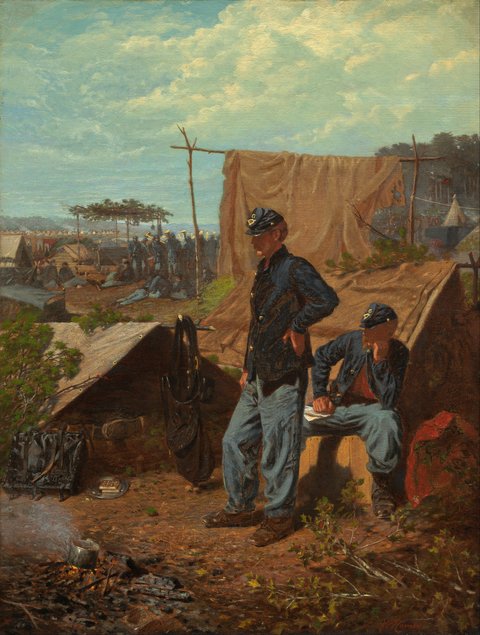

Home, Sweet Home by Winslow Homer

It was a time of great and exalting excitement. The country was up in arms, the war was on, in every breast burned the holy fire of patriotism; the drums were beating, the bands playing, the toy pistols popping, the bunched firecrackers hissing and sputtering; on every hand and far down the receding and fading spreads of roofs and balconies a fluttering wilderness of flags flashed in the sun; daily the young volunteers marched down the wide avenue gay and fine in their new uniforms, the proud fathers and mothers and sisters and sweethearts cheering them with voices choked with happy emotion as they swung by; nightly the packed mass meetings listened, panting, to patriot oratory which stirred the deepest deeps of their hearts and which they interrupted at briefest intervals with cyclones of applause, the tears running down their cheeks the while; in the churches the pastors preached devotion to flag and country and invoked the God of Battles, beseeching His aid in our good cause in outpouring of fervid eloquence which moved every listener.

It was indeed a glad and gracious time, and the half dozen rash spirits that ventured to disapprove of the war and cast a doubt upon its righteousness straightway got such a stern and angry warning that for their personal safety’s sake they quickly shrank out of sight and offended no more in that way.

Sunday morning came-next day the battalions would leave for the front; the church was filled; the volunteers were there, their faces alight with material dreams-visions of a stern advance, the gathering momentum, the rushing charge, the flashing sabers, the flight of the foe, the tumult, the enveloping smoke, the fierce pursuit, the surrender!-then home from the war, bronzed heros, welcomed, adored, submerged in golden seas of glory! With the volunteers sat their dear ones, proud, happy, and envied by the neighbors and friends who had no sons and brothers to send forth to the field of honor, there to win for the flag or, failing, die the noblest of noble deaths. The service proceeded; a war chapter from the Old Testament was read; the first prayer was said; it was followed by an organ burst that shook the building, and with one impulse the house rose, with glowing eyes and beating hearts, and poured out that tremendous invocation — “God the all-terrible! Thou who ordainest, Thunder thy clarion and lightning thy sword!”

Then came the “long” prayer. None could remember the like of it for passionate pleading and moving and beautiful language. The burden of its supplication was that an ever–merciful and benignant Father of us all would watch over our noble young soldiers and aid, comfort, and encourage them in their patriotic work; bless them, shield them in His mighty hand, make them strong and confident, invincible in the bloody onset; help them to crush the foe, grant to them and to their flag and country imperishable honor and glory –

An aged stranger entered and moved with slow and noiseless step up the main aisle, his eyes fixed upon the minister, his long body clothed in a robe that reached to his feet, his head bare, his white hair descending in a frothy cataract to his shoulders, his seamy face unnaturally pale, pale even to ghastliness. With all eyes following him and wondering, he made his silent way; without pausing, he ascended to the preacher’s side and stood there, waiting. With shut lids the preacher, unconscious of his presence, continued his moving prayer, and at last finished it with the words, uttered in fervent appeal,”Bless our arms, grant us the victory, O Lord our God, Father and Protector of our land and flag!”

The stranger touched his arm, motioned him to step aside — which the startled minister did — and took his place. During some moments he surveyed the spellbound audience with solemn eyes in which burned an uncanny light; then in a deep voice he said

“I come from the Throne-bearing a message from Almighty God!” The words smote the house with a shock; if the stranger perceived it he gave no attention. “He has heard the prayer of His servant your shepherd and grant it if such shall be your desire after I, His messenger, shall have explained to you its import-that is to say, its full import. For it is like unto many of the prayers of men, in that it asks for more than he who utters it is aware of-except he pause and think. “God’s servant and yours has prayed his prayer. Has he paused and taken thought? Is it one prayer? No, it is two- one uttered, the other not. Both have reached the ear of His Who hearth all supplications, the spoken and the unspoken. Ponder this-keep it in mind. If you beseech a blessing upon yourself, beware! lest without intent you invoke a curse upon a neighbor at the same time. If you pray for the blessing of rain upon your crop which needs it, by that act you are possibly praying for a curse upon some neighbor’s crop which may not need rain and can be injured by it. “You have heard your servant’s prayer-the uttered part of it. I am commissioned by God to put into words the other part of it-that part which the pastor, and also you in your hearts, fervently prayed silently. And ignorantly and unthinkingly? God grant that it was so! You heard these words: ‘Grant us the victory, O Lord our God!’ That is sufficient. The whole of the uttered prayer is compact into those pregnant words. Elaborations were not necessary. When you have prayed for victory you have prayed for many unmentioned results which follow victory-must follow it, cannot help but follow it. Upon the listening spirit of God the Father fell also the unspoken part of the prayer. He commandeth me to put it into words. Listen!

“O Lord our Father, our young patriots, idols of our hearts, go forth to battle-be Thou near them! With them, in spirit, we also go forth from the sweet peace of our beloved firesides to smite the foe. O Lord our God, help us to tear their soldiers to bloody shreds with our shells; help us to cover their smiling fields with the pale forms of their patriot dead; help us to drown the thunder of the guns with the shrieks of their wounded, writhing in pain; help us to lay waste their humble homes with a hurricane of fire; help us to wring the hearts of their unoffending widows with unavailing grief; help us to turn them out roofless with their little children to wander unfriended the wastes of their desolated land in rags and hunger and thirst, sports of the sun flames of summer and the icy winds of winter, broken in spirit, worn with travail, imploring Thee for the refuge of the grave and denied it-for our sakes who adore Thee, Lord, blast their hopes, blight their lives, protract their bitter pilgrimage, make heavy their steps, water their way with their tears, stain the white snow with the blood of their wounded feet! We ask it, in the spirit of love, of Him Who is the Source of Love, and Who is ever-faithful refuge and friend of all that are sore beset and seek His aid with humble and contrite hearts. Amen.

(After a pause)

“Ye have prayed it; if ye still desire it, speak! The messenger of the Most High waits.”

It was believed afterward that the man was a lunatic, because there was no sense in what he said.

In Chinatown, Rival Clubs Join Forces to Press Congressional Candidates

Avatar photo by Zhe Wu March 19, 2026 (sfpublicpress.org)

six people standing on a stage, with a yellow sign hanging on a curtain saying Chinese American Democratic Club in the background
From left to right, congressional candidates Saikat Chakrabarti, Connie Chan, Marie Hurabiell and Scott Wiener, greeted by organizers of Saturday’s Chinatown forum, Thomas Li and Josephine Zhao. Credit: Teo Valadez-Flynn / San Francisco Public Press

As they compete for the seat Nancy Pelosi is vacating, congressional candidates in San Francisco are taking divergent approaches to immigration and how to connect with Chinese American voters, who comprise a sizable and politically active share of the district. 

At a Saturday forum in Chinatown’s Victory Hall, those differences played out in English and Cantonese as three rival political clubs joined forces to question the candidates.

Each of the four candidates had a different approach to earning trust. They cited track records, dropped names, drew on their immigrant backgrounds and appealed for common ground on local issues. 

Watch the four congressional candidates present their positions at the March 14 Chinatown forum

As the only prominent Chinese American candidate in the race, San Francisco Supervisor Connie Chan stood out for her ability to translate her own statements without the aid of an interpreter.

“The one thing I would do differently,” Chan said to the mostly-Chinese-speaking crowd, “is be able to actually speak directly to our Chinese American community in our language.”

The community is far from a single voting bloc. 

The forum was made possible by an unlikely alliance. Three Chinese political clubs that often clash over endorsements — the Chinese American Democratic Club, the Ed Lee Democratic Club and the Rose Pak Asian American Club — set aside their differences to co-host the event. 

The groups, which take positions spanning San Francisco’s progressive-to-conservative spectrum, are finding reason to mingle and collaborate. This was the second time the three groups co-hosted an event, following a recent holiday party. This time, it was not just mingling with politicians, but presenting them with tough questions.

As longtime fixtures in city politics, both Chan and state Sen. Scott Wiener leaned on their deep connections and knowledge of local issues.

“Working together,” Wiener said, “we have fought for expanded access to health care, and to protect health care from the assaults from the federal government.” The “we” was a reference to his work with community leaders to keep acupuncture as a covered medical benefit.

Chan also used “we” a lot in her speech, but her use of the pronoun was more personal, as a way to signal her background shaped by shared immigrant experiences: arriving in San Francisco’s Chinatown at 13, accompanied by her single mother and younger brother, speaking no English.

She linked that experience to her current role as chair of the city’s Budget Committee, where she pointed to efforts to support immigrants, including securing funding to maintain San Francisco’s sanctuary city policies. She presented that record as evidence of how Chinese immigrants establish themselves in the city.

“We’re running for Congress because we’re here to fight for working families,” she said.

Chan and Wiener emphasized issues such as health care, child care, education, federal immigration enforcement and housing as priorities to take to Washington.

Wiener also included LGBTQ issues in outlining his plan.

Saikat Chakrabarti, a wealthy candidate funding his own campaign, took a different approach. He focused on several national policy proposals, including banning congressional stock trading and cutting military funding, emphasizing issues prominent in Washington debates.

Compared with the others, Chakrabarti has spent less time with Chinese American voters. He drew on his background as the child of immigrants who rose to become a Harvard graduate, a founding engineer at Stripe and a lead architect of the Green New Deal who worked alongside U.S. Sen. Bernie Sanders and Rep. Alexandria Ocasio-Cortez.

The fourth participant was Marie Hurabiell, a former Republican and Trump appointee to the board of the Presidio Trust. She emphasized local issues where she said she and Chinese American voters aligned, including the 2022 recalls of District Attorney Chesa Boudin and school board members, and the campaign to preserve merit-based admissions at Lowell High School.

Hurabiell was the only candidate who did not openly criticize Trump’s foreign policy. Instead, she appealed to the group by talking about immigration, proposing ideas such as speeding up the family reunification process and streamlining the H1B visa program, which many Chinese American immigrants have used.

The forum hosts highlighted immigration, asking candidates to outline their perspectives on a topic given less attention at previous debates.

Chan advocated legal support for sanctuary cities. Chakrabarti focused on protecting naturalized citizens, and called for holding U.S. Immigration and Customs Enforcement accountable for constitutional violations and cutting its funding. Wiener, Chan and Chakrabarti all emphasized opening more opportunities for immigrants to legally stay in the country.

“We need a pathway to citizenship,” Wiener said. “When people say just do it the legal way, there really is not much of a legal way anymore.”

Another top priority mentioned by all but Hurabiell: protecting birthright citizenship, which the Trump administration has attempted to override, despite its basis in the Constitution. That right was affirmed by the Supreme Court a century ago in a case brought by a San Franciscan of Chinese descent.

Support our local in-depth reporting and investigations.

Donate Now!

a crowd of people stands on a stage facing the audience with people taking cell phone pictures
Three Chinese American political clubs that rarely align on their agendas found common ground to press the candidates on immigration and other timely topics. Credit: Teo Valadez-Flynn / San Francisco Public Press

While the candidates worked to tailor their answers to their understanding of Chinese American voters, sometimes the message didn’t come through clearly. On several occasions, the Cantonese interpretation was interrupted and revised.

“Real-time translation is such a challenge,” said Thomas Li, vice president of the Ed Lee Asian American Club. He noted that numbers are particularly difficult, as English and Chinese use different counting systems. In addition, when candidates referenced government agencies, figures and acronyms, interpreters not only had to find the correct Chinese terms but also explain the political context.

Beyond formal word usage, Li said it is politicians’ responsibility to  clearly communicate their platforms.

“Candidates need to change their message when talking to everyday individuals,” he said, including its many limited-English-speaking voters who also are part of the constituency they must serve.

“If we don’t bring those candidates to Chinatown for a debate like this,” Li said, “who else will have them discuss topics like immigration so thoroughly?”

Keep up to date — get the latest news in your inbox weekly!

Related

March 14: Livestream of Asian American Community Congressional Candidates Forum

March 13, 2026

What You Might Find on Your San Francisco Ballot: Party County Central Committees

March 1, 2024

March 2024 California Races

February 21, 2024

Zhe Wu

Zhe Wu is a reporter who is interested in covering stories related to the Asian American community. Previously, she has covered education and local community issues in the East Bay for Oakland North, Oaklandside and Berkelyside. She speaks Cantonese, Mandarin, English and a bit of Hakka. She arrived at the Public Press in 2023 as a member of the first cohort of the California Local News Fellowship program, a multi-year, state-funded initiative to support and strengthen local news reporting in California, with a focus on underserved communities. Zhe Wu received the 2025 award for Outstanding Emerging Journalist from the Society of Professional Journalists, Northern California Chapter.More by Zhe Wu

Time for action!

How to Fight Fascism in America: Economic Justice is a people-powered call for fairness, dignity, and democracy for working families. No. 4.

Laurie Woodward GarciaPeople Power UnitedResist Project 2025Protect Democracy, and Freedom Over Fascism Mar 24

Why the Grassroots Resistance Can’t Wait

Time for action! Freedom Over Fascism

The movement for freedom over fascism, progress, and power to the people starts here.

SFPD May Have Violated Sanctuary Laws By Helping ICE at SFO, Bystander Files Lawsuit

24 March 2026/SF News/Leanne Maxwell

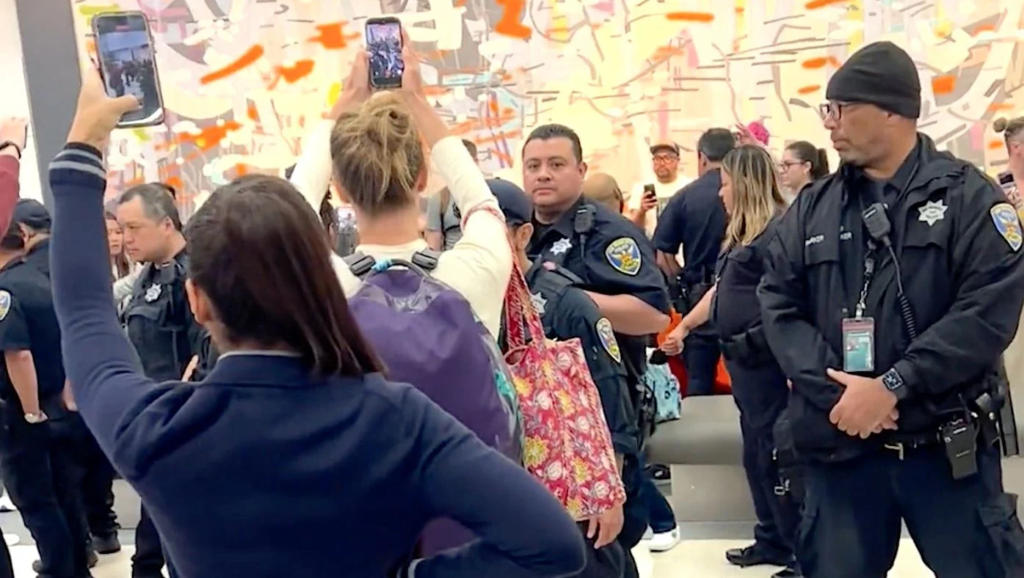
A witness at SFO Sunday filed a complaint that SFPD officers violated sanctuary laws by shielding ICE agents in plainclothes from bystanders who were asking them to identify themselves, as the ICE agents attempted to restrain a woman being deported with her young daughter.

Witness Nicole Killian filed a complaint with the California Department of Justice and the SF City Attorney, as Mission Local reports, alleging that SFPD officers assisted ICE agents who were restraining a mother and her daughter at San Francisco International Airport Sunday as they were being deported to Guatemala.

Attorneys knowledgeable about local sanctuary policies told Mission Local the actions of SFPD officers may have violated SF’s sanctuary ordinance as well as SFPD’s policy directives.

As SFist reported Monday, the arrest was not related to President Donald Trump’s recent directive to send ICE agents to some US airports amid the partial government shutdown — and SFO employs private contractors to manage security checkpoints, so therefore doesn’t rely on federal TSA employees.

The Chronicle reports that the woman being restrained, Angelina Lopez-Jimenez, had tried to escape custody, and officials said she may have been detained elsewhere and was being transported through SFO. An immigration judge had reportedly issued a final order for Lopez-Jimenez and her daughter’s deportation seven years ago, in 2019.

Mission Local reports that a total of 20 SFPD officers were on the scene of the arrest. A group of bystanders filmed police officers forming a buffer around ICE agents in plainclothes, who witnesses say refused to identify themselves. SFPD officers were also filmed escorting ICE agents as they transported the woman in a wheelchair away from the scene.

SFPD released a statement that officers were responding to a 911 call about the incident, and they stayed on the scene to “maintain public safety.”

“The crowd was furious, but was giving them their distance and was only asking reasonable questions about the identification and documenting what was happening,” Killian told Mission Local. “I was like, you’re not supposed to be helping, but if you’re allowed to crowd control, how is that not helping them?”

Grisel Ruiz, ​​the senior managing attorney at the Immigrant Legal Resource Center, pointed out that SFPD’s crowd control role amounted to providing resources that supported ICE operations.

“Creating a perimeter around an ICE arrest to keep the public at a distance so that ICE can conduct an arrest appears to be the SFPD using its resources to support an ICE arrest,” Ruiz told Mission Local.

Bill Ong Hing, a longtime immigration attorney, professor of law at University of San Francisco, and a former police commissioner, told Mission Local that SFPD is only allowed to assist ICE in an emergency or if the public potentially poses harm to ICE agents. Otherwise, police may have violated both the city’s ordinance and SFPD’s directive.

“SFPD may argue [the woman being arrested] created a situation where there was a danger to the public,” Hing says.

Angela Chan, assistant chief attorney at the San Francisco public defender’s office, told Mission Local, “It does not appear there is any crime being committed by any members of the public.”

“A dozen officers stand in a circle to help officials to take or keep someone in custody, that seems to fit the definition of ‘assisting,’” Chan said, calling the incident “alarming and horrifying.”

Previously: ICE Not Deployed to Assist TSA at SFO, But They Were There Arresting Someone Sunday Night

Image: din_jarring/Reddit

California Democrats’ crisis deepens as defiant governor candidates dig in

By Joe Garofoli, Political Columnist Updated March 24, 2026 (SFChronicle.com)

Gift Article

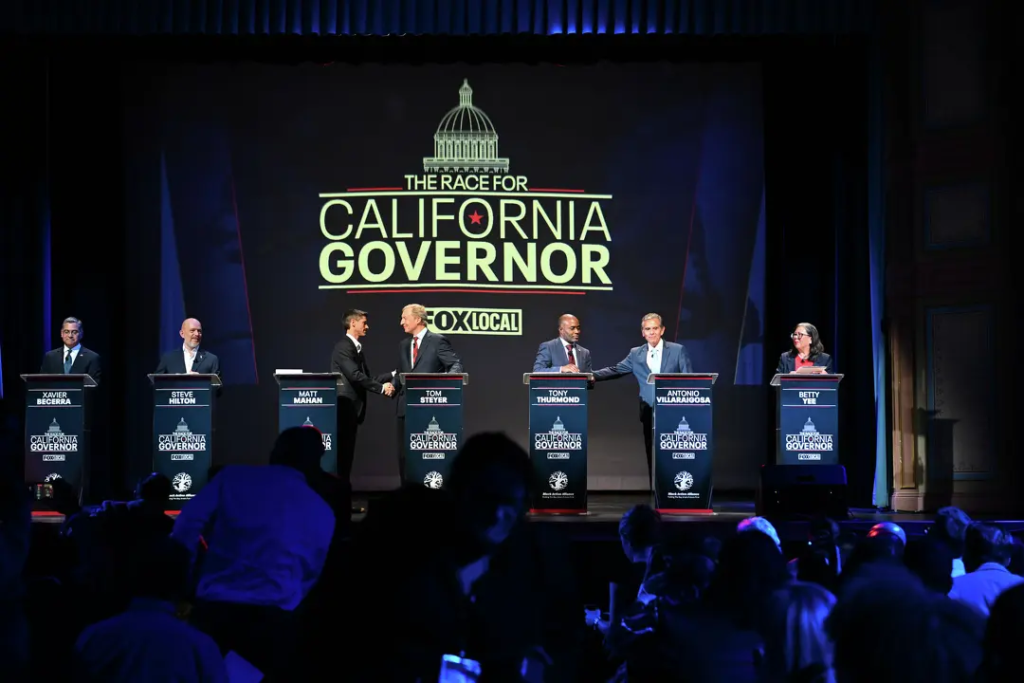
From left, Xavier Becerra, Steve Hilton, Matt Mahan, Tom Steyer, Tony Thurmond, Antonio Villaraigosa and Betty Yee take part in a gubernatorial candidate debate on Feb. 3 in San Francisco.Laure Andrillon/Associated Press

California’s Democratic Party appears to be stuck in neutral: The party’s leaders are still unwilling to take decisive steps to push low-polling candidates out of the governor’s race, even as the prospect of the deep-blue state electing a Republican leader looms.

Tuesday marked two developments that underscored the party’s dilemma. First, the University of Southern California canceled a high-profile debate after days of controversy over four lower-polling candidates being excluded under the organizers’ criteria. The party also released a  new poll intended to pressure low-performing candidates to drop out. But even those at the bottom immediately signaled their intention to stay in the race.

State Democratic Party leaders, including Gov. Gavin Newsom, appear unwilling to force lower-polling Democrats out of the race, which could help consolidate support behind a Democratic candidate and virtually eliminate the chance of a Republican becoming governor in a state where Democrats have nearly twice as many registered voters. The top two finishers in the June 2 primary, regardless of party affiliation, advance to the general election in November. California has not elected a Republican since 2006. And that person was a global superstar with near-universal name recognition: Arnold Schwarzenegger. 

The chance of two Republicans facing off in the general election was 22% on Tuesday, according to an online tool developed by political data expert Paul Mitchell that runs thousands of simulations of the race. Mitchell on Tuesday advised Democrats to unite behind a candidate. 

“Dems should consolidate, but there is a chance they won’t,” Mitchell said. “(Republicans) should consolidate, but there is a chance they won’t. In the overlap where the two parties don’t consolidate, Democrats get boxed out of the general election.”

The survey showed two Republicans — former Fox News commentator Steve Hilton (16%) and Riverside County Sheriff Chad Bianco (14%) — are poised to advance to the general election. They are followed by a tie for third place between Rep. Eric Swalwell, former Rep. Katie Porter and billionaire climate activist Tom Steyer with 10% each. 

They were followed by former Los Angeles Mayor Antonio Villaraigosa (4%), former Secretary of Health and Human Services Xavier Becerra and San Jose Mayor Matt Mahan each tied with 3% support. Former state Controller Betty Yee had 2% and state Superintendent Tony Thurmond had 1%. The survey found that 24% of voters were undecided. 

State Party Chair Rusty Hicks said the polling was conducted by California’s largest Black- and Latina-led polling firm and over-sampled Black, Latino, and Asian American and Pacific Islander voters to ensure their voices are heard. 

Equally foreboding for Democrats was a Berkeley IGS Poll released last week that showed a “historically high” level of unawareness of the election. Democrats have long relied on their advantage in voter registration to overwhelm Republicans in California. 

Yet Hicks, the leader of the party and the person responsible for its success, declined to say whether he has directly asked candidates to bow out. 

“I’m not going to disclose any private conversations that have been had or will have, or any future tactics between now and Election Day,” Hicks said Tuesday. “I have deep respect for all of the candidates that have taken the courageous step to put their name forward. They believe that they have a viable path to win.”

Later, when pressed about what constituted a “viable” candidate, Hicks said, “If you’re polling at 1 to 2%, do you have a path to get to 20(%)? That’s the question. Do you have a path to put you in a position to win the primary election that puts you into the general election?”

Yee, who is polling at 1%, said Tuesday that no state party leaders have asked her to leave the race. At a press conference Tuesday, Yee would not answer directly when asked to lay out her path to win 20% of the vote but said she didn’t think it would take 20% to advance. She also said she would reevaluate her campaign again in mid-April. 

Yet for now, Hicks is unwilling to do anything — including ask Newsom, the most popular Democrat in the state and likely a future presidential candidate — to ask the unviable candidates to leave. Hicks insists there is a lot of time left (about 40 days) between now and when ballots arrive in the mail to voters. But Hicks already missed his window, as all of the above candidates will appear on ballots. 

“I have long said that we are prepared to do what is required to ensure that we elect a governor in November of 2026. I want to ensure that everybody has the opportunity to make their voices heard in this campaign, and there’s a lot of road between here and there.”

Earlier this month, Newsom acknowledged that with so many Democrats running and a public largely disengaged from the race, he may be forced to endorse a candidate.

“When I’m out in the community, people aren’t talking to me about it, which is interesting this late, just weeks before early voting,” Newsom told reporters. “As a consequence, I’m not directly as engaged as perhaps I might need to be.”

Asking candidates to suspend their campaigns has become a very sensitive issue because many of the lowest-performing hopefuls are people of color.

Four of the lower-polling candidates complained last week in a joint press conference about being excluded from a televised debate that was scheduled to be held Tuesday at USC, noting that the only four candidates of color in the race were not invited. Leaders of the Legislature wrote to USC on Monday, asking the university to include the four candidates, saying if USC doesn’t “do the right thing,” voters should “boycott.” 

USC canceled the debate.

And now, Democrats are in a deeper hole. 

There’s one fewer statewide televised debate that could have helped voters consolidate behind a single candidate. And the lower-polling candidates are digging in, refusing to leave. 

“Instead of wasting hundreds of thousands of dollars on polling, the (California Democratic Party) should be focused on stopping Donald Trump by winning back the House after we passed Prop 50,” said Ajay Mohan, Villaraigosa’s campaign manager.

Yee, polling at 2%, appeared to be oblivious to the latest polling. “The poll confirms what we’ve been saying all along: The race is wide open,” she said. “We’ve never been more confident that when voters begin to focus on the election and see our new ad campaign, we will rise above the field of billionaire-backed candidates and build a grassroots victory for working people across the state.”

Mahan, despite being supported by more billionaires than any other candidate, hasn’t taken off with voters either. The state party-commissioned poll showed him at 3%, slightly lower than where the Berkeley IGS poll clocked him (4%). Yet he said Tuesday he is not quitting.

“We don’t plan on leaving the race,” Mahan said. “We plan on going up in the polls and winning the race, because voters are looking for an alternative to what the field has offered over the past year.

Becerra and Thurmond, the other low single-digit polling candidates, did not respond to requests for comment. 

Swalwell’s campaign said the new poll drove home that he is the candidate Democrats should rally behind. 

“It’s time for leaders to come together to coalesce around the candidate who has consistently led in support, public polls and primary donations since entering this race,” said Micah Beasley, a campaign spokesperson.

Steyer was trying to organize an alternative forum to be held Tuesday night in Los Angeles for all of the candidates, but those plans fell through. Steyer spokesman Kevin Liao said all of the candidates of color declined to attend. Thurmond said he would instead appear on social media platforms with a former public school teacher to talk about his platform. Yee said she had two other events to attend.

Meanwhile, Republicans are gloating. 

“What a total joke California Democrats have become,” Hilton said. “Hours before a debate, they kill it after their LPDs (Low Polling Democrats) whined about being excluded. These people can’t organize anything.”

March 24, 2026|Updated March 24, 2026 3:38 p.m.

Joe Garofoli

Senior Political Writer

Joe Garofoli is the San Francisco Chronicle’s senior political writer, covering national and state politics. He has worked at The Chronicle since 2000 and in Bay Area journalism since 1992, when he left the Milwaukee Journal. He is the host of “It’s All Political,” The Chronicle’s political podcast. Catch it here: bit.ly/2LSAUjA

He has won numerous awards and covered everything from fashion to the Jeffrey Dahmer serial killings to two Olympic Games to his own vasectomy — which he discussed on NPR’s “Talk of the Nation” after being told he couldn’t say the word “balls” on the air. He regularly appears on Bay Area radio and TV talking politics and is available to entertain at bar mitzvahs and First Communions. He is a graduate of Northwestern University and a proud native of Pittsburgh. Go Steelers!

Are ICE agents coming to Oakland or San Francisco’s airports?

Immigration agents are appearing at airports throughout the country to support TSA. What does that mean for OAK and SFO?

by Eli Wolfe March 24, 2026 (Berkeleyside.org)

Federal immigration agents walk through Terminal 5 at John F. Kennedy International Airport (JFK) in the Queens borough of New York, Monday, March 23, 2026. (AP Photo/Ryan Murphy)

Travelers throughout the country are dealing with endless lines and Immigration and Customs Enforcement agents, who’ve been deployed by President Trump to support TSA agents during the government shutdown. But the agents haven’t been deployed to the Oakland San Francisco Bay Airport or San Francisco International Airport.

According to CNN, ICE agents have been deployed at 14 airports as of Monday, while the New York Times reports that between 100 and 150 agents have been sent in to help with long security lines. None of the listed airports are in the Bay Area, but several outlets reported that ICE agents appeared to restrain a woman and her daughter inside SFO’s Terminal 3 on Sunday night. SFO officials said federal officers were escorting individuals on an outbound flight, and the Trump administration said it was unrelated to its deployment of ICE agents to airports..

White House border czar Tom Homan said Monday that residents should expect to see ICE agents at more airports in the future. 

The deployment follows weeks of fighting in Congress over a funding package for the Department of Homeland Security. Democrats have refused to fund ICE or Customs and Border Protection without changes to their operations after agents killed two people in Minneapolis. Trump has pushed Republicans in Congress to not accept any deal unless Democrats agree to pass a bill that would make it more difficult for millions of Americans to vote in elections. 

Airport spokesperson Kaley Skantz said that OAK hasn’t been advised of any deployments of ICE agents to the airport at this time, or any other operational changes. 

SFO is one of around 20 U.S. airports that staff security checkpoints with private contractors instead of federal TSA agents, the SF Chronicle reported, noting that the contractors are still being paid.

In a statement, DHS Acting Assistant Secretary Lauren Bis declined to confirm the locations of officers. “President Trump is taking action to deploy hundreds of ICE officers, who are currently funded by Congress, to airports being adversely impacted,” Bis said in an email. “This will help bolster TSA efforts to keep our skies safe and minimize air travel disruptions.” 

As unpaid TSA agents call out of work, airports in some cities have seen nightmarish lines. CNN reported that wait times at Houston hit 270 minutes, while at JFK in New York, it’s over an hour. An airplane crash at one of New York’s other major airports early Monday morning resulted in numerous flight cancellations. 

Travelers in Oakland thus far haven’t been impacted. Skaley said that OAK “has not experienced longer than typical TSA passenger lines recently.” 

“We continue to recommend that passengers arrive at the airport at least two hours prior to their flight for domestic travel, and at least three hours prior for international,” Kaley said in an email. 

Several Reddit users have also reported nothing amiss at OAK. 

“I arrived at 8:11am on 3/23 for a flight,” one commenter reported Monday morning. “No lines at check point. 5 minutes to clear the bags through the scanner. This was for all lines.” 

NO KINGS San Francisco

No Kings - Home

Skip to content

Host an event

NO KINGS San Francisco

Visibility Event · Volunteer organized

NO KINGS San Francisco organized by No Kings

Time

Saturday, March 28

11:30am – 3pm PDT

Location

Embarcadero Plaza

Steuart St San Francisco, CA 94105


About this event

We have the power and are claiming it together. No Thrones. No Crowns. No Kings.

Join Indivisible San Francisco, 50501SF, and many local organizers for No Kings San Francisco!

For all up-to-date information on our march, as well as to volunteer, please visit our website at https://indivisiblesf.org/no-kings-3.

We will gather at 11:30 AM at Embarcadero Plaza, with overflow to Sue Bierman Park.

At 12:00 noon, we will march up Market St. and McAllister St. to Civic Center Plaza.

At 2 PM, the rally at Civic Center Plaza will start. There will also be a resistance tabling fair at the neighboring Fulton Plaza.

Please join us and spread the word so that we can have the biggest, most powerful march yet.

Join us for a March from Embarcadero Plaza to Civic Center Plaza, with a rally and resistance fair to follow. We will come together to promote ways to stand strong against the Trump and MAGA regime, protect our communities from ICE, and get ready for a Blue Wave in 2026.

What began in 2025 as a single day of defiance has become a sustained national resistance to tyranny, spreading from small towns to city centers and across every community determined to defend democracy. Our peaceful movement is bigger than ever.

When our families are under attack and costs are pushing people to the brink, silence is not an option. We will defend ourselves and our communities against this administration’s unjust and cruel acts of violence.

On March 28th, rise up, take to the streets, and say it loud: no thrones, no crowns, no kings. We’re not watching history happen—we’re making it. Join us.

A core principle behind all No Kings events is a commitment to nonviolent action. We expect all participants to seek to de-escalate any potential confrontation with those who disagree with our values and to act lawfully at these events. Weapons of any kind, including those legally permitted, should not be brought to events.Read more


Accessibility

This event meets ADA standards

Accessible restrooms

Mainly flat ground

No stairs or steps

ASL interpretation

Wheelchair ramp

Have accessibility questions? Reply to your registration email to confirm your requirements or request more information.

“NO KINGS” Human Banner-SF Ocean Beach

Rally · Volunteer organized

NO KINGS [Human Banner-SF Ocean Beach] organized by No Kings

Time

Saturday, March 28

11am – 12:30pm PDT

Location

1000 Great Hwy

Ocean Beach – Stairwell 17 San Francisco, CA 94121


About this event

We have the power and are claiming it together. No Thrones. No Crowns. No Kings.

What began in 2025 as a single day of defiance has become a sustained national resistance to tyranny, spreading from small towns to city centers and across every community determined to defend democracy. Our peaceful movement is bigger than ever.

When our families are under attack and costs are pushing people to the brink, silence is not an option. We will defend ourselves and our communities against this administration’s unjust and cruel acts of violence.

On March 28th, rise up, take to the streets, and say it loud: no thrones, no crowns, no kings. We’re not watching history happen—we’re making it. Join us.

A core principle behind all No Kings events is a commitment to nonviolent action. We expect all participants to seek to de-escalate any potential confrontation with those who disagree with our values and to act lawfully at these events. Weapons of any kind, including those legally permitted, should not be brought to events.

Join peaceful people from San Francisco Bay communities and all walks of life for a family-friendly, inclusive and peaceful event on March 28th where we will create a new work of human art together on Ocean Beach. We have more power than we know!

The exact design for this banner is still being developed, and the message’s theme (always subject to last-minute changes) will be announced closer to the event.

When: Saturday, March 28th – Arrive by 11:30 am Location: Ocean Beach, SF – Stairwell 17

Directly across from the Beach Chalet — 1000 Great Highway, SF, CA, 94121 — closest intersection is Fulton and Great Highway.

Please Plan to Arrive at the Beach by 11:30 am – This will ensure we are all in place for photography by our drone crews at NOON SHARP. The event will wrap up by about 1:00 pm.

PLEASE REMEMBER TO REGISTER – Knowing how many people will attend really helps us with the banner design calculations. THANK YOU!

Sign up here: https://www.mobilize.us/nokings/event/901829/


Accessibility

Accessible restrooms

Have accessibility questions? Reply to your registration email to confirm your requirements or request more information.

Billionaire-tax author pushing for bigger, broader levy on the ultrawealthy

Brian Galle for 20260322 SFE
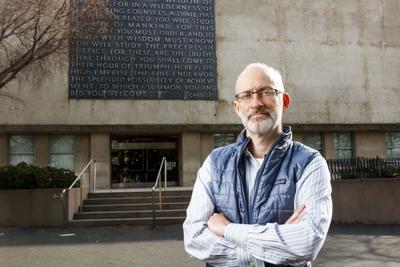
UC Berkeley law professor Brian Galle: “It’s just fair for [the richest Americans] to pay the same share of their economic income as the rest of us.”Craig Lee/The Examiner

Although Brian Galle is one of the co-authors of California’s proposed billionaire tax, he said he doesn’t think it’s the be-all-and-end-all for getting the ultrawealthy to pay what he sees as their fair share.

Instead, the tax-law expert and law professor at UC Berkeley thinks there needs to be a more fundamental, permanent and national change to the way the country assesses the richest among us. 

Earlier this year, the left-leaning Roosevelt Institute published online “How to Tax the Ultrarich,” Galle’s book-length proposal for how to do that. Revolving around what he calls FAST — short for the Fair Share Tax — his plan would significantly revise how the federal government taxes investments, a crucial part of assessing billionaires and centimillionaires.

Galle’s proposal is designed to make the tax system fairer by upping the often minuscule effective tax rate the ultraweatlhy pay. In doing so, it could limit the growth of wealth inequality while raising hundreds of billions and potentially trillions of dollars, he argues.

“It’s just fair for [the richest Americans] to pay the same share of their economic income as the rest of us,” he said in an interview with The Examiner. “Right now, they mostly escape from that obligation.”

Galle’s proposal comes as wealth and income inequality globally, within the Bay Areain Californiain the U.S. and in many other parts of the world have grown markedly in recent years and decades. That increasing concentration of wealth  — and the power and influence it often brings — has led to growing calls, even from among some of the wealthy themselves, to increase taxes on those at the top of the scale.

Guests including Mark Zuckerberg, Jeff Bezos, Sundar Pichai and Elon Musk, arrive before the 60th Presidential Inauguration in the Rotunda of the U.S. Capitol in Washington, Monday, Jan. 20, 2025. Zuckerberg’s Meta and Musk have sought to stop OpenAi’s transition to a for-profit company.Julia Demaree Nikhinson

For his part, Galle has been working on proposals to tax billionaires and the richest Americans for years. In addition to his work on the California billionaires tax, his new book builds on his previous academic work in the field as well as prior policy plans he’s contributed to, including former President Joe Biden’s Billionaires’ Minimum Income Tax proposal, which ultimately died in Congress. 

What Galle’s new proposal and related other ones attempt to rectify is the fact that the ultrawealthy tend to pay exceedingly low tax rates even as their wealth balloons. 

The federal income tax is an imposition on wages and salaries, but many of the richest people in the country report relatively modest income from such sources. That’s because for people in that class, most of the growth in their wealth generally comes not from high salaries but from the appreciation of the assets they hold, such as stocks, bonds and real estate. 

The government does tax income from investments through the capital-gains tax, but the rate is significantly lower than the top income-tax rate. People only have to pay the capital-gains tax when they sell assets and make gains on them. And they can wipe out other gains or income — and any corresponding tax liabilities — if they sell assets at a loss. 

Instead of taking a salary or selling assets, many of the ultrarich fund their regular activities and lifestyles by borrowing against their assets. Even though the cash from such loans is used like regular income, the loans aren’t subject to income taxes.

The proposed billionaire tax would get around all of that by assessing a direct tax on the wealth — other than personal property — held by California residents who have more than $1 billion in assets. Such people would be required to pay a 5% one-time imposition on their assets.

Politicians such as U.S. Senators Bernie Sanders of Vermont and Elizabeth Warren of Massachusetts have proposed similar wealth taxes that would be imposed nationwide. Other politicians have proposed what are called mark-to-market taxes, in which people would pay a tax on the amount by which their wealth increased — or earn credit based on how much it decreased — each year. Additionally some politicians have proposed treating borrowing used to fund personal consumption as essentially income and taxing it as such.

The problem with wealth and mark-to-market taxes is that the Supreme Court in a 2024 ruling indicated it could rule both kinds of taxes unconstitutional, Galle and other legal scholars believe.

The 16th Amendment to the Constitution legalized income taxes, but the Court suggested in Moore et ux. v. United States, that it wouldn’t sign off on allowing unsold assets to be considered income. Taxing borrowing as income could face similar constitutional problems, Galle argues.

Because of the Court’s ruling, if you want to have a tax that acts like a wealth or mark-to-market imposition, “you need to have an alternative structure,” said David Gamage, a law professor at the University of Missouri who focuses on tax law and is one of Galle’s frequent collaborators. 

Galle designed FAST to be just such an alternative. Unlike a straight wealth or mark-to-market tax, it would be enforced only after people sold their assets, so it would get around the obstacle the Supreme Court hinted at in the Moore case. But people’s tax liabilities would increase in tandem with the returns on their investments, mimicking a wealth or mark-to-market tax. To ensure that the tax only hit the wealthiest Americans, it would exempt the first $15 million of assets. 

So, assuming a base 23.8% rate on long-term investment gains — the rate applicable to those in the highest income bracket — those whose assets had doubled in value would pay a tax equivalent to 15% of the total value of their assets. Those whose assets had increased in value by 10 times would pay a tax equivalent to 42% of their assets’ total value. And those who had seen a return of 100 times would owe a tax equal to 67% of their assets.

Under Galle’s proposal, people choose to pay early, before they sell their assets, and even as often as every year. Those that do so would have incentive to do so — they would effectively pay lower rates on their unrealized gains. That option to pay early would allow the tax to function in practice — at least in part — similar to an annual wealth or mark-to-market tax, bringing in regular revenue, rather than only at the time of sale.

FAST would get around borrowing by focusing on people’s assets. People would have no incentive to sell assets early for a loss to decrease their reported incomes, because the FAST liability applies to all of their assets. 

Reuven Avi-Yonah, a law professor at the University of Michigan who also focuses on tax policy, said he was impressed with the proposal.

Given the Supreme Court’s ruling, “this is the most practically feasible proposal that’s out there,” he said.

Galle said reforming the federal tax code is important in part to address growing inequality and the political and economic instability that comes with it. 

Ex // Top Stories

Proposed changes to SF commissions draw public outrage

Speakers warn that quest for government efficiency could come at the high cost of lost community input, oversight 

Pied Piper maintains its history and a locally-famous loyal customer

San Francisco journalist Carl Nolte joined this week’s Sips in The City at one of his favorite bars, Pied Piper in the Palace Hotel.

End of March in The City heats up with these 18 SF events

The last week of the month brings exhibition baseball, a chocolate festival and a craft fair with more than 250 vendors to San Francisco 

Billionaires make up a substantial portion of the top levels of President Donald Trump’s administration, he noted. Some 19% of all federal campaign contributions in 2024 came from just 300 billionaires or their family members, the New York Times reported earlier this month.

Elon Musk alone reportedly spent more than $290 million in that campaign cycle, mostly to support Trump’s reelection campaign. Trump subsequently named Musk to head the so-called Department of Government Efficiency, which slashed thousands of government jobs and effectively shuttered entire departments.

Elon Musk boards Air Force One at Joint Base Andrews in Maryland, March 21, 2025. Eric Lee © 2025 The New York Times Company

“That looks like disproportionate power,” Galle said.

But he said reform is also necessary to address the fundamental unfairness that results in the ultrawealthy often having effective tax rates that are a fraction of what even middle- or working-class people pay.

Between 2014 and 2018, then-Berkshire Hathaway CEO Warren Buffet saw his wealth increase by $24 billion — but he only paid $23.7 million in taxes, an effective rate of about 0.1%, according to the investigative-journalism website ProPublica. Former Amazon CEO Jeff Bezos’ wealth jumped by $99 billion over the same time frame. He paid $973 million in taxes, or about 1% of that increase, ProPublica reported. 

And in numerous cases, the ultrawealthy paid no income taxes at all in particular years. Bezos, for example, didn’t pay any federal income tax in 2007 or 2011, according to ProPublica. 

From 2006 to 2018, Bezos’ wealth grew by $127.8 billion, but he only paid $1.4 billion in taxes, ProPublica reported. By contrast, the report said, the typical American household paid $142,000 in taxes over that same period while seeing its wealth only go up by $89,000, thanks largely to the hits home values took from the Great Recession.

Because the tax rates paid by the ultrarich on their wealth accumulation are so much lower than those paid by everyone else, the tax system is “helping them to become richer faster,” Galle said. 

In theory, estate and gift taxes should level the playing field, allowing the federal government to take a sizable chunk of that accumulated wealth at the time billionaires or centimillionaires die, and limiting the creation of multigenerational dynasties.

But that’s not actually what happens in practice, tax experts say. Instead, when someone dies, the cost basis for the investments they hold is “stepped up” to the fair market value at the time of their death. That allows the gains from those investments up to that point to permanently avoid being taxed.

Meanwhile, the affluent have found legal ways, including using trusts, to pass on much of their wealth to their heirs tax-free. In a previous report, Galle and some fellow researchers estimated that the wealthy have stocked away in trusts more than $5 trillion in assets that would otherwise be subject to tax but now won’t ever be.

Part of Galle’s proposal is to eliminate that step-up provision at death and to have the FAST liability carry over to inheritors. He also would impose a 40% inheritance tax on everything not covered by FAST. But that liability would work much like FAST, being enforced only when people sell their assets, but increasing in tandem with the rise in the assets value.

Gamage said that he generally likes Galle’s plan, but its increase in liability as assets rise in value over time could give the wealthiest Americans an incentive to game the system. Without provisions forcing them to pay taxes on their gains early, they could try to hold out until they can persuade politicians to change or eliminate the tax or give them some kind of tax holiday. Congress has done similar things numerous times in the past, he noted.

“I would put more pressure than he does on taxing what you can in the interim,” Gamage said. 

Avi-Yonah said the problem with Galle’s proposal is that it wouldn’t do much to address rising inequality. For him, a better method would be to bolster entitlement programs. The expansion of the Child Tax Credit in 2021 dramatically reduced poverty levels, he noted, bringing child poverty down to its lowest recorded level ever.

Avi-Yonah said he advocates not for a FAST or wealth tax but a consumption tax, similar to those seen in Europe, as a way to fund such efforts, because they could easily bring in vastly more revenue.

“The key” to addressing inequality “is less taxing the rich and more raising the bottom and the middle class,” he said. “But both are necessary.”

Any effort to reform the tax system is likely to nowhere as long as Trump is in the White House and Republicans control the Congress, Galle said.

In his two terms in office, Trump has pushed through two major rounds of tax cuts favoring the wealthy, including last year’s One Big Beautiful Bill. And Republicans have made cutting taxes central to their brand, even at the expense of ever-widening deficits, not to mention income and wealth inequality.

Galle said he started working on his proposal before the 2024 election that brought unified Republican control to Washington, but he was thinking of abandoning the effort in the wake of that outcome.

But that November, he said, he ended up sharing a cab ride with a Treasury Department official he declined to name who worked under Joe Biden. When Galle expressed his doubts, the official advised him to go forward anyway.

“It takes a long time to write good tax legislation,” he said she told him. “You should get started on it.”