Is SF’s Mission District Still Gentrified?

by Randy Shaw on July 27, 2026 (BeyondChron.org)

A 16th & Mission Miracle

New Affordable Housing Reopens the Mission

Since the late 1970’s a major San Francisco story line has been the Mission’s gentrification. It’s a classic case of the working and middle-class displaced by more affluent residents. Valencia Street’s upscale restaurants, new condos on closed industrial spaces, and tenants facing speculator evictions symbolized the Mission’s transformation.

But today’s Mission offers a different story. While rents on private market rental units and home sales still price out the working and middle-class, a massive amount of new affordable housing has re-opened the Mission to the non-rich. And this expansion of affordable housing is likely to continue.

Which raises the question: can the Mission’s pre-1980 social and economic diversity return?

Three Gentrifying Waves

When I moved to San Francisco in 1979 young activists were congregating in the Haight-Ashbury and Mission. We realized we couldn’t get an apartment in the Haight when a manager asked us if we had nice furniture. He said the owner wanted to rent to tenants with quality furnishings because he was planning on selling the place. The Haight-Asbury’s gentrification was in full swing. This occurred without any new, “luxury” housing promoting this trend.

The Mission’s post-1979 gentrification transformed Dolores Street and much of Guerrero. Guerrero became the Mission’s new western border.

The next big gentrification wave that hit the Mission came with the 1995 dot com boom. Because the Mission was located near highways leading to Silicon Valley, it became a popular choice for affluent tech workers.  Its two BART stations also made the Mission a convenient home for downtown workers. Rents skyrocketed on vacant units. Bad faith speculator evictions were rampant.

The dot com boom priced out a countless number of Latino families who sought to live in the Mission.  Latino families could not afford Mission rents even when they pooled incomes for overcrowded units. Many moved to the Tenderloin. This brought the neighborhood a major influx of immigrant Latinos for the first time. In 2005 the Tenderloin Housing Clinic, which I head, launched the La Voz Latina organization to serve their needs.

The second tech boom of 2011-2019 seemed to finalize the Mission’s gentrification. It appeared that available apartments and houses would be limited to the affluent. But activists convinced Mayor Lee to target most the city’s affordable housing funds to the Mission. This huge victory was obscured by the area’s ongoing transformation.

Massive Affordable Housing

Mayor Ed Lee’s Mission Action Plan 2020, approved by the Planning Commission in 2017, projected roughly 1000 new affordable units in the neighborhood. Many were skeptical the city could reach that goal. But Mission Housing has since built 385 units in the Mission. It has another 136 are under construction and work will begin on another 225 next year. That’s 746 units from one nonprofit builder.

When you add units built by MEDA, inclusionary units, and those acquired through the Small Sites program (also adopted by Mayor Lee), the number of affordable units in the Mission since 2017 easily exceeds the 1000 goal.  Meanwhile, new market rate housing in the neighborhood has largely stopped as builders cannot get financing.

Affordable projects have their own financing pools, and continue to get built.

The Mission also has several SRO hotels leased or owned by nonprofits. The Tenderloin Housing Clinic alone leases roughly 450 units in four hotels. The city’s master-leasing program enables very low-income residents to live in the Mission. In addition to its apartments Mission Housing owns over 170 SRO units in the neighborhood.

Defeating the Monster

The dramatic reversal in the Mission’s fortunes is perhaps best captured by the fate of the proposed “Monster in the Mission” on the northeast corner of 16th and Mission. Our story on the October 4, 2014 march and protest against the project lays out what was happening to the community’s affordability.

Our 2015 story reported on the project’s collapse. As reporter Carl Finamore put it, “A political earthquake just hit San Francisco when, amid much controversy, plans for construction of 331 high-end rentals and deluxe condos in the heart of San Francisco’s working-class Mission District collapsed.”

But the project was revived in 2017.We then wrote about a rally by the over 100 groups in the Plaza 16 coalition opposing the project. The opposition prevailed.

Now the site will be nonprofit affordable housing. Construction is underway on a nine story permanent supportive housing project named “La Maravilla.” A joint project of Mission Housing and Mission Economic Development Agency, the 100+ unit project is a testament to activists demands to preserve the Mission’s affordability. There are few more stark examples of the reversal of the gentrification process. This affordable project will hopefully become the Mission’s new story line.

Translated, “La Maravilla” means the wonder or marvel. The conversion of the 16th and Mission site to affordable housing is truly amazing.

The Mission’s Other Challenges

The Mission has always been atypical of other gentrified neighborhoods. Drug activities and illegal vending at 16th and Mission BART station have long occurred. But they have gotten much worse. Drug activities have also expanded to neighborhood parks. Mission Street between 16th and 20th has a lot more vacant storefronts than before Covid.

The Mission’s sidewalk vendors used to be primarily women selling tacos and used clothing. Today, the 16th Street BART station offers the city’s biggest market for stolen goods. The new state law that was supposed to help crackdown on illegal vending is not working in San Francisco.

Valencia Street has rebounded from its Covid-era downturn. But the media has long misused Valencia to “prove” the Mission’s gentrification while ignoring downscale Mission Street. Valencia Street has always been an outlier.

Activist tenant and community resistance have fueled the Mission’s reopening. Their success sends a message to those in other neighborhoods not to give up the affordability fight.

Randy Shaw offers a more complete account of San Francisco gentrification in Generation Priced Out.

Randy Shaw

Randy Shaw is the Editor of Beyond Chron and the Director of San Francisco’s Tenderloin Housing Clinic, which publishes Beyond Chron. Shaw’s new book is the revised and updated, The Tenderloin: Sex, Crime and Resistance in the Heart of San Francisco. His prior books include Generation Priced Out: Who Gets to Live in the New Urban America. The Activist’s Handbook: Winning Social Change in the 21st Century, and Beyond the Fields: Cesar Chavez, the UFW and the Struggle for Justice in the 21st Century.

More Posts

FEMA’s New Mission: Domestic Terrorism

The disaster response agency forgets the weather, embraces pre-crime

Ken Klippenstein Jul 28, 2026

Upgrade to paid

The Federal Emergency Management Agency, often criticized for its inadequate response to natural disasters like wildfires, floods, hurricanes, and tornadoes, has been assigned a new mission: “domestic terrorism.”

Now FEMA is shelling out grant money to state and local authorities to build up capacity to carry out pre-crime operations against “organized political violence,” as one FEMA information bulletin I obtained says.

The bulletin, dated July 9, instructs local authorities to prioritize “domestic terrorism” in their grant applications. Titled “Implementation of National Security Presidential Memorandum-7…,” the document echoes President Trump’s emphasis on rooting out suspected domestic terrorists before an attack takes place.

To head off these attacks, the bulletin tells states what to buy: training to spot “social media-based indicators,” analysts to monitor “online behaviors and digital footprints,” and teams for “managing persons of concern whose behavior indicates a potential trajectory toward domestic terrorism.”

FEMA Information Bulletin273KB ∙ PDF file
Download

Some form of the word indicator — indicators, indicative, indicates — appears ten times in the eight-page FEMA bulletin. It is a favorite euphemism of law enforcement because it obscures what’s really happening: pre-crime. Indicators are something a person said or did that an officer has been trained to read as a sign of a crime that hasn’t happened and may never happen. Under this approach, the old requirement that evidence of a crime come first before any investigation is replaced by a forecast. It’s vibes-based law enforcement, divination but with the imprimatur of national security respectability. And while it’s mostly only been used against real, organized foreign terrorist organizations like Al Qaeda and ISIS, it’s now being deployed against Americans.

To give you a sense of just how central pre-crime is to this approach, consider the following grant proposals the FEMA bulletin calls for:

  • Learn “the latest tactics and trends used by domestic terrorism actors in order to recognize indicators prior to an attack.”
  • “Prepare and train communities to identify and report threatening or concerning behaviors that may be indicative of larger threat plotting and/or activity.”
  • Conduct “Surveillance and counter-surveillance training to detect pre-operational casing and hostile surveillance of domestic targets.”

As for why any state or local government would entangle itself in such fraught activities, a second document I obtained — from FEMA’s parent agency, the Department of Homeland Security — explains why. It contains a not-so-subtle warning to authorities that don’t adhere to the new domestic terrorism priority, saying:

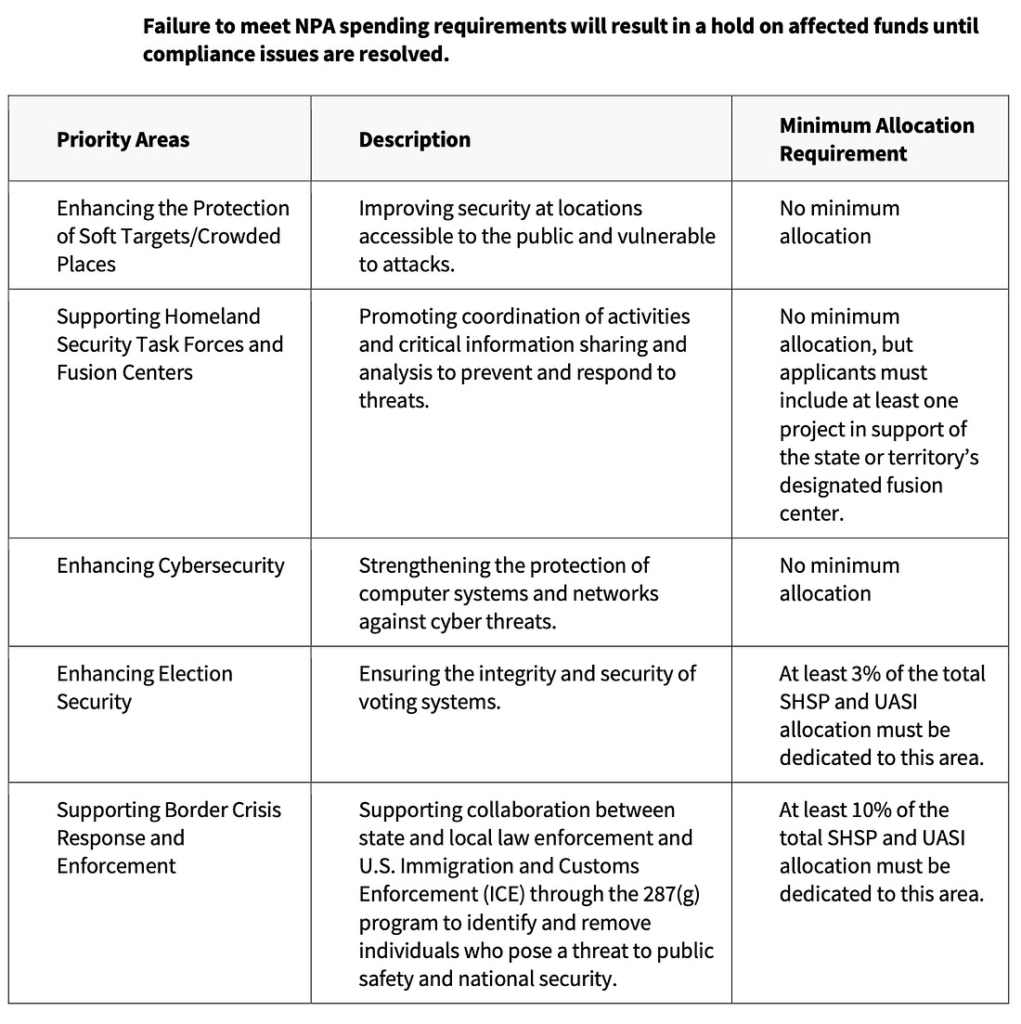
“Failure to meet NPA [National Priority Areas] spending requirements will result in a hold on affected funds until compliance issues are resolved.”

Screenshot of Homeland Security Grant Program Notice

Homeland Security Grant Program Notice1.29MB ∙ PDF file
Download

That second document, a Department of Homeland Security grant program notice, is a $1 billion shopping list of available federal money. But there’s a catch: thirty-five percent, it says, must go to terrorism prevention. Another thirty percent is allocated for five designated Department of Homeland Security priorities:

  1. “Supporting Border Crisis Response,”
  2. “Enhancing Election Security”
  3. “Supporting Homeland Security Task Forces and Fusion Centers”
  4. “Enhancing the Protection of Soft Targets/Crowded Places”
  5. “Enhancing Cybersecurity”

The priorities track the president’s own preoccupations. Just this month, Trump gave a primetime address claiming China had compromised the 2020 election. The “border crisis response” priority, meanwhile, points states straight at ICE’s 287(g) program — which, as I’ve reported, turns local law enforcement into bounty hunters by paying them to do immigration enforcement, including bonuses tied to how many people they find. The “Homeland Security Task Forces” priority refers the new federal-local strike forces Trump created by executive order on his first day back in office to hunt cartels and enforce immigration laws.

And the “crowded places” priority has its own ghost: the assassination of conservative activist Charlie Kirk, shot in front of a crowd at a university event last September.

That murder is what precipitated all of this. Three days after signing an executive order declaring “Antifa” a domestic terrorist organization, Trump issued NSPM-7 on September 25, 2025 — a national security order that opens with a reference to Kirk’s murder and builds a counterterrorism program meant to prevent the next one.

NSPM-7 asserts that political violence in America “does not emerge organically” but is the product of “sophisticated, organized campaigns.” It identifies the common threads it wants investigated: “anti-Americanism, anti-capitalism, and anti-Christianity; support for the overthrow of the United States Government; extremism on migration, race, and gender; and hostility towards those who hold traditional American views on family, religion, and morality.”

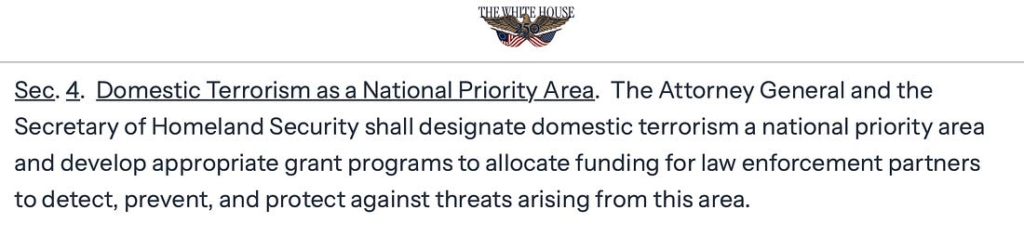
Until now, NSPM-7 has largely pointed at federal machinery, like the FBI and IRS. But a brief section toward the bottom of NSPM-7 reaches down to your county sheriff. It orders the homeland security secretary to develop grant programs to pay local law enforcement to go after domestic terrorism.

Screenshot of NSPM-7 order


Washington knew this would happen, long before Trump entered the White House.

FEMA was created in 1979 as an independent agency. But after the 9/11 attacks, in 2003 it was folded into the new counterterrorism-focused Department of Homeland Security. FEMA’s preparedness functions and grant programs were pulled out and scattered across the department.

That September, the undersecretary for emergency preparedness and response sent Homeland Security Secretary Tom Ridge a seven-page memo warning that the reorganization would cripple America’s ability to respond to disasters. He was overruled. Two years later came Katrina.

By October 2012, a bipartisan congressional investigation reported that the Department of Homeland Security could not say how much it had spent on fusion centers (the state and regional intelligence hubs, built after 9/11, where local police, federal agents and analysts pool information). DHS’s own estimates ranged from $289 million to $1.4 billion. The intelligence coming out of them was “of uneven quality,” the Senate concluded, finding it “oftentimes shoddy, rarely timely, sometimes endangering citizens’ civil liberties.”

Reviewing thirteen months of fusion center reporting, investigators found nothing that uncovered a terrorist threat and no contribution to disrupting an active plot. Of 610 reports, 188 were never published, many because they lacked useful information or risked violating civil liberties protections. Among the reports flagged: a Muslim community group’s book recommendations, parenting advice, and a motorcycle club’s pamphlet advising members to be polite to police during traffic stops.

Fourteen years later, the machine is being handed a mandate to watch digital footprints for indicators of anti-American sentiment.

FEMA, meanwhile, has absorbed roughly a 14 percent workforce reduction since January 2025 while managing more than 300,000 projects across more than 600 open disaster declarations.

Even in my little corner of the world, in Wisconsin, I can see how desperately the country needs a functioning disaster response agency. Yesterday afternoon a tornado came through the Fox Valley, about a hundred miles northeast of where I live. The National Weather Service issued a Particularly Dangerous Situation warning, a designation it saves for the worst of them. Video of what it left behind is heartbreaking and all over social media today: homes torn open, everything inside gone.

I’m sure the people who lost their homes will be relieved to know that they’re safe from domestic terrorism.

What is needed now is the thing FEMA was actually created to do, done by a civil agency neither militarized nor given over to an anti-political terrorism agenda. Instead we see a climate-change denying, domestic terrorism-obsessed administration creating its own disaster, with a do-nothing Congress standing idly by.

It’s insane how little media coverage stories like these get. Help me do more of them by becoming a paid subscriber (or chipping in via my GoFundMe here).

Upgrade to paid

Leave a comment

Share

— Edited by William M. Arkin

Book: “Why Fascists Fear Teachers: Public Education and the Future of Democracy”

Why Fascists Fear Teachers: Public Education and the Future of Democracy

Randi Weingarten

America’s most influential teacher’s union leader tells the anti-fascist history of public education, warning that American teachers today are under a new fascist assault–from book bans to culture wars and organized groups of “concerned” parents dictating what can be taught.

In 1940, as Hitler was gaining power and territory across Europe, a Nazi puppet government was put in power in Norway.  Teachers were among the first to publicly resist their rule—and they were winning. Frustrated that their attempts to recruit teachers into the party failed, the Nazis barged into Norway’s schools, beating teachers and students. When they still refused to submit, the Nazis closed the schools.  But the teachers figured out how to teach in private.  Increasingly incensed, the fascist government sent 1,300 teachers to concentration camps and 500 others to forced labor camps.  Even there, teachers kept teaching–and students kept learning how to think for themselves.  

As the head of one of the largest teacher’s union in the country, Randi Weingarten sees firsthand how today’s teachers are guarding American democracy against the threat of fascism. Drawing on history and decades of experience in the American public school system, she argues that teaching students to think critically is the key to defeating would-be dictators. She encourages teachers to continue promoting difference and healthy debate in their classrooms, and warns against censorship and complacency, looking to history to warn us all about what can happen if we devalue teachers and public schools.

Part history and part call to arms, Why Fascists Fear Teachers is a manifesto for American teachers from the author that Trump-appointed former Secretary of State Mike Pompeo once called “the most dangerous person in the world.” This deeply researched, urgent book from teachers’ greatest champion is necessary reading for our times.

(Goodreads.com)

By 22-Point Margin, Americans Think Netanyahu Should Be Arrested on US Soil

Trump-Netanyahu meeting in Washington DC

US President Donald Trump meets Israeli Prime Minister Benjamin Netanyahu at White House in Washington DC on July 28, 2026. 

(Photo by Maâayan Toaf GPO/Handout/Anadolu via Getty Images)

“Prime Minister Netanyahu has a warrant out for his arrest for committing war crimes,” said one Democratic senator. “He should be nowhere close to the Oval Office of the president of the United States.”

Julia Conley

Jul 28, 2026 (CommonDreams.org)

As with his proposals for government-run grocery stores and a tax on the second homes owned by rich New Yorkers, New York City Mayor Zohran Mamdani’s recent call for Israeli Prime Minister Benjamin Netanyahu, an accused war criminal, to be arrested on US soil sparked outrage among Trump administration officials and others on the right.

And just like his other proposals, despite the claims that the mayor’s comments displayed “extreme views” and were dangerous and divisive, Mamdani’s demand that the US execute the International Criminal Court’s (ICC) arrest warrant for Netanyahu is broadly supported by the public.

RECOMMENDED…

New York City Mayor Zohran Mamdani

Netanyahu ‘Should Be Arrested and Tried,’ Says Mamdani, But NYC Lacks Authority to Detain Him

President Trump Meets With Visiting Israeli PM Netanyahu At The White House

As Mamdani Cites ICC Warrant, Trump Says ‘Netanyahu Will Not Be Arrested’ in NYC

poll taken by The Economist/YouGov between July 25-27 found that 49% of Americans believe the US should arrest Netanyahu, who arrived in Washington, DC on Monday to meet with President Donald Trump and attend the late Sen. Lindsey Graham’s (R-SC) funeral.

Just 27% of respondents said the US should not execute the warrant, while 23% were unsure, according to the poll released Tuesday.

X post: https://x.com/prem_thakker/status/2082125709737075070?ref_src=twsrc%5Etfw%7Ctwcamp%5Etweetembed%7Ctwterm%5E2082125709737075070%7Ctwgr%5E907d3ef8b05ac17c1102a08f732aaa1c50a5eaea%7Ctwcon%5Es1_c10&ref_url=https%3A%2F%2Fwww.commondreams.org%2Fnews%2Fis-netanyahu-wanted-by-the-icc

Nearly a quarter of people who voted for Trump in 2024 agreed with Mamdani, as well as 21% of people who identified themselves as supporters of Trump’s MAGA political movement. The view was also held by 68% of Democrats and 55% of Independents, as well as 24% of Republican voters.

Forty-seven percent of respondents also said they believed Netanyahu was guilty of war crimes.

With Americans increasingly disapproving of Israel and the powerful pro-Israel lobby, sympathizing with Palestinians, and now backing the arrest of Netanyahu by an “overwhelming margin,” said the Institute for Middle East Understanding, Trump is nevertheless “welcoming him back into the White House to lobby for more impunity, more war, and more of our tax dollars going to Israel.”

Columbia University professor Anthony Zenkus wrote that while nearly half of Americans believe the US should execute the ICC warrant, “we’ve got prominent Democrats and Republicans and their online supporters calling Mamdani a terrorist for wanting to do that very thing.”

Sen. John Fetterman (D-Pa.) and Trump’s ambassador to the United Nations, Mike Waltz, are among those who have condemned Mamdani’s demand for Netanyahu’s arrest. Waltz said the US would not execute the warrant because the country, like Israel, is not party to the Rome Statute, which established the ICC, and does not recognize the court’s authority. Secretary of State Marco Rubio has threatened to “dismantle” the court.

On Tuesday, Sen. Chris Van Hollen (D-Md.) denounced the White House for hosting the Israeli prime minister while Israel is “wrongfully detaining an American citizen,” 20-year-old student Sama Safi, who was detained in the West Bank on June 2.

“As I speak, we’ve not been able to get justice for American citizens killed by violent Israeli settlers or by the IDF,” Van Hollen continued, referring to the Israel Defense Forces. “As I speak, Palestinians in the West Bank are under violent assault by Israeli terrorists who are terrorizing Palestinian villages, lighting mosques on fire, torching cars, pushing Palestinians off their lands, killing innocent Palestinians.”

“When Donald Trump meets with Bibi Netanyahu, things don’t go well for the United States of America,” said the senator, noting that five months after Israel convinced the administration to launch an “illegal war against Iran,” American soldiers are being killed and injured in the region.

“On top of all that,” said Van Hollen, “Prime Minister Netanyahu has a warrant out for his arrest for committing war crimes. He should be nowhere close to the Oval Office of the president of the United States.”

Our work is licensed under Creative Commons (CC BY-NC-ND 3.0). Feel free to republish and share widely.

Julia Conley

Julia Conley is a senior editor and staff writer for Common Dreams.

Full Bio >

After 43 Days of Silence, Kentucky’s Dem Governor Calls on McConnell to Prove He Can Serve or Resign

Mitch McConnell 4/30/26

Sen. Mitch McConnell (R-Ky) makes his way to a vote in the US Capitol on April 30, 2026. 

(Photo by Tom Williams/CQ-Roll Call, Inc. via Getty Images)

“Kentuckians are just asking you to be honest,” said Gov. Andy Beshear.

Stephen Prager

Jul 28, 2026 (CommonDreams.org)

After weeks of sitting on his hands, Kentucky’s Democratic Gov. Andy Beshear issued an ultimatum to the state’s absentee Sen. Mitch McConnell on Tuesday: Prove you’re alive and can do the job or step down.

Since he was hospitalized on June 14, McConnell’s 4.6 million constituents have been left with virtually no answers about the 84-year-old Republican’s condition, leading to rampant speculation of a cover-up.

RECOMMENDED…

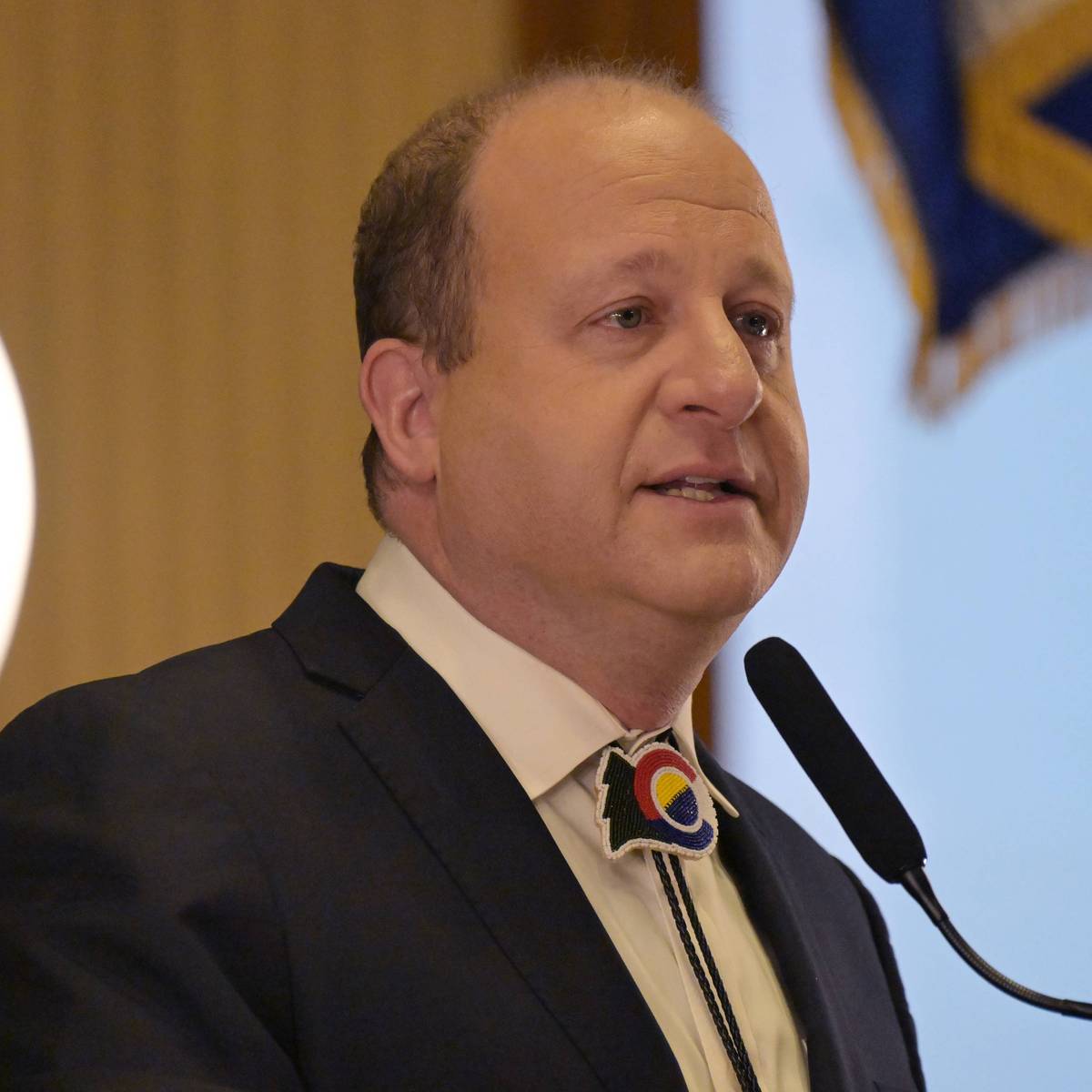
Jared Polis

Colorado Governor Fires Officials Who Criticized Democrat’s Release of Election-Denying Clerk

Hegseth Is Demanding US Households Pay $5,000 More Per Year to Fund the Pentagon, Economist Says

Hegseth Is Demanding US Households Pay $5,000 More Per Year to Fund the Pentagon, Economist Says

Some even pondered whether the former Senate Republican leader may have shuffled off this mortal coil altogether, but that his staff was keeping mum until the presumptive August 3 deadline to avoid a special election that could lead to suboptimal results for the GOP.

Beshear, who has the power to call a special election to fill vacant Senate seats, had chastized McConnell and his staff for weeks for the lack of transparency about his condition. But he continued to balk about taking action, even as members of his party begged him to “do something.”

That is, until Monday, when McConnell’s office released an update from his physician, which stated that the senator was undergoing “a strenuous course of physical therapy and rehabilitation” but was “not yet medically cleared to leave the rehab facility and return to the office.”

Beshear finally sent McConnell a letter demanding proof of life.

X post: https://x.com/PollTracker2024/status/2082124565774233638?ref_src=twsrc%5Etfw%7Ctwcamp%5Etweetembed%7Ctwterm%5E2082124565774233638%7Ctwgr%5E2cdd4384654dcefeb7f86eb883864a8b18a94328%7Ctwcon%5Es1_c10&ref_url=https%3A%2F%2Fwww.commondreams.org%2Fnews%2Fbeshear-mcconnell-proof-of-life

“It has now been 43 days since news of your hospitalization,” Beshear wrote. “During that time you have cast zero votes, engaged in no official activities, and aside from two photos and corresponding statements, have made no effort to communicate with your Kentucky constituents or the nation.”

The governor noted that the physician’s statement still provided no details about the seven-term senator’s actual condition, “including whether you can speak, reason, or carry out your duties as a senator.”

“As governor of the state you serve,” Beshear continued, “I am calling on you to directly and verbally address the people of Kentucky and provide proof of your capacity to serve, or resign.”

Beshear said he’d sent the same letter to Senate Majority Leader John Thune (R-SD), who took over McConnell’s longtime role in 2025 before he announced his plans not to run for reelection.

Beshear said if McConnell still proved “unwilling” to demonstrate his capacity to serve, he’d insist Thune—one of the few people who claim to have spoken to McConnell since he vanished from public view—fully investigate his condition.

“All of this speculation and even this letter could have been avoided with a minimal amount of transparency,” Beshear concluded. “Kentuckians are just asking you to be honest.”

While most states allow governors to name an interim replacement when senators die or get expelled, Kentucky is one of just four exceptions, ironically thanks to some classic McConnell machinations.

In 2021, the then-Senate minority leader pressured Kentucky’s GOP-controlled Legislature to restrict Beshear’s power to unilaterally name a replacement, instead requiring him to pick from a list approved by the departing senator’s party.

Three years later, Kentucky abolished temporary replacements entirely, meaning the most Beshear could do was call a special election.

That said, the law has not yet been tested by a vacancy, and Beshear has said he’d be willing to challenge its constitutionality in hopes of naming the replacement himself, adding a 48th member to the chamber’s Democratic caucus, at least until January, when it would be filled by whoever wins McConnell’s seat during November’s midterms.

While Kentucky is a consistently red state and has not elected a Democratic senator since 1992, Beshear’s multiple terms as governor show it is capable of electing Democrats in statewide races, and could be more likely to do so in what is projected to be a blue wave year.

But Kentucky’s law also says special elections must be called at least 63 days before they occur. This gives Republicans ample incentive to keep McConnell as Schrödinger’s senator until at least August 3, after which a replacement would not be able to take office until the new Senate term begins in January.

In an interview with Bloomberg on Tuesday, Beshear argued that McConnell’s absence for the rest of the year “might not be a bad thing.”

“McConnell hasn’t been there to vote on the SAVE Act, which would tear voting rights away. He hasn’t been there to vote to support this war on Iran that this president started and shouldn’t be continuing,” Beshear said. “Not having Mitch McConnell show up isn’t necessarily a bad thing because he certainly doesn’t show up to help the American people.”

Our work is licensed under Creative Commons (CC BY-NC-ND 3.0). Feel free to republish and share widely.

Stephen Prager

Stephen Prager is a staff writer for Common Dreams.

Full Bio >

Book: “Considerations on Representative Government”

Considerations on Representative Government

John Stuart Mill

In this powerful work, John Stuart Mill sets forth representative government as the most sensible compromise between unreflective rule by the masses and the self-indulgence of the few. The reader may sense that Mill is being pulled in opposing steadfastly committed to majority rule with minority rights while at the same time being just enough of an aristocrat to believe that the masses need examplars to emulate.On Representative Government is one of the most compelling political essays of the 19th century.


About the author

John Stuart Mill

John Stuart Mill, English philosopher, political economist, civil servant and Member of Parliament, was an influential liberal thinker of the 19th century. He was an exponent of utilitarianism, an ethical theory developed by Jeremy Bentham, although his conception of it was very different from Bentham’s.

(Goodreads.com)

Book: “This Is The Plan: How to End America’s Meltdown and Save Democracy”

  • This Is The Plan: How to End America's Meltdown and Save Democracy

This Is The Plan: How to End America’s Meltdown and Save Democracy

by Ben Wikler (Author)  Format: Hardcover


“Ben Wikler is one of the most strategic and respected leaders of his generation. If we do what this book says, we will win.”―Nancy Pelosi

From the most successful Democratic operative of the last decade, a revelatory account of what you―yes, you―can do to defeat Trumpism.

If you are looking at the spiraling crisis of American politics in the Trump era and wondering how the hell we get out of this mess, This Is the Plan is the book you’ve been waiting for.

Ben Wikler led the Democratic Party of Wisconsin to a string of improbable victories in a state with a political system so rigged that it was dubbed a “democracy desert”―which is, coincidentally, Trump’s goal for the whole country.

Now, in This Is the Plan, Wikler distills lessons from the front lines in America’s most closely divided state to map out a comprehensive plan to dictator-proof American government, defeat MAGA at every level of the ballot, and build a future of democracy, opportunity, and freedom for all.

It will be a blast. The plan is to, as he writes, “have fun storming the castle―in a civil, metaphorical, and non-January-6th-y way.”

Drawing on decades of organizing, from local races (including a race for county coroner that hinged on the issue of zombification) to presidential showdowns, Wikler brings us behind the scenes to explore the hidden structures of power that shape our politics and our lives, and takes us into the art and science of winning elections. As he details a people-powered path out of the political wilderness, Wikler reveals what you personally can do to move the needle.

This Is the Plan reveals, year by year and step by step, a vision not only to end America’s collapse into authoritarianism but also to reconnect us to our neighbors―and, fighting side by side for democracy, to build meaning, community, and joy.

(Amazon.com)

Your weekly to-dos

  1. Join our Hands Off Our Vote kickoff call THIS Thursday, July 30 for the national launch of our campaign to protect every single vote from Trump’s election subversion (8pm ET/5pm PT). Don’t wait until October to get into election protection formation! Our work starts NOW to build the foundation for an unshakeable movement equipped to defend voting rights and mobilize in rapid response moments if and when Republicans try to undermine free and fair elections. No matter where you live, you can help ensure every vote is counted this November.
  2. Call your US senators and demand they oppose Jay Clayton — another of Trump’s lackeys and golfing buddies — for Director of National Intelligence. The Senate is voting on Clayton’s nomination TONIGHT. Outside of the very basic and disqualifying problem that Clayton has almost no experience tackling intelligence issues, he refused to say that Joe Biden fairly won the 2020 election during his Senate confirmation hearing. We absolutely cannot afford another Trump loyalist at the helm of American intelligence — the implications for surveillance and opportunities for abuse of information are endless. After you’ve called, follow up with a quick email.
  3. Then, call your US senators and tell them to oppose legislation that would entrench Trump-Netanyahu military partnership. Last week, the House narrowly passed the National Defense Authorization Act (NDAA) with provisions that would further interweave the US and the Israeli militaries through weapons development and intelligence sharing. However, Democrats were nearly united in opposition — proof that we do not have to rubber-stamp Trump’s partnership with Netanyahu. Our senators must reject these provisions in the NDAA, but they need to hear from their constituents. For further reading, check out today’s Substack post for more history, context, and actions you can take.
  4. While your Members of Congress are home for August recess, use our Indivisible resources to schedule an in-district visit or event. If you have Republican Members of Congress, this is a great opportunity to raise your voice in opposition to their attempts to pass voter suppression legislation, pour billions into Trump’s illegal war, and hand more money over to ICE and CBP. If you have Democratic Members of Congress, urge them to refuse to give a single inch to Trump’s authoritarian takeover and illegal and unconstitutional power grabs. Read on for more about the August recess and what our MoCs left unaddressed until September.
  5. With just EIGHT days until Abdul El-Sayed’s Senate primary, join a phonebank for Indivisible’s endorsed candidates in Michigan this Thursday, July 30 or next Monday, August 3 (5:30pm ET/2:30pm PT). El-Sayed is up against a record amount of outside spending for his establishment Dem, Schumer-backed opponent Haley Stevens. With $50 million pouring in to prop up Stevens, we need to bring the people power to this race to help El-Sayed across the finish line. You’ll also get to talk to voters about Donavan McKinney (MI-13) and William Lawrence (MI-07), our other Michigan endorsees. Paid for by Indivisible Action. Not authorized by any candidate or candidate

‘I’m Humbled Beyond Words’: Troy Jackson Raises $2 Million After Maine Senate Nomination

Maine Democrats Senate Nomination Convention 2026

Troy Jackson, Democratic nominee for Maine Senate, greets delegates after winning the vote at the Maine Democrats Senate Nominating Convention in Bangor, Maine, on July 25, 2026.

 (Photo by Tom Williams/CQ-Roll Call, Inc. via Getty Images)

“People across Maine and the country are ready to come together and finish the job” of defeating Susan Collins, said the Democratic candidate.

Julia Conley

Jul 27, 2026 (CommonDreams.org)

With Maine Republican Sen. Susan Collins backed by nearly 100 billionaires, Democratic Senate candidate Troy Jackson has been open about the fact that beating Collins in November will be an uphill battle—but he said Monday that $2 million that’s poured in from small donors in recent days gave him hope about the “extraordinary grassroots momentum” behind his campaign.

Jackson officially became the Democratic nominee on Saturday at the party’s convention—planned in a matter of weeks after former nominee Graham Platner dropped out due to rape allegations—with Democrats across the state apparently eager to throw their support behind a candidate who backs the same progressive policies that his predecessor did.

RECOMMENDED…

Troy Jackson pumps his fist in the air after being nominated for US Senate

‘30 Years of Collins. 100 Days to End It’: Maine Dems Nominate Troy Jackson for Senate

ICE Officers Fatally Shoot Undocumented Immigrant In Maine

‘Working-Class Organizing Wins’: Troy Jackson Pulls Ahead in Race to Replace Platner in Maine

Since securing the nomination, said Jackson’s campaign Monday, he has raised $2 million from more than 58,000 donors, including 30,000 new contributors.

“I’m humbled beyond words by the tens of thousands of people who have stepped up to become part of this campaign,” said Jackson in a statement. “Every contribution—whether it was $5, $20, or more—is a vote of confidence in the working-class movement we’re building together.”

Without a billionaire-backed super political action committee (PAC) like the one set up by Collins’ allies, Pine Tree Results—which is planning to spend $20 million on attack ads against Jackson this fall, according to The New York Times, the fifth-generation logger and former state Senate president is relying on donations that must be $3,500 or smaller per donor.

Collins’ campaign and her allies have reserved about $60 million in air time for ads through the fall, according to AdImpact, while the Democrats have allocated about $24 million for ads in Maine.

Jackson told The New York Times Monday that he will likely need to raise at least $40 million-$50 million to beat Collins due to her fundraising advantage, but emphasized that he believes he is in a good position to win voters over based on the issues they’ll be voting on in November.

“I’m going to definitely bust my ass in these next four months to make up the difference,” Jackson said regarding the fundraising challenge. “And in the end, I think I’m on the right side of the issues compared to Susan Collins. So I feel very good about the race.”

Jackson is a strong supporter of Medicare for Allabolishing US Immigration and Customs Enforcement, ending US military support for Israel, and taxing the ultrawealthy and corporations to address massive wealth inequality in the US—all issues that are increasingly popular with voters.

“In the end, I think I’m on the right side of the issues compared to Susan Collins. So I feel very good about the race.”

He has condemned Collins, the chair of the powerful Senate Appropriations Committee, in recent weeks for backing President Donald Trump’s agenda and for her vote to fund ICE earlier this year—expressing anger over the vote after a federal agent fatally shot a young father in Biddeford, Maine earlier this month.

A poll released by University of New Hampshire last week showed 49% of respondents backing Jackson, compared with 46% who supported Collins.

“Susan Collins has spent years voting with Donald Trump 96% of the time, helping him stack the Supreme Court to overturn Roe v. Wade and supporting an agenda that guts healthcare while handing more power to billionaires and corporations,” said Jackson Monday. “Defeating her won’t be easy, and we’ll need everyone in this fight.”

The early fundraising numbers, said Jackson, prove “that people across Maine and the country are ready to come together and finish the job.”

Our work is licensed under Creative Commons (CC BY-NC-ND 3.0). Feel free to republish and share widely.

Julia Conley

Julia Conley is a senior editor and staff writer for Common Dreams.

Full Bio >