New Video Emerges of ICE Arresting Oakland Woman at Denver Airport

26 July 2026/SF News/Zack Ruskin

New video footage shows ICE agents arresting Chantal Morales Rojas, 27, of Ecuador, at Denver International Airport earlier this week. Currently employed as an au pair in Oakland, Rojas was in Denver to visit with her former host family.

Bay Area resident Alycia Dantzker told ABC 7 that she happened to be on the same flight as Rojas because both were in town for an ultimate frisbee tournament hosted by the family in question. Dantzker began filming after a man approached Rojas and started asking questions about her immigration status.

He was soon joined by “additional people in civilian clothes” who gathered around Rojas on the jetway before she was ultimately taken into custody.

Dantzker says she’s known Rojas for three years and described her to ABC 7 as someone with “a lot of wisdom and just really, really smart and incredibly kind and caring.” Before her tenure in Oakland, according to Dantzker, Rojas also worked as an au pair for a family in Santa Cruz County. They later moved to Denver, prompting the recent visit.

In a statement provided to American Community Media, ICE alleges that Rojas overstayed her visa, claiming it expired in January 2025.

But Laura Lichter, one of Rojas’ attorneys, disputes this account.

Video: https://abc7news.com/video/embed?pid=19580404

Speaking with American Community Media, Lichter asserts that Rojas followed all the rules of her visa program:

“Chantal came to the United States lawfully in early 2023 on a J-1 exchange visitor visa as an au pair. She followed the rules of her program and, before it ended, timely filed an application with U.S. immigration authorities that allowed her to remain in the country while her case has been pending.”

Rojas is currently being held at an ICE detention facility in Colorado and told Dantzker that the experience has been “a nightmare” to endure, per ABC 7. Attorneys for Rojas have filed a habeas petition in hopes of seeking her release.

Per American Community Media, Rojas’ arrest comes “amid a dramatic uptick in immigrant detentions, with ICE reporting some 43,000 arrests in June of this year.”

Earlier this week, SFist reported on video footage showing ICE forcibly detaining a 38-year-old Ukrainian woman at SFO.

RelatedWoman From Ukraine Forcibly Detained at SFO In Viral Video; Feds Say She Overstayed Her Visa

Image: Denver International Airport (Dillon Wanner/Unsplash)

How Morocco wiped the floor with California in the game of high-speed rail

By Joe Mathews, Contributing Columnist July 26, 2026

Gift Article (SFChronicle.com)

A TGV high-speed train awaits passengers at the Casablanca railway station in Morocco.Andia/Andia/Universal Images Group via

The automated English voice over the loudspeaker is polite and American-accented.

“For your convenience, we invite you to make your phone calls from the platform between the cars.”

I am sitting in a plush green seat. Outside, the landscape blurs into a familiar tapestry of scrub, yellowing grasses, eucalyptus trees, oaks, and waves from a west-facing seacoast. If I could ignore the French and Arabic conversations on the double-deck railcar, I might think I’m on a California high-speed train cutting through the Inland Empire or Central Coast.Advertisement

But this isn’t the Golden State. And I can’t travel through time to the distant decade when California actually gets high-speed rail.

I am riding (in late June) the first and only high-speed railway in Africa. It’s called Al Boraq (“The Lightning” in Arabic). It’s run by Morocco’s national rail company, ONCF.

My trek runs the line’s full length. I board on the Atlantic coast at Casablanca’s 10-track station, which has Starbucks, McDonald’s, and glowing arrivals screens. I disembark at Tangier’s station, 400 meters from the Mediterranean. The schedule says the train will arrive in 2 hours,17 minutes. Before Al Boraq opened in 2018, the same route took 5 hours.

Yes, you read that right. Morocco has high-speed rail. And California has excuses.

The comparison between these two places might seem random, but it’s revelatory. Morocco and California are remarkably similar in size (Morocco is 172,000 square miles, California 163,000) and in population (California is 40 million, Morocco 38.4 million). Both are long and narrow places on a continent’s edge, with coastal cities, glorious beaches, interior deserts, and heavily irrigated agriculture.

The big difference is that California is more than 20 times richer. Morocco is a lower-middle-income country (96th in the world rankings) with a GDP of $182 billion. California’s economy is creeping toward $4 trillion.

Yet California claims it doesn’t have enough money for high-speed rail, while Morocco built a 323-kilometer (201-mile) line across floodplains, requiring 286 engineering structures and 13 viaducts—including the landmark 3.5-kilometer Hachef viaduct south of Tangier.

How did Morocco pull this off? The answer lies in international partnership, structural simplicity, and raw political will.

Morocco’s Al Boraq line cost a mere $15 million per mile, one of the lowest high-speed rail construction prices in the world. For context, the first, 171-mile Bakersfield-to-Merced segment of California’s line is projected at $35 billion, more than $200 million per mile.

Morocco achieved this efficiency through partnership with France’s national railway, SNCF, and the engineering giant Alstom, so high-speed rail experts worked with Moroccan teams for every major task. Morocco also used four existing stations for its first line, rather than build new ones.

California, by contrast, has hired a rotating cast of executives and outside consultants who have bloated the project’s budget to more than $125 billion, while delaying its expected opening until 2033.

You can quibble with just how “high-speed” Al Boraq is — unless you’re a Californian. The train runs on conventional, shared slower tracks from dense, urban Casablanca, to its first stop, Rabat. Slowing the train in that segment was a pragmatic compromise that allowed the line to open quickly—at a station with links to the Casablanca airport — and start generating revenue and public adoration.

Which it has.

Trains are full (both of my Al Boraq trips were packed) with young crowds. Transportation officials told me the loans for the project may be paid back early.

As the train reaches Kenitra, 45 minutes north of Rabat, tracks become dedicated, high-speed only. The train races first to 161 mph and then to 192 mph on the journey north to Tangier. 

This coastal line is merely Phase 1 of a 1,500-kilometer high-speed network, slated for completion by 2030, when Morocco is co-hosting the 2030 FIFA World Cup.

The next steps, already underway, include dedicated high-speed service between Rabat and Kenitra (construction I saw in progress), new commuter rail for Casablanca, and a brand-new high-speed line south from Casablanca to Marrakech and onward to Agadir. From Tangier to Agadir is the distance of San Francisco to San Diego.

Yes, Morocco is highly centralized. When King Mohammed VI — the wealthiest individual in the country — decides a train will be built, it gets built. Nor must Morocco contend with California’s labyrinth of zoning, lawsuits, and YIMBY-NIMBY politics.

But attributing Morocco’s triumph to autocracy misses the point. Morocco’s success is rooted in things California desperately lacks: a reliance on institutional expertise rather than contractors and consultants, and a refusal to let the perfect be the enemy of the fast.

About Opinion

Guest opinions in Open Forum and Insight are produced by writers with expertise, personal experience or original insights on a subject of interest to our readers. Their views do not necessarily reflect the opinion of The Chronicle editorial board, which is committed to providing a diversity of ideas to our readership.

Read more about our transparency and ethics policies

As my train reaches the Tangier station right on schedule — exactly 2 hours, 17 minutes — I feel respect and frustration in equal measure. The North African kingdom has lessons to teach our state. Are Californians willing to listen?

Joe Mathews writes the Connecting California column for Zócalo Public Square.lkmn krtdf


July 26, 2026

Joe Mathews

Syndicated columnist

Joe Mathews is Connecting California columnist and California editor at Zócalo Public Square, an Ideas Exchange that is a project of New America and Arizona State University.

Meditations On Moloch

Posted on July 30, 2014 by Scott Alexander (slatestarcodex.com)

I.

Allen Ginsberg’s famous poem on Moloch:

What sphinx of cement and aluminum bashed open their skulls and ate up their brains and imagination?

Moloch! Solitude! Filth! Ugliness! Ashcans and unobtainable dollars! Children screaming under the stairways! Boys sobbing in armies! Old men weeping in the parks!

Moloch! Moloch! Nightmare of Moloch! Moloch the loveless! Mental Moloch! Moloch the heavy judger of men!

Moloch the incomprehensible prison! Moloch the crossbone soulless jailhouse and Congress of sorrows! Moloch whose buildings are judgment! Moloch the vast stone of war! Moloch the stunned governments!

Moloch whose mind is pure machinery! Moloch whose blood is running money! Moloch whose fingers are ten armies! Moloch whose breast is a cannibal dynamo! Moloch whose ear is a smoking tomb!

Moloch whose eyes are a thousand blind windows! Moloch whose skyscrapers stand in the long streets like endless Jehovahs! Moloch whose factories dream and croak in the fog! Moloch whose smoke-stacks and antennae crown the cities!

Moloch whose love is endless oil and stone! Moloch whose soul is electricity and banks! Moloch whose poverty is the specter of genius! Moloch whose fate is a cloud of sexless hydrogen! Moloch whose name is the Mind!

Moloch in whom I sit lonely! Moloch in whom I dream Angels! Crazy in Moloch! Cocksucker in Moloch! Lacklove and manless in Moloch!

Moloch who entered my soul early! Moloch in whom I am a consciousness without a body! Moloch who frightened me out of my natural ecstasy! Moloch whom I abandon! Wake up in Moloch! Light streaming out of the sky!

Moloch! Moloch! Robot apartments! invisible suburbs! skeleton treasuries! blind capitals! demonic industries! spectral nations! invincible madhouses! granite cocks! monstrous bombs!

They broke their backs lifting Moloch to Heaven! Pavements, trees, radios, tons! lifting the city to Heaven which exists and is everywhere about us!

Visions! omens! hallucinations! miracles! ecstasies! gone down the American river!

Dreams! adorations! illuminations! religions! the whole boatload of sensitive bullshit!

Breakthroughs! over the river! flips and crucifixions! gone down the flood! Highs! Epiphanies! Despairs! Ten years’ animal screams and suicides! Minds! New loves! Mad generation! down on the rocks of Time!

Real holy laughter in the river! They saw it all! the wild eyes! the holy yells! They bade farewell! They jumped off the roof! to solitude! waving! carrying flowers! Down to the river! into the street!

What’s always impressed me about this poem is its conception of civilization as an individual entity. You can almost see him, with his fingers of armies and his skyscraper-window eyes.

A lot of the commentators say Moloch represents capitalism. This is definitely a piece of it, even a big piece. But it doesn’t quite fit. Capitalism, whose fate is a cloud of sexless hydrogen? Capitalism in whom I am a consciousness without a body? Capitalism, therefore granite cocks?

Moloch is introduced as the answer to a question – C. S. Lewis’ question in Hierarchy Of Philosophers – what does it? Earth could be fair, and all men glad and wise. Instead we have prisons, smokestacks, asylums. What sphinx of cement and aluminum breaks open their skulls and eats up their imagination?

And Ginsberg answers: Moloch does it.

There’s a passage in the Principia Discordia where Malaclypse complains to the Goddess about the evils of human society. “Everyone is hurting each other, the planet is rampant with injustices, whole societies plunder groups of their own people, mothers imprison sons, children perish while brothers war.”

The Goddess answers: “What is the matter with that, if it’s what you want to do?”

Malaclypse: “But nobody wants it! Everybody hates it!”

Goddess: “Oh. Well, then stop.”

The implicit question is – if everyone hates the current system, who perpetuates it? And Ginsberg answers: “Moloch”. It’s powerful not because it’s correct – nobody literally thinks an ancient Carthaginian demon causes everything – but because thinking of the system as an agent throws into relief the degree to which the system isn’t an agent.

Bostrom makes an offhanded reference of the possibility of a dictatorless dystopia, one that every single citizen including the leadership hates but which nevertheless endures unconquered. It’s easy enough to imagine such a state. Imagine a country with two rules: first, every person must spend eight hours a day giving themselves strong electric shocks. Second, if anyone fails to follow a rule (including this one), or speaks out against it, or fails to enforce it, all citizens must unite to kill that person. Suppose these rules were well-enough established by tradition that everyone expected them to be enforced.

So you shock yourself for eight hours a day, because you know if you don’t everyone else will kill you, because if they don’t, everyone else will kill them, and so on. Every single citizen hates the system, but for lack of a good coordination mechanism it endures. From a god’s-eye-view, we can optimize the system to “everyone agrees to stop doing this at once”, but no one within the system is able to effect the transition without great risk to themselves.

And okay, this example is kind of contrived. So let’s run through – let’s say ten – real world examples of similar multipolar traps to really hammer in how important this is.

1. The Prisoner’s Dilemma, as played by two very dumb libertarians who keep ending up on defect-defect. There’s a much better outcome available if they could figure out the coordination, but coordination is hard. From a god’s-eye-view, we can agree that cooperate-cooperate is a better outcome than defect-defect, but neither prisoner within the system can make it happen.

2. Dollar auctions. I wrote about this and even more convoluted versions of the same principle in Game Theory As A Dark Art. Using some weird auction rules, you can take advantage of poor coordination to make someone pay $10 for a one dollar bill. From a god’s-eye-view, clearly people should not pay $10 for a on-er. From within the system, each individual step taken might be rational.

(Ashcans and unobtainable dollars!)

3. The fish farming story from my Non-Libertarian FAQ 2.0:

As a thought experiment, let’s consider aquaculture (fish farming) in a lake. Imagine a lake with a thousand identical fish farms owned by a thousand competing companies. Each fish farm earns a profit of $1000/month. For a while, all is well.

But each fish farm produces waste, which fouls the water in the lake. Let’s say each fish farm produces enough pollution to lower productivity in the lake by $1/month.

A thousand fish farms produce enough waste to lower productivity by $1000/month, meaning none of the fish farms are making any money. Capitalism to the rescue: someone invents a complex filtering system that removes waste products. It costs $300/month to operate. All fish farms voluntarily install it, the pollution ends, and the fish farms are now making a profit of $700/month – still a respectable sum.

But one farmer (let’s call him Steve) gets tired of spending the money to operate his filter. Now one fish farm worth of waste is polluting the lake, lowering productivity by $1. Steve earns $999 profit, and everyone else earns $699 profit.

Everyone else sees Steve is much more profitable than they are, because he’s not spending the maintenance costs on his filter. They disconnect their filters too.

Once four hundred people disconnect their filters, Steve is earning $600/month – less than he would be if he and everyone else had kept their filters on! And the poor virtuous filter users are only making $300. Steve goes around to everyone, saying “Wait! We all need to make a voluntary pact to use filters! Otherwise, everyone’s productivity goes down.”

Everyone agrees with him, and they all sign the Filter Pact, except one person who is sort of a jerk. Let’s call him Mike. Now everyone is back using filters again, except Mike. Mike earns $999/month, and everyone else earns $699/month. Slowly, people start thinking they too should be getting big bucks like Mike, and disconnect their filter for $300 extra profit…

A self-interested person never has any incentive to use a filter. A self-interested person has some incentive to sign a pact to make everyone use a filter, but in many cases has a stronger incentive to wait for everyone else to sign such a pact but opt out himself. This can lead to an undesirable equilibrium in which no one will sign such a pact.

The more I think about it, the more I feel like this is the core of my objection to libertarianism, and that Non-Libertarian FAQ 3.0 will just be this one example copy-pasted two hundred times. From a god’s-eye-view, we can say that polluting the lake leads to bad consequences. From within the system, no individual can prevent the lake from being polluted, and buying a filter might not be such a good idea.

4. The Malthusian trap, at least at its extremely pure theoretical limits. Suppose you are one of the first rats introduced onto a pristine island. It is full of yummy plants and you live an idyllic life lounging about, eating, and composing great works of art (you’re one of those rats from The Rats of NIMH).

You live a long life, mate, and have a dozen children. All of them have a dozen children, and so on. In a couple generations, the island has ten thousand rats and has reached its carrying capacity. Now there’s not enough food and space to go around, and a certain percent of each new generation dies in order to keep the population steady at ten thousand.

A certain sect of rats abandons art in order to devote more of their time to scrounging for survival. Each generation, a bit less of this sect dies than members of the mainstream, until after a while, no rat composes any art at all, and any sect of rats who try to bring it back will go extinct within a few generations.

In fact, it’s not just art. Any sect at all that is leaner, meaner, and more survivalist than the mainstream will eventually take over. If one sect of rats altruistically decides to limit its offspring to two per couple in order to decrease overpopulation, that sect will die out, swarmed out of existence by its more numerous enemies. If one sect of rats starts practicing cannibalism, and finds it gives them an advantage over their fellows, it will eventually take over and reach fixation.

If some rat scientists predict that depletion of the island’s nut stores is accelerating at a dangerous rate and they will soon be exhausted completely, a few sects of rats might try to limit their nut consumption to a sustainable level. Those rats will be outcompeted by their more selfish cousins. Eventually the nuts will be exhausted, most of the rats will die off, and the cycle will begin again. Any sect of rats advocating some action to stop the cycle will be outcompeted by their cousins for whom advocating anything is a waste of time that could be used to compete and consume.

For a bunch of reasons evolution is not quite as Malthusian as the ideal case, but it provides the prototype example we can apply to other things to see the underlying mechanism. From a god’s-eye-view, it’s easy to say the rats should maintain a comfortably low population. From within the system, each individual rat will follow its genetic imperative and the island will end up in an endless boom-bust cycle.

5. Capitalism. Imagine a capitalist in a cutthroat industry. He employs workers in a sweatshop to sew garments, which he sells at minimal profit. Maybe he would like to pay his workers more, or give them nicer working conditions. But he can’t, because that would raise the price of his products and he would be outcompeted by his cheaper rivals and go bankrupt. Maybe many of his rivals are nice people who would like to pay their workers more, but unless they have some kind of ironclad guarantee that none of them are going to defect by undercutting their prices they can’t do it.

Like the rats, who gradually lose all values except sheer competition, so companies in an economic environment of sufficiently intense competition are forced to abandon all values except optimizing-for-profit or else be outcompeted by companies that optimized for profit better and so can sell the same service at a lower price.

(I’m not really sure how widely people appreciate the value of analogizing capitalism to evolution. Fit companies – defined as those that make the customer want to buy from them – survive, expand, and inspire future efforts, and unfit companies – defined as those no one wants to buy from – go bankrupt and die out along with their company DNA. The reasons Nature is red and tooth and claw are the same reasons the market is ruthless and exploitative)

From a god’s-eye-view, we can contrive a friendly industry where every company pays its workers a living wage. From within the system, there’s no way to enact it.

(Moloch whose love is endless oil and stone! Moloch whose blood is running money!)

6. The Two-Income Trap, as recently discussed on this blog. It theorized that sufficiently intense competition for suburban houses in good school districts meant that people had to throw away lots of other values – time at home with their children, financial security – to optimize for house-buying-ability or else be consigned to the ghetto.

From a god’s-eye-view, if everyone agrees not to take on a second job to help win their competition for nice houses, then everyone will get exactly as nice a house as they did before, but only have to work one job. From within the system, absent a government literally willing to ban second jobs, everyone who doesn’t get one will be left behind.

(Robot apartments! Invisible suburbs!)

7. Agriculture. Jared Diamond calls it the worst mistake in human history. Whether or not it was a mistake, it wasn’t an accident – agricultural civilizations simply outcompeted nomadic ones, inevitable and irresistably. Classic Malthusian trap. Maybe hunting-gathering was more enjoyable, higher life expectancy, and more conducive to human flourishing – but in a state of sufficiently intense competition between peoples, in which agriculture with all its disease and oppression and pestilence was the more competitive option, everyone will end up agriculturalists or go the way of the Comanche Indians.

From a god’s-eye-view, it’s easy to see everyone should keep the more enjoyable option and stay hunter-gatherers. From within the system, each individual tribe only faces the choice of going agricultural or inevitably dying.

8. Arms races. Large countries can spend anywhere from 5% to 30% of their budget on defense. In the absence of war – a condition which has mostly held for the past fifty years – all this does is sap money away from infrastructure, health, education, or economic growth. But any country that fails to spend enough money on defense risks being invaded by a neighboring country that did. Therefore, almost all countries try to spend some money on defense.

From a god’s-eye-view, the best solution is world peace and no country having an army at all. From within the system, no country can unilaterally enforce that, so their best option is to keep on throwing their money into missiles that lie in silos unused.

(Moloch the vast stone of war! Moloch whose fingers are ten armies!)

9. Cancer. The human body is supposed to be made up of cells living harmoniously and pooling their resources for the greater good of the organism. If a cell defects from this equilibrium by investing its resources into copying itself, it and its descendants will flourish, eventually outcompeting all the other cells and taking over the body – at which point it dies. Or the situation may repeat, with certain cancer cells defecting against the rest of the tumor, thus slowing down its growth and causing the tumor to stagnate.

From a god’s-eye-view, the best solution is all cells cooperating so that they don’t all die. From within the system, cancerous cells will proliferate and outcompete the other – so that only the existence of the immune system keeps the natural incentive to turn cancerous in check.

10. The “race to the bottom” describes a political situation where some jurisdictions lure businesses by promising lower taxes and fewer regulations. The end result is that either everyone optimizes for competitiveness – by having minimal tax rates and regulations – or they lose all of their business, revenue, and jobs to people who did (at which point they are pushed out and replaced by a government who will be more compliant).

But even though the last one has stolen the name, all these scenarios are in fact a race to the bottom. Once one agent learns how to become more competitive by sacrificing a common value, all its competitors must also sacrifice that value or be outcompeted and replaced by the less scrupulous. Therefore, the system is likely to end up with everyone once again equally competitive, but the sacrificed value is gone forever. From a god’s-eye-view, the competitors know they will all be worse off if they defect, but from within the system, given insufficient coordination it’s impossible to avoid.

Before we go on, there’s a slightly different form of multi-agent trap worth investigating. In this one, the competition is kept at bay by some outside force – usually social stigma. As a result, there’s not actually a race to the bottom – the system can continue functioning at a relatively high level – but it’s impossible to optimize and resources are consistently thrown away for no reason. Lest you get exhausted before we even begin, I’ll limit myself to four examples here.

11. Education. In my essay on reactionary philosophy, I talk about my frustration with education reform:

People ask why we can’t reform the education system. But right now students’ incentive is to go to the most prestigious college they can get into so employers will hire them – whether or not they learn anything. Employers’ incentive is to get students from the most prestigious college they can so that they can defend their decision to their boss if it goes wrong – whether or not the college provides value added. And colleges’ incentive is to do whatever it takes to get more prestige, as measured in US News and World Report rankings – whether or not it helps students. Does this lead to huge waste and poor education? Yes. Could the Education God notice this and make some Education Decrees that lead to a vastly more efficient system? Easily! But since there’s no Education God everybody is just going to follow their own incentives, which are only partly correlated with education or efficiency.

From a god’s eye view, it’s easy to say things like “Students should only go to college if they think they will get something out of it, and employers should hire applicants based on their competence and not on what college they went to”. From within the system, everyone’s already following their own incentives correctly, so unless the incentives change the system won’t either.

12. Science. Same essay:

The modern research community knows they aren’t producing the best science they could be. There’s lots of publication bias, statistics are done in a confusing and misleading way out of sheer inertia, and replications often happen very late or not at all. And sometimes someone will say something like “I can’t believe people are too dumb to fix Science. All we would have to do is require early registration of studies to avoid publication bias, turn this new and powerful statistical technique into the new standard, and accord higher status to scientists who do replication experiments. It would be really simple and it would vastly increase scientific progress. I must just be smarter than all existing scientists, since I’m able to think of this and they aren’t.”

And yeah. That would work for the Science God. He could just make a Science Decree that everyone has to use the right statistics, and make another Science Decree that everyone must accord replications higher status.

But things that work from a god’s-eye view don’t work from within the system. No individual scientist has an incentive to unilaterally switch to the new statistical technique for her own research, since it would make her research less likely to produce earth-shattering results and since it would just confuse all the other scientists. They just have an incentive to want everybody else to do it, at which point they would follow along. And no individual journal has an incentive to unilaterally switch to early registration and publishing negative results, since it would just mean their results are less interesting than that other journal who only publishes ground-breaking discoveries. From within the system, everyone is following their own incentives and will continue to do so.

13. Government corruption. I don’t know of anyone who really thinks, in a principled way, that corporate welfare is a good idea. But the government still manages to spend somewhere around (depending on how you calculate it) $100 billion dollars a year on it – which for example is three times the amount they spend on health care for the needy. Everyone familiar with the problem has come up with the same easy solution: stop giving so much corporate welfare. Why doesn’t it happen?

Government are competing against one another to get elected or promoted. And suppose part of optimizing for electability is optimizing campaign donations from corporations – or maybe it isn’t, but officials think it is. Officials who try to mess with corporate welfare may lose the support of corporations and be outcompeted by officials who promise to keep it intact.

So although from a god’s-eye-view everyone knows that eliminating corporate welfare is the best solution, each individual official’s personal incentives push her to maintain it.

14. Congress. Only 9% of Americans like it, suggesting a lower approval rating than cockroaches, head lice, or traffic jams. However, 62% of people who know who their own Congressional representative is approve of them. In theory, it should be really hard to have a democratically elected body that maintains a 9% approval rating for more than one election cycle. In practice, every representative’s incentive is to appeal to his or her constituency while throwing the rest of the country under the bus – something at which they apparently succeed.

From a god’s-eye-view, every Congressperson ought to think only of the good of the nation. From within the system, you do what gets you elected.

II.

A basic principle unites all of the multipolar traps above. In some competition optimizing for X, the opportunity arises to throw some other value under the bus for improved X. Those who take it prosper. Those who don’t take it die out. Eventually, everyone’s relative status is about the same as before, but everyone’s absolute status is worse than before. The process continues until all other values that can be traded off have been – in other words, until human ingenuity cannot possibly figure out a way to make things any worse.

In a sufficiently intense competition (1-10), everyone who doesn’t throw all their values under the bus dies out – think of the poor rats who wouldn’t stop making art. This is the infamous Malthusian trap, where everyone is reduced to “subsistence”.

In an insufficiently intense competition (11-14), all we see is a perverse failure to optimize – consider the journals which can’t switch to more reliable science, or the legislators who can’t get their act together and eliminate corporate welfare. It may not reduce people to subsistence, but there is a weird sense in which it takes away their free will.

Every two-bit author and philosopher has to write their own utopia. Most of them are legitimately pretty nice. In fact, it’s a pretty good bet that two utopias that are polar opposites both sound better than our own world.

It’s kind of embarrassing that random nobodies can think up states of affairs better than the one we actually live in. And in fact most of them can’t. A lot of utopias sweep the hard problems under the rug, or would fall apart in ten minutes if actually implemented.

But let me suggest a couple of “utopias” that don’t have this problem.

– The utopia where instead of the government paying lots of corporate welfare, the government doesn’t pay lots of corporate welfare.

– The utopia where every country’s military is 50% smaller than it is today, and the savings go into infrastructure spending.

– The utopia where all hospitals use the same electronic medical record system, or at least medical record systems that can talk to each other, so that doctors can look up what the doctor you saw last week in a different hospital decided instead of running all the same tests over again for $5000.

I don’t think there are too many people who oppose any of these utopias. If they’re not happening, it’s not because people don’t support them. It certainly isn’t because nobody’s thought of them, since I just thought of them right now and I don’t expect my “discovery” to be hailed as particularly novel or change the world.

Any human with above room temperature IQ can design a utopia. The reason our current system isn’t a utopia is that it wasn’t designed by humans. Just as you can look at an arid terrain and determine what shape a river will one day take by assuming water will obey gravity, so you can look at a civilization and determine what shape its institutions will one day take by assuming people will obey incentives.

But that means that just as the shapes of rivers are not designed for beauty or navigation, but rather an artifact of randomly determined terrain, so institutions will not be designed for prosperity or justice, but rather an artifact of randomly determined initial conditions.

Just as people can level terrain and build canals, so people can alter the incentive landscape in order to build better institutions. But they can only do so when they are incentivized to do so, which is not always. As a result, some pretty wild tributaries and rapids form in some very strange places.

I will now jump from boring game theory stuff to what might be the closest thing to a mystical experience I’ve ever had.

Like all good mystical experiences, it happened in Vegas. I was standing on top of one of their many tall buildings, looking down at the city below, all lit up in the dark. If you’ve never been to Vegas, it is really impressive. Skyscrapers and lights in every variety strange and beautiful all clustered together. And I had two thoughts, crystal clear:

It is glorious that we can create something like this.

It is shameful that we did.

Like, by what standard is building gigantic forty-story-high indoor replicas of Venice, Paris, Rome, Egypt, and Camelot side-by-side, filled with albino tigers, in the middle of the most inhospitable desert in North America, a remotely sane use of our civilization’s limited resources?

And it occurred to me that maybe there is no philosophy on Earth that would endorse the existence of Las Vegas. Even Objectivism, which is usually my go-to philosophy for justifying the excesses of capitalism, at least grounds it in the belief that capitalism improves people’s lives. Henry Ford was virtuous because he allowed lots of otherwise car-less people to obtain cars and so made them better off. What does Vegas do? Promise a bunch of shmucks free money and not give it to them.

Las Vegas doesn’t exist because of some decision to hedonically optimize civilization, it exists because of a quirk in dopaminergic reward circuits, plus the microstructure of an uneven regulatory environment, plus Schelling points. A rational central planner with a god’s-eye-view, contemplating these facts, might have thought “Hm, dopaminergic reward circuits have a quirk where certain tasks with slightly negative risk-benefit ratios get an emotional valence associated with slightly positive risk-benefit ratios, let’s see if we can educate people to beware of that.” People within the system, following the incentives created by these facts, think: “Let’s build a forty-story-high indoor replica of ancient Rome full of albino tigers in the middle of the desert, and so become slightly richer than people who didn’t!”

Just as the course of a river is latent in a terrain even before the first rain falls on it – so the existence of Caesar’s Palace was latent in neurobiology, economics, and regulatory regimes even before it existed. The entrepreneur who built it was just filling in the ghostly lines with real concrete.

So we have all this amazing technological and cognitive energy, the brilliance of the human species, wasted on reciting the lines written by poorly evolved cellular receptors and blind economics, like gods being ordered around by a moron.

Some people have mystical experiences and see God. There in Las Vegas, I saw Moloch.

(Moloch, whose mind is pure machinery! Moloch, whose blood is running money!

Moloch whose soul is electricity and banks! Moloch, whose skyscrapers stand in the long streets like endless Jehovahs!

Moloch! Moloch! Robot apartments! Invisible suburbs! Skeleton treasuries! Blind capitals! Demonic industries! Spectral nations!)

…granite cocks!

III.

The Apocrypha Discordia says:

Time flows like a river. Which is to say, downhill. We can tell this because everything is going downhill rapidly. It would seem prudent to be somewhere else when we reach the sea.

Let’s take this random gag 100% literally and see where it leads us.

We just analogized the flow of incentives to the flow of a river. The downhill trajectory is appropriate: the traps happen when you find an opportunity to trade off a useful value for greater competitiveness. Once everyone has it, the greater competitiveness brings you no joy – but the value is lost forever. Therefore, each step of the Poor Coordination Polka makes your life worse.

But not only have we not yet reached the sea, but we also seem to move uphill surprisingly often. Why do things not degenerate more and more until we are back at subsistence level? I can think of three bad reasons – excess resources, physical limitations, and utility maximization – plus one good reason – coordination.

1. Excess resources. The ocean depths are a horrible place with little light, few resources, and various horrible organisms dedicated to eating or parasitizing one another. But every so often, a whale carcass falls to the bottom of the sea. More food than the organisms that find it could ever possibly want. There’s a brief period of miraculous plenty, while the couple of creatures that first encounter the whale feed like kings. Eventually more animals discover the carcass, the faster-breeding animals in the carcass multiply, the whale is gradually consumed, and everyone sighs and goes back to living in a Malthusian death-trap.

(Slate Star Codex: Your source for macabre whale metaphors since June 2014)

It’s as if a group of those rats who had abandoned art and turned to cannibalism suddenly was blown away to a new empty island with a much higher carrying capacity, where they would once again have the breathing room to live in peace and create artistic masterpieces.

This is an age of whalefall, an age of excess carrying capacity, an age when we suddenly find ourselves with a thousand-mile head start on Malthus. As Hanson puts it, this is the dream time.

As long as resources aren’t scarce enough to lock us in a war of all against all, we can do silly non-optimal things – like art and music and philosophy and love – and not be outcompeted by merciless killing machines most of the time.

2. Physical limitations. Imagine a profit-maximizing slavemaster who decided to cut costs by not feeding his slaves or letting them sleep. He would soon find that his slaves’ productivity dropped off drastically, and that no amount of whipping them could restore it. Eventually after testing numerous strategies, he might find his slaves got the most work done when they were well-fed and well-rested and had at least a little bit of time to relax. Not because the slaves were voluntarily withholding their labor – we assume the fear of punishment is enough to make them work as hard as they can – but because the body has certain physical limitations that limit how mean you can get away with being. Thus, the “race to the bottom” stops somewhere short of the actual ethical bottom, when the physical limits are run into.

John Moes, a historian of slavery, goes further and writes about how the slavery we are most familiar with – that of the antebellum South – is a historical aberration and probably economically inefficient. In most past forms of slavery – especially those of the ancient world – it was common for slaves to be paid wages, treated well, and often given their freedom.

He argues that this was the result of rational economic calculation. You can incentivize slaves through the carrot or the stick, and the stick isn’t very good. You can’t watch slaves all the time, and it’s really hard to tell whether a slave is slacking off or not (or even whether, given a little more whipping, he might be able to work even harder). If you want your slaves to do anything more complicated than pick cotton, you run into some serious monitoring problems – how do you profit from an enslaved philosopher? Whip him really hard until he elucidates a theory of The Good that you can sell books about?

The ancient solution to the problem – perhaps an early inspiration to Fnargl – was to tell the slave to go do whatever he wanted and found most profitable, then split the profits with him. Sometimes the slave would work a job at your workshop and you would pay him wages based on how well he did. Other times the slave would go off and make his way in the world and send you some of what he earned. Still other times, you would set a price for the slave’s freedom, and the slave would go and work and eventually come up with the mone and free himself.

Moes goes even further and says that these systems were so profitable that there were constant smouldering attempts to try this sort of thing in the American South. The reason they stuck with the whips-and-chains method owed less to economic considerations and more to racist government officials cracking down on lucrative but not-exactly-white-supremacy-promoting attempts to free slaves and have them go into business.

So in this case, a race to the bottom where competing plantations become crueler and crueler to their slaves in order to maximize competitiveness is halted by the physical limitation of cruelty not helping after a certain point.

Or to give another example, one of the reasons we’re not currently in a Malthusian population explosion right now is that women can only have one baby per nine months. If those weird religious sects that demand their members have as many babies as possible could copy-paste themselves, we would be in really bad shape. As it is they can only do a small amount of damage per generation.

3. Utility maximization. We’ve been thinking in terms of preserving values versus winning competitions, and expecting optimizing for the latter to destroy the former.

But many of the most important competitions / optimization processes in modern civilization are optimizing for human values. You win at capitalism partly by satisfying customers’ values. You win at democracy partly by satisfying voters’ values.

Suppose there’s a coffee plantation somewhere in Ethiopia that employs Ethiopians to grow coffee beans that get sold to the United States. Maybe it’s locked in a life-and-death struggle with other coffee plantations and want to throw as many values under the bus as it can to pick up a slight advantage.

But it can’t sacrifice quality of coffee produced too much, or else the Americans won’t buy it. And it can’t sacrifice wages or working conditions too much, or else the Ethiopians won’t work there. And in fact, part of its competition-optimization process is finding the best ways to attract workers and customers that it can, as long as it doesn’t cost them too much money. So this is very promising.

But it’s important to remember exactly how fragile this beneficial equilibrium is.

Suppose the coffee plantations discover a toxic pesticide that will increase their yield but make their customers sick. But their customers don’t know about the pesticide, and the government hasn’t caught up to regulating it yet. Now there’s a tiny uncoupling between “selling to Americans” and “satisfying Americans’ values”, and so of course Americans’ values get thrown under the bus.

Or suppose that there’s a baby boom in Ethiopia and suddenly there are five workers competing for each job. Now the company can afford to lower wages and implement cruel working conditions down to whatever the physical limits are. As soon as there’s an uncoupling between “getting Ethiopians to work here” and “satisfying Ethiopian values”, it doesn’t look too good for Ethiopian values either.

Or suppose someone invents a robot that can pick coffee better and cheaper than a human. The company fires all its laborers and throws them onto the street to die. As soon as the utility of the Ethiopians is no longer necessary for profit, all pressure to maintain it disappears.

Or suppose that there is some important value that is neither a value of the employees or the customers. Maybe the coffee plantations are on the habitat of a rare tropical bird that environmentalist groups want to protect. Maybe they’re on the ancestral burial ground of a tribe different from the one the plantation is employing, and they want it respected in some way. Maybe coffee growing contributes to global warming somehow. As long as it’s not a value that will prevent the average American from buying from them or the average Ethiopian from working for them, under the bus it goes.

I know that “capitalists sometimes do bad things” isn’t exactly an original talking point. But I do want to stress how it’s not equivalent to “capitalists are greedy”. I mean, sometimes they are greedy. But other times they’re just in a sufficiently intense competition where anyone who doesn’t do it will be outcompeted and replaced by people who do. Business practices are set by Moloch, no one else has any choice in the matter.

(from my very little knowledge of Marx, he understands this very very well and people who summarize him as “capitalists are greedy” are doing him a disservice)

And as well understood as the capitalist example is, I think it is less well appreciated that democracy has the same problems. Yes, in theory it’s optimizing for voter happiness which correlates with good policymaking. But as soon as there’s the slightest disconnect between good policymaking and electability, good policymaking has to get thrown under the bus.

For example, ever-increasing prison terms are unfair to inmates and unfair to the society that has to pay for them. Politicans are unwilling to do anything about them because they don’t want to look “soft on crime”, and if a single inmate whom they helped release ever does anything bad (and statistically one of them will have to) it will be all over the airwaves as “Convict released by Congressman’s policies kills family of five, how can the Congressman even sleep at night let alone claim he deserves reelection?”. So even if decreasing prison populations would be good policy – and it is – it will be very difficult to implement.

(Moloch the incomprehensible prison! Moloch the crossbone soulless jailhouse and Congress of sorrows! Moloch whose buildings are judgment! Moloch the stunned governments!)

Turning “satisfying customers” and “satisfying citizens” into the outputs of optimization processes was one of civilization’s greatest advances and the reason why capitalist democracies have so outperformed other systems. But if we have bound Moloch as our servant, the bonds are not very strong, and we sometimes find that the tasks he has done for us move to his advantage rather than ours.

4. Coordination.

The opposite of a trap is a garden.

Things are easy to solve from a god’s-eye-view, so if everyone comes together into a superorganism, that superorganism can solve problems with ease and finesse. An intense competition between agents has turned into a garden, with a single gardener dictating where everything should go and removing elements that do not conform to the pattern.

As I pointed out in the Non-Libertarian FAQ, government can easily solve the pollution problem with fish farms. The best known solution to the Prisoners’ Dilemma is for the mob boss (playing the role of a governor) to threaten to shoot any prisoner who defects. The solution to companies polluting and harming workers is government regulations against such. Governments solve arm races within a country by maintaining a monopoly on the use of force, and it’s easy to see that if a truly effective world government ever arose, international military buildups would end pretty quickly.

The two active ingredients of government are laws plus violence – or more abstractly agreements plus enforcement mechanism. Many other things besides governments share these two active ingredients and so are able to act as coordination mechanisms to avoid traps.

For example, since students are competing against each other (directly if classes are graded on a curve, but always indirectly for college admissions, jobs, et cetera) there is intense pressure for individual students to cheat. The teacher and school play the role of a government by having rules (for example, against cheating) and the ability to punish students who break them.

But the emergent social structure of the students themselves is also a sort of government. If students shun and distrust cheaters, then there are rules (don’t cheat) and an enforcement mechanism (or else we will shun you).

Social codes, gentlemens’ agreements, industrial guilds, criminal organizations, traditions, friendships, schools, corporations, and religions are all coordinating institutions that keep us out of traps by changing our incentives.

Continue reading

“Past is F*ing Prologue,” – The Origins of the Roger Stone-Donald Trump Relationship and the Ghost of Political Scandals Past

Peter Grant

Peter Grant

Jul 12, 2022 (Medium.com)

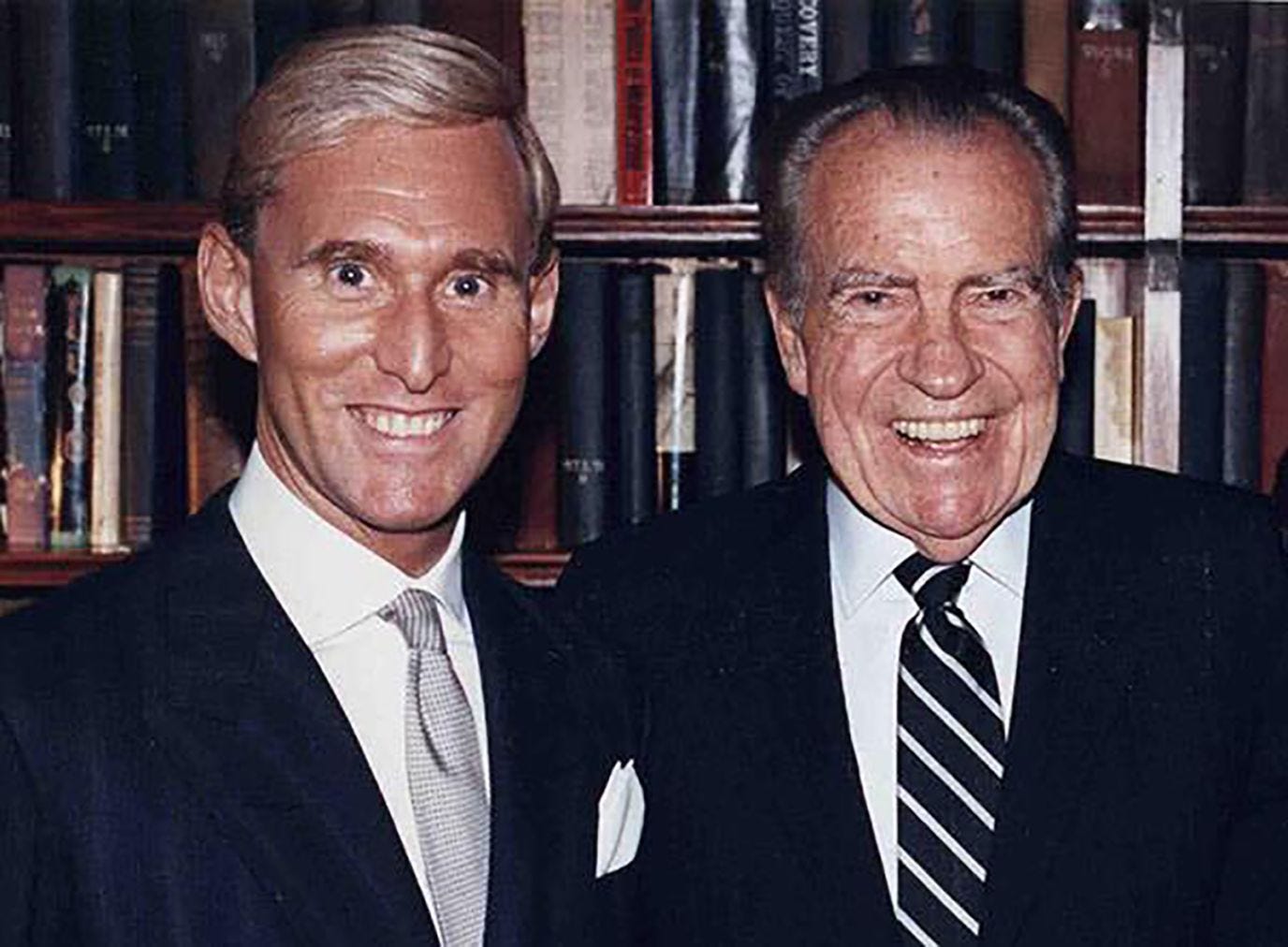
Roger Stone with former President Richard Nixon

“Past is fucking prologue,” — Stone’s Rule #4

This article is an excerpt from my book, While We Slept: Vladimir Putin, Donald Trump, and the Corruption of American Democracy, available here.

ROGER STONE AND THE JANUARY 6TH INSURRECTION

Convicted felon Roger Stone, one of America’s most infamous masters of the political dark arts and a longtime friend and advisor to former President Donald Trump, has come under renewed scrutiny for his promotion of the “Big Lie” that the 2020 election was stolen and for his activities in and around the January 6th insurrection.

Despite achieving prominence following the 2020 election, the idea that the election would be “rigged” against Trump was actually formulated and promulgated before the 2016 election.

The “Stop the Steal” rally that Trump addressed on January 6th immediately prior to the assault on the Capitol borrowed the phrase “Stop the Steal” from Stone, who had coined it as far back the 2016 Republican primaries.

In 2015, Stone facilitated Donald Trump’s first interview with Alex Jones of InfoWars. Jones, America’s most prominent conspiracy theorist, later introduced the idea that the 2016 election was going to be “rigged” against Trump.

Two days after Jones did so, Trump echoed the idea that the upcoming election would be “rigged” at a rally in Columbus, Ohio held on August 1st, 2016. Thus a seed was planted that would germinate for over five years. While Trump’s upset victory in 2016 obviated the need for the “Big Lie,” it was dusted off and put back into use after he lost the 2020 election.

Alex Jones interviewing Donald Trump on his program InforWars in December of 2015. The interview was facilitated by Roger Stone.

Stone is also linked to groups that were centrally involved in the storming of the U.S. Capitol, including the Proud Boys and the Oath Keepers.

Early in the Trump presidency, Stone was a central figure in the so-called “Russia investigation” conducted by the FBI and Special Counsel Robert Mueller.

At critical moments during the 2016 election, Stone was in touch with an online avatar operated by Russian military intelligence, the entity that hacked the Democratic National Committee and the Hillary Clinton Campaign and later provided the stolen emails to Wikileaks.

Shortly thereafter, Stone made public statements which suggested that he had prior, non-public knowledge that Wikileaks was in possession of Clinton campaign chairman John Podesta’s stolen emails.

Investigators have never been able to determine how Stone came into possession of this information. The investigation into Stone was obstructed and Trump later pardoned his old friend.

Stone lied under oath in testimony relating to these matters before Congress. He was subsequently indicted by Mueller’s prosecutors, with additional charges such as witness tampering to follow.

After being arrested and released on bail, Stone began interacting and coordinating with the now notorious right-wing group the Proud Boys, who occasionally served as his “body guards” during the various rallies and legal proceedings that followed.

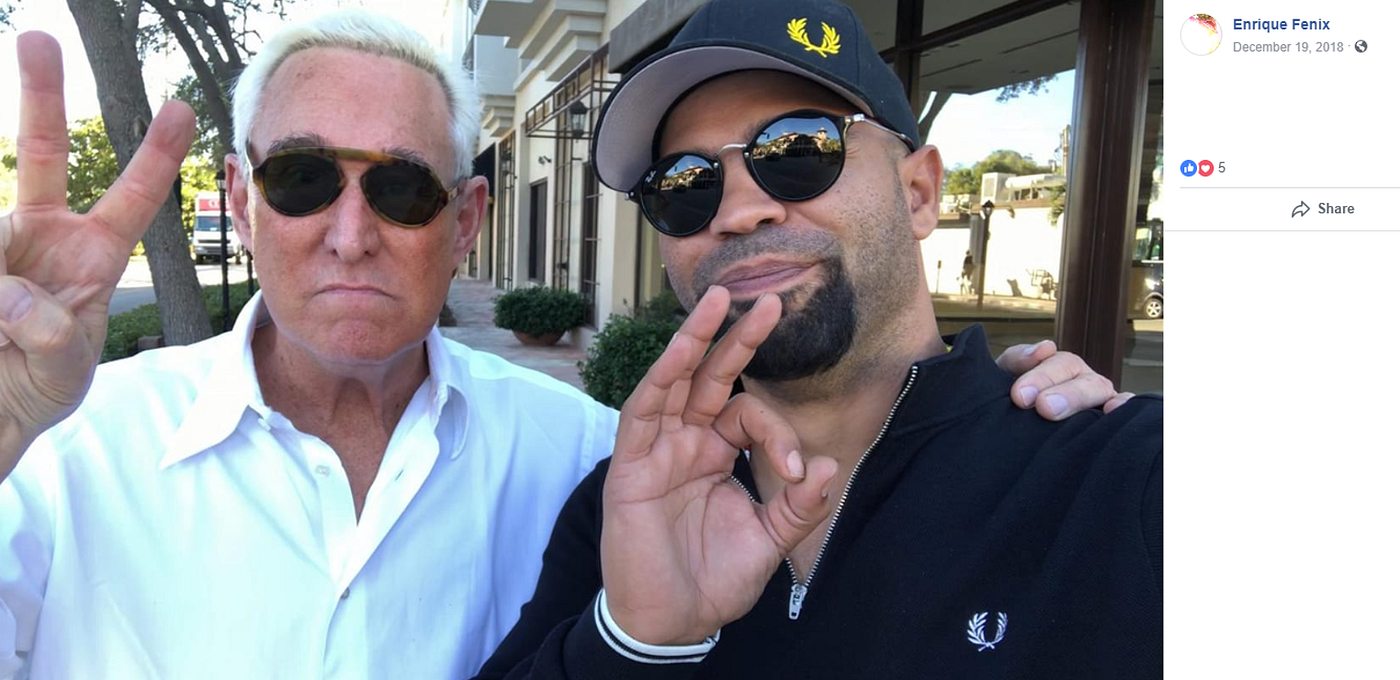
Stone became friendly with Enrique “Ricky” Tarrio, the leader of the Proud Boys who is currently under indictment for seditious conspiracy.

According to the Washington Postthe FBI is investigating Stone and Alex Jones’ connections to the Proud Boys.

Roger Stone with Enrique “Ricky” Tarrio, the leader of the Proud Boys currently under indictment for seditious conspiracy related to the events of January 6th.

The far-right militia group the Oath Keepers, members of which are also currently under indictment for seditious conspiracy for storming the U.S. Capital, also have links to Roger Stone. During the protests in and around Washington, D.C. on January 5th and 6th, members of the Oath Keepers provided Roger Stone with security.

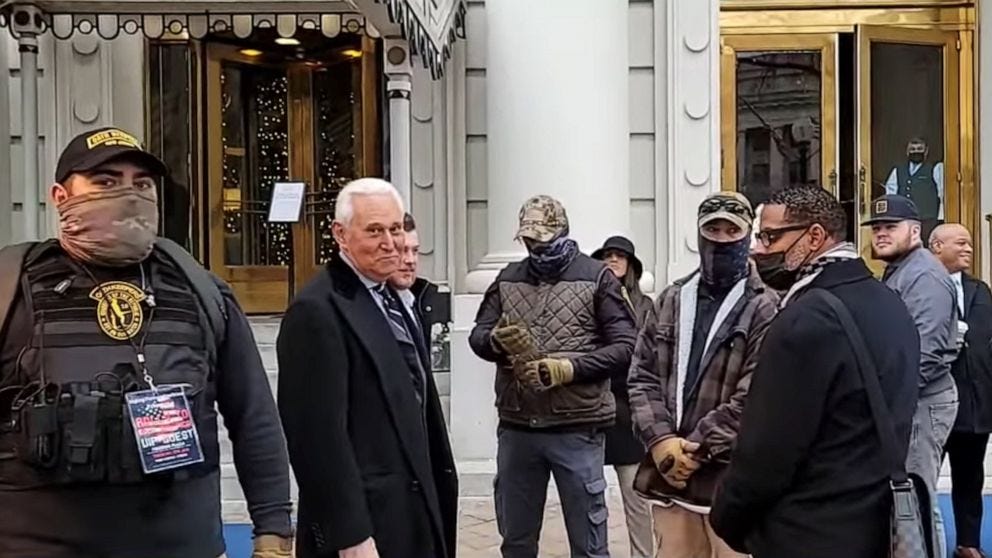
Oath Keeper Roberto Minuta, who is named in the indictment alongside Oath Keeper leader Elmer “Stewart” Rhodes, was seen with Stone outside the Willard hotel in Washington, D.C. on the morning of January 6th. Alex Jones was also staying in a suite at the Willard Hotel, where he interviewed former Trump National Security Advisor Michael Flynn, one of the lead cheerleaders of the “rigged” election canard.

In another suite was located the so-called “Command Center” where, at various times, Trump lawyers Rudy Giuliani and John Eastman, among others, plotted to overturn the results of the 2020 election in the lead up to, and during, the January 6th insurrection.

Roger Stone seen outside of the Willard Hotel Roberto Minuta (far left), a member of the Oath Keepers currently under indictment for seditious conspiracy.

The exact role Roger Stone played in the unprecedented events of the January 6th insurrection remains to be fully explained. The path that led him to January 6th involves decades worth of involvement in political scandals, corruption, and criminal election stunts.

Stone developed an early conviction that American elections are often determined by dirty tricks, criminal associations and subterfuge. An account of Stone’s life, and the story of the circumstances by which he met Donald Trump, paints a disturbing picture.

ROGER STONE, RICHARD NIXON, AND WATERGATE

Roger Stone was born in 1952 and grew up in Lewisboro, New York. Half Italian and half Hungarian, Stone’s mother wrote for a local newspaper and his father was a laborer who dug wells for a living.

Though as a child he had supported John F. Kennedy because he was Catholic and “had better hair than Nixon,” upon receiving a copy of Barry Goldwater’s book The Conscience of a Conservative, Stone became a staunch Republican at the age of 11.

“I read this book,” Stone told The Washington Post, “and I was completely transformed into a zealot.”

During Goldwater’s Presidential run, Stone rode his bike to the local campaign headquarters after school each day to lick envelopes and run errands. The 12 year-old Stone cried after Goldwater lost. However, his passion for politics remained undimmed. By age 13 Stone was taking the train into New York City to work weekends for William F. Buckley, Jr’s unsuccessful bid to become mayor.

Stone developed an early fascination with Richard Nixon and came to believe that he “had been fucked out of the presidency in 1960, thanks to Joe Kennedy and [his] mob friends.”

It is worth pausing for a moment to note how alleged acts of chicanery in the 1960 presidential election influenced Stone’s views on politics.

Another individual who believed the 1960 election had been stolen was Richard Nixon himself. Indeed, this belief influenced Nixon’s later sabotaging of President Lyndon Johnson’s peace negotiations in Vietnam during the 1968 election, as well as the activities and events the led to the Watergate scandal.

After Nixon’s 1960 loss, Stone penned a letter to the candidate encouraging him to run again. Nixon replied with a thank you note, telling Stone that he had no plans to run again but if he did, he would be in touch. Stone’s passion for Nixon would remain undimmed for the rest of his life, ultimately leading him to get a tattoo of the former President on his back.

Stone later moved to Washington, DC to attend George Washington University. At a time when the counterculture movement was in full steam, Stone joined the Young American’s for Freedom.

During Nixon’s 1972 re-election campaign, Stone invited Jeb Magruder, the deputy director of the Committee to Reelect the President (CREEP), to speak before the college’s Young Republican Club. “There are a bunch of hippie-type, leftwing, pinko degenerates that attend and harass him, but he handles it okay,” Stone recalled of the event.

Afterwards, Stone asked Magruder for a job and was hired. He dropped out of college and joined CREEP.

Jeb Magruder

Stone served as the assistant to the President of CREEP Bart Porter, who also ran the organizations notorious dirty tricks operations. During the day, the 19 year-old Stone worked as a scheduler for Nixon campaign surrogates. “By night, I’m trafficking in the black arts. Nixon’s people were obsessed with intelligence.”

Under orders from Porter, Stone arranged for a spy named Michael McMinoway, operating under the codename Sedan Chair II, to infiltrate the McGovern campaign.

Under the pseudonym Jason Rainier, Stone provided donations in the name of the Young Socialist to the campaign of Democrat Pete McCloskey and then forwarded the receipts to the newspaper. Stone’s experiences during the Nixon campaign would have an enduring influence on both his political ideology and his reputation as a “dirty trickster.”

It’s a reputation that far from run away from, he’s spent a lifetime cultivating.

“Roger likes the aura of having done something bad in the past,” said Stone friend David Keene in reference to his hijinks for CREEP during the Nixon reelection campaign. “You get the feeling that he’s sorry it was so minor. He likes to say, ‘Watch me, I’m a tough guy.’”

After Nixon won reelection in 1972, Stone got a job at the Office of Economic Opportunity, which was responsible for many of the programs initiated under Lyndon B. Johnson’s War on Poverty. As Stone describes it, H.R. “Bob” Halderman’s, “charge to us was to dismantle, replace, and fire everybody.”

A year later Halderman was embroiled in the raging Watergate scandal and was tried on counts of perjury, conspiracy and obstruction of justice. Stone had been renting a room from Bart Porter. On the evening of the Watergate break-in, Stone claims that Porter was out of town so he took urgent phone messages from a variety of individuals associated with the break-in, including G. Gordon Liddy, chief operative of the White House Plumbers unit.

Nixon went on to become the first and only President to resign from office to avoid being impeached and removed.

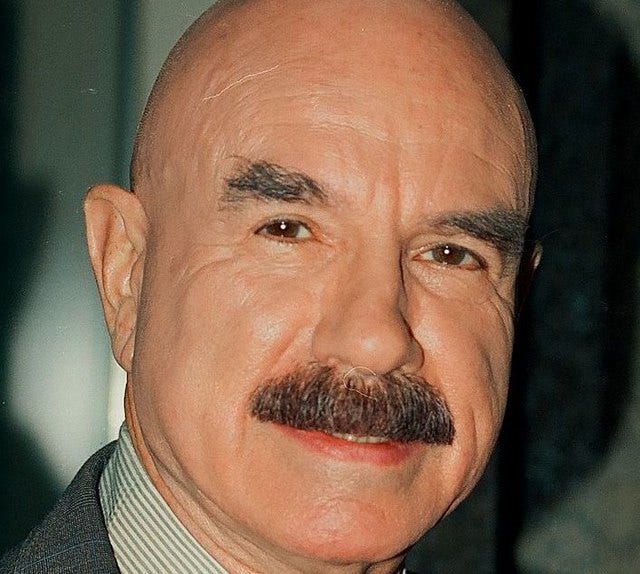
G. Gordon Liddy

Following Nixon’s fall from grace, Stone got a job in December 1973 as a junior staffer for Senator Robert Dole. However, six months after he began, Stone’s association with the “Ratfuckers” of the Nixon campaign was revealed during a Congressional hearing and he was forced to leave Dole’s staff.

In the immediate aftermath of Watergate, many Republicans wished to avoid the taint of scandal and Stone admits, “It was tough to get a job for a couple of years.”

ROGER STONE AND THE REAGAN REVOLUTION

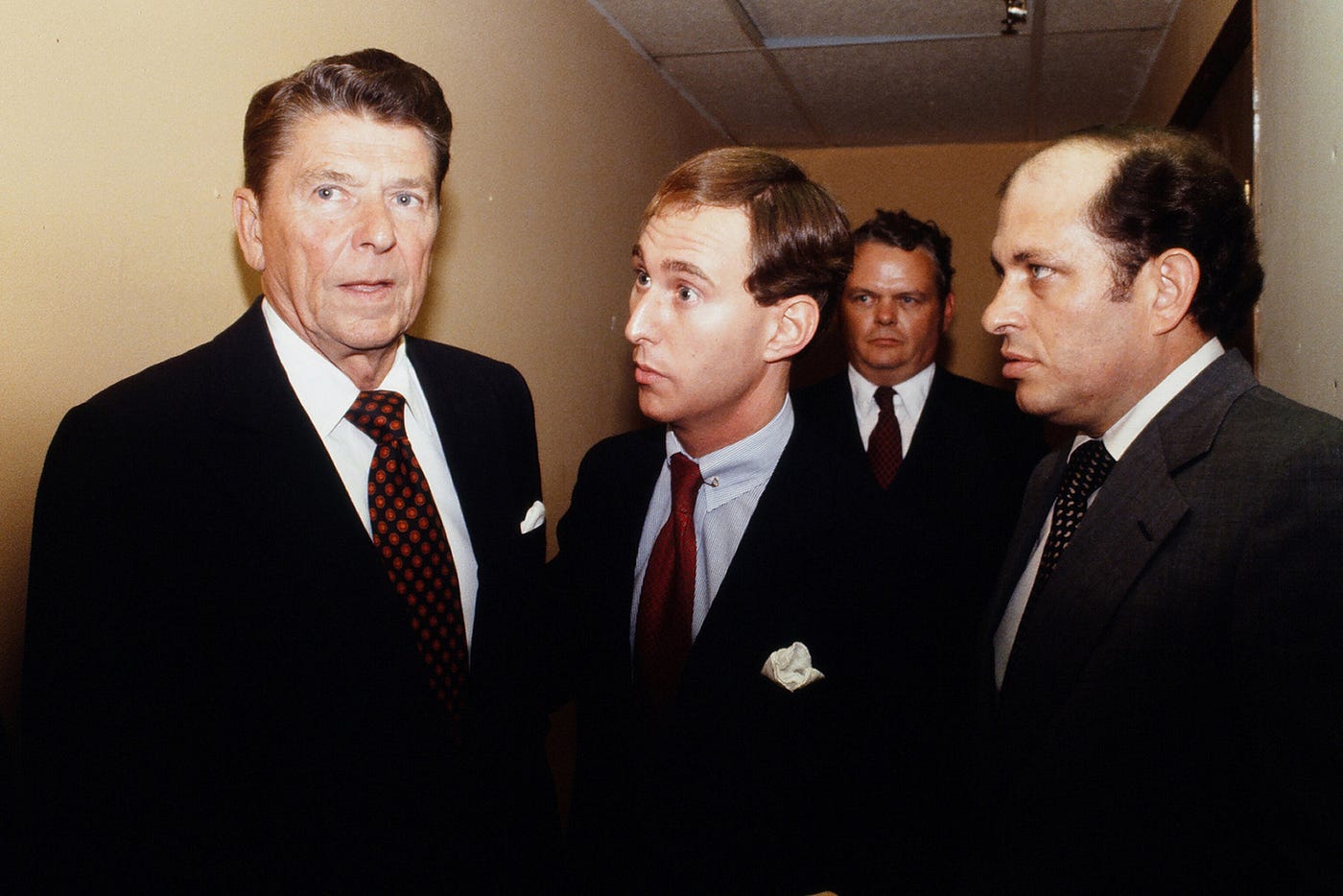
Roger Stone with President Ronald Reagan.

In 1976, Stone served on Ronald Reagan’s first unsuccessful attempt to garner the Republican nomination as the campaigns Youth Director. A year later he formed the National Conservative Political Action Committee with fellow young Republicans Charles Black and Terry Dolan.

The Committee pioneered the practice of bundling campaign contributions in order to circumvent campaign finance limits on individual contributions. It served as a precursor to super Political Action Committees (PACs) that came to dominate politics. It was at this time that Stone worked beneath the legendary Republican pollster and negative campaign strategist Arthur Finkelstein, who had an enduring influence on Stone.

In the spring of 1977, Stone ran to be the chairman of the Young Republicans. A network of influential Republicans between the ages of 18–40, in the days of brokered conventions the Young Republicans was an influential organization. Stone’s candidacy was managed by a young, up-and-coming Republican operative named Paul Manafort.

Manafort later served as chairman of the 2016 Trump Campaign after Stone lobbied the candidate to hire him. Stone and Manafort had known each other from their days in the College Republicans. Manafort managed to convince Stone’s chief rival to run for treasurer instead of president with a promise of future support that he later broke.

Stone won after a campaign that Manafort would later describe as, “one of the great fuck jobs.”

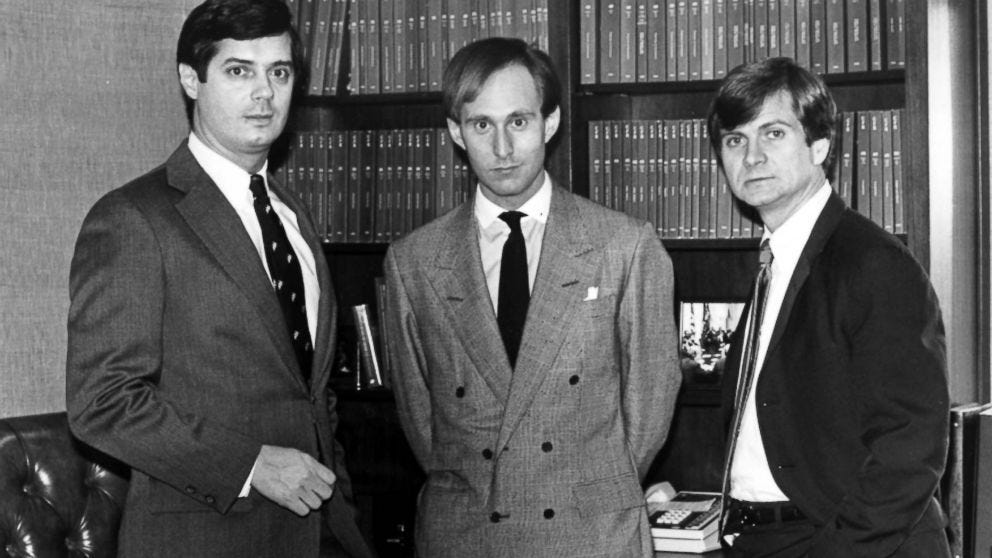
Lobbyists and partners Paul Manafort, Roger Stone and Charles Black (left to right).

By the time Stone was elected Chairman of the Young Republicans, he was already working on Reagan’s 1980 presidential campaign. In this capacity, Stone was introduced to one of America’s most infamous lawyers and political fixers: Roy Cohn.

Stone’s meeting with Roy Cohn in 1979 was perhaps one of the most consequential of his life. Years later, whenever asked about who his heroes were, Stone listed Roy Cohn, Richard Nixon and the Duke of Windsor. It was an unconventional list, but revealing of the man’s taste and character.

ROY COHN AND THE BIRTH OF THE ROGER STONE-DONALD TRUMP POLITICAL ALLIANCE

Roger Stone standing with New York lawyer and political fixer Roy Cohn

Roy Cohn exploded into the American national consciousness as an infamous player in the Red Scare of the 1950s. With the drawing of the Iron Curtain, the onset of the Cold War and the discovery of significant Soviet intelligence infiltration of American political, military and scientific institutions, a sense of fear and in many cases near hysteria swept over the body politic. As is so often the case in moments such as these, reasonable fears can be seized upon by unscrupulous demagogues for their own political purposes.

Cohn was a child prodigy. He graduated from Columbia Law School at the age of 20 and through his family’s political connections landed a job at the US Attorney’s Office in Manhattan. His early cases involved the alleged Soviet spy Alger Hiss, and the infamous Rosenberg trial. The most controversial part of the trial came during sentencing. The Rosenbergs, accused of sharing nuclear secrets with the Soviets, were found guilty.

Cohn claimed that the judge presiding over the trial, Judge Irving Kaufman, owed his position to Cohn’s father, who was a judge based out of the Bronx. Cohn further claimed that he had Kaufman assigned to the case through his connections to the district court’s clerk office. Evidence suggests that Cohn engaged in inappropriate communications with Judge Kaufman at the time he was contemplating what sentences to impose. Cohn suggested the death penalty, and that’s what the Rosenbergs received.

The vast majority of individuals caught up in the Red Scare were innocent and many lives were needlessly destroyed. The demagoguery, hysteria and self-serving cynicism of the era found its personification in Wisconsin Senator Joseph McCarthy, giving rise to the epithet McCarthyism.

Cohn started working with Joe McCarthy as his chief counsel in 1953. McCarthy had built a national profile by making outlandish claims of Communist infiltration and subversion infecting nearly all walks of American life, from Hollywood to the State Department to the Pentagon. McCarthy and Cohn’s hunt for hidden Communists inordinately impacted members of the Jewish faith and homosexuals.

For Cohn to have played such a prominent role in the persecution of these communities was curious indeed as he was both Jewish and a closeted homosexual.

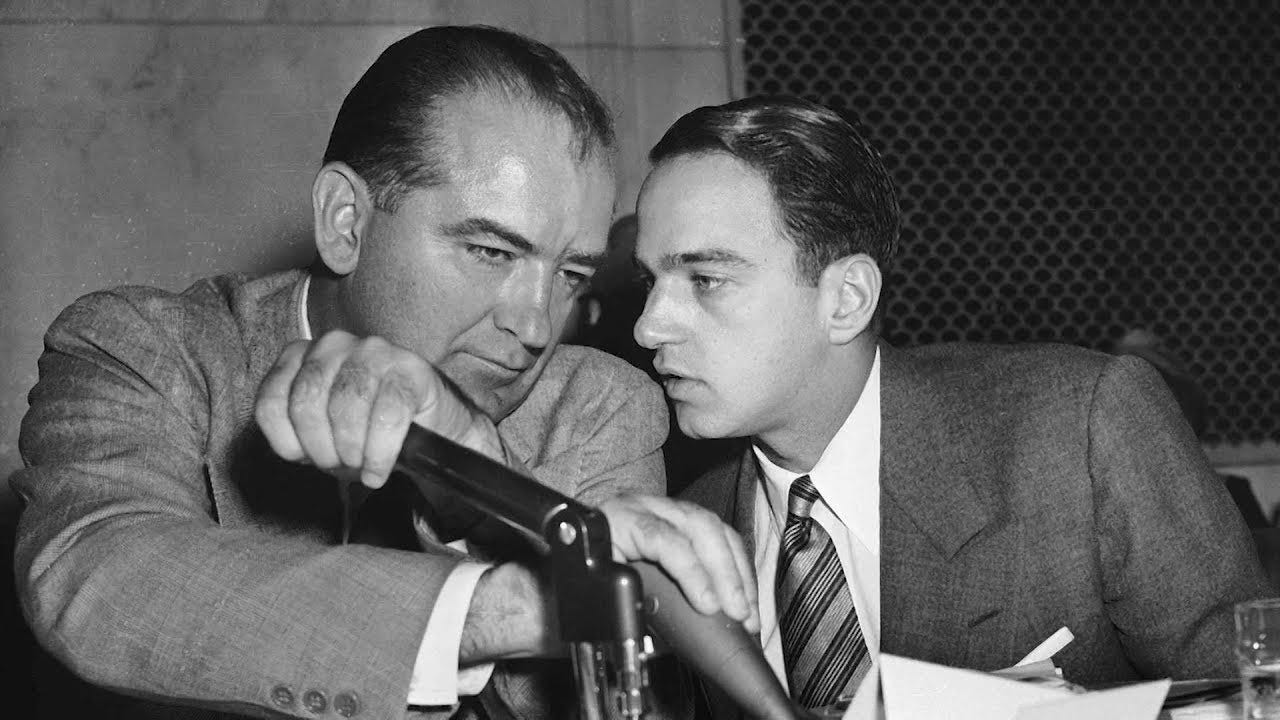
Infamous Red-baiting Wisconsin Senator Joseph McCarthy with his young chief counsel Roy Cohn.

McCarthy’s enemies found the opportunity to pounce when it came to the drafting into the military of G. David Schine, an unpaid “Chief Consultant” working with McCarthy and Cohn. After it became clear that Cohn was seeking preferential treatment for Schine, a scandal broke and culminated in the the Army-McCarthy Hearings.

The hearings led to McCarthy’s downfall and Cohn’s banishment from Washington. Cohn was outclassed and out-lawyered by the Chief Counsel of the US Army Joseph N. Welch, who in a confrontation with McCarthy uttered the phrase that marked the end of the McCarthy era, “At long last, have you no sense of decency?”

Cohn returned to New York where he became one of the city’s most influential power brokers. He developed a reputation as a “legal executioner.” His methods were relentless and unethical.

His professional and personal life were constantly under scrutiny, and yet he always seemed to get away with it. In the 1960’s, when his rival Robert Kennedy was Attorney General, Cohn was indicted four times but acquitted in each an every case. In the 1970’s he was charged with violating banking laws in Illinois and was again acquitted.

Cohn represented the most senior members of the American Mafia. He once boasted that he had gotten Irving Saypol, the the prosecutor of the Rosenberg case, his job as US Attorney. According to Cohn, Saypol’s appointment needed to be approved by Frank Costello, boss of the legendary Luciano crime family (later known as the Genovese crime family), one of the New York mafia’s infamous Five Families.

“In those days, nobody became U.S. Attorney in New York without the O.K. from the mob,” Cohn stated. “But Saypol would not have gotten the nod from Costello without me.”

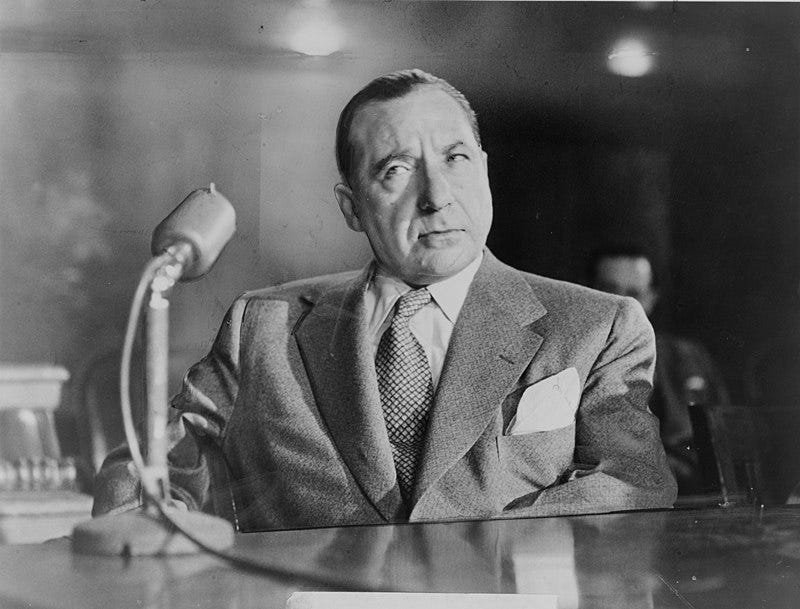
Infamous and politically connected leader of the Genovese Crime Family Frank Costello.

Cohn’s connections to the FBI, he was a personal friend of J. Edgar Hoover’s, along with his network judges, prosecutors and district attorneys, made him an ideal lawyer for a wide range of mafioso. His clients included Genovese Crime Family underboss Anthony “Fat Tony” Salerno, Bonanno boss Carmine “Nino” Galante and numerous members of the Gambino crime family including Carmine Fatico, Aniello Dellacroce, Tommy and Joe Gambino, Angelo Ruggiero and a young and a then little known mobster by the name of John Gotti.

Federal anti-organized crime strike force members told Cohn biographer Nicholas von Hoffman that in the 70s, when wiretapping was increasingly becoming an issue, members of “The Commission,” the governing body of the American mafia, met in Roy’s office because attorney-client privilege made recordings in-admissible in court.

While at the top of his game as a political fixer and mafia attorney in New York, Roy Cohn met a brash young real estate developer by the name of Donald J. Trump.

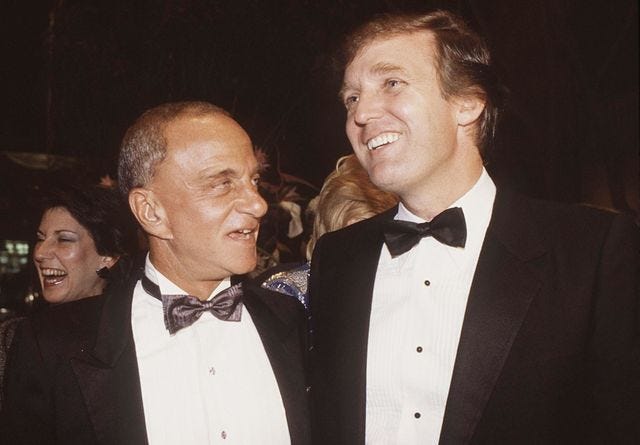
Roy Cohn with a young Donald J. Trump at the opening of Trump Tower.

In 1973, the U.S. Justice Department sued the Trump Organization for housing discrimination against blacks. After a chance encounter at a Manhattan watering hole called Le Club in which Trump bemoaned the timidity of his lawyers, Cohn took Trump on as a client. In typical Cohn fashion, he countersued DOJ for $100 million. The case eventually settled.

Trump was enthralled with Cohn, who went on to play a pivotal role in Manhattan real estate career. Trump also developed a new appreciation for the benefits of having a consummate legal fixer that he took with him to the White House.

Roger Stone tells several variations of the story of how he first met Roy Cohn in 1979. In one version of events, Stone first met Cohn at a party held by Sheila Mosler, a socialite and vice chairman of the New York County Republican Committee.

In another, Roy Cohn’s name came up on a rolodex given to him by Michael Deaver, an advisor to Ronald Reagan. At the time, the 27-year old Stone was the political director of New York, New Jersey, and Connecticut for the Reagan Campaign.

Regardless of how initial contact was made, all the stories end up with Roger visiting Roy at his 68th Street townhouse in Manhattan.

Roger Stone with Ronald Reagan, whose campaign he served as the political director for New York, New Jersey, and Connecticut.

“When I got there, Roy was in his bathrobe, eating three strips of bacon burned crisp and both halves of a deviled egg,” Stone later recalled. He noticed a heavy set man sitting next to Cohn.

“Mr. Stone, I want you to meet Tony Salerno,” Cohn said, introducing the young Reagan staffer to the underboss of the Genovese crime family.

Anthony “Fat Tony” Salerno, Genovese Crime Family underboss and client of Roy Cohn’s.

“So Roy says we’re going with Reagan this time,” Salerno chimed in. Stone launched into his pitch for Reagan as Cohn and Fat Tony listened intently.

“You know, Tony, everything’s fixed.” Stone quoted Cohn as saying. “Everything can be handled.” Salerno mentioned the Supreme Court. Cohn continued. “Cost a few more dollars.”

“He started telling me how he was going to help me set up the Reagan Campaign,” Stone said of Cohn. “[E]verything from union endorsements to office space. He told me to ride down to the courthouse with him. He had a young lawyer with him, and it was clear that Roy knew nothing about the case he was going to argue. But he knew it didn’t matter. He used to say, ‘Don’t tell me the law. Tell me the judge.’ Roy knew how the world worked.”

Years later, Stone told the reporter Matt Labash that he suggested to Cohn that if they could get the candidate John B. Anderson to make a bid for the Presidency on behalf of New York’s Liberal Party, it would split the vote between Carter and Anderson and deliver the New York to Reagan.

“Let me look into it,” Roy replied. Shortly thereafter, Cohn told Stone, “You need to go see this lawyer… and see what his number is.”

“Roy, I don’t understand,” Stone replied.

“How much cash he wants, dumbfuck,” Cohn shouted.

Stone claims to have visited the lawyer and learned that his number was $125,000 cash. Thinking the number was outlandish, Roger returned to Cohn thinking with a number that high that was the end of it. Not according to Cohn, “That’s not the problem. How does he want it?”

“There’s a suitcase,” Stone explained to Labash. “I don’t look in the suitcase… I don’t even know what was in the suitcase… I take the suitcase to the law office. I drop it off. Two days later, they have a convention. Liberals decide they’re endorsing John Anderson for president. It’s a three-way race now in New York State. Reagan wins with 46 percent of the vote. I paid his law firm. Legal fees. I don’t know what he did for the money, but whatever it was, the Liberal party reached its right conclusion out of a matter of principle.”

Remarkably, neither Stone’s introduction to a crime boss, nor the alleged plot to split the liberal vote, was the most important consequence of his meeting with Roy Cohn. Cohn provided Stone with an introduction that would change the course of American history.

“You need to meet Donald and his father,” Cohn insisted. “They’d be perfect for this. Let me set up a meeting.”

Donald Trump and Roy Cohn.

“I went to go see him,” Stone recalled, “and Trump said, ‘How do you get Reagan to 270 electoral votes?’ He was very interested [in the mechanics] — a political junkie. Then he said, ‘O.K., we are in. Go see my father.”

Stone travelled to Fred Trump’s Avenue Z office in Coney Island. “True to his word, I got $200,000. The checks came in $1,000 denominations, the maximum donation you could give. All of these checks were written to ‘Reagan for President.’ It was not illegal — it was bundling. Check trading.”

The Trumps even arranged for Stone to open Reagan’s New York City campaign headquarters in a townhouse next to the 21 Club. It was the beginning of a fateful political alliance.

Roger Stone was hardly the only member of the Reagan Campaign that Cohn was connected to. According to notes taken by Cohn‘s switchboard operator, Reagan’s 1980 campaign manager, William Casey, “called Roy almost daily during [Reagan’s] 1st election.”

Casey was a Wall Street investor and a veteran of America’s World War II-era intelligence service the Office of Strategic Services (O.S.S.). Following the 1980 election, reporters and researchers alleged that Casey cut an “October Surprise” deal with the Iranians, who were holding American diplomatic personnel hostage, to wait until after the election to release them.

Nearly four decades later, Stone and another 1980 Reagan campaign alum, Paul Manafort, would be suspected of “colluding” with a foreign adversary to impact a domestic election.

Interestingly, Stone addressed the so-called “October Surprise” allegations in a book he co-authored with Saint John Hunt during the 2016 Republican primary attacking Jeb Bush and the Bush family in general.

Former OSS officer and Reagan Campaign manager, William Casey standing with Ronald Reagan. Casey, who later led the CIA during the Iran-Contra scandal, is alleged to have negotiated with the Iranians during the 1980 election to delay the release of American hostages until after the election in what became known as the “October Surprise.”

“The Reagan/Bush camp needed to cut a secret deal with the Iranians not to release the hostages before the election,” Stone and Hunt write in Jeb! And The Bush Crime Family: The Inside Story of an American Dynasty.

“As it turned out, the hostages were not released as Carter had promised, and partly as a result of the years-long standoff with the Iranians, Carter lost the election. On January 21st, 1981, the very day that Reagan and Bush were being sworn in, the hostages found themselves on a plane to freedom. Coincidence? The accusations that Reagan and Bush had somehow thwarted the Carter/Iranian deal to free the hostages by election time, thereby winning the election for [Reagan], were rampant. How much of a role did [Bush] play? That’s the million dollar question.”

Stone and Hunt later continue, “Political researcher Robert Morrow interviewed retired admiral Bobby Ray Inman in 2009 in Austin, Texas. Inman, who was involved in intelligence for over 25 years, told Morrow that he was convinced that the Reagan campaign made a deal with the Iranians not to release the American hostages until after the 1980 general election. Inman said he was completely convinced Reagan campaign chair William Casey was involved in such a deal, but he said he did not think G.H.W. Bush was involved because Casey hated Bush. Inman worked at high levels of the Office of Naval Intelligence and the Defense Intelligence Agency while Bush was CIA director in 1976 and they developed a close working relationship.”

“So, as with so many other “facts,” we come to our own conclusions. Do we believe that our candidate was honest and would never dream of co-opting a presidential deal for his own gain? No, I say.” A curious thing to say, seeing as Stone himself had worked on the campaign.

So it appears that just as be believed that Joseph Kennedy had used his connections to Organized Crime to steal the 1960 election, Roger Stone is just as convinced that Reagan’s campaign manager William Casey, who later became Reagan’s director of the CIA and became embroiled in the Iran-Contra scandal, had negotiated with enemies of the United States to engage in activities that would impact the outcome of a Presidential election.

Thirty six years later, Republican presidential candidate Donald Trump would find himself courting help from another American adversary, Vladimir Putin’s Russia, and Roger Stone was exactly where he wanted to be, at the very heart of the controversy.

Forty years later, decades of political corruption and lies would culminate in a violent assault on the very seat of American democracy.

The next article will cover Stone’s involvement in the 1981 New Jersey Governors race and lobbying work for Donald Trump.

You can find my collected writings here.

World Clap Day — August 16, 2026

Earth and planets

(worldclapday.com)

In Humanity We Clap.

Join the Clap

Be part of the biggest human moment in historyJoin the ClapI want to receive email updates about World Clap Day, including announcements and reminders. I can unsubscribe at any time.

or

Add to Google Calendar

Find Your Local Clap Time

Type your city to see when you should clap.

Examples: London, New York, Tokyo, Paris, Sydney, Mumbai, Lagos, Mexico City

Pacific time: 07:00 (7:00 AM), 16 August 2026

World Timezone Map

Wear the Movement

Every tote, shirt or cap helps more people discover World Clap Day.

World Clap Day Tote Bag

World Clap Day Tote Bag

World Clap Day T-ShirtWorld Clap Day Cap

View all World Clap Day Merch

Wall of Claps

The Wall of Claps is the permanent record of founding supporters. Every name is a clap. Every clap is a signal that we can unite.

August 16, 2026 · 10:00:00 AM New York (EDT) · Copyright © 2026 World Clap Day

We use essential cookies to operate this website and analytics cookies to understand how it’s used. You can accept or reject non-essential cookies.Accept AllReject Non-Essential

World Clap Day – A Global Moment of Unity

Our Mission

World Clap Day is a global event happening on August 16, 2026. At one exact coordinated moment, people all around the world will clap their hands for one second.

No politics. No religion. No agenda.

Just one simple, universal action done together.

It is a celebration of being alive. A reminder that beyond language, culture, or beliefs, we are human first.

For one second, the world moves as one.

The goal is not noise. The goal is unity.

Through the simplest action possible, we prove that billions of different people can synchronize, not because of tragedy or crisis, but simply to celebrate existence.

Our Vision

On August 16, 2026 all cities are invited.

In every country, people will meet in the main squares of their cities. Friends, families, strangers. Standing side by side.

This will be broadcast online and become real in the streets.

Before the synchronized clap, each city hosts its own celebration. Music. Food. Local artists. Conversations. A moment of community.

Then, at the exact coordinated second, everyone claps together. Not just imagining the world is connected, but knowing it is.

Large screens in the main squares broadcast the central live feed of the event. Cities see each other. Crowds see crowds. Continents see continents.

The synchronization becomes visible. Tangible. Undeniable.

And immediately after that one second, the silence breaks into a massive applause to celebrate humanity.

For what the world just proved it can do. A peaceful, voluntary, global coordination of joy.

This transforms the idea from a social media movement into a physical global gathering. From movement into experience.

August 16, 2026 · 10:00:00 AM New York (EDT) · Copyright © 2026 World Clap Day

We use essential cookies to operate this website and analytics cookies to understand how it’s used. You can accept or reject non-essential cookies.Accept AllReject Non-Essential

Our Mission – World Clap Day

‘Huge Win for Consumers’: Paramount Delays Warner Bros. Deal Over Court Fight

Free Press Advocates Project Message Opposing The Paramount Warner Brothers Merger On Jazz At Lincoln Center During The News And Documentary Emmy Awards

Free press advocates project messages opposing the Paramount-Warner Bros. merger on Jazz at Lincoln Center during the News and Documentary Emmy Awards on May 27, 2026 in New York City. 

(Photo by Eugene Gologursky/Getty Images for Emmys Rapid Response Project)

California’s attorney general called the development “great news for audiences, movie theaters, and the many people who write, build, and create the art, news, and entertainment so many of us enjoy.”

Jessica Corbett

Jul 24, 2026 (CommonDreams.org)

Paramount Skydance on Friday officially delayed its attempted acquisition of Warner Bros. Discovery after a federal judge in the Northern District of California temporarily blocked the $111 billion deal at the request of a dozen Democratic attorneys general.

US District Judge Araceli Martínez-Olguín granted the temporary restraining order on Monday after finding that the plaintiffs—led by California Attorney General Rob Bonta—provided “compelling evidence that the combined firm resulting from the transaction will possess substantial market share in the wide-release theatrical distribution market.” She extended the order on Thursday.

RECOMMENDED…

'Keep Up the Fight': Federal Judge Pauses Paramount-Warner Bros. Merger

‘Keep Up the Fight’: Federal Judge Pauses Paramount-Warner Bros. Merger

Block the Merger pin

‘No One Is Above the Law’: 12 States Sue to Block Paramount-Warner Bros. Merger

The companies have now agreed not to close the deal—also the target of a Writers Guild of America lawsuit—until five days after a trial is held or June 1, 2027, whichever is sooner. While the attorneys general and their supporters framed the development as a victory for their side, a Paramount spokesperson similarly said that “today’s agreement is a significant win because the result is exactly what we have sought from the outset: a direct path to a trial based on the evidence.”

“This is the fastest and clearest way to prove that this transaction is good for competition, good for consumers, and good for creators, a conclusion dozens of competition authorities around the world have already reached,” the spokesperson continued. “Plaintiffs’ market definitions bear no relationship to the realities of today’s marketplace and cannot withstand scrutiny. We look forward to proving our case at trial.”

Meanwhile, Bonta said in a statement that “our argument against this illegal merger is straightforward: When too few corporations have too much power in markets central to American life, it makes things more expensive, and it makes things worse.”

“Today’s agreement is great news for audiences, movie theaters, and the many people who write, build, and create the art, news, and entertainment so many of us enjoy,” he emphasized. “We are eager to continue to make our case in court and celebrate another tremendous win in our effort to ensure this unlawful merger never sees the light of day.”

Joining Bonta in battle are the attorneys general of Arizona, Colorado, Connecticut, Massachusetts, Minnesota, Nevada, New Jersey, New Mexico, New York, Oregon, and Washington. They, too, celebrated on Friday.

“Stopping this merger while our case proceeds is a critical victory in our efforts to uphold the law and protect the film and television industries,” New York’s Letitia James stressed on social media. In a video, New Jersey’s Jennifer Davenport also called the companies’ decision “a huge win for consumers” and pledged to “continue to fight to block this merger for good.”

Responding to one of Davenport’s social media posts, actor and activist Mark Ruffalo declared: “Today’s news is a repudiation of Paramount’s strategy of currying favor with the Trump administration to grease the wheels on this illegal merger—from sham settlement payments to manipulating its own news coverage. Stay strong and #BlockTheMerger.”

Some opposition to the deal is rooted in the fact that it would give Paramount CEO David Ellison—the son of billionaire Larry Ellison, a major donor to President Donald Trump—control of CNN, as he already faces mounting criticism for his and Bari Weiss’ management of CBS News.

“The Ellisons believed their relationship with President Trump would help them push through a disastrous deal that threatened democracy, creative freedom, and independent journalism. We in the #BlocktheMerger campaign helped prove them wrong,” said Norm Eisen, co-founder and executive chair of Democracy Defenders Fund, in a statement.

“Paramount’s decision keeps two major studios competing instead of handing one company even more power over what Americans watch, what they pay, and where entertainment workers can earn a living,” he continued. “The merger would have eliminated one of Hollywood’s largest buyers of scripts and productions while placing Paramount+, HBO Max, CBS News, CNN, and dozens of local stations under the management of one company.”

“This victory in putting the merger on hold belongs to the people who refused to treat the merger as inevitable,” Eisen added. “Artists, journalists, filmmakers, and consumer advocates spoke out despite the risk of retaliation, more than 5,500 people signed our open letter, and Attorneys General Rob Bonta and Letitia James, along with 10 other attorneys general, acted. This collective resistance is turning the tide.”

X post: https://x.com/AGEllison/status/2080759800225300930?ref_src=twsrc%5Etfw%7Ctwcamp%5Etweetembed%7Ctwterm%5E2080759800225300930%7Ctwgr%5Ebd2105d206937fa99178b5f38e92f955e6066c52%7Ctwcon%5Es1_c10&ref_url=https%3A%2F%2Fwww.commondreams.org%2Fnews%2Fparamount-and-warner-bros

Craig Aaron, co-CEO of the advocacy group Free Press, said that “Paramount tried to tell us this deal was a slam-dunk, but it just shot an airball. Late in the game, Paramount’s lawyers grasped what we’ve said all along: The states have a very solid case that this deal violates US antitrust law. For the broad and growing coalition against this corrupt and dangerous deal, this delay marks a significant victory.”

“Instead of fighting against an injunction and possibly losing now, Paramount’s lawyers have resigned themselves to waiting for a full antitrust trial in federal court,” Aaron added. “Paramount can pretend all it wants that it looks forward to that test, but that’s just more bluster from company mouthpieces trying to spin a major setback. Now this deal will face its day in court, and we are confident the evidence will show this mega-merger should be blocked.”

Our work is licensed under Creative Commons (CC BY-NC-ND 3.0). Feel free to republish and share widely.

Jessica Corbett

Jessica Corbett is a senior editor and staff writer for Common Dreams.

Full Bio >

‘Black Day for Democracy’: Indian Police Bash and Gas Youth-Led ‘Cockroach’ Protesters

INDIA-POLITICS-EDUCATION-PROTEST

Delhi police officers beat Cockroach Janta Party protesters during a July 20, 2026 protest in New Delhi demanding the resignation of India’s education minister.

 (Photo by Arun Sankar/AFP via Getty Images)

“It’s just shocking to see that the people we elected have turned a blind eye to youth dying,” said one protester.

Brett Wilkins

Jul 20, 2026 (CommonDreams.org)

Indian protesters rallying Monday in New Delhi under the banner of the youth-led Cockroach Janta Party were brutally attacked by police as they marched toward the country’s Parliament demanding the resignation of the country’s education minister and denouncing the right-wing government of Prime Minister Narendra Modi.

Tens of thousands of protesters took to the streets of the Indian capital despite police bans, barricades, internet shutdowns, and a heavy security presence. Police, some of them in plain clothes, attacked the overwhelmingly peaceful demonstrators with baton charges and tear gas. Delhi police are controlled by the Bharatiya Janata Party (BJP)-ruled central government.

RECOMMENDED…

Anti-ICE protesters carry cardboard coffins in downtown Los Angeles

‘We Will Not Forget Them’: Nationwide Vigils Demand Justice for People Killed by ICE

Hegseth Is Demanding US Households Pay $5,000 More Per Year to Fund the Pentagon, Economist Says

Hegseth Is Demanding US Households Pay $5,000 More Per Year to Fund the Pentagon, Economist Says

The Wire reported that thousands of people were injured—some seriously—by police. Despite video footage and photos showing officer brutality, Delhi Police denied “sporadic use of violence” against protesters.

The protesters are seeking the resignation of Education Minister Dharmendra Pradhan following repeated leaks of National Eligibility Entrance Test papers that have upended the lives of millions of students by forcing them to retake the grueling exams and delaying university admissions. Protest organizers say more than 20 students have killed themselves over the matter.

Late last month, Pradhan dismissed the protesters as “the B-team of terrorists.”

“Already more than 20 students have died by suicide, but this government is not done yet,” Cockroach Janta Party (CJP) founder Abhijeet Dipke said on social media. “This government has resorted to hooliganism now.”

Protester Rhythm Katoch told The Guardian on Monday: “They are calling this protest illegal, they are calling us anti-national. But I am 22 years old, and I am standing here to fight for our education system, for the rights of the young people, and for our democracy. Is it too much to ask for the government to listen to us?”

The CJP and other student groups have been leading hunger strikes at the Jantar Mantar, an 18th-century astronomical observatory designated as the protest site. Three students from the leftist All India Students’ Association ended their fast on Monday, while environmentalist Sonam Wangchuk, who has been on a hunger strike since June 28, was taken by authorities on Saturday to Safdarjung Hospital, where he continues his fast.

“I am touched and moved by how the youth have held on to peace despite provocation,” Wangchuk said Monday.

The movement began in May after Chief Justice of India Surya Kant reportedly compared unemployed young people to “cockroaches.” The protesters satirically reclaimed the slur as the symbol of a movement that has grown into a broader challenge to Modi’s increasingly authoritarian Hindu nationalist rule, which has seen mounting repression of protest and dissent, including restrictions on journalists and activists, and the use of legal measures to target critics.

On Monday, protesters chanted “Go, Pradhan, Go, Saat Mein Modi Ko Bhi Lo! (Take Modi along with you too!),” banging plastic bottles on the ground to keep the beat.

“It’s just shocking to see that the people we elected have turned a blind eye to youth dying… because of their incompetency,” Sajal, a 22-year-old law student, told The Straits Times.

Another protester, yoga instructor Jyoti Rajput, told The Associated Press that she joined the demonstration because “this rotten system refuses to take action.”

“It cannot see the pain of students, and that’s why so many people have joined this movement,” she added.

Amid Monday’s demonstration, CJP leaders met Union Minister JP Nadda at his Delhi home.

“The minister assured us he will discuss this at the appropriate level,” CJP spokesperson Saurav Das said on social media. “However, no commitments have been made so far.”

Responding to the brutal crackdown, Amnesty International India board chair Aakar Patel said in a statement that “the images and reports emerging from the protest at Jantar Mantar show how peaceful dissent is being suppressed in India.”

“The role of the authorities is to protect and facilitate peaceful protests, not to suppress them,” he continued. “The right to freedom of peaceful assembly is recognized under international human rights law and the Indian Constitution.”

“The Delhi Police’s actions raise serious questions about whether their response met the requirements of legality, necessity, and proportionality under international human rights standards,” Patel added. “We call on the Delhi Police to exercise restraint and immediately cease the use of unlawful force against peaceful protesters. Authorities must ensure that all allegations of unlawful conduct, including the reported excessive use of batons, tear gas, and stone-throwing by police personnel, are promptly, independently, and impartially investigated.”

Our work is licensed under Creative Commons (CC BY-NC-ND 3.0). Feel free to republish and share widely.

Brett Wilkins

Brett Wilkins is a staff writer for Common Dreams.

Full Bio >

Fired ‘60 Minutes’ correspondent Cecilia Vega says she was told to report events ‘that never happened’

By G. Allen Johnson, Staff Writer July 24, 2026

Gift Article (SFChronicle.com)

Former “60 Minutes” correspondent Cecilia Vega, a Bay Area native, is opening up about her final months at CBS News.ABC News

Two months after she was fired from “60 Minutes,” Cecilia Vega is sharing details about the troubling editorial pressures she said she faced after Bari Weiss was placed in charge of CBS News.

The East Bay-raised former Chronicle and ABC7 News correspondent opened up about her final few months at the newsmagazine during the National Association of Hispanic Journalists Conference & Expo in New Orleans on Thursday, July 23, when she appeared in a conversation with John Quiñones, her former colleague while she was the senior White House correspondent at ABC News. 

Vega, 49, said she was particularly disturbed by attempts by CBS News executives to shape her coverage after the fatal shootings of Renee Good and Alex Pretti by U.S. Immigration and Customs Enforcement in Minneapolis in January, alleging she was pressured to include events that “never happened” and slant stories toward Trump administration talking points.

In one example, Vega said she was asked to include a comment by Minneapolis Mayor Jacob Frey in which he purportedly asked city Police Chief Brian O’Hara to order his officers to confront and fight ICE agents. But Vega said she and her production team scoured “every frame” of Frey’s news conference and found no evidence of that statement.

“That never happened,” Vegas told Quiñones. “We could not find any instance of the mayor saying something like that.”

Vega added she was asked to include video footage of protesters attacking people they believed were undercover ICE agents even though Vega and her team found “no credible examples” of such incidents.

Weiss was hired by Paramount CEO David Ellison to be editor in chief of CBS News in October, despite having never worked in television. She had worked in the opinion departments of the Wall Street Journal and New York Times before co-founding the conservative-leaning media company the Free Press with her wife, Nellie Bowles, a San Francisco native who previously worked for the Chronicle.

In May, at the end of its 58th season, “60 Minutes” underwent a series of major changes. Vega, the first Latina correspondent at the oldest and most-watched newsmagazine on television when she was hired in January 2023, was fired along with fellow correspondent Sharyn Alfonsi and senior executive producers Tanya Simon and Draggan Mihailovich.

Correspondent Anderson Cooper also resigned, and in early June correspondent and former CBS News anchor Scott Pelley was fired.

Since then, Vega admitted that she has been reluctant to discuss her firing.

Earlier this month, she declined an interview with the Chronicle, though she shared that “I don’t know what’s next. … For now I’m going to stay on the sidelines for the most part as I explore opportunities.” 

“It’s not that I just lost a job,” she told Quiñones. “There is a lot at stake. Sometimes you’ve got to be scared and do it still.”

In her remarks Thursday, which were first reported by Status, Vega said she was never asked to change her reporting by Weiss directly, but rather by the “new administration at CBS News.”

Soon after Weiss took charge of “60 Minutes,” new executives began attending screenings while stories were in progress to give extensive feedback.

“Never in my career until now have I felt that those edits, those suggestions, came from a place of misinformation or politics,” Vega said. “That’s the difference.”

Vega cited other examples of CBS News’ attempts to shape her stories. She said she was told to open a piece about the U.S.-Israeli war with Iran with, “Who is winning the war? Iran is totally outgunned by the United States and Israel.”

Vega said that proposed language sounded like a Trump “administration talking point.”

In a story about residents in West Virginia who were affected by Supplemental Nutrition Assistance Program benefit cuts in the state, Vega recalled being asked why she had not sought an interview with Vice President JD Vance or referenced his 2016 memoir “Hillbilly Elegy,” about his Ohio upbringing in a culture of poverty and addiction. Her explanation: She wanted to report the story “through the voices of strictly residents.”

Vega said Thursday she was proud that she resisted what Quiñones called “meddling.” 

“If you watch my pieces, you’d see those examples did not make it in,” said Vega to loud applause from the audience.

Vega noted she has clashed with executives in the past as part of the normal give-and-take process, but never expected it to escalate to this extent. She added that she still does not know why she was fired.

“It’s been about three months now … and I don’t know,” she said. “I still have not been given a reason.”

CBS News has not responded to requests from several publications, including the Chronicle, for comment about Vega.

July 24, 2026

G. Allen Johnson

Staff Writer

G. Allen Johnson is a writer in the Datebook section specializing in film and television. He has worked for the Hearst Corp. since 1996, first for the San Francisco Examiner and at the Chronicle since the newspapers’ 2000 merger. Born and raised in Indiana, he graduated from Indiana University before working in Los Angeles, primarily with the Pasadena Star-News. In 2024, he won first place in the California Journalism Awards for film and television reporting.

How to reach Allen

Email ajohnson@sfchronicle.com.

PROTESTS CONTINUE After Police Kill Corey Ruiz

Status Coup News Streamed live 18 hours ago Status Coup reporter JT Cestkowski is covering the continued police protest Live in Wisconsin following the police shooting of Corey Ruiz. We’ve been here daily now since it happened talking to residents, friends and family of Corey as the community’s anger continues to boil over. Status Coup is the leading INDEPENDENT ON-THE-GROUND reporting outlet in America that covers what the corporate media COVERS UP. We are FUNDED BY THE PEOPLE FOR THE PEOPLE—and need your support to help us stay ON-THE-GROUND. Join us as a paying member for as low as $5 bucks a month: https://www.statuscoup.com/join

Why The Ocean Cleanup Hasn’t Solved the Plastic Pollution Crisis

Plastic debris, Beverly Beach, Oregon coast
Plastic debris litters Beverly Beach on the Oregon coast. Photo credit: Tiffany Woods / Oregon Sea Grant / NOAA (CC BY-NC-SA 2.0)

Environment

David Shiffman 07/23/26 (whowhatwhy.org)

Global problems are rarely solved by one person or invention — no matter how much they go viral. The Ocean Cleanup didn’t work, for the reasons experts said it wouldn’t. What can we learn from this?

In 2019 a nonprofit called The Ocean Cleanup conducted a major test of technology designed to remove plastic pollution from the water.

It appeared to work, and the nonprofit released photos proclaiming its success.

But some scientists noticed something else among the accumulated plastic in the Ocean Cleanup’s publicity photos.

“Earlier this year I warned that @TheOceanCleanup would catch and kill floating marine life,” marine ecologist Rebecca Helm wrote on the social media platform then known as Twitter. “This week they announced they’re collecting plastic, and their picture shows HUNDREDS of floating animals trapped with the plastic.”

Social media post, Open Ocean Exploration.
Social media post from Open Ocean Exploration.
Photo credit: The Revelator

The Ocean Cleanup team appeared to be oblivious to this consequence of their test before this public criticism.

It’s not surprising that any attempt to remove plastic from the ocean would catch, and likely kill, many marine organisms, because the waters of this region aren’t a trash-filled biological desert. The area is full of neuston, marine life that lives right at the sea surface — species that may not be as charismatic as dolphins or sea turtles but are extremely ecologically important.

“This region in general has very high densities of several key species,” says Helm, now an affiliate faculty member at Georgetown University. “This ecosystem is ecologically important to species that we do care about. We can’t just go disrupting it in the name of conservation and imagine that everything is OK and that you’re doing a good thing.”

Other scientists agreed.

“Honestly, if that was me, I would have totally stopped,” Kim Martini, a physical oceanographer and founder of the oceanography equipment designer and supplier Tini Scientific, says of the incident. “Because the whole point is supposed to be about how you’re saving animals that live in the ocean.”

But while Ocean Cleanup adapted — the organization claims its latest designs have a “low adverse impact” on ocean wildlife (something its own data contradicts) — it hasn’t stopped. It continues to conduct plastic-removal operations at great financial cost, garner worldwide publicity and social media attention, and attract millions of dollars of donations.

All for an idea that, almost from the day it was announced, scientists have warned could do more harm than good.

A Meteoric Launch

It all began in 2012, when Boyan Slat, an 18-year-old Dutch aerospace engineering student, gave a TED talk announcing a bold scheme to scoop plastic trash out of the ocean. Slat envisioned building what would be the largest human-made structure ever deployed in the ocean (by far), a device that would collect plastic from the Great Pacific Garbage Patch and remove it, saving countless marine organisms.

This idea has since attracted a loyal social media following and become a nonprofit that generates millions of dollars in donations a year, a fundraising and media juggernaut in the ocean conservation space.

What you wouldn’t know from most of the media coverage and social media posts is that experts in ocean plastic pollution and ocean engineering have long been skeptical of Slat’s model, raising concerns about a fundamental misunderstanding of the Great Pacific Garbage Patch and local ecologya misunderstanding of why plastic pollution is a problem, and a lack of experience with the complex marine engineering required to pull off something like this.

That criticism and feedback haven’t dissuaded The Ocean Cleanup, despite the fact that to date it hasn’t accomplished what it set out to do, for exactly the reasons that ocean plastic pollution and ocean engineering experts said it wouldn’t work.

After building and testing expensive prototypes that led to failed tests — which failed exactly the way ocean plastic pollution and ocean engineering experts said they would — the team pivoted in 2019 toward a new model that was first suggested by critics and skeptics as an alternative in 2015. Now they mostly intercept plastic when it first leaves rivers and enters the ocean instead of trying to scoop it out of the middle of the ocean, though the open ocean work is still mentioned on their website and generates praise-filled uncritical media coverage.

Experts say The Ocean Cleanup’s history and current reality represent a useful case study in the role of evidence and expertise in solving complex global environmental problems, and why we should be skeptical of “Only I can fix it” public figures and their self-proclaimed revolutionary inventions.

Misunderstanding of the Background Issues: Ocean Plastic Pollution and the Great Pacific Garbage Patch

There’s no doubt that ocean plastic pollution is a huge problem. Some organisms ingest smaller pieces of plastic, which will either choke them, poison them, or block their digestive tracts (essentially filling their stomachs with items they can’t digest so there’s no room for actual food). Larger pieces of plastic pose entanglement hazards, immobilizing and drowning marine life. This plastic has been found all over the world, and thanks to patterns of global ocean currents, it aggregates in regions called gyres.

dead albatross, Midway Atoll Refuge
A dead albatross at the Midway Atoll Refuge. The unaltered stomach contents of a dead albatross chick photographed on Midway Atoll National Wildlife Refuge in the Pacific in September 2009 include plastic marine debris fed the chick by its parents.
Photo credit: U.S. Fish and Wildlife Service Headquarters / Flickr (
CC BY 2.0)

But when most people think about the ocean plastic pollution problem and the famous “Great Pacific Garbage Patch,” they picture a huge and dense plastic island so thick that you can walk on it. That’s not the case — it’s more like a soup full of tiny bits of plastic, sometimes so small that they’re invisible to the naked eye.

“If you go to the Great Pacific Garbage Patch, what you see is not a big collection of trash, but ocean, and it looks pretty normal,” says Miriam Goldstein, who did her Ph.D. on this region and is now the executive director of the National Ocean Protection Coalition. “When I was doing research out there, we were looking at many, many pieces of plastic — each about the size of a crumb.”

In any situation, if you don’t understand the problem, you’re unlikely to come up with a workable solution. For example, if you incorrectly believe that there are giant mountains of dense plastic floating in the ocean, it’s easier to wrongly believe that we can engineer a way to easily just scoop that plastic out of the ocean. It’s much harder to remove lots of tiny crumb-sized pieces of plastic … at least if your goal is avoiding killing everything else that’s swimming and living nearby.

“I was extremely skeptical of the whole idea, in part because the original TED talk was based on a fundamental misunderstanding of the Pacific Garbage Patch and gyres,” says Clark Richards, a physical oceanographer with Fisheries and Oceans Canada. “That’s the kind of picture that you get from introductory textbooks.”

It’s Hard to Build Things That Can Survive in the Ocean

A major reason why experts were skeptical of the Ocean Cleanup from the beginning was the team’s lack of experience with ocean engineering.

For one thing, the ocean is a rough environment, and it destroys human-made structures.

“You have a lot of concerns for any kind of instrumentation or large hardware that goes into the ocean,” says Martini. “Waves put a really large stress on anything mechanical. And you have issues with biofouling; anything you put in the ocean acts like a little raft and everything likes to grow on it, which makes it heavy and pulls it down.”

3D camera array, before and after
The 3D camera array before deployment (top), and at recovery (bottom).
Photo credit: Ocean Networks Canada / Flickr (CC BY-NC-SA 2.0)

Richards also stressed the corrosive effect of seawater on anything metal and pointed out the complexity and expense of even getting a large structure in place.

“Equipment capable of being moored in the open ocean must be deployed from large capable offshore vessels, which typically cost about $100,000 per day,” he says.

In other words, there’s a reason why no one had built an object as large as the original vision for the Ocean Cleanup before, and it’s not because no one else had ever thought of it before.

“When I first saw the idea, I thought ‘This is very well-intentioned and heartfelt, but it won’t scale, it won’t work,’ ” Goldstein says.

At the time Goldstein and Martini, writing for the ocean blog Deep Sea News, performed a detailed technical review of proposed plans for the Ocean Cleanup, using their expertise to point out why the device could not function as claimed.

“We were trying to do them the courtesy of taking them seriously,” Goldstein said. “And also, as ocean communication people, we thought it was our duty to talk about this, since it was getting so much attention.”

Sure enough, a 2016 test run of a small-scale prototype broke for exactly the reasons Martini said it would and failed to collect a significant amount of plastic for exactly the reasons Richards said it would.

And by breakingthe Ocean Cleanup system itself became ocean pollution.

A representative for the Ocean Cleanup told me via email that they were receptive to expert criticism they received and made substantive changes to the design based on that criticism. The experts I interviewed for this article disagree.

More Issues

After fixing some of the structural issues, subsequent Ocean Cleanup designs began to collect small amounts of plastic trash — nowhere near the amount they claimed they were going to be removing and nowhere near enough to make a substantive difference — while also apparently killing enormous numbers of marine organisms.

Goldstein was not surprised by this.

“Yeah, that’s what happens when you try and catch things in that part of the ocean,” she says. “This was wholly predictable from a basic knowledge of that ecosystem — predictable and predicted. Our concern was a lack of fundamental understanding of both the oceanography and the animals that live among the plastic.”

A representative for the Ocean Cleanup acknowledged via email that their efforts kill some marine life but asserted that their research, published in the journal Scientific Reports, suggests plastic pollution kills more marine life than their cleanup attempts. They further claimed that “a majority of species caught as bycatch are invasive species.” The experts interviewed for this article did not agree with either claim.

The supplementary materials of their Scientific Reports paper, meanwhile, catalogued thousands of marine animals killed during Ocean Cleanup operations, including threatened species of sharks, bony fish, and sea turtles — none of whom are invasive. It found that 84 percent of animals identified as “incidental catch” in their cleanup efforts were fish, including three species of sharks. The paper also detailed how “Species classified as Vulnerable or Endangered, such as sea turtles (e.g., loggerhead, green and olive ridley), have also been encountered as incidental catch during cleanup.”

Pivots

Later designs of the Ocean Cleanup moved on from the free-floating boom and net design and transitioned into what it called System 002 and System 03 — essentially a large net towed behind a pair of boats. Ocean plastic pollution experts, once again, were not impressed. Despite the expenditure of millions of dollars, this new design was just slightly modified fishing gear.

“This organization was so focused on ‘technology development’ that they would adopt whatever they found and claim that they invented it, such as rebranding trawl fishing as trash removal technology,” Richards says.

In 2019 the Ocean Cleanup team also added a new element to their portfolio: trying to stop plastic from entering the ocean by intercepting it at river mouths.

While intercepting trash in this way is a good idea (and one that had been suggested by critics of earlier designs for years), the way they went about it left a sour taste in many people’s mouths.

“The river interceptor design was clearly based on existing solutions” like Mr. Trash Wheel, Richards says. “Rather than work with the organizations who had successfully been removing trash from rivers for years, they ‘reinvented’ a similar design, at a much higher cost, and claimed to be innovators.”

A representative for the Ocean Cleanup told me via email that their river interceptors are custom-designed for each river.

Other Solutions

So if we can’t scoop all the plastic trash out of the ocean without killing large numbers of marine animals, what can we do instead?

One effective (and cost-effective) solution is the Ocean Conservancy’s International Coastal Cleanup. This amazing program has removed more than 400 million pounds of trash from beaches, where it’s much easier to access than in the middle of the ocean, before it gets swept back to sea. They do this at incredibly low cost, because more than 19 million people around the world have volunteered to help.

“Our total annual budget for all our plastics advocacy work, which includes cleanup, science and policy efforts, is about $6 million,” says Jordana Lewis, director of communications for the Ocean Conservancy Director of Communications. “Every organization contributing to the International Coastal Cleanup does things a little differently, but for every $2 invested Ocean Conservancy can remove a pound of trash from the environment and invest in scientific research and upstream policy solutions to prevent plastics from being produced and/or entering our ocean in the first place.”

As of this writing, The Ocean Cleanup reports it has removed 117.3 million pounds of waste from the ocean and (mostly) rivers. The nonprofit spent more than $72 million across its 2022-2024 fiscal years, according to tax filings.

Meanwhile Richards points out that in 2024 Ocean Cleanup’s System 002 “was out there spewing diesel fumes from a ship that cost $100,000 a day, picking up less plastic than a bunch of volunteers on beaches.” (A representative for the Ocean Cleanup told me via email that they are working on improving the cost efficiency of their operations.)

Ultimately the solution to the ocean plastic pollution crisis is going to be changes to our manufacturing and waste storage and treatment processes, which will take international agreements and lots of hard work. Or we could use less plastic — which would solve all these problems at the source.

Lessons Learned?

One of the most important lessons from this is that it shows the public understands the problems that plastic pollution poses to marine life — and that they’re willing to support solutions.

Unfortunately, it also shows how some people can take certain ideas too closely to heart — and take it personally when those ideas are criticized. When experts started speaking out about the Ocean Cleanup several years ago, I witnessed several of them endure online harassment from supporters of the organization, often phrased as “At least they’re trying to do something to help, all you do is complain.” (Note that this was being said to people who devoted their lives and careers to evidence-based solutions to cleaning up the ocean).

Another recurring theme was “You’re just jealous that someone solved a problem you didn’t.” (Of course, this was being said to people pointing out that the Ocean Cleanup had not solved the problem).

Ironically the criticism seemed to cause defenders to double-down on Ocean Cleanup.

“We were cast as the haters who just didn’t want to believe, and there’s a certain personality that sees criticism itself as validation that the idea is a good one,” Goldstein said.

Of course, sometimes when experts say something doesn’t work, it’s because it doesn’t work — not because critics are jealous of an idea.

Critically, trying to help is not the same thing as actually helping, and some popular solutions either make problems worse, or fail to solve them while squandering limited resources. For example, much “Save the bees” rhetoric focuses on nonnative honeybees and not the native species that are actually endangered; far too many well-intentioned online petitions aim to solve problems that have already been solved.

Helm, who worked on the United Nations High Seas treaty as a scientific advisor, knows how complicated effective solutions to complex issues really are. There are no shortcuts to putting in the work.

“There was this spirit at the time that a few well-meaning young people with a lot of passion would find solutions, but for complex problems like this one, the teenage geniuses and their billionaire backers aren’t going to save us, and they’re going to take us on a wild and expensive ride along the way,” Helm says.

Indeed, very few complex global problems will be solved by “imported magic,” a silver bullet technological solution that requires no one to make any sacrifices or changes.

Fixing these problems will require hard work, cooperation, expertise, and evidence. It may not make for snappy social media posts, but in the end, it’s the only thing that will help.

This story by David Shiffman was originally published by The Revelator and is part of Covering Climate Now, a global journalism collaboration strengthening coverage of the climate story. WhoWhatWhy has been a partner in Covering Climate Now since its inception in 2019.