After weeks of sitting on his hands, Kentucky’s Democratic Gov. Andy Beshear issued an ultimatum to the state’s absentee Sen. Mitch McConnell on Tuesday: Prove you’re alive and can do the job or step down.
Since he was hospitalized on June 14, McConnell’s 4.6 million constituents have been left with virtually no answers about the 84-year-old Republican’s condition, leading to rampant speculation of a cover-up.
Some even pondered whether the former Senate Republican leader may have shuffled off this mortal coil altogether, but that his staff was keeping mum until the presumptive August 3 deadline to avoid a special election that could lead to suboptimal results for the GOP.
Beshear, who has the power to call a special election to fill vacant Senate seats, had chastized McConnell and his staff for weeks for the lack of transparency about his condition. But he continued to balk about taking action, even as members of his party begged him to “do something.”
That is, until Monday, when McConnell’s office released an update from his physician, which stated that the senator was undergoing “a strenuous course of physical therapy and rehabilitation” but was “not yet medically cleared to leave the rehab facility and return to the office.”
Beshear finally sent McConnell a letter demanding proof of life.
“It has now been 43 days since news of your hospitalization,” Beshear wrote. “During that time you have cast zero votes, engaged in no official activities, and aside from two photos and corresponding statements, have made no effort to communicate with your Kentucky constituents or the nation.”
The governor noted that the physician’s statement still provided no details about the seven-term senator’s actual condition, “including whether you can speak, reason, or carry out your duties as a senator.”
“As governor of the state you serve,” Beshear continued, “I am calling on you to directly and verbally address the people of Kentucky and provide proof of your capacity to serve, or resign.”
Beshear said he’d sent the same letter to Senate Majority Leader John Thune (R-SD), who took over McConnell’s longtime role in 2025 before he announced his plans not to run for reelection.
Beshear said if McConnell still proved “unwilling” to demonstrate his capacity to serve, he’d insist Thune—one of the few people who claim to have spoken to McConnell since he vanished from public view—fully investigate his condition.
“All of this speculation and even this letter could have been avoided with a minimal amount of transparency,” Beshear concluded. “Kentuckians are just asking you to be honest.”
Beshear: "There's an argument out there that August 3 is a date where I could not later call a special election. Those that are really pushing this I think are under the impression that a Democrat in Kentucky might be able to win that election. It's been since 1992 that we had a… pic.twitter.com/HLcd4HkiVo
While most states allow governors to name an interim replacement when senators die or get expelled, Kentucky is one of just four exceptions, ironically thanks to some classic McConnell machinations.
In 2021, the then-Senate minority leader pressured Kentucky’s GOP-controlled Legislature to restrict Beshear’s power to unilaterally name a replacement, instead requiring him to pick from a list approved by the departing senator’s party.
Three years later, Kentucky abolished temporary replacements entirely, meaning the most Beshear could do was call a special election.
That said, the law has not yet been tested by a vacancy, and Beshear has said he’d be willing to challenge its constitutionality in hopes of naming the replacement himself, adding a 48th member to the chamber’s Democratic caucus, at least until January, when it would be filled by whoever wins McConnell’s seat during November’s midterms.
While Kentucky is a consistently red state and has not elected a Democratic senator since 1992, Beshear’s multiple terms as governor show it is capable of electing Democrats in statewide races, and could be more likely to do so in what is projected to be a blue wave year.
But Kentucky’s law also says special elections must be called at least 63 days before they occur. This gives Republicans ample incentive to keep McConnell as Schrödinger’s senator until at least August 3, after which a replacement would not be able to take office until the new Senate term begins in January.
In an interview with Bloomberg on Tuesday, Beshear argued that McConnell’s absence for the rest of the year “might not be a bad thing.”
“McConnell hasn’t been there to vote on the SAVE Act, which would tear voting rights away. He hasn’t been there to vote to support this war on Iran that this president started and shouldn’t be continuing,” Beshear said. “Not having Mitch McConnell show up isn’t necessarily a bad thing because he certainly doesn’t show up to help the American people.”
Our work is licensed under Creative Commons (CC BY-NC-ND 3.0). Feel free to republish and share widely.
In this powerful work, John Stuart Mill sets forth representative government as the most sensible compromise between unreflective rule by the masses and the self-indulgence of the few. The reader may sense that Mill is being pulled in opposing steadfastly committed to majority rule with minority rights while at the same time being just enough of an aristocrat to believe that the masses need examplars to emulate.On Representative Government is one of the most compelling political essays of the 19th century.
John Stuart Mill, English philosopher, political economist, civil servant and Member of Parliament, was an influential liberal thinker of the 19th century. He was an exponent of utilitarianism, an ethical theory developed by Jeremy Bentham, although his conception of it was very different from Bentham’s.
“Ben Wikler is one of the most strategic and respected leaders of his generation. If we do what this book says, we will win.”―Nancy Pelosi
From the most successful Democratic operative of the last decade, a revelatory account of what you―yes, you―can do to defeat Trumpism.
If you are looking at the spiraling crisis of American politics in the Trump era and wondering how the hell we get out of this mess, This Is the Plan is the book you’ve been waiting for.
Ben Wikler led the Democratic Party of Wisconsin to a string of improbable victories in a state with a political system so rigged that it was dubbed a “democracy desert”―which is, coincidentally, Trump’s goal for the whole country.
Now, in This Is the Plan, Wikler distills lessons from the front lines in America’s most closely divided state to map out a comprehensive plan to dictator-proof American government, defeat MAGA at every level of the ballot, and build a future of democracy, opportunity, and freedom for all.
It will be a blast. The plan is to, as he writes, “have fun storming the castle―in a civil, metaphorical, and non-January-6th-y way.”
Drawing on decades of organizing, from local races (including a race for county coroner that hinged on the issue of zombification) to presidential showdowns, Wikler brings us behind the scenes to explore the hidden structures of power that shape our politics and our lives, and takes us into the art and science of winning elections. As he details a people-powered path out of the political wilderness, Wikler reveals what you personally can do to move the needle.
This Is the Plan reveals, year by year and step by step, a vision not only to end America’s collapse into authoritarianism but also to reconnect us to our neighbors―and, fighting side by side for democracy, to build meaning, community, and joy.
Then, call your US senators and tell them to oppose legislation that would entrench Trump-Netanyahu military partnership. Last week, the House narrowly passed the National Defense Authorization Act (NDAA) with provisions that would further interweave the US and the Israeli militaries through weapons development and intelligence sharing. However, Democrats were nearly united in opposition — proof that we do not have to rubber-stamp Trump’s partnership with Netanyahu. Our senators must reject these provisions in the NDAA, but they need to hear from their constituents. For further reading, check out today’s Substack post for more history, context, and actions you can take.
While your Members of Congress are home for August recess, use our Indivisible resources to schedule an in-district visit or event. If you have Republican Members of Congress, this is a great opportunity to raise your voice in opposition to their attempts to pass voter suppression legislation, pour billions into Trump’s illegal war, and hand more money over to ICE and CBP. If you have Democratic Members of Congress, urge them to refuse to give a single inch to Trump’s authoritarian takeover and illegal and unconstitutional power grabs. Read on for more about the August recess and what our MoCs left unaddressed until September.
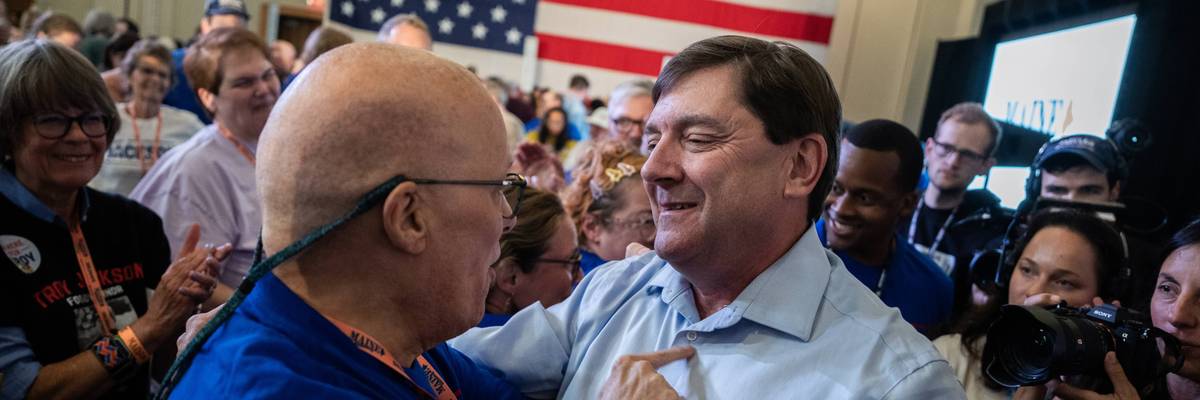
Troy Jackson, Democratic nominee for Maine Senate, greets delegates after winning the vote at the Maine Democrats Senate Nominating Convention in Bangor, Maine, on July 25, 2026.
(Photo by Tom Williams/CQ-Roll Call, Inc. via Getty Images)
“People across Maine and the country are ready to come together and finish the job” of defeating Susan Collins, said the Democratic candidate.
With Maine Republican Sen. Susan Collins backed by nearly 100 billionaires, Democratic Senate candidate Troy Jackson has been open about the fact that beating Collins in November will be an uphill battle—but he said Monday that $2 million that’s poured in from small donors in recent days gave him hope about the “extraordinary grassroots momentum” behind his campaign.
Jackson officially became the Democratic nominee on Saturday at the party’s convention—planned in a matter of weeks after former nominee Graham Platner dropped out due to rape allegations—with Democrats across the state apparently eager to throw their support behind a candidate who backs the same progressive policies that his predecessor did.
Since securing the nomination, said Jackson’s campaign Monday, he has raised $2 million from more than 58,000 donors, including 30,000 new contributors.
“I’m humbled beyond words by the tens of thousands of people who have stepped up to become part of this campaign,” said Jackson in a statement. “Every contribution—whether it was $5, $20, or more—is a vote of confidence in the working-class movement we’re building together.”
Without a billionaire-backed super political action committee (PAC) like the one set up by Collins’ allies, Pine Tree Results—which is planning to spend $20 million on attack ads against Jackson this fall, according to The New York Times, the fifth-generation logger and former state Senate president is relying on donations that must be $3,500 or smaller per donor.
Collins’ campaign and her allies have reserved about $60 million in air time for ads through the fall, according to AdImpact, while the Democrats have allocated about $24 million for ads in Maine.
Jackson told The New York Times Monday that he will likely need to raise at least $40 million-$50 million to beat Collins due to her fundraising advantage, but emphasized that he believes he is in a good position to win voters over based on the issues they’ll be voting on in November.
“I’m going to definitely bust my ass in these next four months to make up the difference,” Jackson said regarding the fundraising challenge. “And in the end, I think I’m on the right side of the issues compared to Susan Collins. So I feel very good about the race.”
“In the end, I think I’m on the right side of the issues compared to Susan Collins. So I feel very good about the race.”
He has condemned Collins, the chair of the powerful Senate Appropriations Committee, in recent weeks for backing President Donald Trump’s agenda and for her vote to fund ICE earlier this year—expressing anger over the vote after a federal agent fatally shot a young father in Biddeford, Maine earlier this month.
A poll released by University of New Hampshire last week showed 49% of respondents backing Jackson, compared with 46% who supported Collins.
“Susan Collins has spent years voting with Donald Trump 96% of the time, helping him stack the Supreme Court to overturn Roe v. Wade and supporting an agenda that guts healthcare while handing more power to billionaires and corporations,” said Jackson Monday. “Defeating her won’t be easy, and we’ll need everyone in this fight.”
The early fundraising numbers, said Jackson, prove “that people across Maine and the country are ready to come together and finish the job.”
Our work is licensed under Creative Commons (CC BY-NC-ND 3.0). Feel free to republish and share widely.
The Planning Commission has been down to four members, the minimum to hold a meeting, for more than a month now, after the terms of three members appointed by the Board of Supes ended. It’s taken Board President Rafael Mandelman a while to make his nominations to fill those slots.
Now we know the three names, and two of them will come before the full board Tuesday/28.
Since the voters changed the City Charter in 2002 to split appointments between the mayor and the board, the supes appointees have almost always been the most independent, progressive—and qualified. Kathrin Moore, an architect with a deep understanding of local planning issues, served for 20 years as a board appointee, often challenging developers (and planning directors).
Board President Rafael Mandelman named one bad, and two interesting Planning Commission members
On many key issues, particularly housing, critical votes came down 4-3, with the board-nominated commissioners siding with the community and the mayor’s folks siding with the developers.
Mandelman is much more of a moderate centrist on planning issues than was Aaron Peskin, who served as board president for several terms and made some excellent appointments. So we’ve all been waiting to see who was on the list.
He announced his nominees, which still need full board approval, July 22: Malea Chavez, Elizabeth Macdonald, and Joel Koppel.
Chavez is chief program officer at Mission Economic Development Agency, and a former executive director of the Women’s Building and deputy director of the Homeless Pre-Natal Program. Macdonald is a planning professor at UC Berkeley who mostly has worked on urban design.
Koppel, a career electrician and leader in IBEW Local 6, already served two terms on the commission, where he was mostly a bad vote under the late Mayor Ed Lee and former Mayor London Breed.
At the Rules Committee today, Koppel said he is a strong supporter of the mayor’s upzoning plan, and said nothing about affordability. He will join the mayor’s four members as a supporter of just about every developer who shows up with just about any plan. So at best, the votes will be 5-2.
The committee couldn’t consider Chavez, since her paperwork wasn’t complete. That will wait until after the August recess.
Macdonald presented an interesting case. She said she supported the upzoning plan, and nobody on the committee asked anything about the impact of density on affordability. But she actually mentioned climate change, and said that planning decisions—including the placement of new housing—need to consider sea level rise. Sup. Stephen Sherill pushed her on whether she would demand urban design changes that could make housing more expensive, and she said “good design doesn’t have to be more expensive.”
Sherrill, one of the most pro-development board members who says the free market will solve most of the city’s problems, then came out in support of her.
The Yimbys did not. Three speakers from SF Yimby said they weren’t convinced she was sufficiently supportive of market-rate housing, and asked for her nomination to be continued.
The Sierra Club, which has been taken over by Yimbys, also declined to support her.
I sent Macdonald an email asking one question:
Do you agree with Profs. Condon and Storper that allowing more market-rate housing will not help with the affordability crisis? If you dispute their findings, esp. the new Storper study, can you explain why?
She did not respond.
The support of Sherrill means both nominees will likely be approved by the full board.
San Francisco for years has moved to limit parking in most new highrise housing development. The idea is that putting housing on transit lines, and limiting parking spaces, will encourage new residents to take public transportation.
That policy was put in place before Uber, Lyft, Waymo, Doordash, and Amazon started clogging the streets and giving people ways to increase vehicle traffic without personally owning a car—or using public transportation. But it’s still part of an effort, however feeble, to reduce private vehicle use.
Now, Sup. Matt Dorsey wants to scrap that concept for any building that is converted from commercial to residential use. A lot of older commercial buildings have large underground garages.
The Planning Commission, perhaps with two new members, will consider July 30 a proposal that would change to code to allow all existing parking to remain in place for conversions:
Parking maximums would not apply to any existing off-street parking that serves new residential uses under the Commercial to Residential Adaptive Reuse Program, as long as the parking is within or on the same lot as the existing structure.
The proposal would also eliminate floor-area ratios for housing conversions, and eliminate
active uses of the ground floor, transparency, and building design elements relative to the street.
I wonder how Macdonald, who has built a career promoting good urban design, will respond to this.
That hearing starts at noon.
48 Hills welcomes comments in the form of letters to the editor, which you can submit here. We also invite you to join the conversation on our Facebook, Twitter, and Instagram.
Tim Redmond has been a political and investigative reporter in San Francisco for more than 30 years. He spent much of that time as executive editor of the Bay Guardian. He is the founder of 48hills.
Glass Empires investigates the architects of constitutional rot. Free subscribers receive every article. Devoted readers who became patrons sponsored today’s work.
The Pentagon scheduled the National Guard’s Washington, D.C., crime-emergency deployment to end on January 20, 2029. Federal officials simultaneously committed taxpayers to a three-year apartment lease extending five months beyond that date, yet omitted that obligation from their public announcement. The deployment carries a projected price tag of roughly $2.5 billion.
Art credit: Winslow Homer, Searchlight on Harbor Entrance, Santiago de Cuba (1901). Homer directs a searchlight across the harbor to examine surveillance, military authority, and American power after the Spanish-American War. He confines visibility to a narrow beam, leaving most of the harbor dark and emphasizing occupation, uncertainty, and control.
Pentagon leaders extended the Washington, D.C., National Guard deployment through January 20, 2029. On June 22, contracting officers awarded Placemakr $292 million for as many as 2,000 apartments.
Federal officials waited 31 days to announce the agreement. Their July 23 release named the cost and apartment total but concealed a three-year term running five months past the deployment’s end date.
Steve Bannon urged Trump on a February podcast to invoke the Insurrection Act and call up the 82nd and 101st Airborne. Bannon wanted those soldiers stationed at polling places during the November 2026 midterms. Defense Secretary Pete Hegseth declined to say whether he would refuse such an order.
The Insurrection Act lets a president deploy federal troops inside the United States without a governor’s consent. Trump has already deployed Guard units in Washington, D.C.
Former NSA litigation counsel George Croner expects Trump to invoke the Insurrection Act. Congress gave presidents broad discretion under the statute and did not set an expiration date.
GSA and District Guard officials arranged the agreement. Bureau officials called the purchase the largest interagency lodging acquisition in National Guard history. Bureau officials say the apartments cost nearly 50 percent less than projected hotel rates and 27 percent less than standard GSA rates.
The reported financial savings fail to explain the three-year commitment. Contracting officers typically could have chosen a one-year base period with separate option years. Acquisition officials selected the longer term without explaining their decision. The government still may cancel the order for convenience, while Placemakr may recover only costs already incurred.
On January 28, 2026, Congressional Budget Office analysts told Senator Jeff Merkley that city deployments cost $93 million monthly. Analysts priced the District at $55 million monthly for more than 2,690 personnel. However, current costs exceed that estimate.
Analysts project $2.5 billion by the lease expiration. Taxpayers will spend $330 million from January through June 2026 and $1.98 billion during the remaining 36 months. CBO analysts priced lodging into that monthly rate. Officers awarded Placemakr the apartment contract five months afterward.
CBO analysts priced each Guard member at $607 daily, the highest rate among deployment cities. Niskanen researchers priced a Metropolitan Police officer at $384 daily. Taxpayers paid more and received fewer measurable results.
Independent investigations cannot continue at the rate of one -two upgrades per week for this level of work. Can you upgrade with a paid membership?
President Trump signed Executive Order 14333 on August 11, 2025, declaring a crime emergency in Washington. Trump claimed the capital was unsafe for federal employees and visitors.
Presidents command the District Guard without a governor’s consent. Section 12406 requires governors to approve state Guard federalization, but Congress placed the District in a separate legal category. Administration lawyers cited that distinction, and Judge Patricia Millett accepted their argument in her December stay.
Niskanen Center analysts reviewed police data behind the Trump administration’s claims of high crime levels. They found a 24 percent decline in opportunistic property crime, but there was no change in violent crime, although officials used violent crime to justify the deployment.
The researchers also mapped troop assignments. Commanders placed Guard members in commercial districts, transit centers, and tourist areas but sent none southeast of the Anacostia River, where residents reported the highest violent-crime levels. Senators Andy Kim and Gary Peters identified that disparity in a February report.
Roughly 5,000 Guard members now patrol the capital after Trump mobilized 800 in August 2025.
Officials described the mission as a temporary response to a crime emergency. Yet, in September 2025, Guard members told CNN they still lacked a clear purpose for the deployment. A Tennessee guardsman patrolled Chinatown from 4 p.m. until 4 a.m. A Louisiana member told his wife he did not understand the assignment.
Another Guard member said morale was “falling fast.” In January, a District guardsman called the mission “bungled and immoral” in Washingtonian. Each member spoke anonymously because they feared retaliation.
A gunman shot two Guard members near the White House on November 26, 2025. West Virginia National Guard Specialist Sarah Beckstrom, twenty, died the following day. Sergeant Andrew Wolfe of the same unit survived serious injuries. Trump then sent 500 additional soldiers into Washington.
D.C. Attorney General Brian Schwalb sued the administration on September 4, 2025. Schwalb cited the Home Rule Act and the Posse Comitatus Act. Schwalb wrote that “armed soldiers should not be policing American citizens on American soil.” Judge Jia Cobb granted a preliminary injunction on November 20, 2025. Cobb ruled that Trump lacked authority to deploy the Guard for crime control.
Three D.C. Circuit judges stayed that injunction on December 17. Judge Patricia Millett cited the District’s separate legal status. Six justices ruled on December 23, 2025, that Trump likely lacked authority to federalize Illinois Guard units. Seventh Circuit judges had written on October 16 that “political opposition is not rebellion.”
Congress wrote Section 12406 to route state federalization orders through governors. Officials send District orders directly to the D.C. Guard commanding general. The justices addressed Illinois alone. Guard units, therefore, will remain in the District.
The contract’s duration matters because governments often extend temporary military measures beyond their original justification. American officials called the August 2025 deployment temporary. Myanmar’s generals also promised only one year of emergency rule.
On February 1, 2021, acting president Myint Swe transferred all three government branches to armed forces commander Min Aung Hlaing. Hlaing promised elected civilian rule, extended emergency rule four times, and still commands Myanmar five years later.
The Tatmadaw justified the takeover with fraud claims about the November 2020 election. Election commission staff found insufficient evidence of decisive irregularities, and outside monitors agreed. Junta-appointed commissioners annulled the results in July 2021.
Myanmar held elections between December 2025 and January 2026. Officials banned the National League for Democracy and dozens of rival parties, then cancelled voting across rebel territory. The military’s proxy party won most contested seats. UN Special Rapporteur Tom Andrews urged foreign governments to reject the results.
Four key differences limit the comparison. Myanmar’s generals drafted the 2008 Constitution and wrote Articles 417 and 418. International IDEA scholars later found the emergency declaration unlawful under that charter. Myanmar’s generals command one unified army, while American governors command separate Guard units.
At the May 30, 2021, For God & Country Patriot Roundup in Dallas, a Marine asked Michael Flynn why Americans could not repeat Myanmar’s coup. Flynn replied that such an outcome “should happen” in America, and the audience applauded. Flynn denied that meaning on Telegram the next night, but PolitiFact reviewers confirmed the exchange on video.
Out-of-state Guard members serve under Title 32. Congress funds those deployments, while governors retain command. Judge Cobb explained the command arrangement in her November 2025 opinion. South Carolina Governor Henry McMaster wrote that he “can and will” recall his soldiers immediately during a hurricane.
Governors can recall troops for reasons beyond storms. Kentucky Governor Andy Beshear withdrew his sole Guard member after officials reassigned the soldier without permission.
All thirteen District Council members sent recall letters to Michigan Governor Gretchen Whitmer and U.S. Virgin Islands Governor Albert Bryan. Minnesota Governor Tim Walz recalled his troops later that month.
Two governors have recalled their troops, while every remaining governor retains the same power and can act.
Two Questions That Could End the Deployment
Residents of states with troops in Washington can ask their governor: “Will you recall our state’s National Guard members from the District of Columbia deployment?”
Readers can ask their representative and both senators: “Will you support legislation setting an end date for the District deployment?”
Keep every message brief, factual, and signed with a real name.
Every investigation exists because a small number of remarkable readers refused to assume someone else would step up. Annual membership is the best value at just 22¢ per day and helps me cover ongoing production expenses. Vanguard members help expand the work for 51¢ per day.
Congressional Budget Office. “Estimating the Costs of Troop Deployments to U.S. Cities.” Letter to Senator Jeff Merkley, January 28, 2026. https://www.cbo.gov/publication/61943
You read Glass Empires by Wendy A. Lawrence as a free subscriber. Patrons fund the context hot takes skip and reach my inbox and Notes DMs. Annual is the best value at a quarter a day. Become a Patron
Speaker Emerita Nancy Pelosi and her communications director Ian Krager on Capitol Hill on Dec. 17, 2025. Photo courtesy of Pelosi’s office.
Speaker Emerita Nancy Pelosi’s communications director, Ian Krager, will be Supervisor Connie Chan’s congressional campaign’s communications director starting Aug. 1, according to Chan’s campaign.
Political consultants say the move is yet another sign that Pelosi is putting her thumb on the scale for Chan. Pelosi endorsed Chan on May 18 and has since shepherded her through major fundraising opportunities in Washington. And, now, she is offering Chan the top talent on her team.
Krager, 26, is one of the last two communications staffers left in Pelosi’s office.
“It has been the honor of a lifetime to help tell the story of Speaker Pelosi’s historic leadership for San Francisco and America,” Krager, who’s been Pelosi’s communications director since July 2024, said in a statement. “I’m thrilled to join Connie Chan’s campaign at this pivotal moment.”
Krager, who will relocate to San Francisco, is expected to bring Chan more news coverage in more prominent newspapers.
“She’s doing everything she can to get [Chan] elected,” said Nadia Rahman, who was the political director of Saikat Chakrabarti’s congressional campaign and now supports Chan.
Campaigns are a different beast versus communications work in the capital, but Krager has the experience of dealing with and building relationships with reporters at every level from local news to international news as Pelosi’s spokesperson, said Rahman. It’s something no one else in this race currently has, she added.
Chan’s current campaign spokesperson and consultant Julie Edwards will stay on as a consultant.
The decision followed Chan’s two-day trip to Washington last week that included a meeting with Pelosi on Wednesday early afternoon, and an evening reception hosted by both Pelosi and Sen. Adam Schiff.
The two days were filled with at least 10 meetings, events and media appearances, which would help build Chan a national Democratic coalition around the themes of labor, abortion rights, gun safety, education and climate.
She also recorded a segment for The Dean Obeidallah Show, a national radio show that examines current issues from a Muslim American perspective.
We won’t ignore your neighborhood
When a San Francisco neighborhood has a Mission Local reporter, it means someone is there. We’re following new housing projects proposed on your block, keeping tabs on what your district supervisor is up to at City Hall, and letting you know when longtime businesses close (and new ones open). When big news breaks, we already know the context.
Most neighborhoods don’t have that. Yours could.
That’s what Mission Local is building. Our reporters don’t parachute in — they write consistently on San Francisco, so you’re never reading about your neighborhood from someone who just looked it up.
So far we are in five of San Francisco’s neighborhoods. But we know all San Franciscans deserve our kind of coverage. Will you join us?
Yujie is a staff reporter covering city hall with a focus on the Asian community. She came on as an intern after graduating from Columbia University’s Graduate School of Journalism and became a full-time staff reporter as a Report for America corps member and has stayed on. Before falling in love with San Francisco, Yujie covered New York City, studied politics through the “street clashes” in Hong Kong, and earned a wine-tasting certificate in two days. She’s proud to be a bilingual journalist. Find her on Signal @Yujie_ZZ.01More by Yujie Zhou
Former mayor Art Agnos pulling away the string to reveal the Art Agnos Way street named after him on July 27, 2026. Photo by Zoe Malen.
Art Agnos stepped off a Greyhound Bus in San Francisco on Labor Day weekend in 1966 as the son of a shoeshine man.
Christ “Christy” Agnos, a Greek immigrant, sold cigars, blocked men’s hats and, yes, shined shoes in a storefront in Springfield, Mass. Art shined shoes next to his father until Christy died of cancer in 1955. Art, 16, went on shining shoes alone and his mother, Mary, blocked and cleaned the hats.
“I couldn’t date certain girls in high school because my father shined shoes for a living and cleaned hats. I never got over that,” says Agnos, now 87. “Springfield was a good city, a nice city to grow up in. But I came here to look for a better life. Our family did not belong to the right class: I could never have been mayor of Springfield.”
At mid-day on the corner of Connecticut and 20th streets, just outside Loard’s Ice Cream, a gathering of friends, family and a who’s-who of San Francisco’s political yesteryear cheered as Agnos yanked a strand of twine. A small, silver sign was unveiled reading “Art Agnos Way.”
San Francisco is a place to reinvent yourself. It’s a place to be who you are. And it’s a place to do big things. Ten years after stepping off the bus, Agnos was elected to the state legislature. Eleven years after that, he was elected mayor. And, 39 years after that — today, in fact — his name went up on a street sign.
The sign is here because of the things he did after stepping off that bus in ’66: Among them, shepherding San Francisco through the weeks and months after the Loma Prieta earthquake in 1989 and making the politically fateful — and damaging — decision to raze the Embarcadero Freeway and re-open San Francisco’s waterfront.
In San Francisco, said Agnos, “Nobody asked me where I went to school.” (For the record: Bates College undergrad, Florida State for a master’s in social work; all three of Christ and Mary Agnos’ children went to college or beyond).
“People asked me who I was and what I did and how I was going to get involved in the city,” Agnos continued. “Man, I loved that.”
Potrero Hill, and Connecticut Street, said Agnos, “had people on it who were my teachers about San Francisco and the West Coast. They oriented me, exposed me to so much, taught me so much about this city. I was propelled by them into public service. When I got married, they celebrated with me. When I got shot, they looked out for me.”
Yes, shot. “Art Agnos Way” is a stone’s throw from both where Agnos has long lived — and where he nearly died.
Former Mayor Art Agnos at the reveal of the Art Agnos Way street named after him on July 27, 2026. Photo by Zoe Malen.
On Dec. 13, 1973, Agnos, a field representative for Assemblyman Leo McCarthy, was finishing up a community meeting near Wisconsin and 23rd streets in Potrero Hill. And while he was talking to a group of women he heard “firecrackers going off.” People scattered.
“The women started running away … and asking me to come with them,” Agnos recounted in a TV news interview shortly after the incident. “I started chasing them to calm them down and reassure them that no one was going to hurt them. At that point they told me the man was trying to kill me.”
Agnos turned and saw a man standing eight or 10 yards off and staring at him, blankly, still holding a gun. “He probably was trying to figure out why I didn’t fall,” Agnos said at the time. “Mainly because I didn’t know I’d been shot.”
The “Zebra Killers,” a group of fanatical extremist Black revolutionaries targeting random white people across the city, murdered at least 15 San Franciscans. Another seven were gravely wounded.
Of those, Agnos said, he was the only victim who wasn’t permanently disabled; had his shooter held the gun level instead of pointing down, the bullets would’ve pierced Agnos’ heart and he would’ve died at age 35, just up the street from his street sign.
Many years ago, Agnos told me that being shot felt a bit like taking an elbow to the chest when you’re going up for a rebound. He didn’t, at the time, mention the year of medical hardships and a deeply unpleasant recovery that followed his attempted murder.
When asked by a 1970s TV interviewer if the experience would keep him from going out and working with the people in his neighborhood, Agnos immediately replied, “Not at all. Not at all.”
“If anything, it’s gonna just put me back on the street working as hard as I can to continue developing programs that the community thinks they need,” he said. “So that we can establish the services that people need to put an end to the kinds of conditions that would lead a man or two men or a group of men to hate somebody so much to do this kind of thing.”
Remember, what was important was where you were going.
Former supervisor Matt Gonzalez and former mayor Art Agnos at the ‘Art Agnos Way’ event. Photo by Zoe Malen
The unveiling of Art Agnos Way was something of a hot ticket. Rep. Nancy Pelosi was there. So was Mayor Daniel Lurie. Mayor Willie Brown — who, like Agnos, got his start shining shoes — RSVPed but did not show. He purportedly had trouble getting a taxi. “Willie Brown is late, as usual,” Agnos told the crowd, which laughed knowingly.
The legislation to, in Yogi Berra’s words, make this day necessary, was carried by Potrero’s home supervisor, Shamann Walton. Former Board President and longtime Agnos ally Aaron Peskin was the master of ceremonies.
It was, as so many San Francisco political fêtes tend to be, an extremely tight-knit affair. At one point, Pelosi pointed into the crowd at Agnos’ son, Steve. “I babysat you!” she said. “I remember!” Steve replied.
Agnos was honored, he said, but, in a discussion last week, seemed a bit sheepish at all the fuss. He’d just wanted to have a neighborhood affair in his longtime neighborhood. “This isn’t worth your time!” he protested. “Send an intern.”
The unveiling of a small sign is indeed a small affair, albeit a pleasant one. But there are larger issues at play, which is why Agnos is still politically involved generations after last holding elective office.
When Christ and Mary Agnos’ son stepped off the bus 60 years ago, he could land a two-bedroom apartment (with a deck and a fireplace) for $150 a month ($1,532 in 2026 dollars).
He could wander through a blue-collar neighborhood that reminded him of home, and just bump into and befriend folks like Jim Herman, who’d go on to be national president of the International Longshore and Warehouse Union.
Speaker Emerita Nancy Pelosi at the reveal of the Art Agnos Way street named after former mayor, Art Agnos, on July 27, 2026. Photo by Zoe Malen.
Agnos could tell you better than most that present-day San Francisco is far safer than its prior iterations. Crime, particularly violent crime, is at near-historic lows. The notion of a racial terror operation preying on indiscriminate victims is now near-incomprehensible; Fox News would surely cover it the way networks covered the Iran Hostage Crisis.
So, that’s for the good. But Agnos could also tell you that Potrero Hill is no longer the affordable blue-collar haven that nurtured him when he needed it the most.
“That’s why I fight so hard, in part, to keep this city the way it is,” he says. “This is a city that lets you be who you want to be.”
This has been Agnos’ fight for the past 60 years.
“The same fight that sustains my Dad,” Steve Agnos said today, “is the fight necessary to sustain San Francisco.”
“Look at the view,” Art Agnos mused today. “I love it every time. It’s changing — not just the skyline. But I still love it.”
As a social worker and a cub politician, he’d head down the hill and wonder, “What can I do today down there to make that place a little better?” As mayor, he’d think, “What are they going to do to me today?”
Art Agnos will be 88 in September. Steve Agnos sends him material about centenarians like Mel Brooks and Dick Van Dyke who remain lucid and active into their 11th decade. But we are only immortal for a limited time.
“I hope one day,” said Agnos, addressing the crowd, “when I’m no longer here and someone is here eating an ice cream and says ‘Who was that guy?’ some of you will respond: ‘He was one of us.’”
Agnos paused and tightened his jaw. He took a deep breath and composed himself. So did everyone else.
“He was a neighbor. Who lived with us while he fulfilled the Ancient Greek promise of the Athenians when they became citizens of their city. They said ‘I promise to leave my city better than I found it.’”
Art Agnos kept this promise. And now he has the sign to prove it.
Lisa Ryers (left) and Pamela Pastrana display the 40-year-old campaign sign treasured by Pastrana’s mother, Lucy, at the unveiling of ‘Art Agnos Way.’ Photo by Joe Eskenazi
We won’t ignore your neighborhood
When a San Francisco neighborhood has a Mission Local reporter, it means someone is there. We’re following new housing projects proposed on your block, keeping tabs on what your district supervisor is up to at City Hall, and letting you know when longtime businesses close (and new ones open). When big news breaks, we already know the context.
Most neighborhoods don’t have that. Yours could.
That’s what Mission Local is building. Our reporters don’t parachute in — they write consistently on San Francisco, so you’re never reading about your neighborhood from someone who just looked it up.
So far we are in five of San Francisco’s neighborhoods. But we know all San Franciscans deserve our kind of coverage. Will you join us?
Joe is a columnist and the managing editor of Mission Local. He was born in San Francisco, raised in the Bay Area, and attended U.C. Berkeley. He never left.
“Your humble narrator” was a writer and columnist for SF Weekly from 2007 to 2015, and a senior editor at San Francisco Magazine from 2015 to 2017. You may also have read his work in the Guardian (U.S. and U.K.); San Francisco Public Press; San Francisco Chronicle; San Francisco Examiner; Dallas Morning News; and elsewhere.
He resides in the Excelsior with his wife and three (!) kids, 4.3 miles from his birthplace and 5,474 from hers.
The Northern California branch of the Society of Professional Journalists named Eskenazi the 2019 Journalist of the Year.More by Joe Eskenazi
The St. Louis Commune of 1877 was a brief worker-led uprising, marked by the first general strike in U.S. history and the temporary control of a major American city by socialist and communist organizers. [1, 2]
Key Events of the Uprising
The Great Railroad Strike: Grew out of national wage cuts in July 1877, spreading quickly to St. Louis, Missouri, where thousands of multiracial industrial and transport workers shut down local commerce. [1, 2, 3, 4, 5]
Workers’ Leadership: The Marxist Workingmen’s Party helped direct the movement, setting up an executive committee that functioned as a temporary municipal authority. [1, 2, 3]
City Control: For about a week, the coalition maintained public order, negotiated work terms, and paralyzed standard capitalist operations before federal troops and local militias suppressed the movement. [1, 2, 3]
Help Outreach Working Group lift the fog of corporate media. Donate to help us maintain this website and distribute literature on the street.
This Sunday’s Town Hall: Announcing This Week’s Progressive Town Hall: Every Sunday at 4pm ET/1pm PT RSVP HERE Join PDA activists online from across the country to discuss the importance of progressives reclaiming the American story from the MAGA right, an issue of heightened importance as we’re now within one... Continue reading →
We protest Heritage Foundation EVERY MONDAY (Join us!!!!) By admin | September 2, 2025 | Uncategorized Cliff Cash Comedy Premiered Jul 26, 2025 Every Monday at The Heritage Foundation 214 Massachusetts Ave. Washington D.C. 4pm protest 6pm pizza Every Friday at Fox News D.C. 400 N. Capitol St. Washington D.C. 4pm protest 6pm pizza We are... Continue reading →
There are less than 9 weeks until the critical November election, and what we do between now and then will shape the future of our health care. We started Nurses for Democracy to fight back against fascism and protect our democracy, but also to elect candidates in key races who are committed... Continue reading →
September General Membership Meeting *We will be voting on November Election endorsements for state propositions!* Date: Tuesday, 15 September, 2026 (third Tuesday of month) Time: 7-9 PM *NEW* In-person Location: Women’s Building (3543 18th St), Audre Lorde Room Remote: Via Zoom Link Here
Join us in person for a deep discussion on the upcoming November election. We’ll break down what’s on the ballot, why it matters, what you need to know before you vote. Featuring: Juliet Williams, CalMatters Ben Trefny, KALW Public Media Lila LaHood, San Francisco Public Press This election is pivotal.... Continue reading →
One Million Rising: Strategic Non-Cooperation to Fight Authoritarianism Virtual Event · Hosted by No Kings Time Wednesdays 8 – 9:30pm EDT Location Virtual event Join from anywhere About this event Across the country, authoritarian forces are getting bolder and more dangerous. Trump and his allies are not hiding their agenda: mass deportations,... Continue reading →
13th anniversary of Occupy Wall Street and Occupy San Francisco By admin | September 17, 2024 | Uncategorized Leave a comment (newlaborforum.cuny.edu) Occupy Wall Street (OWS) was a left-wing populist movement against economic inequality, corporate greed, big finance, and the influence of money in politics that began in Zuccotti Park, located in New York City’s... Continue reading →
Skip to content 15th Anniversary of Occupy Wall Street 15th Anniversary of Occupy Wall Street September 17 – September 20 We are organizing a celebration for the 15th anniversary of Occupy Wall Street, scheduled for September 17, 2026, at Zuccotti Park. The event aims to acknowledge past successes, pass the “torch” to contemporary... Continue reading →
THURSDAY, JUNE 29, 2023 AT 2 AM – 4 AM PDT How to create trust in a group? Details Event by Extinction Rebellion Empathy Circles online EMPATHY CAFE Duration: 2 hr Public · Anyone on or off Facebook How to create trust in a group? This is the question that arose in our... Continue reading →
Skip to content 15th Anniversary of Occupy Wall Street 15th Anniversary of Occupy Wall Street September 17 – September 20 We are organizing a celebration for the 15th anniversary of Occupy Wall Street, scheduled for September 17, 2026, at Zuccotti Park. The event aims to acknowledge past successes, pass the “torch” to contemporary... Continue reading →











 by
by 


 by
by