Be part of the biggest human moment in historyJoin the ClapI want to receive email updates about World Clap Day, including announcements and reminders. I can unsubscribe at any time.
We use essential cookies to operate this website and analytics cookies to understand how it’s used. You can accept or reject non-essential cookies.Accept AllReject Non-Essential
World Clap Day – A Global Moment of Unity
Our Mission
World Clap Day is a global event happening on August 16, 2026. At one exact coordinated moment, people all around the world will clap their hands for one second.
No politics. No religion. No agenda.
Just one simple, universal action done together.
It is a celebration of being alive. A reminder that beyond language, culture, or beliefs, we are human first.
For one second, the world moves as one.
The goal is not noise. The goal is unity.
Through the simplest action possible, we prove that billions of different people can synchronize, not because of tragedy or crisis, but simply to celebrate existence.
Our Vision
On August 16, 2026 all cities are invited.
In every country, people will meet in the main squares of their cities. Friends, families, strangers. Standing side by side.
This will be broadcast online and become real in the streets.
Before the synchronized clap, each city hosts its own celebration. Music. Food. Local artists. Conversations. A moment of community.
Then, at the exact coordinated second, everyone claps together. Not just imagining the world is connected, but knowing it is.
Large screens in the main squares broadcast the central live feed of the event. Cities see each other. Crowds see crowds. Continents see continents.
The synchronization becomes visible. Tangible. Undeniable.
And immediately after that one second, the silence breaks into a massive applause to celebrate humanity.
For what the world just proved it can do. A peaceful, voluntary, global coordination of joy.
This transforms the idea from a social media movement into a physical global gathering. From movement into experience.
We use essential cookies to operate this website and analytics cookies to understand how it’s used. You can accept or reject non-essential cookies.Accept AllReject Non-Essential
Free press advocates project messages opposing the Paramount-Warner Bros. merger on Jazz at Lincoln Center during the News and Documentary Emmy Awards on May 27, 2026 in New York City.
(Photo by Eugene Gologursky/Getty Images for Emmys Rapid Response Project)
California’s attorney general called the development “great news for audiences, movie theaters, and the many people who write, build, and create the art, news, and entertainment so many of us enjoy.”
Paramount Skydance on Friday officially delayed its attempted acquisition of Warner Bros. Discovery after a federal judge in the Northern District of California temporarily blocked the $111 billion deal at the request of a dozen Democratic attorneys general.
US District Judge Araceli Martínez-Olguín granted the temporary restraining order on Monday after finding that the plaintiffs—led by California Attorney General Rob Bonta—provided “compelling evidence that the combined firm resulting from the transaction will possess substantial market share in the wide-release theatrical distribution market.” She extended the order on Thursday.
The companies have now agreed not to close the deal—also the target of a Writers Guild of America lawsuit—until five days after a trial is held or June 1, 2027, whichever is sooner. While the attorneys general and their supporters framed the development as a victory for their side, a Paramount spokesperson similarly said that “today’s agreement is a significant win because the result is exactly what we have sought from the outset: a direct path to a trial based on the evidence.”
“This is the fastest and clearest way to prove that this transaction is good for competition, good for consumers, and good for creators, a conclusion dozens of competition authorities around the world have already reached,” the spokesperson continued. “Plaintiffs’ market definitions bear no relationship to the realities of today’s marketplace and cannot withstand scrutiny. We look forward to proving our case at trial.”
Meanwhile, Bonta said in a statement that “our argument against this illegal merger is straightforward: When too few corporations have too much power in markets central to American life, it makes things more expensive, and it makes things worse.”
“Today’s agreement is great news for audiences, movie theaters, and the many people who write, build, and create the art, news, and entertainment so many of us enjoy,” he emphasized. “We are eager to continue to make our case in court and celebrate another tremendous win in our effort to ensure this unlawful merger never sees the light of day.”
Joining Bonta in battle are the attorneys general of Arizona, Colorado, Connecticut, Massachusetts, Minnesota, Nevada, New Jersey, New Mexico, New York, Oregon, and Washington. They, too, celebrated on Friday.
“Stopping this merger while our case proceeds is a critical victory in our efforts to uphold the law and protect the film and television industries,” New York’s Letitia James stressed on social media. In a video, New Jersey’s Jennifer Davenport also called the companies’ decision “a huge win for consumers” and pledged to “continue to fight to block this merger for good.”
BREAKING NEWS: Thanks to our lawsuit, Paramount and Warner Bros. are backing down and putting their merger on hold.
We won’t let corporate monopolists profit at your expense—driving up prices and reducing your entertainment choices. pic.twitter.com/JLlpfUxaY5
— Attorney General Jennifer Davenport (@NewJerseyOAG) July 24, 2026
Responding to one of Davenport’s social media posts, actor and activist Mark Ruffalo declared: “Today’s news is a repudiation of Paramount’s strategy of currying favor with the Trump administration to grease the wheels on this illegal merger—from sham settlement payments to manipulating its own news coverage. Stay strong and #BlockTheMerger.”
Some opposition to the deal is rooted in the fact that it would give Paramount CEO David Ellison—the son of billionaire Larry Ellison, a major donor to President Donald Trump—control of CNN, as he already faces mounting criticism for his and Bari Weiss’ management of CBS News.
“The Ellisons believed their relationship with President Trump would help them push through a disastrous deal that threatened democracy, creative freedom, and independent journalism. We in the #BlocktheMerger campaign helped prove them wrong,” said Norm Eisen, co-founder and executive chair of Democracy Defenders Fund, in a statement.
“Paramount’s decision keeps two major studios competing instead of handing one company even more power over what Americans watch, what they pay, and where entertainment workers can earn a living,” he continued. “The merger would have eliminated one of Hollywood’s largest buyers of scripts and productions while placing Paramount+, HBO Max, CBS News, CNN, and dozens of local stations under the management of one company.”
“This victory in putting the merger on hold belongs to the people who refused to treat the merger as inevitable,” Eisen added. “Artists, journalists, filmmakers, and consumer advocates spoke out despite the risk of retaliation, more than 5,500 people signed our open letter, and Attorneys General Rob Bonta and Letitia James, along with 10 other attorneys general, acted. This collective resistance is turning the tide.”
Craig Aaron, co-CEO of the advocacy group Free Press, said that “Paramount tried to tell us this deal was a slam-dunk, but it just shot an airball. Late in the game, Paramount’s lawyers grasped what we’ve said all along: The states have a very solid case that this deal violates US antitrust law. For the broad and growing coalition against this corrupt and dangerous deal, this delay marks a significant victory.”
“Instead of fighting against an injunction and possibly losing now, Paramount’s lawyers have resigned themselves to waiting for a full antitrust trial in federal court,” Aaron added. “Paramount can pretend all it wants that it looks forward to that test, but that’s just more bluster from company mouthpieces trying to spin a major setback. Now this deal will face its day in court, and we are confident the evidence will show this mega-merger should be blocked.”
Our work is licensed under Creative Commons (CC BY-NC-ND 3.0). Feel free to republish and share widely.
Delhi police officers beat Cockroach Janta Party protesters during a July 20, 2026 protest in New Delhi demanding the resignation of India’s education minister.
(Photo by Arun Sankar/AFP via Getty Images)
“It’s just shocking to see that the people we elected have turned a blind eye to youth dying,” said one protester.
Indian protesters rallying Monday in New Delhi under the banner of the youth-led Cockroach Janta Party were brutally attacked by police as they marched toward the country’s Parliament demanding the resignation of the country’s education minister and denouncing the right-wing government of Prime Minister Narendra Modi.
Tens of thousands of protesters took to the streets of the Indian capital despite police bans, barricades, internet shutdowns, and a heavy security presence. Police, some of them in plain clothes, attacked the overwhelmingly peaceful demonstrators with baton charges and tear gas. Delhi police are controlled by the Bharatiya Janata Party (BJP)-ruled central government.
The Wire reported that thousands of people were injured—some seriously—by police. Despite video footage and photos showing officer brutality, Delhi Police denied “sporadic use of violence” against protesters.
— Cockroach is Back (@Cockroachisback) July 20, 2026
The protesters are seeking the resignation of Education Minister Dharmendra Pradhan following repeated leaks of National Eligibility Entrance Test papers that have upended the lives of millions of students by forcing them to retake the grueling exams and delaying university admissions. Protest organizers say more than 20 students have killed themselves over the matter.
Late last month, Pradhan dismissed the protesters as “the B-team of terrorists.”
“Already more than 20 students have died by suicide, but this government is not done yet,” Cockroach Janta Party (CJP) founder Abhijeet Dipke said on social media. “This government has resorted to hooliganism now.”
Protester Rhythm Katoch told The Guardian on Monday: “They are calling this protest illegal, they are calling us anti-national. But I am 22 years old, and I am standing here to fight for our education system, for the rights of the young people, and for our democracy. Is it too much to ask for the government to listen to us?”
The CJP and other student groups have been leading hunger strikes at the Jantar Mantar, an 18th-century astronomical observatory designated as the protest site. Three students from the leftist All India Students’ Association ended their fast on Monday, while environmentalist Sonam Wangchuk, who has been on a hunger strike since June 28, was taken by authorities on Saturday to Safdarjung Hospital, where he continues his fast.
“I am touched and moved by how the youth have held on to peace despite provocation,” Wangchuk said Monday.
The movement began in May after Chief Justice of India Surya Kant reportedly compared unemployed young people to “cockroaches.” The protesters satirically reclaimed the slur as the symbol of a movement that has grown into a broader challenge to Modi’s increasingly authoritarian Hindu nationalist rule, which has seen mounting repression of protest and dissent, including restrictions on journalists and activists, and the use of legal measures to target critics.
On Monday, protesters chanted “Go, Pradhan, Go, Saat Mein Modi Ko Bhi Lo! (Take Modi along with you too!),” banging plastic bottles on the ground to keep the beat.
“It’s just shocking to see that the people we elected have turned a blind eye to youth dying… because of their incompetency,” Sajal, a 22-year-old law student, told The Straits Times.
Is this a war zone? Why is the police resorting to tear gas assault on peaceful protesters?
Sir @narendramodi have you decided we are no longer a democracy? First your govt ignored this protest for a month and now when we are peacefully marching your govt is attacking us. Why? pic.twitter.com/F52ELTr2Jp
— Cockroach is Back (@Cockroachisback) July 20, 2026
Another protester, yoga instructor Jyoti Rajput, told The Associated Press that she joined the demonstration because “this rotten system refuses to take action.”
“It cannot see the pain of students, and that’s why so many people have joined this movement,” she added.
Amid Monday’s demonstration, CJP leaders met Union Minister JP Nadda at his Delhi home.
“The minister assured us he will discuss this at the appropriate level,” CJP spokesperson Saurav Das said on social media. “However, no commitments have been made so far.”
Responding to the brutal crackdown, Amnesty International India board chair Aakar Patel said in a statement that “the images and reports emerging from the protest at Jantar Mantar show how peaceful dissent is being suppressed in India.”
“The role of the authorities is to protect and facilitate peaceful protests, not to suppress them,” he continued. “The right to freedom of peaceful assembly is recognized under international human rights law and the Indian Constitution.”
“The Delhi Police’s actions raise serious questions about whether their response met the requirements of legality, necessity, and proportionality under international human rights standards,” Patel added. “We call on the Delhi Police to exercise restraint and immediately cease the use of unlawful force against peaceful protesters. Authorities must ensure that all allegations of unlawful conduct, including the reported excessive use of batons, tear gas, and stone-throwing by police personnel, are promptly, independently, and impartially investigated.”
Our work is licensed under Creative Commons (CC BY-NC-ND 3.0). Feel free to republish and share widely.
Former “60 Minutes” correspondent Cecilia Vega, a Bay Area native, is opening up about her final months at CBS News.ABC News
Two months after she was fired from “60 Minutes,” Cecilia Vega is sharing details about the troubling editorial pressures she said she faced after Bari Weiss was placed in charge of CBS News.
The East Bay-raised former Chronicle and ABC7 News correspondent opened up about her final few months at the newsmagazine during the National Association of Hispanic Journalists Conference & Expo in New Orleans on Thursday, July 23, when she appeared in a conversation with John Quiñones, her former colleague while she was the senior White House correspondent at ABC News.
Vega, 49, said she was particularly disturbed by attempts by CBS News executives to shape her coverage after the fatal shootings of Renee Good and Alex Pretti by U.S. Immigration and Customs Enforcement in Minneapolis in January, alleging she was pressured to include events that “never happened” and slant stories toward Trump administration talking points.
In one example, Vega said she was asked to include a comment by Minneapolis Mayor Jacob Frey in which he purportedly asked city Police Chief Brian O’Hara to order his officers to confront and fight ICE agents. But Vega said she and her production team scoured “every frame” of Frey’s news conference and found no evidence of that statement.
“That never happened,” Vegas told Quiñones. “We could not find any instance of the mayor saying something like that.”
Vega added she was asked to include video footage of protesters attacking people they believed were undercover ICE agents even though Vega and her team found “no credible examples” of such incidents.
Weiss was hired by Paramount CEO David Ellison to be editor in chief of CBS News in October, despite having never worked in television. She had worked in the opinion departments of the Wall Street Journal and New York Times before co-founding the conservative-leaning media company the Free Press with her wife, Nellie Bowles, a San Francisco native who previously worked for the Chronicle.
In May, at the end of its 58th season, “60 Minutes” underwent a series of major changes. Vega, the first Latina correspondent at the oldest and most-watched newsmagazine on television when she was hired in January 2023, was fired along with fellow correspondent Sharyn Alfonsi and senior executive producers Tanya Simon and Draggan Mihailovich.
Correspondent Anderson Cooper also resigned, and in early June correspondent and former CBS News anchor Scott Pelley was fired.
Since then, Vega admitted that she has been reluctant to discuss her firing.
Earlier this month, she declined an interview with the Chronicle, though she shared that “I don’t know what’s next. … For now I’m going to stay on the sidelines for the most part as I explore opportunities.”
“It’s not that I just lost a job,” she told Quiñones. “There is a lot at stake. Sometimes you’ve got to be scared and do it still.”
In her remarks Thursday, which were first reported by Status, Vega said she was never asked to change her reporting by Weiss directly, but rather by the “new administration at CBS News.”
Soon after Weiss took charge of “60 Minutes,” new executives began attending screenings while stories were in progress to give extensive feedback.
“Never in my career until now have I felt that those edits, those suggestions, came from a place of misinformation or politics,” Vega said. “That’s the difference.”
Vega cited other examples of CBS News’ attempts to shape her stories. She said she was told to open a piece about the U.S.-Israeli war with Iran with, “Who is winning the war? Iran is totally outgunned by the United States and Israel.”
Vega said that proposed language sounded like a Trump “administration talking point.”
In a story about residents in West Virginia who were affected by Supplemental Nutrition Assistance Program benefit cuts in the state, Vega recalled being asked why she had not sought an interview with Vice President JD Vance or referenced his 2016 memoir “Hillbilly Elegy,” about his Ohio upbringing in a culture of poverty and addiction. Her explanation: She wanted to report the story “through the voices of strictly residents.”
Vega said Thursday she was proud that she resisted what Quiñones called “meddling.”
“If you watch my pieces, you’d see those examples did not make it in,” said Vega to loud applause from the audience.
Vega noted she has clashed with executives in the past as part of the normal give-and-take process, but never expected it to escalate to this extent. She added that she still does not know why she was fired.
“It’s been about three months now … and I don’t know,” she said. “I still have not been given a reason.”
CBS News has not responded to requests from several publications, including the Chronicle, for comment about Vega.
G. Allen Johnson is a writer in the Datebook section specializing in film and television. He has worked for the Hearst Corp. since 1996, first for the San Francisco Examiner and at the Chronicle since the newspapers’ 2000 merger. Born and raised in Indiana, he graduated from Indiana University before working in Los Angeles, primarily with the Pasadena Star-News. In 2024, he won first place in the California Journalism Awards for film and television reporting.
Status Coup News Streamed live 18 hours ago Status Coup reporter JT Cestkowski is covering the continued police protest Live in Wisconsin following the police shooting of Corey Ruiz. We’ve been here daily now since it happened talking to residents, friends and family of Corey as the community’s anger continues to boil over. Status Coup is the leading INDEPENDENT ON-THE-GROUND reporting outlet in America that covers what the corporate media COVERS UP. We are FUNDED BY THE PEOPLE FOR THE PEOPLE—and need your support to help us stay ON-THE-GROUND. Join us as a paying member for as low as $5 bucks a month: https://www.statuscoup.com/join
Global problems are rarely solved by one person or invention — no matter how much they go viral. The Ocean Cleanup didn’t work, for the reasons experts said it wouldn’t. What can we learn from this?
In 2019 a nonprofit called The Ocean Cleanup conducted a major test of technology designed to remove plastic pollution from the water.
It appeared to work, and the nonprofit released photos proclaiming its success.
But some scientists noticed something else among the accumulated plastic in the Ocean Cleanup’s publicity photos.
“Earlier this year I warned that @TheOceanCleanup would catch and kill floating marine life,” marine ecologist Rebecca Helm wrote on the social media platform then known as Twitter. “This week they announced they’re collecting plastic, and their picture shows HUNDREDS of floating animals trapped with the plastic.”
Social media post from Open Ocean Exploration. Photo credit: The Revelator
The Ocean Cleanup team appeared to be oblivious to this consequence of their test before this public criticism.
It’s not surprising that any attempt to remove plastic from the ocean would catch, and likely kill, many marine organisms, because the waters of this region aren’t a trash-filled biological desert. The area is full of neuston, marine life that lives right at the sea surface — species that may not be as charismatic as dolphins or sea turtles but are extremely ecologically important.
“This region in general has very high densities of several key species,” says Helm, now an affiliate faculty member at Georgetown University. “This ecosystem is ecologically important to species that we do care about. We can’t just go disrupting it in the name of conservation and imagine that everything is OK and that you’re doing a good thing.”
Other scientists agreed.
“Honestly, if that was me, I would have totally stopped,” Kim Martini, a physical oceanographer and founder of the oceanography equipment designer and supplier Tini Scientific, says of the incident. “Because the whole point is supposed to be about how you’re saving animals that live in the ocean.”
But while Ocean Cleanup adapted — the organization claims its latest designs have a “low adverse impact” on ocean wildlife (something its own data contradicts) — it hasn’t stopped. It continues to conduct plastic-removal operations at great financial cost, garner worldwide publicity and social media attention, and attract millions of dollars of donations.
All for an idea that, almost from the day it was announced, scientists have warned could do more harm than good.
A Meteoric Launch
It all began in 2012, when Boyan Slat, an 18-year-old Dutch aerospace engineering student, gave a TED talk announcing a bold scheme to scoop plastic trash out of the ocean. Slat envisioned building what would be the largest human-made structure ever deployed in the ocean (by far), a device that would collect plastic from the Great Pacific Garbage Patch and remove it, saving countless marine organisms.
This idea has since attracted a loyal social media following and become a nonprofit that generates millions of dollars in donations a year, a fundraising and media juggernaut in the ocean conservation space.
That criticism and feedback haven’t dissuaded The Ocean Cleanup, despite the fact that to date it hasn’t accomplished what it set out to do, for exactly the reasons that ocean plastic pollution and ocean engineering experts said it wouldn’t work.
After building and testing expensive prototypes that led to failed tests — which failed exactly the way ocean plastic pollution and ocean engineering experts said they would — the team pivoted in 2019 toward a new model that was first suggested by critics and skeptics as an alternative in 2015. Now they mostly intercept plastic when it first leaves rivers and enters the ocean instead of trying to scoop it out of the middle of the ocean, though the open ocean work is still mentioned on their website and generates praise-filled uncritical media coverage.
Experts say The Ocean Cleanup’s history and current reality represent a useful case study in the role of evidence and expertise in solving complex global environmental problems, and why we should be skeptical of “Only I can fix it” public figures and their self-proclaimed revolutionary inventions.
Misunderstanding of the Background Issues: Ocean Plastic Pollution and the Great Pacific Garbage Patch
There’s no doubt that ocean plastic pollution is a huge problem. Some organisms ingest smaller pieces of plastic, which will either choke them, poison them, or block their digestive tracts (essentially filling their stomachs with items they can’t digest so there’s no room for actual food). Larger pieces of plastic pose entanglement hazards, immobilizing and drowning marine life. This plastic has been found all over the world, and thanks to patterns of global ocean currents, it aggregates in regions called gyres.
A dead albatross at the Midway Atoll Refuge. The unaltered stomach contents of a dead albatross chick photographed on Midway Atoll National Wildlife Refuge in the Pacific in September 2009 include plastic marine debris fed the chick by its parents. Photo credit: U.S. Fish and Wildlife Service Headquarters / Flickr ( CC BY 2.0)
But when most people think about the ocean plastic pollution problem and the famous “Great Pacific Garbage Patch,” they picture a huge and dense plastic island so thick that you can walk on it. That’s not the case — it’s more like a soup full of tiny bits of plastic, sometimes so small that they’re invisible to the naked eye.
“If you go to the Great Pacific Garbage Patch, what you see is not a big collection of trash, but ocean, and it looks pretty normal,” says Miriam Goldstein, who did her Ph.D. on this region and is now the executive director of the National Ocean Protection Coalition. “When I was doing research out there, we were looking at many, many pieces of plastic — each about the size of a crumb.”
In any situation, if you don’t understand the problem, you’re unlikely to come up with a workable solution. For example, if you incorrectly believe that there are giant mountains of dense plastic floating in the ocean, it’s easier to wrongly believe that we can engineer a way to easily just scoop that plastic out of the ocean. It’s much harder to remove lots of tiny crumb-sized pieces of plastic … at least if your goal is avoiding killing everything else that’s swimming and living nearby.
“I was extremely skeptical of the whole idea, in part because the original TED talk was based on a fundamental misunderstanding of the Pacific Garbage Patch and gyres,” says Clark Richards, a physical oceanographer with Fisheries and Oceans Canada. “That’s the kind of picture that you get from introductory textbooks.”
It’s Hard to Build Things That Can Survive in the Ocean
A major reason why experts were skeptical of the Ocean Cleanup from the beginning was the team’s lack of experience with ocean engineering.
For one thing, the ocean is a rough environment, and it destroys human-made structures.
“You have a lot of concerns for any kind of instrumentation or large hardware that goes into the ocean,” says Martini. “Waves put a really large stress on anything mechanical. And you have issues with biofouling; anything you put in the ocean acts like a little raft and everything likes to grow on it, which makes it heavy and pulls it down.”
Richards also stressed the corrosive effect of seawater on anything metal and pointed out the complexity and expense of even getting a large structure in place.
“Equipment capable of being moored in the open ocean must be deployed from large capable offshore vessels, which typically cost about $100,000 per day,” he says.
In other words, there’s a reason why no one had built an object as large as the original vision for the Ocean Cleanup before, and it’s not because no one else had ever thought of it before.
“When I first saw the idea, I thought ‘This is very well-intentioned and heartfelt, but it won’t scale, it won’t work,’ ” Goldstein says.
“We were trying to do them the courtesy of taking them seriously,” Goldstein said. “And also, as ocean communication people, we thought it was our duty to talk about this, since it was getting so much attention.”
A representative for the Ocean Cleanup told me via email that they were receptive to expert criticism they received and made substantive changes to the design based on that criticism. The experts I interviewed for this article disagree.
“Yeah, that’s what happens when you try and catch things in that part of the ocean,” she says. “This was wholly predictable from a basic knowledge of that ecosystem — predictable and predicted. Our concern was a lack of fundamental understanding of both the oceanography and the animals that live among the plastic.”
A representative for the Ocean Cleanup acknowledged via email that their efforts kill some marine life but asserted that their research, published in the journal Scientific Reports, suggests plastic pollution kills more marine life than their cleanup attempts. They further claimed that “a majority of species caught as bycatch are invasive species.” The experts interviewed for this article did not agree with either claim.
The supplementary materials of their Scientific Reports paper, meanwhile, catalogued thousands of marine animals killed during Ocean Cleanup operations, including threatened species of sharks, bony fish, and sea turtles — none of whom are invasive. It found that 84 percent of animals identified as “incidental catch” in their cleanup efforts were fish, including three species of sharks. The paper also detailed how “Species classified as Vulnerable or Endangered, such as sea turtles (e.g., loggerhead, green and olive ridley), have also been encountered as incidental catch during cleanup.”
Pivots
Later designs of the Ocean Cleanup moved on from the free-floating boom and net design and transitioned into what it called System 002 and System 03 — essentially a large net towed behind a pair of boats. Ocean plastic pollution experts, once again, were not impressed. Despite the expenditure of millions of dollars, this new design was just slightly modified fishing gear.
“This organization was so focused on ‘technology development’ that they would adopt whatever they found and claim that they invented it, such as rebranding trawl fishing as trash removal technology,” Richards says.
In 2019 the Ocean Cleanup team also added a new element to their portfolio: trying to stop plastic from entering the ocean by intercepting it at river mouths.
“The river interceptor design was clearly based on existing solutions” like Mr. Trash Wheel, Richards says. “Rather than work with the organizations who had successfully been removing trash from rivers for years, they ‘reinvented’ a similar design, at a much higher cost, and claimed to be innovators.”
A representative for the Ocean Cleanup told me via email that their river interceptors are custom-designed for each river.
Other Solutions
So if we can’t scoop all the plastic trash out of the ocean without killing large numbers of marine animals, what can we do instead?
One effective (and cost-effective) solution is the Ocean Conservancy’s International Coastal Cleanup. This amazing program has removed more than 400 million pounds of trash from beaches, where it’s much easier to access than in the middle of the ocean, before it gets swept back to sea. They do this at incredibly low cost, because more than 19 million people around the world have volunteered to help.
“Our total annual budget for all our plastics advocacy work, which includes cleanup, science and policy efforts, is about $6 million,” says Jordana Lewis, director of communications for the Ocean Conservancy Director of Communications. “Every organization contributing to the International Coastal Cleanup does things a little differently, but for every $2 invested Ocean Conservancy can remove a pound of trash from the environment and invest in scientific research and upstream policy solutions to prevent plastics from being produced and/or entering our ocean in the first place.”
As of this writing, The Ocean Cleanup reports it has removed 117.3 million pounds of waste from the ocean and (mostly) rivers. The nonprofit spent more than $72 million across its 2022-2024 fiscal years, according to tax filings.
Meanwhile Richards points out that in 2024 Ocean Cleanup’s System 002 “was out there spewing diesel fumes from a ship that cost $100,000 a day, picking up less plastic than a bunch of volunteers on beaches.” (A representative for the Ocean Cleanup told me via email that they are working on improving the cost efficiency of their operations.)
One of the most important lessons from this is that it shows the public understands the problems that plastic pollution poses to marine life — and that they’re willing to support solutions.
Unfortunately, it also shows how some people can take certain ideas too closely to heart — and take it personally when those ideas are criticized. When experts started speaking out about the Ocean Cleanup several years ago, I witnessed several of them endure online harassment from supporters of the organization, often phrased as “At least they’re trying to do something to help, all you do is complain.” (Note that this was being said to people who devoted their lives and careers to evidence-based solutions to cleaning up the ocean).
Another recurring theme was “You’re just jealous that someone solved a problem you didn’t.” (Of course, this was being said to people pointing out that the Ocean Cleanup had not solved the problem).
Ironically the criticism seemed to cause defenders to double-down on Ocean Cleanup.
“We were cast as the haters who just didn’t want to believe, and there’s a certain personality that sees criticism itself as validation that the idea is a good one,” Goldstein said.
Of course, sometimes when experts say something doesn’t work, it’s because it doesn’t work — not because critics are jealous of an idea.
Helm, who worked on the United Nations High Seas treaty as a scientific advisor, knows how complicated effective solutions to complex issues really are. There are no shortcuts to putting in the work.
“There was this spirit at the time that a few well-meaning young people with a lot of passion would find solutions, but for complex problems like this one, the teenage geniuses and their billionaire backers aren’t going to save us, and they’re going to take us on a wild and expensive ride along the way,” Helm says.
Indeed, very few complex global problems will be solved by “imported magic,” a silver bullet technological solution that requires no one to make any sacrifices or changes.
Fixing these problems will require hard work, cooperation, expertise, and evidence. It may not make for snappy social media posts, but in the end, it’s the only thing that will help.
This story by David Shiffmanwas originally published by The Revelator and is part of Covering Climate Now, a global journalism collaboration strengthening coverage of the climate story. WhoWhatWhy has been a partner in Covering Climate Now since its inception in 2019.
“The majority of Democrats out there are so far away from the party elders who hold all the power. And I think we have an opportunity as a party to molt: out with the old, in with what the people underneath the party really want.”
Still image of Dr. Abdul El-Sayed (left), a Democrat running to represent Michigan in the US Senate, speaking with TRNN Editor-in-Chief Maximillian Alvarez (right) at the Mexican-American Council in Saginaw, Michigan, on Dec. 5, 2025. Credit: Maximillian Alvarez/TRNN.
The outcome of Michigan’s Senate race will have major implications for the balance of power in Washington, DC, and for the future of the Democratic Party itself. With primaries taking place on August 4, all eyes are on the battle between progressive candidate Dr. Abdul El-Sayed and establishment candidate Haley Stephens to see who will represent Democrats in the general election. TRNN Editor-in-Chief Maximillian Alvarez sits down with El-Sayed to talk about his campaign, the civil war within the Democratic party, and about fighting corporate oligarchy and MAGA fascism at the same time.
Credits:
Videography: Maximillian Alvarez
Post-Production: Maximillian Alvarez, David Hebden
Transcript
The following is a rushed transcript and may contain errors. It will be updated.
Speaker 1:
Michigan is shaping up to be one of the most closely watched Senate races of this entire cycle.
Speaker 2:
Democrats will choose between Congresswoman Haley Stevens and former director of the Department of Health, Human and Veterans Services, Wayne County, Dr. Abdul El-Sayed.
Dr. Abdul El-Sayed:
We pay more for the stuff we got to buy, get paid less for the work that we do and watch as our tax dollars get misappropriated abroad to drop bombs on other people’s kids instead of to invest in our own kids and their schools and their healthcare.
Speaker 4:
We’re done. Business as usual politics is over.
Dr. Abdul El-Sayed:
Most people don’t walk around thinking, where do I stand on the left right spectrum? Most people walk around thinking, how am I going to afford my groceries? How am I going to pay for my rent? Can I ever afford a home? What am I going to do if I get sick? The majority of Democrats out there, when I talk to them, they are so far away from the party elders who hold all the power. And I think we have an opportunity as a party to molt out with the old, in with what the people underneath the party really want.
Speaker 5:
Obviously politics are a very tumultuous time right now and the Democratic Party’s kind of in disarray. So I’m coming out to support Abdul.
Maximillian Alvarez:
He really knew and understood the people, that he was for the people.
Dr. Abdul El-Sayed:
So we’re running a campaign to do three very simple things. Number one, we’ve got to get money out of politics. We’ve got to take on the system that tells us that corporations are people and that their money is speech. So we’ve got to get money out of politics. Number two, we’ve got to put money back in people’s pockets. So what does that mean? It means empowering people to join or form a union in every sector of our lives. It means standing with small businesses like this one that really do create the backbone of our economy. And it means finally taxing billionaires some wealth.
Speaker 7:
And that is precisely why we need people like Abdul in the US Senate.
Speaker 8:
I worked third shift and I made sure to get my butt out here in support before I have to go into work because the message has always been amazing. Watch out. There’s a car right there. But yeah, the way he just speaks to the working class I feel like is really what we need. And also when I shook his hand, he dabbed me up like a homie.He felt like somebody I knew already and that’s somebody I want fighting for us in the Senate. So I’m really glad I came tonight.
Dr. Abdul El-Sayed:
The question for us is bigger than this seat. It is about what we want out of our democracy in the first place. So if everything is working just fine for you, I’m not your guy. Do not vote for me. But if you believe that you deserve healthcare, if you believe that your tax dollars ought to be spent on you, if you believe that corporations should not have a bigger say in our politics than you do, then maybe I am.
Maximillian Alvarez:
We first met when you were running for governor here in Michigan in 2018. The question was how are Democrats going to respond to Trump? But also who’s going to inherit the Bernie Sanders mantle? AOC just won. And so you were part of that progressive cohort. And now we kind of have a similar situation. How are Democrats going to respond to Trump winning again? Zorn Mamdani just won in New York. Who’s going to inherit the progressive movement? But these are two very different moments and you’re a very different person than you were back then. I wanted to ask to start how you would characterize the differences between that campaign and this one.
Dr. Abdul El-Sayed:
Let me break it down two ways. There’s where we are as a country and then there’s the growth that you do as a person. I think where we are as a country, this is a moment where I think to be honest, we had failed to learn the central lesson of Trumpism. I think a lot of folks felt like the record had skipped, that there was this mistake and they didn’t see the fact that Donald Trump was exploiting a foundational pain in people. And I said this thing at the time, I think that was just, it was premature. Most folks didn’t see it. Donald Trump himself is not the disease of our politics. He’s just the worst symptom of the disease of our politics. And the disease is the system that allows corporations and billionaires and would be oligarchs to buy and sell politicians to do their bidding.
You watch as they use their power to suppress our wages for the work that we have to do and to raise our prices for the things we have to buy. And I think this time around people are recognizing that actually we dealt with the symptom, but we didn’t deal with the disease. And as a doctor, I’ll tell you, if you only deal with the symptom and you don’t deal with the disease, it comes back roaring worse. And that’s exactly what’s happened now. So I think folks are a lot more interested in authentic engagement with the structures of our system. Even now though, you got a lot of corporate folks out there who just want to deal with the symptoms. They’re like, “Oh, affordability? Okay, I’ll make one thing more affordable for you. It’d be great.” And they’re like, “No, there’s a structure underneath affordability. There’s a reason why everything accelerates in the wrong direction always.
And if you don’t deal with the foundational infrastructure, you’re not going to deal with the outcome.” One of the frustrations I think I have with some folks in our movement sometimes is that we want people to agree on the critique and we always break apart on the critique. It’s not about the critique, it’s about the outcome.
And I think the more you could focus on how you want the world to be like and get people to agree to that, even if they come at it with different perspectives, I think the better off we are. And I think that’s probably what I’ve learned over time.
Speaker 4:
There’s a big battle brewing. A battle brewing against not only the corrupt fascist forces of the Republican Party, but also against do – nothing Democrats that would rather sit there and collect paycheck after paycheck and fundraise from corporate donors that put your interests second to the interests of those very same corporations.
Maximillian Alvarez:
The 2024 election was less of a referendum on how much people love Donald Trump than it was a referendum on how much people hate the Democrats.
Speaker 2:
Agree.
Maximillian Alvarez:
People’s faith in the Democratic Party is in the basement right now, especially on top of a year of doing what feels like virtually nothing to stop Trump, caving on the longest government shutdown in our history while people are watching their SNAP benefits, their healthcare disappear before their eyes. So the question there is like, is why run as a Democrat? And how are you going to address that lack of faith and prove that this isn’t just the right message that you’re going to meet people’s needs?
Dr. Abdul El-Sayed:
Yeah. I know what I’m about. And Democratic Party hasn’t always met my needs. I think a lot of people out there feel like they’re Democrats by hostage situation. You look at the other guys and you’re like, “That’s crazy.” And then you look at the Democrats and you’re like, “I don’t know what’s worse.” Being cruel and crazy or being feckless in the face of being cruel and crazy. Now the party is so far away from its voters. The majority of Democrats out there, when I talk to them out at Democratic clubs or indivisible or you name the organization that I’m out, they are so far away from the party elders who hold all the power. And I think we have an opportunity as a party to molt. Out with the old, in with what the people underneath the party really want. And I’ve said this for a very long time.
The problem with Democrats is too often they’re taking money from the very same people who created the problem. So now you’re in this weird position of trying to articulate a solution to the problem that includes the people who created the problem. That makes sense. I don’t take over money. I never have. I never will. And I understood from the day I started in politics that that wasn’t the big issue. And so when folks look at me, they say like, “At least I know what he believes because he’s not bought. And I think the party could do the same thing. Say what you will about Donald Trump. He’s got a coherent narrative. You out of a job. Immigrant took your job. Out of a home. Immigrant took your home. Out of healthcare. Immigrant took your healthcare. That’s his narrative. Simple, easy to understand, dead wrong. We could have a narrative too.
Out of a job, corporation offshore automated your job. Out of healthcare, corporation squeezed you out of healthcare. Out of a home, corporation speculated that you can’t afford a home. But when you’re taking money from corporations, guess what you’re not going to
Speaker 2:
Say?
Dr. Abdul El-Sayed:
So you come with your little list of 10 point policy plans that’s going to deliver something for maybe somebody 10 years from now. It’s bullshit. So I think the party could be better and I’m ready to make it better. So I’m a Democrat with lowercase D, and I hope someday we can win the fight for what the Democratic Party can be. And I’m not willing to let go of all that infrastructure because a few folks who can’t let go of power say that it’s theirs.
Speaker 7:
So what the hell is going on? Why are we living in a society where workers are producing more and more and virtually all of that income and wealth is going to the top 1%?
Dr. Abdul El-Sayed:
It’s the system that allows the richest, most powerful people, corporations, billionaires to buy and sell politicians in ways that leave them rigging the system against us. Corporations get bigger, more powerful. Our lives get harder.
Speaker 2:
I feel like I don’t ever see hardly any campaigning politicians come to Saginaw and it’s so underrepresented given how much we’ve been through. I mean, we’re very similar to Flint in a lot of ways and how we had a booming industry and then laws were passed that just discriminated against every single person one way or another that pushed us out of different areas for companies and contractors to come in and exploit us. And I think he touched on that in a way I haven’t seen a lot of politicians really focus on, at least for again, Saginaw.
Speaker 1:
I absolutely think Abdul is right on track of having the billionaires stop having power in politics and allowing us to have a voice and making sure that everybody is treated fairly. I do a lot of the organizing of the Latino community here in Saginaw, Michigan. So I’m trying to get them a voice because for too long there are too many Republicans and Democrats that have been voting to cause harm to the Latino population.
Speaker 5:
I think an unapologetic progressive populism that’s centered on delivering for working class people is how we win in the future. And that’s exactly what Abdul’s message is.
Dr. Abdul El-Sayed:
I mean, democracy was broken the day corporations started to buy elections. That didn’t just happen. We’re at death’s door now, but we’ve been here. We’ve been sick. And so why don’t you talk about it in ways that are actually fully complete? Hey, every time a corporation comes in and buys off a politician, that kills your democracy a little bit. But most of these folks who want us to talk about democracy now didn’t feel it when that happened. And I think we got to talk about it completely. I
Maximillian Alvarez:
Want to talk about what that means for where we are sitting right now in Saginaw, Michigan. And I have a special attachment to this place. My wife grew up here. I have a lot of in – laws who live around here. My wife’s family had generations of men work in the old GM plant up the road. It is a cold, hard, but beautiful place with a lot of families with a lot of deep roots. A lot of igrant families going from back to Poland, Germany, Mexican and other Latino immigrants, a lot of black folks who came up during the Great Depression. People don’t give towns like Saginaw credit for how complex and beautiful they actually are. But in many ways, this is the archetypal rust belt
Speaker 2:
Town.
Maximillian Alvarez:
I mean there is a lot of pride. There’s a lot of joy. There’s a lot of family here. There’s also a lot of boarded up windows. There’s a lot of blight. There’s a lot of pain. There’s a lot of poverty and economic devastation. So why is it important for you to come to a place like Saginaw? And again, moving past the sort of democratic messaging, I guess my question is not how do you hope to reach people who live in places like Saginaw, but what can you and other politicians do for places like Saginaw?
Dr. Abdul El-Sayed:
Yeah. The simple question, how do you reach? You come. We’re here. You know what I mean? This is not my first time in Saginaw. It’s not going to be my last time in Saginaw. For me, I’ve trained as a doctor and that training’s been really useful for me because both doctors and politicians have to be really good at being able to sit with other people’s pain and to speak truth to pain. It’s truth to power, but also truth to pain. And then I think the way you reach folks is to be vulnerable with them. I can’t solve all the problems, but I can’t tell you why the problems exist. And I can tell you I’m going to try like hell to take it on. And then I think you need to go back to that point that I was making to be a really good listener to people’s pain and to try to forge that pain into purpose.
I can’t solve it. Anybody walks in here is like, “I’m going to fix your problems.” No, you’re not. We can solve it. And if I can be a vessel that helps to create something that can organize us and can impose what it is that we’ve been asking for, for a very long time into power, then I think we can solve it. We can’t solve it tomorrow, but we can solve it in due time. And I’ll tell you that the analogy here to medicine is clear. Somebody gets a cancer diagnosis. You want to tell them you’re going to be fine. It’s bullshit. And if I tell you you’re going to be fine, it’s a lie. But what I can tell you is I’m really sorry that this happened to you. And I can tell you what we know and I can tell you what we can do.
And I can tell you I’m going to sit here and listen for as long as you need me to listen to you and that I’m going to be your advocate for helping get the best outcome you want. In this case, it’s not terminal. Places like Saginaw can heal, but not doing the same shit that we’ve been doing. And so in some respects there is an honesty that you have to tell people. It’s not just always going to be okay or I’m going to solve all your problems. I’m not. I’m going to do my best to help you, to be honest with you about what the problem is, to sit down and think about what our approach moving forward can be and to fight like hell for you against people who’ve created this problem. And if we can do that and you can trust me to do that, we can build things over time, but it starts there.
The Real News Network
Independent · Nonprofit · Nonpartisan
The journalism that refuses to be bought. Funded by people like you.
TRNN produces fearless, fact-based reporting on the stories that matter — the ones corporate media ignores, minimizes, or gets wrong. No paywalls. No advertisers. No billionaire owners. Just the truth, sustained by viewers like you.
Editor-in-Chief Ten years ago, I was working 12-hour days as a warehouse temp in Southern California while my family, like millions of others, struggled to stay afloat in the wake of the Great Recession. Eventually, we lost everything, including the house I grew up in. It was in the years that followed, when hope seemed irrevocably lost and help from above seemed impossibly absent, that I realized the life-saving importance of everyday workers coming together, sharing our stories, showing our scars, and reminding one another that we are not alone. Since then, from starting the podcast Working People—where I interview workers about their lives, jobs, dreams, and struggles—to working as Associate Editor at the Chronicle Review and now as Editor-in-Chief at The Real News Network, I have dedicated my life to lifting up the voices and honoring the humanity of our fellow workers.
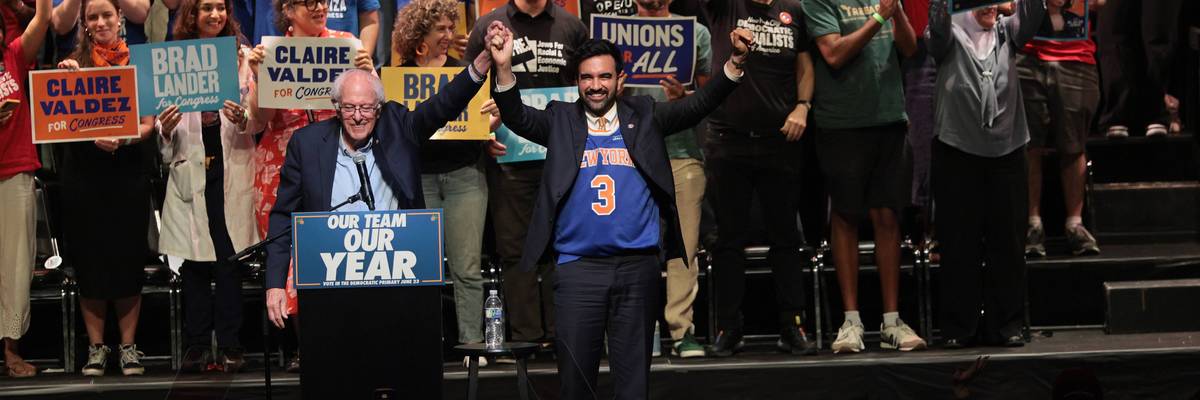
Sen. Bernie Sanders (I-VT) and Mayor Zohran Mamdani raise their hands during a Get Out the Vote (GOTV) rally at Kings Theater on June 18, 2026 in New York City.
(Photo by Michael M. Santiago/Getty Images)
“The American people are disgusted with an economic system in which one guy on top, Elon Musk, owns more wealth than the bottom half of American society.”
Sen. Bernie Sanders on Thursday explained to Fox Business reporter Chase Williams why candidates backed by the Democratic Socialists of America have been racking up victories in Democratic primaries throughout the US.
While walking the halls of the US Capitol building, Williams asked Sanders (I-Vt.) if he believed DSA-backed candidates would hurt the Democratic Party’s chances of retaking Congress from Republicans this fall.
Sanders said he didn’t think so and then offered his opinion on why many voters are attracted to democratic socialism.
“The American people are disgusted with an economic system in which one guy on top, Elon Musk, owns more wealth than the bottom half of American society,” Sanders said. “They’re tired of a situation where 60% of our people live paycheck-to-paycheck… they are tired of a corrupt political system in which billionaires buy elections.”
NEW: I asked Sen. Bernie Sanders whether the rise of Democratic Socialist candidates could hurt Democrats politically in November.
"No," Sanders replied. "The American people are disgusted with an economic system in which one guy on top – Elon Musk – owns more wealth than the… pic.twitter.com/eYb41K3o3h
Williams attempted to interject, but Sanders kept speaking.
“They want change,” he continued. “They want candidates and members of Congress with the guts to stand up for working families and not simply take big checks and not simply have super PACs elect… the next senators and members of Congress.”
Williams again pressed Sanders if he thought democratic socialists were a liability for the Democratic Party.
“No,” Sanders replied. “I think that if you have candidates who are standing up for the working class, and explaining that there is something wrong when the billionaire class is getting richer and richer, while so many Americans can’t afford groceries, they can’t afford housing, they can’t afford healthcare. That’s not the kind of economy the American people want.”
Our work is licensed under Creative Commons (CC BY-NC-ND 3.0). Feel free to republish and share widely.
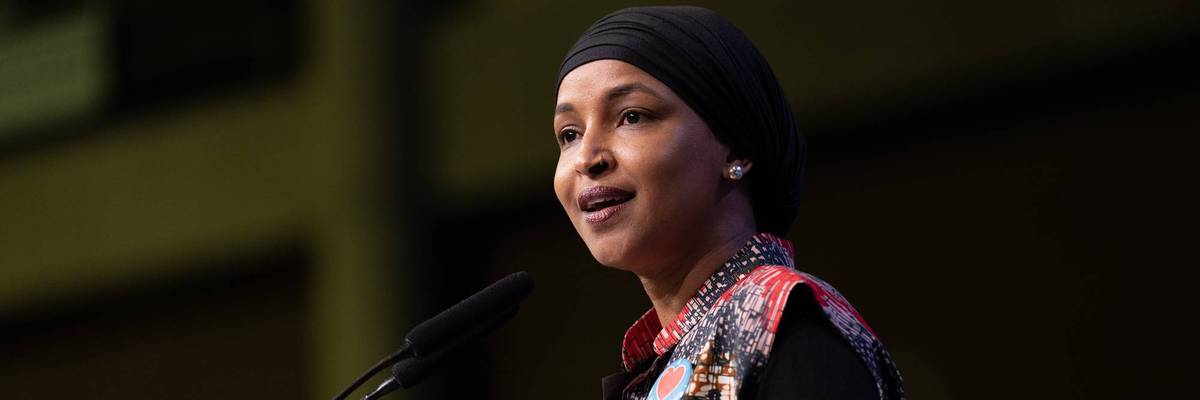
US Rep. Ilhan Omar (D-Minn.) speaks at the Mayo Civic Center in Rochester, Minnesota on May 30, 2026.
(Photo by Alex Kormann/The Minnesota Star Tribune via Getty Images)
“We stand firmly against this report and other efforts by the Trump administration to weaponize the federal government against dissent, which is a patriotic tradition.”
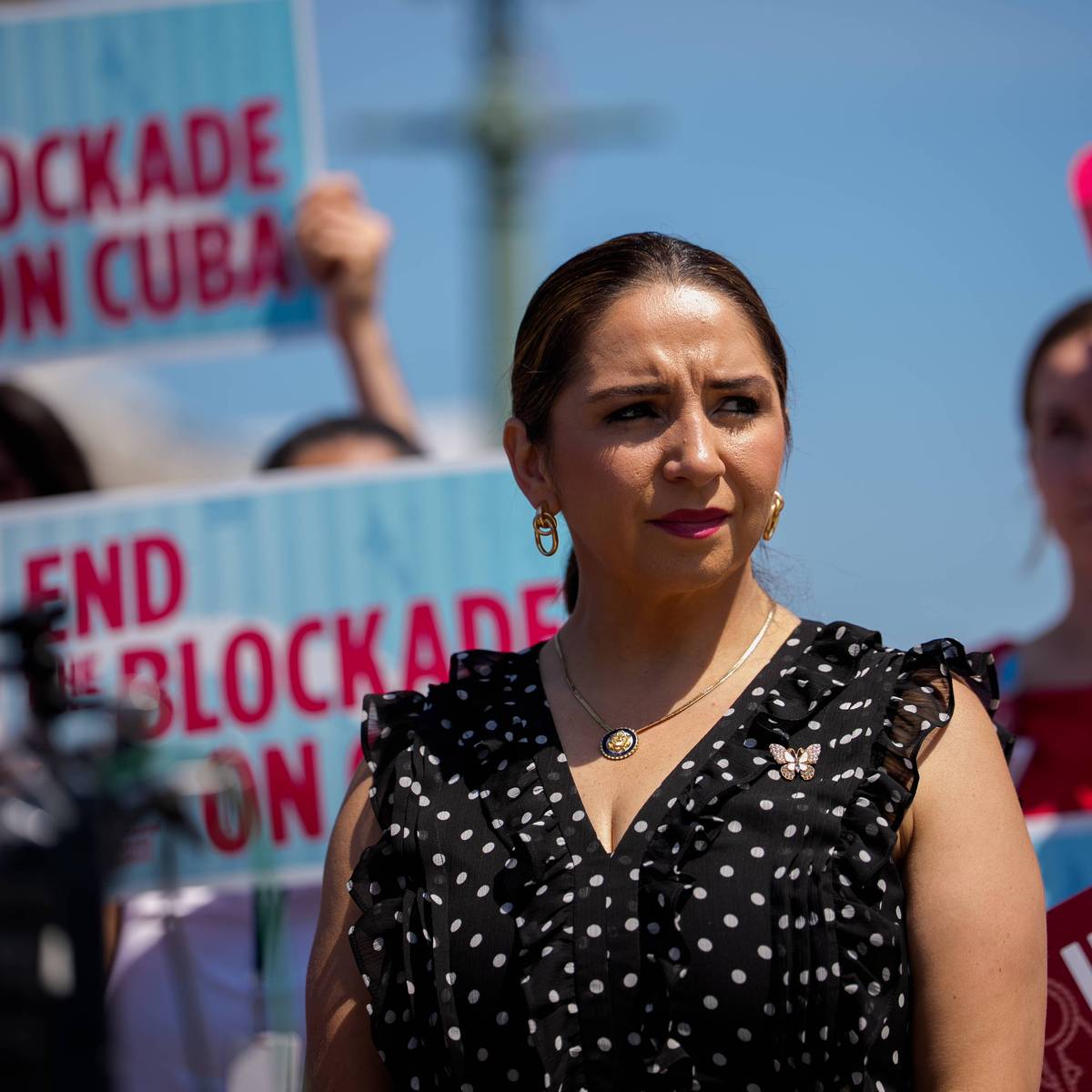
President Donald Trump’s escalating claims that Cuba and its supporters poses a threat to US security have been denounced as “laughable” and “crazy,” but progressive lawmakers are warning that the State Department’s report alleging that the country of roughly 10 million people aims to “conquer” the United States and is backing “left-wing terrorism on American soil” represents a genuine attack on Trump’s perceived political enemies.
“Trump appears hell-bent on taking America back 70 years to the height of Cold War McCarthyism, when hawkish foreign policy was paired with unsubstantiated accusations of communist subversion and political repression against dissidents at home,” said a group of Democrats led by progressive Rep. Ilhan Omar (D-Minn.), chair of the Congressional Progressive Caucus Peace and Security Taskforce. “We condemn this report’s attack on Americans’ constitutional rights to free speech and assembly.”
Omar on Thursday was joined by 10 other lawmakers, including Reps. Alexandria Ocasio-Cortez (D-NY), Jim McGovern (D-Mass.), Delia Ramirez (D-Ill.), and Rashida Tlaib (D-Mich.), in speaking out days after the State Department released its report titled “Cuba: The Capital of 21st Century Communism.”
The report, said the lawmakers, was a “McCarthyite attack on Americans’ free speech rights.”
The 100-page document claims that Cuba’s communist government “has waged a sustained campaign of subversion against the United States” and recruited “generations” of activists in the US, listing by name people who have participated in solidarity campaigns in support of Cuban people as the Trump administration has imposed a destructive oil blockade on the island nation.
“Trump appears hell-bent on taking America back 70 years to the height of Cold War McCarthyism.”
In January, Trump issued an executive order declaring that Cuba posed an “extraordinary threat” to US national security and threatened countries with tariffs should they provide oil to the Cuban government. The administration had already cut off Cuba’s top source of energy by taking control of Venezuela’s vast oil reserves. The blockade has left the Cuban healthcare and education systems and other daily public services struggling to operate.
US groups and citizens named in the report as having spoken out against the administration’s blockade and its threats of military action against Cuba include commentator Hasan Piker, Amazon Labor Union founder Christian Smalls, the National Lawyers Guild, and campus activist Isra Hirsi—Omar’s daughter.
“We denounce this administration’s irresponsible attacks against civil society organizations, activists, journalists, labor leaders, members of Congress, elected officials, and private individuals based on their advocacy for peaceful foreign policy and social justice at home,” said Omar and the Democrats who joined her in the statement.
The lawmakers said they would use their “full oversight power as members of Congress and elected officials to stop the persecution of Trump’s perceived political enemies,” including those who speak out publicly against the president’s policies in Cuba—activity that is protected by the First Amendment.
“We stand firmly against this report and other efforts by the Trump administration to weaponize the federal government against dissent, which is a patriotic tradition,” they said.
The report is the administration’s latest attack on the free speech rights that are integral to the US Constitution and American history. The White House has pushed to deport foreign students who protested the US-backed Israel war on Gaza, designated anti-fascist organizers as “terrorists,” and, nearly a year after issuing a presidential memo demanding a strategy to “disrupt” left-wing networks, recently convened a summit to launch a “global offensive against the transnational threat of Radical Left terrorism.”
Meanwhile, said Omar on Thursday, Trump and Secretary of State Marco Rubio—the son of Cuban immigrants and a long-time proponent of regime change on the island—“are intensifying decades of economic war” against the people of Cuba and deliberately depriving “the entire island’s population of adequate food, fuel, and medicine.”
Along with ending his attacks on those who oppose his policies, said Omar, “it is past time for Trump to obey the Constitution and end the dangerous, cruel, and illegal naval blockade causing collective punishment against Cuba.”
Our work is licensed under Creative Commons (CC BY-NC-ND 3.0). Feel free to republish and share widely.
More than a third of the 148,000 rejected mail-in ballots from California’s June primary were discarded because they were postmarked late, which experts largely attribute to a recent change in the US Postal Service’s postmarking policy.
As the Associated Press reports, nearly 150,000 California mail-in ballots were rejected in the June primary, with many arriving with postmarks that made them ineligible to be counted. Voting experts say the increase appears to be tied in part to recent US Postal Service changes that can delay when a mailpiece receives its postmark.
California allows mail ballots to be counted if they are postmarked by Election Day and arrive within seven days afterward, but experts say the issue is that some ballots are now receiving a postmark date based on when they are processed rather than when they were handed over to the Postal Service.
The state’s rejection rate in June was reportedly 1.73%, with 148,241 ballots rejected out of all returned mail ballots. That was higher than recent primary elections, including 2024, when 108,982 ballots were rejected, or about 1.56%. According to the AP, late arrival was by far the most common reason ballots were discarded — more than 93,000, followed by nearly 44,000 ballots where the voter’s signature did not match county records and more than 8,300 returned without a signature altogether.
Kim Alexander, president of the nonpartisan California Voter Foundation, said the problem is largely related to postmark timing rather than ballots simply arriving too late.
“Ballots rejected due to lateness are caused primarily to being postmarked too late to count, not because they arrived too late to count,” Alexander told the AP in an email.
Per the Postal Service’s new policy, customers can request a postmark on the same day it is mailed by dropping it off a Postal Service retail counter. The service is free, but many voters are unaware that they must specifically request one.
Without a manual postmark, the date applied to a ballot’s envelope may reflect when the mail is processed at a sorting facility rather than the day it was accepted by the Postal Service. Recent Postal Service consolidations have also reportedly moved some processing centers farther from communities, potentially adding delays before a postmark is applied.
California election officials warned voters earlier this year to mail ballots early or drop them off at polling stations because of concerns that Postal Service changes could affect delivery times.
The rejected ballots became fuel for a broader political fight after late-counted ballots shifted some election results weeks after Election Day.
President Donald Trump reportedly criticized California’s counting process, while state officials said the extended counting period is required under state law to allow counties to verify and count eligible ballots.
The site Rolling Out recommends that voters utilize the state’s free BallotTrax tracking system to make sure their votes were counted. Researchers reportedly found that voters who do not sign up are more likely to have ballots rejected, largely because they may not learn about signature issues in time to correct them.
Image: In this photo illustration, the envelope holding an official ballot, mailed to a Southern California resident, ahead of a state primary election, photographed May 5, 2026 in Los Angeles, California. Every registered voter in California will receive a ballot by mail. (Photo Illustration by Jay L Clendenin/Getty Images)
Help Outreach Working Group lift the fog of corporate media. Donate to help us maintain this website and distribute literature on the street.
This Sunday’s Town Hall: Announcing This Week’s Progressive Town Hall: Every Sunday at 4pm ET/1pm PT RSVP HERE Join PDA activists online from across the country to discuss the importance of progressives reclaiming the American story from the MAGA right, an issue of heightened importance as we’re now within one... Continue reading →
We protest Heritage Foundation EVERY MONDAY (Join us!!!!) By admin | September 2, 2025 | Uncategorized Cliff Cash Comedy Premiered Jul 26, 2025 Every Monday at The Heritage Foundation 214 Massachusetts Ave. Washington D.C. 4pm protest 6pm pizza Every Friday at Fox News D.C. 400 N. Capitol St. Washington D.C. 4pm protest 6pm pizza We are... Continue reading →
There are less than 9 weeks until the critical November election, and what we do between now and then will shape the future of our health care. We started Nurses for Democracy to fight back against fascism and protect our democracy, but also to elect candidates in key races who are committed... Continue reading →
September General Membership Meeting *We will be voting on November Election endorsements for state propositions!* Date: Tuesday, 15 September, 2026 (third Tuesday of month) Time: 7-9 PM *NEW* In-person Location: Women’s Building (3543 18th St), Audre Lorde Room Remote: Via Zoom Link Here
Join us in person for a deep discussion on the upcoming November election. We’ll break down what’s on the ballot, why it matters, what you need to know before you vote. Featuring: Juliet Williams, CalMatters Ben Trefny, KALW Public Media Lila LaHood, San Francisco Public Press This election is pivotal.... Continue reading →
One Million Rising: Strategic Non-Cooperation to Fight Authoritarianism Virtual Event · Hosted by No Kings Time Wednesdays 8 – 9:30pm EDT Location Virtual event Join from anywhere About this event Across the country, authoritarian forces are getting bolder and more dangerous. Trump and his allies are not hiding their agenda: mass deportations,... Continue reading →
13th anniversary of Occupy Wall Street and Occupy San Francisco By admin | September 17, 2024 | Uncategorized Leave a comment (newlaborforum.cuny.edu) Occupy Wall Street (OWS) was a left-wing populist movement against economic inequality, corporate greed, big finance, and the influence of money in politics that began in Zuccotti Park, located in New York City’s... Continue reading →
Skip to content 15th Anniversary of Occupy Wall Street 15th Anniversary of Occupy Wall Street September 17 – September 20 We are organizing a celebration for the 15th anniversary of Occupy Wall Street, scheduled for September 17, 2026, at Zuccotti Park. The event aims to acknowledge past successes, pass the “torch” to contemporary... Continue reading →
THURSDAY, JUNE 29, 2023 AT 2 AM – 4 AM PDT How to create trust in a group? Details Event by Extinction Rebellion Empathy Circles online EMPATHY CAFE Duration: 2 hr Public · Anyone on or off Facebook How to create trust in a group? This is the question that arose in our... Continue reading →
Skip to content 15th Anniversary of Occupy Wall Street 15th Anniversary of Occupy Wall Street September 17 – September 20 We are organizing a celebration for the 15th anniversary of Occupy Wall Street, scheduled for September 17, 2026, at Zuccotti Park. The event aims to acknowledge past successes, pass the “torch” to contemporary... Continue reading →