Do Democrats Have a Plan for the Post-Trump World Order?

A party tries to figure it out in real time, on the world stage in Munich.

by Jen Kirby February 18, 2026 (Prospect.org)

Rep. Alexandria Ocasio-Cortez speaks at a conference
Rep. Alexandria Ocasio-Cortez (D-NY) takes part in the Munich Security Conference, February 13, 2026. Credit: Sven Hoppe/picture-alliance/dpa/AP Images

MUNICH – The Friday nightcap session at the Munich Security Conference focused on “seismic shifts” in U.S. foreign policy, and it featured a bit of an odd grouping: Matthew Whitaker, the current United States ambassador to NATO; Gretchen Whitmer, the Democratic governor of Michigan; and Alexandria Ocasio-Cortez, the progressive Democratic congresswoman from New York.

The panelists sat in a circle at the center of the room, surrounded on both sides by the audience, all wearing lanyards around their neck, some sipping wine, and many reaching upward to take photos. The tilt of their iPhones gave away who they were all here to see.

This event was one of a few in Ocasio-Cortez’s foreign-policy coming-out party in Germany where she, along with other Democrats who are not-so-subtly seeking national office in the future, sought to lay out a vision for American power after Donald Trump, in a world that the U.S. president has radically remade.

In Munich, U.S. Secretary of State Marcio Rubio proposed a “new Western century,” built around a manufactured claim of shared Christian and white heritage, propped up by an elementary-school understanding of world history. Democrats rejected that, but the challenge for the party, including the maybe 2028 candidates, is the same one faced by all leaders in Munich: There’s a rough consensus that the world is transitioning to a new order, but no one really has any idea what the world is moving toward.

There’s a rough consensus that the world is transitioning to a new order, but no one really has any idea what the world is moving toward.

This transformation—or rupture—has tended to sanitize an old order that has had its many critics, on both the left and the right. Of late, the eulogy has mostly focused on an idealized American reliability and predictability, and a commitment to alliances and cooperation in rules-based international order. The unequal application of those rules that has allowed for costly military intervention and economic exploitation does not get quite as much airtime. There is also a fear, including in Europe, that what replaces it might be even more destruction. It helps explain why some Democrats clung to it, some more forcefully critiqued it, and some fell in between, acknowledging the damage done by Trump 2.0, but maybe not quite ready to let go.

Across those camps, many politicians still found themselves using different versions of the “r” word: rebuildredeemrecoverreassureremind them it’s not all Trump. This reflexive desire to convince allies and partners that Trump will be gone, and that repair of the old order is possible, does not serve as quite the same salve to allies that it was ten years ago—less reassurance, more manifestation.

“I hope if there is nothing else I communicate today: Donald Trump is temporary. He’ll be gone in three years,” California Gov. Gavin Newsom said on a panel on climate change, as he was also advocating for leaders to continue to see California as a “stable and reliable” partner in countering Trump’s damaging environmental policies.

Other Democrats pushed back on specific Trump policy. Sen. Chris Murphy (D-CT) lambasted the administration’s Gaza reconstruction plan, which he tied to the president’s corruption. Another governor, Whitmer, criticized Trump’s tariffs. “The damage that has been done from alienating allies through tariffs, I think is going to take a long time to recover from, and that will continue to vex us as a nation,” she said during that foreign-policy panel.

On that same panel, Ocasio-Cortez elaborated on more of her foreign-policy thinking, which was, again, the draw of the event. “We have an opportunity to explore what a world would look like if we upheld democracy, human rights, trade that actually centers working-class people instead of accruing overwhelmingly the benefits of trade to the wealthiest,” Ocasio-Cortez said, in response to a question on the new world order.

This is part of a “foreign policy for the working class,” which Ocasio-Cortez later discussed alongside Rep. Jason Crow (D-CO). The two described the policy as one of American military restraint, where strategic alliances would benefit the interests of the working class, rather than corporations.

“What we know is that isolating ourselves from the world will deliver disastrous consequences at home and abroad,” Crow said. “Our foreign policy is being turned into an extortion ring for Big Oil, for the Trump family, for elites. They’re bullying our partners and allies … We want to be a force for good.”

In some ways, this has echoes of the Biden administration’s “foreign policy for the middle class,” which sought to address domestic economic concerns in global policy. Matt Duss, executive vice president of the Center for International Policy, who is also advising Ocasio-Cortez, said the Biden approach recognized the problem, but mostly shaped the message to make the same old policy sound more appealing.

“How do we better sell continuing American global military hegemony to the American people, rather than hearing that Americans just aren’t that into global military hegemony,” Duss said. “I think that is what progressives have brought: Americans are just not that into global military hegemony because it’s destructive, it’s wasteful. It increases inequality, it steals money from the working class, and it funnels it upwards to a tiny, unaccountable elite.”

Ocasio-Cortez also described this kind of foreign policy as a way to address income inequality and push back against the authoritarian, populist right around the globe—a kind of foil to the transnational MAGA movement Rubio described.

A deeper reckoning is required among the Democratic Party about what U.S. foreign policy needs to be to serve Americans at home and allies abroad.

Yet even she couldn’t escape the reassurance instinct. “I know that the Democratic Party is here for our allies,” she told the crowd Friday. “We are shocked at the president’s destruction of our relationship with our European allies, his threatening over Greenland is not a joke. It is not funny. It threatens the very trust and relationships that allow peace to persist.”

“I believe what I can say is that unequivocally, the vast majority of the American people do not want to see these relationships frayed, and they are committed to our partnerships and our relationships and our allies,” she added.

That does not seem like a promise the U.S. can really make, or at least it’s one that doesn’t mean all that much as Europe tries to untangle itself from the United States. This isn’t Trump’s first term, where President Joe Biden saying “America is back” was enough to somewhat soothe U.S. allies who also wanted to believe MAGA was an aberration. In Trump’s second term, those illusions are gone, especially in Europe, which has been taking it on the chin since Vice President JD Vance went to the podium at Munich last year.

That requires a deeper reckoning among the Democratic Party about what U.S. foreign policy needs to be to serve Americans at home and allies abroad. It’s worth noting that Ocasio-Cortez got a lot of attention at Munich because she always gets a lot of attention, and this was a new stage for her. That was particularly true when she stumbled, including a long pause and tortured response to a question on Taiwan, which tended to overshadow both the substantive breaks and points of agreement with the past that characterized her approach.

This was the largest U.S. delegation to the security conference ever, and the weekend is a mix of competing panels and press conferences and missed connections, which means it offers far from exhaustive, or definitive, answers about how Democrats are imagining a post-Trump world. What Munich made clear is that many really are trying to figure this out in real time, with some doing it more quietly than others.

There were real glimmers in Munich of what the U.S. could build toward after Trump, but much of it is still based on a familiar framework, which positions the U.S. as mostly a global power, with allies and partners, retaining its influence and leverage and authority. But beyond what this new world order might bring, no one knows what kind of America we will be in a year—or three.

 Read more

Can Marco Rubio Con Trump Into Cuban Regime Change?

Can Marco Rubio Con Trump Into Cuban Regime Change?

The president clearly prefers graft and plunder to full-scale wars. But he’s also easily tricked.

by Nathan ThompsonFebruary 12, 2026

Olympic Spirits on ICE

Olympic Spirits on ICE

Why would tourists come to the 2028 Los Angeles Olympics when Trump is transforming the entire country into a xenophobic danger zone?

by Whitney Curry WimbishFebruary 11, 2026

Board of Peace Is a Board of Profits

Board of Peace Is a Board of Profits

Corporate interests dominate the organization planning the reconstruction of Gaza.

by Ellen Ioanes February 9, 2026

You’ve just read one of the stories we published this week because readers like you made it possible.

The Prospect doesn’t answer to advertisers or billionaire owners. We answer to you. That’s not a slogan—it’s how we’re funded, and it’s why we can report without fear or favor.

Independent, reader-supported journalism is rare. We’d like to keep it going. If you believe this kind of reporting should exist and remain free to read we hope you’ll consider chipping in. Every contribution, however modest, makes a real difference.

Support independent journalism

With gratitude,

Mitchell Grummon

Mitch Grummon
Publisher

Jen Kirby

Jen Kirby is a freelance foreign-policy journalist, currently based in Rome. More by Jen Kirby

Every Single Participant in NYT Focus Group Preferred Progressive Candidates Over Moderate Ones

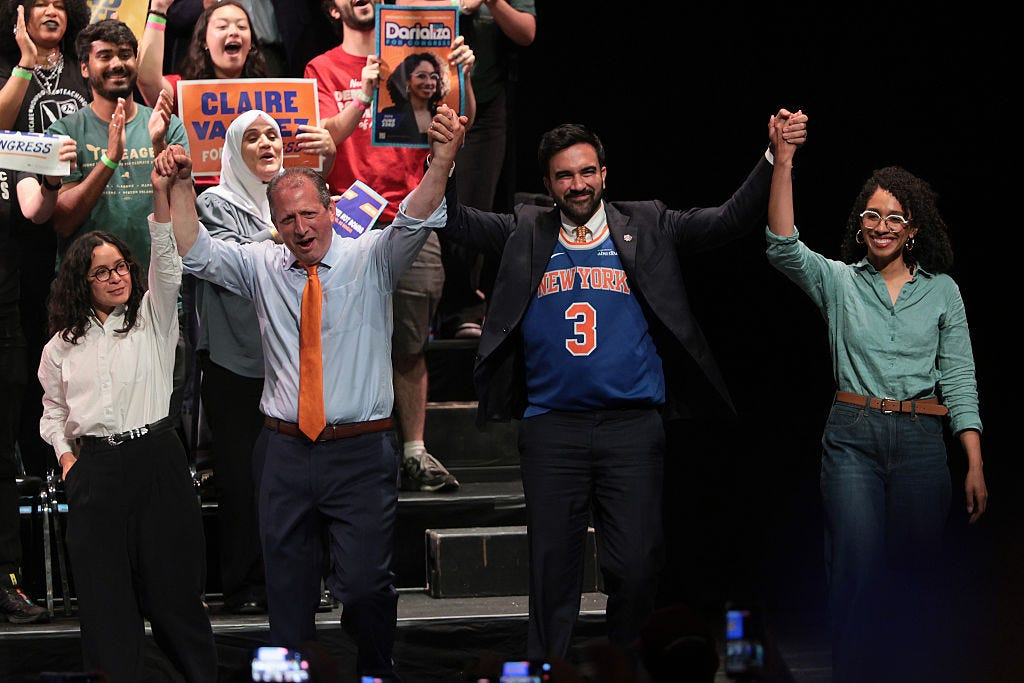
New York Is Not For Sale Rally In NYC

Over 13,000 people pack Forest Hills Stadium in Queens, New York, for mayoral candidate Zohran Mamdani’s New York Is Not For Sale rally on October 26, 2025.

 (Photo by Neil Constantine/NurPhoto via Getty Images)

“The Democratic Party needs to embrace voices that resonate with people,” said one participant

Julia Conley

Feb 18, 2026 (CommonDreams.org)

The New York Times’ “America in Focus” series has assembled dozens of focus groups in recent years, often asking supporters of President Donald Trump how they feel about his domestic and foreign policy one year into his second term—but political observers suggested Tuesday that the newspaper’s latest focus group should capture the attention of Democratic leaders who have been condemned for capitulating to the president and refusing to embrace and learn from the victories of progressive leaders like New York City Mayor Zohran Mamdani.

The newspaper spoke to 13 Democratic and independent voters including retirees from Indiana and Michigan, working people from states such as North Carolina and Nevada, and an unemployed voter from Iowa. The topic of discussion was the participants’ frustrations with the Democratic Party as it faces the Trump administration and the president’s aggressive deployment of US Immigration and Customs Enforcement (ICE) across the country.

RECOMMENDED…

62nd Munich Security Conference

As Dem Voters Seek a ‘Fight’ With the Superrich, AOC is Now Their Favorite Candidate: Poll

Data Center Giant Secures $14 Million Deal to Consume 40% of Pennsylvania Town's Excess Water

Data Center Giant Secures $14 Million Deal to Consume 40% of Pennsylvania Town’s Excess Water

“Spineless” was one word a participant had for the Democratic Party when asked to describe it. Another said the party appears “paralyzed” while a 46-year-old Latina woman from Nevada said Democrats in Congress are “sellouts and suckers.”

Terrill, a 68-year-old retired Indiana resident, agreed that the party leadership has “sold out.”

“I just feel we were never being governed,” said Terrill. “We’re being looted. The Democratic Party lined their pockets and created—they created this mess.”

A number of respondents expressed ire over the decision by eight members of the Senate Democratic caucus to vote with Republicans last November to end a record-breaking government shutdown—without securing any concessions on protecting healthcare for millions of Americans who rely on Affordable Care Act subsidies.

The response from participants “tracks 100% with what I’ve seen on the streets, from No Kings protests to the resistance against ICE,” said commentator Hasan Piker.

Democratic leaders, he added, “are oblivious to the anger” felt by voters. “They’re speaking into an echo chamber of consultants who tell them what they want to hear.”

X post: https://x.com/zachdcarter/status/2024097351019765891?ref_src=twsrc%5Etfw%7Ctwcamp%5Etweetembed%7Ctwterm%5E2024097351019765891%7Ctwgr%5E2c295afa9d1c1acac9031101544709d36bf299be%7Ctwcon%5Es1_c10&ref_url=https%3A%2F%2Fwww.commondreams.org%2Fnews%2Ffocus-group-nyt

With voters expressing such intense dissatisfaction with the leadership of establishment Democrats, “how on Earth do Chuck Schumer and Hakeem Jeffries still manage to cling to their leadership roles?” asked journalist Mehdi Hasan, referring to the Senate and House minority leaders, who both represent New York.

But along with unloading their frustration about the Democrats who continue to back ICE—even as support for the agency craters among voters—and refuse to develop what one voter called “clear, concise messaging” that communicates how the party will fight for working Americans, the participants talked about the political leaders who “excite” them about the future of the party and the country.

Mike, a 33-year-old telecommunications professional in North Carolina, said that Mamdani, a democratic socialist, exemplifies what the party “should be doing more of.”

Less than two months into his mayoral term, said Mike, Mamdani has provided voters in New York and across the country with a “clear and concise” message about how he plans to govern and what he plans to prioritize.

Mike drew a comparison to Sen. Bernie Sanders (I-Vt.), an early backer of Mamdani who is continuing the Fighting Oligarchy nationwide tour he began last year, speaking to crowds in both red and blue districts about the need for policies that serve working families rather than billionaire political donors and corporations.

“Bernie has said the same thing since the ‘80s,” said Mike. “You’ve got to tax the billionaires. You’ve got to tax the upper class. He’s never changed. That’s the messaging. You’ve just got to drill it into them, and Zohran did it. Man, it’s beautiful.”

While other respondents expressed some enthusiasm about more moderate leaders like Gov. Gavin Newsom of California and former Transportation Secretary Pete Buttigieg, several participants agreed with Mike’s comments on Mamdani and one independent voter named Rep. Alexandria Ocasio-Cortez (D-NY), another outspoken democratic socialist and a potential 2028 contender, as a leader who “excites” them.

If given a choice between voting for a moderate candidate in an election or a progressive, all 13 participants said they would choose the progressive.

X post: https://x.com/PushDemsLeft/status/2023934611613483195?ref_src=twsrc%5Etfw%7Ctwcamp%5Etweetembed%7Ctwterm%5E2023934611613483195%7Ctwgr%5E2c295afa9d1c1acac9031101544709d36bf299be%7Ctwcon%5Es1_c10&ref_url=https%3A%2F%2Fwww.commondreams.org%2Fnews%2Ffocus-group-nyt

A 29-year-old independent voter named Panth from Arizona said the term moderate reminded him of “people like [former West Virginia Sen.] Joe Manchin, who hold up some of the policies that I would want supported.”

“I feel like moderates are happy with the status quo and will basically do what we’ve always done. The system is working for them and they want to keep it the same. I think for a large part of Americans, the system isn’t working, so we need something new,” said Panth.

Days after taking office, Mamdani announced that he and Democratic New York Gov. Kathy Hochul had finalized a deal to fund his universal childcare plan for the city. He also announced the launch of “rental ripoff” hearings to hold landlords accountable for abuses, intervened in a major renters’ dispute, personally aided with snow removal, and repaved a dangerous bump in the road on the Williamsburg Bridge.

Progressive policymakers “actually do stuff,” summarized Panth.

The widespread expression of enthusiasm for progressive candidates came a week after grassroots organizer Analilia Mejía’s victory in the Democratic primary in New Jersey’s 11th Congressional District, after which Sanders asserted that victories on the left “can be done everywhere.”

As Trump has ramped up his attacks on immigrant communities and First Amendment rights, leaders including Schumer and Jeffries have incensed progressive commentators by backing down on demands to rein in ICE, refusing to clearly condemn the administration’s arrest and attempted deportation of pro-Palestinian protesters, and expressing frustration at advocacy groups that have demanded they fight the Trump agenda.

X post: https://x.com/shannonrwatts/status/2024144387094032596?ref_src=twsrc%5Etfw%7Ctwcamp%5Etweetembed%7Ctwterm%5E2024144387094032596%7Ctwgr%5E2c295afa9d1c1acac9031101544709d36bf299be%7Ctwcon%5Es1_c10&ref_url=https%3A%2F%2Fwww.commondreams.org%2Fnews%2Ffocus-group-nyt

“The Democratic Party needs to embrace voices that resonate with people,” said Panth. “When you hear Bernie, he has energy because he really believes in what he’s saying. It’s the same reason Trump resonates with people, because he acknowledges some of the struggles that they’re facing. Sure, he blames the wrong groups, but he at least voices it. The Democratic Party doesn’t do the same.”

Alex Jacquez, a former Obama administration official who’s now chief of policy and advocacy at the economic justice group Groundwork Collaborativecommented: “Bingo.”

Our work is licensed under Creative Commons (CC BY-NC-ND 3.0). Feel free to republish and share widely.

Julia Conley

Julia Conley is a staff writer for Common Dreams.

Full Bio >

Sanders to Rally for Billionaire Tax in California as Crypto Industry Joins Newsom in Opposition

SANDERSAOC

US Sen. Bernie Sanders (I-Vt) speaks at a rally in Folsom, California on April 15, 2025.

 (Photo by Paul Kuroda for The Washington Post via Getty Images)

“While US billionaires became $1.5 trillion richer last year, the average worker in America has just $955 in retirement savings,” said Sen. Bernie Sanders. “That’s why I’ll be in LA this week fighting for a wealth tax on billionaires.”

Jake Johnson

Feb 18, 2026 (CommonDreams.org)

US Sen. Bernie Sanders is set to rally in California on Wednesday with frontline healthcare workers and other supporters of a proposed ballot measure that would impose a one-time 5% tax on the wealth of the roughly 200 billionaires who reside in the Golden State.

Sanders (I-Vt.), a longtime champion of efforts to redress massive income and wealth inequality nationwide, said in a statement ahead of Wednesday’s rally that he “strongly” supports the proposed wealth tax in California, which is home to more billionaires than any other state in the US.

RECOMMENDED…

Progressives-Mobilize-in-Los-Angeles

‘It Should Be Common Sense’: Sanders to Headline Billionaire Tax Campaign Kickoff in California

Sen. Bernie Sanders speaks at the Billionaire Tax Now rally

Sanders to Oligarchs Opposing California Billionaire Tax: ‘You’re Treading on Very, Very Thin Ice’

“While US billionaires became $1.5 trillion richer last year, the average worker in America has just $955 in retirement savings and 21% of seniors are trying to survive on less than $15,000 a year,” Sanders wrote in a social media post earlier this week. “That’s why I’ll be in LA this week fighting for a wealth tax on billionaires.”

Sanders’ appearance at Wednesday’s rally in Los Angeles, which is set to begin at 5 pm local time, comes as organizers behind the California wealth tax push are working to collect the roughly 875,000 signatures required to get the proposal on the November ballot.

“Union leaders believe the visit by Mr. Sanders will energize their campaign, which has already trained more than 1,000 volunteers and doubled the amount per signature that it is paying petition circulators,” the New York Times reported on Tuesday.

“We are very grateful for the support of US Sen. Sanders, who for years has been telling the truth about the threat that income inequality poses to our nation—and to working people.”

The Times also reported that “an opposition campaign committee with ties to the crypto industry, called Golden State Promise, officially formed on Friday” and “was expected to report this week $10 million in donations, including $5 million from Chris Larsen, a founder of the cryptocurrency company Ripple.”

The proposal has also drawn opposition from Democratic California Gov. Gavin Newsom, who has close ties to Silicon Valley elites—some of the most vocal opponents of the state wealth tax plan. (Notably, the billionaire CEO of the most valuable company in the world, Nvidia, said earlier this year that he is “perfectly fine” with the proposal as others in his class pumped millions into the effort to defeat it.)

Newsom, widely seen as a possible 2028 presidential candidate, has publicly vowed to defeat the proposed wealth tax, which is aimed at raising funds to prevent a looming healthcare crisis spurred by federal Medicaid cuts that US President Donald Trump and congressional Republicans approved last summer.

“This will be defeated—there’s no question in my mind,” Newsom said in January. “I’ll do what I have to do to protect the state.”

Proponents of the tax estimate that it would raise around $100 billion in revenue—much of which would be placed in a “Billionaire Tax Health Account” designed to help shore up the state’s healthcare system.

Mayra Castaneda, an Ultrasound Technologist at St. Francis Medical Center in Lynwood, said that “we are very grateful for the support of US Sen. Sanders, who for years has been telling the truth about the threat that income inequality poses to our nation—and to working people.”

“If we let these healthcare cuts stand, my patients will suffer. Hospitals and ERs will close, others will be strained by taking on more patients, and people will lose access to life-saving care,” said Castaneda. “This is all avoidable if billionaires just pay their fair share in California, so I’m going to do whatever is in my power to see this proposal pass in November. I’ll be telling my story alongside Sen. Sanders and urging my fellow Californians to take action to save lives.”

Our work is licensed under Creative Commons (CC BY-NC-ND 3.0). Feel free to republish and share widely.

Jake Johnson

Jake Johnson is a senior editor and staff writer for Common Dreams.

Full Bio >

As Trump Marches US Toward Iran War, Critics Ask: Where’s the ‘Pushback’ From Dems and Media?

US-POLITICS-CONGRESS-DEMOCRATS

US Senate Minority Leader Chuck Schumer (D-NY), and US House Minority Leader Hakeem Jeffries (D-NY) depart a press conference on Capitol Hill in Washington, DC, on January 8, 2026.

 (Photo by Saul Loeb/AFP via Getty Images)

“It’s astonishing that we’re building up for a significant military clash, and Congress isn’t involved, no real case is being made to the public, and the average American has no clue.”

Stephen Prager

Feb 18, 2026 (CommonDreams.org)

Amid reports that President Donald Trump is pushing the US toward a “massive” war in Iran, critics have found themselves shocked by the lack of “pushback” from top Democrats and mainstream media institutions.

Barak Ravidreported for Axios on Wednesday that, with a deal between the US and Iran appearing increasingly out of sight, “the Trump administration is closer to a major war in the Middle East than most Americans realize” and “It could begin very soon.”

RECOMMENDED…

image shoes US military planes headed to the midde east

‘The Tankers Just Keep Coming’: US Military Movements Spike Fears of Imminent Attack on Iran

Negotiations between Iran and the US received extensive coverage newspapers in Tehran

Peace Campaigners Demand Congress Stop Trump From Waging ‘Devastating’ War on Iran

Sources told the outlet that “A US military operation in Iran would likely be a massive, weeks-long campaign that would look more like full-fledged war than last month’s pinpoint operation in Venezuela.”

“Such a war would have a dramatic influence on the entire region and major implications for the remaining three years of the Trump presidency,” Ravid wrote.

However, with Congress on recess and the media largely distracted by a whirlwind of other issues, he noted, “there is little public debate about what could be the most consequential US military intervention in the Middle East in at least a decade.”

As columnist Adam Johnson pointed out on social media, Trump’s sabre-rattling toward Iran was underway well before Congress left town.

Despite this, Johnson said, the “two most powerful Democrats in the country,” Senate Minority Leader Chuck Schumer (D-NY) and House Minority Leader Hakeem Jeffries (D-NY), “have once again not leveled a single word of substantive pushback,” as was the case when Trump conducted strikes against Iran over the summer.

He said the top Democrats have only acknowledged Trump’s threats “when asked by reporters” and have made only “process criticisms” rather than criticizing the merits of the war itself.

Last month, as Trump threatened to carry out massive strikes in retaliation for Iran’s brutalization of protesters, Schumer limited his criticism to the fact that Trump had not consulted Congress.

“It has to be debated by Congress. Something like that, the War Powers Act, the Constitution, requires a discussion in Congress. We’ve had no reach-out from the administration at this point,” he told reporters.

More recently, Jeffries—a member of Congress who is briefed on national security matters—was asked on CBS’s Face the Nation what he knew about the war plans or what he would want to know.

He did not answer that question, but vaguely lamented that Trump “has been slow to provide information… to the Gang of Eight members of Congress” and “hasn’t provided a significant amount of information to Congress in general.”

“When it comes to sanctions, perma-war, and bombings, we do not have an opposition party,” Johnson said. “We have sleepy AIPAC-funded hall monitors paid to get wedgies and vaguely object after the craters are smoking in the ground.”

New York Times columnist David French agreed: “It’s astonishing that we’re building up for a significant military clash, and Congress isn’t involved, no real case is being made to the public, and the average American has no clue. If this gets serious, it will be a shock for lots of people.”

X post: https://x.com/brhodes/status/2024209063853379928?ref_src=twsrc%5Etfw%7Ctwcamp%5Etweetembed%7Ctwterm%5E2024209063853379928%7Ctwgr%5E3a277672ed4df168297c70d5754db37b5fdd22d0%7Ctwcon%5Es1_c10&ref_url=https%3A%2F%2Fwww.commondreams.org%2Fnews%2Ftrump-iran-war-pushback

There is little hunger in the American public for a war with Iran. A YouGov survey from early February found that 48% said they strongly or somewhat opposed military action in Iran, compared with just 28% who supported it and 24% who weren’t sure.

Trita Parsi, the executive vice president of the Quincy Institute for Responsible Statecraft, said in an interview with Democracy Now! on Wednesday that, despite the public’s broadly anti-interventionist attitudes, “their voices are more or less not being heard in the mainstream media.”

“We’re seeing exactly what we saw during the Iraq War, in which a large number of pro-intervention Iraqi voices were paraded through mainstream media in order to give the impression that not only is this something that is supported by the overwhelming majority of the Iraqi society, but also that this is the morally right thing to do,” Parsi said.

Drop Site News founder Ryan Grim said that when compared with the invasion of Iraq, which was built up over the course of more than a year through persistent propaganda to get the public on board, the Trump administration’s effort to sell a war with Iran is laughable.

“We don’t even get the respect of being lied into war anymore,” he said. “He’s just going to do it.”

Our work is licensed under Creative Commons (CC BY-NC-ND 3.0). Feel free to republish and share widely.

Stephen Prager

Stephen Prager is a staff writer for Common Dreams.

Full Bio >

Trump administration drops appeal of court order banning ‘coercive’ federal funding cuts to UCLA

trump_Hayes Gaboury_SS.jpg
The dismissal of the appeal preserves a preliminary order barring the federal government from wrongly withholding research funding. Hayes Gaboury | Senior Staff

President Donald Trump’s administration dropped its appeal of a federal court order blocking the government from withholding research funding to pressure the University of California into accepting its list of demands.

The dismissal of the appeal preserves a preliminary order issued by a federal judgebarring the Trump administration from freezing federal funds to the university system over allegations of discrimination without complying with procedural requirements.

The lawsuit, American Association of University Professors v. Trump, was filed by labor unions and faculty groups representing thousands of UC employees. This came after the Trump administration withheld nearly $600 million in research funding from UCLA due to alleged antisemitism and other misconduct.

The Department of Justice sent the UC system a $1.2 billion settlement agreement, which would require UCLA to revise multiple policies,  including discontinuing all race- and ethnicity-based scholarships, restricting gender-affirming care for minors and banning transgender women from participating in women’s sports.

“The primary theory is that the Trump administration is seeking to punish the University of California for speech by its faculty, staff and students (and that its) trying to coerce the University of California to crack down on speech by those with which it disagrees,”said plaintiff’s attorney Stacey Leyton.

This led the American Association of University Professors and other groups to sue the Trump administration.Plaintiffs in the case alleged the Trump administration suspended federal research grants awarded to UC researchers through agencies such as the National Institutes of Health and the National Science Foundation to force the university into adopting policy changes. 

In their complaint, faculty groups characterized these actions as “coercive” and violating constitutional protections, including the First Amendment and the “separation of powers.”They argued that threatened funding cuts harmed research and increased uncertainty for faculty members whose work is supported by federal grants. 

“We put in declarations showing that there were no other sources of funds for this research,” Leyton said.“Labs were going to be shutting down. Grad students and other staff of the laboratory were going to be laid off. We were concerned that UCLA and any other UCs that were affected were going to potentially even have to reduce their faculty.”

A federal judge granted a preliminary injunction in November 2025. This order will hold until a final verdict is made. This order also reversed prior grant suspensions from the NIH and the NSF.

The Trump administration appealed this injunction but dropped the appeal last Wednesday. The DOJ declined to comment on the matter.

“Our hope is that the victory in the UC case … will really show that institutions need to stand up and that if they do that the courts will enjoin this unlawful behavior,” Leyton said.

ICE arrests Bay Area activist Guillermo Reyes, who fought detention

Legal team says Reyes was taken by federal agents outside his home on Valentine’s Day

A woman with long blonde hair and large glasses, wearing a white ruffled top, smiles slightly in front of a plain light background.by Béatrice Vallières February 18, 2026 (MissionLocal.org)

Two people stand close together, one with an arm around the other, holding papers. Balloons decorate the background, and another person stands behind them.
Guillermo Medina Reyes (right) spoke in front of a crowd of supporters at a rally before his bond hearing at the ICE field office at 630 Sansome street on Jan. 23. Photo by Béatrice Vallières.

After months of fighting efforts by Immigration and Customs Enforcement to detain him, Bay Area activist Guillermo Medina Reyes was arrested by federal agents on Valentine’s Day, his legal team said.

Reyes was arrested outside his San Jose home and processed through the ICE field office in Stockton before being taken to the California City Detention Facility, a former prison in California City currently used for ICE detention, according to his supporters.

Mission Local logo, with blue and orange lines on the shape of the Mission District

Want the latest on the Mission and San Francisco? Sign up for our free daily newsletter below.Sign up

ICE did not respond to a request for comment on the case.

Reyes is an outspoken advocate against immigration detention.

In 2022, while detained by ICE at Golden State Annex, a for-profit detention facility operated by the GEO group in McFarland, California, he participated in labor and hunger strikes to protest conditions inside. He was a named plaintiff in a lawsuit against the GEO Group over alleged forced labor and wage theft. 

He was released in 2023. ICE announced its intention to re-detain Reyes in May 2025 after he was arrested for vandalism. He was arrested again in August after police said he attempted three carjackings.

Dance Downtown 2/20-3/6

Reyes has been fighting ICE in court since May. His lawyers said he was being unfairly targeted due to his advocacy against the agency. His case became a rallying point for immigration activists in San Francisco, who have been organizing demonstrations at his court appearances for months.

In July, a federal judge ruled that the agency could not detain Reyes until he was granted a bond hearing before an immigration judge, a decision Reyes’ lawyers heralded as a victory for immigrants’ right to due process.

Reyes’ bond hearing took place on Jan. 23 in front of San Francisco immigration Judge Steven Kirchner at the immigration court at 630 Sansome St. Dozens of Reyes’ supporters attended and staged an hours-long demonstration outside the building, holding signs and chanting.

Judge Kirchner issued a decision on Feb. 13, ordering Reyes’ re-detention without bond, said Lisa Knox, who is part of his legal team.

Knox called the decision a “horrendous injustice.” She said that Reyes’ attorneys were not told what evidence the judge was considering in his decision, nor were they allowed to challenge any of the evidence that was presented against him in court.

“We’re looking into legal options to possibly appeal or have a court review that decision,” she said.

A group of people protest outside a building with banners reading "Our Faiths Unite Against Racism & Militarism" and "All People Are Equal.
Dozens of supporters showed up in front of the ICE field office at 650 Sansome Street for Guillermo Reyes’ bond hearing on Jan. 23. Photo by Béatrice Vallières.

From Mexico to ICE detention to organizing

Born in Mexico, Reyes was brought to the United States at age 6. He was convicted of attempted murder for a crime he committed at 16, and served more than 12 years in prison.

Reyes was transferred to ICE custody in 2021. He spent more than a year in ICE detention, and was finally released on bond in 2023, when an immigration judge determined he was not a danger to the community nor a flight risk, his lawyers said.

Since then, the 31-year-old has worked as a tattoo artist in San Jose and as a community organizer advocating for immigrants’ rights, friends said.

In May, after Reyes was arrested on vandalism charges, during what his lawyers described as an episode of mental illness, ICE notified Reyes’ lawyers of its intention to detain him at his next immigration appointment.

Reyes fought back. In June, his lawyers filed a habeas corpus petition and a civil complaint in federal court to prevent ICE from detaining him. 

Later that month, U.S. District Court Judge Rita Lin granted Reyes a temporary restraining order against ICE, shortly followed by a preliminary injunction barring the agency from re-detaining Reyes until an immigration judge could rule on the agency’s right to detain him.

He was able to temporarily remain out of ICE detention, but had to wear a GPS ankle monitor.

In late July, Reyes was reportedly arrested again in Berkeley and taken for a mental evaluation at a local hospital after police said he attempted three carjackings.

His lawyers argued that the arrest followed another episode of mental illness; Reyes said the recent immigrant crackdown and the possibility he could be sent to ICE detention triggered the episode. 

Two people stand near a building entrance; one reads from a paper while wearing a colorful stole, the other stands beside them in a white short-sleeve shirt with tattoos visible.
Guillermo Media Reyes (right) walked out of the immigration court after his bond hearing on Jan. 23, 2026. He was accompanied by Rev. Deborah Lee (left), executive director Interfaith Movement for Human Integrity. Photo by Béatrice Vallières.

Speaking to the crowd before his bond hearing on Jan. 23, Reyes described his stay in ICE detention as worse than prison, and called the detention conditions “inhumane.”

“The racist treatment by the guards, the lack of medical and mental care, working for eight hours a day, and only being paid $1 surely made me want to go back to prison,” Reyes said.

“For people who are at risk of being detained or deported, it’s like being hunted. And I cannot imagine what that feels like every single day,” said Stephanie Jayne, Reyes’ friend, who was present at the rally on Jan. 23.

Jayne said she met Reyes in 2023 during a walk from San Jose to San Francisco to advocate for a path to citizenship for undocumented immigrants.

“The system has not treated him kindly, and he has still come out of that with a heart that is just welcoming people in and fighting for others,” she said.

Advocates said his case also highlights what they say is the unfair punishment applied to immigrants with criminal records. 

“For U.S. citizens, even with a criminal record, they don’t get exiled or kicked out of the country. This is the second punishment that is only applied to immigrants,” said Ezperanza Cuautle, co-director of Pangea Legal Services, which represents Reyes in court.

“They should have the right to a second chance to be able to reintegrate into the community and to be able to thrive with their family members.”

Reyes’ deportation case is still ongoing, but it could take years before it is resolved, said Knox. In the meantime, “we’re continuing to push to look for avenues for his immediate release,” she said. 

His supporters are planning a rally Friday at the immigration court at 630 Sansom St. to protest his arrest.

A group of ten people standing outdoors in a park with a city skyline in the background.

Join the 3,250 readers who keep Mission Local free for all!

Because of you, Mission Local reached and surpassed our $300,000 year-end fundraising goal. All we can say is thank you. 

Thank you for choosing to invest in a local newsroom rooted in San Francisco’s communities — one that listens first and reports deeply. 

If you haven’t yet had a chance to give, it’s not too late to be part of this community. Your contribution today helps sustain the reporting our city relies on all year long.

We’re grateful you’re here — and we’d be honored to have you join our donors.

Donate

Latest on Immigration enforcement

‘Elderly nanny’ arrested by ICE in S.F. has been released

‘Elderly nanny’ arrested by ICE in S.F. has been released

Inside San Francisco’s hollowed-out immigration court, where asylum is ‘essentially over’

Inside San Francisco’s hollowed-out immigration court, where asylum is ‘essentially over’

Her partner deported, S.F. mother of four copes with fear and loss in a sanctuary city 

Her partner deported, S.F. mother of four copes with fear and loss in a sanctuary city 

Béatrice Vallières

beatrice@missionlocal.com

Béatrice is a reporting intern covering immigration and the Tenderloin. She studied linguistics at McGill University before turning to journalism and getting a master’s degree from Columbia Journalism School.More by Béatrice Vallières

REP. JAMES TALARICO’S CENSORED APPEARANCE ON THE LATE SHOW WITH STEPHEN COLBERT

4,218,020 views (and counting) The Late Show with Stephen Colbert Feb 16, 2026 Stephen Colbert hosts Texas State Rep. James Talarico for an online-exclusive interview that touches on the issues raised in Talarico’s campaign for the Democratic nomination for Senate including the separation of church and state, the dangers of consolidated corporate-owned media, and the fabricated culture wars pushed by Republicans in states like Texas. If you’re curious why this interview with James Talarico was an online-exclusive, click here to watch Stephen Colbert explain:    • Why CBS Didn’t Broadcast Stephen Colbert’s…  .