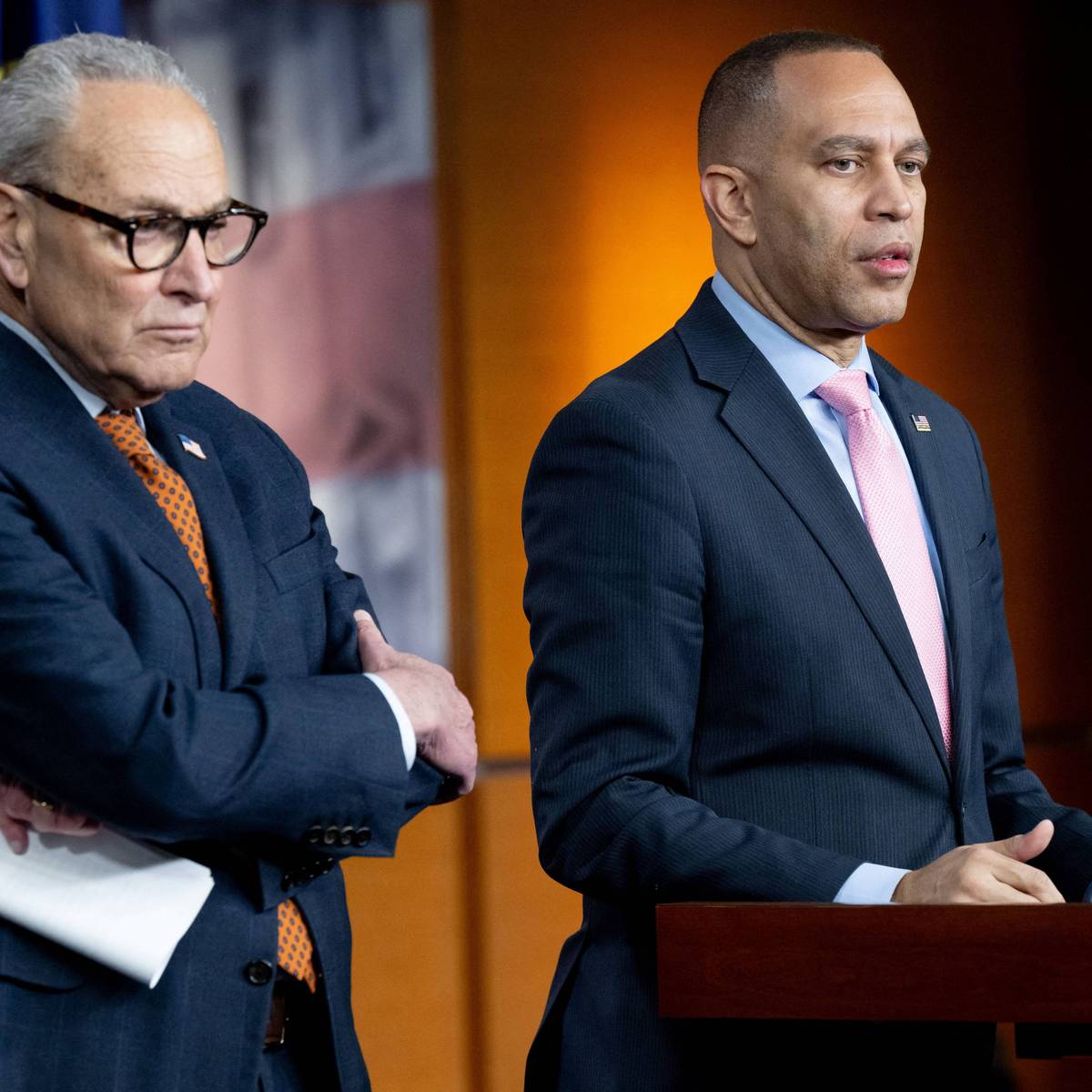
US Senate Minority Leader Chuck Schumer (D-NY) (L) and House Minority Leader (D-NY) attend a press conference on Department of Homeland Security (DHS) funding at the US Capitol on February 4, 2026 in Washington, DC.
(Photo by Kevin Dietsch/Getty Images)
“Schumer needs to get the hell out,” said Rep. Delia Ramirez. “He continues to demonstrate to us that he can’t meet the moment.”
Democratic leaders in Congress are already backing down on one of their key demands in the fight to reform the federal immigration agencies terrorizing Minnesota and other parts of the country.
On Wednesday, Democrats laid out a list of 10 “guardrails” they said they wanted to see put in place to protect the public from abuses by Immigration and Customs Enforcement (ICE) and Customs and Border Protection (CBP) agents, before agreeing to a new round of funding for their parent agency, the Department of Homeland Security (DHS).
The list called to “prohibit ICE and immigration agents from wearing face coverings” to conceal their identities, which Democratic leaders have stressed as a key reform for weeks.
But during a press conference on Wednesday, House Minority Leader Hakeem Jeffries (D-NY) and Senate Minority Leader Chuck Schumer (D-NY) raised many eyebrows when they introduced a heap of caveats to their demand.
“I think there’s agreement that no masks should be deployed in an arbitrary and capricious fashion, as has been the case, horrifying the American people,” Jeffries said.
Schumer added that agents “need identification and no masks, except in extraordinary and unusual circumstances.”
When a HuffPost reporter attempted to ask Schumer if the party had changed its position on masks, Schumer sidestepped the question. But other top Democrats clarified that they were looking at certain exceptions.
Sen. Chris Murphy (D-Conn.) said that while masks should generally be “prohibited by law” as a part of everyday enforcement, there are “sometimes safety reasons why you may need a mask.”
Rep. Rosa DeLauro (D-Conn.), who went against the majority of the party earlier this week to vote for two weeks of DHS funding to keep the government open, said they were discussing when to implement “narrow exceptions” with members of law enforcement and suggested that “dealing with a cartel” could be one of them.
Of course, the Trump administration has often asserted that all the immigrants they target are dangerous criminals—“the worst of the worst”—including cartel members, even when this is not the case, raising questions about who might be in charge of determining when masks are necessary.
Critics have been underwhelmed by many of the other demands on the list as well.
Journalist and commentator Adam Johnson said it was a collection of “mostly cosmetic, pointless, unenforceable, or actively harmful ‘reforms,’” with some—including the requirement for judicial warrants and a ban on racial profiling—already being mandated by the Constitution but flouted by agents regardless.
He described it as outrageous that Democrats were demanding “zero reduction in DHS’ obscene budget which… tripled, just 12 months ago.”
Civil rights lawyer Alec Karakatsanis, the founder of the group Civil Rights Corps, called the list “one of the great political failures of our time” and said “it must be immediately denounced by all people of goodwill.”
Meanwhile, Axios reported on Thursday that many rank-and-file members of the Democratic caucus are fuming over party leadership’s refusal earlier this week to use the threat of a government shutdown to force reforms.
Rep. Pramila Jayapal, the CPC’s chair emerita, pondered “’What are we going to get in 10 days that we didn’t get?’”
“Every time that we are winning, we seem to somehow sabotage [it],” said Rep. Delia Ramirez (D-Ill.), a member of the Congressional Progressive Caucus (CPC).
She noted that House Speaker Mike Johnson (R-La.) has already ruled out several Democratic demands, including the requirement of judicial warrants.
ICE agents do not need a warrant to make arrests, but the Fourth Amendment prohibits them from entering private residences without a judicial warrant. An internal memo last month advised agents to ignore that law. Johnson said this week that requiring federal agents to obtain judicial warrants is “a road we cannot and should not go down.”
Other Democrats anonymously expressed their distrust in Schumer, who has caved in other hugely consequential fights in the second Trump era, most recently regarding the extension of Affordable Care Act subsidies during last fall’s record-breaking government shutdown, which left tens of millions of Americans facing doubled health insurance premiums.
“The main feeling among members is a lack of trust in his strength and ability to strike a hard bargain,” one anonymous Democrat said.
Another said, “All those spending bills, that is the most leverage,” adding that “many folks in the [House] Democratic caucus wish that we had more confidence in Schumer’s ability to navigate a good, tough deal.”
Sixty votes will be required for a deal to pass the Senate, meaning at least seven Democrats will need to join Republicans for DHS to receive full funding and avoid shutting down on February 14.
While this still gives Democrats some leverage to push demands, Ramirez said previous fights give her zero confidence in Schumer’s willingness to hold the line.
“I’m gonna continue to tell you that Schumer needs to get the hell out over and over and over until he does,” Ramirez said. “He continues to demonstrate to us that he can’t meet the moment.”
Our work is licensed under Creative Commons (CC BY-NC-ND 3.0). Feel free to republish and share widely.
‘We are left with no other option but to announce that, without an agreement that meets the needs of our students and educators, United Educators of San Francisco intends to strike on Monday, Feb 9.’
by Joe Eskenazi February 5, 2026 (MissionLocal.org)
Parents, students and educators attend a rally at San Francisco International High School demanding protections for newcomer education programs on Jan. 29, 2026. Photo by Mariana Garcia.
The San Francisco’s teachers union has called for a strike to start Monday, Feb. 9. Teachers are expected to walk off the job and picket their schools starting that morning.
The district’s 6,400 educators were informed of the union decision in an email earlier this morning, and United Educators of San Francisco officially announced the strike date at an 8:45 a.m. press conference.
“We are announcing the strike here this morning because we want our community and families to be prepared in case the district does not make that agreement in time,” union president Cassondra Curiel told a mix of reporters and parents Thursday morning, standing outside the school district headquarters.
Want the latest on the Mission and San Francisco? Sign up for our free daily newsletter below.Sign up
She said educators are intending to strike, but that there is still time for the district and the union to come to an agreement.
A full 97.6 percent of teachers last month voted to authorize a strike after 99.34 percent did so in a preliminary December vote.
“Since the strike vote, SFUSD management has begun exploring creative solutions, but so far, no proposals have been made. The 100+ person UESF negotiations team is scheduled to meet on Thursday and is ready to hear from district management,” reads an email sent to the district’s teachers by their union a little after 6 a.m. with the subject line, “Our Students Deserve Stability — UESF Strike Begins Monday, Feb 9th.”
“While we appreciate the late-stage urgency,” the letter continues, “we are left with no other option but to announce that, without an agreement that meets the needs of our students and educators, United Educators of San Francisco intends to strike on Monday, Feb 9.”
Barring a last-ditch turnaround at the negotiating table, it would be the first teacher strike in San Francisco since 1979, when teachers walked off the job for more than six weeks.
It comes after a nearly year-long bargaining effort between the union and the school district over wage increases, healthcare for dependents, special education, and other issues.
Mission Local has learned that, following today’s announcement of a strike date by the teachers union, the principals and administrators union will commence an emergency vote at noon on whether to hold a sympathy strike.
The online voting period will last 24 hours until noon Friday, and it is all but certain that the principals and administrators will vote in solidarity with the teachers.
While Superintendent Maria Su and Mayor Daniel Lurie have said their No. 1 priority is keeping schoolhouse doors open, it is hard to conceive of how that would happen during a strike of not only teachers but principals and administrators.
It is also unlikely that unionized maintenance workers and others would cross a picket line to provide access to school buildings.
The strike was called on the morning after a state-mandated fact-finding report was released that, legally, gave the teachers union the right to set a walkout date.
The report was non-binding, and could neither prevent nor even delay a strike. It largely favored the district, but found that the district could afford higher wage increases than it had offered, but not as high as the union desired.
The potential walkout is one of several across the state. In Los Angeles, 94 percent of teachers voted to authorize a strike, and in San Diego educators greenlit a walkout over special education concerns.
In San Francisco, absent a major development, “Morning picket lines will be held at every work site starting Monday, Feb 9.”
Additional reporting by Marina Newman
Join the 3,250 readers who keep Mission Local free for all!
Because of you, Mission Local reached and surpassed our $300,000 year-end fundraising goal. All we can say is thank you.
Thank you for choosing to invest in a local newsroom rooted in San Francisco’s communities — one that listens first and reports deeply.
If you haven’t yet had a chance to give, it’s not too late to be part of this community. Your contribution today helps sustain the reporting our city relies on all year long.
We’re grateful you’re here — and we’d be honored to have you join our donors.
Managing Editor/Columnist. Joe was born in San Francisco, raised in the Bay Area, and attended U.C. Berkeley. He never left.
“Your humble narrator” was a writer and columnist for SF Weekly from 2007 to 2015, and a senior editor at San Francisco Magazine from 2015 to 2017. You may also have read his work in the Guardian (U.S. and U.K.); San Francisco Public Press; San Francisco Chronicle; San Francisco Examiner; Dallas Morning News; and elsewhere.
He resides in the Excelsior with his wife and three (!) kids, 4.3 miles from his birthplace and 5,474 from hers.
The Northern California branch of the Society of Professional Journalists named Eskenazi the 2019 Journalist of the Year.More by Joe Eskenazi
Bezos was feted as the savior of the Washington Post in 2013, now he’s reviled for mass layoffs. But it’s also Google who helped crush the paper. Liberal elites are starting to learn about oligarchy.
In August of 2019, Senator Bernie Sanders faced negative coverage of his Presidential campaign by a vaunted national newspaper, the Washington Post. This publication was revered in D.C., having broken the Watergate scandals and brought down Richard Nixon in the 1970s. It had delivered a host of important stories over the decades since, seen as a public trust so important that Steven Spielberg made a movie about the publisher’s decision to help publish the Pentagon Papers. But like most newspapers, it had stumbled in the early 2010s.
At the time, newspapers were doing badly due to what they thought was a decline in ad spending due to the financial crisis. Philanthropists were musing on how to save journalism, and tech barons, such as Salesforce’s Marc Benioff and Facebook co-founder Chris Hughes, were buying legacy publications and pledging to reinvent them with capital and innovative savvy.
In 2013, Amazon founder Jeff Bezos bought the Washington Post for $250 million. Local elites in D.C. were immensely grateful to Bezos. The paper adopted the slogan “Democracy Dies in Darkness” and took on a sharp edge against Donald Trump. Bezos had deep pockets, and had saved the town’s pride.
Six years later, Sanders, running for President against what he called the billionaire class, did something unusual in polite liberal society. He said Bezos had an incentive to shade coverage of politicians he didn’t like. Sanders had been discussing how Amazon doesn’t pay enough in taxes.
“See, I talk about that all of the time. And then I wonder why The Washington Post — which is owned by Jeff Bezos, who owns Amazon — doesn’t write particularly good articles about me. I don’t know why. But I guess maybe there’s a connection.”
And that comment created a bitter reaction within D.C. towards the populist politician. The executive editor of the Washington Post, a deeply respected man named Marty Baron (played by Liev Schreiber in the 2015 film “Spotlight”), responded the way all of D.C. felt. He called Sanders a conspiracy theorist.
Jeff Zeleny@jeffzeleny
. @PostBaron responds to absurd attack: “Sen. Sanders is a member of a large club of politicians—of every ideology—who complain about their coverage….Contrary to the conspiracy theory the senator seems to favor, Jeff Bezos allows our newsroom to operate with full independence.”
Jeff Zeleny @jeffzelenyIn NH today, @BernieSanders sounds a lot like @realDonaldTrump as he trashes Amazon: “I talk about that all of the time and then I wonder why the Washington Post, which is owned by Jeff Bezos, who owns Amazon, doesn’t write particularly good articles about me I don’t know why.”
1:09 AM · Aug 13, 2019112 Replies · 66 Reposts · 193 Likes
How dare Sanders cast shade on the willingness of a benevolent billionaire to steward a public institution like the Washington Post?!? While most journalists and readers of the Post would in other contexts understand the conflict of interest at issue here, here they felt differently. What newspapers write, they believed, is truthful, and neutral, and objective. Bezos was naught but a kindly check-writer, perhaps ruthless at Amazon, but now ascended to the pantheon of philanthropy. Who is this rag-tag old Jewish socialist to annoy us with his complaining?
What a difference six years makes.
Yesterday, the Washington Post engaged in layoffs across the organization, getting rid of the Middle East team, war correspondents, its entire sports department, and everyone in the West coast office who covers big tech. Local coverage will be cut to just 12 people. Overall, Bezos is firing 300 out of 800 reporters, decimating what is widely regarded as a key newspaper covering government in America. “It’s an absolute bloodbath,” said one employee.
Importantly, the paper also fired the reporter tracking Amazon. The stated reason is that the company is losing money due to a loss of local market power, falling ad revenue, and generative AI.
Mr. Murray further explained the rationale in an email, saying The Post was “too rooted in a different era, when we were a dominant, local print product” and that online search traffic, partly because of the rise of generative A.I., had fallen by nearly half in the last three years. He added that The Post’s “daily story output has substantially fallen in the last five years.”
Bezos’ change of heart has horrified the D.C. elites who feted him in 2013. It’s so bad that even the local influence peddlers are angry. Here’s a Democratic lobbyist for big tech, a man named Matt Bennett, offering a public and shocking complaint against the founder of Amazon.
Matt Bennett@ThirdWayMattB
Jeff Bezos has $250 billion. The Post, even if it hemorrhages money, is utterly irrelevant to his net worth. Why is he killing one of the few remaining major American newspapers? Why????
Dylan Byers @DylanByersNEW: Massive layoffs coming to Washington Post… rumor inside Post is that sports desk could be shuttered entirely… foreign desk will be hit hard too
2:10 AM · Jan 25, 2026 · 333K Views225 Replies · 448 Reposts · 3.49K Likes
Why the open rage? Some of the anger is coming from a place of delusion and arrogance. I’m not a particular fan of the Washington Post. They helped get us into the war in Iraq and endorsed a series of obnoxious local candidates for as long as I’ve paid attention to politics. Even the vaunted Woodward and Bernstein investigations into Watergate are exaggerated. Also, D.C. writ large is a community that looks down on Trump. The Atlantic called these layoffs “The Murder of the Washington Post, while the New Yorker titled their article How Jeff Bezos Brought Down the Washington Post.
And what of the executive editor, that Marty Baron fellow? Now retired, he called the layoffs “one of the darkest days” in the history of one of the world’s greatest news organizations,” and attacked Bezos for being “gutless.” There was no apology to Sanders, and he even thanked his former boss, saying that he was “personally grateful for Jeff Bezos’s steadfast support and confidence during my eight-plus years as The Post’s executive editor.” It’s remarkable that Baron’s mewling statement expressed less genuine outrage than that of a big tech lobbyist, but it is a belated acknowledgment of a problem.
But mostly, the frustration is reasonable. The Washington Post is a local paper with good coverage of local events and government policy, and there are a lot of reporters who work on national and international questions that would otherwise go unnoticed. It’s where people who live in D.C. read their favorite sports columnist, find out stuff about the local industry, and learn about how the snow will be plowed. Like any local community, people here are upset about losing the newspaper.
That’s not to say that the newspaper is doing well, because it’s not. There are financial problems, as there are across the industry. Since 2005, the number of people working at newspapers has dropped by 75%, and a third of U.S. counties now have no daily newspaper. But while most regional papers don’t have the scale to transition to a subscription model, a few – like the New York Times and Wall Street Journal – do. And for a time, the Washington Post did as well.
But Bezos himself ruined this opportunity for the paper. In 2024, Bezos intervened in the editorial page to prevent an endorsement of Kamala Harris, which was a violation of the promise he made in 2013 when he bought the paper. That decision led to 200,000 subscription cancelations. We don’t know how many the paper has left, but the guess was that it had 2.5 million before Bezos’s intervention. So the drama aside, that’s… not a bad number of customers. And actual traffic to the Washington Post is still pretty good. Here’s a chart from the New York Times.
The Washington Post has 40 million people visiting the website every month, it is a credible and trustworthy brand, and the region needs, if nothing else, local news. Those 200,000 subscribers are clearly willing to pay for news, they are just not willing to pay for news delivered in an untrustworthy manner.
So most observers don’t think the layoffs are some sort of inevitable choice, but a discrete decision to destroy the paper. Why would Bezos ruin this asset instead of selling it to someone else? There are likely two big reasons. The first is that the Washington Post used to be an extremely useful political tool for Bezos, but it no longer is. And the second is financial and political – the Washington Post is being pillaged by Google’s illegal adtech monopoly. Interestingly, many media outlets are suing Google over this situation, such as Vox, The Atlantic, Business Insider, McClatchy Media Co., Slate, and Advance Publications. But the Washington Post, owned by a foe of antitrust law, is not.
And this curious fact that the Washington Post is leaving money on the table to avoid litigating on antitrust suggests that Bezos never had any good intentions with the Post in the first place. To understand why, let’s go back to the original purchase of the paper in 2013. While most saw Bezos as a savior, there was a less magnanimous interpretation of his acquisition.
There have always been media barons, but those barons made their money in media. Bezos, however, was making his money elsewhere, and subsidizing media. At the time of the purchase, Amazon was starting to be in the crosshairs of regulators and media outlets over its consolidation of the book industry, as well as its advantages over retailers due to sales tax loopholes. Here’s the cover of The New Republic in 2014:
The year before buying the paper, Bezos made other moves to fortify his political power. He put the deeply wired super-lawyer Jamie Gorelick on the Amazon board, likely because she had pull with the Obama Department of Justice. A few years later, he bought a giant mansion in D.C., with the assumption he would assume the role of the Graham family as a local social leader. Then he awarded Amazon’s “second headquarters” to the D.C. area.
In other words, the purchase of the Washington Post in retrospective appears like part of a campaign to curry favor with political and media elites in D.C. in order to get government contracts, protect Amazon’s business, ward off scrutiny, and manipulate politics. It looks exactly as Sanders suggested.
Just a few years after Bezos bought the Post, Donald Trump said in campaign speeches that Bezos had an “antitrust” problem. If elected, he said he’d go after the company. In 2017, Lina Khan’s famous law review article, Amazon’s Antitrust Paradox, went viral. Trump, despite prodding from allies in real estate, angry that Amazon had hurt their shopping mall investments, didn’t attack Amazon. But Joe Biden did, appointing Khan to run the Federal Trade Commission. In September 2023, the FTC sued Amazon for monopolization, a case that is still in process. The Washington Post became less useful, once the case got filed.
When Trump ran again in 2024, he made it very clear that he would retaliate against business leaders who were hostile and reward those who were deferential. So the political value of the Washington Post disappeared, and “Democracy Dies in Darkness” turned into a sick joke, like Google’s “Don’t Do Evil.” In other words, one interpretation is that Bezos bought the Washington Post to delay an antitrust case and curry favor with politicians. He failed at blocking the case, and so now it’s important to shut down ongoing critical coverage of both his company and the Trump administration.
And that’s where we get to the monopoly problem, which the Washington Post itself reported last April.
As Judge Leonie Brinkema ruled, Google has been systematically monopolizing the technology and process for selling advertising on the open web, exactly the kind of ads the Post sells. Google controls ad revenue and distribution, and it has used that power to kill thousands of newspapers in America by monetizing the work they do and taking that money for itself. And it is this behavior, the diversion of revenue from publishers to tech monopolies, that led to the Washington Post becoming the plaything of a billionaire, who then threw it away.
In 2022, I described the basic dynamic that allows Google to appropriate billions from newspapers and divert it to its own properties.
By 2014, Google was no longer just a search engine; if you bought advertising, sold advertising, brokered advertising, tracked advertising, etc, you were doing it on Google tools. It tied its products togethers so you couldn’t get access to Google search data or YouTube ad inventory unless you used Google ad software, which killed rivals in the market. It downgraded newspapers who tried to negotiate different terms.
This leverage came from Google’s control of both the distribution of news and the software and data underpinning online ad markets. Roughly half of Americans report getting news from social media, while 65% get it from a search engine like Google. That means newspapers are getting a lot of their customers from entities who compete with them to sell ads, often to their same audience. And they must use the software offered by Google to sell those ads, and often display content on Google News under the terms that Google demands, which includes allowing Google to display much of the article itself on its own properties. (If you want a good example of how Google steals content, read this piece on what it did to Celebrity Net Worth.)
Over these years, Google introduced Google News and standards for web pages that privileged its own services, cut favorable deals with adblockers, and fought against things like header bidding, which was an attempt by publishers/advertisers to get better prices than Google was offering for ad inventory. Google began demanding terms for data and formatting that publishers had no choice but to supply. In 2017, for instance, the Wall Street Journal refused to allow Google search users to read its content for free, instead locating its content behind a paywall. Google downgraded the status of the newspaper in its search rankings. While subscriptions went up, traffic to the newspaper dropped by 44%.
Over the course of these twenty years, under Republican and Democratic administrations, neither Congress nor the FTC created mandatory public rules over the use of data, and enforcers pursued no meaningful antitrust suits to stop big tech firms. In 2012, the FTC Bureau of Economics, in one of the all time most embarrassing episodes for economics, actively killed a suit that could have stopped the monopolization of the search market. So Google became a monopoly in the advertising industry, not just over search ads, but over most online advertising markets. Last year, Google’s global revenue amounted to $257.6 billion, which is nearly all from advertising. That’s a huge amount of money, some of which used to go to finance journalism but now goes to private jets in Palo Alto.
The financial problems Google has fostered have turned a business based on credibility into a charity based on the dependency on an oligarch’s goodwill. Consider that if the Washington Post could profit by producing good journalism, Bezos would be less likely to gut its operations. And even if Bezos did gut it, it would be easy to create a competitive newspaper, as has happened for 200 years of American history.
The situation in D.C. has been mirrored in newspapers in cities across the country, though it’s less noticeable elsewhere. We’ve known about this problem in various forms for around 15 years, and there have been a number of attempted policy interventions to save newspapers. In 2018, then-Missouri Attorney General Josh Hawley announced an antitrust investigation into Google. In 2020, Texas Attorney General Ken Paxton filed an antitrust lawsuit against Google, a suit which is still ongoing after many procedural delays by the courts. In 2022, the Antitrust Division sued Google along similar lines as Paxton, and won earlier this year. Unfortunately, the remedy phase is still ongoing, and there are likely to be years of appeals.
A different attempt was the Journalism Competition and Preservation Act, a bill sponsored by Amy Klobuchar that allows newspapers to band together and negotiate with platforms like Google and Meta over data and ad revenue, a sort of collective bargaining approach. That bill did have some movement in the Senate, but ultimately failed due to the lobbying of big tech. In California, lawmakers proposed something similar, but Governor Gavin Newsom, operating on behalf of Google, ultimately killed it.
In Australia, a similar law did pass, this law fostered so much revenue for newspapers that the job market for journalists there was buoyant. Google and Meta put $1 billion into the media ecosystem over three years, which those companies then could use to support their search and social media operations. There are problems with the law, and it needs modification, but it has basically kept journalism viable in that country.
Another policy change is the emergence of generative AI. In 2022, big tech platforms, seeing OpenAI’s ChatGPT product, pursued a specific model to commercialize generative artificial intelligence. They began sucking up all journalism and creative content without compensation to journalists. They built AI-powered chatbots who could take what newspapers reported, repackage it, and give it to users. By monetizing the work of others without giving them compensation, these products have undermined the business model underpinning ad-funded journalism. Google’s AI Overviews, which summarize the web on search queries, has crushed web traffic. Here’s the Economist with a viral article and chart published last year.
For companies that sell advertising or subscriptions, lost visitors means lost revenue. “We had a very positive relationship with Google for a long time…They broke the deal,” says Neil Vogel, head of Dotdash Meredith, which owns titles such as People and Food & Wine. Three years ago its sites got more than 60% of their traffic from Google. Now the figure is in the mid-30s. “They are stealing our content to compete with us,” says Mr Vogel. Google has insisted that its use of others’ content is fair. But since it launched its AI overviews, the share of news-related searches resulting in no onward clicks has risen from 56% to 69%, estimates Similarweb.
Generative AI is not just a politically neutral innovation, it’s technology engineered with certain political assumptions in mind, notably that copyright holders have no rights. Plenty of judges are wrestling with copyright as it pertains to large language models. Now-Senator Hawley has a bill to prohibit big tech from using copyrighted works to train AI models without permission from the creator. That bill hasn’t moved. And in the Google search antitrust remedy case, the Antitrust Division asked to allow publishers to opt-out of AI Overviews, but Judge Amit Mehta didn’t listen. The political pressure has forced some deals between AI firms and bigger content producers, but with a lot less value for the content than they should have received.
You might think, and many would, that forcing big tech to license content would make AI non-viable. But I know of at least one AI firm that uses licensed content, and their models can do things that big tech models can’t, and their compute needs are a tiny fraction of the hyperscalers. It turns out, incorporating lots of crap data requires a bloated inefficient approach, while actually working with creators is a far more efficient process. The point, however, isn’t that one policy choice is better than another, it’s that the path of AI development is a political choice that has technological implications. And we chose, as a society, to kill local journalism, just as we are choosing to eliminate cattle ranchers, movie producers, local bankers, independent pharmacists and dentists, and basically anyone who works for a living.
Bezos’s attack on the D.C. community is doing something I thought I’d never see – the liberal class is waking up to oligarchy. Now I don’t want to overstate the dynamic. Take Marty Baron. Like many boomer liberals, Baron is an intelligent fool. He is, for instance, on the board of a Google-backed think tank, the Center for News, Technology, and Innovation, and almost certainly doesn’t realize that his beloved newspapers have been decimated by the entity he currently helps. The fact, however, that even Baron has been forced to reckon with the dangers of the superrich, is meaningful.
Taking a step back, the stakes of our politics are becoming undeniable. Even the rich are becoming afraid of the superrich. Wealthy Hollywood producers are terrified of the Silicon Valley takeover of their livelihood, and the second tier of Wall Street is scared, as the wealth protection industry itself is under attack from the oligarchs who want to automate their servants away. Chris Hayes, a wealthy TV personality, made the point in a viral tweet, saying essentially that Jeff Bezos and billionaires believe that everything that is ours should be theirs.
Chris Hayes@chrislhayes
I think it’s best for everyone to understand that the unified class project of billionaires right now is to do to white collar workers what globalization and neoliberalism did to blue collar workers.
As Louis Brandeis once said, “We can have democracy in this country, or we can have great wealth concentrated in the hands of a few, but we can’t have both.”
That is a lesson Jeff Bezos is helping to impart to all of us, once again.
Thanks for reading! Your tips make this newsletter what it is, so please send me tips on weird monopolies, stories I’ve missed, or other thoughts. And if you liked this issue of BIG, you can sign up here for more issues, a newsletter on how to restore fair commerce, innovation, and democracy. Consider becoming a paying subscriber to support this work, or if you are a paying subscriber, giving a gift subscription to a friend, colleague, or family member. If you really liked it, read my book, Goliath: The 100-Year War Between Monopoly Power and Democracy.
cheers,
Matt Stoller
This is a free post of BIG by Matt Stoller. If you liked it, please sign up to support this newsletter so I can do in-depth writing that holds power to account.
As if the world didn’t have enough trouble already, with wars, climate catastrophe, and the Donroe Doctrine, a recent news report warned that the United Nations soon may go bankrupt and close its New York headquarters. Instead of convening diplomatic meetings there to negotiate ceasefires, urge disarmament, and respond to earthquakes and famine with international rescue operations, the UN itself appears to be in need of a rescue.
California could solve this problem: Offer the UN funds and space in San Francisco, where it began.
We have ample, empty downtown space for a new headquarters, maybe around Union Square if Macy’s moves out. Governor Gavin Newsom and Mayor Daniel Lurie can hold a joint press conference and invite the United Nations to take up residence in the city where the UN charter was first signed by member nations in 1945.
This city already has U.N..Plaza. What better place for the U.N.? Wiki Commons photo by Guilhem Vellut)
It all began in San Francisco’s Herbst Theatre, across from City Hall, and City Hall could now welcome it back. New York’s loss would be our gain.
I can see the headlines now: “UN moves to San Francisco. California offers to pay the dues Donald Trump refused.”
Two billion dollars owed to the UN by the United States account for a large part of its financial crisis. Fortunately, San Francisco, as a city run by and for billionaires, has plenty of wealthy men who can help pay the bills and finance a new or renovated building’s construction to accommodate the UN.
Consider the worldwide publicity that money would buy for the city, and consider all the downtown restaurants, shops and hotels that will find business booming once hundreds of UN diplomats begin to work and live here. And what’s a couple of billion given to the UN by Nvidia or Meta or Google, compared to the astronomical sums their companies and new A.I. industry in town are valued at these days?
A high-end UN sponsor like Nvidia might ask for the new West Coast assembly hall to be named after it — it would become the Nvidia United Nations (NUN)—and another sponsor might require a new luxury office complex it builds for UN delegates to be called Salesforce Tower Two. But I suspect the UN’s General Secretary would accept these names if it enables his organization to survive a New York closure and re-open in San Francisco.
Sponsored link
Local voters who complained in the past that our Board of Supervisors should confine its business to city matters, and not take positions on international issues such as genocide in Gaza, could now agree that wars abroad, and global climate catastrophe are local issues: “It’s something our city should address,” the supervisors will agree, “take it up the street to the UN.”
San Francisco already offers sanctuary to refugees from other countries. But now we have an opportunity to welcome hundreds of nations, the whole United Nations.
Mayor Lurie already has turned to some of his friends and friendly foundations for grants to improve city life; surely, he can find a few local billion dollars to lure the UN here and keep its peace-seeking assembly alive. And the UN may well accept the invitation. San Francisco already has a U.N. Plaza. How about bringing the rest of the U.N. here?
Donald Trump may object, because the newly relocated and generously endowed UN will rival his own new organization, The Board of Peace, which requires its members to pay him a billion dollars for a permanent seat on the board. That fee—$1 billion less than Trump owes the UN in dues—may seem like a bargain to some state leaders, but since Trump has given himself veto power over all Board of Peace decisions, joining with him also means surrendering final control to him.
San Francisco’s U.N. will be more democratic than the Board of Peace, and its delegates won’t have to brave ice and snowstorms every winter, as they do at the in New York.
Speaking of Trump, which I am reluctant to do any more than necessary, there’s one line in the recent Times report on the UN that I consider comic journalism of the first order. Farnaz FassihiI writes for theTimes that the UN “warned it would run out of money by July and have to close its New York headquarters if countries, namely the United States, did not pay annual dues that amount to billions of dollars.” That phrase, “if countries, namely the United States,” sums up the problem faced by the United Nations without mentioning the president by name, briefly denying him the attention he lives for.
Following Fassihil’s commendable example, I too will omit a certain well-known name here as I speculate that the U.N. might not face so many crises if countries, namely the United States, spent less of their budget on gunboat diplomacy, deployed fewer naval armadas like those now threatening Venezuela and Iran, and instead more generously funded peaceful international meetings among diplomats.
United Nations, won’t you please come home?
48 Hills welcomes comments in the form of letters to the editor, which you can submit here. We also invite you to join the conversation on our Facebook, Twitter, and Instagram.
Yesterday, February 3, the House passed a package of six funding bills, ending the partial government shutdown and temporarily funding the Department of Homeland Security (DHS) through February 13.
This vote buys time to negotiate a DHS funding bill that protects communities from two DHS agencies that have been terrorizing and brutalizing our communities: ICE and Border Patrol.
It’s critical we use that time to put pressure on every Member of Congress — especially Democrats — to insist on real guardrails that put an end to ICE and CBP’s lawless thuggery and get them out of our cities. We can’t settle for insufficient reforms like body cams — we’ve all seen that Trump’s goons are perfectly happy to gas, tackle, and kill innocent people on film.
Whether or not you’ve already called or emailed: We need EVERYONE to be loud over the next nine days and make capitulation politically impossible.
More often than not, we’ve seen Congress fail to stand up to Trump with Republicans falling in line with his cruel agenda, and Democrats forfeiting their leverage in critical funding fights. But there have also been moments where the grassroots pressure and the public backlash have been so strong that Democrats find their spines and Republicans start to peel away from the regime.
We saw this when Congress defied Trump and passed a bill requiring the release of the Epstein files. We saw it again last month (at least initially), when five Republican senators joined with Democrats to advance a war powers resolution after Trump’s invasion of Venezuela.
The killing of Renee Good and Alex Pretti has created a backlash against ICE that spans parties. And if we keep up the pressure, we could see Congress defy Trump again and rein in his lawless secret police force.
And whether or not Republicans listen to their constituents who are clamoring for action, DHS funding cannot pass without Democratic votes.
There are only nine days to go, so we need to act quickly. Contact your Members of Congress and demand they vote no on any DHS funding bill unless, at a minimum, it:
Pulls ICE and Border Patrol out of Minneapolis and the rest of our communities
Prevents ICE or Border Patrol enforcement at designated “sensitive locations” such as houses of worship, day cares, and hospitals
Restricts ICE and Border Patrol’s ability to target people based on their race, language or accent, place of employment, or location at the time of the apprehension
Ends the administration’s unlawful practice of warrantless home entry and arrests
Use our updated call scripts and email tool to contact your Members of Congress today:
4️⃣ Check out our explainer for the latest updates, our full list of demands, and answers to common questions about ICE/CBP funding and a potential shutdown.
Ultimately, there’s no reforming ICE. When we regain power, we need to strip the entire Department of Homeland Security down to the studs. But we don’t have to wait that long to rein in ICE and CBP. We have a chance to do it now, and we have to take it.
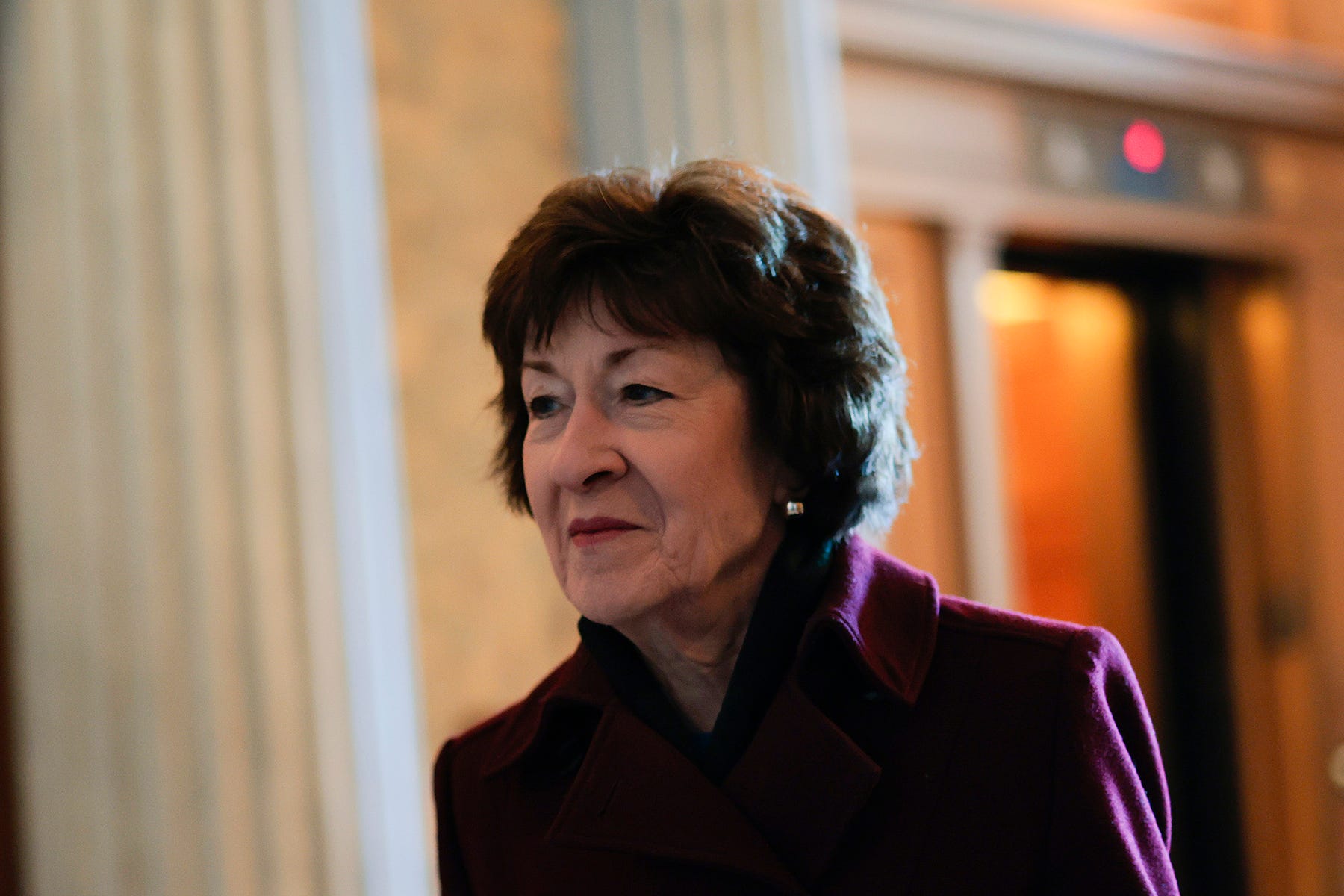
Susan Collins at the US Capitol on Jan. 26, 2026. Photo by Heather Diehl/Getty Images.
America’s pro-Israel lobby, AIPAC, accounted for nearly 20% of the money that Republican Senator Susan Collins raised last year in the lead-up to Maine’s all-important US Senate election.
The total collected for Collins by AIPAC’s political action committee far outpaces what she raised from small donors, in another show of the Israel lobby’s outsized influence on US elections.
Collins, 73, is widely expected to run for her sixth term. She is one of the longest-serving sitting senators, having taken office in 1997. Oysterman Senate candidate Graham Platner and Governor Janet Mills are running in the Democratic primary to face Collins, with Platner leading both of them in fundraising last year.
Mourners react following the death of Palestinians killed by an Israeli strike at Al-Shifa Hospital in Gaza City, on February 4, 2026.
(Photo by Majdi Fathi/NurPhoto via Getty Images)
It comes as nearly 20,000 Palestinians are being denied the ability to leave Gaza for medical treatment, in what activist Muhammad Shehada called “a slow-motion massacre.”
Israeli bombings across Gaza have killed at least 23 Palestinians since dawn on Wednesday, including at least two infants, according to hospital officials and other health authorities.
“Where is the ceasefire? Where are the mediators?” asked Dr. Mohamed Abu Salmiya, director of Gaza City’s Shifa Hospital, which received the bodies of 11 people—mostly from the same family—who were killed after Israeli soldiers fired upon a building in northern Gaza.
Israel said the attack was in retaliation after Hamas militants fired at an Israeli soldier, badly wounding him. The Associated Press reports that among the Palestinians killed were “two parents, their 10-day-old girl Wateen Khabbaz, her 5-month-old cousin, Mira Khabbaz, and the children’s grandmother.”
Another attack on a tent in the southern city of Khan Younis killed three more people: Nasser Hospital, which received the bodies, said they included a 12-year-old boy. Another strike killed five more people, including a paramedic named Hussein Hassan Hussein al-Semieri, who was on duty at the time.
A total of 38 Palestinians were wounded in the series of attacks, according to the Gaza Health Ministry.
Since a “ceasefire” agreement went into effect on October 10 last year, the Gaza Government Media Office says Israel has committed at least 1,520 violations, killing at least 556 people—including 288 children, women, and elderly people—and wounding 1,500 others.
In comments to Al Jazeera, the Palestinian human rights advocate Muhammad Shehada said a ceasefire that is violated so consistently “is no ceasefire at all”.
“At most, [the deal] can be just described as some sort of mild diplomatic restraint,” Shehada said. “Whenever the world’s attention is elsewhere, Israel escalates dramatically.”
Since its genocidal war in Gaza began in October 2023, nearly 72,000 Palestinians have been killed and 171,000 injured, according to the Gaza Health Ministry, whose figures the Israel Defense Forces (IDF) recently conceded are accurate after more than two years of denial. Independent estimates suggest the true death toll is much higher.
Wednesday’s onslaught came as Israel began to slowly open the Rafah crossing—the main point of entry and exit from the strip—for those in severe need of medical attention to leave.
Gaza’s hospitals have been rendered largely inoperable by two years of relentless bombing and a lengthy blockade on medical supplies entering the strip, which has left more than half the population without medical treatment.
The World Health Organizationsaid last week that 18,500 Palestinians are in need of medical treatment abroad, including hundreds in need of immediate treatment.
According to Egyptian officials, 50 patients were expected to enter through the crossing each day. However, on Monday, just five Palestinians were allowed to leave Gaza for treatment, followed by 16 on Tuesday, according to Al Jazeera reporters on the ground.
Around 4,000 of those awaiting treatment are children. According to health officials, one of them, 7-year-old Anwar al-Ashi, died of kidney failure on Wednesday while on a waitlist.
Meanwhile, those attempting to cross have been met with treatment described as “humiliating” by reporters who witnessed it. Israeli troops have subjected patients to strip searches and interrogations—some were blindfolded and had their hands tied.
“The Rafah crossing continues to be a cruel and severely restricted ‘passage’ of pain and humiliation,” said the Palestinian politician and activist Hana Ashrawi. “This continues to be a multifaceted war of aggression, based on the deliberate manipulation of the pain of a captive people.”
Salmiya said that at the rate Israel is allowing them to leave, “it will take about five years on average for all patients to be discharged.” He referred to Israel’s actions as “crisis management, not a solution to the crisis.”
On Tuesday, United Nations Secretary-General António Guterres called for “the facilitation of rapid and unimpeded passage of humanitarian relief at scale—including through the Rafah crossing.”
He added that Israel’s recent suspension of dozens of aid organizations—including Doctors Without Borders, Oxfam, and Save the Children—defies humanitarian principles, undermines fragile progress, and worsens the suffering of civilians.“
Shehada, who said he and his family were eagerly awaiting the end of travel restrictions, told Al Jazeera that “Israel hollowed [it] out of any substance or meaning.” Instead, he said, “it’s basically a slow-motion massacre.”
Our work is licensed under Creative Commons (CC BY-NC-ND 3.0). Feel free to republish and share widely.
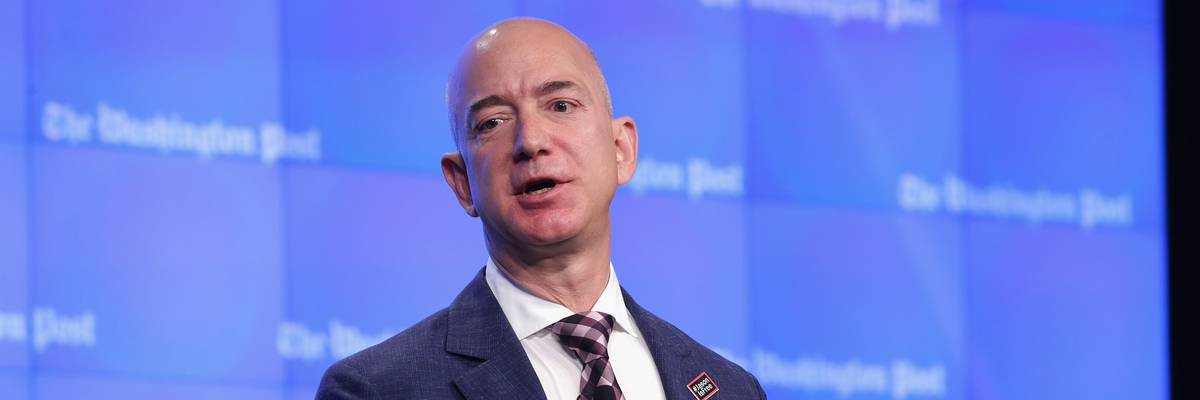
Amazon founder and Washington Post owner Jeff Bezos delivers remarks during the opening ceremony of the media company’s new location January 28, 2016 in Washington, DC.
(Photo by Chip Somodevilla/Getty Images)
“Oligarchs are not the benevolent saviors media have long depicted them to be.”
The Washington Post announced massive cuts to its newsroom staff on Wednesday, unleashing a wave of disgust directed toward its owner, billionaire Amazon founder Jeff Bezos.
As reported by Semafor reporter Maxwell Tani, Washington Post executive editor Matt Murray told staffers at the paper that it would be closing its sports department “in its current form,” and would also be “killing its book section, suspending its Post Reports podcast, restructuring its metro section, and shrinking its international footprint.”
With hundreds of journalists expected to lose their jobs, Murray told Post employees that the cuts were needed to help the paper “become more essential to people’s lives” in “what is becoming a more crowded, competitive and complicated media landscape, and after some years when, candidly, the Post has had struggles to do that.”
Many critics, however, scoffed at claims that cuts at the paper were needed to make it profitable, suggesting the real motivation came from Bezos’ desire to take an ax to the US free press.
Brian Phillips, senior writer at The Ringer, rejected the notion that one of the richest men in the world couldn’t afford to keep what was once a revered newspaper fully staffed.
“Bezos isn’t destroying the Washington Post because it isn’t profitable,” he wrote in a social media post. “He’s destroying the Washington Post because he’s calculated that a robust free press threatens the ability of his class to warp society around their interests.”
Phillips also implored other journalists to not report on the Post layoffs as “a straightforward business story,” but rather “a story about coercive social transformation being imposed by people so rich they’ve ceased to see the rest of us as legitimate stakeholders in our own lives.”
David Sirota, founder of The Lever, said the layoffs should end journalists’ fantasies that billionaire owners will rescue journalism in an era of mass consolidation by corporate conglomerates, slashed newsroom budgets, and wave after wave of layoffs.
“The media world’s stunned/shocked reaction to the awful WaPo layoffs shows that even now, so many in journalism still can’t believe billionaires aren’t going to rescue them,” he wrote. “This is a wake-up call: Oligarchs are not the benevolent saviors media have long depicted them to be.”
Adam Serwer of the Atlantic also raised concerns about the power of wealthy oligarchs to buy and destroy historic media institutions.
“I personally do not think some rich man should be able to buy an institution like this like a toy and then break it when he doesn’t want to play with it anymore,” he wrote. “Bezos fucked the paper and instead of fixing it he’s destroying it despite the fact that he could spend the money to make things right without even noticing its absence.”
Jonathan Cohn, political director for Progressive Mass, noted that the Post isn’t the only media organization that’s being gutted by a billionaire owner, referencing billionaire Larry Ellison, a major donor to President Donald Trump, who recently acquired CBS News alongside other media properties.
“What we are seeing with WaPo and with CBS News is that the mega-rich see real financial value for themselves in destroying journalism,” he wrote. “Let that sink in.”
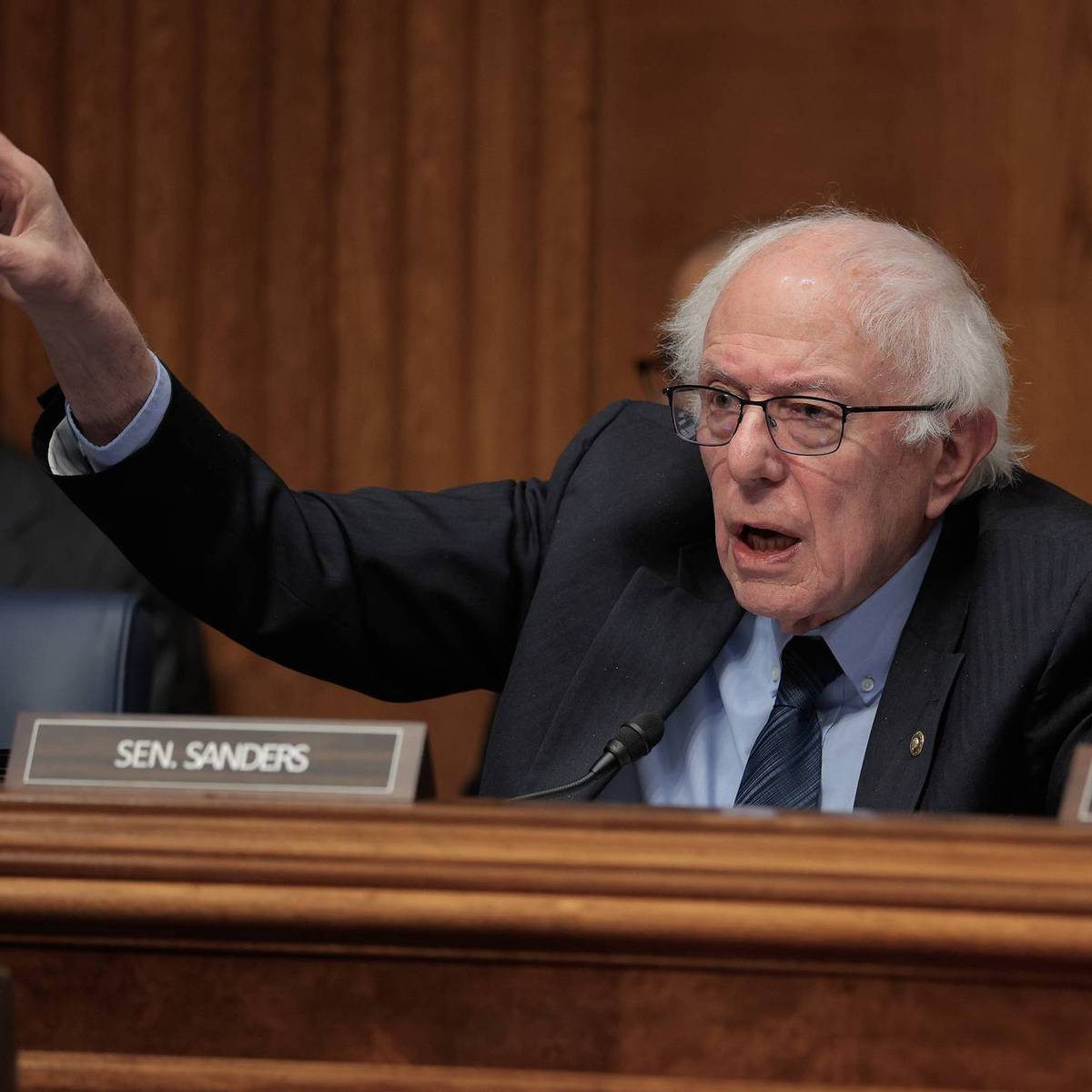
Sen. Bernie Sanders (I-Vt.), in a post written before the Post layoffs were announced, drew attention to billionaire control over not just traditional media, but social media as well.
“When we talk about authoritarianism, it’s not just Donald Trump,” wrote Sanders. “[Elon] Musk owns X. Bezos owns Twitch. [Mark] Zuckerberg owns Instagram and Facebook. Larry Ellison controls TikTok. Billionaires increasingly control what we see, hear and read.”
Our work is licensed under Creative Commons (CC BY-NC-ND 3.0). Feel free to republish and share widely.
Federal agents patrol the halls of immigration court at the Jacob K. Javits Federal Building on October 27, 2025, in New York City.
(Photo by Michael M. Santiago/Getty Images)
“This is a red alert moment,” said Sen. Ed Markey. “We have to start working to protect polling places from Trump’s paramilitary ICE goons before it’s too late.”
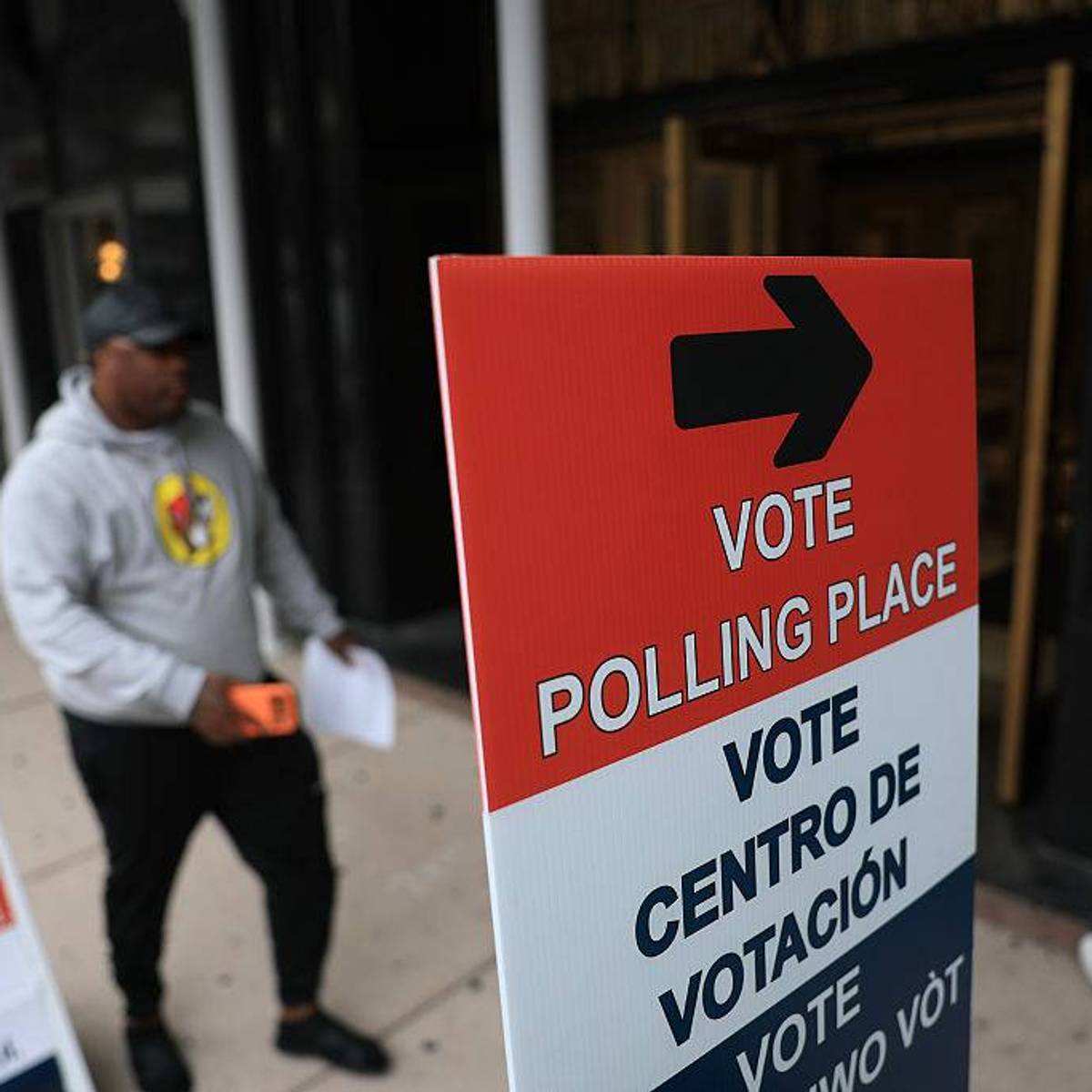
Days after President Donald Trumpsuggested that Republicans should “nationalize the voting” in Democratic districts, his former White House adviser telegraphed another way Trump may seek to prevent a free and fair election later this year: illegally flooding polling places with Immigration and Customs Enforcement agents.
“You’re damn right we’re gonna have ICE surround the polls come November,” Bannon said on his War Room podcast on Tuesday.
“We’re not gonna sit here and allow you to steal the country again,” he continued. “And you can whine and cry and throw your toys out of the pram all you want, but we will never again allow an election to be stolen.”
Steve Bannon: “We‘re gonna have ICE surround the polls…We’ll never again allow an election to be stolen.” pic.twitter.com/9R9tZdolHx
What Bannon proposed would be in direct violation of state and federal law. As Sean Morales-Doyle, the director of the Brennan Center’s voting rights and elections program, explained back in October:
The law is crystal clear: It is illegal to deploy federal troops or armed federal law enforcement to any polling place. In fact, it is a federal crime for anyone in the US military to interfere in elections in any way. More specifically, it is a crime, punishable by up to five years in prison, to deploy federal “troops or armed men” to any location where voting is taking place or elections are being held, unless “such force be necessary to repel armed enemies of the United States.” …
It is also a federal crime for anyone, including federal agents, to intimidate voters. Anyone who does so may be liable for a number of different federal criminal offenses.
While Trump has not explicitly said ICE should be deployed in 2026, he has said he regrets not deploying the National Guard to seize voting machines during the 2020 election, which he attempted to overturn with a litany of disproven fraud allegations.
He has since followed through somewhat on this desire, sending the FBI to seize 2020 election materials from a voting hub in Fulton County, Georgia, as part of what the FBI said was an “investigation” into election fraud, which he said caused him to lose the election to former President Joe Biden.
It’s unclear how, if at all, ICE may figure into his goal, stated earlier this week, to have Republicans “take control of the voting in at least 15 places,” which would violate the constitutional right for states and localities to administer their own elections.
He has, however, used ICE to demand that Minnesota—a key swing state in 2026—turn over its voter rolls to the federal government in exchange for a withdrawal of agents who have killed three US citizens over the past month and unleashed a wave of violence and civil rights violations.
Expressing fear that Republicans will be trounced in November’s midterm elections—which polls currently indicate is likely—Trump has also recently suggested on multiple occasions that the elections should simply be “canceled” outright.
https://twitter.com/i/status/2018841948082032846
Sen. Chris Murphy (D-Ct.) said all of this adds up to a frightening picture.
“Donald Trump can’t win the 2026 election, so he’s putting in place a plan to steal it,” he said in a video posted to social media. “That is not hyperbole. That is not conspiracy. He is literally doing it, and telling you he’s going to do it every single day.”
Murphy said, “He wants the federal government, meaning Donald Trump’s MAGA loyalists, to run elections in places like Georgia and Minnesota, and probably Pennsylvania and Texas and Maine—anywhere that there’s a race that might determine control of the House or the Senate.”
Trump’s threats come amid negotiations in Congress over whether to provide additional funding to ICE and its parent agency, the Department of Homeland Security (DHS).
Democrats have said they will not provide the necessary votes to fund DHS unless certain reforms are put in place to rein in the agency’s abuses—such as requiring agents to wear body cameras, carry identification, and obtain judicial warrants before making arrests.
Rep. Dan Goldman (D-NY), who voted against the bill Tuesday to extend DHS funding for two weeks while negotiations continue, has said Democrats must also pursue guarantees that ICE will not be used to interfere with elections.
“We must not agree to another dollar for ICE until we add my amendment blocking the federal government from seizing voter rolls, ballots, or voting machines,” he said on Tuesday. “If the House GOP is serious about election integrity, they will agree that elections must remain run by states, not rigged by a wannabe dictator.”
Sen. Ed Markey (D-Mass.) agreed: “This is a red alert moment… We have to start working to protect polling places from Trump’s paramilitary ICE goons before it’s too late.”
Our work is licensed under Creative Commons (CC BY-NC-ND 3.0). Feel free to republish and share widely.
We protest Heritage Foundation EVERY MONDAY (Join us!!!!) By admin | September 2, 2025 | Uncategorized Cliff Cash Comedy Premiered Jul 26, 2025 Every Monday at The Heritage Foundation 214 Massachusetts Ave. Washington D.C. 4pm protest 6pm pizza Every Friday at Fox News D.C. 400 N. Capitol St. Washington D.C. 4pm protest 6pm pizza We are... Continue reading →
Milk Club Trans Caucus Meeting Date: Tuesday, April 28 Time: 5-7 PM Location and Zoom Link: Meeting info available to members of the Milk Club Trans Caucus. Please reach out to trans@milkclub.org if you would like to join the Milk Club Trans Caucus.
San Francisco Young Democrats meet with SFDems Chair Nancy Tung Wednesday, April 29th | 2pm Location: SC T-160 (third floor of Student Center) Register The San Francisco Young Democrats at SF State are teaming up with SFDems to make sure their voices are heard. Want to get more plugged into San Francisco... Continue reading →
One Million Rising: Strategic Non-Cooperation to Fight Authoritarianism Virtual Event · Hosted by No Kings Time Wednesdays 8 – 9:30pm EDT Location Virtual event Join from anywhere About this event Across the country, authoritarian forces are getting bolder and more dangerous. Trump and his allies are not hiding their agenda: mass deportations,... Continue reading →
THURSDAY, JUNE 29, 2023 AT 2 AM – 4 AM PDT How to create trust in a group? Details Event by Extinction Rebellion Empathy Circles online EMPATHY CAFE Duration: 2 hr Public · Anyone on or off Facebook How to create trust in a group? This is the question that arose in our... Continue reading →



 by
by 






 Jeff Zeleny@jeffzeleny
 Jeff Zeleny @jeffzelenyIn NH today, @BernieSanders sounds a lot like @realDonaldTrump as he trashes Amazon: “I talk about that all of the time and then I wonder why the Washington Post, which is owned by Jeff Bezos, who owns Amazon, doesn’t write particularly good articles about me I don’t know why.”
 Matt Bennett@ThirdWayMattB
 Dylan Byers @DylanByersNEW: Massive layoffs coming to Washington Post… rumor inside Post is that sports desk could be shuttered entirely… foreign desk will be hit hard too


 Chris Hayes@chrislhayes