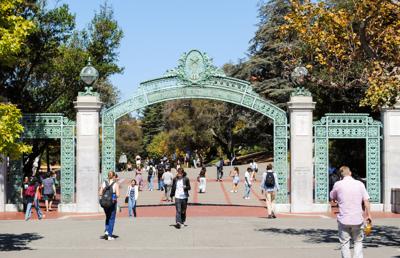
Hundreds of students, staff and community members took part in a walkout for Gaza at noon today.
This week marks two years since Hamas’ Oct. 7 attacks on Israel and the state’s subsequent war on Gaza. A September United Nations legal analysis found that Israel is committing a genocide against Palestinians in Gaza, which Israel denies. The demonstration took place on Sproul Plaza, where about a dozen speakers called for the liberation of Palestine and for UC Berkeley to divest its holdings in corporations aiding Israel’s genocide.
“We mark this week (two years ago) as the beginning of this escalation of genocide,” said graduate student and organizer Zaid Yousef. “We use (this week) to say we are going to remain steadfast, that we will answer and heed the cause of Gaza.”
Venezuela’s Gonzalez says Machado a ‘brave and courageous political figure’
Above the Mario Savio Steps in front of Sproul Hall, students mounted a large slingshot with a keffiyeh wrapped around its base. The slingshot, Yousef said, is representative of Palestinian land, as it is traditionally made from Palestinian olive wood. He added that the slingshot “epitomizes the asymmetric power imbalance that is between the Palestinians and their oppressors.”
Demonstrators held signs and banners in support of the action, with one stating “to exist is to resist” and others stating “stop arms to Israel.”
The walkout drew a crowd of approximately 350 people at 1:30 p.m. and remained consistent until the end of the walkout at 2 p.m.
Peyrin Kao, a campus EECS lecturer who recently ended a 38-day hunger strike in protest of the genocide in Gaza, called attention to the “resistance fighters who are staying steadfast after two years of starvation” in his speech.
In an interview with The Daily Californian, Kao said that the significant turnout indicates that the student body and broader student community “will not be silenced by repression tactics,” specifically referencing campus’ disclosure of 160 names in a federal antisemitism investigation.
“This kind of turnout shows that people are still thinking about (Gaza),” Kao said. “They’re aware of it and they don’t want to be complicit.”
Throughout the demonstration, protesters rallied in a series of chants with organizers, including “we want justice, you say how, end the siege on Gaza now” and “disclose, divest, we will not stop, we will not rest.”
About a dozen counter-protesters were also present during the duration of the walkout, many holding Israeli flags. Among them were members of Mothers Against College Antisemitism.
About 20 police officers were also present, but the protest remained nonviolent throughout its duration.
Campus lecturer Hatem Bazian spoke to the crowd about the importance of action. Multiple speakers also referenced campus’s history with student activism through the Free Speech Movement and the divestment from apartheid in South Africa movement.
“History’s arc bends not by apology or silence but by action,” Bazian said in his speech. “Where institutions have failed, people have not.”
The walkout was one of several events planned by campus’s Students for Justice in Palestine this week, with a film screening set for tomorrow and a prayer for Friday.
Myesha Phukan and Juliette Damian contributed to this report.
Swasti Singhai is a senior staff news reporter. Contact her at ssinghai@dailycal.org.
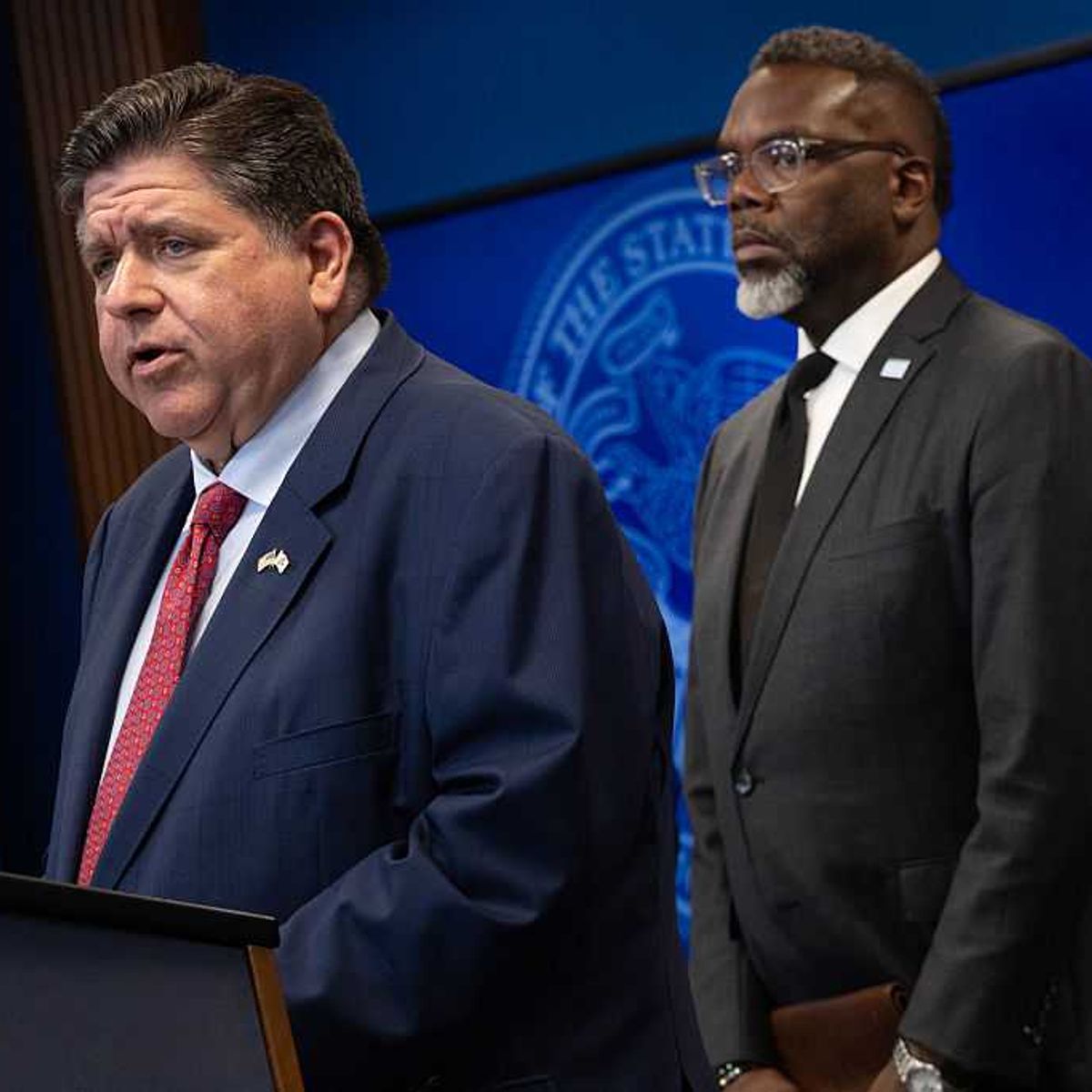
Illinois Gov. JB Pritzker speaks to the press following a visit to the National Museum of Mexican Art in the Pilsen neighborhood on September 9, 2025 in Chicago, Illinois.
(Photo by Scott Olson/Getty Images)
“Come and get me,” the Illinois governor said when asked about the president’s call to have him arrested.
Illinois Gov. JB Pritzker issued a new warning on Wednesday about President Donald Trump’s efforts to deploy the American military in US cities against the wishes of local elected officials.
Hours after Trump called for Pritzker’s imprisonment in a Wednesday morning Truth Social post, the Illinois governor claimed in an interview with MSNBC that the president’s ultimate goal with sending troops into US cities was to control the outcomes of future elections.
“He wants to militarize major cities across the United States, especially blue cities in blue states, because he wants us to get used to the idea of military on the streets,” he said. “2026 elections, I believe he’s going to post people outside ballot boxes and polling places, and, if he needs to in order to control those elections, he’ll assume control of the ballot boxes and count the votes himself.”
Pritzker pointed out that Trump considered ordering the military to seize ballot boxes after he lost the 2020 presidential election, but he was met with resistance from officials in his own administration.
However, Pritzker said that “I believe he would do it in 2026” to help Republicans maintain control of Congress.
Pritzker also struck a defiant tone when asked about Trump’s call to imprison him.
“This guy’s a convicted felon who’s threatening to jail me!” he exclaimed. “This guy is unhinged. He’s insecure. He’s a wannabe dictator. And there’s one thing I really want to say to Donald Trump: If you come for my people, you come through me. So come and get me.”
Pritzker’s remarks come as Trump and his administration have deployed Texas National Guard soldiers to Chicago over the objections of both Pritzker and Chicago Mayor Brandon Johnson. The state and city are challenging the deployment in court.
Federal immigration officials have been employing increasingly aggressive and violent tactics in the Chicago area in recent weeks, including attacking a journalist and a protesting priest with pepper balls outside an Immigration and Customs Enforcement facility; slamming a congressional candidate to the ground; dragging US citizens, including children, out of their homes during a raid in the middle of the night; and fatally shooting a man during a traffic stop.
The U.S. is on a fast track to authoritarianism like nothing I’ve ever seen. Meanwhile, corporate news outlets are utterly capitulating to Trump, twisting their coverage to avoid drawing his ire while lining up to stuff cash in his pockets.
That’s why I believe that Common Dreams is doing the best and most consequential reporting that we’ve ever done.
Our small but mighty team is a progressive reporting powerhouse, covering the news every day that the corporate media never will. Our mission has always been simple: To inform. To inspire. And to ignite change for the common good.
Now here’s the key piece that I want all our readers to understand: None of this would be possible without your financial support.
That’s not just some fundraising cliche. It’s the absolute and literal truth. We don’t accept corporate advertising and never will. We don’t have a paywall because we don’t think people should be blocked from critical news based on their ability to pay. Everything we do is funded by the donations of readers like you.
Will you donate now to help power the nonprofit, independent reporting of Common Dreams?
Thank you for being a vital member of our community. Together, we can keep independent journalism alive when it’s needed most.
– Craig Brown, Co-founder
about:blank
about:blank
Our work is licensed under Creative Commons (CC BY-NC-ND 3.0). Feel free to republish and share widely.
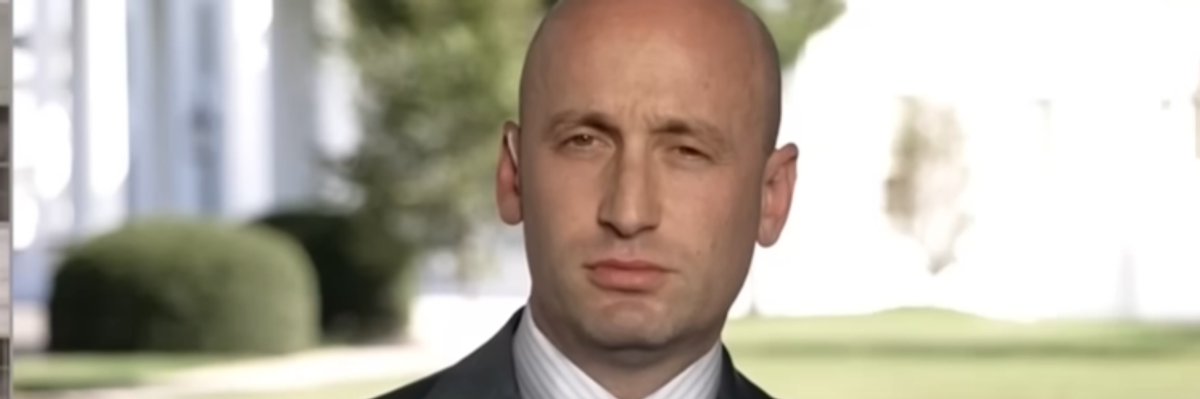
White House deputy chief of staff Stephen Miller appears on CNN with anchor Boris Sanchez, during which he asserted that President Donald Trump has “plenary authority”—essentially unlimited power—to deploy the military to US cities, on October 6, 2025.
(Screenshot from CNN on YouTube)
“Miller’s statements show their real position,” said writer Greg Sargeant. “Trump’s power to invent pretexts for emergency actions is limitless.”
White House deputy chief of staff Stephen Miller appeared to slip up in an interview Monday, admitting that he believes President Donald Trump possesses the authority of a dictator.
Miller, who has made himself the face of the Trump administration’s efforts to crush political dissent, made the comments while appearing on CNN to defend the president’s deployment of troops to Portland and Chicago, which have run into roadblocks from federal courts.
The anchor, Boris Sanchez, asked Miller about a ruling by US District Judge Karin Immergut on Saturday that the president had no legal or factual basis to commandeer the Oregon National Guard and deploy the forces in Portland against protests against Immigration and Customs Enforcement (ICE).
Over the weekend, Miller had referred to the ruling as a “legal insurrection,” adding that “the president is the commander-in-chief of the Armed Forces, not an Oregon judge.”
Given Miller’s comments, Sanchez asked, “Does the administration still plan to abide by that court ruling?”
Miller responded: “Well, the administration filed an appeal this morning with the 9th Circuit. I would note the administration won an identical case, in the 9th Circuit, just a few months ago, with respect to the federalizing of the California National Guard. Under title 10 of the US Code, the president has plenary authority, has…”
Miller then suddenly stopped speaking.
“Stephen? Stephen? Hey, Stephen, can you hear me?” Sanchez asked as Miller sat, wordlessly, his eyes blinking and darting around.
Sanchez then apologized, saying, “It seems like we’re having a technical issue,” before cutting to a break.
The recording of the interview reveals that there was not, in fact, a “technical issue.” Miller had appeared to cut himself off in the middle of his sentence before sitting motionless for approximately 15 seconds.
In a post with over 32,000 likes, one social media user speculated that it was because Miller had “said the quiet part out loud,” adding, “The plan wasn’t to be made public. Clearly, someone hit the panic button in his earpiece.”
After returning from the commercial, the interview continued. But the oddly specific phrase “plenary authority” was not invoked again. As the same user noted, the interview appears on CNN‘s YouTube channel, but has mysteriously been edited to remove Miller’s mention of “plenary authority.”
According to Cornell University’s Legal Information Institute, “plenary authority” refers to “power that is wide-ranging, broadly construed, and often limitless for all practical purposes.”
The law Miller cited, Title 10 of the US Code, states the three conditions under which the president may deploy a state’s National Guard: if there is a military invasion by a foreign power, if there is a rebellion against the US government or the danger of one, or if the president is “unable with the regular forces” to execute US laws.
The phrase “plenary authority” does not appear anywhere in the code. But as Huffington Post reporter Sara Boboltz explained, “Miller appeared to mean that the president has total control over everything the military does, even though he shares some of that power with Congress.”
Though Trump has asserted that Portland is “war-ravaged” to justify his use of military force, Immergut—a Trump appointee—shot this characterization down in her ruling as “untethered to facts,” as there was “substantial evidence that the protests at the Portland ICE facility were not significantly violent or disruptive in the days—or even weeks—leading up to the president’s directive.”
But Miller’s invocation of the phrase “plenary authority” in this context seems to imply that Trump alone is the judge of what situations warrant the use of the most extreme emergency powers.
“Trump just threatened to invoke the Insurrection Act if governors and judges act lawfully within the constitutional system in ways that displease him,” saidNew Republic writer Greg Sargent on social media. “Miller’s statements show their real position: Trump’s power to invent pretexts for emergency actions is limitless.”
Sargent described this theory in more detail in a piece published Wednesday: “Miller is working overtime to polarize the public debate about Trump’s increasingly dictatorial abuses of power. And he’s doing so quite consciously. He relentlessly depicts Democrats as allied with a vast, inchoate class of violent criminals and insurrectionists operating in every shadow of American life.”
Trump’s deployments of troops to US cities are decisively unpopular. A CBS survey published Sunday found that 58% of Americans oppose Trump’s National Guard deployments.
But Sargent argued that “Miller plainly believes there’s a latent majority out in the country that can be sleepwalked into authoritarianism,” in part due to the muted response from many top Democrats.
With the exceptions of California Gov. Gavin Newsom and Illinois Gov. JB Pritzker—the latter of whom Trump stated should be arrested on Wednesday along with Chicago Mayor Brandon Johnson—Sargent says that many of the opposition party’s leaders have declined to confront Trump’s narratives of urban anarchy head-on, seeing them as a “trap” to lure them into “a losing debate about crime.”
One Democratic strategist recently told Politico that “just like with immigration, Trump has found another issue where the Democratic Party is on a back foot“ and repeated false claims that crime is rampant in the nation’s large cities; in fact, violent crime is on the decline in the major cities the president has targeted, with particularly stark drops in Portland.
“Do Democrats, broadly speaking, have a theory of this moment that’s consciously matched to MAGA’s authoritarian politics? They need one,” Sargent said. “Because guess who does have a theory of the moment? Miller does. And he’s amassing unprecedented power to put it into practice as we speak.”
The U.S. is on a fast track to authoritarianism like nothing I’ve ever seen. Meanwhile, corporate news outlets are utterly capitulating to Trump, twisting their coverage to avoid drawing his ire while lining up to stuff cash in his pockets.
That’s why I believe that Common Dreams is doing the best and most consequential reporting that we’ve ever done.
Our small but mighty team is a progressive reporting powerhouse, covering the news every day that the corporate media never will. Our mission has always been simple: To inform. To inspire. And to ignite change for the common good.
Now here’s the key piece that I want all our readers to understand: None of this would be possible without your financial support.
That’s not just some fundraising cliche. It’s the absolute and literal truth. We don’t accept corporate advertising and never will. We don’t have a paywall because we don’t think people should be blocked from critical news based on their ability to pay. Everything we do is funded by the donations of readers like you.
Will you donate now to help power the nonprofit, independent reporting of Common Dreams?
Thank you for being a vital member of our community. Together, we can keep independent journalism alive when it’s needed most.
– Craig Brown, Co-founder
about:blank
about:blank
Our work is licensed under Creative Commons (CC BY-NC-ND 3.0). Feel free to republish and share widely.
Peyrin Kao ends his hunger strike after 38 days. Peyrin Kao | File
After 38 days, UC Berkeley lecturer Peyrin Kao suspended his hunger strike. Kao was protesting the war on Gaza and “the use of tech in Israel’s genocide in Gaza” earlier this week.
Kao, a lecturer in the Electrical Engineering and Computer Science department, or EECS, began his strike Aug. 27 and said he recently concluded it to “avoid permanent damage to (his) body.”
“By launching a hunger strike, I hoped to bring the starvation here to Berkeley, and send a message to the campus community and leadership that starvation and genocide is not just some anonymous event happening thousands of miles away,”Kao said in an email. “It’s a war crime happening with the support of our university’s investments in Israel.”
Hostages may be released Monday or Tuesday, says Trump
Over the course of the hunger strike, Kao restricted his diet to foods available to Gazans, such as bread, flour and pasta. He also consumed water, but with the recognition that “there is a massive shortage of clean water in Gaza.”
Kao described his experience as “exhausting,” as he was put through “severe emotional stress” from extreme hunger.He added that this experience is only a “tiny fraction of what Palestinians in Gaza have faced for the past 700 days.”
While the hunger strike did not yield its original disclosure or divestment demands, Kao commented on the university’s inclusion of his name in documents provided by campus administration to the federal government in response to their antisemitism investigation.
“Their reliance on scare tactics proves that they have no real rebuttal to their complicity in genocide,” Kao said in an email. “We are on the right side of history, and we can defeat this suppression of free speech by continuing to speak out and organize for Palestinian liberation.”
Kao said the reason why the strike was possible was due to support from multiple campus organizations, including the recently formed Berkeley EECS for Palestine. These organizations were responsible for running social media accounts, scheduling media appearances and organizing fundraising efforts, according to Kao.
Although he has suspended his hunger strike, Kao emphasized the importance of continuing fundraising efforts to “mitigate the forced starvation in Gaza.” He plans to continue raising money for Nedal Mohammed, who is located in central Gaza and provides food and water for Palestinians who have been displaced.
“Although the hunger strike action is over, the struggle for Palestinian liberation continues, and will continue until we see a free Palestine, in our lifetimes,” Kao said in an email.
UC Davis School of Law professor Brian Soucek and Catherine Lhamon, the executive director of the Edley Center at the UC Berkeley School of Law, will host a talk Thursday to “grapple” with the nearly 160 names that campus released.Andoe Glaser | Staff
UC President James B. Milliken released a statement Oct. 3 addressing the university’s cooperation with the U.S. Department of Education’s Office for Civil Rights, which included UC Berkeley’s release of about 160 student, staff and faculty names.
The letter claims that in the course of an investigation into campus’s response to complaints of antisemitic discrimination, the Office of Civil Rights, or OCR, demanded unredacted case files and police reports. Milliken said UC requests to keep documents anonymized were denied by the OCR, and a June agreement was made to release the unredacted files “as a last resort.”
A supporting FAQ released by the UC Office of the President, or UCOP, clarified that the university did not produce a “list of individuals,” although the files included names and, in some instances, contact details of complainants, respondents and witnesses. However, further information on the details of the original request was not provided in the FAQ, and UCOP declined to provide further details about the release in an email to The Daily Californian.
Hostages may be released Monday or Tuesday, says Trump
“If the school is giving over more information than it needs to, the chilling effect of those disclosures is going to be greater than necessary and that would be a problem,” said UC Davis School of Law professor Brian Soucek. “I don’t know if that’s the case because we haven’t had enough transparency to be able to independently evaluate that. We’re just left having to take the administration at its word.”
Campus policy says privacy laws such as the Family Educational Rights and Privacy Act, or FERPA, typically protect student records and information from being disclosed without consent. However, UCOP claimed that this disclosure did not violate FERPA, as the law allows records to be passed to the federal government “in certain contexts.”
UCOP’s FAQ also denied that the university “capitulated” to the federal government, an accusation leveled against UC administration by academics and commentators after UC Berkeley’s release of names. It claimed that compliance with the federal government is a legal obligation unrelated to politics or party lines.
Soucek noted that although the university must comply with all federal agencies at the risk of losing vital funding, he doubts the nature of OCR’s request.
In the letter, Milliken claimed universities receiving federal funding have complied with federal oversight from agencies such as OCR “for decades.” However, Soucek noted that while the university would have to comply with a legitimate request for unredacted, de-anonymized information, OCR wouldn’t necessarily need personal information from particular complainants to investigate the campus response.
While Milliken’s letter states the most recent investigation will not target individuals and solely focus on campus complaint response, Soucek did not think “any reasonable person should believe the government is conducting these investigations fully in good faith.”
“The problem here is that we have a set of investigations around the country that are clearly retaliatory in nature — clearly aimed at targeting the administration’s perceived enemies,” Soucek said. “The information used in those investigations is being handed off for improper purposes like deporting people on the basis of their protected speech.”
Along with Catherine Lhamon, executive director of the Edley Center at the UC Berkeley School of Law, Soucek will host a talk Thursday to “grapple” with the nearly 160 names that campus released.
They aim to address both the background on the investigation and faculty concerns about its ramifications, as well as the protections offered to university employees by the university’s policy on academic freedom.
“There are responsibilities that come with academic freedom, but the protections are incredibly clear,” Soucek said. “It might be that within these documents that were turned over, there are complaints about professors … that are clearly protected by academic freedom.”
Progressive Democrats of America Oct 8, 2025 PDA Weekly Town Halls Everyone who attends will leave with a renewed sense of possibility for creating the inclusive and prosperous progressive America that PDA has always worked to build. Our guest, Ro Khanna, has been traveling the country, speaking with Americans from all walks of life and from all political persuasions, and what he has learned will amaze you. Americans embrace progressive economics! Indeed, if engaged sincerely and respectfully, Ro has learned that Americans want a progressive America! On Sunday, we will discuss how to build that America together. So, if Trump, Stephen Miller, and the cast of goons and villains in the current administration have been getting you down, join us this Sunday for a blast of hope! Ro Khanna is a leader in Congress on issues related to Gaza, the Epstein files, and numerous progressive policies. He’s genuinely one of the great progressive leaders of our time.
GOP lawmakers are now admitting House Speaker Mike Johnson is slow-walking Arizona Democrat Adelita Grijalva’s swearing in because of the Epstein files.
It’s been two weeks since Democratic Rep.-elect Adelita Grijalva won a special election for Arizona’s 7th Congressional District, defeating her Republican opponent in a landslide that dwarfed the 22-point margin Democrats won the seat by in 2024.
But Speaker Mike Johnson still hasn’t sworn Grijalva into the seat, which became vacant in March when her father died of complications from cancer.
And GOP lawmakers are now admitting Johnson is slow-walking Grijalva’s swearing in because of the Epstein files.
Once she’s sworn in, Grijalva will be the final signature on the petition that would force Johnson to hold a vote on a bipartisan bill that would compel the Trump administration to release the files it possesses on convicted sex offender Jeffrey Epstein. If the bill came up for a vote before the full House, it would likely pass—embarrassing Johnson’s Dear Leader Donald Trump, who wants to keep the files secret likely because his name has been confirmed to be littered throughout the documents.
“Contrary to what he says, @SpeakerJohnson is doing everything he can, including delaying the swearing in of the most recently elected member of Congress and spreading misinformation about the legislation, to block a vote in Congress on legislation to release the Epstein files,” Rep. Thomas Massie (R-KY), who co-sponsored legislation, wrote Monday in a post on X.
Massie was responding to an interview Johnson gave to MSNBC, in which Johnson claimed that he was “for maximum disclosure” but that the government doesn’t want to release the files to “protect the innocent victims” who Epstein abused.
Of course, the legislation that would force the Epstein files to be released specifically says that information that would identify victims would be redacted—so Johnson’s claim is a red herring.
Grijalva, for her part, has been demanding that Johnson swear her in so she can get to work for her constituents—who have been without congressional representation since her father died on March 13.
“The people of Southern Arizona deserve representation and I’m ready to get to work. Swear me in NOW @SpeakerJohnson!” Grijalva wrote Monday in a post on X.
Johnson, for his part, claims he can’t swear Grijalva in because Congress isn’t in session.
But that, too, is an absurd lie, as back in April Johnson swore in two GOP lawmakers the day after they won special elections in Florida— even though Congress was in recess at the time.
Rep. Thomas Massie
Even more absurd is the fact that the House isn’t in session right now, given that the government is shut down and only Congress has the power to pass funding legislation that would reopen it.
In fact, Johnson announced on Thursday that Congress will be out on recess until Oct. 13.
Massie is hammering Johnson for not calling Congress into session.
“The government is shut down, but the House refuses to go back in session. Why are we in recess? Because the day we go back into session, I have 218 votes for the discharge petition to force a vote on releasing the Epstein files,” Massie wrote in a post on X on Sunday night. “@SpeakerJohnson doesn’t want that to be the news.”
But ultimately, no matter how much Johnson tries to delay Grijalva’s swearing in, the fact is that she will be seated in the coming days. And then Johnson will have a mess on his hands as he tries to stop the Epstein files legislation from passing.
by Randy Shaw on October 6, 2025 (BeyondChron.org)
When the original edition of my book, The Tenderloin: Sex, Crime and Resistance in the Heart of San Francisco, came out in 2015, the neighborhood was on the rise. The Tenderloin Museum opened that year, eciting new businesses like the Black Cat jazz club and Onsen Spa were emerging and Little Saigon thrived.
My January 7, 2020 story, “A Tenderloin Breakthrough in 2020,” identified many of the projects that were revitalizing the neighborhood. I could not imagine that a pandemic would arrive in March. And that Mayor London Breed would use the COVID crisis to halt the neighborhood’s progress.
The Tenderloin’s shifting fortunes required me to update my 2015 book to include the 2015-2025 period. I’ll be talking about my book and how City Hall has a long history of undermining the Tenderloin this Wednesday, October 8, at my alma mater, UC Law SF (formerly Hastings School of Law).
The event details are included in the photo above. Lunch will be provided.
City Hall’s Longtime Opposition
My updated book describes how Mayor Breed’s undermining of the Tenderloin was all too typical of City Hall’s approach to the neighborhood. Consider: City Hall actually closed down the Tenderloin in 1917. That attack on the neighborhood’s bars and working women was short-lived; once Prohibition made all bars illegal in 1920 the Tenderloin’s underground economy soared again.
For decades the Tenderloin was among San Francisco’s most prosperous neighborhoods. Much of the city was hurt by the Great Depression. Not the Tenderloin. It’s bar scene thrived when Prohibition ended in 1933 and its underground economy was stronger than ever.
All of San Francisco boomed during WWII but perhaps only North Beach did better than the Tenderloin. The book includes photos of the many matchbooks from the era’s entertainment venues that dominated the neighborhood. When the war ended and San Francisco’s economy again declined, the Tenderloin still had a powerful underground economy coupled with restaurant and bar patronage from those attending Mid-Market movie theaters.
But City Hall wasn’t happy about the Tenderloin’s success.In researching for my book and the Tenderloin Museum I discovered that the leading books about San Francisco excluded the Tenderloin entirely. The city elite was ashamed of a neighborhood that prospered from gambling and vice (all while partaking of it).
The Tenderloin’s decline began when George Christopher was elected mayor in 1955. He began intentionally wrecking the Tenderloin economy. If you think I’m exaggerating read my book. Christopher was so committed to destroying the Tenderloin that he even tried to close the legendary Blackhawk Jazz Club!
In 1960 there was not a single block of the Tenderloin that the U.S. Census determined to be slum housing. This was a when virtually the entire Mission District and SOMA was considered slums. Yet by the mid-1960’s Mayor Christopher’s attacks combined with Mid-Market’s decline brought the Tenderloin down (it also led to the rise of the city’s LGBTQ movement, described in the book).
The Tenderloin still had Wally Heider Studios, where the Grateful Dead, Crosby, Stills & Nash, Creedence Clearwater Revival and other rock legends recorded the nation’s top albums from 1969-73. But a lot of this history was forgotten.
It took nearly fifty years for the neighborhood to get back on track.
That’s why I felt it so important for people to get the facts—through photos and text— about what happened to the Tenderloin during COVID. The Tenderloin was on a path toward revitalization when COVID hit. What the updated edition of my book shows is that Mayor Breed used COVID to turn the Tenderloin into a drug containment zone. That may sound extreme, but I provide the evidence.
The Tenderloin is finally bouncing back, and we have a mayor who wants to support the neighborhood’s revival. But the Tenderloin’s local and national reputation remains tarnished by events that occurred during the 2000-2024 years and by ongoing sidewalk drug activities.
Come to my book event to hear more. The Tenderloin has a rich history and is one of the nation’s great neighborhoods. Many cities once had Tenderloin neighborhoods; only San Francisco’s remains.
My book describes the resistance that preserved the Tenderloin’s low-income and working-class status in an increasingly affluent city. I co-founded the Tenderloin Housing Clinic in 1980, arriving just in time to join the massive campaign against luxury hotels that forever changed the neighborhood.
We’ll have a great discussion about the Tenderloin’s past, present and future at the Wednesday book event. And if you can’t make it, you can buy the updated book here. All book sale proceeds go to the Tenderloin Museum.
I’ve worked fulltime in the Tenderloin for 45 years. I still find it an amazing neighborhood.
<I>Randy Shaw is the Editor of Beyond Chron and the Director of San Francisco’s Tenderloin Housing Clinic, which publishes Beyond Chron. Shaw’s new book is the revised and updated, The Tenderloin: Sex, Crime and Resistance in the Heart of San Francisco. His prior books include Generation Priced Out: Who Gets to Live in the New Urban America. The Activist’s Handbook: Winning Social Change in the 21st Century, and Beyond the Fields: Cesar Chavez, the UFW and the Struggle for Justice in the 21st Century. </I>
by Randy Shaw on October 6, 2025 (BeyondChron.org)
As San Francisco awaits Congressmember Nancy Pelosi’s re-election decision, the signs are becoming clear. We break down the growing evidence and provide an early assessment of the three leading candidates to replace her.
The Evidence Trail
Nancy Pelosi has been a leading, high-profile national spokesperson for the Democratic Party since becoming the House leader in 2003, She has not played that role in 2025. Some of this shift is attributable to her no longer formally leading House Democrats. But I think Pelosi only ran in 2024 because she wanted to help shepherd through President Kamala Harris’ ambitious agenda in 2025. She did not run because she was eager to potentially again lead the fight against President Trump.
Pelosi will be 86 before the 2026 election. She recently lost 92-year old John Burton, her longtime friend and political mentor. Burton’s death offered a stark reminder of what a great life Pelosi has outside politics.
I always recall the Pelosi-Burton connection because I backed progressive Harry Britt in his 1987 congressional race against Pelosi. Britt was San Francisco’s champion for tenants’ rights. We saw Pelosi as a Democratic Party fundraiser with no grassroots connections. Burton kept telling me that I was wrong about Pelosi. He insisted she was an even bigger fighter for progressive causes than he was. He was right.
A Viable Rival
If she runs, Pelosi faces a well-funded rival campaigning nonstop for her job. Saikat Chakrabarti, a former chief of staff for Rep. Alexandria Ocasio-Cortez, will make this more of a contest than Pelosi has faced before. He has no chance to win, but the longtime incumbent may not want to have to attend the debates and/or campaign interviews that this challenge requires.
Scott Wiener and Christine Pelosi’s Increased Visibility
It’s been long assumed that Nancy Pelosi would be succeeded by either her daughter, Christine, or State Senator Scott Wiener. Both have increased their social media posts about national issues in recent months.
True, part of this could be Trump’s actions. But based on what I see in my feed, in previous years neither has posted so often about national issues. Both are likely laying the groundwork for their congressional campaigns.
Wiener vs Pelosi
Scott Wiener has been the most impactful state legislator on housing issues in California history. He has done as much to reshape the state’s future as any California legislator ever.
Wiener’s support for upzoning and overcoming the longtime political dominance of homeowners has brought him passionate allies. And powerful enemies. Backers of the recent recall of Joel Engardio attacked the supervisor as a Wiener ally who must be defeated.
Opponents of Mayor Lurie’s upzoning plan blame Wiener for promoting the measure. They seem more interested in attacking Wiener than the mayor. Wiener won key votes from Westside Chinese-American voters in his tight 2016 race against Jane Kim. Those voters have broken with Wiener over Prop K.
Scott Wiener has held elective office in San Francisco since 2010. He has never hesitated to take strong positions on controversial issues. That’s not the typical gateway to higher office, which is why so few politicians go that route.
Wiener has the demonstrated ability to get big stuff done in a challenging legislative environment. He also gives the city a chance to do what Harry Britt asked voters to do in 1987, which is to elect San Francisco’s first GLBTQ congress member.
Wiener’s allies will work day and night to elect him. He has a legendary work ethic—he’s reputed to have knocked on virtually every D8 door when running for supervisor—and has no trouble raising money for his campaigns.
Wiener starts as the likely frontrunner in the race.
Don’t Underestimate Christine Pelosi
It would be easy to see this contest as a referendum on Wiener. But many voters will see it as a referendum on Nancy Pelosi. That’s one why her daughter, Christine, can win.
I know firsthand that in 1987 Nancy Pelosi benefited from being the choice of her predecessor, Sala Burton. I talked to tenants who appreciated Britt’s leadership but who were voting for Pelosi because they wanted to honor the enormous contributions of Phil and Sala Burton.
Thousands of voters in June 2026 will have benefited from Nancy Pelosi’s actions. Many who like Wiener will nevertheless feel obligated to support Pelosi’s daughter.
Christine Pelosi is on the Democratic National Committee. She has long been active in the California Democratic Party. She’s been involved in countless campaigns and may well be better known in San Francisco than her mother was in 1987.
This will be a hugely funded and very competitive race. Saikat Chakrabarti’s campaign could be a deciding factor, as he will win progressive votes that would otherwise go to Pelosi. There is no ranked choice voting in this congressional election. Many on San Francisco’s left have never been big Nancy Pelosi fans. I can see them backing Charkrabarti even if it appears he cannot win.
We expect to hear Nancy Pelosi’s formal decision not to run soon after the November election. In the meantime, keep working to pass Prop 50 on November 4.
<I>Randy Shaw is the Editor of Beyond Chron and the Director of San Francisco’s Tenderloin Housing Clinic, which publishes Beyond Chron. Shaw’s new book is the revised and updated, The Tenderloin: Sex, Crime and Resistance in the Heart of San Francisco. His prior books include Generation Priced Out: Who Gets to Live in the New Urban America. The Activist’s Handbook: Winning Social Change in the 21st Century, and Beyond the Fields: Cesar Chavez, the UFW and the Struggle for Justice in the 21st Century. </I>
Two thirds of likely San Francisco voters support the idea of a public bank, a new poll by the Public Bank Coalition shows.
It’s a pretty dramatic outcome for an issue that isn’t even on the ballot. Hardly any proposal gets 67 percent support the first time voters are asked about it.
Sup. Jackie Fielder has strong momentum for a public bank, one of her signature issues
The poll provides a big boost at a time when the city budget is tight and the mayor and the supes are more conservative than the 2022 board that moved the plan forward.
Yet there is at this point no organized opposition, and Sup. Jackie Fielder is preparing to take the next steps to fund at least the beginnings of a municipal finance agency.
The poll, by Underpin, a national consulting firm, found consistent support for a public bank across almost all demographics. Among millennial voters, who are the largest generation in US history, support was 75 percent.
From the polling memo:
Even among San Franciscans with higher risk aversion according to a standard attitudinal measure, support is above 68%. Predictably, younger voters and those with higher trust in government management of funds (high civic trust) were also more likely to support a public bank. Given this range of support, a public bank campaign would likely have strong baseline support.
More:
Sponsored link
Help us save local journalism!
Every tax-deductible donation helps us grow to cover the issues that mean the most to our community. Become a 48 Hills Hero and support the only daily progressive news source in the Bay Area.
Most voters are more likely to support a public bank in San Francisco if it is a Green Bank. A green bank was defined as having an “initial focus on local renewable energy infrastructure, with profits used later for affordable housing and other community lending needs.” We compare more and less likely support across five parameters or frames: a green bank, “people over profits” + “lower costs” framing and “greater public control” framing. The final two framing questions also noted the intended investments of a public bank in affordable housing, small business growth, and green energy.
The questions were relatively neutral, not leading—and only about seven percent of people responding were strongly against the idea.
“San Franciscans, especially young people, are demanding bold solutions to today’s affordability and climate crises,” saidSupervisor Jackie Fielder, co-founder of the San Francisco Public Bank Coalition. “A public bank is how we take our money back from Wall Street and reinvest it into housing, clean energy, and small businesses right here at home. This poll makes it clear: voters are ready for a Green Bank that works for the people, not for profit.”
The next step for the Public Bank Coalition is likely a ballot measure that will require some sort of funding mechanism—and that could be where Mayor Daniel Lurie and some of the supes play a role. Lurie’s not about to set aside money from the General Fund for a public bank, so supporters are going to need another approach.
But the high popularity of the concept will make it hard for anyone at City Hall to oppose the next steps.
48 Hills welcomes comments in the form of letters to the editor, which you can submit here. We also invite you to join the conversation on our Facebook, Twitter, and Instagram.
Tim Redmond has been a political and investigative reporter in San Francisco for more than 30 years. He spent much of that time as executive editor of the Bay Guardian. He is the founder of 48hills.
Help Outreach Working Group lift the fog of corporate media. Donate to help us maintain this website and distribute literature on the street.
We protest Heritage Foundation EVERY MONDAY (Join us!!!!) By admin | September 2, 2025 | Uncategorized Cliff Cash Comedy Premiered Jul 26, 2025 Every Monday at The Heritage Foundation 214 Massachusetts Ave. Washington D.C. 4pm protest 6pm pizza Every Friday at Fox News D.C. 400 N. Capitol St. Washington D.C. 4pm protest 6pm pizza We are... Continue reading →
January Membership Meeting Join Alice for our first membership meeting of the year! Come vote to confirm and meet the incoming 2026 board (new roster listed at the end of this email). ️Monday, January 12, 2026 6:00–7:00 PM | Doors 5:30 PM 518 Valencia Street (at 16th)This meeting qualifies as a voting event for... Continue reading →
One Million Rising: Strategic Non-Cooperation to Fight Authoritarianism Virtual Event · Hosted by No Kings Time Wednesdays 8 – 9:30pm EDT Location Virtual event Join from anywhere About this event Across the country, authoritarian forces are getting bolder and more dangerous. Trump and his allies are not hiding their agenda: mass deportations,... Continue reading →
THURSDAY, JUNE 29, 2023 AT 2 AM – 4 AM PDT How to create trust in a group? Details Event by Extinction Rebellion Empathy Circles online EMPATHY CAFE Duration: 2 hr Public · Anyone on or off Facebook How to create trust in a group? This is the question that arose in our... Continue reading →
When you volunteer for Saikat, it’s on us to give you a great experience and a genuine chance to make a difference. We don’t want to waste a second of your time. That’s why we’re always optimizing. And I’m excited to report that this Saturday we talked with 300% more... Continue reading →
This Sunday’s Town Hall: Announcing This Week’s Progressive Town Hall: Every Sunday at 4pm ET/1pm PT RSVP HERE Join PDA activists online from across the country to discuss the importance of progressives reclaiming the American story from the MAGA right, an issue of heightened importance as we’re now within one... Continue reading →
https://us06web.zoom.us/j/83499963761?pwd=x6vbYvt5bywKggEjac4QV2vf71MGKc.1 A new world order? More like a New World chaos. Kidnaps and cannons. Dionne quintuplets. Canadian cruelty. Rest in pentapeace. (1) Return to the moon? Well, around it, anyway. No cheese eating yet. Measles, flu, the blues. Weight loss pills and vaccine thrills. Not rid of Covid. Epstein? Epstein... Continue reading →
Honor Dr. King’s Legacy Through Service This MLK Jr Day Dr. Martin Luther King Jr. understood that true freedom meant more than legal equality. It required a society where everyone had access to food, shelter, and dignity. He believed that “everybody can be great, because everybody can serve.” This year,... Continue reading →
We protest Heritage Foundation EVERY MONDAY (Join us!!!!) By admin | September 2, 2025 | Uncategorized Cliff Cash Comedy Premiered Jul 26, 2025 Every Monday at The Heritage Foundation 214 Massachusetts Ave. Washington D.C. 4pm protest 6pm pizza Every Friday at Fox News D.C. 400 N. Capitol St. Washington D.C. 4pm protest 6pm pizza We are... Continue reading →
One Million Rising: Strategic Non-Cooperation to Fight Authoritarianism Virtual Event · Hosted by No Kings Time Wednesdays 8 – 9:30pm EDT Location Virtual event Join from anywhere About this event Across the country, authoritarian forces are getting bolder and more dangerous. Trump and his allies are not hiding their agenda: mass deportations,... Continue reading →