URGENT: Call your Republican representative NOW and tell them to vote against billions more for ICE and Border Patrol. In the early hours of the morning on Friday, Republican senators (with the exception of Lisa Murkowski) passed Trump’s reconciliation bill, handing ICE and Border Patrol $70 billion to fund their kidnappings, concentration camps, and family separations. The House is expected to vote on the bill in the next 24 hours so if you have a Republican representative, please make a call now.
Next Monday, June 15, join our kickoff call for endorsed candidate Peggy Flanagan (MN-Sen) (8pm ET/5pm PT). Join Indivisibles across the country to hear from Co-Executive Director Ezra Levin about our plans to get Peggy Flanagan across the finish line in Minnesota’s US Senate primary this August. Flanagan is a proven leader for working people, and we’re proud to stand with her in the fight against fascism. Paid for by Indivisible Action. Not authorized by any candidate or committee.
Do some local organizing with Rise Up and Sing Out this Sunday. While Trump is holding his little birthday cage match, the Committee for the First Amendment will be counterprogramming with a nationally livestreamed night of joy, music, and action. The No Kings coalition is helping folks organize hundreds of watch parties to build hyperlocal organizing structures and grow existing groups. Host an event, find an event, or just tune in and participate in calls to action announced from the stage.
Congresswoman Pramila Jayapal (D-Wash.) speaks at a rally in Lafayette Park near the White House in Washington, DC on May 1, 2025.
(Photo by Bryan Dozier/Middle East Images/Middle East Images/AFP via Getty Images)
“This is unprecedented and further proof that ICE and their private, for-profit prison contractors should not be sent another cent of taxpayer dollars.”
Congresswoman Pramila Jayapal on Monday demanded accountability for the Trump administration officials responsible for the “unprecedented” number of people who have died while detained by US Immigration and Customs Enforcement during President Donald Trump’s second term.
“Yesterday, I was notified of the 50th death in ICE custody since Trump returned to office,” Jayapal (D-Wash.)—the ranking member of the House Subcommittee on Immigration Integrity, Security, and Enforcement—said on social media. “This is unprecedented and further proof that ICE and their private, for-profit prison contractors should not be sent another cent of taxpayer dollars. There must be accountability.”
According to ICE’s public database, 51 people have died while detained by the Department of Homeland Security (DHS) agency during Trump’s second term, including two people who were killed in a sniper attack on an ICE administrative and processing center in Dallas. At least 10 of the deaths were men who killed themselves, according to an Associated Press investigation published late last month.
ICE recently announced it would stop reporting the deaths of people recently released from ICE detention. The reporting policy, enacted in 2021, was meant to assure accountability and prevent the agency from offloading severely ill detainees.
Many of the deaths were preventable, say experts who point to systemic understaffing and DHS policy choices that weaken detainee care and employee oversight.
Jayapal’s call comes as ICE detainees across the nation are resisting abuse in concentration centers across the nation, through hunger strikes and other civil disobedience, as well as via lawsuits.
Hundreds of detainees at Delaney Hall in Newark, New Jersey—which is operated by prison profiteer GEO Group—are participating in a hunger and labor strike over unsanitary conditions, inedible food, poor medical care, and prolonged detention, while federal agents have attacked people outside the facility including protesters and a sitting US senator.
Similar strikes and other acts of resistance are either ongoing or recently occurred at Adelanto Processing Center and its Desert View Annex in California, North Lake Processing Center in Michigan, Moshannon Valley Processing Center in Pennsylvania—all run by GEO Group—and other lockups. Detainees who participate in hunger strikes or speak to reporters say they have been placed in solitary confinement and subjected to other retaliation.
Despite—some critics say because of—reports of widespread abuses, DHS recently shut down its Office of the Immigration Detention Ombudsman (OIDO), which was created by an act of Congress signed into law during Trump’s first term amid rampant systemic abuse of migrants including detainee deaths, family separation, and severe overcrowding. OIDO had the power to receive detainee complaints, investigate alleged abuse or misconduct, inspect detention facilities, and report systemic problems to DHS leaders and Congress.
Jayapal, who is an immigrant, has been one of Congress’ most vocal critics of Trump’s xenophobic immigration crackdown. She was a leading voice for the replacement of former DHS Secretary Kristi Noem and has visited several ICE detention centers—and been blocked from conducting official oversight duties at one of them.
She also introduced the Dignity for Detained Immigrants Act, a proposal “to end the use of private, for-profit detention centers, end the use of mandatory detention, update and implement robust minimum requirements for care, and conduct urgent oversight at other facilities across the country.”
Last week, Jayapal highlighted a report published by the office of DHS Inspector General Joseph Cuffari that detailed violations of food safety and medical care standards, excessive use of force, and other improprieties at the Winn Correctional Center in Louisiana, which is run by prison profiteer LaSalle Corrections.
“This DHS OIG report details what we have heard from detained immigrants across the country—that these detention centers have violated numerous required standards and are putting people’s health and safety at serious risk,” Jayapal said in a statement. “And this report verifies what many immigrants have stated is happening at these private, for-profit detention centers across the country.”
“DHS must immediately withdraw funding from the numerous detention centers that consistently do not meet the minimum required standards for housing immigrant detainees,” the congresswoman added. “For those that remain, DHS must require facilities to take immediate corrective action and engage in serious oversight of these for-profit prison operators who are prioritizing their cash coffers over meeting basic health and safety standards.”
Our work is licensed under Creative Commons (CC BY-NC-ND 3.0). Feel free to republish and share widely.
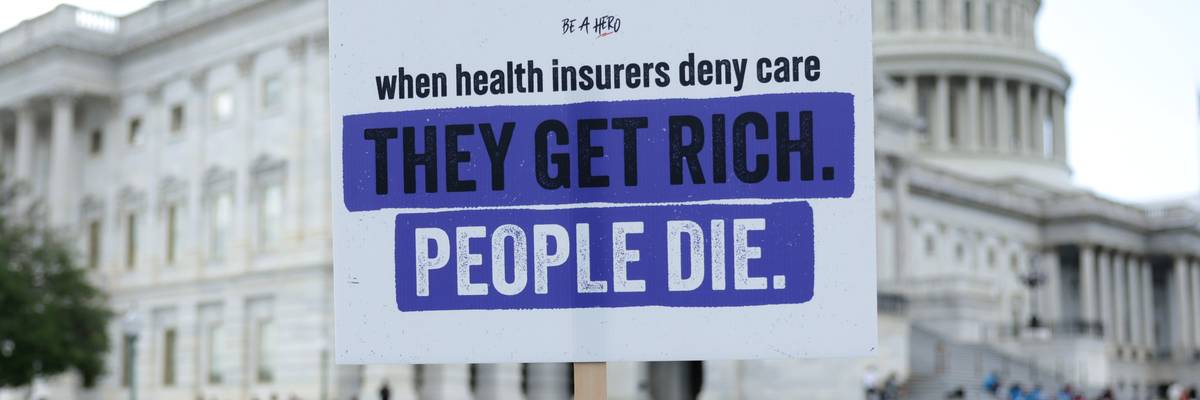
An advocate holds a sign during a news conference on Medicare Advantage plans in front of the US Capitol on July 25, 2023 in Washington, DC.
(Photo: Alex Wong/Getty Images)
“The American people are hungry for bold ideas that reform fundamental institutions that have failed them for too long. And they are looking for leaders who will take on powerful interests and fight for working people.”
“Our democracy is struggling, and the status quo is not working. Too many corporate-backed politicians continue to push for a ‘business as usual’ approach while wages stagnate, public goods and services erode, and billionaires amass grotesque amounts of wealth,” says the coalition’s open letter.
“How can one feel optimism for our future when over 40% of us are carrying around the burden of medical debt?” the letter asks, citing data from KFF. “How can we plan for our futures when we can’t afford to go to the doctor or cover rent?”
According to the coalition:
We need an agenda that working-class people and everyday Americans can rally behind. Without one, far-right, fascist politicians are filling that void. This fascist agenda redirects people’s rightful anger at our system’s failures to unjustly place blame on immigrants, low-income people, and people of color. It’s time to acknowledge that failing to provide transformational policies and hope to the working class has allowed fascism to rise and hold on to power. It’s time to challenge the corrupt CEOs who profit off despair. To show people real solutions that can work.
No one can fix our rigged economy overnight. Our structural inequality is decades in the making. But one piece of the solution is to take on one of the largest industries in our country: healthcare.
On Capitol Hill, Sen. Bernie Sanders (I-Vt.) and Reps. Pramila Jayapal (D-Wash.) and Debbie Dingell (D-Mich.) have repeatedly introduced the Medicare for All Act. While support for the bill among elected Democrats and the US public has grown, the legislation hasn’t progressed in either chamber, which are both narrowly controlled by the GOP.
However, “we may face a once-in-a-generation opportunity to legislate on healthcare in 2029,” notes the letter. While the midterms are less than five months away, enacting a federal Medicare for All system would likely require electing more members of Congress and a new president who would support such legislation in the November 2028 election.
“We need to rally behind the boldest possible reform, Medicare for All, that brings together the broadest possible movement, not overly complex incremental measures that prop up the same systems we’re seeing fail under the weight of attacks by Trump and Republicans,” the groups argued. “The American people are hungry for bold ideas that reform fundamental institutions that have failed them for too long. And they are looking for leaders who will take on powerful interests and fight for working people.”
“Now is the time to organize and inspire!” the coalition stressed. “A small minority of skeptical healthcare policy wonks may try to convince us to scale back, that structural change isn’t winnable. The reality is that alternative proposals don’t move us towards Medicare for All and complicate our already broken system. Halfway measures allow corporations to continue profiting off the sick.”
The letter urges members of Congress “to stop listening to the political consultants and start listening to the people,” and Americans nationwide to “join us in dreaming of an economy that works for all of us. Where workers get paid a living wage and have expanded and enforced rights. A future where people can afford safe, healthy, and affordable housing and utilities. Where schools are robustly funded.”
“A core part of that vision is making healthcare a human right,” the letter emphasizes. “Americans understand we must get corporate greed out of our healthcare system once and for all.”
The letter was circulated Monday by the consumer watchdog Public Citizen, whose healthcare policy advocate, Eagan Kemp, said in a statement that “the massive momentum for Medicare for All should serve as a wake-up call to all who profit from our broken healthcare system and those who do their bidding.”
“Everyday Americans are tired of watching the pigs at the healthcare trough gorge themselves day after day while hundreds of millions of people in the wealthiest country in the world suffer from inadequate access to care, delays and denials, and crushing medical debt,” Kemp argued. “Medicare for All would end the ability of corporations to put greed ahead of people’s needs and would finally guarantee that everyone in the US can get the care they require.”
“The movement for Medicare for All is growing by leaps and bounds because the people are demanding change,” he added. “It is time those in power meet the moment and fight for the healthcare system we need and that the people are demanding, Medicare for All.”
Coalition members include the Democratic Socialists of America, Indivisible, MoveOn, National Nurses United, National Organization for Women, One Fair Wage, Our Revolution, People’s Action Institute, Physicians for a National Health Program, Progressive Democrats of America, RootsAction, Sunrise Movement, United We Dream Action, and other organizations that advocate for people with disabilities, seniors, women’s rights, workers, and more.
Our work is licensed under Creative Commons (CC BY-NC-ND 3.0). Feel free to republish and share widely.
The short answer is: yes, advocates of the takeover generally argued that buses would be more modern, flexible, and economical than streetcars, but there is no well-known record of General Motors explicitly promising, “We will run Los Angeles transit more efficiently.”
What happened is that the Los Angeles Railway (“Yellow Cars”) was sold in 1944 to American City Lines, a subsidiary of National City Lines, which had financial backing from GM and other companies. The new owners quickly began replacing streetcars with buses. Their public case was that buses were cheaper to operate, required no tracks or overhead wires, and could be rerouted as the city grew.
The controversy comes from what happened afterward. Critics, including later investigators such as Bradford Snell, argued that the real goal was not transportation efficiency but selling more buses, tires, gasoline, and ultimately automobiles. GM and related companies were later convicted of conspiring to monopolize the sale of buses and supplies to transit companies they controlled, though they were not convicted of conspiring to destroy streetcar systems themselves.
Most historians today take a middle position:
GM-backed companies did buy transit systems and convert many streetcar lines to buses.
However, many streetcar systems were already struggling financially because of rising automobile ownership, fare regulations, deferred maintenance, and competition from publicly funded roads.
So Los Angeles’s rail decline was probably caused by both corporate decisions and broader economic and political trends, rather than a single conspiracy.
In other words, the sales pitch was largely, “buses are the efficient transportation technology of the future,” but whether that proved true for Los Angeles is still debated.
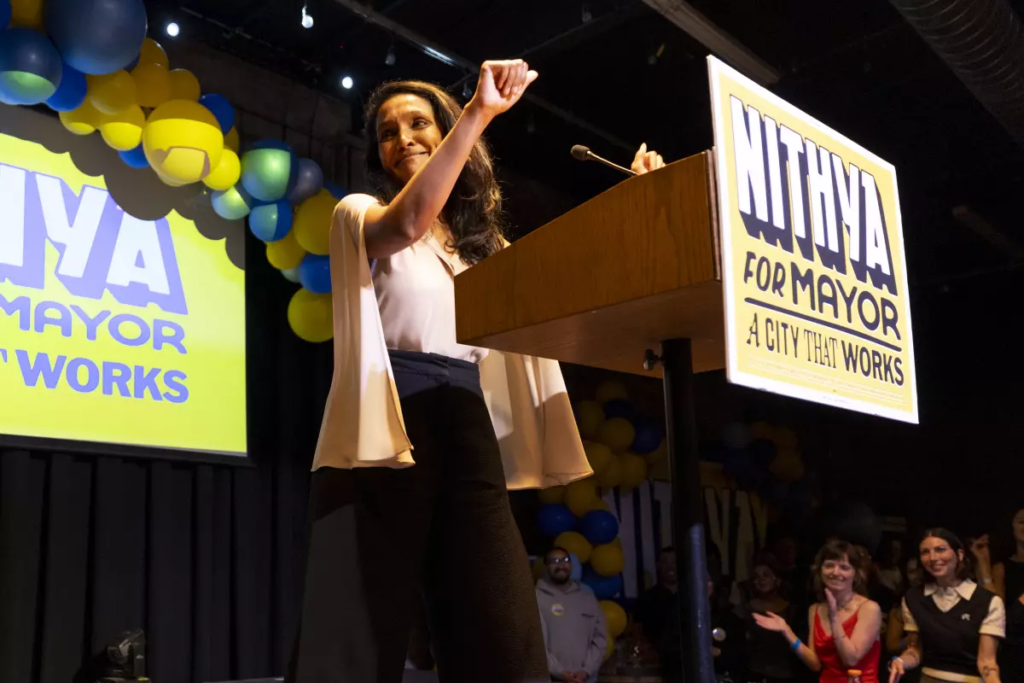
Mayoral candidate Nithya Raman raises her arms to thank her supporters at the end of her election night speech at Boomtown Brewery in Los Angeles. (Gina Ferazzi/Los Angeles Times)
With just 115 days to campaign after a surprise entry, Councilmember Nithya Raman secured a spot in the Nov. 3 mayoral runoff against incumbent Karen Bass.
Raman relied on a ground game that targeted renters and younger voters, while painting Spencer Pratt as too radical for L.A.
Nithya Raman had 115 days to make her case to Los Angeles voters.
The City Council member made a surprise late entry into the mayor’s race, the last of the major candidates to file for the primary. That left little time for her to form a campaign team, build her name recognition and persuade voters that she would be the best choice to lead the city.
On Monday, the Associated Press called the race, concluding that Raman would have enough votes to make a Nov. 3 runoff against Mayor Karen Bass, the first-place finisher who secured her spot in the showdown last week.
Reality television personality Spencer Pratt, who was in second place on election night, saw his lead over Raman steadily erode as mail-in ballots postmarked as late as June 2 were counted.
On Monday, Raman widened her gap over Pratt to nearly 3 percentage points. Bass had 34.3% of the vote, compared with 28.6% for Raman and 25.8% for Pratt, the latest results showed.
Raman, in a statement, said she was “incredibly honored” by the results, and invited Angelenos who are “frustrated by the broken status quo” to join her campaign.
“For too long, City Hall has prioritized giving political advantage to powerful interests that fund elections. Meanwhile, working people pay the price in higher rents, depleted services, and a city that has stopped working for them,” she said.
Raman led Pratt by 21,819 votes, 229,576 to 207,757, election officials reported Monday evening, with an estimated 148,100 votes countywide still outstanding.
Bass strategist Douglas Herman responded to Monday’s results by issuing a broadside against Raman.
“A campaign against Nithya Raman, who allows encampments near schools and cuts the police force, is one Mayor Bass looks forward to winning,” he said in a statement.
Pratt didn’t immediately respond to a request for comment.
A Republican and onetime star of MTV’s “The Hills,” Pratt grabbed much of the national spotlight, appearing on “Fox & Friends” and chatting up podcaster Joe Rogan.
Raman spent her time crisscrossing the city, going to dozens of events and zeroing in on renters and younger voters — groups she viewed as her base. Her team also navigated the city’s complex matching funds program, which quickly secured $1.25 million in taxpayer money to power her campaign.
Raman attended nearly 100 community meet-and-greets, her political team said. Those included numerous sessions with restaurant owners, including one in Echo Park, a “Families for Nithya” event in South L.A. and a comedy show at Upright Citizens Brigade.
Pratt “made a lot of noise and did a lot of television and got a lot of social media amplification, while she was out actually campaigning, meeting with voters, canvassing,” said Mike Bonin, a progressive former City Council member who now runs the Pat Brown Institute for Public Affairs at Cal State L.A. “That matters.”
In the end, Raman accomplished two crucial goals: Make herself better known to Angelenos outside her Hollywood Hills-centered district, while framing Pratt as someone whose views were radically out of step with L.A. voters.
While Bass largely floated above the fray, Raman worked to amplify Pratt’s political views, linking them to President Trump and the far right. During a freewheeling debate on NBC4 Los Angeles, she said Pratt — who had been portraying the city as a dystopian hellscape — was offering a “MAGA Republican’s idea of what Los Angeles looks like.”
Raman’s team went much further on social media. In one video, the campaign excerpted Pratt’s interview with an ABC7 Los Angeles reporter, distorting his voice as he claimed that the city’s homeless residents are all drug addicts. That video cut back and forth between images of Pratt and footage of Trump.
In another video, Raman urged voters directly to keep Pratt from making the runoff. Using clips from his appearances on “The Alex Jones Show” — one where he questioned global warming, another where he discussed claims that 9/11 was an inside job — Raman portrayed Pratt as a far-right extremist.
“These are the politics that Spencer Pratt wants to bring to Los Angeles — hatred, fear, conspiracy theorizing, stupidity — the same thing that we’ve seen from the Trump administration,” Raman said. “If his campaign is allowed to continue for even a few more months … it’s going to make this city a lot more hateful and a lot more stupid.”
Pratt repeatedly sought to downplay his party registration, pointing out that the election is nonpartisan. He insisted that his campaign was aimed at Angelenos angry about how the city was being managed, as evidenced by disrepair of city streets and unchecked homeless encampments.
Still, Pratt limited his own appeal by going on Trump-friendly news outlets and doing “Trump performative stuff,” said Mike Murphy, a Los Angeles-based political strategist. Although that type of behavior grabbed attention on social media, it did not resonate with a significant percentage of L.A. voters, he said.
“There was a lot of hype, because he was different, loud and provocative,” said Murphy, a conservative who has advised former Gov. Arnold Schwarzenegger and many other Republicans. “But a lot of the hype was on the internet, not in the city of Los Angeles voter rolls.”
If Raman was assailing Pratt on the right, she was also fending off an insurgent campaign from the left run by another member of the Democratic Socialists of America, the Rev. Rae Huang.
Huang pitched herself as the true progressive in the race, saying Raman had drifted too close to the middle during her time on council.
Raman’s campaign attempted to get Huang to drop out just weeks before the election, saying such a move was needed to defeat Pratt. Huang declined and went public about those efforts.
Although the push to get Huang out of the race failed, the leftist’s campaign ended up falling flat, securing less than 3% of the vote in the primary.
Leslie Chang, a Raman supporter and co-chair of DSA’s L.A. chapter, said Raman had a sophisticated field operation to reach voters directly, while also relying on influencers and actors on social media to boost her name recognition.
Chang also said DSA’s voter guide, which recommended Raman, played a part in winning over progressive voters who may have considered Huang.
The voter guide recommended Raman, while not formally endorsing her, and questioned Huang’s experience in politics, saying it raised “significant questions on on how she plans to accomplish the specifics of such an ambitious agenda.”
One of the major differences between Huang and Raman’s campaigns was the amount of cash each had on hand to reach out to voters.
Huang’s campaign tried and ultimately failed to receive matching funds from the city, whereas Raman’s campaign unlocked the maximum allowed, $1.25 million.
Raman’s campaign also received contributions from writers and comedians who have made up the council member’s donation base in her previous elections. Her husband, Vali Chandrasekaran, is a prominent television writer.
Raman’s campaign expenditures included $300,000 to Middle Seat, a Washington, D.C.-based consulting business that also worked on the independent expenditure group supporting Zohran Mamdani’s mayoral campaign in New York City.
The company helped the Raman campaign with digital advertising.
While Pratt ran as an outsider, critiquing Bass over her handling of the 2025 Palisades fire and the homelessness crisis, Raman pursued a different lane, saying Angelenos want a well-run city — one where potholes and streetlights are repaired in a timely manner. She also argued that City Hall makes decisions on favors and political expedience, not what’s best for the public.
Her campaign’s slogan reflected that.
During an early conversation with staffers and volunteers, conducted in a back house behind Raman’s Silver Lake home, she said: “We’re trying to build a city that works.”
“Those of us in the room at the time said, ‘That’s it. That’s the slogan for the campaign,’” said Adam Conover, a comedian who volunteered for Raman.
Days later, the campaign was printing the slogan on lawn signs and using it on social media.
Noah Goldberg covers Los Angeles City Hall for the Los Angeles Times. He previously worked on its breaking news team and has also written an array of offbeat enterprise stories. Before joining The Times in 2022, Goldberg worked in New York City as the Brooklyn courts reporter for the New York Daily News and as the criminal justice reporter for the Brooklyn Eagle. He graduated from Vassar College.
From New York Times bestselling and National Book Award–winning author Evan Osnos comes a timely and provocative collection of essays exploring American oligarchy and the culture of excess, providing a wry, unfiltered look at how the ultra-rich shape—and sometimes warp—our social and political landscape.
The ultra-rich hold more of America’s wealth than they did in the heyday of the Carnegies and Rockefellers. Here, Evan Osnos’s incisive reportage yields an unforgettable portrait of the tactics and obsessions driving this new Gilded Age, in which superyachts, luxury bunkers, elite tax dodges, and a torrent of political donations bespeak staggering disparities of wealth and power.
With deft storytelling and meticulous reporting, this is a book about the indulgences, incentives, and psychological distortions that define our economic age. In each essay, Osnos delves into a world that is rarely visible, from the outrageous to the fabulous to the a private wealth manager who broke with members of an American dynasty and spilled their secrets; the pop stars who perform at lavish parties for thirteen-year-olds; the status anxieties that spill out of marinas in Monaco and Palm Beach like real-world episodes of Succession and The White Lotus; the ethos behind the largest Ponzi scheme in Hollywood history; the confessions of disgraced titans in a “white-collar support group.” A celebrated political reporter, Osnos delves into the unprecedented Washington influence of Silicon Valley and Wall Street, drawing on in-depth interviews with Mark Zuckerberg and other billionaires, about their power and the explosive backlash it stirs.
Originally published in The New Yorker, these essays have been revised and expanded to deliver an unflinching portrait of raw ambition, unimaginable fortune, and the rise of America’s modern oligarchy. Osnos’s essays are a wake-up call—a case against complacency in the face of unchecked excess, as the choices of the ultra-rich ripple through our lives. Entertaining, unsettling, and eye-opening, The Haves and the Have-Yachts couldn’t be more relevant to today’s world.
Evan Osnos joined The New Yorker as a staff writer in 2008. He is a correspondent in Washington, D.C. who writes about politics and foreign affairs. He is the author of “Age of Ambition: Chasing Fortune, Truth, and Faith in the New China” (Farrar, Straus & Giroux, May 2014). Based on eight years of living in Beijing, the book traces the rise of the individual in China, and the clash between aspiration and authoritarianism. He was the China Correspondent at The New Yorker magazine from 2008 to 2013. He is a contributor to This American Life on public radio, and Frontline, the PBS series. Prior to The New Yorker, he worked as the Beijing bureau chief of the Chicago Tribune, where he contributed to a series that won the 2008 Pulitzer Prize for investigative reporting. He has received the Asia Society’s Osborn Elliott Prize for Excellence in Journalism on Asia, the Livingston Award for Young Journalists, and a Mirror Award for profile-writing. Before his appointment in China, he worked in the Middle East, reporting mostly from Iraq.
The Tantura massacre occurred on May 22–23, 1948, when Israeli forces from the Alexandroni Brigade captured the Palestinian coastal village of Tantura. Following the village’s surrender, Israeli troops executed dozens to over 200 unarmed Palestinian men, burying them in mass graves believed to be beneath the current Tel Dor beach parking lot. [1, 2, 3]
The Event
Date: May 22–23, 1948 (during the 1948 Arab-Israeli War).
Location: Tantura, a Palestinian fishing village of roughly 1,500 residents, located about 35 kilometers south of Haifa.
Perpetrators: The 33rd Battalion of the Alexandroni Brigade (part of the Haganah).
Casualties: Estimates range from “dozens” to over 200 fatalities. [1, 2, 3]
Historical Context & Aftermath
The Attack: Tantura was specifically targeted under Plan Dalet, the Haganah’s master plan for military control of Palestine. The village fell to Israeli forces a week after the declaration of the State of Israel. [1, 2, 3]
The Massacre: Survivors reported—and later investigations corroborated—that after combat operations ceased, disarmed Palestinian fighters and young men were systematically separated, tied up, and shot in groups. [1, 2, 3]
Expulsion & Destruction: Surviving women, children, and the elderly were expelled to the nearby village of Furaydis. Tantura was subsequently demolished, and the Israeli kibbutz and beach resort of Nahsholim was later established on its lands. [1, 2, 3]
Modern Controversy and Investigations
Teddy Katz’s Research: In the late 1990s, Israeli graduate student Teddy Katz collected extensive oral testimonies from both Palestinian survivors and Alexandroni Brigade veterans for a master’s thesis. His findings prompted veterans to sue him for libel. Facing immense pressure, Katz signed a retraction, though he later stated he did so under duress and maintained that the testimonies were accurate. [1, 2, 3]
The 2022 Documentary: The massacre gained renewed international and Israeli attention following the 2022 release of the documentary Tantura by Israeli director Alon Schwarz. The film featured archival audio of Alexandroni Brigade veterans confessing to the killings and confirming the presence of mass graves. [1, 2, 3, 4, 5]
Forensic Investigation: In 2023, independent researchers at Forensic Architecture published a visual and spatial investigation that analyzed aerial photography, historical records, and survivor testimonies to reconstruct the events and pinpoint the probable locations of the mass graves. [1, 2, 3]
Chinese Hand Laundry Alliance in front of an ambulance being donated to China, 1939, Museum of Chinese in America (MOCA) Collection. 1939 年,纽约华侨衣馆联合会在他们捐赠给中国的救护车前合影,美国华人博物馆(MOCA)
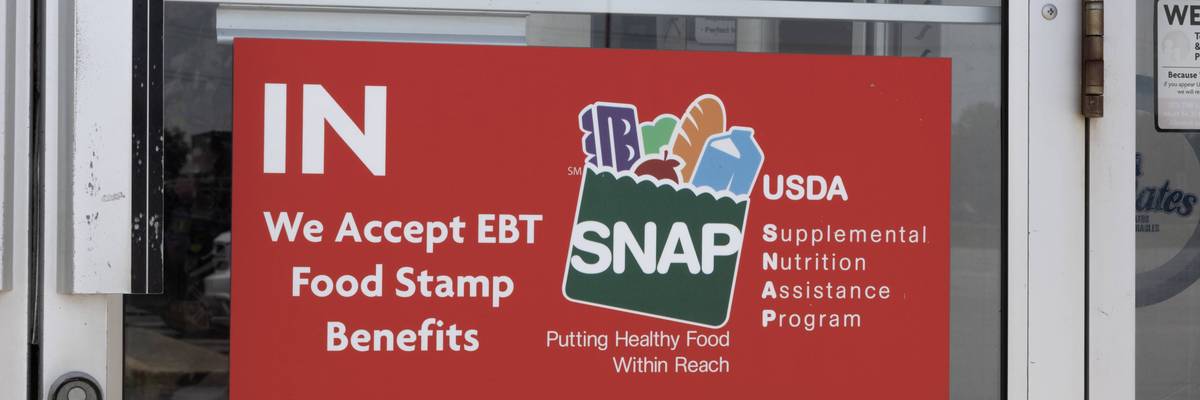
A sign states that a business accepts Supplemental Nutrition Assistance Program benefits in Gas City, Indiana on July 22, 2025.
(Photo by jetcityimage/iStock Editorial/Getty Images)
“This protects every Oregon family who depends on these programs to put food on the table,” said the state’s attorney general, who is among the 21 AGs behind the case.
A federal judge on Friday temporarily blocked an attempt by the US Department of Agriculture to force state governments to comply with President Donald Trump’s positions on gender and immigration or lose out on billions of dollars in funding, including for food assistance.
The attorneys general of the District of Columbia and 20 Democrat-led states sued the department and Secretary of Agriculture Brooke Rollins in March, arguing that “USDA has now thrown unconstitutional and unlawful roadblocks between the programs created by Congress and the states that rely on them, threatening critical nutrition support, vital agricultural research, and the safety of our national food chain and communities.”
Specifically, the Trump administration imposed “a vague set of funding conditions relating to USDA’s purported anti-discrimination ‘policies,’ ‘gender ideology,’ ‘fair athletic opportunities’ for women and girls, and immigration,” without specifying the policies or even confirming “that certification is limited to currently existing policies,” says the complaint, filed in the District of Massachusetts.
The March filing also makes the case that “even if USDA went back and cured its vagueness problem and conducted a reasoned analysis before taking final agency action, the challenged conditions would still be unlawful.”
While US District Judge Myong Joun has not explicitly agreed, the appointee of former President Joe Biden granted a preliminary injunction sought by the AGs and said he would issue a memorandum explaining his decision at a later date.
Welcoming the judge’s unexplained decision on social media, Oregon Attorney General Dan Rayfield highlighted that the move safeguards funding for school lunches, emergency aid, the Supplemental Nutrition Assistance Program (SNAP), and the Special Supplemental Nutrition Program for Women, Infants, and Children (WIC).
“This protects every Oregon family who depends on these programs to put food on the table,” Rayfield said. “The court rejected the Trump administration’s attempt to hold school lunches, WIC, and SNAP hostage to its political agenda. These are lifelines for 86,000 Oregon kids, working families, seniors, and rural communities—and they will remain protected.”
New York Attorney General Letitia James also celebrated that “we won a court order protecting billions of dollars in USDA funding as our lawsuit continues,” and pledged that “my office will keep fighting to protect New Yorkers and stop the federal government from punishing our state for refusing to bend.”
The other states involved in the case are California, Colorado, Connecticut, Delaware, Hawaii, Illinois, Maine, Maryland, Massachusetts, Michigan, Minnesota, New Jersey, New Mexico, Rhode Island, Vermont, Virginia, Washington, and Wisconsin. Collectively, according to the complaint, “’plaintiff states receive over $74 billion annually in funding from USDA.”
The judge’s decision came on the heels of four Democrats in the US House of Representatives voting with Republicans to approve legislation that the Center on Budget and Policy Priorities (CBPP) has estimated would strip modest fruit and vegetable benefits from “nearly 5.4 million toddlers, preschoolers, and pregnant and postpartum WIC participants.”
Already, since congressional Republicans passed and Trump signed the One Big Beautiful Bill Act last year, at least hundreds of thousands of Americans have lost federal food assistance. Last month, Trump’s USDA chief suggested that some of them were receiving SNAP benefits fraudulently—without offering evidence—while others are “moving into the American dream and off of welfare.”
Katie Bergh, a senior policy analyst at CBPP, responded that “unless the Trump administration has redefined ‘the American dream’ to mean ‘losing the help your family needs to afford groceries because of federal cuts,’ I have some bad news for Secretary Rollins.”
Our work is licensed under Creative Commons (CC BY-NC-ND 3.0). Feel free to republish and share widely.
Mary Alice Pilafian wears a hat that reads, ‘Lock Him Up,’ as she joins with other protesters outside of the Trump National Doral golf resort urging congress to impeach President Donald Trump on December 17, 2019 in Doral, Florida.
(Photo by Joe Raedle/Getty Images)
As wild and crazy Trump becomes more of a political disaster for the GOP in November, Republicans will want to save their own political skins over Trump’s.
Several leaders of national progressive citizen groups are counseling delaying such a drive until after the election in anticipation of a Democratic Party victory in both the House and the Senate. This mirrors what the feeble Democratic Party leadership (Hakeem Jeffries and Chuck Schumer) are telling their increasingly restless rank and file in the House and Senate (see the April 11, 2026 article in the New York Times by Annie Karni, “Democrats Warm to Idea of Removing the President”).
Meanwhile, as Trump’s illegal and erratic daily behavior and executive dictates worsen the wrecking of our country, the present majority of Americans favor impeaching Trump and removing him from office is nearing 60 percent.
Consider the pluses for launching an Impeachment drive supported by the people focused on Capitol Hill and a Congress controlled by the Republicans, who are likely to block any vote or formal Committee hearings.
1. It is a great campaign issue – tying together in an authentic way – see Res.1155 – all of Trump’s vicious shredding of the people’s health, safety and economic benefits and constitutional freedoms. Majorities despise openly corrupt Trump, whose support in polls is slumping, but many voters also don’t trust or believe in the wavering Democratic Party, which can’t come up with a credible compact that addresses the needs of the people and a set of political commitments embodied in specific pending bills. A compact with voters should be convincingly advanced and emblazoned across the land.
H.Res.1155’s thirteen Impeachment Articles, introduced by Cong. John Larson (D-CT) and their connection to “kitchen-table necessities” must be highlighted in this year’s political campaigns.
The people want fighters for them who care for them in Washington, D.C., using the citizens’ delegated powers and tax revenues in the interest of the people, the families, and the children. “Impeachment” is our founding fathers’ word for “YOU’RE FIRED,” a phrase used by Tyrant Trump against millions of civil servants, contractors, and other people working to help make a better country.
Regardless of their political labels, just about all families want fair play, justice, protections, and opportunities where they live, work, and raise their children. Articles of Impeachment are constitutional-level MANDATES for a political party and candidates to run on, replacing insincere throw-away lines and bloviating rhetoric so despised by a disgusted populace.
2. Making Impeachment front and center educates and inspires people about how central this Constitution of ours is to their daily lives. The mission of our government is to “promote the general welfare.” Only Congress can spend your money, not the president. Only Congress can take us from peace to war, not the president. Only Congress can define the authority entrenched in the executive branch, not the president or six “Injustices” on the Supreme Court for life. Only Congress can tax or not tax, not the president wielding arbitrary tariffs, charging fees, or riddling the tax code with loopholes and escapes for the super-rich and powerful.
Only “We the People,” not “We the Corporations,” nor “We the Congress,” is in the Preamble to our Constitution, making us the fundamental sovereign power in our country.
3. A grassroots Impeachment movement – already petitions are circulating (see impeachtrumpagain.org) – signals deterrence if Trump, with his rabid, dangerous personality, is thinking of more major disruptions of the November elections. Foreshadowing his invoking the Insurrection Act to take over the gears of the states’ election machinery, the fevered Trump said in January, “…we shouldn’t even have an election” in November. This is subversion of our Republic, and the Constitution for which it stands, beyond the wildest imaginations of our historic overseas enemies.
The most promising reform movements are often sparked and strengthened by the perpetrating outlaws providing continual, incriminating evidence of their own lawlessness. That is the essence of the foul-mouthed, lying, violent, corrupt, delusional, egomaniacal Trump. (See the April 30, 2026 statement from medical professionals in the Congressional Record – “Medical Concerns About President Donald J. Trump and His Fitness For Office.” Remember, with Trump the worst is yet to come as he continues to double down. Even a conservative columnist for the Washington Post, military historian Max Boot, is fearful of what might come abroad from the zigzag actions of an impulsive, fact-deprived Trump with his finger on the nuclear trigger.
All this is to say that what the Democratic Party leadership thinks is prudent to delay until after the election is in reality a very risky position. They are barely in contention to recover the Senate, even with the advantage of having far fewer seats (12) up for election than do the Republicans (20).
The Democrats, who are comfortable taking big bucks from giant corporate PACs, should run WITH and FOR the people. The time for political posturing is over. If their “loser leaders” don’t step aside, they should at least free the rank and file, including the progressive primary winners, to show the way to landslide, by far, the worst GOP in history. That means, for starters, let a willing Rep. Jamie Raskin, ranking member of the House Judiciary Committee, have “shadow hearings” on Trump’s many ongoing impeachable offenses. Such a hearing would draw prominent witnesses and great media attention to further galvanize the people.
Since all Democrats on Capitol Hill, if asked, would say “Yes,” Trump should be impeached, but the Party’s upper echelons say taking it to a vote can’t go anywhere so long as the GOP runs Congress. The push for Impeachment doesn’t have to reach a vote. As wild and crazy Trump becomes more of a political disaster for the GOP in November, Republicans will want to save their own political skins over Trump’s.
That’s what happened with defiant Nixon in 1974, after the one-time Watergate scandal, when the GOP jumped ship and forced his resignation. Trump’s crimes are far worse than Nixon’s and intensifying every day. As in 1974, it is before the elections when the GOP feels more insecure. Today Republican members of Congress know their majority is at risk.
In raw politics, sometimes it doesn’t take a vote. It just takes pressure from a President’s Congressional base and, for Tiring Trump, the public humiliation that comes with abandonment.
In addition to all its collateral benefits, an impeachment drive is a road to Trump’s resignation.
Ralph Nader is a consumer advocate and the author of “The Seventeen Solutions: Bold Ideas for Our American Future” (2012). His new book is, “Wrecking America: How Trump’s Lies and Lawbreaking Betray All” (2020, co-authored with Mark Green).