Associated Press Streamed live 3 hours ago Watch live as New York City Mayor-elect Zohran Mamdani participates in a private swearing-in ceremony at the Old City Hall subway station.
The power went out in the Sunset on Christmas Eve, and then for a fifth time Dec. 27. Neither was as bad as the earlier blackout, but it showed again: PG&E is unable to provide reliable service to the city.
Sup. Alan Wong, who represents the neighborhood, issued a statement that reads:
These repeated outages raise important questions about how our power grid is managed and whether the current system is meeting the needs of San Francisco residents and small businesses. Electricity is a public necessity, and reliability, transparency, and accountability must remain core expectations. In light of this latest outage, I will be asking City departments to evaluate what options may exist to strengthen oversight, reliability, and the long-term resilience of our electric system, including an assessment of practical, fiscal, and operational considerations to better maintain a power grid in the public interest.
That’s a lot of words that fall short of saying: We need to kick PG&E out of City Hall. I followed up, asking if he supports public power, and he told me:
I can bring up the historical context and ask for the fiscal and operational implications to figure out the practicalities of such a move.
Wong is still learning the job (and the role of PG&E in local politics) but like the rest of the newer supes, he’s going to have to get up to speed quickly. Public power is going to be on the agenda in 2026.
Sup. Alan Wong in unhappy with PG&E’S failures in his district.
Natalie Gee, who is running against Wong in D4, told me she supports a municipal takeover of the grid. So does Albert Chow, who is also a candidate in the district, according to his campaign staff.
Sup. Bilal Mahmood, who is also calling for a hearing on the issue, supports a public power system, his office told me. So does fellow “moderate” Matt Dorsey. All of the progressives on the board are going to back the idea. If Wong comes along (and maybe even if he doesn’t) there’s clearly a majority in favor.
While nobody has yet called for a hearing on the next steps to municipalization, when the supes go back into session after the holidays, it’s almost certain to come up—and PG&E will be trying to find a way to delay and pretend that this reliability crisis was just an isolated problem, nothing serious, nothing more to worry about.
I am already hearing PG&E’s talking points on social media: San Francisco can’t even run the buses on time. The city is mismanaged. City worker pensions are too expensive already. How can we run a major public utility?
But there’s another important point here: Many of the public services that San Francisco offers are, by definition, money losers. Muni fares will never cover the cost of operating the system. San Francisco General Hospital will never charge high enough fees to pay its expenses. That’s the point of a “public service.” When local tax money and state and federal support decline, those operations have problems providing their services at the level people want.
Public power systems are different: They make money. So, for the most part, do airports; SFO is widely considered a well-managed operation the functions very well—and the landing fees the airlines pay cover all its costs, and more.
Selling retail electricity in a compact area like San Francisco is very lucrative. That’s why PG&E fights so hard to keep its illegal monopoly. Public power systems in California, and the US, are typically well run, have better reliability than PG&E, and have far lower rates.
Just a few minutes of online research (yeah, ChatGPT is good for a few things) shows:
Silicon Valley Power (Santa Clara), Sacramento Municipal Utility District, and the LA Deparetment of Water and Power offer significantly lower electricity rates than PG&E across residential, commercial, and industrial classes, with SVP and SMUD averaging 36-58% lower than PG&E depending on customer type.
Since 2010, SMUD has also been the highest-scoring utility in California for business customer satisfaction.
The idea that San Francisco can’t run a public power utility is nonsense. In fact, the last time I ran the numbers, which was more than a decade ago, I concluded the city could buy the system for $2.5 billion, pay the interest on the revenue bonds, pay all the salaries and (yes) pensions of all the PG&E workers who would become city workers, cut rates by 20 percent—and clear about $500 million in “profit” a year. Since rates have gone up so much, the profit level is almost certainly higher now.
That money could go, as it does in Sacramento, to lower rates, more reliability by rebuilding aging infrastructure, renewable power projects—and potentially to the General Fund to address the deficit. Public power could fund Muni, and SF General.
(Santa Clara made so much money from its public power system that it used some surplus to help fund the 49ers stadium and entice the team to leave SF. Not a good use of revenue, from my perspective, but you get the point. When the team was planning to leave because SF couldn’t afford and didn’t want to use public money for a new stadium, then-Mayor Gavin Newsom told a department head’s meeting that Santa Clara, thanks to its public power system, had too much available cash to match. Then-Sheriff Mike Hennessey told me he asked Newsom: “Are you saying if we had a public power system, we could keep the 49ers?” The mayor never answered.)
Public power systems are far, far more willing to fund distributed power systems like rooftop solar—because they don’t have to make a profit for shareholders. They run by elected boards or officials, who have to be accountable to the public.
SMUD made a big mistake in the 1970s, and built a nuclear power plant. It was an environmental and financial disaster. So a slate of progressives (backed by the late Tom Hayden) organized, won election to the SMUD board, put the issue to a vote, and shut the dangerous plant down. Now SMUD has one of the most robust renewable energy programs in the nation.
PG&E built a dangerous, expensive nuclear power plant at Diablo Canyon around the same time. It’s driven up our rates, and sits on an active earthquake fault. It’s still operating.
There’s never been a better time to bring the city into compliance with the Raker Act and create a reliable public power system. The major delay at this point is Gov. Gavin Newsom’s Public Utilities Commission.
San Francisco can’t run a public power system without taking over PG&E’s distribution network—the lines, the poles, the meters, the substations. The process for that is well established in law: The city uses eminent domain to take over that property, and pays PG&E fair market value.
The city has filed documents with the CPUC stating that the system is worth between $2.3 billion and $2.8 billion. The idea is that the agency will come up with a final number, and the city can use it in court during the eminent domain filing.
That’s so little money when you consider the revenue.
PG&E’s revenue and expense data is public. The company has about 472,000 residential and commercial customers in SF, and earns about $2,400 a year per customer. That’s $1.1 billion revenue in San Francisco.
After costs, PG&E’s statewide, systemwide profit is about $5 billion a year. San Francisco has about ten percent of PG&E’s customers.
As a dense city, the costs of providing service are the lowest in the system. So at the very worse, San Francisco would be clearing at least $500 million in profit from a public power system; at the very worst, based on today’s rates, the interest on a $3 billion revenue bond (more than the city says the system is worth) would be less than $200 million.
These revenue and cost numbers are way conservative and just based on simple data; San Francisco already has a hydropower dam that costs very little to operate. (I did an in-depth study about 15 years ago that showed far higher profits, but the Bay Guardian website lost much of its content when the paper was shut down so I can’t link to it.)
But the bottom line is: The cost of the system ($2.5 billion? $3 billion?) almost doesn’t matter. The bond payments are so much less than the profit (not revenue; profit, AFTER paying for all the workers and their pensions, and the trucks, and the maintenance) that the city doesn’t need to fight too hard over the details.
The CPUC, frankly, is dragging its feet. The agency keeps asking the city for more data that it doesn’t need. I don’t think Gov. Gavin Newsom wants this to happen on his watch.
It’s not just PG&E campaign money or lobbying: Taking the most profitable territory out of PG&E’s system will have impacts all over the state. The company will argue that it now has to raise rates in Oakland, and Sonoma County, and other places.
That could lead to ratepayer rebellions all over—and since San Francisco showed the solution, other cities and counties might also move to create public power systems. PG&E in ten years could cease to exist as we know it.
That’s not so scary: Northern California has a robust public power infrastructure. SMUD could expand to take many more customers in the northern areas. The East Bay Municipal Utility District could move beyond water and sewers and became a public power agency. The state already has a system ready to go.
Newsom, though, doesn’t like anything that could make his campaign for president harder, and he doesn’t want to offend every private investor-owned utility in the country. (He promised single-payer health care when he was running the first time, but that was empty; he never wanted to cut off access to money from the private insurance industry.)
48 Hills welcomes comments in the form of letters to the editor, which you can submit here. We also invite you to join the conversation on our Facebook, Twitter, and Instagram.
Tim Redmond has been a political and investigative reporter in San Francisco for more than 30 years. He spent much of that time as executive editor of the Bay Guardian. He is the founder of 48hills.
US Air Force personnel prepare an MQ-9 Reaper drone for a mission on the tarmac at Rafael Hernandez Airport in Aguadilla, Puerto Rico on December 27, 2025.
(Photo by Miguel J. Rodriguez Carrillo/AFP via Getty Images)
One expert called the reported drone strike a “violation of Article 2(4) of the UN Charter and the Take Care Clause of the Constitution.”
The US Central Intelligence Agency reportedly carried out a drone strike earlier this month on a port facility inside Venezuela, marking the first time the Trump administration launched an attack within the South American country amid a broader military campaign that observers fear could lead to war.
CNN on Monday was first to report the details of the CIA drone strike, days after President Donald Trumpsuggested in a radio interview that the US recently took out a “big facility” in Venezuela, prompting confusion and alarm. Trump authorized covert CIA action against Venezuela in October.
According to CNN, which cited unnamed sources, the drone strike “targeted a remote dock on the Venezuelan coast that the US government believed was being used by the Venezuelan gang Tren de Aragua to store drugs and move them onto boats for onward shipping.”
To date, the Trump administration has not provided any evidence to support its claim that boats it has illegally bombed in international waters were involved in drug trafficking. No casualties were reported from the drone strike, and the Venezuelan government has not publicly commented on the attack.
“This is an act of war and illegal under both US and international law, let’s just be clear about that,” journalist Mehdi Hasan wrote in response to news of the drone strike.
Our people-powered journalism cannot survive without you
Your support allows Common Dreams to continue covering the stories and amplifying the voices that the corporate media never will. Make a tax-deductible year-end gift to ensure we can sustain the reporting needed to meet the challenges of 2026.
“Seemingly conducted as covert action and then casually disclosed by POTUS while calling into a radio show,” he added.
CNN‘s reporting, later corroborated by the New York Times, came after the Trump administration launched its 30th strike on a vessel in international waters, bringing the death toll from the lawless military campaign to at least 107.
The Timesreported late Monday that “it is not clear” if the drone used in last week’s mission “was owned by the CIA or borrowed from the US military.”
“The Pentagon has stationed several MQ-9 Reaper drones, which carry Hellfire missiles, at bases in Puerto Rico as part of the pressure campaign,” the Times added.
Our work is licensed under Creative Commons (CC BY-NC-ND 3.0). Feel free to republish and share widely.
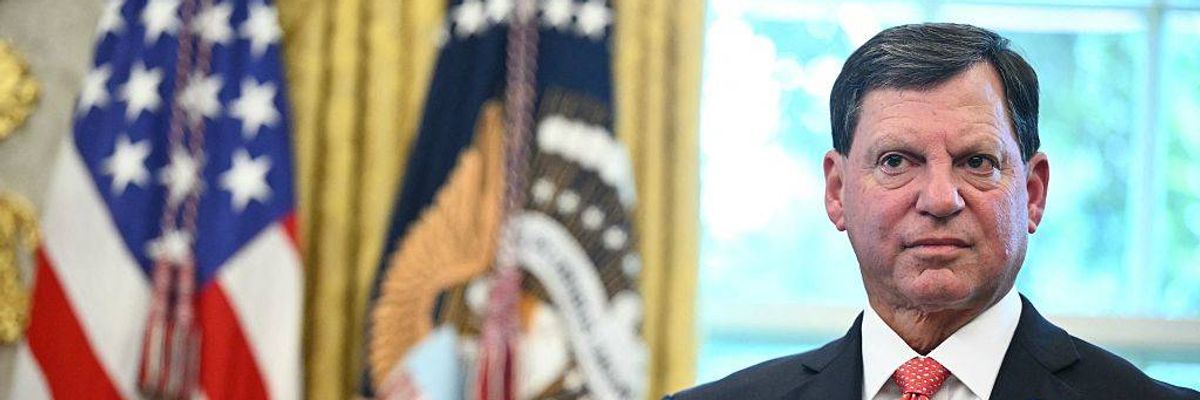
Commissioner of the Social Security Administration Frank Bisignano looks on as US President Donald Trump speaks in the White House in Washington, DC on August 14, 2025.
(Photo by Mandel Ngan/AFP via Getty Images)
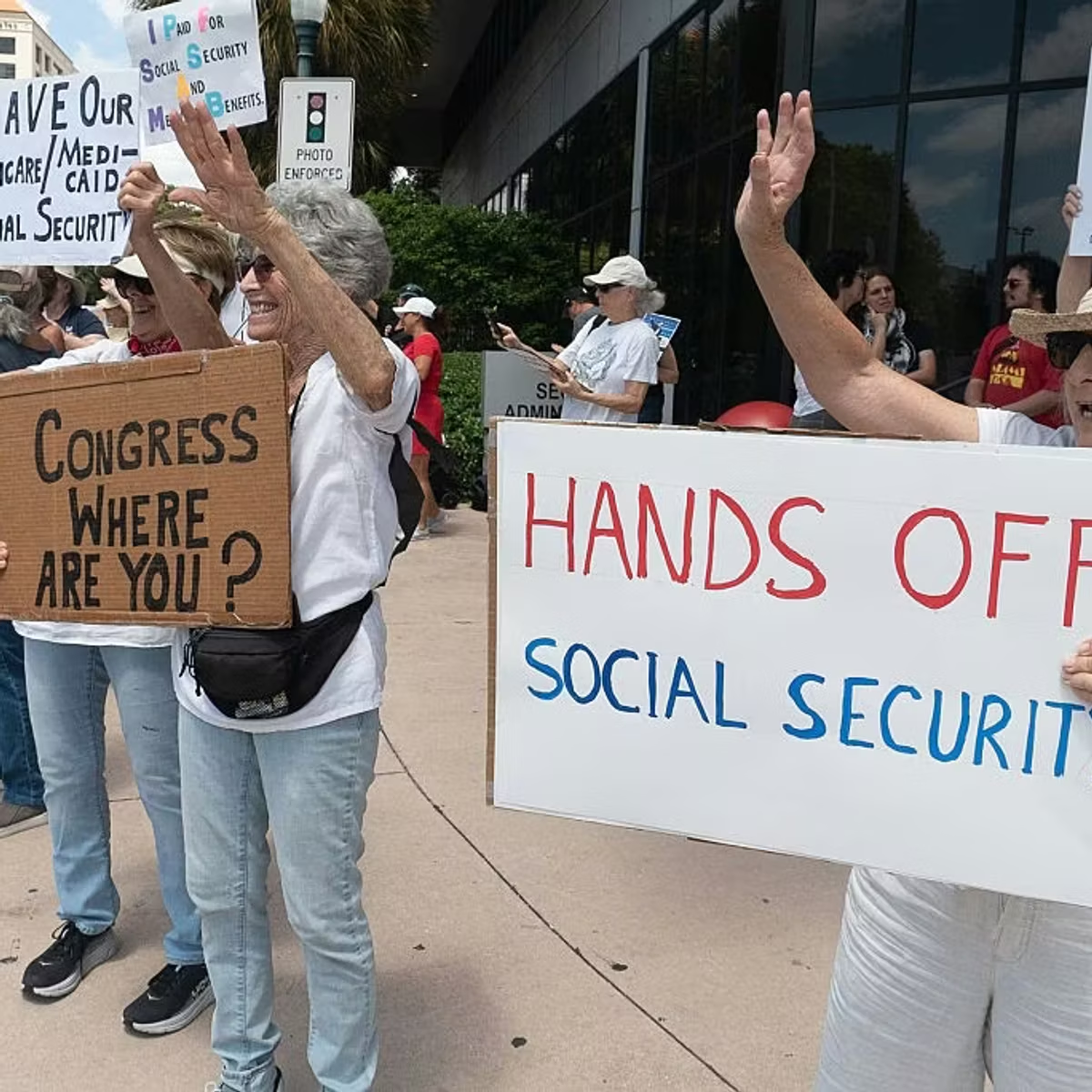
In-depth reporting from the Washington Post found the Social Security Administration is dealing with “record backlogs that have delayed basic services to millions of customers.”
An in-depth report published by the Washington Post on Tuesday offers new details about the damage being done to the Social Security Administration during President Donald Trump’s second term.
The Post, citing both internal documents and interviews with insiders, reported that the Social Security Administration (SSA) is “in turmoil” one year into Trump’s second term, resulting in a customer service system that has “deteriorated.”
The chaos at the SSA started in February when the Trump administrationannounced plans to lay off 7,000 SSA employees, or roughly 12% of the total workforce.
This set off a cascade of events that the Post writes has left the agency with “record backlogs that have delayed basic services to millions of customers,” as the remaining SSA workforce has “struggled to respond to up to 6 million pending cases in its processing centers and 12 million transactions in its field offices.”
The most immediate consequence of the staffing cuts was that call wait times for Social Security beneficiaries surged to an average of roughly two-and-a-half hours, which forced the agency to pull workers employed in other divisions in the department off their jobs.
Our people-powered journalism cannot survive without you
Your support allows Common Dreams to continue covering the stories and amplifying the voices that the corporate media never will. Make a tax-deductible year-end gift to ensure we can sustain the reporting needed to meet the challenges of 2026.
about:blank
However, the Post‘s sources said these employees “were thrown in with minimal training… and found themselves unable to answer much beyond basic questions.”
One longtime SSA employee told the Post that management at the agency “offered minimal training and basically threw [transferred employees] in to sink or swim.”
Although the administration has succeeded in getting call hold times down from their peaks, shuffling so many employees out of their original positions has damaged the SSA in other areas, the Post revealed.
Jordan Harwell, a Montana field office employee who is president of American Federation of Government Employees (AFGE) Local 4012, said that workers in his office no longer have the same time they used to have to process pay stubs, disability claims, and appointment requests because they are constantly manning the phones.
An anonymous employee in an Indiana field office told the Post that she has similarly had to let other work pile up as the administration has emphasized answering phones over everything else.
Among other things, reported the Post, she now has less time to handle “calls from people asking about decisions in their cases, claims filed online, and anyone who tries to submit forms to Social Security—like proof of marriage—through snail mail.”
Also hampering the SSA’s work have been new regulations put in place by Tesla CEO Elon Musk’s Department of Government Efficiency that bar beneficiaries from making changes to their direct deposit information over the phone, instead requiring them to either appear in person at a field office or go online.
The Indiana SSA worker told the Post of a recent case involving a 75-year-old man who recently suffered a major stroke that left him unable to drive to the local field office to verify information needed to change his banking information. The man also said he did not have access to a computer to help him change the information online.
“I had to sit there on the phone and tell this guy, ‘You have to find someone to come in… or, do you have a relative with a computer who can help you or something like that?’” the employee said. “He was just like, ‘No, no, no.’”
Social Security was a regular target for Musk during his tenure working for the Trump administration, and he repeatedly made baseless claims that the entire program was riddled with fraud, even referring to it as “the biggest Ponzi scheme of all time.”
Our work is licensed under Creative Commons (CC BY-NC-ND 3.0). Feel free to republish and share widely.
People attend the funeral of Dr. Hussein Najjar, a member of the Doctors Without Borders team who was killed by shrapnel from an Israeli airstrike, in Deir al Balah, Gaza on September 16, 2025
(Photo by Alaa Y. M. Abumohsen/Anadolu via Getty Images)
“The humanitarian response in Gaza is already highly restricted, and cannot afford further dismantlement,” the renowned organization warned.
The Israeli government said Tuesday that Doctors Without Borders, one of the largest medical organizations currently operating in Gaza, is among the 25 humanitarian groups that will be suspended at the start of the new year for their alleged failure to comply with Israel’s widely criticized new registration rules for international NGOs.
According to the Associated Press, Israel’s Ministry of Diaspora Affairs “said the organizations that will be banned on January 1 did not meet new requirements for sharing staff, funding, and operations information.” The Israeli government specifically accused Doctors Without Borders, known internationally as Médecins Sans Frontières (MSF), of “failing to clarify the roles of some staff that Israel accused of cooperation with Hamas and other militant groups,” AP reported.
In addition to providing medical assistance to desperate Palestinians, MSF has been an outspoken critic of what has it described as Israel’s “campaign of total destruction” in Gaza. The group said in a report released last December that its teams’ experiences on the ground in Gaza were “consistent with the descriptions provided by an increasing number of legal experts and organizations concluding that genocide is taking place.”
Ahead of Tuesday’s announcement, Doctors Without Borders warned that the looming withdrawal of registration from international NGOs “would prevent organizations, including MSF, from providing essential services to people in Gaza and the West Bank.”
“With Gaza’s health systemalready destroyed, the loss of independent and experienced humanitarian organizations’ access to respond would be a disaster for Palestinians,” the group said in a statement last week. “The humanitarian response in Gaza is already highly restricted, and cannot afford further dismantlement.”
Our people-powered journalism cannot survive without you
Your support allows Common Dreams to continue covering the stories and amplifying the voices that the corporate media never will. Make a tax-deductible year-end gift to ensure we can sustain the reporting needed to meet the challenges of 2026.
about:blank
“If Israeli authorities revoke MSF’s access to Gaza in 2026, a large portion of people in Gaza will lose access to critical medical care, water, and lifesaving support,” the group added. “MSF’s activities serve nearly half a million people in Gaza through our vital support to the destroyed health system. MSF continues to seek constructive engagement with Israeli authorities to continue its activities.”
Pascale Coissard, MSF’s emergency coordinator for Gaza, noted that “in the last year, MSF teams have treated hundreds of thousands of patients and delivered hundreds of millions of liters of water.”
“MSF teams are trying to expand activities and support Gaza’s shattered health system,” said Coissard. “In 2025 alone, we carried out almost 800,000 outpatient consultations and handled more than 100,000 trauma cases.”
Israel’s announcement came shortly after Prime Minister Benjamin Netanyahu met with US President Donald Trump in Florida, where both dodged questions about their supposed “peace plan” for Gaza after more than two years of relentless bombing. The Israeli military has been accused of violating an existing ceasefire agreement hundreds of times since it took effect in October.
Al Jazeerareported Tuesday that “Israeli forces have carried out strikes across the Gaza Strip as they continue with their near-daily violations of the ceasefire agreement, with Israel’s genocidal war on the besieged enclave continuing apace and displaced Palestinians enduring the destruction of their few remaining possessions in flooding brought about by heavy winter rains.”
Our work is licensed under Creative Commons (CC BY-NC-ND 3.0). Feel free to republish and share widely.
President Donald Trump and his administration have been openly plotting to scrap the nation’s top consumer protection watchdog, but a federal judge has at least temporarily put those plans on hold.
US District Judge Amy Berman Jackson ruled on Tuesday that the US Federal Reserve must continue providing funds to the Consumer Financial Protection Bureau (CFPB), rejecting the Trump administration’s claims that the nation’s central bank currently lacks the “combined earnings” to fund the bureau’s operations.
The administration had argued that the Federal Reserve should not be making payments to the CFPB because it has been operating at a loss since 2022, when it began a series of aggressive interest rate hikes aimed at taming inflation.
However, Jackson rejected this reasoning and accused the administration of using it as a cover to defund an agency that the president and top officials such as Russell Vought, director of the Office of Management and Budget, had long expressed a desire to abolish.
“It appears that defendants’ new understanding of ‘combined earnings’ is an unsupported and transparent attempt to starve the CPFB of funding,” the judge wrote.
Our people-powered journalism cannot survive without you
Your support allows Common Dreams to continue covering the stories and amplifying the voices that the corporate media never will. Make a tax-deductible year-end gift to ensure we can sustain the reporting needed to meet the challenges of 2026.
about:blank
The CFPB must now be funded at least until the DC Circuit of Appeals weighs in on an ongoing lawsuit brought by the National Treasury Employees Union (NTEU) against Vought over layoffs at the agency that is scheduled for hearings in February.
The NTEU took a victory lap in the wake of the ruling and taunted Vought for his defeat.
“Yet another loss for Rusty Vought,” the union posted on Bluesky. “Wonder how much longer Donald is going to put up with this?”
While it will continue to receive funding for the time being, the CFPB has still seen its ability to fulfill its mission severely diminished during Trump’s second term.
A Tuesday report from Reuters claimed that the CFPB is “on the brink of collapse” given that the Trump administration, congressional Republicans, and industry lawsuits have “undone a decade’s worth of CFPB rules on matters ranging from medical debt and student loans to credit card late fees, overdraft charges and mortgage lending.”
The report also noted that, during Trump’s second term, the CFPB has “dropped or paused its probes and enforcement actions, and stopped supervising the consumer finance industries, leading to a string of resignations” at the agency.
Sen. Elizabeth Warren (D-Mass.), who first drew up plans to create the CFPB in the wake of the 2008 global financial crisis, explained the agency’s importance in an interview with Reuters.
“I was stunned by the number of people in financial trouble who had lost a job or got sick but who had also been cheated by one or more of their creditors,” she said. “For no agency was consumer protection a first priority, it was somewhere between fifth and 10th, which meant there was just no cop on the beat. If the CFPB is not there, people have nowhere to turn when they get cheated.”
Our work is licensed under Creative Commons (CC BY-NC-ND 3.0). Feel free to republish and share widely.
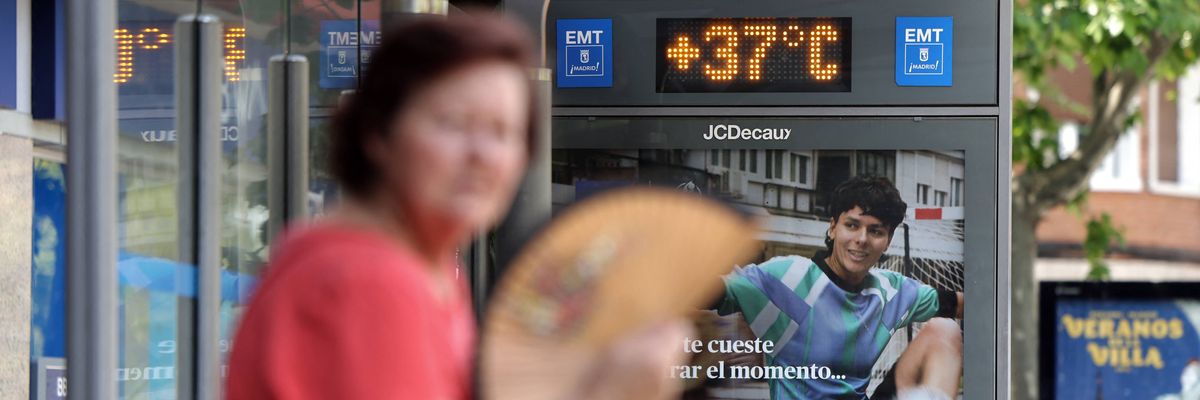
Climate change driven by human burning of fossil fuels helped make 2025 one of the hottest years ever recorded, a scientific report published Monday affirmed, prompting renewed calls for urgent action to combat the worsening planetary emergency.
Researchers at World Weather Attribution (WWA) found that “although 2025 was slightly cooler than 2024 globally, it was still far hotter than almost any other year on record,” with only two other recent years recording a higher average worldwide temperature.
For the first time, the three-year running average will end the year above the 1.5°C warming goal, relative to preindustrial levels, established a decade ago under the landmark Paris climate agreement.
“Global temperatures remained very high and significant harm from human-induced climate change is very real,” the report continues. “It is not a future threat, but a present-day reality.”
“Across the 22 extreme events we analyzed in depth, heatwaves, floods, storms, droughts, and wildfires claimed lives, destroyed communities, and wiped out crops,” the researchers wrote. “Together, these events paint a stark picture of the escalating risks we face in a warming world.”
Our people-powered journalism cannot survive without you
Your support allows Common Dreams to continue covering the stories and amplifying the voices that the corporate media never will. Make a tax-deductible year-end gift to ensure we can sustain the reporting needed to meet the challenges of 2026.
about:blank
The WWA researchers’ findings tracked with the findings of United Nations experts and others that 2025 would be the third-hottest year on record.
This year highlighted again, in stark terms, how unfairly the consequences of human-induced climate change are distributed, consistently hitting those who are already marginalized within their societies the hardest. But the inequity goes deeper: The scientific evidence base itself is uneven. Many of our studies in 2025 focused on heavy rainfall events in the Global South, and time and again we found that gaps in observational data and the reliance on climate models developed primarily for the Global North prevented us from drawing confident conclusions. This unequal foundation in climate science mirrors the broader injustices of the climate crisis.
The events of 2025 make it clear that while we urgently need to transition away from fossil fuels, we also must invest in adaptation measures. Many deaths and other impacts could be prevented with timely action. But events like Hurricane Melissa highlight the limits of preparedness and adaptation: When an intense storm strikes small islands such as Jamaica and other Caribbean nations, even relatively high levels of preparedness cannot prevent extreme losses and damage. This underscores that adaptation alone is not enough; rapid emission reductions remain essential to avoid the worst impacts of climate change.
“If we don’t stop burning fossil fuels very, very, quickly, very soon, it will be very hard to keep that goal” of 1.5°C, WWA co-founder Friederike Otto—who is also an Imperial College London climate scientist—told the Associated Press. “The science is increasingly clear.”
The WWA study’s publication comes a month after this year’s United Nations Climate Change Conference—or COP30—ended in Brazil with little meaningful progress toward a transition from fossil fuels.
Responding to the new study, Climate Action Campaign director Margie Alt said in a statement that “2025 was full of stark reminders of the urgent need to cut climate pollution, invest in clean energy, and tackle the climate crisis now.”
“Today’s report is a wake-up call,” Alt continued. “Unfortunately, [US President Donald] Trump and Republicans controlling Congress spent the past year making climate denial official US policy and undermining progress to stave off the worst of the climate crisis. Their reckless polluters-first agenda rolled back critical climate protections and attacked and undermined the very agencies responsible for helping Americans prepare for and recover from increasingly dangerous disasters.”
“Across the country, people are standing up and demanding their leaders do better to protect our families from climate change and extreme weather,” Alt added. “It’s time those in power started listening.”
Our work is licensed under Creative Commons (CC BY-NC-ND 3.0). Feel free to republish and share widely.
Democratic Socialists of America – San Francisco Chapter seeks to create a system based on justice and equality for all people. We believe everyone deserves to live their own life with dignity. We work to equalize political and economic power, because true democracy cannot coexist with inequality. We urgently fight to stop the many crises facing our most powerless members of society.
We are not a political party. We are a coalition of people, united to create a more powerful front against the worst that capitalism has to offer.
When you volunteer for Saikat, it’s on us to give you a great experience and a genuine chance to make a difference. We don’t want to waste a second of your time. That’s why we’re always optimizing. And I’m excited to report that this Saturday we talked with 300% more... Continue reading →
This Sunday’s Town Hall: Announcing This Week’s Progressive Town Hall: Every Sunday at 4pm ET/1pm PT RSVP HERE Join PDA activists online from across the country to discuss the importance of progressives reclaiming the American story from the MAGA right, an issue of heightened importance as we’re now within one... Continue reading →
We protest Heritage Foundation EVERY MONDAY (Join us!!!!) By admin | September 2, 2025 | Uncategorized Cliff Cash Comedy Premiered Jul 26, 2025 Every Monday at The Heritage Foundation 214 Massachusetts Ave. Washington D.C. 4pm protest 6pm pizza Every Friday at Fox News D.C. 400 N. Capitol St. Washington D.C. 4pm protest 6pm pizza We are... Continue reading →
January Membership Meeting Join Alice for our first membership meeting of the year! Come vote to confirm and meet the incoming 2026 board (new roster listed at the end of this email). ️Monday, January 12, 2026 6:00–7:00 PM | Doors 5:30 PM 518 Valencia Street (at 16th)This meeting qualifies as a voting event for... Continue reading →
One Million Rising: Strategic Non-Cooperation to Fight Authoritarianism Virtual Event · Hosted by No Kings Time Wednesdays 8 – 9:30pm EDT Location Virtual event Join from anywhere About this event Across the country, authoritarian forces are getting bolder and more dangerous. Trump and his allies are not hiding their agenda: mass deportations,... Continue reading →
THURSDAY, JUNE 29, 2023 AT 2 AM – 4 AM PDT How to create trust in a group? Details Event by Extinction Rebellion Empathy Circles online EMPATHY CAFE Duration: 2 hr Public · Anyone on or off Facebook How to create trust in a group? This is the question that arose in our... Continue reading →
When you volunteer for Saikat, it’s on us to give you a great experience and a genuine chance to make a difference. We don’t want to waste a second of your time. That’s why we’re always optimizing. And I’m excited to report that this Saturday we talked with 300% more... Continue reading →
This Sunday’s Town Hall: Announcing This Week’s Progressive Town Hall: Every Sunday at 4pm ET/1pm PT RSVP HERE Join PDA activists online from across the country to discuss the importance of progressives reclaiming the American story from the MAGA right, an issue of heightened importance as we’re now within one... Continue reading →
https://us06web.zoom.us/j/83499963761?pwd=x6vbYvt5bywKggEjac4QV2vf71MGKc.1 A new world order? More like a New World chaos. Kidnaps and cannons. Dionne quintuplets. Canadian cruelty. Rest in pentapeace. (1) Return to the moon? Well, around it, anyway. No cheese eating yet. Measles, flu, the blues. Weight loss pills and vaccine thrills. Not rid of Covid. Epstein? Epstein... Continue reading →
Honor Dr. King’s Legacy Through Service This MLK Jr Day Dr. Martin Luther King Jr. understood that true freedom meant more than legal equality. It required a society where everyone had access to food, shelter, and dignity. He believed that “everybody can be great, because everybody can serve.” This year,... Continue reading →















 by DSA SF
 When you volunteer for Saikat, it’s on us to give you a great experience and a genuine chance to make a difference. We don’t want to waste a second of your time. That’s why we’re always optimizing. And I’m excited to report that this Saturday we talked with 300% more... Continue readingJan11Sun1:00 pm PDA Progressive Democrats Meeting @ Online via ZoomPDA Progressive Democrats Meeting @ Online via ZoomJan 11 @ 1:00 pm – 3:00 pm
 This Sunday’s Town Hall: Announcing This Week’s Progressive Town Hall: Every Sunday at 4pm ET/1pm PT RSVP HERE Join PDA activists online from across the country to discuss the importance of progressives reclaiming the American story from the MAGA right, an issue of heightened importance as we’re now within one... Continue readingJan12Mon4:00 pm Protest Heritage Foundation @ The Heritage FoundationProtest Heritage Foundation @ The Heritage FoundationJan 12 @ 4:00 pm – 6:00 pmWe protest Heritage Foundation EVERY MONDAY (Join us!!!!) By admin | September 2, 2025 | Uncategorized Cliff Cash Comedy Premiered Jul 26, 2025 Every Monday at The Heritage Foundation 214 Massachusetts Ave. Washington D.C. 4pm protest 6pm pizza Every Friday at Fox News D.C. 400 N. Capitol St. Washington D.C. 4pm protest 6pm pizza We are... Continue reading6:00 pm Allce January membership meeting @ 518 ValenciaAllce January membership meeting @ 518 ValenciaJan 12 @ 6:00 pm – 7:00 pmJanuary Membership Meeting Join Alice for our first membership meeting of the year! Come vote to confirm and meet the incoming 2026 board (new roster listed at the end of this email). ️Monday, January 12, 2026 6:00–7:00 PM | Doors 5:30 PM 518 Valencia Street (at 16th)This meeting qualifies as a voting event for... Continue readingJan14Wed5:00 pm One Million Rising @ Virtual eventOne Million Rising @ Virtual eventJan 14 @ 5:00 pm – 6:30 pm
 One Million Rising: Strategic Non-Cooperation to Fight Authoritarianism Virtual Event · Hosted by No Kings Time Wednesdays 8 – 9:30pm EDT Location Virtual event Join from anywhere About this event Across the country, authoritarian forces are getting bolder and more dangerous. Trump and his allies are not hiding their agenda: mass deportations,... Continue readingJan15Thu10:00 am Extinction Rebellion Empathy Circle @ Online via ZoomExtinction Rebellion Empathy Circle @ Online via ZoomJan 15 @ 10:00 am – 12:00 pm
 THURSDAY, JUNE 29, 2023 AT 2 AM – 4 AM PDT How to create trust in a group? Details Event by Extinction Rebellion Empathy Circles online EMPATHY CAFE Duration: 2 hr Public · Anyone on or off Facebook How to create trust in a group? This is the question that arose in our... Continue readingJan17Sat11:00 am Door knock for Saikat @ Dolores ParkDoor knock for Saikat @ Dolores ParkJan 17 @ 11:00 am – 3:00 pm
 Honor Dr. King’s Legacy Through Service This MLK Jr Day Dr. Martin Luther King Jr. understood that true freedom meant more than legal equality. It required a society where everyone had access to food, shelter, and dignity. He believed that “everybody can be great, because everybody can serve.” This year,... Continue reading