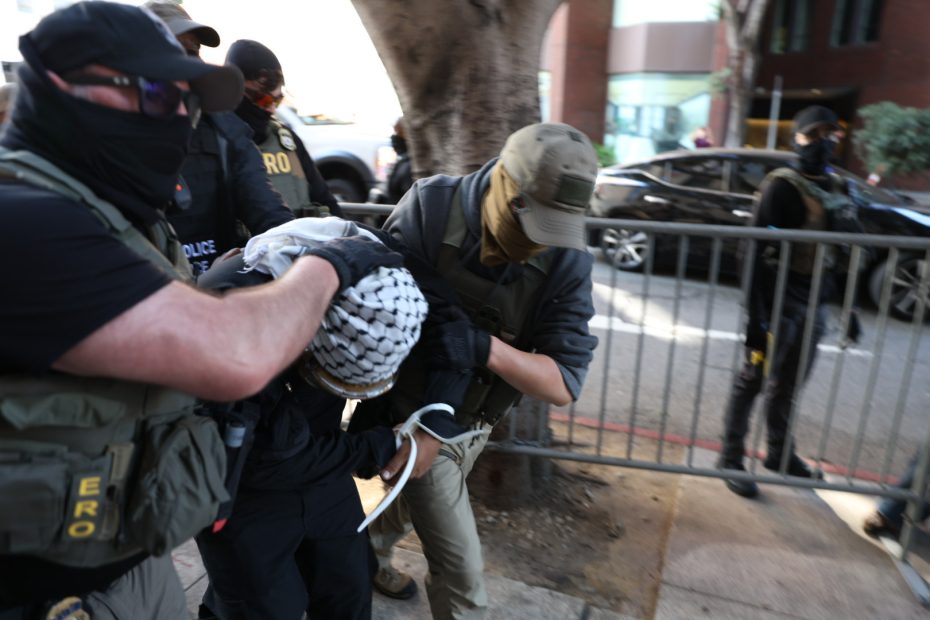
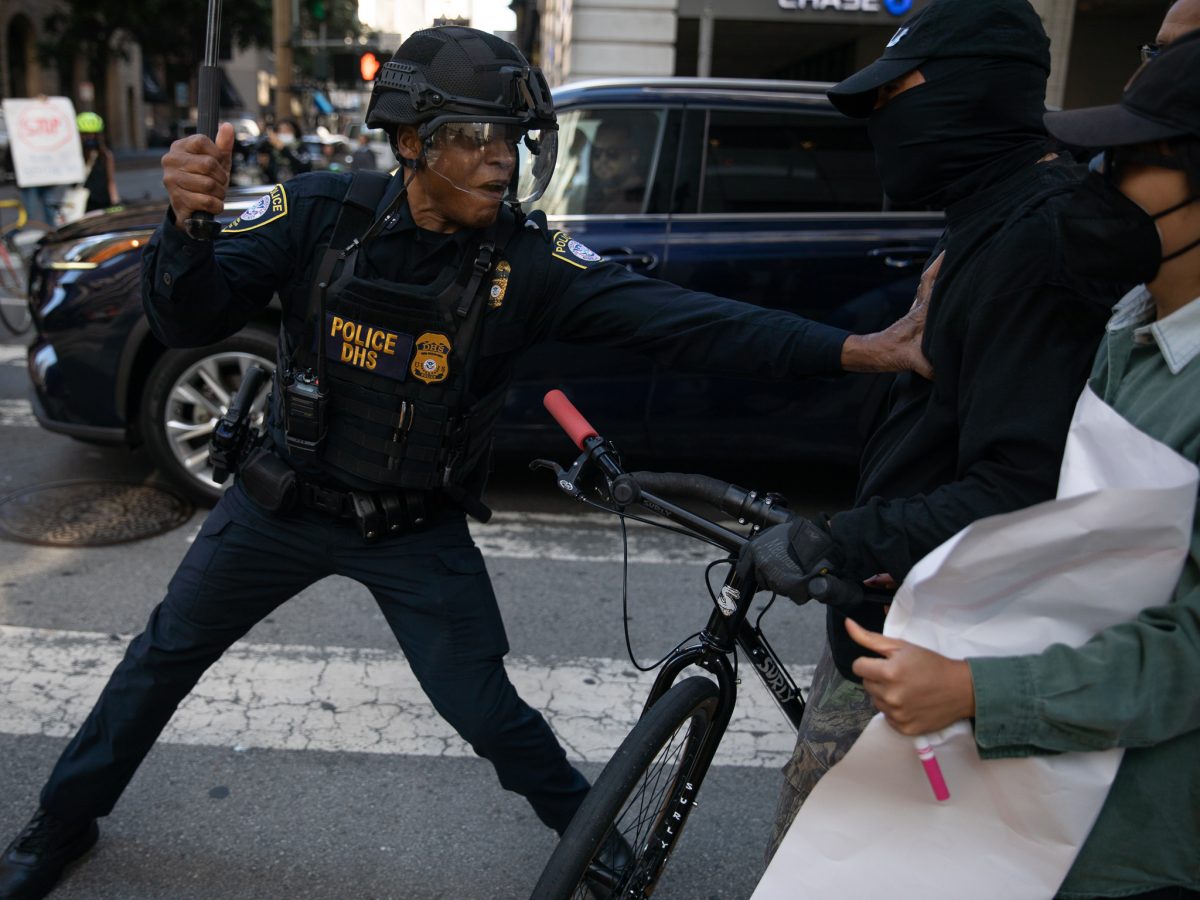
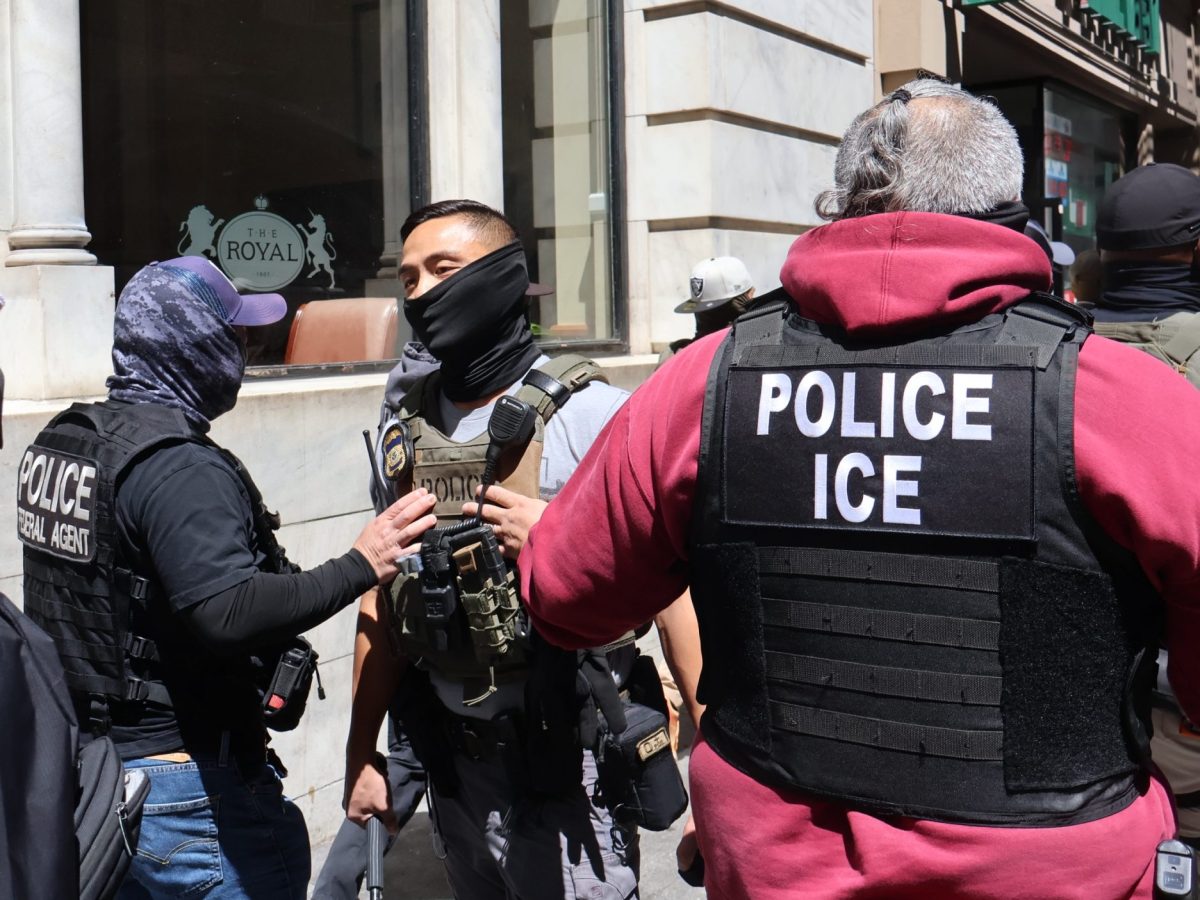
We are now at the point where ICE agents are apparently arresting and detaining US citizens, as a San Francisco native became the third US citizen ICE agents have arrested this month in SF, though she was released on Thursday.
There was another skirmish between ICE agents and protesters at the SF immigration court at 630 Sanasome Street on Wednesday, and the ICE agents pepper-sprayed the protesters and arrested one person for allegedly rowdy behavior. Mission Local pointed out this arrest was the third US citizen ICE has arrested in SF for protesting just this month, and by Thursday, Mission Local had identified the person arrested as being named “Angélica,” describing her as “a trans woman from an immigrant family.”
SF assistant chief public defender Angela Chan told Mission Local that it was (previously) “unheard of” for agents to detain a US citizen at an ICE facility. Chan said that there are “extremely specific circumstances” in which ICE can detain a US citizen, saying, “They must witness a federal felony offense in front of them while engaging in immigration-related enforcement and have completed requisite training.”
“I was shipped back and forth between a bunch of different agencies,” Guerrero told NBC Bay Area after being released. “For a while I was afraid that I was going to be taken somewhere like Louisiana because they have been taking citizens and non-citizens alike all across the country.”
Guerrero is apparently a member of the union SEIU 1021, which would indicate she’s some sort of service employee. Members of that union rallied outside the federal building before Angie’s release, along with Guerrero’s family.
“The people get secretly transferred somewhere else without the families knowing where they are and even sometimes shipped out of the country,” her father Ernest Guerrero told KTVU. “So, that has happened. As a parent, you’re rushing toward all those possibilities.”
While she’s been released from custody, Angie Guerrero is not out of the woods. According to Mission Local, Guerrero has been charged with two misdemeanors; destruction of property, and assaulting, resisting, or impeding a federal officer. She has a court date scheduled for sometime in September.
Image: WASHINGTON, DC – AUGUST 16: ICE and other federal agents take a delivery driver into custody at Union Station on August 16, 2025 in Washington, DC. U.S. President Donald Trump announced plans to deploy federal officers and the National Guard to the District in order to place the DC Metropolitan Police Department under federal control and assist in crime prevention in the nation’s capital. (Photo by Andrew Leyden/Getty Images)
Federal agents arrested a protester outside the San Francisco immigration court on Wednesday and charged the protester with two federal misdemeanors: Destruction of property and assaulting, resisting, or impeding a federal officer.
Bay Area attorneys say this is the first time they can remember Department of Homeland Security authorities filing such charges filed against a citizen in San Francisco. While protesters have been charged by federal agents in Los Angeles, moving the practice north is a sign of “escalation,” said Angela Chan, the city’s assistant chief public defender.
The protester, a U.S. citizen who asked to be identified by her first name, Angélica, was arrested around 10 a.m. yesterday during a chaotic street scene: Video showed ICE agents tackling several protesters to the ground after a crowd tried to stop ICE from transporting an asylum-seeker whom agents had arrested that morning.
Want the latest on the Mission and San Francisco? Sign up for our free daily newsletter below.Sign up
Angélica allegedly had a knife, slashed the front left tire of an ICE van, and threatened an agent, according to prosecutors’ complaint.
She was one of those filmed being zip-tied and led away, her head wrapped in a keffiyeh and held down by officers. Angélica, a trans woman from an immigrant family, was brought into the Immigration and Customs Enforcement headquarters at 630 Sansome St. without a cellphone, her partner, Renee, said.
A day passed before her family heard from Angélica again.
Holding a citizen at an ICE building is “unheard of,” Chan said. Earlier this month, ICE agents detained two protesters in downtown San Francisco for the first time in recent memory.
Supporters spent the rest of Wednesday checking the inmate logs of every jail in the area, Renee said, trying to find Angélica. The gym Angélica works at in Oakland closed to let her co-workers join the search. One supporter reached out to Nancy Pelosi’s office.
Around midnight, Renee said, Angélica’s name finally appeared on a list of people held at Santa Rita jail in Alameda County. Angélica told family members that there was no access to a phone or an attorney in the holding cell.
Angélica said the sheriff’s deputies appeared confused: They did not seem to know what to do with someone brought over by federal agents.
At 7 a.m. on Thursday, Angélica’s name disappeared from the Santa Rita logs, Renee said. Two hours later, Angélica’s supporters learned that she was scheduled to appear at the federal courthouse at 450 Golden Gate Ave. at 10:30 a.m.
ICE agents arrest Angélica in downtown San Francisco during what have become common anti-ICE actions, on Aug. 20, 2025. Photo by Tyler Morris.
Unlike most defendants who are arrested on federal charges, Angélica was never in the custody of the U.S. Marshals Service, and was brought to Santa Rita instead by officers with Homeland Security Investigations, a division of ICE. ICE officers also took Angélica to federal court.
Angélica, a born and raised San Franciscan, was represented by federal public defender Samantha Jaffe, who declined to comment. U.S. District Court Magistrate Judge Sallie Kim ordered Angélica be released until a pending court date in September.
ICE agents can make arrests only in “extremely specific circumstances,” Chan said. “They must witness a federal felony offense in front of them while engaging in immigration-related enforcement and have completed requisite training.”
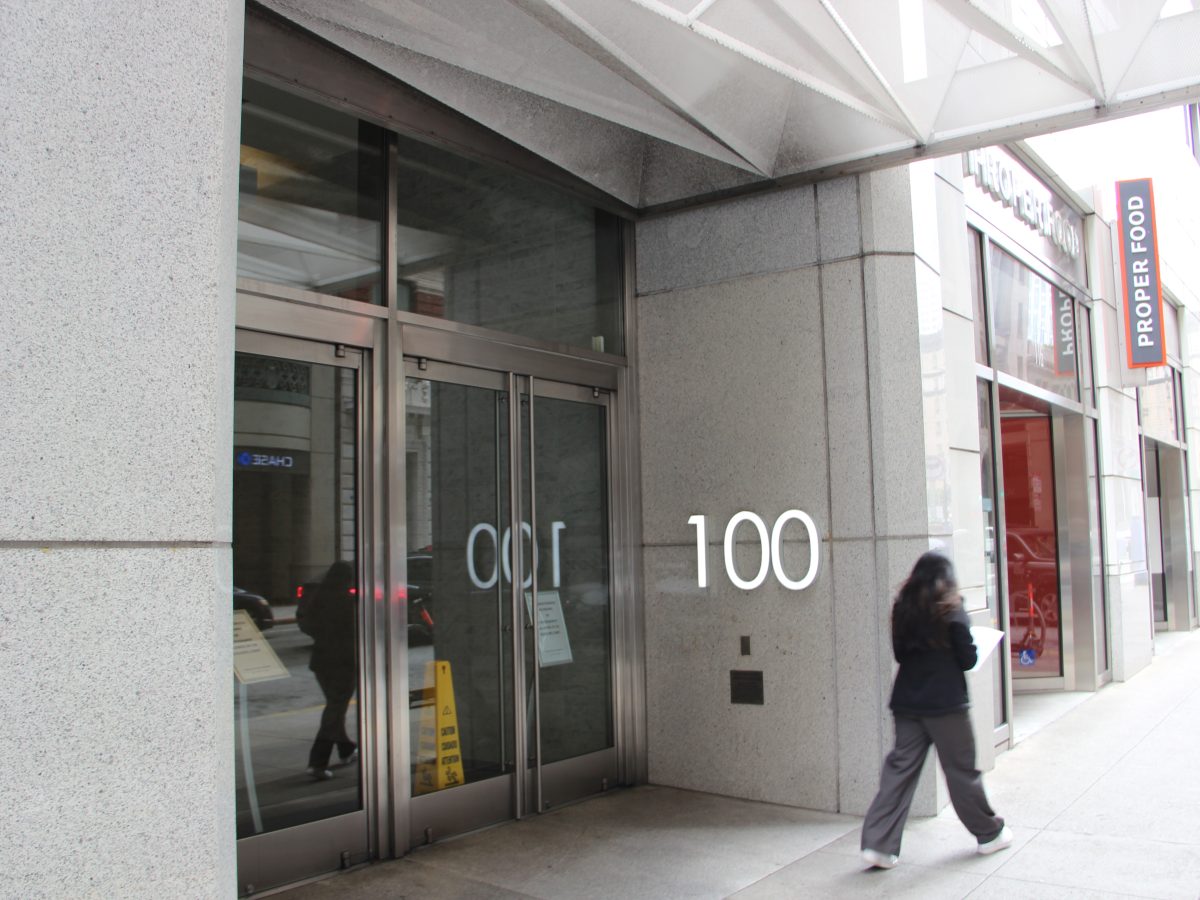
Angélica has been ordered to stay away from the immigration courts at 100 Montgomery St. and 630 Sansome St. Federal prosecutors had requested an order to keep Angélica from all federal buildings and officers, Renee said, but Judge Kim noted that this would be impractical — Angélica has to attend her own hearings, after all, and federal agents aren’t always visible.
Her case has caused an outcry among labor, immigrant, queer and trans community groups.
“SEIU 1021 members were outraged to learn that Angélica, a U.S. citizen and the child of one of our own members, was violently arrested by ICE in San Francisco while exercising her First Amendment rights,” wrote Theresa Rutherford, the president of the service employees’ union.
Renee said that Angélica was “standing up for all the things the mayor says he supports, but has been silent on.”
We’re a small, independent, nonprofit newsroom that works hard to bring you news you can’t get elsewhere.
In 2025, we have a lofty goal: 5,000 donors by the end of the year — more than double the number we had last year. We are 20 percent of the way there: Donate today and help us reach our goal!
Abigail covers criminal justice, accountability, and behavioral health. She’s originally from New York City, where she was a youth advocate and watched hundreds of arraignments. Now, she enjoys foggy San Francisco mornings with her cat, Sally Carrera. (Yes, the shelter did in fact name the cat after the Porsche from the animated movie Cars.)More by Abigail Vân Neely
Bill Gates, Marc Andreessen, and Even Akon Are Envisioning Utopias Without Considering How They’ll Be Governed
By Joe Mathews August 19, 2025 (ZocaloPublicSquare.org)
Many visionary cities—without clear governance—will never be anything more than dreams, writes columnist Joe Mathews. | Rendering of California Forever’s city project in Solano County. Credit: California Forever
In 2020, the rapper Akon secured 136 acres of land to build his own eponymous city on the site of the coastal village of Mbodiène, not far from where he grew up in Senegal.
Akon envisioned Akon City as a real-life Wakanda, the Afrofuturist utopia from Marvel’s Black Panther. But his extensive plans—100% solar power, Africa’s most advanced hospital, a high-tech university, an economy running on Akon’s personal cryptocurrency—omitted one crucial detail:
How Akon City would be governed.
Akon’s failure to plan for governance of his own city created questions about the project that he never could answer. Last month, the Senegalese government confirmed the project no longer exists.
Akon’s combination of ambition, and disinterest in governance, is remarkably common. With the world seeming stuck, a growing number of celebrities, oligarchs, and governments are seeking to create futuristic, paradigm-shifting new cities. From the seaside cliffs of Borneo to the deserts of Saudi Arabia to the swampy delta of Northern California, the rich and famous and powerful are proposing visionary metropolises that advance new aesthetics, pioneer technologies, or surpass previous milestones in sustainability or energy efficiency.
But for all their awesome grandeur, these proposals typically fall down for the same reason. They offer no new ideas—and often no details at all—about how their dream cities will be governed.
Why this void? Some urban creators are authoritarians, who offer no vision of government because they believe they can dictate to the future residents of their grand cities. Others see governance questions as difficult and divisive, and thus avoided in service of completing projects.
But the bigger problem is ignorance. In failing to include governance in their future visions, the world’s rulers demonstrate that the planet Earth is suffering from a lack of imagination when it comes to local democracy and government.
This fundamental failure to think about governance is perhaps most evident in the project known as California Forever. An enterprise called California Forever, backed by venture capitalists who pride themselves on world-changing ideas—including LinkedIn’s Reid Hoffman, Netscape co-founder Marc Andreessen and Emerson Collective’s Laurene Powell Jobs—secretly purchased land in Solano County, on the eastern outskirts of the Bay Area.
When the purchases became public, Jan Sramek, the founder and CEO of California Forever, promised a 21st-century city (population 400,000) to embody the “California Dream”—and prove that great things can be built here. His plans include North America’s largest site for advanced manufacturing, job centers integrated with plentiful housing, and the most walkable and sustainable neighborhoods possible.
What Sramek has yet to offer is any clear idea on how this city would be governed. In response to questions, California Forever has said they needed to get the city built first. But that failure to figure out governance has already stalled the project. At first, they sought voter approval for an unincorporated community, only to drop that idea when it appeared a ballot initiative might lose. More recently, they’ve been exploring having California Forever combine with existing cities.
But many visionary cities, without clear governance, will never be anything more than dreams.
It’s a similar trajectory to Bill Gates’ cutting-edge tech city of Belmont, proposed for Arizona in 2017, and stalled since. Gates’ plans are heavy on tech innovations to reduce traffic, and light on any governance plans that go beyond the billionaire’s personal beliefs. (Belmont also has never found a reliable source of water.)
To be fair, California Forever at least is operating in the mostly democratic realm of local government. Other technology visionaries reject democratic governance as they pursue their own utopias. Among them is Larry Ellison, the Oracle co-founder who purchased most of the Hawaiʻian island of Lanai, to turn it into an even more exclusive place.
Then there’s Peter Thiel—a Trump supporter who declared, “I no longer believe that freedom and democracy are compatible”—and provided the seed funding for the Seasteading Institute, which supports the building of cities that float in international waters, beyond democratic accountability. Thiel also backed the corporate island-state of Próspera, which the Honduran government wants to shut down because it won’t follow the country’s laws.
One of Próspera’s investors was San Francisco venture capital firm Pronomos, which invests in “prosperous cities that grow to empower entire nations.” Pronomos’ most high-profile project, the network state Praxis, has registered more than 2,200 citizens but has yet to find a territorial home (it’s looking in the Mediterranean, Greenland, and Ukraine). Perhaps that’s because its plans—which don’t describe governance but declare a commitment to “vitality” and opposition to “mediocrity”—have been called fascist by critics.
The narrator of a promotional video for Praxis offers this rebuttal: “Contemporary media proclaims that having any ideals is fascist. Everything of conviction is fascist.”
To be fair, it isn’t just tech bros who foreswear democratic governments for their dream cities. National governments have shown the same distaste for democracy in new metropolitan developments.
Indonesia is a decentralized democracy with strong local governments, but its increasingly autocratic national government has decided that the country’s new capital, now under construction on the east coast of Borneo, will have no local government at all. It will be administered by an agency of the national government, under rules as yet undrafted. Meanwhile, construction is dogged by delays and scandals.
China’s government is developing a series of future cities—most notably, Chengdu Future Science and Technology City—that are supposed to demonstrate new ways of living, but don’t include any new methods of governance. Mexico and Malaysia have proposed new “forest cities” to demonstrate a more ecological future, but the plans skip the governance details.
Saudi Arabia has said not a word about the governance structure of The Line, a planned city in the northwest region of Tabuk. Renderings of The Line are mesmerizing—two skyscrapers that stretch 100 miles across the desert, with space to house 9 million people—but they do not include any sign of local autonomy. The best bet is that The Line will be governed by a corporation owned by the Saudi ruling family.
Not all visions of future cities exclude governance. Plans for the former Walmart executive Marc Lore’s city of Telosa call for transparency in all government decision-making, participatory democracy, and an inclusive economic system in which residents would share in the city’s wealth. One caution: you would have to survive an application process to become a resident.
At smaller scales, a few new places have experimented with new ideas in liberal democracy. One pop-up city, Zuzalu, which appeared on Montenegro’s coast for a few months, had its residents create laws to encourage longer lifespans. Mexico City’s award-winning “utopias”—experimental neighborhood developments in the borough of Iztapalapa—are models of shared participatory governance, with authority divided among the mayor’s office, civil society groups, and local residents.
Democratic eco-villages, where small groups of people create democratic and environmental alternatives to civilization, are also on the rise. In Schloss Tempelhof in Germany (which I’ve visited), all 150 residents make decisions and share the work.
But many visionary cities, without clear governance, will never be anything more than dreams. Indeed, in Switzerland, the packaging mogul Daniel Model’s Avalon, the libertarian town-republic he declared within the rural village of Müllheim, remains imaginary.
Akon’s city in Senegal is not a total fiction. But the rap star managed to build only a welcome center and a basketball court, which is why the Senegalese government reclaimed most of Akon city’s land. On a small remaining patch, Akon may build a resort.
Perhaps someone can hold a giant conference there, to think up the new models of city governance that elude today’s would-be urban visionaries.
Joe Mathews writes the Connecting California column for Zócalo Public Square and is founder-columnist of Democracy Local, a planetary publication.
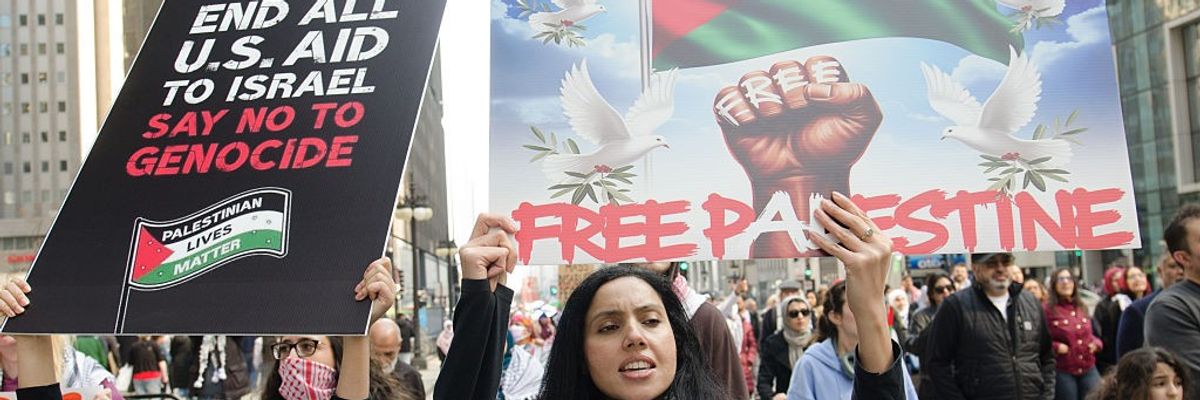
Protesters gather to demand an arms embargo on Israel, an end to repression and genocide in Gaza, and the release of all the arrested students, on April 12, 2025, in Chicago.
(Photo by Jacek Boczarski/Anadolu via Getty Images)
“Young Americans have made their voices clear,” said the national president of the College Democrats. “A modern Democratic Party must stand against global injustice.”
The national president of the College Democrats is co-sponsoring a Democratic National Committee resolution calling for party members to support an arms embargo and the suspension of military aid to Israel, as well as the recognition of a Palestinian state.
The resolution comes after just 8% of voters in the Democratic Party said in a July Gallup poll that they support Israel’s military actions in the Gaza Strip, a dramatic sea change from October 2023, when 36% expressed support.
TOGETHER, WE CAN DEFEND THE TRUTH WHEN IT’S UNDER SIEGE.
Your support powers the fearless, independent reporting that democracy depends on.
about:blank
According to an Economist/YouGovpoll from mid-August, 69% of Democratic voters said they believed Israel was committing a genocide against Palestinian civilians.
Disapproval of Israel’s actions is most staggering among young voters. Among Democrats ages 18 to 49, Pew Research found that unfavorable views of Israel have shot up to 71% from just 62% in 2022. Just 6% of Americans under 35, across all parties, said they had a favorable opinion of Israeli Prime Minister Benjamin Netanyahu.
“Young Americans have made their voices clear,” said the national president of the College Democrats, Sunjay A. Muralitharan. “A modern Democratic Party must stand against global injustice.”
The College Democrats were joined by a trio of activist groups—Progressive Democrats of America, RootsAction, and Our Revolution—who signed on in support of the proposal Thursday.
“This resolution is a critical step toward aligning our foreign policy with our values,” said Joseph Geevarghese, executive director of Our Revolution. “By calling for an arms embargo and suspending military aid to Israel, the DNC would be recognizing what grassroots movements have long demanded: that American taxpayer dollars must not bankroll human rights abuses.”
The resolution is one of two dueling proposals that will be considered at the DNC meeting on August 26. Another, backed by DNC chair Ken Martin, expresses support for long-held Democratic Party policies of a “two-state” solution and a ceasefire between Israel and Hamas.
RootsAction political director Sam Rosenthal describes it as a “watered-down resolution that stops far short of calling for an end to arms shipments to Israel.”
That proposal closely mirrors the one put forward during the 2024 Democratic National Convention, which stopped short of calling for the suspension of weapons sales to Israel and emphasized the importance of maintaining Israel’s “qualitative military edge.”
Allison Minnerly, the 26-year-old DNC member from Florida who introduced the embargo resolution earlier this month, told The Intercept that Martin offered his resolution as a compromise in the face of her more ambitious one.
Though her resolution now has the support of the College Dems and delegations from Maine, California, and Florida, it nevertheless faces an uphill battle to pass. If it fails, Minnerly says, it will further exacerbate the yawning rift between the Democratic Party and its supporters.
“Our voters, our base, they are saying that they do not want US dollars to enable further death and starvation anywhere across the world, particularly in Gaza,” Minnerly said. “I don’t think it should be a hard decision for us to say that clearly.”
Though the vote is largely symbolic, Matt Duss, a former foreign policy adviser to Sen. Bernie Sanders (I-Vt.), said that “the position of the DNC does matter” because “it sets the tone for the entire party.”
“There are two Gaza-related DNC resolutions,” said Prem Thakker, a reporter and commentator at Zeteo. “A status quo one. And one that recognizes public opinion and events in the past 22 months.”
“We have a moral obligation to do what we can to stop the slaughter, but most people feel powerless,” said Alan Minsky, the executive director of Progressive Democrats of America. “However, it is well understood that Israel would not be able to maintain the siege of Gaza without the steady flow of US weapons.”
Update: This article has been updated to include comments from Our Revolution, RootsAction, and the Progressive Democrats of America and note their endorsement of the resolution.
Our work is licensed under Creative Commons (CC BY-NC-ND 3.0). Feel free to republish and share widely.
A Starbucks barista prepares coffee at a store in Park City, Utah on January 24, 2025. The pay ratio between the company’s CEO compensation and the average worker’s pay hit 6,666-to-1 in 2024.
(Photo by Tommaso Boddi/Getty Images for Vox Media)
“At a time when many American workers are struggling with high costs for groceries and housing, the nation’s largest low-wage employers are fixated on making their overpaid CEOs even richer,” said the author of a new report.
Detailing the widening gap between outrageously high CEO compensation and the median wages of employees at some of the world’s largest and most profitable companies, a progressive think tank on Thursday warned executives will continue to enrich themselves at the expense of their lowest-paid workers unless policies are adopted to curb such corporate greed.
“Across the political spectrum, Americans are fed up with overpaid CEOs,” said Sarah Anderson, program director at the Institute for Policy Studies (IPS) and author of a new report out Thursday. “Policymakers should take long overdue action to push Corporate America in a more equitable direction.”
The report, Executive Excess 2025, finds that absent federal policies forcing corporations to rein in their spending on stock buybacks and exorbitant CEO pay packages, the average CEO-to-worker pay gap widened by 12.9% last year at what IPS calls the “Low-Wage 100″—the 100 S&P 500 companies with the lowest median worker pay.
The average gap between executive and worker pay now stands at 632-to-1 at these firms, up from 560-to-1 in 2023.
Between 2019-24, the average CEO at a Low-Wage 100 company saw their pay rise 34.7%, unadjusted for inflation, while the average median worker pay rose just 16.3%.
CEO compensation increased by 22.6% over the time period, far outpacing inflation. Meanwhile, wage hikes by these same companies didn’t even match inflation, including for warehouse workers at software company Aptiv, where the CEO-to-worker pay gap was 2,072-to-1 last year, or cashiers at Ross Stores, where the gap was 1,770-to-1.
“We can curb this runaway source of inequality by taxing corporate greed.”
Aptiv CEO Kevin Clark was paid $18.8 million last year while the median worker at the firm made just $9,052. Ross Stores’ pay ratio was similar, with CEO Barbara Rentler taking home $17 million compared to the company’s median worker, who made just $9,602.
Starbucks, which has made headlines in recent years both for its store employees’ fight to unionize across the United States and for its executives’ illegal union-bustingtactics, had far-and-away the largest gap between CEO and median worker pay in 2024, with CEO Brian Niccol taking home $95.8 million and the median employee earning just $14,674.
That makes the wage gap 6,666-to-1 at the coffee chain.
A petition organized last year by Starbucks Workers United, which has unionized at hundreds of stores since a landmark victory in Buffalo, New York in 2021, warned Niccol that the cost of living across the US “is skyrocketing while you continue to make millions” and the employees “who actually make your Starbucks run can’t make ends meet.”
IPS said the petition reflected its report’s main finding: “At a time when many American workers are struggling with high costs for groceries and housing, the nation’s largest low-wage employers are fixated on making their overpaid CEOs even richer.”
Contributing to the growing wage gap at the Low-Wage 100 is the companies’ focus on stock buybacks, in which firms buy back their own shares to “artificially inflate executive stock-based pay and siphon resources out of worker wages and productive long-term investments.”
The 100 companies spent $644 billion on stock buybacks from 2019-24, according to IPS, with home improvement giant Lowe’s ranking as the “stock buy back leader,” spending $46.6 billion buying its own shares over the past six years.
“That sum could’ve instead covered the cost of giving each of the firm’s 273,000 global employees an annual $28,456 bonus for six years,” reads the report. “In 2024, Lowe’s CEO Marvin Ellison enjoyed total compensation of $20.2 million, which is 659 times the retailer’s $30,606 median annual worker pay.”
Anderson said the report highlights “how America’s largest low-wage employers are funneling profits into their CEOs’ pockets—at the expense of both their workers and their companies’ long-term growth.”
IPS pointed to “three particularly promising areas for CEO pay policy reform,” including:
Subjecting corporations to higher tax levies if they have excessive levels of CEO pay;
Taxing and restricting stock buybacks; and
Using federal contracts and subsidies to discourage wide corporate pay gaps.
Congress should pass the Curtailing Executive Overcompensation (CEO) Act, which would apply an excise tax to companies with CEO-to-worker pay ratios exceeding 50-to-1, or the Tax Excessive CEO Pay Act, said the group.
“A May 2024 survey suggests that such taxes would be enormously popular,” reads the report. “Overall, 80% of likely voters favor a tax hike on corporations that pay their CEOs over 50 or more times more than what they pay their median employees. Large majorities in every political group support this approach: some 89% of Democrats, 77% of independents, and 71% of Republicans. In swing states, 83% of likely voters give this proposal a thumbs up.”
Other legislation, the Stock Buyback Accountability Act, would quadruple the 1% federal excise tax currently in effect for stock buybacks, and would have raised $6.3 billion from the Low-Wage 100 if it had been in effect in 2023 and 2024—enough to cover the cost of 327,218 public housing units each year for two years.
“We can curb this runaway source of inequality,” said IPS, “by taxing corporate greed.”
Our work is licensed under Creative Commons (CC BY-NC-ND 3.0). Feel free to republish and share widely.
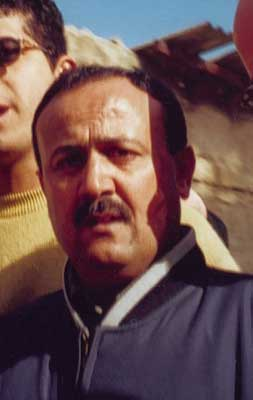
Marwan Barghouti (also transliterated al-Barghuthi; Arabic: مروان البرغوثي; born 6 June 1959) is a Palestinian political leader who has served as an elected legislator and has been an advocate of a two-state solution since prior to his imprisonment by Israel.[1][2][3]
Barghouti led street protests and diplomatic initiatives until 2002, the early Second Intifada, when he was captured, convicted, and imprisoned by Israel on charges of involvement in deadly attacks that resulted in the deaths of five people.[4] Barghouti declined to recognise the legitimacy of the court or enter a plea, but stated that he had no connection to the incidents for which he was convicted.[5] An Inter-Parliamentary Union report found that Barghouti was not given a fair trial and questioned the quality of the evidence.[6][7]
Despite his imprisonment, Barghouti has consistently topped opinion polls asking Palestinians who they would vote for in a Presidential election, ahead of both current Palestinian Authority President Mahmoud Abbas and leaders of Hamas. Several prominent supporters of a resumption of the Israel-Palestine peace process view Barghouti as the leader most able to unify the Palestinians and negotiate a compromise with Israel. He has been referred to as “the Palestinian Mandela.”[8][9][10][11]
During his years in prison, Barghouti has continued to be politically active. He was an instigator and lead author of the 2006 Palestinian Prisoners’ Document, which proposed a political path to a two-state solution, and secured support from Hamas. He has organised education for fellow inmates, and in 2017 led a hunger strike that led to increased visitation rights.[12] Since October 2023, he has been denied visits from his family and been severely beaten several times, leading to persistent damage to his health, according to his lawyer.[13] Israeli authorities have rejected his complaints over the incidents. Several attempts to secure his release through negotiations have failed.[14]
Early life, education and expulsion
Barghouti with his two sons
Barghouti was born in the village of Kobar near Ramallah in the West Bank. Like his distant cousin Mustafa Barghouti, a fellow Palestinian political leader, he belongs to the extended Barghouti family. His younger brother Muqbel described him as “a naughty and rebellious boy.”[15]
In 1967, when Barghouti was seven-years-old, Israel occupied the West Bank in the Six-Day War. According to The Economist, Marwan’s “neighbours were beaten up or arrested for flying Palestinian flags. Military bases and Jewish settlements sprang up around their village. Israeli soldiers shot dead the family dog for barking.”[14]
Barghouti joined Fatah at age 15,[2] and he was a co-founder of the Fatah Youth Movement (Shabiba) on the West Bank. That year he was first imprisoned by Israel.[16] At 18, he was imprisoned again. He later wrote that during the subsequent interrogation, he was forced to strip naked, spread his legs, and was struck on the genitals so hard that he lost consciousness.[16] He completed his secondary education and received a high school diploma while serving a four-year term in jail, where he became fluent in Hebrew.[17]
Barghouti enrolled at Birzeit University in 1983, though arrest and exile meant that he did not receive his Bachelor’s degree (History and Political Science) until 1994. He earned a Master’s degree in International Relations, also from Birzeit, in 1998. As an undergraduate, he was active in student politics on behalf of Fatah and headed the Birzeit Student Council. In 1984, he married Fadwa Ibrahim, a fellow student. Fadwa studied law and was a prominent advocate in her own right on behalf of Palestinian prisoners, before becoming the leading campaigner for her husband’s release from his current jail term. Together the couple had four children. Before his eldest son was born, and while still a student leader, Barghouti was jailed for a third time.[14] He missed the birth of his eldest son.[16] In May 1987, Israel expelled him. Initially Barghouti and Fadwa moved to Tunis, and then in April 1988 to Amman.
First Intifada, the Oslo Accords and the aftermath
From exile, during the First Intifada, Barghouti continued to maintain contacts among activists in the West Bank. He simultaneously built relationships with the older generation of Fatah activists, who had waged their struggle from exile for more than three decades. He was elected to Fatah’s Revolutionary Council, the movement’s internal parliament, in 1989.[18] When he was allowed to return to Palestine in April 1994 as a result of the Oslo Accords, Barghouti found that he was able to bridge the divide between the two groups.[17]
Although he was a strong supporter of the peace process, he doubted that Israel was committed to it.[2] In 1996, he was elected to the Palestinian Legislative Council for the district of Ramallah.[2] Barghouti campaigned against corruption in Arafat’s administration and human rights violations by its security services.[2] He participated in diplomacy and built relationships with a number of Israeli politicians, and with leaders of Israel’s peace movement. A series of peace conferences in the wake of the Oslo accords featured “heated discussions.”[18] When Meir Shitreet fell ill during a peace conference in Italy, Shitreet said that Barghouti sat at his bedside through the night.[14] In 1998 he attended a meeting with members of the Israeli Knesset, referring to those present as friends, and called to “strengthen this peace process.”[7]Haim Oron, a former Israeli cabinet minister, recalled that “he spoke about the right of the Palestinians, and when I spoke about the right of Jews, he understood”.[14] His assistant has claimed that Barghouti never refused to meet any Israeli.[14] By the late 1990s, Palestinians had become frustrated with the lack of progress toward an independent state that they felt had been promised by the Oslo accords, and by the privations of life under occupation. There were frequent demonstrations by civil society and political groups. According to Diana Buttu, “Marwan was somebody who was present at each and every protest for weeks and weeks and weeks on end. It became very clear that we were just never going to see freedom.”[7] Barghouti met with the central committees of almost every Israeli party, the journalist Gideon Levy has claimed, to warn them that, with an impasse in the peace process, the situation was tending toward violence.[7]
The formal position occupied by Barghouti was Secretary-General of Fatah in the West Bank.[19] By the summer of 2000, particularly after the Camp David summit failed, Barghouti was disillusioned and said that popular protests and “new forms of military struggle” would be features of the “next Intifada.”[2][17]
Outbreak of Second Intifada and political leadership
In September 2000, the Second Intifada began. Barghouti became increasingly popular as a leader of demonstrations, as a spokesperson for Palestinian interests, and as leader of the Tanzim, a grouping of younger activists within Fatah who had taken up arms. Barghouti described himself as “a politician, not a military man.”[15] Barghouti led marches to Israeli checkpoints, where riots broke out against Israeli soldiers and spurred on Palestinians in speeches at funerals and demonstrations, advocating the use of force to expel Israel from the West Bank and Gaza Strip.[2] He has stated that, “I, and the Fatah movement to which I belong, strongly oppose attacks and the targeting of civilians inside Israel, our future neighbor, I reserve the right to protect myself, to resist the Israeli occupation of my country and to fight for my freedom” and has said, “I still seek peaceful coexistence between the equal and independent countries of Israel and Palestine based on full withdrawal from Palestinian territories occupied in 1967.”[20]
As the Palestinian death toll in the Second Intifada mounted, Barghouti called for Palestinians to target Israeli soldiers and settlers in the West Bank and Gaza, but not within Israel.[17][21] Others, such as leaders of Hamas, openly backed attacks on civilians within Israel.
Israel has accused Barghouti of having co-founded and lead the Al-Aqsa Martyrs’ Brigades during this period, which he has denied.[2] Israel attempted to assassinate him in 2001.[1] That August, Israeli forces fired two missiles from an illegal West Bank settlement at a convoy of cars in Ramallah and injured Barghouti’s bodyguard.[22] At the time, Israeli security sources claimed that they had intended to kill another Fatah operative. The then-head of Shin Bet subsequently claimed to have made two attempts to assassinate Barghouti.[23] Barghouti went into hiding.
Barghouti was captured on 15 April 2002 by Israeli soldiers, who had disguised their journey to his location by hiding in a civilian ambulance.[24] He was transferred to the Moscovia Detention Centre. On 18 April, Barghouti was reported to have declined to cooperate with his interrogators, and allowed to communicate freely with his lawyer. He was then denied the right to see his lawyer for the next month, except for an occasion on which they were not allowed to discuss the investigation.[6] The next time he was able to talk freely with his lawyer, Barghouti described having been subject to severe sleep deprivation and insufficient food. He described the torture, in the form of the shabeh method, in a later book, 1000 Days In Solitary Jail.[25] He said that he was forced to sit on a chair with nails protruding into his back for hours at a time.[25] Simon Foreman, the lawyer commissioned by the Inter-Parliamentary Union to report on the trial, has said “the witnesses whose statements were used to accuse [Barghouti], many of them made the same kind of statements and those allegations were disregarded, openly disregarded by the courts.”[6][7] Barghouti has also stated that the interrogators threatened to kill him and his eldest son.[6] He has written that during his pre-trial detention, in addition to Moscovia, he was held for periods at Camp 1391 and the Petah Tikva prison.[25]
Charges, verdict and sentences
Israel filed its indictment on 14 August and Barghouti’s trial commenced on 5 September.[26] Barghouti was charged with 26 charges of murder and attempted murder stemming from attacks carried out by the al-Aqsa Martyrs’ Brigades on Israeli civilians and soldiers.[27][28] Barghouti refused to present a defense to the charges brought against him, maintaining throughout that the trial was illegal and illegitimate.[29] He stressed that he supported armed resistance to the Israeli occupation, but condemned attacks on civilians inside Israel. According to the case argued by Israel at his trial, he had supported and authorized such attacks. On 20 May 2004, he was convicted of five counts of murder: authorizing and organizing the murder of Georgios Tsibouktzakis (a.k.a. Father Germanos, a Greek Orthodox monk-priest), a shooting adjacent to Giv’at Ze’ev in which a civilian was killed, and the Seafood Market attack in Tel Aviv in which three civilians were killed. In addition, he was convicted of attempted murder for a failed car bomb attack near Malha Mall that exploded prematurely, resulting in the deaths of two suicide bombers, and for membership and activity in a terrorist organization. He was acquitted of 21 counts of murder in 33 other attacks as no proof was brought to link Barghouti directly with the specific decisions of the local leadership of the Tanzim to carry out these particular attacks.[30] Following the verdict, Barghouti shouted in Hebrew, “This is a court of occupation that I do not recognize. A day will come when you will be ashamed of these accusations. I have no more connection to these charges than you, the judges, do.”[31] On 6 June 2004, he was sentenced to the maximum possible punishment for his convictions: five cumulative life sentences for the murders and an additional 40 years, consisting of 20 years each for attempted murder and for membership and activity in a terrorist organization. The Israeli verdict against him in effect removed Arafat’s only political rival.[32]
Criticism of trial
The Inter-Parliamentary Union found that the “numerous breaches of international law” to which Barghouti was subjected “make it impossible to conclude that Mr. Barghouti was given a fair trial.”[6][33] The criticisms raised by Simon Foreman, the report’s author, included the court’s failure to consider the public allegations of torture; its authorisation of incommunicado detention; prejudicial statements by the presiding judge; the transportation of Barghouti to Israel contrary to the Fourth Geneva Convention; and the poor evidence for guilt.[6] Foreman wrote, “According to the prosecution, only 21 of the prosecution witnesses were actually in a position to testify directly regarding Mr. Barghouti’s role in these attacks. But none of these 21 individuals in fact accused him. About 12 of them explicitly told the court that he was not involved.”[6] Concerning “material” evidence, Barghouti’s lawyer told Foreman that “no document originated by Mr. Barghouti had implicated him in the acts of which he was being accused.”[6]
Campaign for release and prisoner-swap negotiations
A flag in support of Marwan Barghouti at a demonstration at Kafr ad-Dik.
Fadwa began campaigning for her husband’s release the day he was arrested.[34] The International Campaign to Free Marwan Barghouti and All Palestinian Prisoners was launched in 2013 from Nelson Mandela’s former cell on Robben Island.[35] The campaign was launched by Fadwa and Ahmed Kathrada, who was jailed alongside Mandela at the Rivonia Trial. Barghouti has often drawn comparisons to Mandela from commentators inclined toward a resumption of the peace process.[9][10][36] For example, Reuters reported that some see Barghouti “as a Palestinian Nelson Mandela, the man who could galvanize a drifting and divided national movement if only he were set free by Israel.” Many of his supporters have campaigned for his release. They include prominent Palestinian figures, members of European Parliament and the Israeli group Gush Shalom. According to The Jerusalem Post, “[u]nlike many in the Western media, Palestinian journalists have rarely referred to Barghouti in these terms.[37]
In August 2023, Barghouti’s wife Fadwa held meetings with senior officials and diplomats across the world, including Jordanian Foreign Minister Ayman Safadi, to advocate for her husband’s release and position him as a successor to Abbas. According to Al-Sharq al-Awsat, Barghouti would run in Palestinian presidential elections and maintained a polling lead over all other candidates.[38]
The Israeli debate on whether to free Barghouti
In 2008, 45% of Israelis supported the release of Barghouti, while 51% were opposed.[39] Another approach is to suggest that Israel’s freeing of Barghouti would be an excellent show of good faith in the peace process. Some prominent Israelis have called for Barghouti’s release, citing his unique ability to unite Palestinians These include Ami Ayalon,[40][41]Efraim Halevy,[42][43]Meir Shitreet,[14] and both Yossi Beilin[7] and Haim Oron,[14] two former ministers on the left of Israeli politics.[6] Several IDF officers involved in Barghouti’s 2002 capture have taken a similar view.[23]
Every Israeli administration since Barghouti’s imprisonment has declined to release him. Ayalon claimed in 2024 that “You will not find anybody in our current political community that has any interest in releasing Marwan Barghouti.”[44] Figures who have spoken in opposition to his release include former Defense Minister Moshe Ya’alon, Avi Dichter, and former Foreign Minister Silvan Shalom, who called Barghouti “an assassin who has blood on his hands.”[23][45][46]
This view gained popularity among the Israeli left after the 2005 disengagement from the Gaza Strip. Still others, operating from a realpolitik perspective, have pointed out that allowing Barghouti to re-enter Palestinian politics could serve to bolster Fatah against gains in Hamas‘ popularity.[47]
In January 2007, Israeli Deputy Prime Minister Shimon Peres declared that he would pardon Barghouti if elected president. Peres was elected, but issued no pardon.[48]
History of negotiations concerning Barghouti’s release
In 2004, Israel’s ambassador to Washington Danny Ayalon proposed, with the “tacit agreement” of Ariel Sharon, that Israel would free Barghouti in exchange for the Israeli spy Jonathan Pollard, who was imprisoned by the United States. Secretary of State Condoleezza Rice rejected the request.[23] In 2006, there were conflicting claims concerning proposals for Barghouti’s release. A Saudi newspaper reported that Condoleezza Rice had proposed such a step to Israel, with no mention of a quid pro quo, but Ehud Olmert denied that the idea had been raised in talks with the United States.[49] He reportedly continued to oppose Barghouti’s release in 2007.[50]
Hamas sought the inclusion of Barghouti in the 2011 prisoner exchange deal that led to the release of Gilad Shalit, but Israel refused to include him.[23]
During the prisoner swap negotiations in 2024 and 2025 that arose from the Gaza War, Hamas said that Barghouti was at the top of their list of prisoners whom they wanted Israel to free.[51] Israel again refused.[52]The Economist reported that Mahmoud Abbas, who was expected to face a political challenge from Barghouti on the latter’s release, “urged Qatari mediators to remove Barghouti’s name from the list of prisoner exchanges.”[52] In January 2025, an Israeli government official denied reports that Barghouti was set to be released and exiled to Turkey.[53]
Political activity in prison
2005 and 2006 Palestinian elections and disputes with Fatah
Yasser Arafat died in November 2004, and the Palestinian Authority called a presidential election for January 2005. Barghouti announced from his isolation cell that he would contest the election, challenging interim-President Mahmoud Abbas, a long-time Fatah administrator of Arafat’s generation. Fadwa registered her husband’s candidacy as an independent on 1 December.[54][55]
The Israeli government came to know that two of Barghouti’s closest confidantes – Fadwa and advisor Qadura Fares – privately opposed Barghouti’s decision to stand, and decided to allow the two to meet with Barghouti to press their case, breaking two years in which he had been denied such contact.[23] His candidacy was also criticised by Fatah leaders as a threat to the movement’s unity.[56][57] His campaign manager announced Barghouti’s decision to withdraw from the race on 12 December. In a letter read at the announcement, Barghouti accused Fatah’s leadership of having grown “old, weak and alienated” from the rank and file.[58] In 2016, Fares said that he believed his advice had been a mistake.[23]
Abbas won the election, and there has been no Palestinian presidential election since.
In 2006 Israeli media reported that MK Haim Oron had met with Barghouti in prison dozens of times, and had carried messages back and forth between Barghouti and Prime Minister Ehud Olmert.[49] Foreign Minister Tzipi Livni also met directly with Barghouti.
Split from Fatah
A banner in support of Marwan Barghouti at a demonstration at Beit Ummar.
On 14 December 2005, Barghouti announced that he had formed a new political party, al-Mustaqbal (“The Future”), mainly composed of members of Fatah’s “Young Guard”, who repeatedly expressed frustration with the entrenched corruption in the party. The list, which was presented to the Palestinian Authority’s central elections committee on that day, included Mohammed Dahlan, Qadura Fares, Samir Mashharawi and Jibril Rajoub.[29]
The split followed Barghouti’s earlier refusal of Mahmoud Abbas‘ offer to be second on the Fatah party’s parliamentary list, behind Palestinian Prime Minister Ahmed Qurei. Barghouti had actually topped the list,[59] but this had not become apparent until after the new party had been registered.
Reactions to the news were split. Some suggested that the move was a positive step towards peace, as Barghouti’s new party could help reform major problems in Palestinian government. Others raised concern that it could wind up splitting the Fatah vote, inadvertently helping Hamas. Barghouti’s supporters argued that al-Mustaqbal would split the votes of both parties, both from disenchanted Fatah members as well as moderate Hamas voters who do not agree with Hamas’ political goals, but rather its social work and hard position on corruption. Some observers also hypothesized that the formation of al-Mustaqbal was mostly a negotiating tactic to get members of the Young Guard into higher positions of power within Fatah and its electoral list.
Barghouti eventually was convinced that the idea of leading a new party, especially one that was created by splitting from Fatah, would be unrealistic while he was still in prison. Instead he stood as a Fatah candidate in the January 2006 PLC elections, comfortably regaining his seat in the Palestinian Parliament.
Prisoners’ Document and other activism
On 11 May 2006, Palestinian leaders held in Israeli prisons released the National Conciliation Document of the Prisoners. The document was a proposal initiated by Marwan Barghouti and leaders of Hamas, the PFLP, the Palestinian Islamic Jihad and the DFLP that proposed a basis upon which a coalition government should be formed in the Palestinian Legislative Council. This came as a result of the political stalemate in the Palestinian territories that followed Hamas’ election to the PLC in January 2006. Crucially, the document also called for negotiation with the state of Israel in order to achieve lasting peace. The document quickly gained popular currency and is now considered the bedrock upon which a national unity government should be achieved. According to Haaretz, Barghouti, although not officially represented in the negotiations of a Palestinian unity government in February 2007, played a major role in mediating between Hamas and Fatah and formulating the compromise reached on 8 February 2007.[60] In 2009, he was elected to party leadership at the Fatah Conference in Bethlehem.[61]
Barghouti declined to testify before an Israeli court in January 2012, but used the opportunity of his appearance to say that “an Israeli withdrawal to the 1967 lines and the establishment of a Palestinian state will bring an end to the Israeli-Palestinian conflict,” according to Haaretz’s Avi Issacharoff.[62] That March, in a letter from prison, Barghouti called for a new wave of civil resistance against the occupation, and for the Palestinian Authority to end all coordination with Israel. He wrote “Large-scale popular resistance at this stage serves the cause of our people.”[63] Barghouti has frequently been punished for releasing statements through internment in solitary confinement.[34]
In November 2014, months after more than 2,000 Palestinians were killed by Israel in the 2014 Gaza War, Barghouti urged the Palestinian Authority to end security cooperation with Israel and called for a Third Intifada against Israel.[64] In 2016, a plan for confronting the occupation, purportedly authored by Barghouti and smuggled from prison, was presented by an ally. The plans hinged on “mass disobedience” and demonstrations of hundreds of thousands of people according to the Economist’s 1843 Magazine.[14] Barghouti expected that Israel would kill some of the demonstrators.
2017 hunger strike and prison education programme
In April 2017 he organized a hunger strike of Palestinian security prisoners in Israeli jails.[65] In an op-ed for The New York Times, Barghouti said that the hunger strikers sought to end the “torture, inhumane and degrading treatment, and medical negligence” to which prisoners were subject.[16] A list of demands issued by the strikers included access to telephones to communicate with their families, increased visitation rights, and a series of steps to address medical negligence.[66] They also included access to books and newspapers and an end to the practices of solitary confinement and administrative detention.
On 7 May, the Israel Prison Service released videos allegedly showing Barghouti hiding in the toilet stall of his cell while eating cookies and candy, then trying to flush the wrappers. The videos were recorded on 27 April and on 5 May, a period during which almost 1,000 of Barghouti’s fellow prisoners were refusing all food.[67][68] Anonymous sources in the prison service confirmed the authenticity of the videos, saying that the food was made available to Barghouti to test his adherence to the hunger strike. Barghouti’s attorney refused to respond to the videos, while his wife claimed that they had been “fabricated” to discredit him. Israeli media reported that this was not Barghouti’s first time being caught secretly breaking a hunger strike, and that in 2004 he had been photographed hiding a plate after eating off it in his cell.[69][70][71] According to Haaretz’s Amos Harel, among Palestinians, the episode “only strengthened his image as a leader who is feared by Israel – which resorts to ugly tricks in order to trip him up,”.[72] The hunger strike ended after Israel conceded a second family visit for each prisoner per month.[12]
Barghouti has organised a programme to provide education to his fellow prisoners. In a 2014 interview he stated:
I teach and lecture on a variety of topics in various disciplines, including at the university level. . . There are dozens of prisoners who never had the chance to be educated at the secondary or university level and who want to pursue their education. I have been in charge of teaching them and we’ve achieved good results in both foreign language instruction and university syllabuses with the help of some of my fellow detainees.[73]
Subsequent activism and continued popularity
Barghouti intended to contest the Palestinian Presidential elections slated for 2021,[74] but they were cancelled by President Abbas, citing Israel’s refusal to permit voting in East Jerusalem.[75] Immediately prior to the cancelation, a poll suggested that Barghouti would go on to win the Presidency, with more than double Abbas’s support, and significantly more than that of Ismail Haniyeh.[76] Barghouti remains the most popular Palestinian leader. In each of the six polls conducted by the Palestinian Centre for Policy and Survey Research between September 2023 and May 2025, Barghouti came out ahead of a Hamas candidate when Palestinians were asked who they would vote for as President in a two-way race.[4][3] There has been no Palestinian Presidential election since 2005.
Conditions of imprisonment and alleged mistreatment
Barghouti was held in solitary confinement for three years following his 2002 detention and has frequently been returned to solitary confinement since.[77] Since 7 October 2023, Barghouti has been interred in solitary confinement. Shortly after that date, the governor of Ofer Prison ordered Barghouti to kneel before the governor, according to his son, Arab Barghouti.[78] Arab described the order as an attempt to humiliate Barghouti, and by extension the watching prisoners, who saw Barghouti as a leader. Arab added that when his father refused to comply he was forced to his knees by prison guards, dislocating his shoulder.
In December 2023, his lawyer claimed, Barghouti was beaten on several occasions, and on one occasion “dragged on the floor naked in front of other prisoners.”[79] In March 2024, Barghouti told his lawyers that he was dragged to an area of Megiddo prison without security cameras and assaulted with batons by prison guards.[79][80] The Guardian reported, “He recalled bleeding from the nose as he was dragged across the floor by his handcuffs, before he was beaten unconscious.”[79] According to his family, speaking in February 2024, Barghouti was held in the dark, with loud music playing into his cell for days at a time.[51] In May 2024, The Guardian reported that Barghouti “spends his days huddled in a cramped, dark, solitary cell, with no way to tend to his wounds, and a shoulder injury from being dragged with his hands cuffed behind his back,”.[79] The Public Committee Against Torture in Israel said that Barghouti had been subjected to treatment amounting to torture, which they said had “become standard across all detention facilities since 7 October.”[11]
Israeli prison authorities were accused of “brutally assaulting” Barghouti in September 2024.[80] The Israeli prison service said in October 2024 that they had rejected two complaints of mistreatment by Barghouti over the past year on the grounds that there had been no violation of the law.[13]
In August 2025, Itamar Ben-Gvir, the Minister of National Security, was recorded on video visiting and threatening Barghouti that Israel will “obliterate” anyone who opposes the state, stating, “Whoever messes with the people of Israel, whoever murders our children, whoever murders our women, we will obliterate them. You will not defeat us.”[81]
In death, Jeffrey Epstein has managed to do something no one else has been able to – drive a wedge between Donald Trump and his loyal base.
Releasing the so-called “Epstein files” was one of the campaign promises that resonated most with Donald Trump’s supporters.
The files, 300 gigabytes of data and physical evidence of the vile crimes of billionaire pedophile Jeffrey Epstein, have long been thought to contain the names of others in his depraved network.
Despite his friendship with Epstein, Trump has long positioned himself as the person capable of exposing the dark secrets contained in the files. But last month, after teasing the release of the files, the President and his administration backflipped.
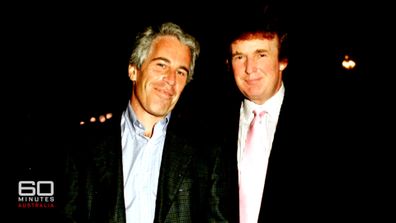
Jeffrey Epstein and Donald Trump were often seen together at parties and events. (60 Minutes)
The fallout has spiralled into a full-blown scandal that, for once, Donald Trump can’t seem to shake.
A soured friendship
In the 1990s Trump and Epstein were well known as men about town. One a notorious property developer, the other a wealthy financier, the pair were pictured together at parties and events from New York to Florida. Epstein was even invited as a guest to Trump’s wedding to Marla Marples in 2002.
By 2006 though, Epstein had been exposed as a paedophile and convicted of child sex trafficking. It would be years before the full extent of his depravity was revealed.
“I threw him out.”
Donald Trump has long denied knowing anything about Epstein’s crimes, and insists he ended the friendship many years ago.
“For years I wouldn’t talk to Jeffrey Epstein… and I threw him out of the place, persona non grata, I threw him out,” Trump told reporters recently.
But the friendship between the two men is now under renewed scrutiny due to President Trump’s handling of the Epstein files.
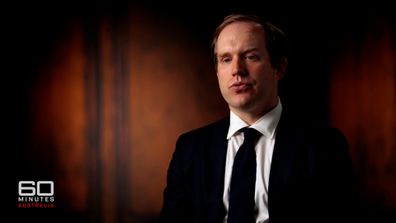
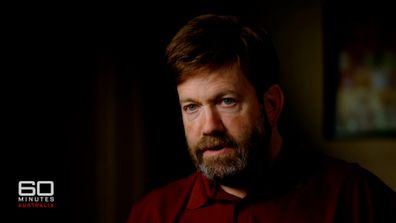
Seasoned political reporter and author Will Sommer told 60 Minutes many Americans voted for Trump because of his promise to declassify the files and “expose” the Washington elites.
Political reporter and author Will Sommer told 60 Minutes many voters made their decision based on Trump’s promises around the Epstein files. (60 Minutes)
“Trump supporters see Jeffrey Epstein as the devil,” he said.
“They also see him, as perhaps, someone who was the key to this larger network, this guy who was, in their belief, providing young girls to world elites.”
Many believe the names of who was in that network lie in the ‘Epstein files’ – more than 300 gigabytes of data and physical evidence of the vile crimes committed against more than 1000 girls and young women.
Earlier this year, Donald Trump was briefed by his attorney-general, Pam Bondi, on the fact his name appeared several times in the files, but it’s unclear in what capacity.
“So as a result people – even Trump supporters – are starting to say, you know, jeez, this is really suspicious,” Mr Sommer said.
A disturbing encounter
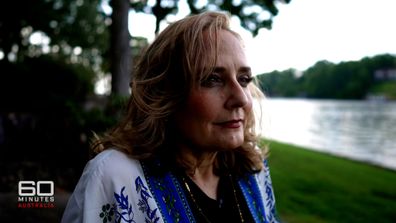
Among those with suspicions is Maria Farmer, who was hired, and abused by Jeffrey Epstein in the mid-1990s. During that time, Maria says she witnessed first hand how close her boss was to Donald Trump.
Speaking with 60 Minutes, Maria claims she had a disturbing encounter with Donald Trump in Epstein’s Manhattan office late at night in 1995.
Maria Farmer worked for Jeffrey Epstein in the mid 1990s. (60 Minutes)
Maria claims Epstein summoned her to the office, where she first met Trump. She says after she arrived, Trump walked in and looked at her with a “Cheshire grin”, to which she made the “ugliest face” she could think of.
Maria claims Epstein “thought it was adorable”. He then, according to Maria, told Trump “she’s not here for you,” and took him out of the room.
“So he escorts Trump into this other room and Trump utters under his breath, he mutters, “Oh, I thought she was 16,” and I thought that was just really weird,” she told 60 Minutes.
“It was beyond locker room talk.”
Maria says she reported Epstein and his accomplice, Ghislaine Maxwell to the FBI in 1996 and mentioned Donald Trump as someone who associated with the pair, but says authorities did nothing. She is now suing the US government for failing to protect her.
The White House contested Maria’s version of events and said Trump ‘was never’ in Epstein’s office.
A turning support base
Donald Trump has been particularly adept in his ability to endure scandal. In the last five years, the President has faced 91 felony counts, four criminal indictments, two impeachment trials and in a civil case has been found liable for sexual abuse.
Some MAGA supporters have turned on President Trump over his broken promise. (60 Minutes)
Yet, last November a majority of Americans still voted for him to lead them. But, with the promise of exposing Jeffrey Epstein’s darkest secrets as a significant campaign platform, many voters have been left feeling betrayed.
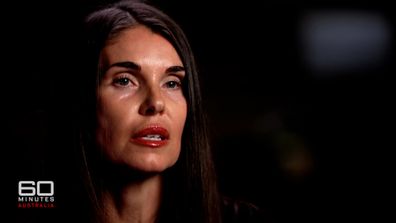
Among them is Teresa Helm, who was lured into Jeffrey Epstein’s dark orbit when she went for a job interview in 2002 at just 22 years old. At the time, Teresa was studying massage at a Los Angeles college.
Teresa says she was sexually assaulted by Epstein but it was years before she realised she was one of hundreds of young women ensnared in his depraved world.
“It was definitely systematic. Everything was pre-planned, prearranged, organised,” she told 60 Minutes.
Teresa Helm voted for Trump in last year’s election based on his promise to declassify the Epstein files. (60 Minutes)
“It’s impossible to do everything that they’ve done and harmed as many people as they have harmed without help … so, who are they?”
Teresa voted for President Trump in last year’s election because she believed he would expose Epstein’s wider network. And she’s not alone – videos posted on social media show supporters burning MAGA hats in response to Trump’s bumpy handling of the scandal.
“I think that that comes certainly when you make statements and promises and then you walk it back,” Teresa said.
What’s next for Donald Trump?
Pollster and political analyst Frank Luntz has done more focus groups with Trump voters than just about anyone in the United States. So he knows why, even in the face of scandal, Trump’s base is unshakeable.
“Donald Trump is the ultimate survivor.”
“His own voters aren’t voting for him because of his character. They’re voting for him because he’ll bring about the change they want and they need, and frankly, they deserve,” he told 60 Minutes.
While Luntz thinks his supporters are concerned about the President’s mishandling of the Epstein files, he doesn’t believe it will have a meaningful impact.
Frank Luntz says Donald Trump’s mishandling of the Epstein files may not harm him in the long-term. (60 Minutes)
“Donald Trump is the ultimate survivor, and I expect nothing different about this current situation.”
Will Sommer is not as convinced. He told 60 Minutes that Trump’s handling of the files has prompted serious questions from his supporters.
“It looks like he’s covering something up that he’s either covering up his relationship with a wealthy paedophile or that he’s maybe covering up for one of his friends,” he said.
“I think it will be a huge hit to his political capital and his prestige. I think this is a serious issue.”
“And I think it’s gonna haunt the 2028 presidential race too.”
BEVERLY HILLS, California, Aug 16 (Reuters) – Director Spike Lee’s multi-part documentary series for ESPN Films about former NFL quarterback Colin Kaepernick, who sparked a national debate when he protested racial injustice nearly a decade ago, will not be released, the filmmaker and ESPN said.
“ESPN, Colin Kaepernick and Spike Lee have collectively decided to no longer proceed with this project as a result of certain creative differences,” ESPN said in a statement to Reuters on Saturday.
The Reuters Daily Briefing newsletter provides all the news you need to start your day. Sign up here.
“Despite not reaching finality, we appreciate all the hard work and collaboration that went into this film.”
Lee told Reuters on Friday that the series was not going to be released.
“It’s not coming out. That’s all I can say,” Lee said on the red carpet ahead of the Harold and Carole Pump Foundation dinner, a fundraiser for cancer research and treatment, in Beverly Hills, California.
Asked why, the Oscar-winning director declined to elaborate, citing a nondisclosure agreement.
“I can’t. I signed a nondisclosure. I can’t talk about it.”
Kaepernick played for the San Francisco 49ers from 2011 to 2016. He ignited a national debate in 2016 when he knelt during the U.S. national anthem to protest systemic racism and police brutality.
The 37-year-old athlete has not played in the NFL since that season. Many experts believed his political activism, which triggered a movement that drew the ire of U.S. President Donald Trump, was the key reason teams were wary of signing him.
He later filed a collusion grievance against team owners, which was settled with the league in 2019.
A representative for Kaepernick said the player had no comment about the docuseries on Saturday.
Production on the series began in 2022, with Walt Disney-owned (DIS.N), opens new tab ESPN touting it as a “full, first-person account” of Kaepernick’s journey that would feature extensive interviews with the player.
In September, Puck News reported the project faced delays amid disagreements between Kaepernick and Lee over the direction of the film, and that ESPN Chairman Jimmy Pitaro was open to allowing the filmmakers to shop it elsewhere.
Help Outreach Working Group lift the fog of corporate media. Donate to help us maintain this website and distribute literature on the street.
One Million Rising: Strategic Non-Cooperation to Fight Authoritarianism Virtual Event · Hosted by No Kings Time Wednesdays 8 – 9:30pm EDT Location Virtual event Join from anywhere About this event Across the country, authoritarian forces are getting bolder and more dangerous. Trump and his allies are not hiding their agenda: mass deportations,... Continue reading →
THURSDAY, JUNE 29, 2023 AT 2 AM – 4 AM PDT How to create trust in a group? Details Event by Extinction Rebellion Empathy Circles online EMPATHY CAFE Duration: 2 hr Public · Anyone on or off Facebook How to create trust in a group? This is the question that arose in our... Continue reading →
When you volunteer for Saikat, it’s on us to give you a great experience and a genuine chance to make a difference. We don’t want to waste a second of your time. That’s why we’re always optimizing. And I’m excited to report that this Saturday we talked with 300% more... Continue reading →
This Sunday’s Town Hall: Announcing This Week’s Progressive Town Hall: Every Sunday at 4pm ET/1pm PT RSVP HERE Join PDA activists online from across the country to discuss the importance of progressives reclaiming the American story from the MAGA right, an issue of heightened importance as we’re now within one... Continue reading →
https://us06web.zoom.us/j/83499963761?pwd=x6vbYvt5bywKggEjac4QV2vf71MGKc.1 A new world order? More like a New World chaos. Kidnaps and cannons. Dionne quintuplets. Canadian cruelty. Rest in pentapeace. (1) Return to the moon? Well, around it, anyway. No cheese eating yet. Measles, flu, the blues. Weight loss pills and vaccine thrills. Not rid of Covid. Epstein? Epstein... Continue reading →
Honor Dr. King’s Legacy Through Service This MLK Jr Day Dr. Martin Luther King Jr. understood that true freedom meant more than legal equality. It required a society where everyone had access to food, shelter, and dignity. He believed that “everybody can be great, because everybody can serve.” This year,... Continue reading →
We protest Heritage Foundation EVERY MONDAY (Join us!!!!) By admin | September 2, 2025 | Uncategorized Cliff Cash Comedy Premiered Jul 26, 2025 Every Monday at The Heritage Foundation 214 Massachusetts Ave. Washington D.C. 4pm protest 6pm pizza Every Friday at Fox News D.C. 400 N. Capitol St. Washington D.C. 4pm protest 6pm pizza We are... Continue reading →
One Million Rising: Strategic Non-Cooperation to Fight Authoritarianism Virtual Event · Hosted by No Kings Time Wednesdays 8 – 9:30pm EDT Location Virtual event Join from anywhere About this event Across the country, authoritarian forces are getting bolder and more dangerous. Trump and his allies are not hiding their agenda: mass deportations,... Continue reading →
THURSDAY, JUNE 29, 2023 AT 2 AM – 4 AM PDT How to create trust in a group? Details Event by Extinction Rebellion Empathy Circles online EMPATHY CAFE Duration: 2 hr Public · Anyone on or off Facebook How to create trust in a group? This is the question that arose in our... Continue reading →
When you volunteer for Saikat, it’s on us to give you a great experience and a genuine chance to make a difference. We don’t want to waste a second of your time. That’s why we’re always optimizing. And I’m excited to report that this Saturday we talked with 300% more... Continue reading →


 by
by