


Alec Regimbal, SFGATE
State and local officials throughout California are busy drafting proposals for reparations packages, seen as a way to make amends to the state’s Black residents whose families were impacted by slavery and the decades of racial discrimination that followed.
The state’s reparations task force has spent more than two years on the issue and must make recommendations to the California Legislature by July 1. The San Francisco Board of Supervisors recently expressed support for proposals made by a city-appointed reparations committee, and school districts in Berkeley and Oakland are weighing reparations for students, too.
The massive reparations package being discussed in San Francisco has garnered international attention and includes proposals such as direct one-time payments of $5 million, the elimination of all personal debt, a guaranteed income of $97,000 per year for 250 years and the opportunity to buy homes within the city limits for $1.
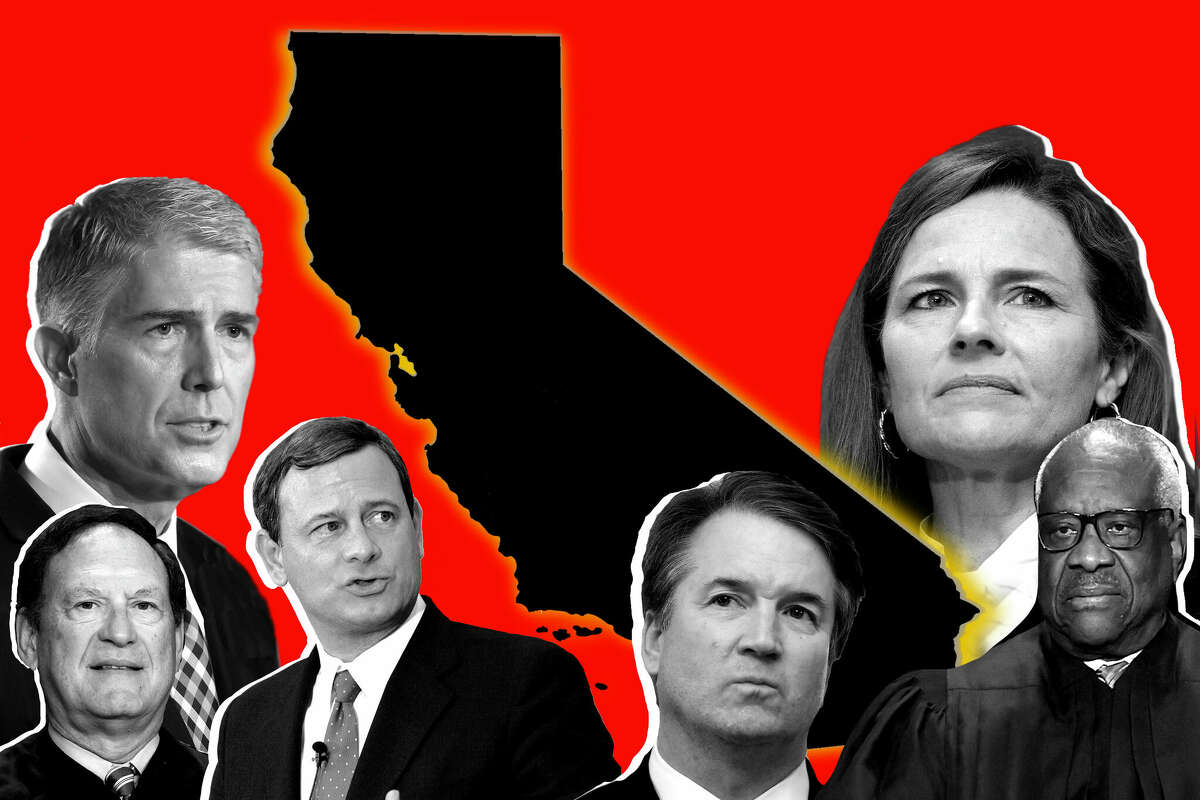
But there’s a good chance many of these reparations plans, even if formally adopted, never actually go into effect thanks to the conservative supermajority on the U.S. Supreme Court.
California legal experts interviewed by SFGATE believe that the simplest form of reparations — benefits to all Black residents — will be dead on arrival.
“If they just said, ‘People of a particular race get these benefits,’ then that, I think, would almost certainly get struck down,” said Gabriel J. Chin, a law professor at UC Davis.
The legal issue most likely to be at play in a case against reparations would be the Equal Protection Clause of the 14th Amendment, which generally prohibits public institutions from offering preferential treatment to one category of people over another. Any policies that sort people by racial categories — known as “racial classifications,” in legal parlance — are typically seen as a violation of the Equal Protection Clause, unless governments can provide a strong justification for them.
“The court’s rules about what the Equal Protection Clause means and how they will enforce it say that they are very suspicious of some forms of discrimination but not of other forms of discrimination,” said David B. Cruz, a law professor at the University of Southern California. “And when government action is expressly based on race, then the court is very suspicious, not deferential, and will typically invalidate such government action.”
The legal standard applied in such cases is known as “strict scrutiny,” and to meet that standard, governments must show that the policies they’re trying to implement serve a “compelling governmental interest.” But that’s a very tough bar to meet.
Even affirmative action policies at public universities, which have been repeatedly determined to serve a compelling government interest by the courts, are likely to be declared unconstitutional by the current Supreme Court in June.
If affirmative action is deemed unconstitutional, are reparations doomed to suffer the same fate? Cruz said it’s important for legislative bodies to avoid creating racial classifications in their reparations packages if they want to give those policies a chance.
“Once it gets kicked into the racial classification side of the doctrine … that would give the court lots of tools to try to strike down this kind of measure,” Cruz said.
He said those classifications may be avoided if the officials drafting the plans define the beneficiaries as the descendants of slaves — and not by their race. In other words, if only the descendants of slaves qualify for reparations, one could successfully argue that the reparations policies aren’t about race, which would mean that the standard of strict scrutiny wouldn’t apply.
Last year, for example, California’s reparations task force decided that only Black Californians who can prove a direct lineage to enslaved ancestors should be eligible for benefits. That excludes Black residents whose ancestors were free, as well as Black immigrants from other nations. The Legislature could change that, but both Chin and Cruz argued that an ancestry requirement would help support a legal argument from the state that any reparations policies aren’t about race.
Chin pointed to the Civil Liberties Act of 1988, which gave $20,000 checks to surviving Japanese Americans who were forced into internment camps during World War II. While the Supreme Court never ruled on the legality of those payments, Chin said they serve as an example of reparations being awarded to one race of people because of an injustice they suffered at the hands of the federal government.
“It’s not that Japanese Americans as a whole were each offered a check; it was the victims of what the United States was acknowledging was illegal and, in a certain sense, was discrimination,” he said.
However, Cruz acknowledged that such a strategy isn’t foolproof. If reparations are awarded only to the ancestors of those who were enslaved, he said the Supreme Court may decide that the slavery requirement serves as a “proxy” for race.
“If the court says, ‘Well, you’re writing it in terms of a legal status — enslavement of an ancestor — but we know who were enslaved, and that was racial,’ they could conclude that really this is a proxy for race, that it’s just wordplay to deny that it’s about a racial group,” he said. “Then they would subject it to that very demanding standard.”
He pointed to Rice v. Cayetano, a 2000 Supreme Court case that involved elections for the Office of Hawaiian Affairs, as an example of the proxy reasoning. Previously, voting for trustees for that office was limited to people who had ancestors in the Hawaiian Islands dating back to the 1770s. But a rancher of European descent sued the state, saying that requirement was impermissible racial discrimination.
The court sided with the rancher, saying that — even though the voting qualifications were defined in terms of ancestry — those qualifications served as a proxy for race, which made the law unconstitutional.
“That, to me, would be a precedent that defenders of a reparations measure would need to engage with and try to find ways to distinguish it from,” Cruz said.
Jon Michaels, a law professor at UCLA, said he believes any legislative body in California could draft a reparations plan that would survive even the most thorough constitutional review. However, he said that might not matter given the current makeup of the Supreme Court.
“Staring down the barrel of a court that is gunning for any type of racial classifications, it makes it incredibly tricky,” he said.
He said he could see the court overturning an ancestry-based reparations plan for two reasons. First, those receiving benefits may not be the people who were directly injured. And second, the actual injury happened too long ago, especially when you consider the ostensible advances that the U.S. has made when it comes to race, like the Civil Rights Movement.
He argued that those two reasons alone shouldn’t be death knells for a reparations plan, especially since they don’t take into account how pervasive racism against Black Americans has been since the end of slavery. He said a reasonable court would recognize that a reparations package would serve a compelling governmental interest but also acknowledged that he has to be realistic when thinking about the current court.
“Even less right-wing courts have proven to be increasingly hostile to racially ameliorative legislative programs,” he said.
Regardless of what happens with commitments to redress Black residents in California, the legal experts interviewed by SFGATE largely agreed that the conversation is still important to have, even if nothing concrete comes out of it.
“[The court likely striking it down is] not a good enough reason to ignore essential and overdue conversations (and actions) regarding our most intractable and damaging problems, including chattel slavery and its lingering aftermath,” Savala Nolan, a law professor at UC Berkeley, told SFGATE in an email. “The Court will do what it does — so should the activists, scholars, lawyers, and community members seeking to tangibly and practically respond to the ongoing and demonstrable social, economic, and political brutalities that flow from this country’s practice of racial hierarchy.”
Written By Alec Regimbal
Alec Regimbal is a politics reporter at SFGATE. He graduated from Western Washington University with a bachelor’s degree in journalism. A Washington State native, Alec previously wrote for the Yakima Herald-Republic and Seattle Post-Intelligencer. He also spent two years as a political aide in the Washington State Legislature.


