


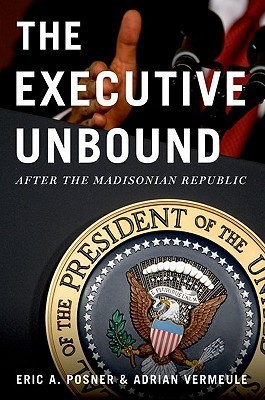
The Executive Unbound: After the Madisonian Republic
Eric A. Posner, Adrian Vermeule
Ever since Arthur M. Schlesinger Jr. used “imperial presidency” as a book title, the term has become central to the debate about the balance of power in the U.S. government. Since the presidency of George W. Bush, when advocates of executive power such as Dick Cheney gained ascendancy, the argument has blazed hotter than ever. Many argue the Constitution itself is in grave danger. What is to be done? The answer, according to legal scholars Eric Posner and Adrian Vermeule, is nothing. In The Executive Unbound , they provide a bracing challenge to conventional wisdom, arguing that a strong presidency is inevitable in the modern world. Most scholars, they note, object to today’s level of executive power because it varies so dramatically from the vision of the framers. But there is nothing in our system of checks and balances that intrinsically generates order or promotes positive arrangements. In fact, the greater complexity of the modern world produces a concentration of power, particularly in the White House. The authors chart the rise of executive authority straight through to the Obama presidency. Political, cultural and social restraints, they argue, have been more effective in preventing dictatorship than any law. The executive-centered state tends to generate political checks that substitute for the legal checks of the Madisonian constitution.
About the author

Eric A. Posner
Eric Posner is the Kirkland & Ellis Professor of Law at The University of Chicago.
His books include Law and Social Norms (Harvard 2000); Chicago Lectures in Law and Economics (Foundation 2000) (editor); Cost-Benefit Analysis: Legal, Economic, and Philosophical Perspectives (University of Chicago 2001) (editor, with Matthew Adler); The Limits of International Law (Oxford 2005) (with Jack Goldsmith); New Foundations of Cost-Benefit Analysis (Harvard 2006) (with Matthew Adler); and Terror in the Balance: Security, Liberty, and the Courts (Oxford 2007) (with Adrian Vermeule). He is also an editor of the Journal of Legal Studies. He has published articles on bankruptcy law, contract law, international law, cost-benefit analysis, constitutional law, and administrative law, and has taught courses on international law, foreign relations law, contracts, employment law, bankruptcy law, secured transactions, and game theory and the law. His current research focuses on international law, immigration law, and foreign relations law. He is a graduate of Yale College and Harvard Law School.
(Goodreads.com)


