


I didn’t understand the machinery of autocratic power, the mechanisms of control, the unspoken rules of party discipline. Now I do. And I see it developing here
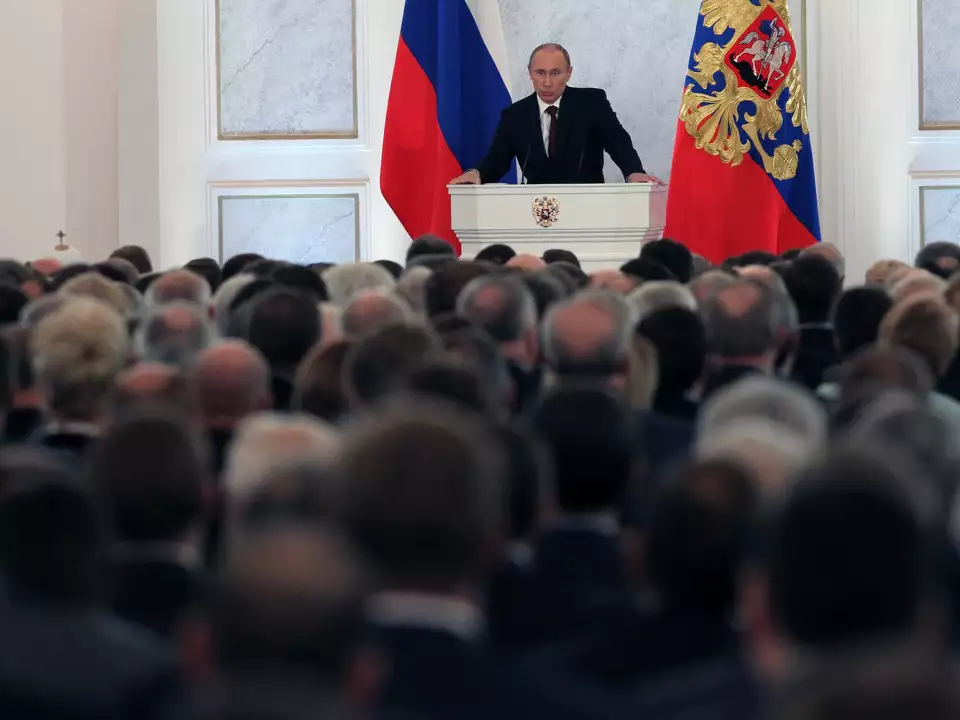
Russian President Vladimir Putin delivers a state-of-the-nation address to the Duma, Russia’s parliament, in 2012. What’s happening in the U.S. today is eerily similar to Russia’s slide to a dictatorship. Sasha Mordovets/Getty Images
By Oxana Pushkina
July 19, 2025 (SFChronicle.com)
When I tell my American friends that they’re closer to becoming Russia than they think, they laugh.
“We have a Constitution,” they say. “We have democracy.”
But everything we once said about Russia — “that could never happen” — has long been a reality. And what I see in America today feels eerily familiar.
I don’t say this as an outsider. I’m a former member of the Duma, Russia’s parliament.
I didn’t enter politics right away. For nearly 25 years, I hosted my own television show, where I told the stories no one else would — especially women’s stories. Domestic violence. Gender inequality. Discrimination. Loneliness. Despair. I tried to help — with words, with visibility, with human connection.
But eventually, I realized that storytelling wasn’t enough. You can’t protect a woman from abuse when there’s no law recognizing domestic violence. You can’t change a broken system just by exposing it.
So, in 2016, I ran for office. And I won. Even though I wasn’t a member of United Russia, President Vladimir Putin’s party, it officially nominated me. Under Russian electoral law, that’s possible: You can be an independent candidate with a party endorsement.
People often asked, “Why are you with them?”
And I always answered — and still do: Because I was pushing through legislation to protect women and children, and at that moment, I needed political power behind me.
I entered politics with one clear mission: to create fundamental, enforceable protections for women and children.
At first, the party didn’t take me seriously. It certainly didn’t see me as a threat. I was a TV journalist, yes, and popular. But convenient. Safe. Someone the party could use to bring in a huge female audience when needed.
Still, my public visibility gave me power — and I used it.
I had limited support in parliament, but strong backing from civil society. Human rights groups stood with me. So did ordinary people. At one point, 90% of Russian citizens supported a draft law on domestic violence. Still, it never passed.
Ultimately, I didn’t yet understand the full weight of what I had walked into — the machinery of autocratic power, the mechanisms of control, the unspoken rules of party discipline. I only began to understand it once I was truly inside.
By 2018, the conservative lobby tightened its grip — infiltrating every corner of public life. Reformers like me were edged out.
When I fought for a law on domestic violence prevention, I was called a “foreign agent.”
“If he hits you, it means he loves you.” As if that were part of the sacred “traditional values” of the Russian people.
They tried to humiliate me, to silence me, to break me.
They didn’t. But I left.
Now I read the news: The U.S. Supreme Court has granted the president the authority to fire federal employees and restructure entire agencies without congressional approval.
People tell me: “It’s just a temporary decision.”
Yes — formally, it is.
But in substance, this is a significant crack in the wall. This is how centralized, unchecked control begins.
In Russia, that moment came in 2004, when Putin abolished gubernatorial elections — also in the name of “efficiency.”
At the time, many accepted it. The country was exhausted — by instability, by economic hardship, by weak regional leadership. The official line was comforting: “We need unity. We need order. We need strong vertical control.” People wanted stability so badly, they let themselves believe it. Others were simply afraid to speak out. And some turned away — weary, cynical, numb. That’s how authoritarianism takes root; it’s not always with tanks in the streets, but through fatigue, fear and false promises.
In the U.S., the Supreme Court decision was issued per curiam, with no author named.
I’m told, “That’s normal. It’s standard practice.”
But I remember how this became a way to blur responsibility in Russia. It ended in complete judicial subordination.
At first, it was low-key. Judges who ruled against the state were quietly removed — reassigned, not reappointed or pressured into silence. Then came the warnings. Those who tried to uphold constitutional rights or challenge powerful officials were smeared in the press, disciplined or even prosecuted. Over time, loyalty replaced professionalism. Obedience became the price of survival. The message was unmistakable: independence was no longer welcome — it was dangerous.
Today, even ordinary judges make decisions with one eye on politics, afraid of crossing an invisible line. There are no independent courts left. Not at the local level. Not at the regional level. Not one.
America is not there yet. But I see the tilt toward a judiciary that acts, not as a neutral arbiter, but as a political actor.
They say, “The president still has to follow the law.”
But I know how that game is played.
In Russia, the government also “follows the law.” Because laws can be rewritten. Circumvented. Ignored.
That’s how elections were canceled. That’s how nongovernmental organizations were shut down. That’s how journalists were labeled “foreign agents.”
Trump’s executive order has no mechanism for congressional oversight.
“But Congress can still intervene,” some argue.
Can it?
In Russia, the parliament still exists — on paper. But it’s called the “mad printer” because it rubber-stamps whatever it is told. Independent political candidates have been effectively frozen out of elections.
No debate. No resistance. Just speed and silence.
America isn’t there. Not yet.
But if a president can bypass Congress — as Trump’s order suggests — the legislative branch ceases to properly balance power.
And there’s something else.
In the U.S., the word “democracy” is still spoken. But listen closely — it’s increasingly met with sarcasm, with cynicism.
In Russia, “democracy” became a dirty word. It’s been replaced by talk of “spiritual values,” “sovereignty” and “traditional norms.”
It didn’t happen overnight. It took decades of propaganda. But it happened.
In the U.S., I see the early signs.
You think this is far away? So did I.
I thought a modern country couldn’t be dragged backward by a regime built on fear, nostalgia and brute power. But in Russia, it didn’t take long.
Once, we had a free press. We had honest elections. We had independent courts. Now we have illusions.
America still has a choice. But the window is narrowing faster than you think. Absolute power doesn’t lie in executive orders. Or in purges. Or in fear. Real power lies in trust. In transparency. In the separation of powers.
If America wants to remain America, it will have to fight for it daily.
Oxana Pushkina is a former deputy in the Russian Duma. She now lives in San Francisco.
July 19, 2025
Oxana Pushkina





Thank you so much for your insightful article. It does not surprise me, but your astute observations are invaluable. I would be interested in what suggestions you might have as to what average Americans can do in this situation. We can do little to sway the major levers of power for at least the next two years.
I read your article in the SF Chronicle and look forward to reading more in the future, and you can also email me.
Thanks again for your valuable work!