


- By Patrick Hoge | Examiner staff writer
- Feb 20, 2026 (SFExaminer.com)
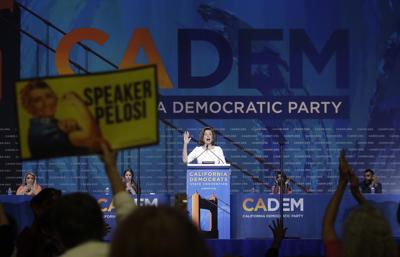
This weekend is a big one for state Democrats, several thousand of whom will converge on Moscone Center in San Francisco to try to decide who to endorse for races for governor down to the Board of Equalization.
The 3,500 delegates and others will be treated to speechifying from party leaders and elected officials, discussions of causes and policy, hospitality suites for schmoozing and workshops and training, including panels on organizing in the “Age of AI” and “Virtual Volunteer Engagement.”
Events around town include a walk at Sunset Dunes Park on Friday afternoon, a California Young Democrats reception at the Hibernia SF on Friday night, a Saturday LGBTQ happy hour at The Alchemist, and a large Saturday night dinner at a local hotel honoring U.S. Rep. Nancy Pelosi, who is not seeking reelection.
Kicking the weekend off, the San Francisco Democratic County Central Committee Friday afternoon will host what is billed as a series of fireside chats with all nine major Democratic candidates for governor at the Commonwealth Club on The Embarcadero. About 400 people are expected to attend the event, for which in-person tickets are sold-out. The event will also be streamed online (enter SFDCCC for free admission).
“Where can you see all nine candidates and be able to draw the comparisons right away between all of them, except for this one special occasion?” said Nancy Tung, chair of the San Francisco Democratic County Central Committee. “So it should be really exciting.”
The likelihood of any of the candidates for the state’s top office walking away with a party endorsement is widely considered to be slight, given the number of people in the race and the requirement for getting 60% of delegate votes.
“What makes it really exciting this year is that we have such an open field of gubernatorial candidates,” Tung said.
“With a field as big and diverse as what we have with these nine candidates, it’s unlikely for anyone to really walk away with endorsement,” but the convention is an opportunity to gain momentum for their campaigns, she said.
In contrast, state Sen. Scott Wiener is a virtual lock to win the California party’s endorsement to succeed Pelosi as the representative for congressional District 11, which covers most of San Francisco.
Wiener got 77.5% of online preconference delegate votes in January, or 117 votes. San Francisco Supervisor Connie Chan had 19.9%, or 30 votes, while no votes went to Saikat Chakrabarti, a thus-far largely self-funded former Stripe engineer who was a top staffer to U.S. Rep. Alexandria Ocasio-Cortez.
Wiener said in a statement that the pre-conference votes he received reflected “strong support from grassroots Democratic Party activists” in San Francisco.
David Campos, vice chair of the state Democratic party and a former San Francisco supervisor, has not taken a position in the District 11 congressional race, but he said he’s hoping to mobilize support for candidates in “10 or so” other congressional districts in the state with an eye to flipping control of the House of Representatives.
“That’s the only way that we can check the power, the unlimited power that [President Donald] Trump has,” said Campos, who characterized the convention as an important galvanizing event for marshaling unity and party energy to win at the ballot box.
Campos identified priority issues as affordability and defending “constitutional protections” from a “corrupt” president who “is out of control.”
“I think that what happens this weekend in California will be critical to whether Democrats will be successful at the national level in November,” Campos said.
Candidates not on the convention’s endorsement consent list like Wiener must try to win enough support before the final vote Saturday night by working the crowd at Moscone Center, where exhibitors will include candidates and a wide variety of interest groups, including unions, environmentalists, pro-housing development advocates and others.
While the convention’s central focus will be the Saturday night voting for candidate endorsements, San Francisco District 5 Supervisor Bilal Mahmood said it was fortuitous for other reasons that the event should be held in The City.
Mahmood said that with crime down and a new mayor and Board of Supervisors majority getting results, such as the recently passed Family Zoning Plan, which aims to accommodate more housing development, The City is “showing how a Democratic city can function.”
“We are showing every day now in San Francisco that our progressive values are not in conflict with good governance,” Mahmood said.
Among the hospitality suites at Moscone, billionaire environmentalist and gubernatorial candidate Tom Steyer, who is promising to make life in the state more affordable, will host a “California You Can Afford” lounge with “food, quick games, conversation and a chance to share ideas and be a part of making change happen,” according to the convention agenda.
Service Employees International Union-United Healthcare Workers West will have a hospitality suite of its own to promote its proposal for a ballot initiative to impose a one-time 5% tax on billionaires in California. The union is currently collecting signatures to qualify a measure for the November ballot.
Renée Saldaña, a union spokesperson, said SEIU-UHW expects to host nearly 50 delegates and others with food and drink and a message about “how California voters can have the chance to make billionaires pay their fair share to help prevent a health care collapse.” The union will also have a booth.
Quick on the heels of the state Democratic Party’s endorsement convention, the San Francisco Democratic County Central Committee will meet Wednesday and possibly consider whom to endorse in the upcoming June primary election in several races for local office as well as what positions to take on two ballot measures.
The races the committee may take action on include those for supervisor for District 2 and District 4, a seat on the San Francisco Unified School District Board of Education and a superior court judge seat.
Ballot measures include a $535 million bond measure for earthquake safety and emergency response and a charter amendment that would change the current limit of two consecutive terms for mayor and supervisors to a lifetime limit of two terms, whether or not successive.
In March, the local party committee is expected to consider two more competing local tax measures likely headed for the June ballot. One is a union-backed initiative that would increase The City’s Overpaid Executive Tax, which levies charges on large companies at which the highest-paid manager makes more than 100 times the median of what employees are paid in San Francisco.
The other, a competing measure backed by business groups, would exempt most businesses that have up to $7.5 million in San Francisco gross receipts from The City’s gross-receipts tax and Overpaid Executive Tax. It would also accelerate an increase in the Overpaid Executive Tax rate that is scheduled for the 2028 tax year so that it would apply in the 2027 tax year.


