


By Rachel Swan, Staff Writers June 18, 2026 (SFChronicle.com)
Gift Article
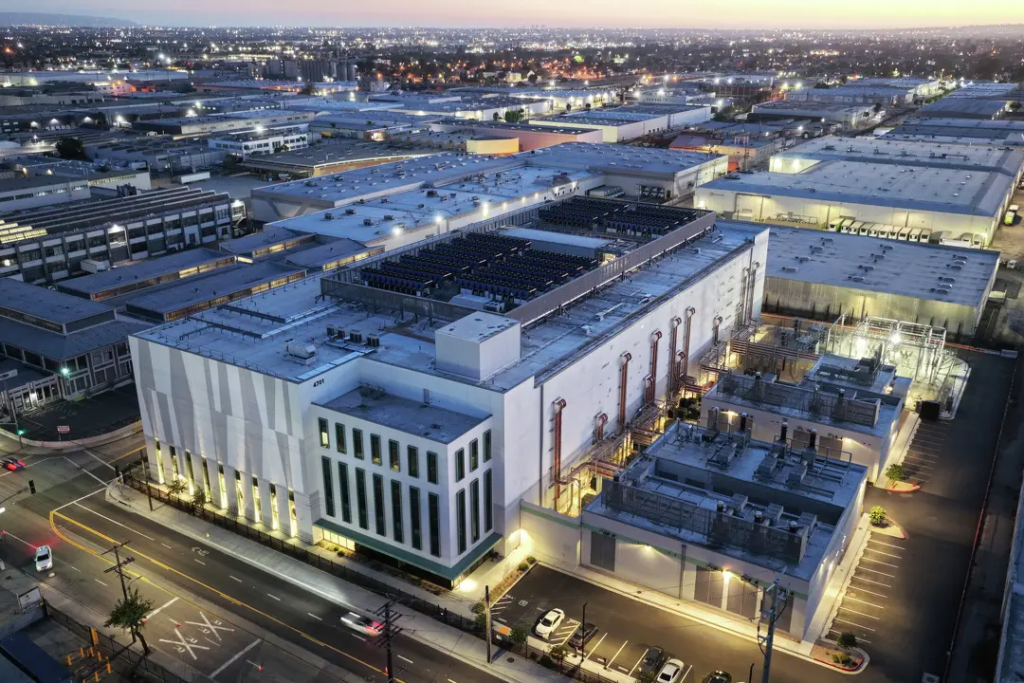
A surge in demand for AI infrastructure is fueling a boom in data centers, such as this 33-megawatt facility with a closed-loop cooling system in Vernon, just south of downtown Los Angeles. That could mean more data centers near the state’s high-speed rail line.Mario Tama/Getty Images
One day, bullet trains could zip from a palm-lined street in Anaheim to the foot of Salesforce Tower in SoMa.
Along the way, they may pass through a new kind of California landscape: vast acres of warehouses, all humming with servers. These buildings could be essential to the rail system’s survival.
That’s the dystopian future that Visalia (Tulare County) resident Joseph Mello conjured when he addressed the High-Speed Rail Authority board on June 1. Mello said he had read the draft business plan the board was set to approve that day, and one particular element struck him. The plan proposed leasing land or providing energy for data centers that could be built in the Central Valley, fueling a massive tech boom up north.
“As a potential rail user,” Mello said, “I do not want to ride through a valley of data centers.”
He was not alone. Much of the public comment period during the board’s June 1 meeting zeroed in on this new form of industrial development, and how high-speed rail might shape it. People worried that data centers would consume staggering amounts of water, release toxins into the soil, create noise, cause runaway fires should their battery storage ignite, and despoil the loamy, farm-checkered land. They echoed the concerns of small towns across the country whose councils are banning these facilities, viewing them as symbols of techno-colonialism.
Officials at the High-Speed Rail Authority see it differently. After the Trump administration yanked $4 billion in federal funding, California was left on its own to lay 171 miles of track from Merced to Bakersfield, then extend it north to the Bay Area, and south to Los Angeles, at a cost of $126 billion. The agency’s only option, according to CEO Ian Choudri, is to monetize every asset associated with the nascent rail network, from land along the right-of-way to surplus electricity to fiber-optic connections. Developers of “hyperscale” data centers are a perfect market for these resources, and many of them are eyeing the rural hinterlands where high-speed rail is currently under construction.
“We do have a corridor that will have fiber connectivity, renewable power and clean power available,” Choudri said during the June 1 board meeting. “We heard that some of these hyperscalers are actually having active discussions in the Central Valley about their intent to provide data centers.”
Choudri told the Chronicle that he had heard of one such discussion underway between officials in Kern County and a prospective data center developer, though he was not directly involved in the conversation. (Representatives of Kern County did not immediately return phone calls seeking comment.)
To pave the way for potential leases of land, fiber or electric transmission along the corridor, the rail authority has signed a co-development agreement with a consortium of infrastructure investors. They would act as a kind of intermediary for the rail line, helping match assets in the rail right-of-way with companies that would pay to use them. Within a few months Choudri expects to finalize a second agreement with another group of investors, this one focused on generating revenue from the solar arrays, wind farms, substations or batteries that will power the trains. The deals represent a strategic response to a harsh economic reality. Transit can only earn so much from the fare box. For high-speed rail to be self-sufficient, every piece of the system must be treated as possible income.
People involved in the megaproject hope these public-private transactions will get the Merced-Bakersfield portion in service by 2033, enabling a quick expansion to Gilroy so the full San Francisco-Los Angeles railway could open seven years later. That timeline would be welcome news for Gov. Gavin Newsom, who needs to show progress toward California’s most ambitious transportation dream should he decide to run for president. Choudri, meanwhile, has offered a practical rationale for courting the private sector. Once the track and stations are built, state law requires high-speed rail to fund its own operations. Data centers could supply a financial lifeline. Project insiders believe, moreover, that if tech companies have a vested interest in high-speed rail, they could help boost its political support.
“This is where AI in Silicon Valley is going,” Choudri said in an interview. “We just need to be mindful that if they’re doing something in the Central Valley, and they need some support services from us, we are going to put that on the table for our investors.”
Still, at least one observer acknowledged Newsom’s fragile position. Always an evangelist for innovation and new mobility, the governor now has to display “serious policy chops” if he’s making a bid for the White House, said David McCuan, a political science professor at Sonoma State University.
“He has a time frame that’s measured in months” to get the project under control, McCuan said. “And that means he has to embrace the latest, greatest, most divisive devil in politics, which is data centers.”
Steve Kawa, the new High-Speed Rail Authority board chair who served as Newsom’s chief of staff when the governor was mayor of San Francisco, said adamantly that the authority is “not proposing to build or operate data centers,” even though data centers built by others could be part of its commercial strategy.
“Let me be clear,” Kawa wrote in a statement, “the first and only priority is building out a world class high-speed rail system in California. All the work of the Authority is done in service of that goal.”
The challenge for the rail authority is winning over cities that wanted trains, not tech infrastructure. Madera Mayor Cecilia Gallegos insisted her city would reject any plans for data centers because of their heavy water consumption. A spokesperson for Bakersfield said city leaders had not heard information about “proposals to lease land” for data centers around the high-speed rail corridor.
Article continues below this aMerced Mayor Matthew Serratto recalled a hearing vague rumor that data centers might rise on the outskirts of Merced County. He mistrusts them for many of the reasons his constituents cited, including the scarcity of water and strain on the grid. Serratto noted, further, that Central Valley residents do not want outside forces “dictating” land-use decisions in the region.
“Ian’s got big ideas,” Serratto said, referring to Choudri. “He’s very plugged in with the Silicon Valley types. He’s a move-fast, visionary kind of guy, and he wants this project to pay for itself.”
Serratto managed a dry laugh.
“But really,” he said, “just build the train, dude.”


