How Chicago’s Division Street Rebellion Brought Latinos Together

In 1966, Police Shot a Young Puerto Rican Man. What Followed Created a Blueprint for a New Kind of Solidarity

By Felipe Hinojosa August 13, 2025 (ZocaloPublicSquare.org)

The 1966 Chicago uprising on Division Street isn’t as well-known as other 1960s protests, but it’s significant for paving the way for multiracial and pan-Latino coalitions and organizations across the United States, writes historian Felipe Hinojosa. Credit: Illustration by Rafael Francisco Salas

Chicago hit a boiling point on Sunday evening, June 12, 1966, just one day after the city’s first Puerto Rican Day parade. Police shot a young Puerto Rican man, Arcelis Cruz, in an alley near the Humboldt Park area. Officers said Cruz had pulled a gun. Witnesses refuted the claim. Crowds of young Puerto Ricans, continuing the celebration at a nearby music festival, heard the shot and poured in to see what was happening. Anger mounted quickly; protesters hurled rocks at police and busted store windows along Division Street as police threatened them with their guns and riot sticks. Over three days, what started as a protest turned into a full-scale rebellion. The unrest stretched a mile along Division Street, one of Chicago’s major east-west thoroughfares, from West Town to Humboldt Park, involved more than 80 police officers and a K-9 unit, and resulted in 50 arrests, countless injuries, and millions of dollars of destruction.

The Division Street “riots,” as they came to be called, marked an important moment in U.S. history. They were part of a wave of charged protests during the 1960s, from Harlem and Newark to Watts, as Black and Brown Americans expressed frustration over poverty, police brutality, joblessness, and housing. The Chicago uprising isn’t as well-known as others, but it’s significant for paving the way for multiracial and pan-Latino coalitions and organizations across the U.S. Led by a pair of Mexican immigrant brothers, Obed and Omar López, the movement for solidarity seeded by Division Street would shift the city’s landscape of activism and coalition building, uniting Puerto Ricans with Mexicans and other recent arrivals. Ultimately, it helped create a new style of democracy, rooted in rage, that established Latinos as a legitimate local political force.

Located just west of the Chicago River and northwest of downtown, the West Town and Humboldt Park neighborhoods had long been home to an ethnic mix of Europeans (primarily Polish, German, and Norwegian). Puerto Ricans began moving in during the late 1950s and early 1960s after highway construction projects in the name of urban renewal pushed them out of Chicago’s Near West Side “just steps ahead of the bulldozers,” as historian Lilia Fernández wrote.

They brought with them the smell of Caribbean foods, the sight of Puerto Rican flags hanging from rearview mirrors, and the sound of salsa music on Sunday afternoons at the park. By 1970, Puerto Ricans made up nearly 40% of the neighborhood’s residents. But as the deindustrializing economy wobbled, racial tensions escalated as the ethnic whites blamed declining property values on the newcomers.

Troubles also flared between Puerto Ricans and police, who harassed and targeted them—sometimes simply for gathering on street corners or walking through the park. In the summer of 1965, just a year before the rebellion, police brutally beat several young Puerto Rican men in a dispute over fire hydrants. “Residents of the Division Street area shared a pervasive belief,” sociologist Félix M. Padilla wrote, “that policemen were physically brutal, harsh, and discourteous to them because they were Puerto Ricans; that policemen did not respond to calls, enforce the law, or protect people who lived in this community because they were Puerto Ricans.”

So it was hardly a surprise when the streets erupted, calming down only on the third day, when an overwhelming police presence flooded the area. But what happened in the weeks and months that followed changed the course of the Latino experience in Chicago forever.

When the shooting occurred and the commotion began, brothers Omar and Obed López were standing a block away, waiting for an order of tacos at Doña Maria’s restaurant. They sprang into action, joining friends and community leaders to calm the fury, and helping keep others safe by pointing them to hiding spots. The Lópezes were from Mexico, which made them unusual in the neighborhood; while Mexicans and Puerto Ricans lived in proximity in the Near West Side in the 1940s, urban renewal projects largely drove them to different parts of the city in the next two decades. Rebellion, however, would join them together again. Relative unknowns in the neighborhood, in the coming months and years, the López brothers would become known across Humboldt Park and Chicago as leaders of the Latino community.

Led by a pair of Mexican immigrant brothers, Obed and Omar López, the movement for solidarity seeded by Division Street would shift the city’s landscape of activism and coalition building, uniting Puerto Ricans with Mexicans and other recent arrivals.

In the immediate aftermath of Division Street, neighborhood activists who had been touched by the rebellion—youth, families, religious leaders—decided there was no going back. Cultural recognitions like a Puerto Rican Day parade, they vowed, would no longer be enough. Chicago’s Puerto Ricans began planning direct political action. Throughout the second half of 1966, they organized peaceful rallies at Humboldt Park, participated in the Chicago Commission on Human Relations hearings on police brutality, and marched to city hall. There, they demanded full citizenship rights and decried how housing discrimination, lack of jobs, poor city services, and police brutality structured everyday life.

But it would be the work of grassroots organizations, and leaders like the López brothers, that built lasting Puerto Rican political power and laid the foundation for multiracial and pan-Latino community organizing. In the months after the Division Street rebellion, Obed López tried to help the cause by joining the Puerto Rican-only Spanish Action Committee of Chicago (SACC). “I thought to myself, if I can’t be in SACC because I’m Mexican, I still wanted to do something,” López told his fellow activist and Chicago organizer José “Cha Cha” Jiménez in a 2012 interview. So López founded the Latin American Defense Organization (LADO).

LADO was non-violent but “aggressive in the political sense,” López said, as well as welcoming to all Latin Americans in Chicago. LADO first worked to get Division Street protesters out of jail. Soon, it turned attention to delivering resources to the community, including helping families navigate the welfare system. And in 1969, LADO was part of a major political action in partnership with the group Cha Cha Jiménez had founded, the radical Young Lords Organization—whose minister of information was Omar López.

Originally a Puerto Rican gang, the Young Lords evolved into a radical political organization just two years after the rebellion in order to fight urban renewal policies that targeted Puerto Rican families in the Lincoln Park neighborhood, just two miles from where the rebellion started on Division Street. The Young Lords were also pioneers in coalition-building; together with white radicals and the Black Panther Party, they formed the first Rainbow Coalition, which brought together groups along shared antiracist class struggles. And along with LADO, in 1969, they occupied McCormick Seminary in response to the school’s indifference to Latino families losing their homes in Lincoln Park. The López brothers played an integral role in the occupation—Omar as a member of the Young Lords and Obed as the key spokesperson for the entire occupation, which he called “an act of love.” After five days of peaceful protest, the Seminary agreed to provide funding for social services like daycare and a public health clinic in the Armitage Methodist Church, community educational workshops on Puerto Rican history, and an architectural plan for mixed-income housing. The occupation brought national attention to the struggles of Latinos in Chicago that inspired similar movements in barrios across the country including in Houston, New York, and Los Angeles.

Born in rebellion, in a city marked by segregation, LADO and the Young Lords propelled Latinos into the center of a multiracial civil rights movement that encouraged families to speak out on the issues that mattered to them. The solidarity of the movement would later fuel political coalitions like the one that elected Harold Washington, the city’s first Black mayor, in 1983. Chicago’s Latinos were no longer invisible; “the riots,” as Obed López made clear, “were what gave birth to the political movement in this community.”

Almost 60 years later, most Americans know nothing about the rage that fueled change in Chicago’s neighborhoods, next to nothing about the place of Latinos in American history, and just barely more than that about the struggles across the country to secure equal rights, dignity, and the right to call this place home. And yet even in this moment of ICE raids on the streets, I’m hopeful that a new story of the Americas and the United States is being written; one where (im)migrant struggles and grassroots organizing can once again show us what solidarity and democracy look like.


Felipe Hinojosa was born and raised in Brownsville, on the Texas-Mexico border. A historian, he holds the John and Nancy Jackson Endowed Chair at Baylor University.


This piece publishes as part of “What Can Become of Us?,” a collaboration between the Stanford Institute for Advancing Just Societies and Zócalo Public Square.


Primary editor: Eryn Brown | Secondary editor: Sarah Rothbard

DSA Convenes, Argues, and Celebrates

Energized by Zohran Mamdani’s primary triumph, 1,200 DSA members came to Chicago to chart the group’s future.

BY EMMA JANSSEN 

AUGUST 14, 2025 (Prospect.org)

Janssen-DSA 081425.jpeg

ZACH CADDY

The Democratic Socialists of America meeting in Chicago this month

https://trinitymedia.ai/player/trinity-player.php?pageURL=https%3A%2F%2Fprospect.org%2Fpolitics%2F2025-08-14-dsa-convenes-argues-and-celebrates%2F%3Futm_source%3DActiveCampaign%26utm_medium%3Demail%26utm_content%3DDSA%2520Convenes%252C%2520Argues%252C%2520and%2520Celebrates%26utm_campaign%3DDaily%2520Prospect%252008-14-2025&GDPR=%24%24GDPR_MACRO%24%24&GDPR_CONSENT=%24%24GDPR_CONSENT_MACRO%24%24&contentHash=9da0e5f6989f0f025ac9bfe511454f5c4e731de923bcf942c199bcce5ddf1811&unitId=2900001720&userId=a143de11-b5db-4fd1-bdec-b0e6b692767c&isLegacyBrowser=false&isPartitioningSupport=1&version=20250806_0a5cc818db4a5e97910f842e941d2c543416f1d1&useBunnyCDN=0&themeId=140&isMobile=0&unitType=tts-player

CHICAGO – It’s been a tumultuous decade for the Democratic Socialists of America (DSA), and an even more intense year. So when 1,200 delegates from across the country came to Chicago last weekend for the group’s biannual convention, there was much to debrief. And argue about. And celebrate.

Most recently, New York City DSA member Zohran Mamdani burst into national attention after winning the city’s Democratic mayoral primary, beating Andrew Cuomo and becoming a national target for Republicans (and some Democrats). It’s impossible to ignore DSA’s hand in his win: The organization created a network of tens of thousands of canvassers who spent months going door-to-door in all five boroughs to bring voters Mamdani’s socialist message, tightly focused on basic economic issues.

DSA badly needed that victory. Last summer, the organization was hit with three major electoral defeats. First, in the most expensive House primary in history, AIPAC money and corporate Democrats pushed Rep. Jamaal Bowman from his New York seat. Bowman had a complicated history with DSA over his record on Israel (some members had sought to expel him) but nonetheless was endorsed by the group and had been proof that socialists could gain federal office.

More from Emma Janssen

Just two months after Bowman’s loss, Missouri Rep. Cori Bush lost her seat in much the same way. The third defeat was the dispiriting presidential campaign and Trump’s eventual election, which left many DSA members all the more disillusioned with American electoral politics and the Democratic Party’s stance on Palestine.

Every two years, DSA delegates from across the country meet to vote on resolutions and elect their National Political Committee (NPC), which largely steers the group’s direction, though local chapters retain a great deal of autonomy. This year, reckoning with the wins and losses of 2024 and 2025 was top of mind, along with crafting the organization’s response to the genocide in Palestine.

Walking around the massive Chicago convention center that housed the convention, I could see the organization’s concerns and tensions just by looking around. Members wore keffiyehs on their heads or draped over their shoulders. Some caucuses (ideological groups within the DSA) had their own hats (green for the electorally focused Groundwork Caucus), T-shirts (the communist Emerge Caucus had a nice cherry blossom design), and bandanas (worn by the moderate Socialist Majority Caucus). I worried at first that some of these caucus dynamics would unfocus the group and push so-called “sectarian” debate to the forefront. But I left with a much stronger view of the organization, which emerged united on many of its most crucial questions.

“I think it is a critical juncture for the organization. This moment is clearly very dire,” said Colleen Johnston, who joined DSA after President Trump took office in 2017. “Fascism is barreling through the country. And so the urgency is definitely there. And the question for us is: How seriously and clearly are we going to be meeting the moment with urgent, focused power-building demands that are going to unite a broad coalition of people to fight fascism?”

Though some might be concerned by the infighting they saw at the convention (or on social media), I have a more optimistic view after three days of observing debate and speaking to delegates from across the ideological spectrum. Regardless of what happens at the convention, serious material work is being done on the local chapter level across the country, which builds local power.

The Mamdani Effect

One obvious route to power is by winning elections at all levels of government. The majority of DSA members, delegates told me, support its moves into the American electoral system, regardless of their ideological leanings. Many of the group’s furthest-left members, those who might otherwise reject the Democratic Party, actively canvassed for Mamdani, who ran as a Democrat—as have virtually all DSA elected officials who’ve run in partisan elections.

Sammy Zimmerman, a member of the left-wing Emerge Caucus, is one of those members. “I volunteered for several canvassing shifts and petitioning shifts for Mamdani. It was really, really heartening,” they said. “It was definitely the most helpful I felt about a candidate for office in a long time.”

Expand

Janssen-DSA 081425 4.jpg

LEV RADIN/SIPA USA VIA AP IMAGES

Democratic nominee for New York City mayor Zohran Mamdani

That hope helped kick-start a massive growth in NYC-DSA’s membership. Grace Mausser, a co-chair of NYC-DSA and longtime adviser of Mamdani’s, said that the chapter has grown by several thousand members since the June victory. That brings the total number of members in the chapter to 10,500.

These new members are eager to build on Mamdani’s momentum, Mausser said. “[They’re] very excited to see what the organization will be doing in 2026 with our electoral work.” Mausser also noted a number of legislative campaigns built around Mamdani’s agenda, such as their effort to pass revenue-raisers in Albany, which still controls the tax funding necessary to any city initiatives.

Electoral Philosophy

Today, DSA is looking to replicate Mamdani’s success across the country. Minnesota State Sen. Omar Fateh is a democratic socialist running for mayor in Minneapolis. DSA’s National Electoral Commission has endorsed 12 candidates from across the country in municipal elections this year.

And the group made their first 2028 move, passing a resolution called “Unite Labor & the Left to Run a Socialist for President and Build the Party,” which encourages the group to run a presidential candidate in the next election. After Rep. Rashida Tlaib gave a fiery speech to open the convention—“The working masses are hungry for revolutionary change,” she said—some DSA members both on X and in person suggested that she could be a good fit for the role. Whomever the group runs, it will likely be on the Democratic ballot line, in recognition that third parties are not currently viable in the U.S.

Kareem Elrefai, a New York member who was elected to the NPC at the end of the convention, said that resolution was one of his biggest takeaways from the weekend, steering DSA in a power-building direction. He recounted that the body debated whether their 2028 candidate should run as a Democrat or a third-party candidate, but he was happy with the ultimate outcome. “There was an amendment that would have strongly urged us to go independent. I am very excited that it has kept us on the Democratic Party ballot line, not because I’m a proud Democrat, certainty not by any means,” he said. “Third-party agitational campaigns fail pretty consistently.”

It was a Democratic presidential primary campaign that first brought Elrefai to DSA. While working on the Bernie Sanders campaign in 2020, he met dozens if not hundreds of democratic socialists who were eager to build power together. On the day Sanders dropped out, just as the pandemic came crashing down on the country, Elrefai signed up to join DSA “through tears.” He certainly wasn’t alone: The group’s membership shot up by the thousands each time Sanders ran for president (indeed, membership growth had been moribund for three decades until Sanders first declared his candidacy in 2015).

A common criticism of DSA is that its members aren’t serious about gaining electoral power and making material change; the delegates I spoke to fervently denied this claim.

“We’re more electorally focused than we [were] five, six years ago,” said Mausser from NYC-DSA. “There are no longer live debates about whether socialists should participate in electoral contests.”

Now, Mausser said, the debates focus on “how we engage in those electoral contests.” The question of running candidates as Democrats versus as third-party candidates is still one such debate, as Elrefai mentioned.

Zimmerman believes that there isn’t a one-size-fits-all approach to party politics. “A strategic relationship with the Democrats necessarily looks very different in different parts of the U.S.,” they said. “You have places like New York where, basically, the Democratic primary determines the mayoral election. That’s very different than somewhere like Idaho, where … a plurality of people [is] more conservative and wouldn’t vote for a Democrat anyway.”

Some caucuses value electoral politics above other forms of organizing, while others prefer instead to prioritize mutual aid work or labor organizing. But the vast majority of DSA members don’t see these goals as mutually exclusive. “We want to win and wield power,” Johnston summarized. “One of the ways we can do that is through the power of the state, by actually changing conditions in people’s lives. I think there are a lot of other ways that can be done that are not oppositional to electoral politics but actually very complementary.”

Ethan, a member from New York, identified some of those other methods of organizing: “Our theory of change is defined by a diversity of tactics,” he said. “We have members of the organization that are really actively doing labor organizing, running people in elections, doing field organizing in elections and doing street organizing, organizing on college campuses.” The list goes on.

Red Lines for Palestine

Delegates also debated the criteria that would determine their support for politicians’ views and votes on Israel. One resolution passed by the group, “For a Fighting Anti-Zionist DSA,” called for DSA members and endorsed elected officials to be expelled from the group if they give material support to Israel or related lobbying groups like AIPAC or longtime two-state advocate and Likud critic J Street. Members could also be expelled for statements like “Israel has a right to defend itself.” An amendment that would have removed the expulsion clause was voted down. Fully 40 percent of the delegates opposed the unamended resolution, however, and by its criteria, DSA’s NPC could vote to expel Sanders if he were a member, and might also expel Rep. Alexandria Ocasio-Cortez.

The resolution’s passage comes after years of public disagreement within DSA about how to approach Israel and Palestine. Both AOC and Bowman faced censure from DSA due to their votes and comments on Israel. In 2021, Bowman voted to fund Israel’s Iron Dome, attended a trip to Israel sponsored by J Street, and met with Israeli Prime Minister Naftali Bennett. These actions prompted DSA’s NPC to re-evaluate their endorsement of him; they eventually decided to publicly condemn his actions but didn’t expel him from the group.

Last June, the NPC voted to endorse AOC if she followed a short list of demands on Palestine. Less than a month later, the committee withdrew their endorsement (she remained endorsed by NYC-DSA) in part due to her support for the Iron Dome, even as she has consistently joined Sanders in opposing the sale of offensive weapons to Israel and decrying the nation’s bloody apartheid policies.

Expand

Janssen-DSA 081425 2.jpeg

NICK WEBER

Rep. Rashida Tlaib (D-MI) speaking at the convention

After October 7, 2023, some longtime members of the organization left, citing comments other DSA members made in the wake of Hamas killing 1,200 Israelis, as well as the increasingly sectarian politics of many DSA caucuses. My colleague at the ProspectHarold Meyerson, was one such DSA member. Since late 2023, when Meyerson left the group, DSA has worked to articulate a clear anti-Zionist position. The new resolution comes in response to the debates around Bowman, AOC, and the nature of DSA’s policy on Palestine and Israel, drawing brighter red lines on the issue for members and elected officials alike, even as a sizable minority of delegates opposed it.

It was just one time of many that Palestine animated the convention’s attendees. One of the most pressing reasons that DSA is looking toward gaining more power in 2028 is Palestine. In 2024, DSA worked with the Uncommitted movement for delegates to the forthcoming Democratic convention as a way to protest the Biden administration’s continued support for Israel’s war on Palestine, and joined the call for a Palestinian American speaker at the Democratic National Convention. That call was rejected by nominee Kamala Harris and her team. In the early days of her campaign, Harris had tried to signal a superficial difference between her and Biden on Israel, but ultimately toed the party line. Now, Trump sits in the Oval Office and, of course, hasn’t put a stop to Israel’s destruction of Gaza, either. Sixty-one thousand Palestinians have been killed by Israel, and half a million are living in famine conditions.

“I think we as the left really felt the void that was left in 2024 with no presidential candidate,” Elrefai said. “There was nobody up there to anchor our ideas … and that was a mistake, especially in the midst of an ongoing genocide.”

DSA is looking to 2028, but also hopes to make change in the three years before then. “Whether we’re talking about the genocide that’s happening in Gaza, the climate crisis, the rise of fascism, [or] the dismantling of civil society, we don’t have the luxury of time to be setting a plan for figuring things out in two or three or four years,” Johnston said. We have to be acting urgently now.”

Public Struggle

DSA’s debates—whether over Palestine, elections, or anything else—tend to get broadcasted to outsiders (especially over social media). After scrolling on X during the convention, it would be easy to take a cynical view of DSA, whose convention was chock-full of niche arguments, caucus callouts, and oblique and obscure references. But at least some DSA members say that disagreement within the organization is a feature, not a bug.

“Every organization has this level of dissent and disagreement, and we’re just open about it,” Mausser said. “Our debate and our disagreement [are] intentional.”

And on Palestine, Johnston said: “We’re not really interested in … focusing on that inward-facing stuff about who has the perfect position. If you’re against the genocide and you want to stop it, we want to work with you.”

It will remain to be seen if Johnston’s hope for unity comes true, especially due to the newly passed resolution’s expulsion clause. But it seems that years of debate on Israel and Palestine have cohered the organization around a set of guiding principles, including support for the BDS movement.

That’s not to say that all delegates welcomed the disagreements or supported everything the convention did or didn’t do. Elrefai and Mausser both pointed to losses in the convention that deeply concerned them. Elrefai, along with his caucus, Groundwork, wanted to amend the convention agenda to put two issues up for discussion: transgender rights and the Green New Deal. That effort failed.

“The reason I find that as upsetting as I do is that, at a moment where the Democrats have completely failed to be a bulwark against trans rights, at a moment when they’ve largely stopped talking about climate change, that’s an opportunity for us,” Elrefai said. “And if we don’t fill that void, somebody else will.”

Expand

Janssen-DSA 081425 3.jpeg

ZACH CADDY

The NYC-DSA choir leading convention-goers in song

Mausser echoed that frustration. “I am a little disappointed that at the convention we’re not spending a lot of time on the floor talking about some of the biggest existential fights of our time,” she said. “We’re not spending too much [time] on the floor talking about Trump himself, not spending too much time talking about trans rights, but we do have active programs on those things.”

Paul Garver, a longtime DSA member from the Boston chapter, said that he understands why delegates spent less time talking about Trump than they did about, say, Gaza. When it comes to Trump, he said, chuckling, “there’s nothing controversial, so people don’t think it’s interesting!” But speaking more seriously, he reflected on his own activism during the Vietnam War and said that he too had had a narrow focus on the atrocities he saw abroad. “It’s perfectly understandable that Trump didn’t come up” as frequently as some might have expected, he told me.

Mausser, despite her own disappointment about the lack of debate on Trump’s policies, cautioned against seeing convention arguments as definitive statements about DSA. “I think sometimes at convention, we focus on what we disagree on, which is actually pretty small in the scheme of things,” she said. “And it seems like we’re deprioritizing [things we agree on], but in reality … once we go home after this, that’s where most of the work is going to live.”

Marina, a member of the Emerge Caucus from NYC-DSA, said that she came to conference to build coalitions around resisting ICE, work that would follow her back home to New York. After working to pass a resolution calling for action against ICE, she started making connections with kindred members from across the country.

“I was also here to create a national network of immigrant justice organizers, which has now become an ongoing chat and a series of meetings,” she said.

Going Home

After I left the convention hall, I wondered if I’d been swept up in the excitement of being among so many hopeful people, all striving, roughly, in the same direction. At the end of the convention, the NYC-DSA choir led the thousand-strong ballroom in song. Delegates stood for “The Internationale,” some taking their hats off, others waving massive red flags over the crowd. Behind me, a man swayed with his fist held high for the whole song. The singers bounced and smiled as they sang; someone strummed a guitar. But I think there was really something there, behind all the singing.

“Things are starting to feel very real,” Zimmerman said. “I think that’s the vibe at this convention. It really feels like eyes are on us right now, and what we do next as an organization really matters.”

And now delegates have made it back to their home chapters, where the outside world awaits them: Metro DC DSA is organizing against Trump’s takeover of their city; NYC-DSA returns to canvas for Mamdani; DSA-LA teaches their ranks to resist ICE.

“People always say [DSA] is a big-tent organization,” Zimmerman said, “and that really allows it to be this dynamic thing that is able to adapt to the moment and what people are thinking and needing in the moment. So I think what DSA becomes is really always up for debate.”

EMMA JANSSEN

Emma Janssen is a writing fellow at The American Prospect, where she reports on anti-poverty policy, health, and political power. Before joining the Prospect, she studied political philosophy at UChicago and worked as an editor and freelancer.

‘Go Home Fascists’: Protesters Jeer Federal Agents in Streets of DC

Trump Increases Federal Law Enforcement Presence, Deploys National Guard In Nation's Capital

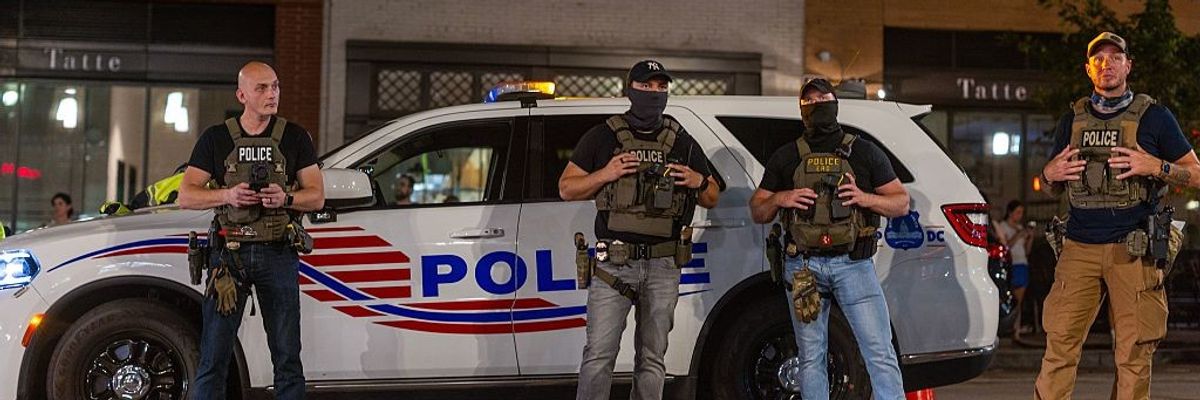
Police officers set up a roadside checkpoint on 14th Street Northwest on August 13, 2025 in Washington, D.C.

 (Photo: Tasos Katopodis/Getty Images)

Demonstrators yelled at federal agents to “get off our streets” as they set up a police checkpoint on a popular street in the nation’s capital.

JAKE JOHNSON

Aug 14, 2025 (CommonDreams.org)

More than 100 protesters gathered late Wednesday at a checkpoint set up by a combination of local and federal officers on a popular street in Washington, D.C., where U.S. President Donald Trump has taken over the police force and deployed around 800 National Guard members as part of what he hopes will be a long-term occupation of the country’s capital—and potentially other major cities.

The officers at the Wednesday night checkpoint reportedly included agents from the U.S. Department of Homeland Security, which is also taking part in immigration raids in the city. Some agents were wearing face coverings to conceal their identities.

After law enforcement agents established the checkpoint on 14th Street, protesters gathered and jeered the officers, chanting “get off our streets” and “go home fascists.” Some demonstrators yelled at the agents standing at the checkpoint, while others warned oncoming drivers to turn to avoid the police installation.

https://youtube.com/watch?v=Ho72b5YnfUc%3Frel%3D0

There was no officially stated purpose for the checkpoint, but it came amid the Trump administration’s lawless mass deportation campaign and its broader threats to deploy U.S. troops on the streets of American cities to crush dissent.

At least one person, a Black woman, was arrested at Wednesday’s checkpoint. One D.C. resident posted to Reddit that agents were “pulling people out of cars who are ‘suspicious’ or if they don’t like the answers to their questions.” The Washington Post reported that a “mix of local and federal authorities pulled over drivers for seat belt violations or broken taillights.”

The National Guard troops activated by Trump this week were not seen at the checkpoint, which shut down before midnight.

Wednesday night’s protests are expected to be just the start as public anger mounts over Trump’s authoritarian actions in the nation’s capital—where violent crime fell to a 30-year low last year—and across the country.

Radley Balko, a journalist who has documented the growing militarization of U.S. police, wrote earlier this week that “the motivation for Donald Trump’s plan to ‘federalize’ Washington, D.C., is same as his motivation for sending active-duty troops into Los Angelesdeporting people to the CECOT torture prison in El Salvador, his politicization of the Department of Justice, and nearly every other authoritarian overreach of the last six months: He is testing the limits of his power—and, by extension, of our democracy.”

“He’s feeling out what the Supreme Court, Congress, and the public will let him get away with. And so far, he’s been able to do what he pleases,” Balko wrote. “We are now past the point of crisis. Trump has long dreamed of presiding over a police state. He has openly admired and been reluctant to criticize foreign leaders who helm one. He has now appointed people who have expressed their willingness to help him achieve one to the very positions with the power to make one happen. And both he and his highest-ranking advisers have both openly spoken about and written out their plans to implement one.”

“It’s time to believe them,” Balko added.

Our work is licensed under Creative Commons (CC BY-NC-ND 3.0). Feel free to republish and share widely.

JAKE JOHNSON

Jake Johnson is a senior editor and staff writer for Common Dreams.

Full Bio >

Another to-do list

Donald Trump’s authoritarian house of cards is propped up by the cowardice and compliance of others in positions of power: business leaders, universities, law firms, media, and more. His authority collapses without their support. But right now, too many powerful institutions are bending and bowing.

We need to show our institutions that we’ll have their back when they fight — and that there’s a real price to pay when they don’t.

In the One Million Rising series that wrapped up last night, we laid out strategies and actions nearly anyone can use to hit Trump’s enablers where it hurts. If you didn’t catch One Million Rising, you can watch all three trainings here.

Now, we’re putting non-cooperation into action on a massive scale! Here are three nationwide initiatives you can join to undermine Trump’s power structures.


1) Slow down ICE with Signs of Solidarity

Masked ICE agents are raiding businesses and workplaces in broad daylight, rounding up our neighbors and purposefully cultivating an atmosphere of chaos and fear. We need business leaders to stand their ground and show immigrant communities we stand with them.

Our Signs of Solidarity program is how you can help make that happen! We’re asking Indivisibles to visit local businesses, speak to small business owners or store managers, and distribute signs that do two things:

  1. Clearly mark “Staff Only” areas to create safe zones where ICE can’t legally operate without a signed judicial warrant
  2. Unequivocally show they stand WITH immigrant workers and clientele and AGAINST Trump’s secret police tactics

Once you’ve signed on below, we’ll give you everything you need to succeed, like guidelines for speaking to businesses, tools to track progress/success, and the signs you’ll help businesses post.

Protect your community from fascist ICE raids by signing up to complete a Signs of Solidarity canvass!

Get started >>

2) Ground Avelo Airlines’ deportation flights

Avelo Airlines is profiting off Trump’s terror tactics. By contracting with the Department of Homeland Security to run their (often illegal) deportation flights, Avelo is complicit in destroying the very same communities it relies on for its business to succeed.

With our allies on the frontlines, we’ve been keeping pressure on Avelo for months — and there are signs that they’re feeling the heat. Now, we need to take our pressure campaign to the next level and finally force Avelo to disavow its work with Trump’s terror cops for good.

Join our campaign to make Avelo’s deportation flights too costly to continue! Use this link to find at-home actions and in-person events in your area.

Ground Avelo >>

3) Fight the Trump redistricting coup

Texas Democrats are bravely showing us what non-cooperation looks like in action! By leaving behind their homes and families — even risking arrest in the process — to block redistricting in Texas, they’re throwing sand in the gears of Trump’s power-grab and reminding us how much courage matters.

But Trump’s map-rigging scheme won’t end in Texas, so we need Democratic leaders and everyday people in every state ready to be brave and fight hard. That’s why we’re proudly supporting a nationwide day of action and rolling out a new toolkit to lead the fight against GOP map-rigging.

Here’s what you can do:

  1. Join a protest this Saturday, August 16, to raise hell and rally support in the fight against the MAGA redistricting coup. We’re gathering across the country to show support for the brave TX Dems, demand courage from Dems everywhere else, and show the GOP their scheme won’t go unanswered.
  2. Check our toolkit to see how folks in your state can respond to Trump’s map-rigging scheme. We lay out where GOP redistricting threats are most dangerous, where Dems can counter with new maps, and how folks in other states can support those on the front lines.

It’s on us — all of us — to hold the line against this new threat, so please make sure you do your part whether you’re in a red, blue, or purple state.


To close out our One Million Rising series, Texas House Democrats’ leader, Gene Wu, reminded us of this:

“It’s fine that people are waking up late. It’s fine that people didn’t get it until now. It’s fine that people didn’t see it until now. But the real question is: Can we change it?”

We can change the direction of this country and stop Trump’s hostile takeover! But it’ll take all of us pulling together — not just on single days of mass action, but through relentless daily organizing and sustained non-cooperation.

The three initiatives above are a start, and there’s so much more to come. Please stay tuned, and thanks for being with us.

In solidarity,
Indivisible Team

Fact-Checking Trump On Crime

Published: August 14, 2025 (TheOnion.com)

President Donald Trump has claimed that crime is “out of control” in the nation’s capital and beyond. The Onion assesses the veracity of the president’s claims. 

Claim: D.C. has endured a record amount of robberies.

Partially true: Some places in Georgetown sell a cup of coffee for $9.

Claim: Chicago, New York, and Los Angeles are crime-ridden cesspools.

False: These cities are safe, vibrant cesspools.

Claim: The National Guard is being deployed to crack down on crime.

False: The National Guard is being deployed to give Stephen Miller an erection.

Claim: Just last week, a high-ranking politician was shot in the head at a D.C. theater. 

False: Trump is mixing up last week with April 14, 1865. 

Claim: Violent foreigners traveled to D.C. to savagely beat Americans.

False: The UFC fight on the White House South Lawn isn’t until next year.

Claim: Basically anything.

False: “False” continues to be a very safe assumption to make.

‘You Have Poked the Bear’: Defiant Gavin Newsom Puts Trump on Notice in Speech Pushing New Maps

'You Have Poked the Bear': Defiant Gavin Newsom Puts Trump on Notice in Speech Pushing New Maps

Gov. Gavin Newsom speaks at Google San Francisco office in San Francisco, California, on August 7, 2025.

 (Photo: Tayfun Coskun/Anadolu via Getty Images)

“Who else sends ICE at the same time while having a conversation like this? Someone who is weak. Someone who’s broken. Someone whose weakness is masquerading as a strength,” said Newsom.

BRAD REED

Aug 14, 2025 (CommonDreams.org)

Democratic California Gov. Gavin Newsom on Thursday struck a defiant tone during a political rally in Los Angeles aimed at promoting a ballot initiative that would allow the state legislature to redraw the Golden State’s electoral maps.

During his speech, Newsom emphasized his preference to having an independent commission draw up districts in California and across the country. However, he said that U.S. President Donald Trump’s push to have Texas Republicans redraw their state’s map in the middle of the decade to gain five more Republican seats in the U.S. House of Representatives has left him with no choice but to return the favor.

“You have poked the bear, and we will punch back,” Newsom said during the speech, addressing Trump directly.

The California governor then explained why doing nothing in response to Trump’s pressure on Texas is not an option.

“[Trump] doesn’t play by a different set of rules—he doesn’t believe in the rules,” Newsom said. “And as a consequence, we need to disabuse ourselves of the way things have been done. It’s not enough to just hold hands, have a candlelight vigil, and talk about way the world should be. We have got to recognize the cards that have been dealt, and we have got to meet fire with fire!”

Newsom also pointed out that several Immigration and Customs Enforcement (ICE) officials had stationed themselves nearby where California Democrats were holding their rally, which he called a deliberate attempt at intimidation.

However, Newsom said that instead of subduing lawmakers and advocates with the mass deportation force, Trump was only exposing his weakness.

“He is a failed president,” Newsom declared. “Who else sends ICE at the same time while having a conversation like this? Someone who is weak. Someone who’s broken. Someone whose weakness is masquerading as a strength. The most unpopular president in modern history.”

Newsom encouraged voters in his state to approve a ballot initiative this coming November 4 that would allow the redrawing of California’s congressional map on a temporary basis before returning to the independent commission that has long been used in the state starting in 2030.

Our work is licensed under Creative Commons (CC BY-NC-ND 3.0). Feel free to republish and share widely.

BRAD REED

Brad Reed is a staff writer for Common Dreams.

Full Bio >

To Beat Back Trump’s GOP in 2026, Progressive Leader Says ‘Corporate’ Dems Must Go

Senate Lawmakers Work On Capitol Hill Ahead Of Summer Recess

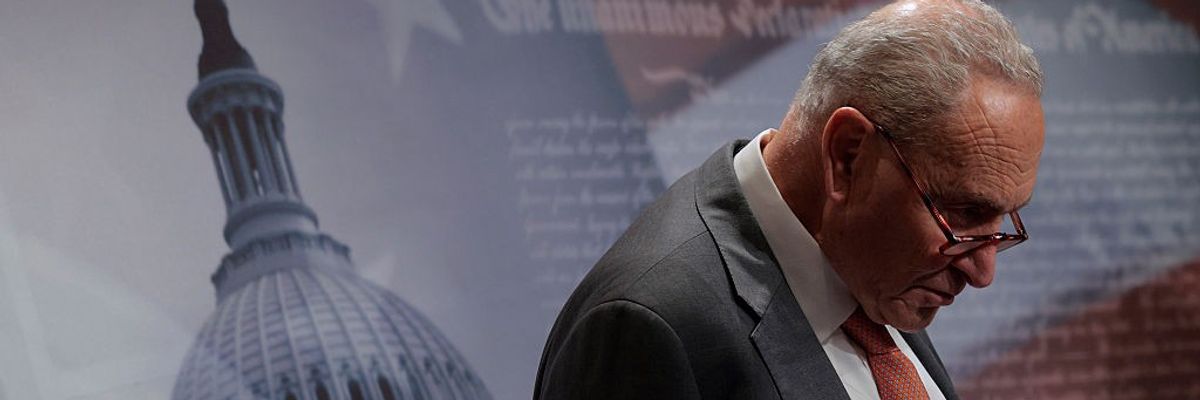
Senate Minority Leader Chuck Schumer (D-N.Y.) holds a news conference criticizing President Donald Trump’s trade policy at the US Capitol on July 31, 2025, in Washington, DC.

 (Photo: Chip Somodevilla/Getty Images)

“Voters have made their feelings clear,” said the leader of Justice Democrats. “The majority do not see themselves in this party and do not believe in its leaders or many of its representatives.”

STEPHEN PRAGER

Aug 14, 2025 (CommonDreams.org)

A top progressive leader has given her prescription for how the Democratic Party can begin to retake power from US President Donald Trump: Ousting “corporate-funded” candidates.

Justice Democrats executive director Alexandra Rojas wrote Thursday in The Guardian that, “If the Democratic Party wants to win back power in 2028,” its members need to begin to redefine themselves in the 2026 midterms.

“Voters have made their feelings clear, a majority do not see themselves in this party and do not believe in its leaders or many of its representatives,” Rojas said. “They need a new generation of leaders with fresh faces and bold ideas, unbought by corporate super [political action committees] and billionaire donors, to give them a new path and vision to believe in.”

Despite Trump’s increasing unpopularity, a Gallup poll from July 31 found that the Democratic Party still has record-low approval across the country.

Rojas called for “working-class, progressive primary challenges to the overwhelming number of corporate Democratic incumbents who have rightfully been dubbed as do-nothing electeds.”

According to a Reuters/Ipsos poll conducted in June, nearly two-thirds of self-identified Democrats said they desired new leadership, with many believing that the party did not share top priorities, like universal healthcare, affordable childcare, and higher taxes on the rich.

Young voters were especially dissatisfied with the current state of the party and were much less likely to believe the party shared their priorities.

Democrats have made some moves to address their “gerontocracy” problem—switching out the moribund then-President Joe Biden with Vice President Kamala Harris in the 2024 presidential race and swapping out longtime House Speaker Rep. Nancy Pelosi (Calif.) for the younger Rep. Hakeem Jeffries (N.Y.).

But Rojas says a face-lift for the party is not enough. They also need fresh ideas.

“Voters are also not simply seeking to replace their aging corporate shill representatives with younger corporate shills,” she said. “More of the same from a younger generation is still more of the same.”

Outside of a “small handful of outspoken progressives,” she said the party has often been too eager to kowtow to Trump and tow the line of billionaire donors.

“Too many Democratic groups, and even some that call themselves progressive, are encouraging candidates’ silence in the face of lobbies like [the America-Israel Public Affairs Committee] (AIPAC) and crypto’s multimillion-dollar threats,” she said.

Public Citizen report found that in 2024, Democratic candidates and aligned PACs received millions of dollars from crypto firms like Coinbase, Ripple, and Andreesen Horowitz.

According to OpenSecrets, 58% of the 212 Democrats elected to the House in 2024—135 of them—received money from AIPAC, with an average contribution of $117,334. In the Senate, 17 Democrats who won their elections received donations—$195,015 on average.

The two top Democrats in Congress—Jeffries and Senate Minority Leader Chuck Schumer (D-N.Y.)—both have long histories of support from AIPAC, and embraced crypto with open arms after the industry flooded the 2024 campaign with cash.

“Too often, we hear from candidates and members who claim they are with us on the policy, but can’t speak out on it because AIPAC or crypto will spend against them,” Rojas said. “Silence is cowardice, and cowardice inspires no one.”

Rojas noted Rep. Summer Lee (D-Pa.), who was elected in 2022 despite an onslaught of attacks from AIPAC and who has since gone on to introduce legislation to ban super PACs from federal elections, as an example of this model’s success.

“The path to more Democratic victories,” Rojas said, “is not around, behind, and under these lobbies, but it’s right through them, taking them head-on and ridding them from our politics once and for all.”

Our work is licensed under Creative Commons (CC BY-NC-ND 3.0). Feel free to republish and share widely.

STEPHEN PRAGER

Stephen Prager is a staff writer for Common Dreams.

Full Bio >

Today’s to-do list

Join us on the front lines for our rights, freedoms, democracy and rule of law. We can do this!

  • Click here to Protect the 2026 Elections
  • Click here to Demand Congress protect more than $100 million in funding for Tribal colleges now
  • Click here to Ban members of Congress and their families from trading individual stocks now!
  • Click here to Oppose Trump’s AI plan. Don’t give more power to Google & Musk’s xAI!

ICE HQ in S.F.’s Financial District has 80-year history of detaining immigrants

Decades ago, 630 Sansome St. was called a San Francisco ‘skyscraper concentration camp’

by FRANKIE SOLINSKY DURYEA August 14, 2025 (MissionLocal.org)

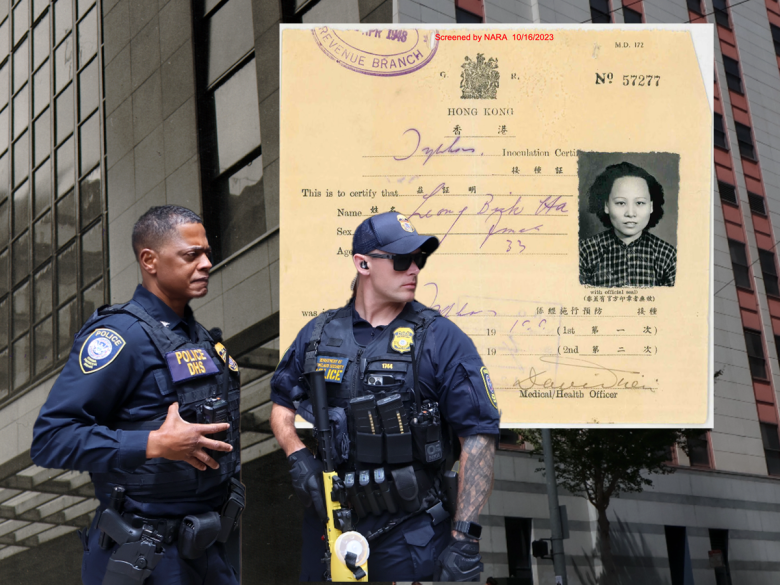
Two uniformed police officers stand in front of a modern building, with an old Hong Kong immunization certificate overlaid above them.
For nearly 80 years, 630 Sansome St. has had a relationship with immigration enforcement. Photo-illustration by Xueer Lu
Comic strip showing a newspaper's various reader engagement methods: in the park, drive-in, print delivery, and data visualization online.

Read Mission Local often?

Help grow our newsroom, joining the hundreds of San Franciscans who support us by giving below.

Donate today!

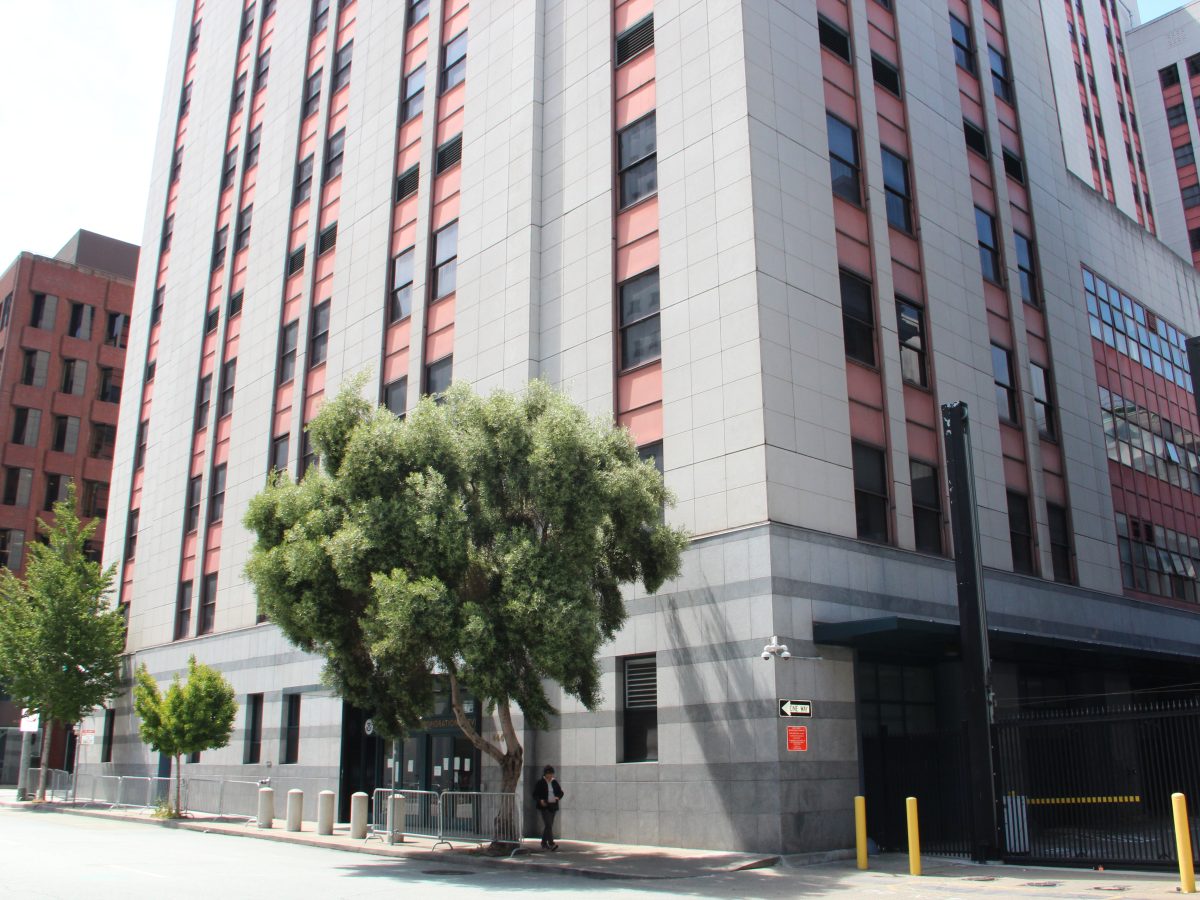
Over the past couple of months, mass immigrant arrests, asylum-seekers detained for longer and longer stays, and protests turned violent have shone a spotlight on the Immigration and Customs Enforcement office in San Francisco, located inside the Appraiser’s Building at 630 Sansome St. 

It’s not the first time, however, that efforts to detain immigrants within the building have invited scrutiny. Ever since it was built, 630 Sansome has been linked with American immigration policy — and its tragic consequences.

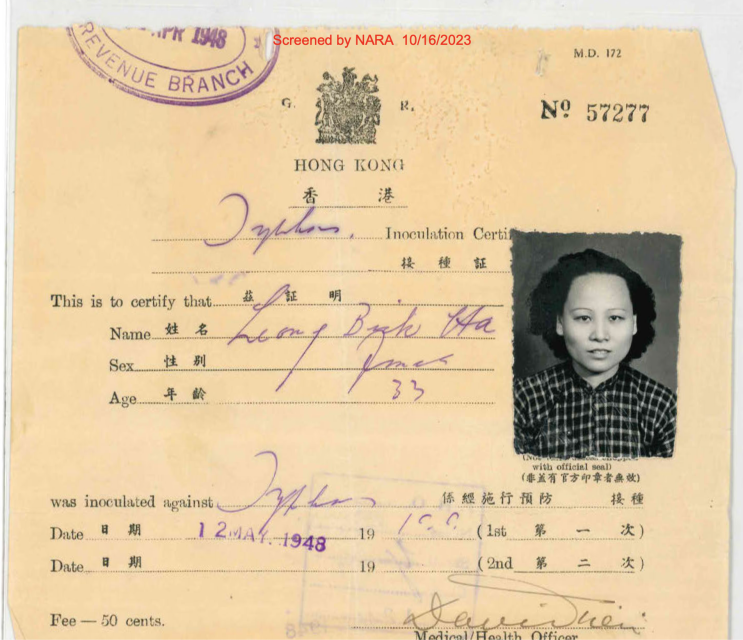
The night of September 21, 1948, 33-year-old Leong Bick Ha hanged herself on the 13th floor of the building, which at that time was the city’s headquarters for the now-defunct Immigration and Naturalization Services, which predated ICE.

Mission Local logo, with blue and orange lines on the shape of the Mission District

Want the latest on the Mission and San Francisco? Sign up for our free daily newsletter below.Sign up

Leong — her surname — was one of nearly 4,000 Chinese women who were detained inside the building between 1946 and 1948 after arriving in the United States to reconnect with their American GI husbands. 

After being held for three months in jail-like conditions, unable to communicate with her husband U.S. Army Sergeant Ng Bak Teung and her 15-year-old son, Leong was subjected to a long interview process as officials tried to determine the legitimacy of her marriage.

She was so anxious before her official interview that immigration officials prescribed her sedatives. Afterwards, she was told that she had failed the interview and would soon be deported. 

That night, several floors up from where ICE detains immigrants in holding cells today, Leong hanged herself in a shower stall. 

A vintage Hong Kong inoculation certificate from 1948, featuring a black-and-white portrait of a woman and handwritten personal details.
Leong Bick Ha. File 1300/078976, Immigration and Deportation Investigation Case Files, 1944–1955, RG 85, National Archives and Records Administration, San Francisco. (Courtesy of Brianna Nofil)

630 Sansome St.’s relationship with immigration enforcement began around the end of World War II, when an electrical fire destroyed a 30-year-old immigration detention center on Angel Island. Shortly after, INS moved its headquarters and detention center to 630 Sansome St., an unassuming federal building in the Financial District completed in 1944.

The building has always housed some federal agencies unrelated to INS and ICE. But from the start, it had a relationship with immigration enforcement and detention. INS occupied six of the building’s 16 floors, and devoted two floors to the detention of men, women, and children. In 1947 the San Francisco Chronicle described the detention space as “a prison-like atmosphere — barred windows, locked doors, guards everywhere.”

Though Leong Bick Ha is arguably the best-known detainee at the INS headquarters, thousands of immigrants passed through in its first decade. European communists were tried and deported from the building in 1950. A Russian family was inexplicably held in detention for over 14 months in 1951. And a 21-month-old baby girl and her mother were held in the building for three months even after being ordered removed to Canada. 

And yet, many San Franciscans were unaware of the hordes of immigrants detained in the modest building every day, according to historian Brianna Nofil, author of “The Migrant’s Jail: An American History of Mass Incarceration.” Nofil argues that 630 Sansome marks the beginning of the practice of detaining individuals in office spaces to avoid scrutiny. 

Despite the scale, she says, “If you just hold people in an office building, there’s a pretty good chance that most observers will have no idea it’s happening.”

There were occasions when 630 Sansome lost its anonymity. A couple of months before Leong’s death, 41-year-old Huang Lai crawled onto a ledge of the building’s 14th floor. Lai, who had been in detention for nine months while awaiting an interview, sat on the ledge for hours until police successfully brought her back inside. Five thousand onlookers gathered to watch on the street below.

According to Nofil, this incident was the first time that many San Franciscans learned 630 Sansome St. was a detention center.  

In July 1948, a columnist writing in the San Francisco Examiner under the pen name of “Freddie Francisco” implored “officer workers who spend their days in the financial district,” to look closer at the “shining white skyscraper that is the Customs Building on Sansome Street.”

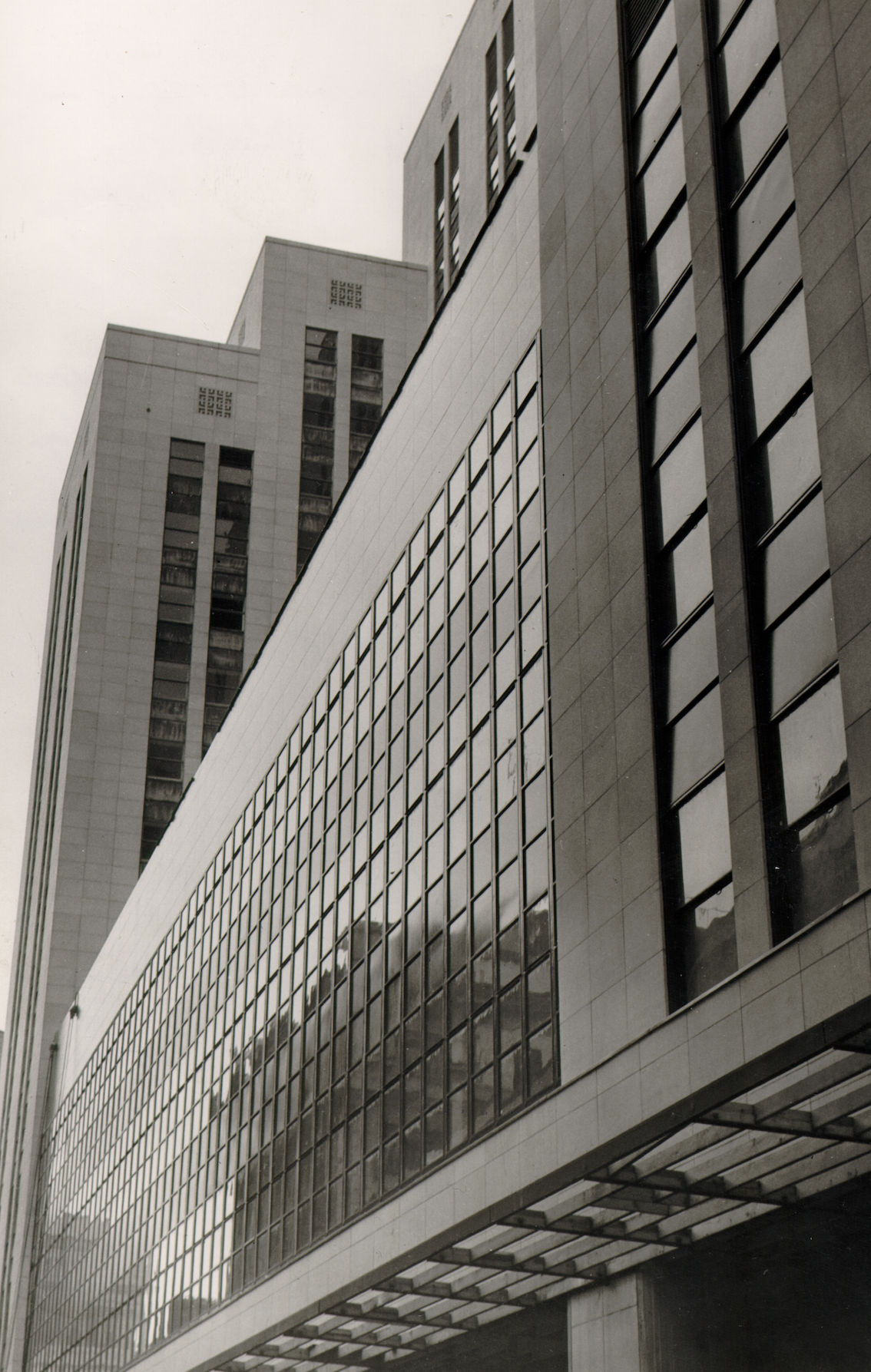
A modern multi-story office building with large glass windows and a geometric facade, photographed from a low angle.
March 1944 picture of the ‘New Appraisers Building.’

INS was likely doing its best to provide adequate conditions, Francisco wrote. But, “the fact remains that the top of an office building, in the center of a big city, is not the place in which to house hundreds upon hundreds of men, women and children for periods ranging from six months to a year, and more.”

During a 1952 hearing in front of the President’s Commission on Immigration and Naturalization about the financial cost of detaining immigrants for longer periods of time, the lawyer Welburn Mayock called the building a “skyscraper concentration camp.” 

He represented American President Lines Ltd., a large American shipping company, and he complained to the commission about the high cost of detaining immigrants there. 

Mayock wrote that the detention space “increases the risk of hospitalization” to those inside, and that on average one baby a month was born to women detained at the facility. 

Shortly after, President Dwight Eisenhower promised to change immigration detention standards, passing the Refugee Relief Act of 1953 and opening new immigration pathways to 214,000 people. “This action demonstrates again America’s traditional concern for the homeless, the persecuted and the less fortunate of other lands,” reads his statement upon signing the act.

The detention center closed the next year on October 31, 1954. The holding areas were turned into office space or immigration courts — staying that way for a long time. All the remaining detainees were reportedly distributed between county jails and hotels, or released on parole.

While Eisenhower’s administration saw a shift towards alternative detention policies like monitored parole in big cities, immigration restrictions were only tightening at the southern border. The 1954 act Operation Wetback — which some advocates see as a predecessor for Trump’s current mass deportation plan — reportedly deported over one million Mexican day laborers, and wielded racialized immigration policy primarily against Latino people. 

“It’s a story of shifting geography,” Nofil said of the 1954 closure, “not a history of eliminating migrant incarceration.”

Nowadays, 630 Sansome St. is again being used to discreetly hold immigrants. But it is no longer anonymous: It has become a place of protest by anti-ICE demonstrators, and for lawyers it is often the easiest place to access clients while trying to get them released through habeas corpus petitions

Nofil said there was no particular precedent for what to do with immigrants when they first started coming into Sansome. The fledgling system that INS developed in the 1940s still informs modern detention, she said. “Everyone is just flying by the seat of their pants. No one has a plan.”

Back to its roots

Until the 2000s, 630 Sansome St. was mostly known as the headquarters for the regional U.S. Forest Service and the auction site of seized and unclaimed items gathered by the U.S. Customs Service, including confiscated liquor.

But even when INS dissolved in 2003, immigrants continued to shuffle through the court still there, said Jennifer Friedman, deputy director of the immigration unit at the San Francisco Public Defender’s Office. Established under the Department of Homeland Security, ICE adopted the court already housed on the building’s fourth floor, using it to try detained immigrants facing deportation. 

Elsewhere in the building, United States Customs and Immigration Services, also under the DHS, processes immigrants for green cards and naturalizations.

Between 2008 and 2014, the number of people attending immigration court every day at the building hovered around 25, according to a data analysis conducted by Vera, a national organization composed of advocates and researchers. Immigrants would be brought to 630 Sansome St. for days when they had court, bused in from jails and prisons that housed people detained by ICE. 

The number of people peaked in 2008, when ICE arrested 63 immigrants in a city-wide raid, and then again on July 13, 2011, when 88 people passed through the building.

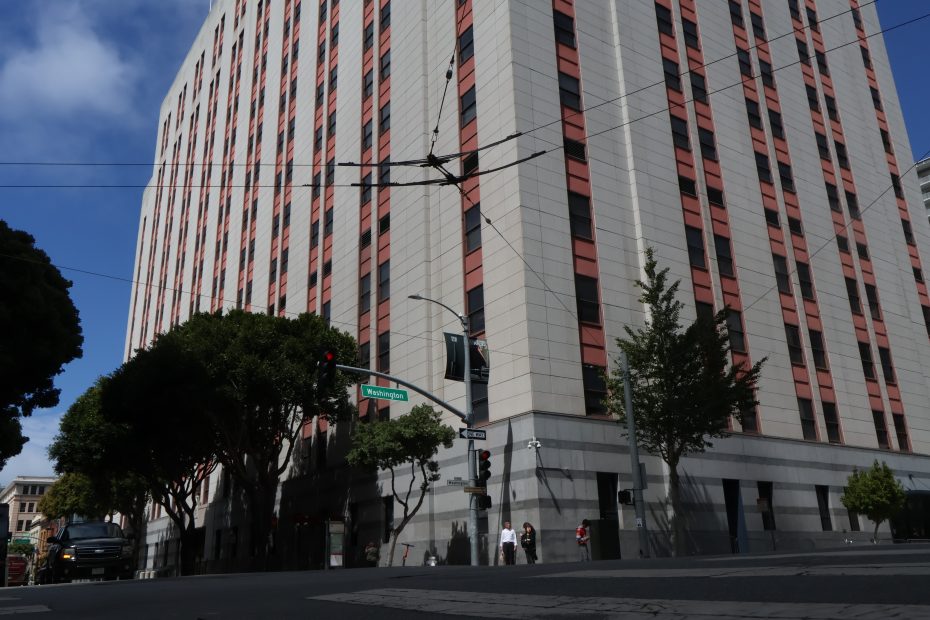
Tall office building with red and gray exterior, trees along the sidewalk, traffic lights, and street signs at an urban intersection during daytime.
630 Sansome St. on July 25, 2025. Photo by Frankie Solinsky Duryea.
San Francisco’s courts for detained immigrants at 630 Sansome St. closed in 2021 after all California jails and prisons ended their contracts with ICE, facing public pushback. The closest long-term ICE detention center was then in Bakersfield, said Friedman, and the court moved south to accommodate that change. Friedman added that this change also isolated detained immigrants from San Francisco’s pro-bono lawyers.

What remained at 630 Sansome St., however, was a courtroom where immigrants not in detention appeared for hearings — mostly related to asylum cases. Up until recently, they did not worry about being arrested at these hearings.   

630 Sansome St. saw a decline in detainees in the late 2010s. Since the vast majority of the immigrants passing through the building were free to return home after their hearings, it was impractical to process immigrants there since it is so far from any detention court or long-term detention facility.

Patrick O’Brien and Joseph Park, two of the judges who preside over the courtrooms of 630 Sansome St. today, began hearing more general immigration and asylum cases when the detained court closed in 2021. Until 2025, an average of two immigrants were kept at Sansome per day. 

But 630 Sansome St. is getting busier. Most immigrants arrested around the Bay Area are now being processed at the ICE office at 630 Sansome St. And many of those who show up for hearings are being arrested inside the building, as ICE agents wait outside the courtroom.

Some lawyers question the legality of these arrests, and have had success filing habeas petitions to release them. 

Recent data indicates that people are being held in these spaces for longer and longer periods of time. Data analysis by Mission Local, using the Deportation Data Project’s most recent release, shows that at least 172 people were held at 630 Sansome St. from June 26 to July 29. Eleven of those people were held for over 24 hours. Two were held for over 72 hours. 

Detainees who have stayed overnight said that the cells are cold, and they sometimes have to sleep on the floor with just a Mylar blanket, a sheet that looks like aluminum. Video smuggled out of holding cells in New York City’s equivalent to 630 Sansome St. — 27 Federal Plaza — shows cramped conditions in brightly lit rooms. 

Only lawyers and family members of the detained have a legal right to get access to the sixth floor, where immigrants are detained. Media members are technically allowed to enter, but Mission Local reporters have been repeatedly denied access.

For visitors, the sixth floor is mostly made up of one long windowless hallway. Visitors are put into a small fluorescent-lit room, where they can speak with detained people across a plastic divider, through wall-mounted phones. 

Francisco Ugarte, the first attorney to be hired to the immigration unit at the San Francisco Public Defender’s Office, said that arrests inside the courthouse are new. “What’s happening now, with masked agents at courthouses, this is unprecedented, authoritarian, and indicative of a government that’s failing its people,” he wrote to Mission Local.

630 Sansome becomes ground zero for San Francisco protests 

Over the years, 630 Sansome has been a magnet for civil resistance.

The first major instance of protests began after Leong Bick Ha’s death, when 104 women detainees, the majority of them Chinese war brides, reportedly began a hunger strike, said Leona Lau, the founder of the 1945 Chinese War Brides Project.

While INS tried to downplay the protest, Lau said that Leong’s death became a lightning rod for the frustration and anger of the Chinese community. People protested outside the building, and the Chinese-language media lambasted what they saw as racist immigration and detention policies.

Lau said that this frustration and anger remain today, especially as some immigration policies target Chinese people.

“How many more years do we have to fight the fight to have this country recognize us?” Lau asked.

In later years, protestors at 630 Sansome St. were arrested for a 1976 sit-in against the expansion of detention centers, for a 1986 protest against President Ronald Reagen’s support of Nicaraguan anti-communist “Contra” rebels, and for a 1990 demonstration for the rights of immigrants with HIV/AIDS.

In 2007 and 2008, students protested there against immigration raids. In 2010, the building became the site of protests supporting sanctuary city policies and, in 2013, dozens of protesters gathered around a bus believed to be carrying undocumented immigrants to deportation, blocking the bus’s movement for several hours. 

But recent protests have focused on what’s going on inside the building’s hallways — the arrest of immigrants as they leave regularly scheduled asylum hearings. Protesters have succeeded in closing the immigration court at 630 Sansome St. on a couple occasions, and they’ve done the same at 100 Montgomery St., San Francisco’s main immigration courthouse, around 10 blocks away.  

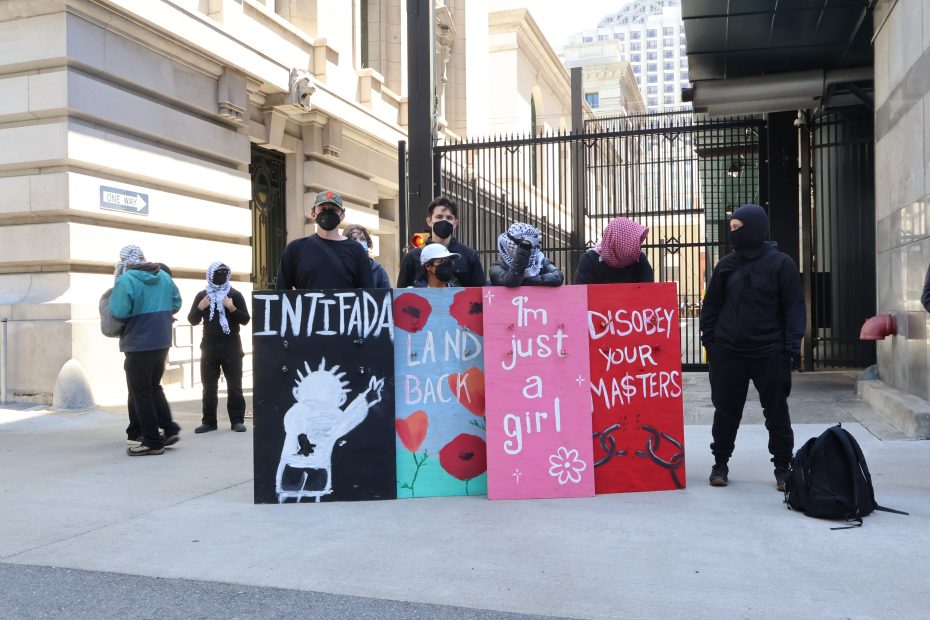
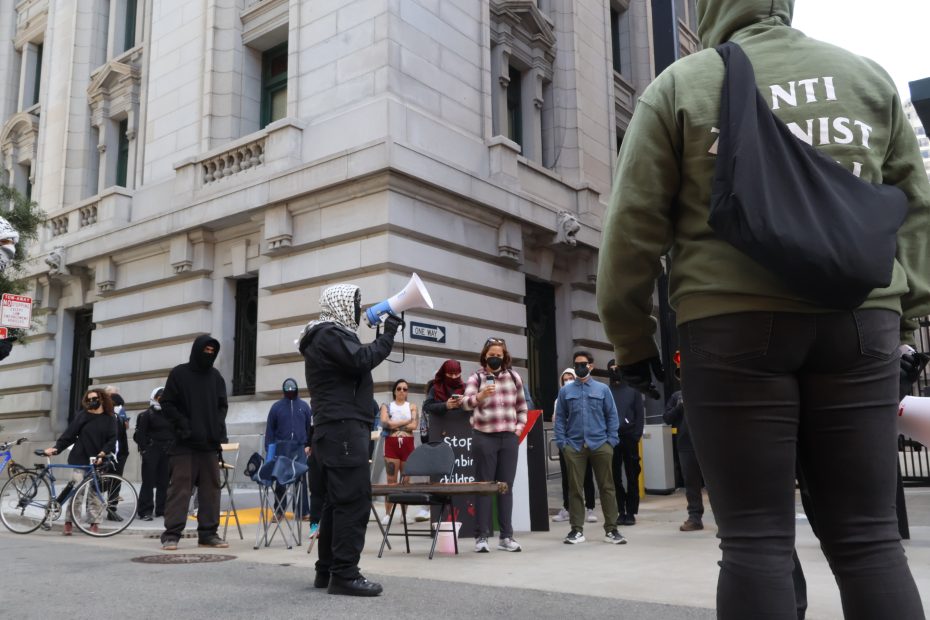
  • A group of masked protesters stands on a street holding painted signs with slogans including "INTIFADA," "LAND BACK," "I'm just a girl," and "DISOBEY YOUR MASTERS.Protesters gathered outside 630 Sansome St. on July 29, 2025. Photo by Frankie Solinsky Duryea
  • A group of people stand on a city street near a building; one person uses a megaphone while others hold signs and wear masks.Protesters gathered outside 630 Sansome St. on July 29, 2025. Photo by Frankie Solinsky Duryea
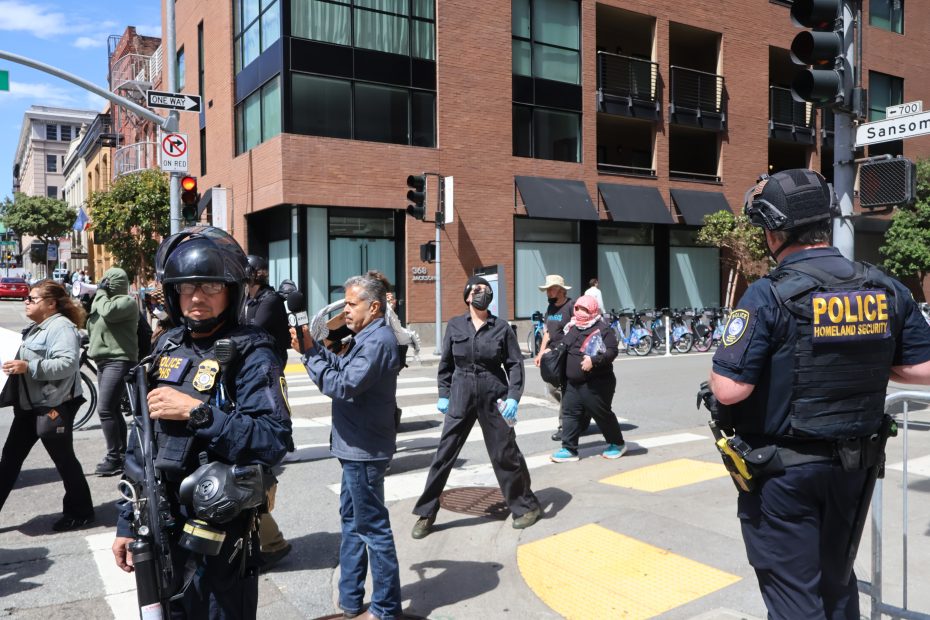
  • Police officers stand at a city intersection while pedestrians and masked individuals cross the street during daytime.Protesters and federal officers outside 630 Sansome St. on July 29, 2025. Photo by Frankie Solinsky Duryea
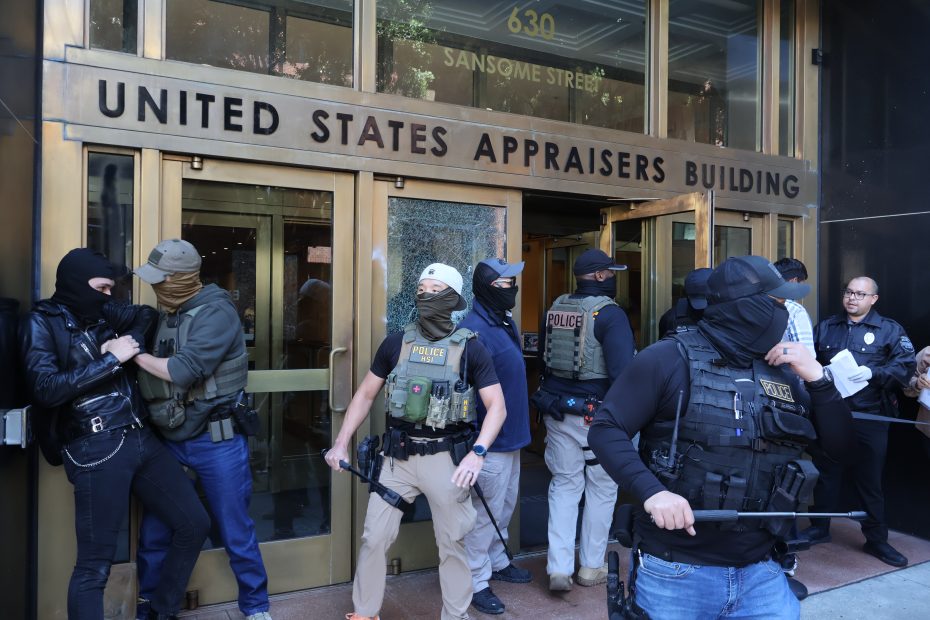
  • Law enforcement officers detain and search individuals outside the United States Appraisers Building, with police presence and activity near the entrance.Protesters and ICE officers outside 630 Sansome St. on July 8, 2025. Photo by Frankie Solinsky Duryea
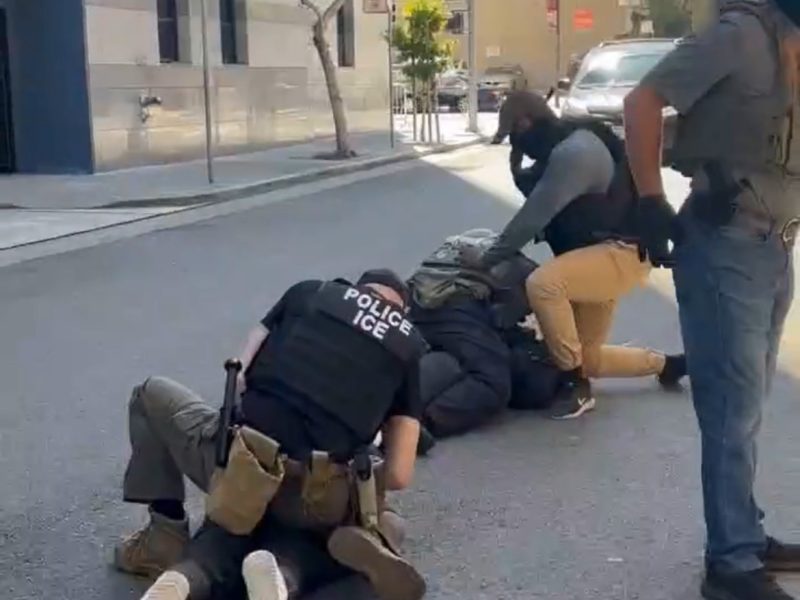
The demonstrations have had mixed results. When protesters tried to stop ICE officers from taking a detainee from 100 Montgomery St., the ICE van drove through the crowd. And, in the most recent attempt to stop ICE vehicles leaving 630 Sansome St., two protesters were tackled and detained.

Protesters continue to regularly show up at 100 Montgomery St. There, they hope that they can keep ICE officers out of the building. But at 630 Sansome St., protestors have said, there’s no ideal strategy. ICE officers can arrest immigrants and then process them two floors above, all out of sight. 

At least 50 people have been arrested while attending routine immigration court arrests this year, Mission Local reporters have observed. But legal experts say that number is much higher, and courthouse arrests are occurring nearly daily. 

As an unknown number of people are detained there every day, without an opportunity for observers to see courthouse arrests, immigration detention is again invisible, much as it was 80 years ago. 

“Few, if any, detention spaces have endured since the 1940s,” said the historian Brianna Nofil. But, from INS to ICE, immigration enforcement has held a lease in San Francisco’s downtown for over 80 years. Nofil said she doesn’t know of any other detention space in the country that’s lasted that long. 

Margaret Kadifa contributed reporting.


Correction: A previous version of this article stated that 176 people were held at 630 Sansome St. from June 26 to July 29. Several of those were duplicate entries in ICE’s data. The more accurate number of detained people during that time frame is 172.

MORE ON IMMIGRATION ENFORCEMENT

What can San Francisco teachers do if ICE comes knocking?

What can San Francisco teachers do if ICE comes knocking?

ICE arrests one asylum-seeker from S.F. immigration court

ICE arrests one asylum-seeker from S.F. immigration court

For first time in recent memory, ICE officers detained U.S. citizens in S.F.  

For first time in recent memory, ICE officers detained U.S. citizens in S.F.  

Support the Mission Local team

A group of people posing outdoors with a city skyline in the background on a sunny day.

We’re a small, independent, nonprofit newsroom that works hard to bring you news you can’t get elsewhere.

In 2025, we have a lofty goal: 5,000 donors by the end of the year — more than double the number we had last year. We are 20 percent of the way there: Donate today and help us reach our goal!

Donate!

FRANKIE SOLINSKY DURYEA

frankie@missionlocal.com

I’m covering immigration and running elsewhere on GA. I was born and raised in Burlingame but currently attend Princeton University where I’m studying comparative literature and journalism. I like taking photos on my grandpa’s old film camera, walking anywhere with tall trees, and listening to loud music.More by Frankie Solinsky Duryea

Oakland Mayor Barbara Lee rips Trump, says city will stand against threats

Lee and other Alameda County elected officials tore into the president and signaled they’re bracing for a fight.

by Eli Wolfe Aug. 14, 2025 (Oaklandside.com)

Oakland Mayor Barbara Lee at an August 14, 2025 press conference at City Hall. Credit: Eli Wolfe/The Oaklandside.

Help us tell the Oakland stories that matter to you and your fellow Oaklanders.

Yes, I want to chip in to support Oaklandside’s work!

President Donald Trump’s casual reference to Oakland during a press conference about crime on Monday has sparked a furious response from the city’s elected officials, who accused him today of distorting the truth, fomenting authoritarianism, fearmongering, and trying to distract the public from his ties to the deceased pedophile Jeffrey Epstein. 

At a City Hall press conference on Thursday, Mayor Barbara Lee promised residents that her administration will not back down against any threats from Trump. 

“No one knows this president’s playbook better than I do,” Lee said, noting that she served in Congress during his first administration, and was on the House floor on January 6, 2021, when Trump encouraged his supporters while they stormed the Capitol in an attempted insurrection. 

Trump’s recent comment about Oakland was made during a press conference announcing his takeover of the Washington D.C. police. Through the D.C. takeover and Trump’s earlier deployment of the National Guard in Los Angeles, Trump has signaled a willingness to clash with the Democratic Party leaders of major cities, which he has characterized as lawless, despite historically low and falling crime rates in most metro areas.

Never miss a story. Sign up for The Oaklandside’s free daily newsletter.Email

Lee said Oakland’s legal team is analyzing the constitutionality of some of Trump’s statements, including his threat to send National Guard troops to different cities across the country, and coordinating how to respond with state and local allies. 

“When Donald Trump threatens our communities, we stand up, and I stood up to him before, over and over and over again. And as mayor, I will continue to stand firm with you,” Lee said. 

Alameda County Supervisor Nikki Fortunato Bas said that Trump is wrong about Oakland, and that local leaders are “laser focused” on public safety improvements. She touted the county’s recent work approving plans to spend hundreds of millions of dollars from Measure C on early childcare and education, and a “historic $1.4 billion investment of Measure W funds for homelessness solutions across the county.” 

“Let’s be clear today that Trump’s threats and his deployment of the National Guard are not about safety or law, this is about fear and control, and it is a blatant abuse of power,” Bas said. 

Several councilmembers also condemned Trump’s remarks. Rowena Brown, Oakland’s at-large councilmember, argued Trump’s comments are part of a “long, harmful pattern where leaders distort the truth about majority Black communities to justify federal overreach, aggressive policing, and the erosion of our civil liberties.” 

Councilmember Janani Ramachandran said Trump is using Oakland as a scapegoat to distract the public from his connection to Jeffrey Epstein. 

Calling Trump “Mister Convicted Felon,” Councilmember Carroll Fife scoffed at the idea that Trump cares about law and order, referring to Trump’s criminal convictions. Fife also accused the president of “grooming communities “to prepare us for an abusive relationship that he wants to have with the American people.” 

Brenda Harbin-Forte, a former Alameda County Superior Court judge who helped lead the recall against former Mayor Sheng Thao, spoke at the press conference, sharing a statement from NAACP President and CEO Derrick Johnson, who said that Trump campaigned on law and order but is a “president of chaos and corruption.” 

Oakland leaders promised to support immigrants, but advocates say they need more help from the city

The press conference at City Hall occurred just two days after Immigration and Customs Enforcement agents detained at least six people in East Oakland. The detainees include a 17-year-old and a person with Down Syndrome, according to Nikolas De Bremaeker, an immigrants’ rights managing attorney at Centro Legal de la Raza

At the press conference on Thursday, De Bremaeker shared that the detained residents had been held in “deplorable conditions” at ICE’s San Francisco field office and that the situation has been especially traumatizing for the child.

“When I had to explain that his family members had been transferred, he just broke down in tears,” De Bremaeker said. He said the cell that held the child had a “piece of plastic to use as a blanket,” a bare cement floor, and one toilet without any privacy partition. 

According to De Bremaeker, the child has been transferred to a facility in New York, and several of the other detained residents, including the person with Down Syndrome, have been sent to a facility in Tacoma, Washington. 

During her speech, Lee affirmed that Oakland is a sanctuary city, providing support to immigrant communities and families affected by ICE. 

De Braemaker said what Centro Legal needs is support from the city to help fund the work being done by attorneys, who file habeas petitions and temporary restraining orders to try to free detained immigrations, plus the social workers and other response staff who handle these matters. 

“We are calling on the city of Oakland to work with us to build resources to be able to file more of these [motions],” De Braemaker told reporters. “The Trump administration is not playing by the rules; they’re breaking the law, and the only way to address this is by bringing these petitions to federal court.” 

Lourdes Martinez, directing attorney of Centro Legal’s immigrants’ rights practice, said that Oakland did help fund some rapid response immigration services during the first Trump administration. Alameda County recently allocated money to the Alameda County Immigration Legal Education Partnership, which runs a hotline used to report ICE interactions and detentions. But Oakland so far hasn’t thrown in support. Martinez said she hopes the city will come to the table and work with the organizations and agencies that are collaborating on this front. 

“Our assessment of the city of Oakland is we’re not prepared for what may come in terms of ICE enforcement now that ICE is the best-funded law enforcement agency of the federal government,” Martinez said. “It really could increase what we see at the local level.” 

ELI WOLFE

eli@oaklandside.org

Eli Wolfe reports on City Hall for The Oaklandside. He was previously a senior reporter for San José Spotlight, where he had a beat covering Santa Clara County’s government and transportation. He also worked as an investigative reporter for the Pasadena-based newsroom FairWarning, where he covered labor, consumer protection and transportation issues. He started his journalism career as a freelancer based out of Berkeley. Eli’s stories have appeared in The Atlantic, NBCNews.com, Salon, the San Francisco Chronicle, and elsewhere. Eli graduated from UC Santa Cruz and grew up in San Francisco.More by Eli Wolfe