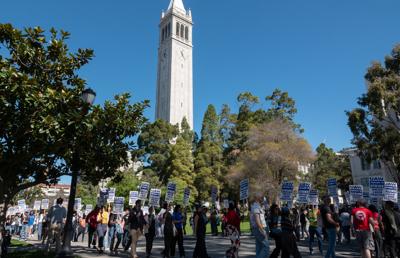
Hundreds of members of United Auto Workers Local 4811, a union representing 48,000 student employees, postdocs and academic researchers across the UC system, held a protest at the steps below the Campanile on March 12 over alleged unfair labor practices by the university.
According to union sources, union leaders will decide by March 15 whether they will initiate a strike, which could begin as soon as next week.
Richard Villagomez, a head steward and undergraduate tutor for Data 8, said the protest was the union’s “last chance” to show the UC system that they are leveraging a “very real” strike threat if no fair contract is reached.
“UC still hasn’t agreed to things like fair wages and strong international worker protections, and they’ve been bargaining in bad faith, breaking the law, doing things like cutting appointments in half unilaterally, capping TA appointments, and imposing new fees,” Villagomez said.
Many of the hundreds of protesters in attendance were, or had been, graduate student instructors, or GSIs. Noelle Blose, a graduate student researcher and former GSI in the physics department, said she was driven to attend the protest after witnessing alleged harsh cuts to the department’s GSI staff.
“The physics department cut our GSI staff to one-half the usual numbers,” Blose said, “The workload for the intro courses is always the highest for any of the GSIs in the physics department, and these cuts functionally meant that we could barely run the classes. The discussion and lab sections were so overcrowded. We couldn’t answer questions.”
Former U.S. Rep. Katie Porter — who is currently a candidate for California governor — also attended the protest. Porter marched in the picket line and met with union leaders about an hour after the protest began.
“I am here to support labor unions,” Porter said. “I’m here to support the people who make the UCs great, the people who are in the trenches every day teaching and running this university. They are workers and they need to be able to afford to live and to thrive.”
Porter, who is a UCI law professor, also said she taught at UC Berkeley as a visiting professor in 2009 and 2010, focusing on consumer protection. She added that she sees a lot of parallels between the union movement and consumer protection in their shared fight for economic justice.
Porter also emphasized the importance of treating university workers like any other employee in the private or public sector.
“(The UCs) want to be their own category,” Porter said. “But at the end of the day, they’re paying payroll, and they need to honor the labor laws.”
In a statement, UC Office of the President spokesperson Heather Hansen said the UC has been bargaining in good faith with the union in their mediation talks.
Hansen added that the number of bargaining units makes negotiations more complex.
“Our focus is on making real progress while ensuring any agreements are financially sustainable and workable across the entire UC system,” Hansen said in an email. “We strongly disagree with the union’s unfair labor practice claims, which can be filed during negotiations before they are reviewed or determined to have merit. Real progress happens at the bargaining table, and that is where UC remains focused.”
100 UCSF workers walked a picket line at the Weill Neurosciences building in Mission Bay on Thursday, March 12. Similar demonstrations were held at UC campuses across the state. Photo by Béatrice Vallières.
From cancelling a federal student loan repayment program to attempting to cut diversity programs, the Trump administration’s attacks against higher education have thrown universities into uncertainty.
Workers at the University of California have found what they think might be a solution: unionize.
On Wednesday, workers in communications, marketing and sales at the University of California, representing 2,000 people statewide and 200 in San Francisco, voted at an 82-percent clip to form a new union with United Auto Workers.
Want the latest on the Mission and San Francisco? Sign up for our free daily newsletter below.Sign up
It marked the third time in recent months that UC workers formed a new union with UAW. Student services and advising professionals unionized in April, and research professionals followed suit in September.
In total, that represents 12,000 new union members working for the University of California system.
“There’s a lot of exciting energy in the labor movement right now, and especially at UC,” said Rebecca Griffin, a member of the new communication workers union’s organizing committee and communications director at UCSF’s Bixby Center for Global Reproductive Health.
The creation of the Communications, Marketing, and Sales Professionals Union (CoMaS) brings the total number of UC workers represented by UAW to more than 60,000.
At UCSF—one of the city’s largest employers, with 39,000 employees according to UC data—about 1,600 workers have joined one of three new unions in the past 12 months, according to union estimates.
The three unions have similar demands: higher wages, increased job security, protections for international workers and more flexible work arrangements.
More than that, union leaders say this is also a way to defend their workers as attacks coming from the federal government have meant budget cuts, layoffs and hiring freezes.
“We’re realizing that, by forming a union like this, we now have a platform to protect the important work that we do that we care so much about,” said Eve Perry, a data scientist at UCSF and member of the Research and Public Service Professionals bargaining team.
In March last year, faced with financial uncertainty due to proposed federal budget cuts, UC implemented a systemwide hiring freeze.
In July, the Trump administration attempted to pull $584 million in federal funds to UCLA over the university’s supposed failure to fight antisemitism on campus. In exchange for releasing those funds, the federal government later demanded a $1.2 billion settlement from the University.
Most recently, four public health programs within UCSF have faced cuts due to the government’s plans to undo $600 million in Centers for Disease Control and Prevention grants.
UC’s unions have been fighting back. In September, UAW successfully filed a lawsuit against the Trump administration over the $1.2 billion fine. The university system did not join the lawsuit.
UAW is also working with UC on a state bill that would put a $23 billion bond to fund scientific research across California on the November 2026 ballot.
Potential strike brewing
Two of the recently formed UC unions are currently in contract negotiations. Negotiations for Student Services and Advising Professionals started in July, and Research and Public Service Professionals commenced in October. But eight months in, negotiations are grinding to a halt.
On Thursday, UC workers across the state walked picket lines as a “last chance” measure. In San Francisco, 100 employees held a demonstration before the Weill Neurosciences building in Mission Bay.
Three UC unions have already voted to authorize a strike, with 93 percent voting in favor out of 23,300 voting members.
Union leaders say the university has not been acting in good faith in the negotiations and engaging in unfair labor practices.
In an emailed statement to Mission Local, the University of California’s Office of the President said it “strongly disagree[s]” with the unions’ claims.
“These negotiations are complex because they encompass multiple bargaining units that cover academic student employees as well as newly represented staff employees transitioning from policy-covered roles into union-covered positions,” the statement read.
“Our focus is on making real progress while ensuring any agreements are financially sustainable and workable across the entire UC system.”
Asked about the newly formed union, the Office of the President acknowledged its formation, and added that “UC respects our employees’ right to choose whether to organize” and “look[s] forward to working with them in good faith.”
The unions will decide whether to strike by Sunday. If a work stoppage occurs, it could come as early as next week, said Riley Stockard, graduate student researcher at UCSF.
Across the state, that would represent close to 40,000 people on strike. At UCSF, that would be about 2,000 people.
“I think it’s a really important time for people just to see the power of the labor movement and understand, how more full and strong we are when we are working in solidarity with one another,” Griffin said.
“I’m very excited to see what we and other UAW unions at UC can get done.”
Join the 3,300 readers who keep Mission Local free for all!
Because of you, Mission Local reached and surpassed our $300,000 year-end fundraising goal. All we can say is thank you.
Thank you for choosing to invest in a local newsroom rooted in San Francisco’s communities — one that listens first and reports deeply.
If you haven’t yet had a chance to give, it’s not too late to be part of this community. Your contribution today helps sustain the reporting our city relies on all year long.
We’re grateful you’re here — and we’d be honored to have you join our donors.
Béatrice is a reporting intern covering immigration and the Tenderloin. She studied linguistics at McGill University before turning to journalism and getting a master’s degree from Columbia Journalism School.More by Béatrice Vallières
A person holds a protest sign that says “Protect Our Neighbors” and “Keep Families Together” outside of the ICE headquarters at 630 Sansome Street. Photo by Sage Rios Mace.
Arrests at immigration check-ins, which were effectively paused for about a month and a half, have resumed in San Francisco, according to at least three immigration attorneys who spoke to Mission Local.
Hundreds of immigrants were arrested at check-ins between January 20th and October 15 of last year before they came to a halt at the end of December. Although these arrests have not resumed at as high a level as before, Immigration and Customs Enforcement is again starting to arrest immigrants at their appointments.
ICE check-ins are required appointments for immigrants seeking legal status. They are typically scheduled once or twice a year.
Want the latest on the Mission and San Francisco? Sign up for our free daily newsletter below.Sign up
Since President Trump took office in January, however, immigrants in San Francisco told Mission Local that the frequency has increased to sometimes every three months. Many immigrants are arrested and detained at those appointments.
Those arrested at ICE check-ins and elsewhere both in Northern California and nationwide often have no criminal history. Many have lived in the United States for decades. Once in ICE custody, they are often pressured by immigration agents into giving up on their immigration cases and returning to their home countries, according to court filings reviewed by Mission Local.
Arrests at San Francisco ICE check-ins have occurred on rare occasions for years but historically, many immigrants have lived with orders of deportation as they went through the legal process.
In S.F. check-in arrests ramped up in June 2025 along with arrests of immigrants at court. Then, in December, they slowed, a change that immigration attorneys said was likely linked to lawsuits challenging ICE practices.
In November a federal judge issued a preliminary injunction in the case that temporarily halted arrests at immigration courts in the city. Though the order did not prevent ICE from arresting immigrants at their check-ins, it did challenge the conditions inside the temporary holding cells and prevented arrests outside of courtrooms.
The recent resumption of arrests at ICE check-ins could indicate that, in the agency’s opinion, it is legally safe to begin detaining immigrants again, Atkinson said.
“They are saying that they are complying with the order, providing the blankets, food and water,” she explained. She said her team will continue monitoring any possible violations.
The majority of ICE check-ins take place at 630 Sansome, one of two immigration courts in downtown San Francisco, where immigrants line up early and wait in line, often for hours, before being brought inside the building. Arrests at check-ins and other immigration interviews, like green-card appointments, occur outside of the public eye. They have been much less scrutinized by the public and media than courthouse arrests, which often take place in public courthouse hallways.
There also continue to be occasional ICE arrests in communities across the Bay Area. Last month, an elderly nanny was arrested outside of her workplace in Diamond Heights.
For many arrested by ICE in the Bay Area, including those arrested at ICE check-ins, immigration attorneys have been rapidly filing habeas corpus petitions to get them released from detention. Those petitions have proven hugely effective, attorneys say.
Join the 3,300 readers who keep Mission Local free for all!
Because of you, Mission Local reached and surpassed our $300,000 year-end fundraising goal. All we can say is thank you.
Thank you for choosing to invest in a local newsroom rooted in San Francisco’s communities — one that listens first and reports deeply.
If you haven’t yet had a chance to give, it’s not too late to be part of this community. Your contribution today helps sustain the reporting our city relies on all year long.
We’re grateful you’re here — and we’d be honored to have you join our donors.
Clara-Sophia Daly is an award-winning journalist who covers immigration for Mission Local. Previously, she reported for the Miami Herald, where she covered education and worked on the investigative team. She graduated with honors from Skidmore College, where she studied International Affairs and Media/Film, and later earned a master’s degree from Columbia Journalism School.
Her reporting portfolio includes investigations into a gymnastics coach who abused his students for more than a decade — work that led to his arrest.
She also covered the privatization of Florida’s public education system, state-funded anti-abortion pregnancy centers, and the deputization of university police officers under federal immigration programs.
A Northern California native, she first joined Mission Local as an intern for a year during the pandemic — and is excited to be back writing stories about immigration.
The Department of Homeland Security (DHS) is spending millions on warehouses they plan to repurpose as ICE detention “mega-centers” to hold as many as 10,000 human beings per warehouse. Draft layouts show “pods” in which individuals are to be held, each pod crammed tightly against the next. The risks and trauma inherent to such crowding almost don’t bear mentioning — because to do so suggests a world in which there is a good way to warehouse human beings. There isn’t.
Across the country, concerned Americans have already shown they’re unwilling to sit by as these new concentration camps are built and filled. Instead, they’ve been fighting back and winning — even in some deep red districts. In Utah, Minnesota, and Oklahoma, from Marshall County, MS to Hanover County, VA, grassroots pressure has swayed politicians and property owners, successfully preventing the sale of commercial spaces to DHS.
Some progressive politicians have joined the fight, and the growing backlash has scared even a few Republicans into opposing the purchase of these properties by DHS — at least, in their own backyards — while putting everyone else, even the most loyal MAGA elected officials, on the defensive. Which makes this the perfect time to go on offense.
Finally, look out for upcoming emails from Indivisible about how to wage this fight at the local level by putting pressure on state legislatures and city and county officials to refuse to give Trump and his enablers what they want.
Have no doubt, the public is with us, and even Trump may be starting to figure that out. The White House has reportedly asked House Republicans to shut up about “mass deportations” already, recognizing that the regime’s handling of their signature issue is tanking Trump’s approval and Republican midterm prospects.
But a change in messaging won’t help. Because we know what they’re trying to hide.
We’re on a path to repeating some of the darkest chapters in modern history. ICE is already holding nearly 70,000 people in its existing network of concentration camps; we cannot sit by and watch as Trump and his enablers work to warehouse tens of thousands more.
Disrupting the regime’s plans to abduct, abuse, and literally warehouse whomever it chooses won’t end ICE’s campaign of terror; we still have a long fight ahead of us. When we’re back in power, we’ll need to strip DHS down to the studs and hold to account everyone responsible for its horrors.
But this is a critical step to laying the groundwork for that future. Let’s keep fighting.
1. Friday, 3:00pm, Quds Day – No U.S. Intervention!
Embarcadero Plaza SF
This Quds Day, our communities unite in protest against the U.S.-Israeli expansion of the genocide in Gaza into an all-out regional war.
Every year on the last Friday of the Islamic Holy month of Ramadan, people around the globe pour into the streets to stand for justice in support of Palestinians and all oppressed people. Quds Day is a global day against imperialist and Zionist war and aggression — a day of solidarity and unity for Palestine, Iran, Lebanon, and beyond — uplifting the peoples’ right to liberation, sovereignty, and self-determination.
Already, over a thousand people have been killed as a result of the U.S. and Israel warmongering in the region, while the genocide in Gaza and Israel’s terrorization of Palestinians all over Palestine continues. People of conscience won’t stand by while the U.S. and Israel seek to spread terror and claim more lives as Trump and the billionaires of the Epstein class cheer.
Info from ANSWER via email
Saturday, March 14
2. Saturday, 9:00am – 3:00pm, Train for Mass Disruption: May Day & Beyond
Organizing Meeting Conference to plan for May Day, General Strike, Against ICE and fascist dictatorship
Organizing direct action: Strikes, Boycotts, Community Defense
Accessibility:
Elevator Access
• An elevator is available for step free access to upper levels of the building.
• Some breakout sessions may take place on different floors and the elevator can be used to reach those spaces.
• Volunteers will be available if anyone needs help locating or using the elevator.
Bathrooms
• Accessible bathrooms are available in the building.
• Gender neutral bathrooms will be designated with clear signage.
• If a bathroom is not accessible, signs will direct you to the nearest accessible option.
Live Captioning & Language Access
• Live captioning will be projected on a screen during the main program via Zoom.
• Spanish interpretation will be available.
Quiet / Mask Space
• A smaller, quieter room will be available as a mask friendly space.
• This room can also be used as a calm space for anyone who needs a quieter environment or is feeling overwhelmed.
Materials Access
• Documents and materials will be shared online and can be accessed through a QR code available at the event.
On Site Support
• Volunteers will be stationed throughout the venue to help direct participants, answer accessibility questions, and assist with finding rooms or seats.
Food & Water
• Please bring a water bottle if you can.
• If you have dietary restrictions, we encourage you to bring your own food.
• Lunch provided: Banh mi sandwich’s chicken and pork, gluten-free vegetarian/vegan option with spring rolls. The food is cooked in the same place where peanuts live/there are no peanuts in the food.
3. Saturday, 10:30am, Celebration of Irish Palestinian Solidarity
Meet up at St. Patrick’s Day parade
2nd & Brannan SF
let’s show the crowds what solidarity between colonized peoples looks like. Let’s show out for Palestine! We need to show San Francisco that the bond between Ireland and Palestine is unbreakable! Come join us! All welcome to be irish for the day and Palestinian forever!!!!!
We do not consent to Trump and his billionaire allies taking a chainsaw to our government and our economy for their benefit! San Francisco is a sanctuary city and We the People need to defend the values that make it so. Let’s stand united and oppose the endless assaults on our communities, our civil rights, the rule of law, and our democracy.
Keep democracy alive every Saturday by showing up, taking a stand, and sticking together for the long haul. Standing together is better than standing alone. Let’s get together and call out the Trump/MAGA regime as a community. Plus, it’s fun! Think of it as our democracy corner—a place for you to voice your opinion, hang out with like-minded fellow protesters, and experience a cathartic moment together.
What you can do: • If you’ve got signs, flags, cardboard cutouts, or any protest visuals you want to make, bring ’em! We also have spare signs to lend. • If you have whistles, drums, cowbells, or other noisemakers, bring ’em! • Musicians are welcome and encouraged. Sing the song of democracy!
Ann traveled to West Africa with The Nation magazine’s newest educational tour, West Africa and the Origins of the Slave Trade. She will share about her experiences, including:
● How to define Slave and Slavery ● Explore the Euro-American Trans-Atlantic slave trade from capture to voyage ● Explore the voices and vision of West African Culture: art, journalism, spirituality, music, dance ● Explore the remaining effects of slave trade and colonialism in West Africa
Since October 2023, Israel has escalated their systematic violence against Palestinian political prisoners, carrying out a hidden genocide behind bars. Israel’s escalated assault against political prisoners and strategy of turning prisons into death camps is another tactics used in attempt to dismantle the infrastructure of Palestinian society and eliminate its most vital elements.
Today, more than 9,300 Palestinians are held in Israeli prisons subjected to widespread acts of torture, starvation, denial of medical treatment, sexual violence, and other cruel, degrading, and inhumane forms of abuse, deprivation, and detention.
hear first hand testimonies from released political prisoners and lawyers, and to learn more about how you can get involved with the global launch of the Freedom for Palestinian Prisoners Campaign.
We will be joined by:
Salah Hamouri, a French-Palestinian lawyer who spent years advocating for Palestinian prisoners. After facing multiple periods of administrative detention and the revocation of his Jerusalem residency, he was forcibly deported to France in December 2022. He currently lives in France, where he continues to speak internationally on legal rights and the conditions of prisoners.
Amani Sarahneh, the Director of Media and Documentation at the Palestinian Commission of Detainees and Ex-Detainees Affairs.
Mohamad Qaoud, a Palestinian journalist, researcher, and former prisoner, who holds a Master’s degree in Journalism and Media from the Islamic University of Gaza.
Israel’s genocide in Gaza is being mirrored by an accelerating campaign of violent ethnic cleansing in the West Bank. Since October 7, attacks have surged dramatically, with more than one thousand Palestinians killed—nearly half the total recorded over the previous two decades.
Fueled by the Israeli government’s extremist leadership and its unabashed vision of Jewish domination “from the River to the Sea,” the relentless destruction of homes, forced evictions, and dispossession has intensified, deliberately strangling Palestinian livelihoods.
Our panel will examine this escalating Israeli expansionism, the forces enabling it—including the role of the United States—and the pathways available to disrupt and ultimately shift this deadly dynamic. Watch the curated videos included in the registration confirmation email at your convenience ahead of the discussion.
Join the Q&A discussion with:
– Michael Schaeffer Omer-Man: Director for Israel-Palestine at DAWN; former Editor-in-Chief, +972 Magazine
– Mazin Qumsiyeh: Director, Palestine Institute for Biodiversity and Sustainability; author; activist
– Mai Shahin: Specialist, nonviolent communication & trauma therapy; Co-founder, Satyam Homeland Peace Center
– Ken Dorph (Moderator): Developmental economist specializing in the Arab world; writer and speaker.
On Saturday, February 28th, the U.S. and Israel launched a war on Iran (while simultaneously negotiating with Iranian diplomats). Its first barrage killed Ayatollah Ali Khamenei, members of his family, and 170 young girls at a school in the Iranian city of Minab.
We’re now in the 2nd week of that war! Veterans For Peace has organized a zoom session for Monday, March 16th at 7:30 EST with speakers Matt Hoh and Ray McGovern from Veterans For Peace and Khury Petersen-Smith from the Institute for Policy Studies.
Matthew Hoh is a disabled Marine Corps veteran of the Iraq War and former Afghan War State Department Officer. In 2009, after being appointed to the Foreign Service, Hoh resigned his post in Afghanistan over the Obama administration’s escalation of the Afghan War. He is now an analyst and commentator on foreign and military policy issues as a senior fellow with the Eisenhower Media Network. He serves on the advisory boards of many peace organizations, including Veterans for Peace and World Beyond War, and is an associate member of Veteran Intelligence Professionals for Sanity.
Ray McGovern’s longtime focus has been on Russian foreign policy. He joined the analysis side of the CIA in early 1963 after serving two years as an Army Infantry Intelligence officer. He speaks Russian, German, Spanish.
From 1981-85, Ray conducted early morning one-on-one briefings of The President’s Daily Brief. At retirement, he was awarded the Intelligence Commendation Medallion, but later returned it, saying he did not want to be associated – however remotely – with an agency involved in torture.
In January 2003 he co-created Veteran Intelligence Professionals for Sanity (VIPS) to expose the fraudulent intelligence concocted to “justify” war on Iraq.
On May 4, 2006, in Atlanta, Ray confronted Secretary of Defense Donald Rumsfeld on live TV with pointed questions like: “Why did you lie to get us into a war that was not necessary and that has caused these kinds of casualties?” http://www.youtube.com/watch?v=v1FTmuhynaw.
Khury Petersen-Smith is the Michael Ratner Middle East Fellow and the Co-Director of the New Internationalism Project at IPS. He researches U.S. empire, borders, and migration and strategizes with activists to work against the violence that the U.S. carries out and supports around the world. Khury focuses especially on U.S. militarism in the Middle East and in the Pacific, and movements that resist it. He graduated from the Clark University Graduate School of Geography in Massachusetts, after completing a dissertation on U.S. military bases in the Pacific. He is one of the co-authors and organizers of the 2023 Black Voices for Ceasefire statement, which was signed by over 6,000 Black activists, artists, and scholars
An attack ad posted by the National Republican Senatorial Committee (NRSC) on March 11, 2026 uses a deepfake depiction of James Talarico, the Democratic nominee for the US Senate in Texas.
(Screenshot from a video posted by the National Republican Senatorial Committee/X)
“Political deepfakes are a profound threat to our democracy, because there is no realistic way for voters to understand they are seeing fake representations,” said the co-president of Public Citizen.
In the latest example of Republicans using artificially generated deepfakes to attack their opponents, the Senate GOP’s official social media account has posted an attack ad depicting a synthetic version of Texas Democrat James Talarico, a state representative and US Senate candidate.
The video, posted on Wednesday to the National Republican Senatorial Committee (NRSC) page on X, portrays a frighteningly realistic approximation of Talarico’s (D-50) appearance and voice.
The state representative, who won the Democratic nomination for Texas’ US Senate seat in a primary earlier this month, is depicted reading an array of old social media posts that the NRSC described as “extreme statements praising transgenderism, twisting Christian beliefs, and advocating for open borders.”
The posts were all real. Talarico did indeed state, following a spate of mass shootings against minorities in 2021, that “radicalized white men are the greatest domestic terrorist threat in our country.” He also did say that his office had added personal pronouns to official business cards out of respect for transgender Texans, that he believed God was “nonbinary,” and that he was “the only teenage boy at Planned Parenthood’s March for Women’s Lives in 2004.”
However, all of the posts are at least several years—if not more than a decade—old. The video also depicts its AI simulacrum of Talarico smiling and reminiscing fondly about the posts, which he never actually did.
“So true,” he is depicted saying after reading the tweet about “radicalized white men.” “I love this one too,” he says before reading the post about “pronouns.”
Aside from a small, translucent watermark in the bottom-right corner of the video, labeling it “AI Generated,” there is no indication that the video is a fabrication.
While both sides of the aisle have dabbled in the use of AI to attack their opponents, Politico’s Adam Wren has noted that deepfakes were not being deployed equally and have become central to the “approach” of the GOP in campaigns.
In October, after Republicans made a similar video showing a simulated Senate Minority Leader Chuck Schumer (D-NY) celebrating the government shutdown, Wren noted the frequency with which such tactics were being used by Republican campaigns at both the state and federal level:
Other examples of AI-generated advertising have also come from Republicans. An ad for Mike Braun, now governor of Indiana, last year used AI to fake scenes, without disclosing it. President Donald Trump’s account regularly posts clearly fake videos of the president ridiculing opponents…
The [NRSC] released one hitting Democratic Maine Gov. Janet Mills as she launched her Senate campaign, and one simulating a Democratic group chat.
Deepfakes have also been deployed heavily by social media accounts for President Donald Trump’s White House to degrade opponents.
Earlier this year, the official account posted a photo of an organizer who’d been arrested during a protest against US Immigration and Customs Enforcement (ICE), doctored to portray her uncontrollably crying, when actual photos of the event show her appearing stone-faced and stoic while being led away in handcuffs.
While more than half of all US states have legislation regulating the use of AI deepfakes for election-related content, the consumer advocacy group Public Citizen has said such content needs to be addressed at the federal level.
The group has called on the Federal Elections Commission (FEC) to designate the use of AI for deceptive political messaging as fraudulent misrepresentation and on Congress to pass legislation banning the practice and requiring AI-generated content to be prominently labeled.
Robert Weissman, the co-president of Public Citizen, told Common Dreams that the deepfake of Talarico “is a disgrace and the NRSC should put it down immediately.”
“Political deepfakes are a profound threat to our democracy, because there is no realistic way for voters to understand they are seeing fake representations rather than real video,” Weissman said. “This deepfake has an ‘AI-generated’ watermark, but it’s all but invisible–sort of like an admission of wrongdoing, more than an effort at transparency.”
Our work is licensed under Creative Commons (CC BY-NC-ND 3.0). Feel free to republish and share widely.
Tell Congress:Block Trump’s Election Denier Pick to Lead DHS,Power up: Reject Markwayne Mullins Confirmation, Call your Senator at (202) 224-3121 and tell them to vote NO on Mullin for DHS
Be the change Tell State AGs: Block the Warner-Paramount Mega-Merger
Speak out now: Tell Your Secretary of State: No ICE at the Polls.
Use your voice: Stop the next Great Recession before it starts
BONUS: Make your voice heardRegister to vote, vote in every election, and help your community do the same. Reproductive freedom is won and lost at the ballot box.
BONUS: Drive the changeSign up for the next national No Kings Day of Action and show up in solidarity with everyone whose rights are under attack.
The movement for resisting out of control wars starts here.
Welcome to our weekly “Meet the Candidates” series, in which we ask local candidates who have filed to run for office to respond to a question in 100 words or fewer. Answers will be published each week.
District 4 covers the area from 19th Avenue to Ocean Beach, Golden Gate Park to Lakeshore. It includes the Sunset, Parkside and Lakeshore neighborhoods.
In January, funding challenges shelved the affordable housing project for seniors at 1234 Great Highway, a former motel facing Ocean Beach between Lincoln Way and Irving Street. Technically, it is “an extended hiatus,” according to the developers.
The eight-story project was expected to be completed in 2028, but now, developers say they are reapplying for funding in 2027. If successful, they will begin construction in early 2028. The development cost is approximately $181 million.
The project co-developers, Tenderloin Neighborhood Development Corporation and senior service nonprofit Self-Help for the Elderly, failed to land a key state grant. Jacob Goldstein, TNDC’s project manager, said that without the state funding, the project can’t “advance to the next funding stages.”
The project would provide 199 units for seniors, with household incomes between 15 to 60 percent of area median income. It would also provide an on-site adult day health care center, operated by Self-Help for the Elderly.
This week’s question: If you were supervisor, would you do anything to help move the project forward? If so, what specific actions would you take? If not, why not?
Mission Local color codes the answers to yes/no questions. A blue background means the candidate answered yes, an orange background means no, and a yellow background means that the candidate dodged the question.
Answered yes
Answered no
Answered ambiguously
Jeremy Greco
Job: Campus coordinator at Presidio Hill School
Age: 54
Residency: Renter, living in District 4 since 2001
Transportation: Driving
Education: Bachelor’s degree from San Francisco State University
Languages: English
I support moving forward with senior housing at 1234 Great Highway because many longtime Sunset residents want to age in the neighborhood they helped build. If federal funding has stalled, we should explore creative partnerships rather than let the project sit idle.
I would prioritize housing for low-income seniors while including a small number of affordable units for artists who create intergenerational programming with residents. We’ve seen projects in San Francisco where arts partnerships attract philanthropic support and help close funding gaps. That kind of model could help seniors age in place while building a vibrant community.
Endorsed by: N/A
David Lee
Job: Educator at Laney College and San Francisco State University
Age: 57
Residency: Homeowner, living in D4 since September 2025
Transportation: Driving, biking, public transit and walking
Education: Bachelor’s degree from Hamilton College, master’s and doctorate degree from San Francisco State University
Languages: English. Can understand Cantonese, Mandarin and Toishanese, but limited fluency.
Senior affordable housing is a priority I take seriously.
I am familiar with the 1234 Great Highway project, a 199-unit affordable senior housing development led by Tenderloin Neighborhood Development Corporation and Self Help for the Elderly, currently on extended hiatus due to financing challenges. The developers plan to reapply for funding in 2027, with a construction start hoped for 2028.
If elected, I would not wait. I would engage directly with the Mayor’s Office of Housing and Community Development to explore whether bridge financing or alternative funding sources could accelerate the timeline, and meet with TNDC and Self Help for … read more here.
Endorsed by: Retired judge Quentin Kopp, Lillian Sing, Julie Tang, Supervisor Chyanne Chen, Former Supervisor Aaron Peskin, Sandra Lee Fewer, Sophie Maxwell, Former SFPD Commander Richard Corriea
Alan Wong
Job: Current District 4 Supervisor / Commander in California’s National Guard
Age: 38
Residency: Renter. Born and raised in District 4, and moved back to District 4 from Inner Sunset in October 2025
Transportation: Driving, walking and public transit
Education: Bachelor’s degree from the University of California, San Diego; master’s degree from University of San Francisco
Languages: English, Cantonese
The 1234 Great Highway project was approved under a state law that allows fast-tracking ministerial approval of qualifying affordable housing developments.
A key concern I’ve heard from residents is the proposal to mix senior housing with housing for seniors who have recently experienced homelessness. Both groups deserve stable housing, but they often have different needs. Those exiting homelessness may require more intensive supportive and wraparound services.
This raises important questions about whether the building and the surrounding neighborhood will have the resources and service model needed to support residents successfully. These concerns must be addressed before the developer moves forward.
Endorsed by: Mayor Daniel Lurie, GrowSF, San Francisco Police Officers Association, San Francisco Democratic Party, Lieutenant Governor Eleni Kounalakis, State Treasurer Fiona Ma, State Controller Malia Cohen, Congressmember Kevin Mullin, Assemblymember Catherine Stefani, Former Mayor Willie Brown, Sheriff Paul Miyamoto … read more here.
Albert Chow
Job: Owner of Great Wall Hardware, president of People of Parkside Sunset
Age: 59
Residency: Homeowner, living in District 4 since 1978
Transportation: Driving and walking
Education: Bachelor’s degree from the University of California, Berkeley
Languages: English, semi-fluent in Cantonese
My family moved from Chinatown to the Sunset in 1978 when we needed more space. Growing up here, I value the light and space that comes with a neighborhood that is not defined by high rises.
While I accept that we need to accommodate growth, I don’t believe the best path is allowing buildings of the height and mass of the 1234 Great Highway proposal which assaults the character of the neighborhood we are passionate about maintaining.
We can accomplish the same goals by incentivizing ADUs and building on sites farther from the ocean where the height would not dramatically … read more here.
Endorsed by: Retired SFPD Commander Richard Corriea, Retired SFPD Commander Peter Walsh, President of United Irish Cultural CenterLiam Reidy
Natalie Gee
Job: District 10 legislative aide
Age: 40
Residency: Renter, living in District 4 since 2021
Transportation: Driving, walking and Muni
Education: Bachelor’s degree from San Francisco State University
Languages: English, Cantonese
Affordable senior housing is the kind of project I will fight for as Supervisor.
The funding gap at 1234 Great Highway falls on Trump, not San Francisco. HUD cuts have destabilized affordable housing financing nationwide, but as supervisor I would convene MOHCD, the developer, foundations, and housing partners to pursue every local, regional, and state avenue to unlock funding. If necessary, we could reduce the height and cost of the project.
I would also work with my colleagues to protect and build up resilient sources of funding so that critical projects that address our affordability and homelessness crises don’t stall.
Endorsed by: Former Mayor Art Agnos, Assemblymember Matt Haney, Supervisor Connie Chan, Myrna Melgar, Jackie Fielder, Shamann Walton, Chyanne Chen, Former Supervisor Gordon Mar, IFPTE 21, SEIU 1021, AFT 2121, San Francisco Tenants Union … read more here.
Candidates are rotated alphabetically. Answers may be lightly edited for formatting, spelling, and grammar. Do you have questions you’d like to ask the candidates? Email junyao@missionlocal.com.
The highway impact report found Oakland forgoes $23.9 billion in development and $181 million a year in property taxes thanks to urban land swallowed up by freeways.
Oakland is crisscrossed by many miles of freeways that cost the city lost development opportunities and tax revenue, a researcher found. Credit: Amir Aziz/The Oaklandside
Oakland is crisscrossed by freeways, the multi-lane arteries that massively expanded in the 1950s and reshaped city life.
A new report, “The Atlas of Inner-City Highway Impacts,” found that those highways have not lived up to their mission of facilitating traffic and are instead squatting on highly valuable land that could be better used for economic development.
Patrick Kennedy, an engineering lecturer at Southern Methodist University and longtime highway critic, found that the use of urban land for highways costs cities hundreds of millions of dollars in property taxes every year.
By his calculations, Oakland would benefit more than any of the 142 cities he studied by removing freeways within a three-mile radius of downtown, with a potential gain of $23.9 billion in new development.
To come up with his analysis, Kennedy told the Oaklandside, he drew two circles, one with a radius of one mile from each city’s downtown, and one with a radius of three miles. Then he looked up county tax assessment data to calculate the average tax revenue generated by recent property development. This allowed him to calculate the average per-acre value of the land if the freeways were removed and a little over half of the recovered land was used for development.
Never miss a story.Sign up for The Oaklandside’s free daily newsletter.Email
“Let’s say 55% of it becomes developable as new private investment that’s taxable, and that 45% would be new surface streets, parks, schools, that might be tax-exempt,” he said. “So the two things that go into making a really high number like Oakland has are high-value real estate and lots of highway land. As you can imagine, with California land prices and costs, you get to a really big number when you have a lot of highway land.”
His approach doesn’t account for how freeways degrade the value of surrounding land, due to pollution and road safety concerns, and how their removal might increase that land value — and further boost tax revenue.
Kennedy’s research found that other cities have much more land in freeways than Oakland, including Newark, New Jersey, and Houston, Texas, but their lower property values put them lower on the list for the potential benefits of removal and development. Other cities he analyzed with land roughly as valuable as Oakland’s, such as San Francisco, have fewer freeways crisscrossing densely populated areas.
Engineer Patrick Kennedy’s analysis of Oakland starts with the area around City Hall as its center and extends outward in one- and three-mile rings. Credit: Patrick Kennedy
In his rankings, Oakland ranks in the top five across multiple metrics.
Oakland ranked third in the nation for cities with the most development potential within one mile of downtown, at $8.1 billion, behind Dallas ($10.7 billion) and San Diego ($10 billion). Miami ($7.2 billion) and Portland ($7.2 billion) rounded out the Top 5.
Oakland ranked first for the most development potential within three miles of downtown, at $29.9 billion. The other top-ranked cities were Boston ($23.4 billion), Washington, D.C. ($23.1 billion), San Jose ($20.3 billion), and Miami ($19.1 billion).
Oakland ranked second for cities with the largest amount of foregone property taxes within that three-mile radius at $181 million per year, behind Dallas at $217 million. Chicago ranked third ($169 million), Minneapolis fourth ($161 million) and Houston fifth ($158 million).
Removal of the I-980 is under review
Kennedy’s research comes on the heels of two decades of research assessing the potential of freeway removals to accelerate economic development, especially as old highways get older and costlier to maintain and more young people want to live in denser downtowns that don’t rely on highway transit.
In Oakland, the removal of the I-980 highway in particular has in recent years gone from a daydream to a strong possibility.
In 2020, the Biden administration sought to reconsider the long-term use of highways. Its Reconnecting Communities program, managed by then transportation secretary Pete Buttigieg, awarded billions of dollars in funding to state agencies to study how the potential removal of highways could affect the communities displaced by their construction. The gist of the idea, built on a community equity model, was to develop plans that would financially benefit those communities — which in Oakland and elsewhere were majority Black and low-income — and also benefit the city as a whole.
In California, Caltrans, the state transportation agency, has been studying the I-980, which began construction in the 1950s and over more than two decades uprooted the residents of West Oakland, many of whom had migrated from the American South seeking new jobs and opportunities.
“From the 1960s through the 1970s, the interstate system was displacing over 100,000 people per year every year, which is just an insane number,” Kennedy said. “I wanted to chart what the impact on population density in various cities across the country was, and could I learn from that, and then say, ‘Okay, I see this data point says this city lost population in downtown, dropped to 20%, and how does that relate to where the highways were built?’”
I-980 cuts West Oakland off from downtown Oakland. Only a few car and footbridges pass over the wide interstate. Credit: Darwin BondGraham/The Oaklandside
During a tour of Oakland in 2022, Buttigieg told The Oaklandside that the I-980 was like a “gash” across the urban landscape, creating a physical separation between low-income communities in West Oakland and the growing job opportunities downtown. This separation, he said, led to decades of disinvestment in West Oakland.
Since Buttigieg’s visit, Caltrans has been working with city officials, the local community, academics, and design and construction companies to study the potential effects of removing the I-980. RBA Creative, an Oakland company led by Randolph Belle, the main community partner for Caltrans’ I-980 outreach, has been raising the question of how economic reparations might be provided to affected communities.
Besides the potential economic benefits of I-980 removal, experts have found that it’s underused by drivers.
Kennedy’s report cites John Stewart Bragdon, a key player at the U.S. Bureau of Public Roads, the main agency in charge of constructing the nation’s highway system, saying in a 1960 report that cities “should actually invest in high-capacity transit, rail transit, to solve local issues and let us build the interstate system outside of cities,” according to Kennedy. That recommendation appears to have gone unheard, and freeway construction has bisected cities for decades.
Kennedy told us that the European model of building freeways around major city centers and then using public transit for intra-city travel is still the best, most cost-effective way for people to get around — and the system that most benefits a city’s economy. If a highway today, like I-980, is not well used by city residents to get around, he said, it’s just a shortcut that’s not truly necessary.
“For Oakland, I-880, that swings around by the port, you’re probably not gonna be able to get rid of that,” he said. “But on the other hand, I-980, that’s a local road, and has no business being an interstate or part of the interstate system.”
Last year, the Reconnecting Communities federal program was “zeroed out” by the Trump administration, according to the National Association of City Transportation Officials, cutting off $200 million in funds that had been expected to be allocated through national grants to cities. A month ago, on February 3, Trump signed the $1.2 trillion act that ended the partial government shutdown, which included only $30 million for the Reconnecting Communities programs.
Your gift fuels our journalism.
Everyone deserves to have someone looking out for them, including you. That’s why we made it our job. When you give to The Oaklandside, you’re defending facts, funding truth-seekers and keeping Oakland informed.
Jose Fermoso covers road safety, transportation, and public health for The Oaklandside. His previous work covering tech and culture has appeared in publications including The Guardian, The New York Times, and One Zero. Jose was born and raised in Oakland and is the host and creator of the El Progreso podcast, a new show featuring in-depth narrative stories and interviews about and from the perspective of the Latinx community.More by Jose Fermoso
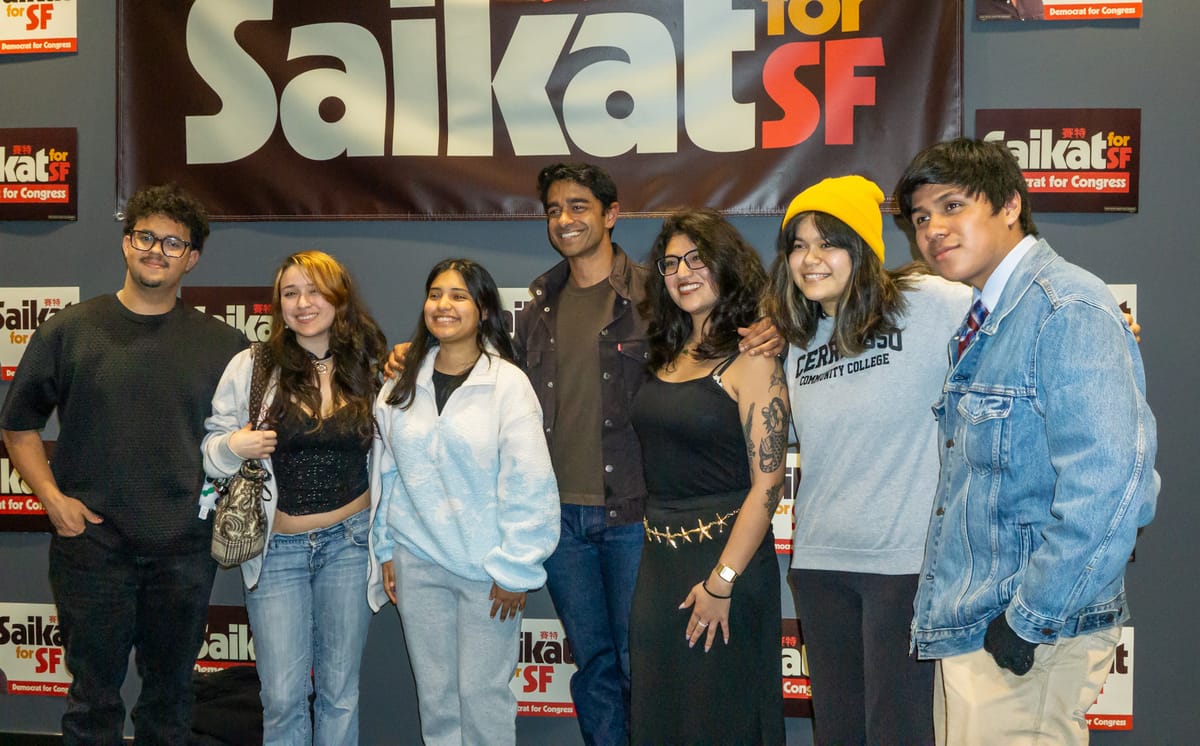
Saikat Chakrabarti posing for a photo with attendees for Saikat college night. February 27, 2026, San Francisco Calif. (Teresa Madrigal/The Guardsman)
As the race to represent San Francisco in the U.S. House of Representatives heats up, Saikat Chakrabarti is trying to separate himself from the field by reaching out to San Francisco’s young people.
On Feb. 24, Chakrabarti hosted an open house for college students at his campaign headquarters on Irving St. and 9th Ave., where the candidate fielded questions and discussed issues of import to young people.
Chakrabarti, who worked for Bernie Sanders’ 2016 presidential campaign, touted his support of free higher education while promising to fight for the Free City College tuition program. Sanders famously celebrated the beginning of the Free City tuition at City College in 2017, calling the program “a model for the U.S.”
“I would push Mayor (Daniel) Lurie to fully fund it,” Chakrabarti told The Guardsman. “But more than that, I would try to actually legislate at the Congressional level to get federal funding for the Free City programs, because I think when it comes to tuition free public colleges and community colleges and trade schools, it is difficult for cities on their own to support them, and that’s a big reason why I’m running for Congress.”
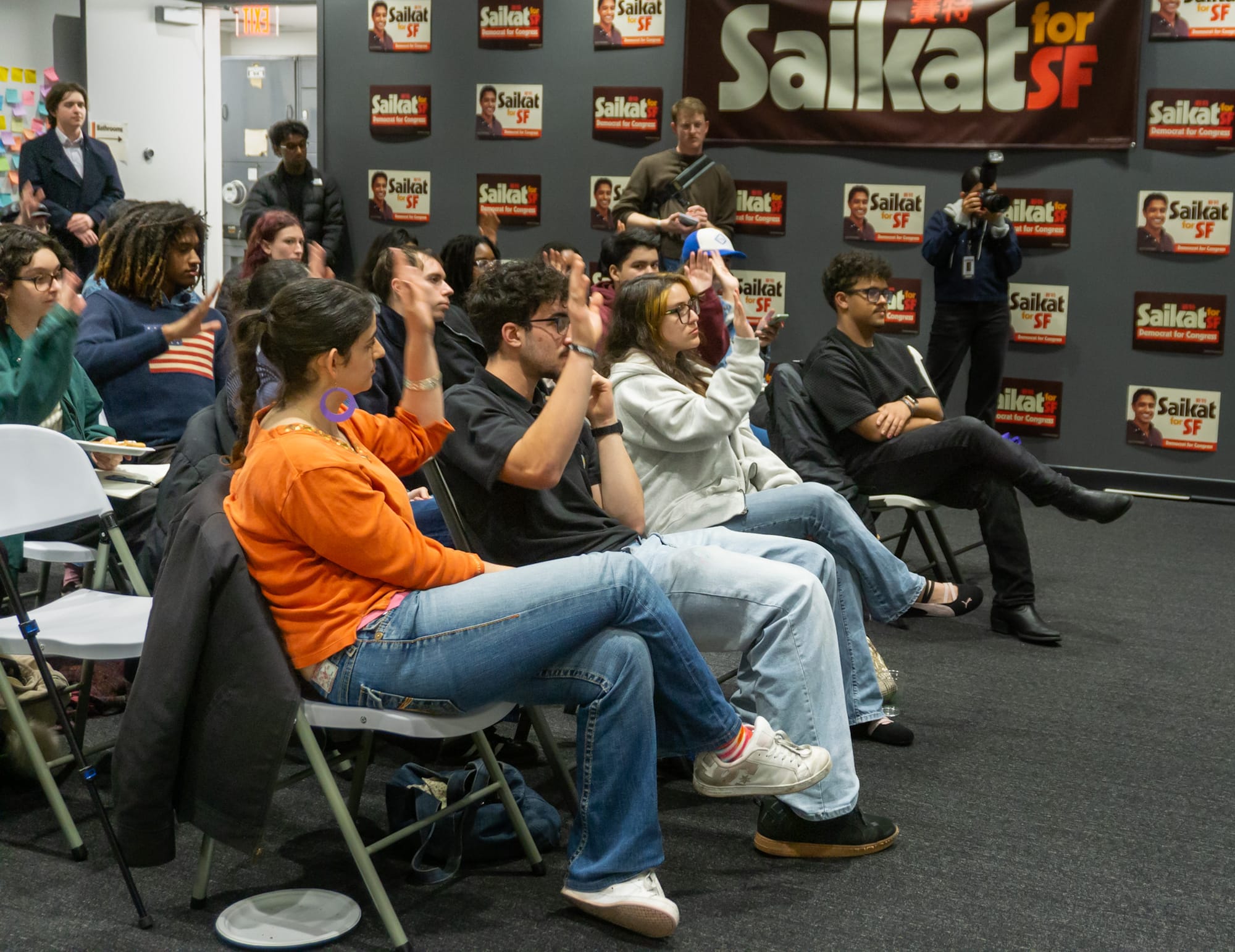
The event attracted around 30 college students hungry for change with overtures of free pizza, discussion of Chakrabarti’s “time with AOC and Bernie,” and a robust policy platform.
Attendance was split between undergraduates from San Francisco State and the University of San Francisco, with a handful from San Jose State and City College.
Audience shown raising their hands to question Saikat. February 27, 2026, San Francisco Calif. (Teresa Madrigal/The Guardsman)
“We’re not trying to run a campaign just about being against Donald Trump,” Chakrabarti told his audience. “We’re in the middle of an authoritarian coup right now, I want to be clear about that … But ultimately what we’re trying to do with this campaign is we actually want to present a vision for what the future should be.”
The candidate, who is running to fill Speaker Emerita Nancy Pelosi’s seat, discussed his support of healthcare for all, affordable public-housing, a wealth tax, and ending genocide.
Then, Chakrabarti directed the first question of the evening back at his audience. He wanted to know: “What are you worried about, and what are you hopeful for?”
The students shared concerns and queried Chakrabarti on his plan to tackle the cost of living crisis, ICE violence, the threat of AI, sky-high drug prices, Israel’s war crimes in Gaza, queer and trans rights under attack, and homelessness.
Many of Chakrabarti’s responses drew applause from the audience, as well as a few chuckles at his relatably millenial Star Trek references.
He labeled AI an “existential threat to society,” promised to challenge the current Democratic establishment, and declared that “when ICE shows up to a neighborhood, lawmakers should show up too.”
“I find it interesting,” City College student Maya Mason said her reason for attending. “My favorite part about engaging in politics is getting to interact with other people and get other people’s perspectives.”
Chakrabarti supports the College for All Act, introduced by Senators Sanders (I-Vt.) and Pramila Jayapal (D-Wash.) in May of 2025, which would make public colleges and universities tuition free for 95% of American students.
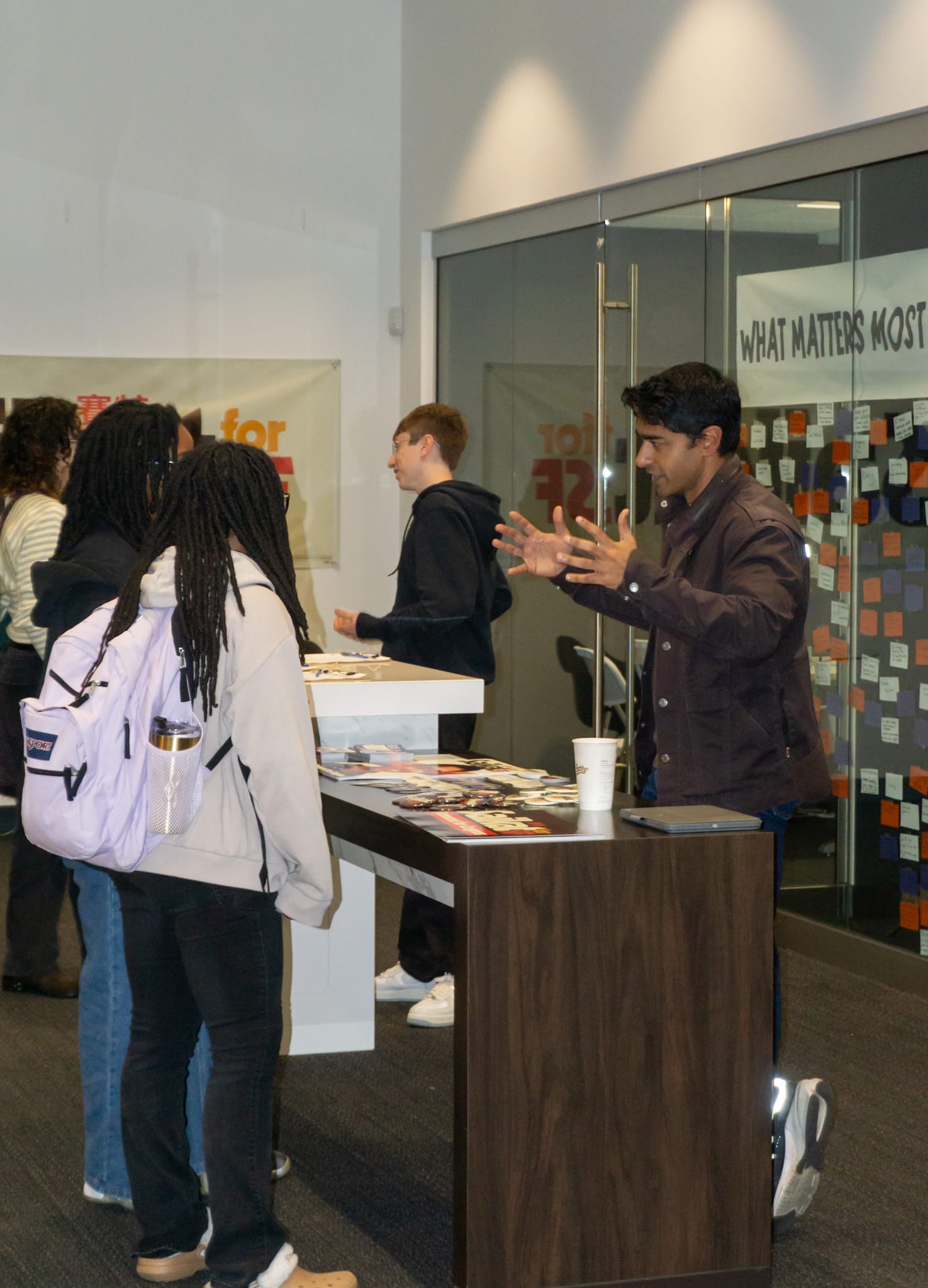
Saikat speaking with a few of the attendees prior to the event. February 27, 2026, San Francisco Calif. (Teresa Madrigal/The Guardsman)
At the local scale, Mayor Lurie’s proposed 2026 city budget would slash funding to the Free City program, threatening the college’s ability to provide free tuition to all San Franciscans.
Yet Chakrabarti — who prioritizes cost of living issues — has largely avoided criticism of Lurie, saying the mayor “has been okay” at a Working Families Party Congressional forum in early February. Lurie recently came out against the proposed “overpaid CEO tax” ballot measure and state wealth tax on billionaires initiative.
Chakrabarti has said his campaign “is going to carry out the largest grassroots canvassing effort for Congress that San Francisco has ever seen.”
After State Sen. Scott Weiner received a coveted endorsement from the California Democratic Party, and District 1 Supervisor Connie Chan drew over 200 people at her Chinatown kickoff event, Chakrabarti may need such a massive groundswell if he stands a chance in the upcoming June primary.
“I went to the first debate (between the candidates), and I was like ‘Okay, I just want to hear more from everybody,’” said Mason, a fifth-semester sociology major. “I feel like it was hard to find a distinction between the three for the most part.”
After the Q&A, Chakrabarti pitched students on volunteering for the campaign, saying “it’s actually really fun to canvass.” He claimed more than 3,000 people had already signed up.
Help Outreach Working Group lift the fog of corporate media. Donate to help us maintain this website and distribute literature on the street.
We protest Heritage Foundation EVERY MONDAY (Join us!!!!) By admin | September 2, 2025 | Uncategorized Cliff Cash Comedy Premiered Jul 26, 2025 Every Monday at The Heritage Foundation 214 Massachusetts Ave. Washington D.C. 4pm protest 6pm pizza Every Friday at Fox News D.C. 400 N. Capitol St. Washington D.C. 4pm protest 6pm pizza We are... Continue reading →
Milk Club Trans Caucus Meeting Date: Tuesday, April 28 Time: 5-7 PM Location and Zoom Link: Meeting info available to members of the Milk Club Trans Caucus. Please reach out to trans@milkclub.org if you would like to join the Milk Club Trans Caucus.
San Francisco Young Democrats meet with SFDems Chair Nancy Tung Wednesday, April 29th | 2pm Location: SC T-160 (third floor of Student Center) Register The San Francisco Young Democrats at SF State are teaming up with SFDems to make sure their voices are heard. Want to get more plugged into San Francisco... Continue reading →
One Million Rising: Strategic Non-Cooperation to Fight Authoritarianism Virtual Event · Hosted by No Kings Time Wednesdays 8 – 9:30pm EDT Location Virtual event Join from anywhere About this event Across the country, authoritarian forces are getting bolder and more dangerous. Trump and his allies are not hiding their agenda: mass deportations,... Continue reading →
THURSDAY, JUNE 29, 2023 AT 2 AM – 4 AM PDT How to create trust in a group? Details Event by Extinction Rebellion Empathy Circles online EMPATHY CAFE Duration: 2 hr Public · Anyone on or off Facebook How to create trust in a group? This is the question that arose in our... Continue reading →


 by
by 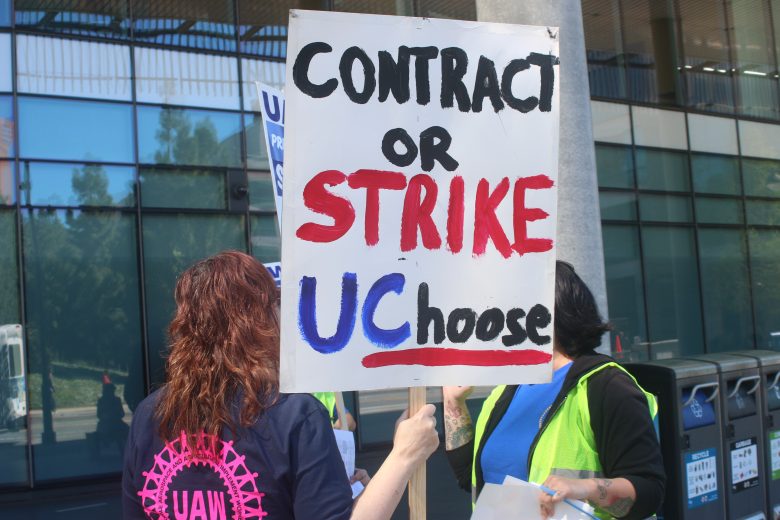





 by
by 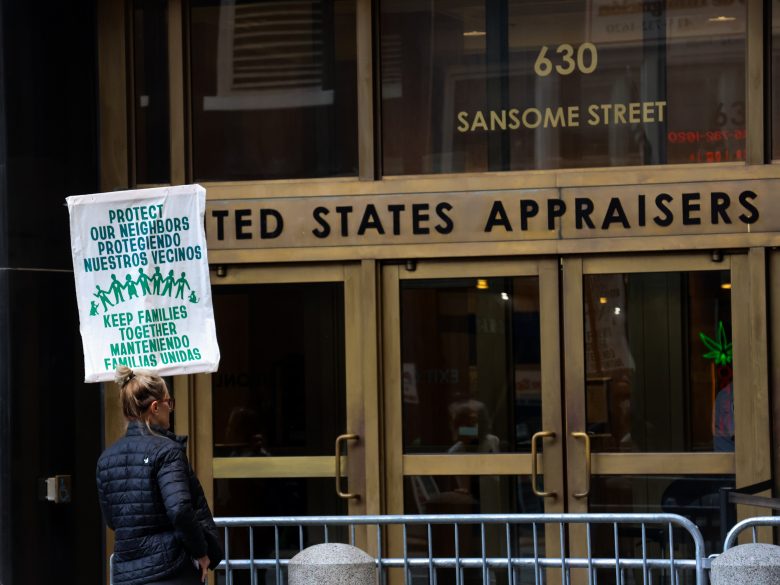




 by
by 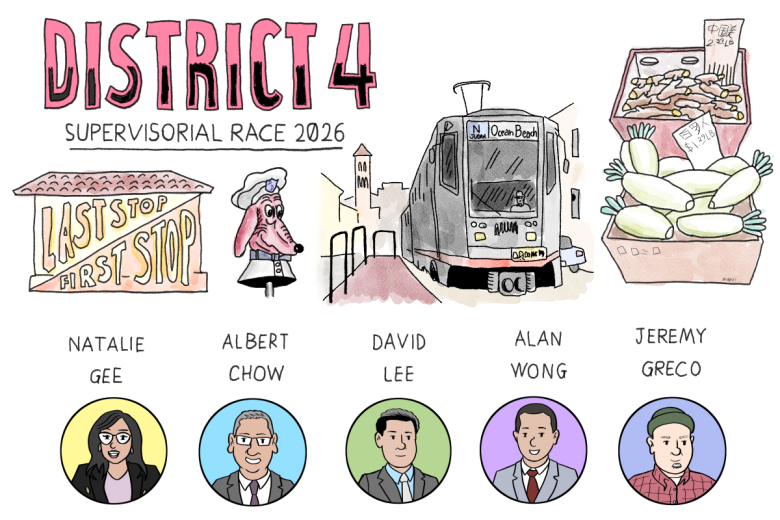





 by
by