A very big day in Palm Beach, Florida, where it was my Great Honor to have the Palm Beach International Airport be renamed, by a spectacular vote, The President Donald J. Trump International Airport. The Area is HOT, the Location is GREAT, and the Renovation will be SPECTACULAR. Thank you to all in Palm Beach for your Vote and your Confidence. This will soon be one of the Greatest and Most Spectacular Airports anywhere in the World! President DONALD J. TRUMP
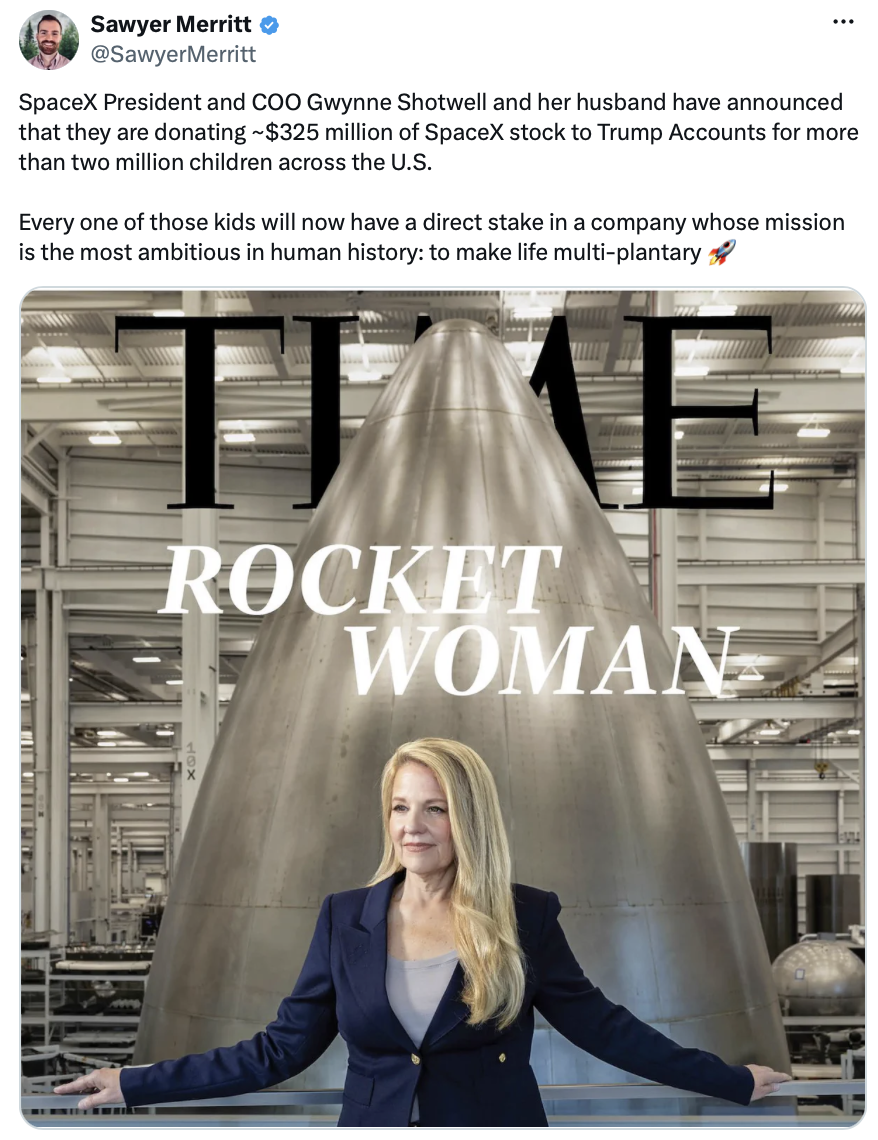
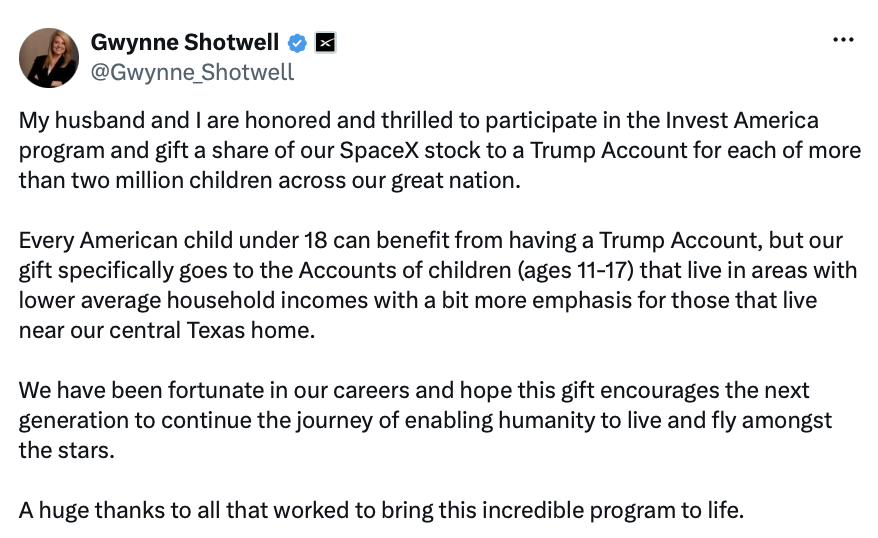
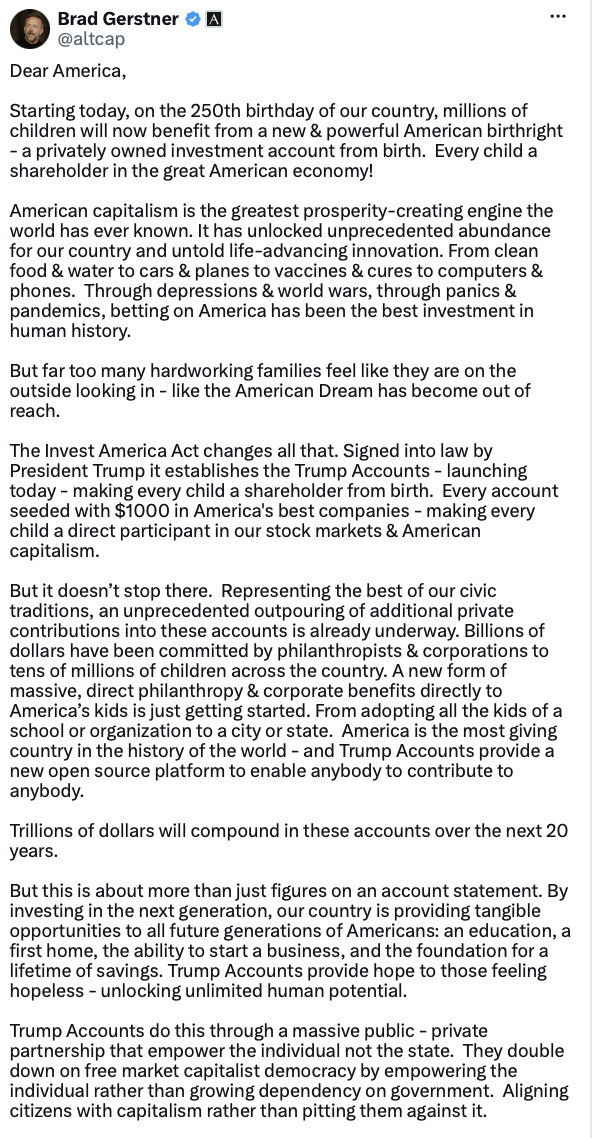
Thank you to the brilliant and highly respected Gwynne Shotwell, and her husband, Robert, for their extreme Generosity in helping children to attain the ever magnificent American Dream! Their Gift of 325 Million Dollars of SpaceX Stock is greatly appreciated by all. Thousands of children have just been given a better life. Thank you Gwynne and Robert, and continued Great Success! President DONALD J. TRUMP
Gavin Newscum’s recent Career Threatening Interview where he said he can’t read a speech, he was a stupid person, but smarter than the people in the room (RACIST!), has mental incapacity, difficulty, and various other ailments, may be the worst Interview given by a “professional” Politician in 100 years. No Politician has ever made such statements, and survived! Newscum is in BIG TROUBLE when he openly admits that Kamala is smarter than he is! President DONALD J. TRUMP
We just landed and met up with our new Air Force One, which was sent earlier to RAF Mildenhall, so we could show the wonderful Servicemembers, as per the entire Base’s request. They were very excited, picture enclosed. It was on our way back to the States from Turkey, with virtually no deviation of flightpath. President DONALD J. TRUMP
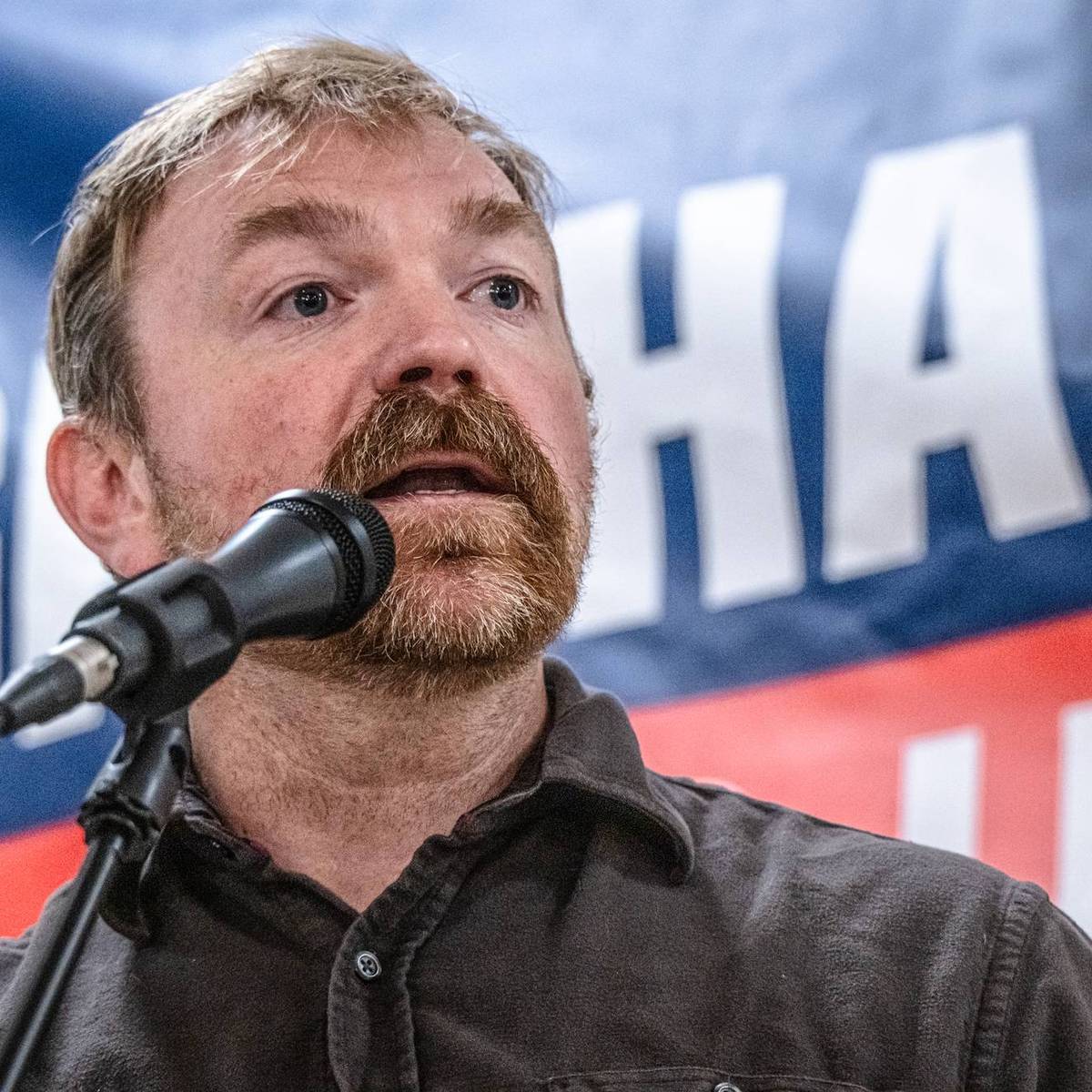
Graham Platner speaks at a town hall at the Leavitt Theater on October 22, 2025 in Ogunquit, Maine.
(Photo by Sophie Park/Getty Images)
“We firmly believe that the supporters and volunteers who built this movement deserve to have a real role in any nomination process,” said Graham Platner’s campaign manager.
Graham Platner’s campaign manager on Wednesday accused the MaineDemocratic Party of coordinating with national Democrats “behind closed doors” and cutting the embattled US Senate nominee’s supporters out of the process to determine his potential replacement in the wake of a sexual assault allegation—and amid expectations that he will soon drop out of the race.
In a text message sent to Platner supporters, campaign chief Ben Chin wrote that the Maine Democratic Party “allowed the DC-based Democratic Senatorial Campaign Committee to send staffers to plan a potential nominating process behind closed doors. Both the state and national parties cut our team, our volunteers, and our vast networks of supporters out of the conversation completely.”
“We firmly believe that the supporters and volunteers who built this movement deserve to have a real role in any nomination process,” Chin’s message continued. “If the Maine Democratic Party hopes to harness our movement, and avoid disillusioning the hundreds of thousands of supporters who came into the fray because of our movement’s policies, it must consult the feedback and proposals of the people who built and sustained this.”
The text included a link to a two-question survey asking Platner volunteers, “What message do you have for the Democratic Party?” and, “What message do you have for Graham?”
The defiant message came as Platner’s campaign was reportedly planning the nominee’s exit from the US Senate race to pave the way for a different Democratic candidate to take on five-term Sen. Susan Collins (R-Maine) in November. Platner has denied the sexual assault allegation that prompted mass calls for him to exit the race, including from his most prominent supporters such as Sen. Bernie Sanders (I-Vt.).
Chin’s text message was circulated a day after Devon Murphy-Anderson, the Maine Democratic Party’s executive director, said in a video posted to social media that the party has been “working around the clock” to develop a plan to replace Platner that is “open, inclusive, transparent, and fair.” The party has not yet publicly specified what that plan could entail, saying Platner must formally withdraw from the race first.
Murphy-Anderson accused Platner’s team of “repeatedly reach[ing] out” to the Maine Democratic Party “in an attempt to put their thumb on the scale of what this process looks like.”
“We have repeatedly reiterated to Graham Platner’s team that they have no role in determining our next Democratic nominee for the US Senate,” Murphy-Anderson added.
In response to Murphy-Anderson’s statement, the Platner campaign denied that it has attempted to exert influence over the replacement process, saying it simply “reached out to the party to try and understand what this process would look like.”
“Over 150,000 Mainers voted for this movement, and over 15,000 Mainers volunteered their time and energy to it,” an unnamed Platner campaign official told NBC News late Tuesday. “While Graham wouldn’t want to be a part of the process, he would want to make sure the voters and volunteers make this decision—not the political establishment.”
On Wednesday, the Maine Democratic Party issued a new statement decrying what it called the Platner team’s “false accusations against us” while also expressing gratitude for “his supporters and all of their efforts to defeat Susan Collins.”
“They are a vital part of our party and deserve to participate in an open process to select Platner’s replacement,” said Maine Democrats.
CNN reported that Platner is “expected to announce his decision” on his candidacy “through a recorded video, which could come later Wednesday.”
Platner must drop out of the race by July 13 if he’s to be replaced on the November ballot. If he exits the race, an alternative must be selected by July 27.
Politico reported that Platner “quietly fielded a poll Tuesday gauging the strength of people who could replace him on the ballot.”
“The flash poll, obtained by Politico, was conducted by Public Policy Polling and commissioned by Platner’s campaign,” the outlet reported. “It tested head-to-head match-ups between Republican Sen. Susan Collins and Platner, along with five possible Democratic replacements for Platner, including former Maine state Senate President Troy Jackson and Secretary of State Shenna Bellows.”
“Of the Democrats tested, Jackson performed the best, leading Collins 49% to 44%, with 7% of voters undecided,” Politico reported. The outlet also noted that the poll, conducted the day after the sexual assault allegation against Platner was first reported by Politico, showed Platner trailing Collins 47% to 42%.
Jackson has filed paperwork to explore a Senate bid in preparation for Platner’s expected exit, and Bellows—who lost badly to Collins in 2014—has said she would “seriously consider entering this race.” Nirav Shah, former director of the Maine Center for Disease Control and Prevention, is also weighing a Senate bid.
Our work is licensed under Creative Commons (CC BY-NC-ND 3.0). Feel free to republish and share widely.
Michigan U.S. Senate candidates Abdul El-Sayed, left, and Rep. Haley Stevens (D-MI) debated last night in Grand Rapids. Credit: Kristen Norman/AP Photo
Last night’s debate between Abdul El-Sayed and Rep. Haley Stevens for the Democratic nomination for Michigan’s U.S. Senate seat was feisty. Stevens, who is behind in the polls, was desperate to deliver a set of well-rehearsed attack lines about El-Sayed not releasing his taxes, wanting to be a “celebrity” through podcasts and speaking engagements, doing nothing to boost Kamala Harris in the 2024 election (this one isn’t true; El-Sayed endorsed and campaigned for Harris), and having his father-in-law run a super PAC on his behalf. (For the record, the father-in-law, Jukaku Tayeb, has put in $200,000 for a modest digital ad and direct mail campaign; Stevens has more than $30 million in support from super PACs in this campaign, including more than $7 million from AIPAC’s super PAC.)
El-Sayed stayed on the issues that have animated his campaign, exemplified by the slogan “Get money out of politics, put money in your pocket, and Medicare for All.” He returned to the theme again and again in saying that status quo politics and status quo politicians like Stevens were inadequate to the challenges facing the country.
What I found more interesting were the relatively rare moments when Stevens wasn’t avoiding questions to launch her attacks. Because when that happened, she said that Israeli Prime Minister Benjamin Netanyahu has failed and has made Jewish people less safe, that ICE is out of control and agents must be held criminally accountable, that America needs paid family leave, that billionaires should pay higher taxes, that data centers should be forced to pay utility and water bills for individuals, that the Social Security payroll tax gap should be scrapped, that Social Security Administration workers should be rehired, and that she would “stand up for the little guy.”
It’s not that I believe much, or maybe any, of this. Stevens is an ideological moderate who would slot in as a reliable vote for Chuck Schumer’s policy agenda if he manages to drag her across the finish line. She opportunistically capitalized on Netanyahu calling her out by name in a CNN interview, but her standing with pro-Israel donors, who helped her keep her House seat to the tune of $5 million in a member-on-member race against Andy Levin in 2022, is undisputed.
What’s more interesting is that the last refuge of Democratic candidates who face defeat is to veer to the left. Scrapping the Social Security cap is a Bernie Sanders policy. So is taxing billionaires.
This trip to the left has a long history. Al Gore decided in 2000 at the Democratic convention to make his presidential race about “the people versus the powerful,” after falling behind. Obama made his somewhat uncomfortable turn to populism in 2012 when it looked as if Mitt Romney might win. Frequently this campaign season, super PACs backing candidates with big dollars paint them as taking on ICE.
The Michigan race this year is sometimes characterized as part of a larger battle for the soul of the Democratic Party. If that’s the case, judging from Stevens’s words the progressive side has already won.
The reason it’s not believable coming from Stevens is because of the points El-Sayed has elevated in his campaign, to great effect: The same promises from the same politicians buoyed by the same money is not going to lead to different results. El-Sayed is focused on money in politics because it’s a good heuristic for how to assess candidates whose ideas and promises have begun to converge. In this telling, getting money out of politics is a key to unlocking every policy door.
“I think we need to think differently. That means standing up to Wall Street, not taking their money to fund your campaigns,” El-Sayed said last night. “As long as we are taking money from those corporations then we are not going to regulate them.”
The old era exemplified by legendary California Assembly Speaker Jesse Unruh saying that politicians have to be able to “take their money and then vote against them” is impossible to square with the last two decades of political stasis and small-ball solutions when the money is brought to bear. I wish it were different, but it’s not. In the end, El-Sayed has simplified the stakes, in his race and in Democratic politics: Do you want a candidate who is bought, or not?
Before you go.
I hope that you found this article interesting and thought-provoking. The reason we’re able to publish stories like this — free of programmatic ads and never behind a paywall — is because readers like you step up to support our work.
The Prospect doesn’t answer to advertisers or billionaire owners. We answer to you and to our commitment to pursuing the truth, wherever that leads us.
Independent, reader-supported journalism is critical at a time when the free press is under assault.
If you believe this kind of reporting should exist and remain free to read, we hope you’ll consider chipping in. Every contribution, however modest, makes a real difference.
David Dayen is the executive editor of The American Prospect. He is the author of Monopolized: Life in the Age of Corporate Power and Chain of Title: How Three Ordinary Americans Uncovered Wall Street’s Great Foreclosure Fraud. He co-hosts the podcast Organized Money with Matt Stoller. He can be reached on Signal at ddayen.90. More by David Dayen
A City Charter amendment that could lead to the creation of a public bank cleared the Board of Supes today—with two members voting against it.
That means the voters will have the opportunity in November to start the process of creating an alternative financial institution that could provide financing and consumer services that private banks won’t. It could set a national precedent. This is, in other words, a big deal.
Alan Wong, who once identified as a progressive on the Community College Board, joined Stephen Sherrill, the most conservative supervisor, in opposing the measure.
Sup. Chyanne Chen is a primary sponsor of the public bank measure
Sherrill raised some concerns about the plan when it was in committee. Wong, at the first vote on the measure week, said that he doesn’t think the city is capable of running a public bank. That’s the same old right-wing argument we hear about almost any new public services, including public power: Supes allies with PG&E used to say that the city can’t manage a municipal utility, although 2,000 cities around the county do that very successfully. San Francisco runs an exceptionally complicated operation, SFO, which involves far more money than a startup public bank.
The process for creating a public bank would, by law, be incremental, with the new agency demonstrating its financial solvency at every step. It would set a national model for local government to use its leverage to finance things like affordable housing.
Sup. Jackie Fielder ran for office in part on a promise to create a public bank.
Since Mayor Daniel Lurie appointed him to the board, Wong has never strayed from the mayor’s positions and has been among his most loyal allies.
Wong and I used to talk about City College on a fairly regular basis. Since Lurie put him on the board, he has not once responded to my calls and texts.
So far, though, Lurie’s Office has done nothing to oppose the public bank measure, and has not indicated to the primary sponsors, Sups. Chyanne Chen and Jackie Fielder, that he has any intention of working against the November ballot measure.
Nine votes is a strong statement of support. Unless the private banking industry decides to mount a well-funded campaign against this, or the mayor decides to oppose it, changes of a public bank moving forward in November are good.
48 Hills welcomes comments in the form of letters to the editor, which you can submit here. We also invite you to join the conversation on our Facebook, Twitter, and Instagram.
Tim Redmond has been a political and investigative reporter in San Francisco for more than 30 years. He spent much of that time as executive editor of the Bay Guardian. He is the founder of 48hills.
The nomination caucus would not have to be held in each one of Maine’s 57 active lighthouses. Credit: David Dayen
The first of the two times I wrote about Graham Platner at these pages was last year, in a story entitled “Politicians Aren’t Heroes.” Among other things, it made the point that candidates are vessels for ideas and policies, and that none of them are indispensable.
The second time, a week ago, was about how financial corruption exists on a different plane than other scandals. That is not diminished by the latest news; Platner’s actions and Susan Collins’s corruption can both be inexcusable and described as such.
Regardless of any public defiance from unnamed sources, Platner is not going to survive the latest allegations, and he should not. What comes next is the only thing that matters now, in a world where a Democratic Senate is vital to preventing continued unchecked lawlessness, the confirmation of dozens more right-wing judges, and to preserve the vestiges of democracy.
When Platner drops out, Maine Democrats will have a narrow window to find a new candidate by July 27, three weeks from today. According to the bylaws, the party need only hold a meeting, figure out the rules for a replacement, and then make a choice. There is nothing specific beyond that.
Reporting indicates that Maine Democrats are thinking about holding a state convention to choose a new candidate. The convention would nominate delegates, who would make that selection.
This would be better than a simple announcement by the state’s party committee, which has officially been ruled out. Democrats caucused to select party delegates back in February, so there’s a patina of legitimacy. And the process of selecting the decision-makers would at least be public and transparent. But there’s a whiff of insider-ism here that is likely to toxify the process.
If Maine can hold a caucus to select delegates, they can hold a caucus to select a nominee. They have a couple of weeks to assemble it. Maine just had its statewide primary and the likely candidates to substitute for Platner are well known. A primary election overseen by political parties rather than governmental election officials is known as a firehouse primary. This is Maine; let’s have a lighthouse primary.
You can already hear, before Platner has even officially withdrawn, rumblings about who “deserves” the nomination. Some base it on who best represents similar ideas expressed by Platner, like Troy Jackson, a logger from the northern Aroostook County who served two terms in the state Senate and finished third in the gubernatorial primary. Some look at who got the most first-place votes in that gubernatorial primary: Nirav Shah, director of the Maine Center for Disease Control and Prevention during the COVID-19 pandemic, and acting director of the federal CDC at the end of the Biden presidency.
Some might say that Gov. Janet Mills, who placed second to Platner in the Senate race with about one-fifth of the vote despite having dropped out of the race, should be the nominee. (Most observers doubt that she’s under consideration.) Or people could claim that Secretary of State Shenna Bellows, two also-rans in Maine’s Second Congressional District primary (Jordan Wood and Joe Baldacci), or even current Second District officeholder Jared Golden should get a shot.
The realities of modern Democratic politics make it likely that any decision will be savaged by at least some as establishment scheming. To be clear, in my view Maine Democrats are likely just trying to stand up who they consider their best nominee at this point. But to maximize that chance of victory, how they select the nominee matters. There’s a way to do it that’s transparent, in the spirit of primaries to which American voters are accustomed, and actually somewhat cleansing of what has been an enervating process. The best way to legitimize the result is to open it to the people.
It would be a difficult undertaking to do it in time for the July 27 deadline, but it’s not impossible. The Senate race is high-profile among local Democrats, who were energized enough to vote in record numbers in June. As the party runs caucuses for delegates, they have the potential to pull this off in similarly grassroots fashion. If the party needs money to do so, I’m sure the Democratic Senatorial Campaign Committee has an interest in a strong candidate.
One thing this would force is the kind of campaign everyone purports to want in America: a short window focused on person-to-person contact rather than throwing millions of dollars on the air. The party is running the caucus, and they could force each candidate to forswear any television advertising in the next couple of weeks as a condition of eligibility.
The result would have the best claim on reflecting the will of Mainers as they head into the general election. Not inferring from Platner’s performance or what happened in unrelated primaries, but a real result. And it could create something unique and important. The winner would need dedicated statewide organizers, a strategy that will help in November. Having the state dominated by a contest for Senate for the next few weeks could create momentum. And it would blow the events of the past 24 hours off the front page.
This also avoids the obvious uneasiness of a Democratic Party apparatus choosing a nominee after the primary, as was done with Kamala Harris in 2024. There is nothing positive about that scenario right now other than convenience.
Platner needs to affirmatively withdraw to set this in motion. The only way to follow through on the ideas he claimed to support for the better part of a year is by getting the hell out. As Maine Democratic gubernatorial nominee Hannah Pingree said today, “Platner tapped into something real—voters hungry for change showed up with real passion and energy. That energy doesn’t have to go away.” A lighthouse primary is the best way to keep it going.
Before you go.
I hope that you found this article interesting and thought-provoking. The reason we’re able to publish stories like this — free of programmatic ads and never behind a paywall — is because readers like you step up to support our work.
The Prospect doesn’t answer to advertisers or billionaire owners. We answer to you and to our commitment to pursuing the truth, wherever that leads us.
Independent, reader-supported journalism is critical at a time when the free press is under assault.
If you believe this kind of reporting should exist and remain free to read, we hope you’ll consider chipping in. Every contribution, however modest, makes a real difference.
David Dayen is the executive editor of The American Prospect. He is the author of Monopolized: Life in the Age of Corporate Power and Chain of Title: How Three Ordinary Americans Uncovered Wall Street’s Great Foreclosure Fraud. He co-hosts the podcast Organized Money with Matt Stoller. He can be reached on Signal at ddayen.90. More by David Dayen
The freedom to vote is the very foundation of our democracy. Voting is how we secure our civil rights and liberties and help shape our country, state, and town. Every eligible citizen has the right to cast a ballot freely, fairly, and accessibly — without fear of deception or intimidation. As President Trump and his administration’s abuses of power continue, it is all the more important to plan ahead and learn about your rights when voting.
All Scenarios
You have the right to vote free from intimidation
What to do if there are reports of ICE, National Guard, or other federal agents in your community during early voting or Election Day
What to do if you’re stopped by local or federal law enforcement or National Guard troops while attempting to vote
What to do if you’ve been arrested while attempting to vote
What to do if you’re asked about your immigration status
Do you offer this information in other languages?
I want to share this information on social media
More Resources
News & Commentary
Sep 2025
National Security
Know Your Rights in Encounters with Law Enforcement and Military Troops
The recent militarization of D.C. is a reminder of how quickly government power can expand. Our guide explains what to do if you’re stopped by police or troops.
President Trump has dangerously deployed thousands of troops into our communities in response to protests against dangerous ICE raids. We must take action.
Whoever, being an officer of the Army or Navy, or other person in the civil, military, or naval service of the United States, orders, brings, keeps, or has under his authority or control any troops or armed men at any place where a general or special election is held, unless such force be necessary to repel armed enemies of the United States, shall be fined under this title or imprisoned not more than five years, or both; and be disqualified from holding any office of honor, profit, or trust under the United States.
This section shall not prevent any officer or member of the armed forces of the United States from exercising the right of suffrage in any election district to which he may belong, if otherwise qualified according to the laws of the State in which he offers to vote.
Employers are required to pay no less than the San Francisco minimum wage to employees performing work in San Francisco, including part-time and temporary employees.
Employees performing work in San Francisco, including part-time and temporary employees, must be paid no less than the San Francisco minimum wage, currently $19.18 and increasing to $19.61 on July 1, 2026.
The San Francsico minimum wage rate will be adjusted based on the annual increase in the Consumer Price Index. This increase is based on Article 1.4 of the San Francisco Labor and Employment Code.
Note: A small number of “Government Supported Employees” are subject to a minimum wage rate $16.97 (increasing to $17.35 beginning July 1, 2026). View the historical San Francisco minimum wage rates for more information.
If you have questions about the San Francisco minimum wage or wish to report a violation of the law, fill out a complaint form, call 415-554-6292, or email mwo@sfgov.org.
Print the poster on 8.5″ x 14″ paper. Covered employers must display this poster at each workplace or job site where workers can easily read.
Legal Authority
In 2003, San Francisco voters passed a local minimum wage, becoming the first local jurisdiction to pass a minimum wage rate higher than the federal or state minimum wage. In 2014, San Francisco voters passed a new initiative to increase the local minimum wage to $15.00 per hour by July 1, 2018, and to adjust the wage rate each July 1 thereafter based on the annual increase in the Consumer Price Index.
Chinese Program Manager Albert Lam, left, and Noah Kline call voters from the phone bank at Saikat Chakrabarti’s former campaign headquarters — now the SF Solidarity PAC campaign for Connie Chan — on Irving Street in the Inner Sunset.Craig Lee/The Examiner
Shortly after being knocked out of the race to succeed U.S. Rep. Nancy Pelosi in Congress in the June 2 primary, centimillionaire and progressive activist Saikat Chakrabarti gathered campaign staffers for a bonfire on Ocean Beach. Attendees at the event said he talked about the idea of working to support former opponent Connie Chan as an alternative to state Sen. Scott Wiener.
Six days per week, the operation has been phone-banking and running canvassing crews in support of Chan, who represents District 1 on the Board of Supervisors, across Pelosi’s 11th Congressional district, which covers all but a southern chunk of The City.
The committee also provided support to Melat Kiros, a progressive Democratic candidate for Congress who just won an upset primary victory in Colorado.
Mel Halem: “This is my first campaign — it was my first job in politics at all, but I’m hooked now. I really feel like I want to stay involved in this.”Craig Lee/The Examiner
“This is my first campaign — it was my first job in politics at all, but I’m hooked now,” said Mel Halem, a 25-year-old former cafe barista who worked her way up over the past year from volunteer to senior field organizer for Chakrabarti’s campaign and is now deputy campaign manager for the SF Solidarity operation. “I really feel like I want to stay involved in this.”
Like her co-workers, Halem — a transplant from Orlando, Fla. — said she was inspired by Chakrabarti’s talk about matters such as wealth inequality, affordable housing and healthcare and believed Chan would have similar priorities.
“I feel like we need trustworthy people in Congress, and that comes from people who aren’t funded by mega billionaires and big pharma and things like that,” Halem said.
Halem and others also expressed a desire to keep working with a youthful crew that forged connections with each other through the long days trying to sell voters on Chakrabarti.
“We are all friends, like outside of this, we all see each other after hours and on the weekends, and I think that’s what makes our bond and our work ethic so strong,” said 23-year-old Dior Hartman. “Here you want to go above and beyond because you love your coworkers.”
Hartman joined in March as a canvasser along with several others, all of whom had been doing similar work to raise money for The Nature Conservancy.
“This is the hardest I’ve worked in a job, but it also just feels very energizing,” said Kaizen Betts-LaCroix, a Berkeley resident and former bartender in Emeryville who joined Chakrabarti’s campaign in January.
The SF Solidarity PAC’s operation is about half the peak size of Chakrabarti’s campaign, which Chakrabarti called the largest field operation in The City’s history. Its headquarters are in a retail space at 9th Avenue and Irving Street in the Inner Sunset, one of the three offices that Chakrabarti’s campaign had at its height.
The new operation will continue at its current level until July 15 and then continue in a slimmed-down form through November, Chakrabarti said. He estimated that “all in, it’s going to end up being a seven figure [independent expenditure] by November, for sure.”
Alex Vanscoy, right: “I am just on the lookout for the next big progressive cause that I can join, because, you know, the fight is definitely not over.”Craig Lee/The Examiner
Current campaign manager Alex Vanscoy, 22, is expecting to return soon to San Francisco State University, from which he took a leave of absence to work on Chakrabarti’s campaign. He said he plans to stay politically involved.
“I am just on the lookout for the next big progressive cause that I can join, because, you know, the fight is definitely not over,” he said.
Jason Olaru-Hagen, 23, said working on the campaigns had been stimulating after working in the health-care industry.
“I could still be doing an office job where I really did not feel any meaning attached to my work,” he said. “It’s been the exact opposite, and it’s been the most fulfilling thing I’ve ever done.”
Olaru-Hagen said he likes the high intensity of campaign work and he is hoping to continue working in progressive politics in some fashion.
Shawn Canin, 23, an organizer who is a senior at UC Berkeley majoring in media studies with a focus on law and policy, said he hoped to stay connected to his coworkers.
“This is, I think, just the beginning,” he said.
Whether the intensive door-knocking operation on Chan’s behalf will have more effect than the one for Chakrabarti remains to be seen. Chakrabarti ultimately won 42,060 votes (or 17.87%) to Chan’s 69,899 (29.7%) and Wiener’s 95,816 (40.71%).
Chakrabarti said in an interview that voters who supported him skewed younger than Chan’s and could complement her base of support.
“If we actually combine those two bases, that’s a winning coalition,” he said. “That’s a formidable coalition.”
Saikat ChakrabartiCraig Lee/The Examiner
“It’s really important just to establish who she is and get her name out there, so people know who she is and what she stands for,” Chakrabarti said.
The SF Solidarity PAC is an independent-expenditure committee. A Chan spokesperson declined to comment about the independent operation.
The message Chakrabarti’s team is purveying is “We Trust Connie” because she does not take “corporate bribes,” including money from lobbyists or CEOs or contributions from the American Israel Public Affairs Committee.
Joe Arellano, Wiener’s campaign spokesperson, said that Wiener “has not taken and will not take money from AIPAC due to significant policy differences.”
Wiener’s campaign money has come almost entirely from individual donors, and though the campaign has accepted funds from union political-action committees, it has a rule against taking money from corporate PACs — and if such donations sneak through, the policy is to return them, Arellano said.
The money theme is one that members of Chakrabarti’s committee staff said resonated with them and helped them to switch to supporting Chan.
“We’re all fighting the same fight — and especially when it comes to corporate money,” Hartman said.
Chakrabarti, who made a fortune as an early software engineer at the payments company Stripe, loaned or contributed at least $9.9 million of the $10.3 million his campaign raised in the leadup to the election. Chan, who declared her candidacy relatively late, on Nov. 20, had raised about $700,000 by the time of the election. Wiener raised about $4 million.
Arellano said that Chakrabarti’s new spending won’t have a different result.
“Saikat’s money wasn’t effective then, and his corporate super PAC for Connie Chan won’t work either,” Arellano said.
Arellano predicted voters will choose Wiener, highlighting in particular his record on housing. Among the numerous pieces of legislation Wiener has authored are laws aimed at spurring new housing development and weakening cities’ regulatory ability to impede it.
“This November, voters have a clear choice: Connie Chan, who’s blocked housing at every turn, or Scott Wiener, who has the record — and the vision — to actually solve the housing-affordability crisis when he gets to Congress,” Arellano said.
Chan spokesperson Julie Edwards, meanwhile, said that, “Scott Wiener has claimed to be a housing champion for 16 years, and housing has never been more expensive.”
Edwards said Wiener “has said he supports progressive taxation — but every chance he gets, he caves to his corporate donors instead of making big corporations pay their fair share.”
Wiener has said he opposes a labor-union-backed November ballot measure that would impose a one-time tax of up to 5% on taxpayers and trusts with certain assets valued over $1 billion, primarily to fund health care, as well as food-assistance or education-related programs.
Wiener has said he has supported progressive tax proposals in the past, but a one-time tax is not the optimal strategy, Arellano said.
Wiener also opposed the union-backed Proposition D, a measure that San Francisco voters rejected in June that would have increased The City’s Overpaid Executive Tax, which generally imposes a gross-receipts tax on companies at which the highest-paid managerial employee earns more than 100 times the median compensation of employees based in San Francisco. Wiener said the measure could hurt The City’s economy, Arellano said.
Chan supported Prop. D and also supports the impending statewide measure.
“Voters have had enough of his corporate Democratic ‘leadership,’ and that’s why 60% of San Francisco voters rejected him in June,” Edwards said of Wiener.
Chakrabarti, a co-founder of the economic-policy think tank New Consensus, said he believed voters lost confidence in him partly because U.S. Rep. Alexandria Ocasio-Cortez of New York did not endorse him. He was campaign manager and chair for Ocasio-Cortez and her chief of staff in Washington, D.C. for about eight months, and had sought her endorsement.
In addition, Chakrabati said, “attack mailers” against him took a toll. An independent group funded mailers playing on the allegation that Chakrabarti lived in Maryland, though Chakrabarti insisted he only bought a home there for his parents.
“So the message no longer mattered, because people lost their trust in me as a candidate, and so we think it’s really important to establish that Connie Chan is someone you can trust,” he said.
Everything You Need to Know About Voting In Your State
Select Your State Alabama Alaska Arizona Arkansas California Colorado Connecticut Delaware Washington, D.C. Florida Georgia Hawaii Idaho Illinois Indiana Iowa Kansas Kentucky Louisiana Maine Maryland Massachusetts Michigan Minnesota Mississippi Missouri Montana Nebraska Nevada New Hampshire New Jersey New Mexico New York North Carolina North Dakota Ohio Oklahoma Oregon Pennsylvania Rhode Island South Carolina South Dakota Tennessee Texas Utah Vermont Virginia Washington West Virginia Wisconsin Wyoming XXXXXXXXXXXXXXXXXXXXXXXXXXXXXXXXXXXXXXXXXXXXXXXXXXX
If you have Questions, we have Answers
Find out all you need to know about elections in 2026. Have questions about voter registration deadlines, requesting absentee or mail-in ballots, or how to vote in-person during early voting or on Election Day? Call or text 866-OUR-VOTE (866-687-8683) to speak with a trained Election Protection volunteer. More information about voting in your state can be found below.
Get help registering to vote or find tools to help others register. Read More
Social Media Toolkit
Check out these resources to mobilize voters in your community. Read More
Volunteer Stories
See why Election Protection Volunteers are dedicated to protecting voting rights. Read More
Ensuring all voters have an equal opportunity to participate
The national, nonpartisan Election Protection coalition is made up of more than 300 local, state and national partners, We work year-round to advance and defend the right to vote.
About Us In Your State Select Your State Alabama Alaska Arizona Arkansas California Colorado Connecticut Delaware Washington, D.C. Florida Georgia Hawaii Idaho Illinois Indiana Iowa Kansas Kentucky Louisiana Maine Maryland Massachusetts Michigan Minnesota Mississippi Missouri Montana Nebraska Nevada New Hampshire New Jersey New Mexico New York North Carolina North Dakota Ohio Oklahoma Oregon Pennsylvania Rhode Island South Carolina South Dakota Tennessee Texas Utah Vermont Virginia Washington West Virginia Wisconsin Wyoming
Thanks for contacting the Election Protection hotline! Please click “Message Us” below to be connected to a trained volunteer.Please select your preferred language from the dropdown menu to continue.EnglishEspañolالعربية中文 (普通话)中文 (廣東話)Tiếng Việt한국어বাংলাاردوहिन्दीTagalogਪੰਜਾਬੀMessage Us!
Help Outreach Working Group lift the fog of corporate media. Donate to help us maintain this website and distribute literature on the street.
Trump Regime Takedown: Every Saturday Saturday, March 7, 2026 12:00 PM 2:00 PM Tesla San Francisco999 Van Ness AvenueSan Francisco, CA, 94109United States (map) Google Calendar ICS Keep democracy alive every Saturday by showing up, taking a stand, and sticking together for the long haul. Standing together is better than standing alone. Let’s get together... Continue reading →
This Sunday’s Town Hall: Announcing This Week’s Progressive Town Hall: Every Sunday at 4pm ET/1pm PT RSVP HERE Join PDA activists online from across the country to discuss the importance of progressives reclaiming the American story from the MAGA right, an issue of heightened importance as we’re now within one... Continue reading →
We protest Heritage Foundation EVERY MONDAY (Join us!!!!) By admin | September 2, 2025 | Uncategorized Cliff Cash Comedy Premiered Jul 26, 2025 Every Monday at The Heritage Foundation 214 Massachusetts Ave. Washington D.C. 4pm protest 6pm pizza Every Friday at Fox News D.C. 400 N. Capitol St. Washington D.C. 4pm protest 6pm pizza We are... Continue reading →
One Million Rising: Strategic Non-Cooperation to Fight Authoritarianism Virtual Event · Hosted by No Kings Time Wednesdays 8 – 9:30pm EDT Location Virtual event Join from anywhere About this event Across the country, authoritarian forces are getting bolder and more dangerous. Trump and his allies are not hiding their agenda: mass deportations,... Continue reading →
THURSDAY, JUNE 29, 2023 AT 2 AM – 4 AM PDT How to create trust in a group? Details Event by Extinction Rebellion Empathy Circles online EMPATHY CAFE Duration: 2 hr Public · Anyone on or off Facebook How to create trust in a group? This is the question that arose in our... Continue reading →
Trump Regime Takedown: Every Saturday Saturday, March 7, 2026 12:00 PM 2:00 PM Tesla San Francisco999 Van Ness AvenueSan Francisco, CA, 94109United States (map) Google Calendar ICS Keep democracy alive every Saturday by showing up, taking a stand, and sticking together for the long haul. Standing together is better than standing alone. Let’s get together... Continue reading →
This Sunday’s Town Hall: Announcing This Week’s Progressive Town Hall: Every Sunday at 4pm ET/1pm PT RSVP HERE Join PDA activists online from across the country to discuss the importance of progressives reclaiming the American story from the MAGA right, an issue of heightened importance as we’re now within one... Continue reading →
We protest Heritage Foundation EVERY MONDAY (Join us!!!!) By admin | September 2, 2025 | Uncategorized Cliff Cash Comedy Premiered Jul 26, 2025 Every Monday at The Heritage Foundation 214 Massachusetts Ave. Washington D.C. 4pm protest 6pm pizza Every Friday at Fox News D.C. 400 N. Capitol St. Washington D.C. 4pm protest 6pm pizza We are... Continue reading →
One Million Rising: Strategic Non-Cooperation to Fight Authoritarianism Virtual Event · Hosted by No Kings Time Wednesdays 8 – 9:30pm EDT Location Virtual event Join from anywhere About this event Across the country, authoritarian forces are getting bolder and more dangerous. Trump and his allies are not hiding their agenda: mass deportations,... Continue reading →
THURSDAY, JUNE 29, 2023 AT 2 AM – 4 AM PDT How to create trust in a group? Details Event by Extinction Rebellion Empathy Circles online EMPATHY CAFE Duration: 2 hr Public · Anyone on or off Facebook How to create trust in a group? This is the question that arose in our... Continue reading →












 by
by