In the mythology of history, 1776 belongs to Philadelphia: declarations, rebellion and the birth of the United States. Yet on the far edge of a continent the revolutionaries hadn’t fully imagined, another founding was quietly unfolding that same year.
While Thomas Jefferson drafted ideals of liberty and self-government in the East, Spanish conquistadors and Franciscan missionaries were establishing a tiny outpost beside one of the world’s greatest natural harbors. That settlement would become San Francisco.
The coincidence is more than historical trivia. It is a revealing dual narrative about the American experiment itself: one founding devoted to principles, the other to possibility.
The United States was born from an argument about freedom. San Francisco was born from geography, ambition and grit. Together, they tell the story of a nation forever oscillating between ideals and reinvention.
In 1776, the future San Francisco — located on the ancestral homeland of the Ramaytush Ohlone people — was mainly known for windblown dunes and rolling hills.
Then, Spain — worried about Russian and British encroachment on the Pacific coast — moved to secure Alta California. That summer, colonists established the Presidio of San Francisco and Mision San Francisco de Asis, today better known as Mission Dolores.
Mere days before the Continental Congress signed the Declaration of Independence, Juan Bautista de Anza planted a cross in the ground establishing the Presidio on the bluffs above the Pacific. The contrast between the two foundings could not have been sharper.
The American Revolution announced itself with soaring language about equality and liberty. San Francisco’s founding emerged from empire. One was loudly ideological; the other deeply pragmatic — but over the centuries, San Francisco would evolve into perhaps the most vivid expression of the very ideals articulated in Philadelphia.
For most of its early life, San Francisco remained obscure. No one could have predicted that this remote village would one day become one of the most influential cities on Earth. Then came 1848.
The discovery of gold transformed San Francisco almost overnight from a sleepy port into a global magnet for ambition, becoming — in a matter of years — the most cosmopolitan place west of New York.
The California Gold Rush did more than enrich prospectors. It created a civic culture built around reinvention. In older societies, identity often depended on class, ancestry or inherited status. In San Francisco, identity became fluid. Here, a laborer could become a merchant, a refugee could become a restaurateur, and an immigrant could become a titan of industry.
The City rewarded audacity more than pedigree. That ethos still defines San Francisco today.
The rest of America often imagines San Francisco as a place of contradictions: radical and wealthy, bohemian and corporate, idealistic and relentlessly ambitious. But beneath these polarities lies a coherent civic philosophy.
San Francisco has long believed that talent matters more than origins and that the future belongs to those willing to invent it. That is the deeper connection between the two foundings of 1776.
The founders of the United States envisioned a society in which individuals were not permanently trapped by aristocracy or inherited hierarchy. Their vision was incomplete and deeply flawed in practice, especially in a nation still burdened by slavery and exclusion.
But the democratic aspiration was revolutionary: Ordinary people could shape their own destinies. San Francisco became one of the ultimate realizations of that aspiration.
The City’s history is a procession of outsiders arriving with little and building something transformative. Chinese railroad workers and merchants helped define its commercial and cultural identity despite fierce discrimination. LGBTQ communities found refuge and political power in San Francisco decades before much of America accepted them. Artists, activists and entrepreneurs repeatedly turned our home into a laboratory for social and technological change.
And then came Silicon Valley.
Though the region geographically exists outside the city limits, the Bay Area spawned a technological revolution over the 20th century that cemented San Francisco’s place in the global imagination as the cradle of innovation. The personal computer, the internet economy, social media, artificial intelligence and venture capital culture all carry the unmistakable imprint of San Francisco’s frontier mentality.
This place has always attracted people who believe the world can be remade.
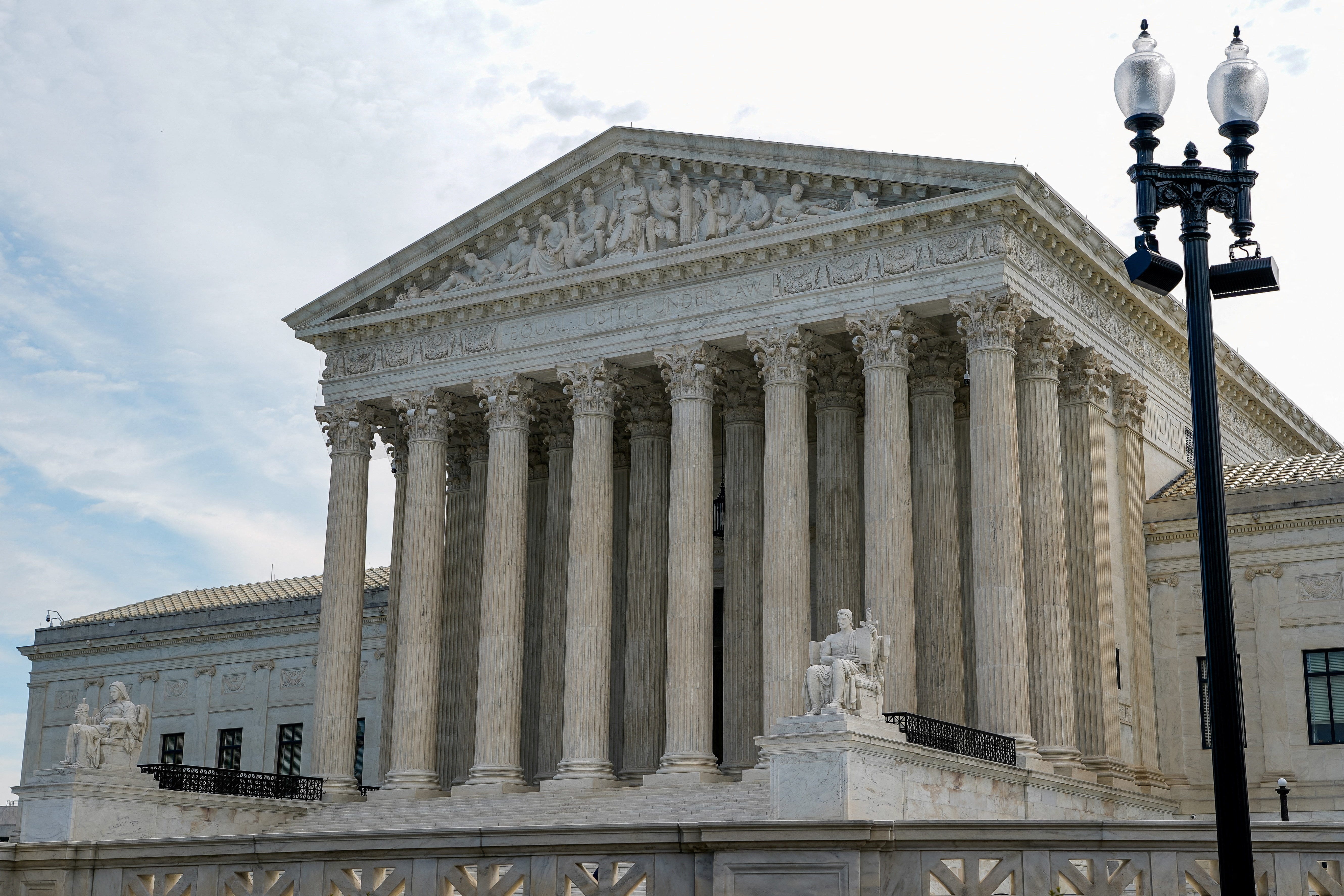
Congress passed the laws. Previous presidents signed them. The Supreme Court has now declared they can be ignored whenever this particular president chooses (but not Biden)…
Something happened inside the Supreme Court chamber on Thursday that almost never happens: Justice Sonia Sotomayor was so disgusted by what the six radical, on-the-take Republican appointees had just done that she read her dissent aloud from the bench, and Justice Samuel Alito, who’d written the majority opinion, snapped back at her in real time, a breach of the Court’s normally stage-managed decorum that left veteran reporters in the room visibly startled in slack-jawed amazement.
On the surface they were fighting about asylum seekers. But Sotomayor understood, as Alito surely did, that the real question wasn’t who gets to cross the border: it was whether the laws Congress writes still mean anything once a neofascist, imperial president (like Alito and his peers want) decides he’d rather not follow them because he’s above the law.
Back in 1980, a bipartisan Congress passed the Refugee Act to bring American law in line with our promise not to send the persecuted back to be killed, and it laid out a specific, mandatory set of steps.
Under the law Congress wrote that year, a noncitizen who reaches our border and says she fears persecution gets referred for an asylum interview to determine the legitimacy of her fear of violence or death in her home country or the country she’s fleeing. The word Congress chose to write into the law was the administration “shall,” not “may,” hold that hearing and a judge “shall” make that determination.
On Thursday the Republicans on the Court, however, ruled that Trump can erase or effectively ignore that law by simply ordering border agents to physically block people on the Mexican (or, presumably, Canadian or at an airport arrival) side of the line, so they never technically “arrive in the United States” and the law never kicks in.
Sotomayor called the reasoning illogical, because it is. A person standing at the threshold of a port of entry has plainly arrived. The Republican Trump toadies on the Court, however, pretended otherwise so Trump’s racial enforcers could essentially ignore both the intention and the letter of the law that elected members from both parties in Congress wrote.
The second ruling is even worse, albeit quieter.
Congress (whose job is to write laws for the United States) created Temporary Protected Status (TPS) in 1990 for people who can’t safely go home, and it built in court review of whether an administration followed the required procedures before yanking that status away.
The Trump administration recently tried to strip TPS protections from hundreds of thousands of Black Haitians and brown-skinned Syrians as part of its “Make America White Again” program, and multiple lower courts found it had ignored those procedures the law requires, noting that Trump’s Haiti decision, in particular, was tainted by racial animus (hate of Black people from what Trump calls “shithole countries”).
As Amy Howe of SCOTUSblog wrote about Justice Elana Kagan’s reaction:
“Kagan called it ‘plain to see’ that race played a role in the decision to terminate the TPS designation for Haiti. ‘The evidence’ that the Haiti TPS beneficiaries ‘have offered,’ she stressed, ‘includes statements by the President so repellent and racially inflected that the majority declines to put them in print.’ But those ‘statements fairly shout,’ she said, ‘in their racial undertones and overtones alike, that race entered into the President’s resolve to remove Haitians from this country.’”
The Republican majority didn’t even bother to say if the Trump regime had or had not complied with the plain letter and clear intent of the law Congress passed. Instead, the six corrupt Republicans on the Court declared that no court anywhere in America is allowed to even ask if Trump, et al, are breaking that particular law (an oversight process by a court called “judicial review”).
As the American Immigration Council pointed out, that means even an openly illegal decision is now insulated from any review by any judge in the country, closing the courthouse door in a way that, in my opinion, even the most conservative of the Founders would have found astonishing and plainly unconstitutional.
Congress, in other words, wrote a law that told the courts to check the legitimacy of asylum seekers claims to determine if they can or cannot stay here and apply for legal status; writing such laws is what the Constitution requires of an elected Congress.
But the six radical justices that rightwing billlionaires have spent decades and hundreds of millions of dollars to get on the Supreme Court told all the rest of the courts in America to simply look away and ignore the law. They’re not allowed to enforce it any more, even though Congress passed it and a president signed it.
Robert Reich put his finger on it yesterday afternoon, noting in his excellent newsletter that:
“[A] majority of the current Supreme Court — the abominable Roberts Court — has bent over backwards to ignore those laws.
“This must be seen for what it really is — a systemic effort by the six Republican appointees on the court to shrink congressional authority and enlarge the authority of the executive branch.
“If there was any doubt before, there should be none now: The Supreme Court is part of the anti-democracy movement led by Trump and the billionaires behind him.”
This agreement with Trump’s racist efforts to purge America of Black and brown refugees aren’t only losses for those would-be immigrants. As Reich points out, these decisions are stripping power from Congress, from the basic idea that the people’s elected representatives get to write laws that the Constitution requires a president to obey.
The Court’s defenders will tell you I’m being unfair in that assessment, claiming that the justices are just neutral umpires reading statutes as written. But that’s a lie, and recent history proves it.
Just a few years later, the same conservative bloc reasoned its way to blocking Joe Biden’s student debt relief, insisting Congress would never hand a president that kind of authority without saying so in unmistakable language.
When a Democratic president acts, in other words, they read laws Congress has passed with a magnifying glass and demand crystal-clear permissions. But when Trump (or, presumably, future Republican presidents) wants to shred the asylum process or wants his immigration purges of nonwhite people placed beyond the reach of any judge, the magnifying glass disappears and the words suddenly bend whichever way Trump wants.
These six lawyers in robes started from the outcome that today’s captured hard-right MAGA Republican Party and its white supremacist Dear Leader wants and reverse-engineered their reasoning to reach it, and the reasoning changes from case to case because the only thing that has to stay fixed is who wins.
As Sotomayor wrote, pointing to that magnifying glass in her dissent to yesterday’s Mullin v. Al Otro Lado decision:
“The Court’s illogical interpretation [of Congress’ written law] is driven almost entirely by a fixation on a single word: ‘in.’”
And the consequences of these decisions aren’t merely academic: people will die because of the actions these corrupt Republicans just took allowing the President and his whiteness enforcers to ignore the statutes that Congress wrote, both parties passed, and presidents signed into law. As Sotomayor also wrote in her dissent:
“One woman who had fled Honduras after receiving death threats from gang members was beaten, cut, and knocked unconscious by an unknown man after being turned back from a port of entry. Another asylum seeker who was turned back at a port three times was later raped in the presence of her child.
“Those living in migrant camps were subjected to break-ins, robberies, and assaults, ‘fac[ing] serious harm at the hands of criminal organizations, including kidnapping, extortion, physical violence, and sexual assault.’ Some were ‘murdered in Mexico while waiting for an opportunity to be processed by U. S. officials.’
“Desperate to flee these conditions and secure the opportunity to apply for asylum, ‘[s]ome attempted to reach U. S. soil by other means,’ including by attempting to cross the border between ports of entry by trekking through deserts or swimming across the Rio Grande. Often, these efforts had tragic ends.
“One couple that grew discouraged after a month of waiting in a camp near the border decided to cross the river and ask for asylum once they reached U. S. soil, but they were caught in a swift current and drowned. Another woman also drowned, along with her 2-year-old son, after she gave up waiting in a tent camp and attempted to swim across the river. Hundreds of others have met a similar fate, and many more died crossing the desert along the southern border, all making 2020 and 2021 some of the ‘deadliest year[s] for migrant crossings’ in various regions of the southern border.”
I lived and worked in Germany in the 1980s, and you couldn’t be there in those years without feeling how the entire postwar refugee framework — in America and across postwar Europe — grew out of one unbearable lesson, that turning desperate people away at the door and sending them back to die is something decent nations swore they’d never do again.
In 1939, the United States turned away the St. Louis, a ship carrying 937 Jewish refugees fleeing Hitler’s Nazi Germany purge of all “non-Aryan” people. The ship returned to Europe where the Nazis seized its passengers, ultimately murdering 254 of them in the “detention centers” Germany ran in occupied countries.
Americans were horrified and humiliated as the story became known well after the war, and the Refugee Act of 1980 was our nation writing the promise that we’d never repeat such a horror into law; it passed with broad bipartisan support.
On Thursday of this week five unelected men and one unelected woman in robes decided that promise is now optional for a president who welcomes white South African “refugees” but wants to purge American of people whose skin is darker than his.
I’ve argued for years, including in The Hidden History of the Supreme Court and the Betrayal of America, that Republicans on this Court long ago seized powers the Framers never gave it, and have — since Nixon flipped the court to the right and appointed Lewis Powell (of Powell Memo infamy) in 1972 — spent the last fifty years using them on behalf of the morbidly rich and the party that serves them.
From Buckley in 1976 and Bellotti (written by Powell himself in 1978) through Citizens United in 2010, this generation’s Republican justices — each carefully placed on the Court by big money interests since the 1980s — rewrote our democracy and turned it into an auction; earlier this term they even gutted what was left of the Voting Rights Act to help solidify raw GOP political power.
Now they’re telling Congress its laws are merely suggestions whenever a Republican president disagrees.
Justice Louis Brandeis warned us a century ago that, “[W]e can have democracy in this country or we can have great wealth concentrated in the hands of the few, but we can’t have both.” The morbidly rich men who put these justices on the Court made their choice, and the justices are delivering for them, tearing another bite out of our democracy with every decision.
The good news is that the branch the Court just tried to sideline is the one closest to you. Ahilan Arulanantham, who argued the Syrian case, urged Congress to act to overrule the Court, and he’s right, because Congress can restore judicial review, can rewrite these statutes in language even Sam Alito can’t twist, can expand and rebalance the Court itself, and can be made to do all of it if enough of us demand it.
Call your senators and representative at 202-224-3121 and tell them a Court declaring Congress irrelevant is a five-alarm constitutional emergency: we need a judicial code of ethics for SCOTUS so they have the follow the same laws as all other federal judges must; impeachment hearings for Thomas, Alito, Kavanaugh, and Roberts; 18-year term limits; and a rapid expansion of the Court to at least 13 members to bring it into line with previous, historic ratios to other senior courts.
None of this changes unless ordinary people refuse to let it stand. So get loud, stay in it, and if this piece helped you understand what really happened yesterday, share it and send people to hartmannreport.com so more of us understand exactly what we’re up against, exactly who to hold responsible, and how.
Posted on June 27, 2026 by Ellen Brown (EllenBrown.com)
As Americans prepare to celebrate the 250th anniversary of the Declaration of Independence, few are paying attention to a bill moving through Congress that could seriously impinge on our financial independence.
The Clarity for Payment Stablecoins Act, H.R. 4766, is slated to make privately issued stablecoins a major component of the U.S. monetary system. Supporters see stablecoins as a way to strengthen the dollar’s global role while creating a vast new market for U.S. Treasury securities. Critics see the rise of programmable private money that can be monitored, frozen, or restricted by its issuers. Banks fear the loss of the deposits that are essential to advancing affordable credit. What appears to be a debate about digital tokens has thus become a battle over the future of banking itself and finance.
Why Stablecoins Matter
Stablecoins are privately issued digital tokens that can circulate on blockchain networks independently of the banking system. They are designed to maintain a stable value, typically one dollar per token. Unlike Bitcoin and other cryptocurrencies, whose values fluctuate wildly, stablecoins are usually backed by reserve assets such as cash and short-term U.S. Treasury securities.
Their growth has been explosive. The stablecoin market now measures in the hundreds of billions of dollars and continues to expand rapidly. Advocates see them as the next stage in the evolution of money: faster, cheaper, available around the clock, and capable of moving across borders without relying on traditional banking networks.
For users in countries suffering from inflation, currency controls, or banking instability, dollar-denominated stablecoins can function as digital dollar savings accounts. Residents of Argentina, Turkey, Nigeria, and other countries may trust a Treasury-backed dollar token more than their own national currency. In some countries suffering from inflation, merchants quote prices in dollar stablecoins and accept them directly through mobile apps.
The Push from Cryptocurrency Advocates: Ending “Regulation by Enforcement”
The stated goal of the CLARITY Act is to establish a statutory framework that clarifies whether digital assets are securities, commodities, or payment stablecoins. Before this legislation, regulators—primarily the SEC—often applied decades-old laws to modern blockchain technology. Because the rules weren’t explicitly written for crypto, companies would discover they were in violation only when they were served with a lawsuit or a fine.
The most prominent example is SEC vs. Ripple Labs. Ripple launched its XRP token in 2012 and operated for nearly a decade without specific guidance that its token was considered a security. In 2020, the SEC sued Ripple, alleging they had been selling unregistered securities for years. Ripple was forced into years of litigation and hundreds of millions in legal fees to determine if a rule applied to them retroactively.
The CLARITY Act, alongside the GENIUS Act (which focuses on stablecoins), represents a shift from “Regulation by Enforcement” to “Regulation by Guidance,” where firms have a clear rulebook to follow before they launch products rather than waiting for a subpoena to understand their legal status.
The Government’s Interest
The push for passage of the Clarity Act has come not only from crypto advocates but from policymakers, because every stablecoin backed by Treasury securities creates another buyer for U.S. government debt. Treasury Secretary Scott Bessent has embraced stablecoins as a means of strengthening the dollar’s global role. The Treasury Department projects that the stablecoin market could eventually reach trillions of dollars. If that happens, stablecoin issuers could become some of the largest buyers of Treasury bills in the world, helping to replace losses from those central banks that have been “de-dollarizing” by selling their reserves of U.S. debt.
Another advantage of stablecoins from the government’s perspective is their ability to reassert U.S. monetary sovereignty over the eurodollar market — the massive, offshore market where dollars are created through bank lending without direct oversight from the Fed. This is a complicated subject for a later article, but the bottom line is that by shifting global demand from uncollateralized eurodollar bank promises to tokens backed 1 to 1 by U.S. Treasuries, stablecoins effectively force privately-issued offshore dollars back onto the U.S. government’s balance sheet.
Promise or Threat?
Those are some of the upsides, but stablecoins are not neutral payment tokens. Part 3 of this series discussed Project Hamilton, which showed what a public digital dollar could look like — fast, privacy-protected and democratic. The stablecoin system rising in its place looks very different. It is private, not public; programmable, not cash‑like; surveilled, not anonymous.
Every stablecoin transaction is permanently recorded on a public blockchain. Tokens can be frozen, seized, or destroyed. Users can be blocked. Circle (USDC) maintains a blacklist function and has frozen addresses at the request of law enforcement or at its own discretion. Tether (USDT) has frozen billions of dollars’ worth of tokens across thousands of addresses. PayPal’s PYUSD includes explicit “freeze” and “wipe” functions in its smart‑contract code.
This is the sort of “programmability” that CBDC critics fear – the ability to embed code into the money itself, causing it to execute transactions automatically when specific conditions are met. In fact, stablecoins could potentially be more invasive than a CBDC, since private issuers are not subject to the constitutional obligations imposed on the U.S. government by the 4th and 5th Amendments. In a June 23, 2026 podcast, Catherine Austin Fitts, former Assistant Secretary of Housing and Urban Development, called stablecoins “much more terrifying than CBDCs because you have complete non-accountability.” Private stablecoins operate via private contracts and “terms of service” that often bypass traditional due process. They can embed algorithmic terms that are enforced automatically, without recourse to a court or even a human teller.
A Digital Gold Mine for Issuers
Under the Guiding and Establishing National Innovation for U.S. Stablecoins Act (GENIUS Act), passed in July 2025, stablecoins must be backed 1 to 1 with dollar collateral. That collateral can take various forms, but stablecoin issuers typically maintain their reserves in highly liquid, short-term instruments—primarily 3-month U.S. Treasury Bills—to ensure they can satisfy redemptions quickly. As of June 18, 2026, the 3-month Treasury yield is 3.83% (down from 5%+ in 2024-25).
Stablecoin issuers make huge profits under this arrangement. The issuer sells stablecoins, uses the proceeds to buy Treasuries, and keeps the interest. Tether, the largest stablecoin issuer, has achieved a market cap of $120 billion with a staff of only about 50 employees. It reported a record-breaking net profit of $6.2 billion for the full year of 2023, and quarterly profits reaching $4.52 billion in Q1 2024 alone. A significant portion of this income is derived from its massive holdings of U.S. Treasuries, estimated at over $100 billion.
Particularly controversial are the stablecoin and crypto businesses of the president’s own family, and the potential conflicts of interest involved.
Who Should Receive the Interest – Private Middlemen or the Public?
Cornell Law professor Robert Hockett proposes a different model. He suggests that TreasuryDirect accounts could function as digital wallets, allowing individuals to hold Treasury-backed digital dollars directly and receive the Treasury yield themselves rather than through private intermediaries.
This is also the major concern of the banking establishment with the pending Clarity Act. A provision allowing stablecoin issuers to pay their customers “rewards,” considered the equivalent of yield or interest, could suck away their deposit base. Issuers collecting nearly 4% interest on their Treasuries could pay rewards of 2% or 3% to investors and easily outcompete banks paying 0.1 or 0.2 percent on deposits. Banking‑industry estimates of potential deposit flight into stablecoin platforms range from $65 billion to over $1 trillion, with some analysts warning that in a fully developed stablecoin system, as much as $6 trillion could migrate out of the banking system.
But wait: if banks can create deposits on their books just by making loans, as the Bank of England has confirmed, why are deposits so important to them?
This is another complicated subject for a follow-up article, but the bottom line is that while a bank can create deposits, it cannot create the “reserves” necessary to transfer the loaned funds out of the bank. Deposits created when a bank makes a loan are a liability of the bank – its promise to pay on demand. What it pays with are reserves, which only the central bank can issue – either as vault cash (coins and dollar bills) or as digital reserves held in a “master account” at the Fed. The reserves are the payment rails for transferring deposits, and the cheapest way for banks to get them is through deposits transferred from other banks.
Deposits are thus considered the lifeblood of banks, and we need banks for our credit requirements. Stablecoin issuers don’t create new dollars or extend credit. They just tokenize existing dollars drawn from chartered banks, invest them in government securities, and keep the interest. Banks are the only institutions that create credit for the real economy.
If deposits leave the banking system, lending capacity shrinks; and the most vulnerable institutions are the community banks that extend credit to local businesses. Megabanks have other ways to acquire cheap reserves, including the repo market and the Fed discount window. Community banks rely heavily on incoming deposits to provide the reserves to move their loans, and they cannot compete with stablecoins in attracting deposits because they have substantially higher costs than issuers working with algorithms in the cloud.
Why We Need the Community Banks That Stablecoins Could Undermine
Richard Werner, Prof. of Economics at the University of Winchester in the UK, argues that community banks are particularly important for economic growth. Large banks prefer large deals with large customers. A banker can spend time arranging a billion dollar transaction for a hedge fund or private equity firm, or spend the same time processing dozens of small loans to local businesses. Small and medium-sized businesses today account for the majority of jobs; and without community banks, they often struggle to get the financing to adopt new technologies and expand production.
Werner points to the German model, where small businesses typically work with local community banks, cooperative banks, and savings banks that lend only within their local areas. Because the bank and its customers share the same economic fortunes, the banks have an incentive to support local productive enterprises. When a business identifies a promising investment opportunity, it can present its plan to a local bank that already knows the company and understands the local economy. Funding decisions can sometimes be made within days, allowing firms to adopt new technologies quickly and remain globally competitive.
The result, he says, is visible in Germany’s remarkable number of “hidden champions”—small and medium-sized firms that nevertheless rank among the top companies in the world within their specialized market niches. Germany’s success, Werner argues, is closely tied to the fact that roughly 80 percent of German banks are small local institutions that lend locally.
Werner extends the same argument to China. After coming to power in 1978, Deng Xiaoping sought to improve economic performance by decentralizing credit allocation. Rather than relying on a handful of central planners to determine where financing should go, China created thousands of local banks, village banks, cooperative banks, and regional institutions. The result was a vast network of local loan officers making lending decisions based on local knowledge. Werner contrasts “five central bankers” making decisions with “five million loan officers” evaluating opportunities throughout the country. He argues that this decentralized approach played a crucial role in China’s sustained high growth and poverty reduction over the following four decades.
The same has been true in the United States, which had a record 30,456 banks in 1921. Today, however, that number has shrunk to only 9,082 insured financial institutions (banks and credit unions). Small banks have had to merge with much larger banks to stay solvent, largely due to higher regulatory costs and the competitive pressure of the megabanks.
Werner observes that bank size also affects where credit is directed. A banking sector dominated by a few large institutions tends to channel credit toward financial speculation and large corporate borrowers. A banking system composed of many small local banks tends to channel newly created money toward productive local enterprises. When credit goes into new technologies, equipment, and productive capacity, the result is to increase output, employment, and sustainable economic growth without triggering inflation.
Werner concludes that if governments want stronger productivity growth, more small-business formation, greater regional prosperity, and less inequality, they need to encourage the creation of local community banks and adopt a lighter regulatory regime for smaller institutions.
Productivity and the Burgeoning Federal Debt
Economic growth is also particularly important for dealing with the federal debt. Stablecoins may help finance the debt, but they do not shrink it. They just fill some of the gap left by the People’s Bank of China and other central banks that have been selling U.S. Treasuries. The unsustainable $1.2 trillion interest tab must still be paid and continues on its exponential upward growth trajectory.
Treasury Secretary Scott Bessent has argued that the U.S. can “grow our way out of the debt” by increasing production and expanding the economy faster than the debt grows. President Trump has similarly argued that economic growth can reduce the relative burden of the national debt, much as occurred after World War II.
The federal debt exceeded 100% of GDP at the end of the war. But the debt burden gradually declined as the economy expanded faster than the debt, shrinking the debt-to-GDP ratio. And for that sort of growth in today’s economy, preserving the viability of community banks is essential.
Currency Backed by Debt or Productivity?
As artificial intelligence and automation replace jobs while dramatically increasing productive capacity, however, policymakers may one day question whether money must be issued against debt at all – or whether some portion of it could be issued directly against the productive capacity of the economy itself.
That is not a new idea. In fact it represents a return to our revolutionary roots. It was how the American colonists broke free of the “British system” that exploited the colonies for the production of commodities. Rather than relying on foreign currencies, the American colonial governments paid for goods and services with paper scrip they issued themselves. When the king banned that practice, the colonists rebelled – and they won.
Abraham Lincoln used the same funding mechanism to avoid usurious interest rates from British-backed banks that would have re-colonized the States by debt. He paid for the Civil War effort and major national infrastructure with government-issued Greenbacks (U.S. Notes).
When these government notes exceeded the production of goods and services, the supply and demand curve was skewed toward price inflation. But in a world of AI abundance, the curve will tilt the other way – toward too little money chasing too many goods and services. In an economy of that sort of unprecedented productivity, the government will need to issue new money just to balance the scales. And this money will need to be paid to the consumers who will buy the products, not only to close the wealth gap but to provide the demand to absorb the hyper-abundant supply.
Thus this series comes full circle, to the need for a “universal high income” or “sovereign wealth dividend” to solve an AI-induced unemployment crisis – and for a government-issued digital currency to fund it, built on the cash-like, privacy-protected model of Project Hamilton and the ECASH Act.
SFPD officers kicked off San Francisco’s Pride festivities by arresting five protesters for alleged acts of paint-related vandalism following Friday’s Trans March. Eyewitnesses say one detainee was dragged along the ground by an officer and that another was forcibly pinned to the ground.
On-the-ground reporting from Mission Local details how the march quickly transformed into a protest once it kicked off from its usual starting point at Dolores Park:
This was not spontaneous. Young organizers from several groups darted through the crowd, pointing out logistics and discussing next steps. A member of PSL Bay Area held a sign high, while an Antifascist Action organizer waved a flag overhead.
A young person dressed in black bloc, a balaclava covering their face, dragged a red wagon filled with cans of spray paint. A speaker inside the wagon boomed chants over the crowd.
Mission Local notes that masked protesters also utilized paint-filled water guns to cover the lenses of security cameras they encountered “in splatters of pink and blue.” Chants taken up by the crowd during this time reportedly included “Free Palestine” and “Blue Lives Murder” as well as criticism directed at local and statewide elected officials.
SF Mayor Daniel Lurie and Gov. Gavin Newsom were both called out by name in chants, while State Sen. Scott Weiner — who is currently vying with SF District 1 Sup. Connie Chan to fill Nancy Pelosi’s coveted CA-11 seat in this fall’s election — was filmed by bystanders being forcibly booed from Dolores Park after attempting to join the event.
https://www.youtube.com/embed/C55AFmhHYfA?feature=oembedVideo footage of State Sen. Scott Weiner being booed at Dolores Park (@sadfranciscopodcast/X)
Mission Local reports that Chan was also present on Friday, marching seemingly without incident alongside the San Francisco Labor Council.
In a statement issued on Saturday, Weiner decried his treatment at both Dolores Park and at a nearby restaurant, where, in a separate viral video, he was recently seen being confronted by a pro-Palestine constituent.
“…when opposition and disagreement transition to harassment, including cornering me, touching me, or trying to physically bully me out of a public event, that crosses a line. We’re living in a time when violence is all too often threatened or used against people in public life. In San Francisco, we’re better than that.”
The arrest of five protesters came around 7:40pm as the march hit the end of Market Street. According to eyewitnesses, one person was pinned to the ground as part of their arrest while another was reportedly “dragged along the ground” towards an officer’s vehicle.
In a statement issued Saturday morning and published by KRON4, the SFPD confirmed the five arrests: three for assault and vandalism, two for obstructing an investigation. SFPD alleges that a protester “assaulted and sprayed paint on a person” before officers were subsequently “obstructed” by marchers while attempting to detain the suspect.
San Francisco’s Pride festivities continue today. As NBC Bay Area reports, organizers anticipate more than a million people to turn out over the weekend.
This story has been updated to include a statement issued by State Sen. Scott Weiner.
California Governor Gavin Newsom holds press conference in San Francisco, California, May 8, 2026. REUTERS/Manuel Orbegozo Manuel Orbegozo/Reuters
California Gov. Gavin Newsom on Friday proposed a national tax on billionaires that he says is the first part of an “economic reset for America” agenda, which aides explicitly say is part of his considering to launch a presidential campaign.
“The system America’s founders built was designed to prevent the concentration of power in a few hands, but we have allowed that concentration to happen anyway, slowly, in plain sight, over decades,” Newsom writes. “We can reverse it together, as a country.”
It is extremely early in the presidential campaign cycle for a policy proposal — but comes as Democrats continue to embrace economic populism and moves against the wealthy. It also comes as California voters in November will decide on a billionaires’ tax after the governor and opponents of the tax late Thursday failed to reach a deal to keep it off the ballot.
Newsom, who is term-limited in California and will leave office in January 2027, lays out his proposal in a Substack post that went live on Friday morning, calling for a minimum tax on anyone worth more than $100 million so that they pay at least the same rate, rather than less, than the average American worker who doesn’t have loopholes and other maneuvers to benefit from.
Various wealth tax ideas have been proposed by Democrats before, including by Massachusetts Sen. Elizabeth Warren as part of her 2020 Democratic presidential campaign. Newsom says his idea comes out of wanting to create a bulwark against how artificial intelligence will reshape the economy, also proposing what he calls a “national public equity fund” to give every American, rather than just tech companies and investors, a share in the wealth likely to be produced. That fund, an aide said, would cover worker transition benefits, universal childcare, free higher education and career training, healthcare and a national industrial strategy for AI.
Newsom also called for rewriting the rules around inheritance, arguing that with what he says will be the largest intergenerational wealth transfer in human history coming over the next 20 years, “if we do not act, that transfer of wealth among the ultra-wealthy will lock in a permanent Americanaristocracy of inherited wealth, with all the political consequences the founders warned us about.”
Newsom explains why that he will personally vote no on the California proposal, which would levy a one-time 5% tax on residents with a net worth over $1 billion.
Backers of the measure gathered more than 870,000 signatures and include progressives like Vermont Sen. Bernie Sanders and California Rep. Ro Khanna – himself a 2028 contender. Newsom and others fear it would drive businesses out of California, and that the revenue collected would not be spread around widely enough.
“We’re competing with 50 states,” Newsom told the World Economic Forum earlier this year. “Capital flows and move(s). That’s real. It’s not imagined. It’s very, very real.”
In his Substack post, Newsom writes that while he understands “the anxiety” driving interest in the California proposed tax, it “turns a blind eye to safety-net clinics and reproductive healthcare providers that Planned Parenthood has fought for decades to protect. There is nothing for housing, nothing for childcare, nothing for public safety workers who must answer 911 calls, and nothing for our public universities that have powered California’s economy for a decade.”
Khanna, however, called Newsom’s proposal a distraction, arguing in a call with reporters on Friday that it didn’t actually constitute a wealth tax.
“Taxing the loans on assets is something that the tech oligarchs themselves have proposed,” he said. “That will raise a fraction of the revenue of an actual wealth tax, the kind that Bernie Sanders or Elizabeth Warren or I have proposed.”
Long a presumed candidate for president in 2028, Newsom has begun to show his political hand more explicitly with a video last week about what he said was a Justice Department investigation into his wife, Jennifer Siebel Newsom: “Donald Trump isn’t just coming after me because of my mean tweets, he’s coming after me because I am considering running for president.”
CNN confirmed earlier this month that Jennifer Siebel Newsom is under investigation. However, a person familiar with the probe denied that it was launched by the department’s Trump-appointed leadership in DC.
This story has been updated with additional details.
Europe’s record heatwave in the month of June would have been “virtually impossible” 50 years ago, scientists said Friday, proof that human-caused climate change is “unequivocally” responsible for the intensity of the latest scorcher. Half-a-century ago, a similar heatwave would have been 3.5°C cooler, the study found.
Human-caused climate change is “unequivocally” responsible for the intensity of a record-breaking heatwave scorching Europe, scientists said Friday.
It would have been “virtually impossible” for such exceptional temperatures to occur in June fifty years ago, the World Weather Attribution group of scientists said.
A similar heatwave would have been 3.5°C cooler during the day in June 1976, concluded the study by scientists from Europe, the United States and the United Kingdom.
But the world is hotter today and “the chance of a heatwave like this has changed immensely”, said the study’s lead author Theodore Keeping from Imperial College London.
“This event would not have been possible in June without climate change,” Keeping told reporters.
The planet has warmed about 1.4°C above pre-industrial times, driven by the burning of coal, oil and gas.
Scientists agree this is making extreme weather events like heatwaves more frequent and intense, and that limiting warming is vital to avoiding the worst impacts of climate change.
Europe is the world’s fastest-warming continent and tens of millions of people have sweltered this week in temperatures that broke records in some countries.
“The weather pattern itself is not particularly unusual, but the temperatures are – or at least they used to be, without human-induced climate change,” Friederike Otto, the co-founder of World Weather Attribution from Imperial College London, told reporters.
‘Unpleasant and dangerous’
As the heatwave is still unfolding, scientists used observed and forecast temperatures to compare this heatwave against how it might have behaved in the cooler climates of 2003 and 1976.
Even compared to 2003 – when tens of thousands of people died in a major European heatwave – the current episode was notably extreme, the authors said.
A similar heatwave in June 2003 would have been about 2°C cooler, the study said.
“In 2003… daytime heat like this would still have been very rare”, while overnight temperatures would have been more than a hundred times less likely.
“Our analysis here shows that intense heat is increasing rapidly even in living memory, with such events tens to hundreds of times more likely since only 2003 and virtually impossible just 50 years ago,” said the study.
The El Nino weather pattern – a natural warming climate phase – had “no role in driving the heat”, the authors said.
Otto also singled out the threat of “heat stress” posed by the combination of high temperatures and humidity.
Heat stress occurs when the body’s natural cooling systems are overwhelmed, causing symptoms ranging from dizziness and headaches to organ failure and death.
Of the nearly 850 cities in Europe analysed in the study, some 45 percent had broken – or were expected to break – their all-time heat stress records in June, the study said.
This made the heatwave “particularly unpleasant and dangerous”, Otto said.
This episode is the second of the year for Europe after an early-season heatwave in May brought temperatures more typical of high summer to central and western parts of the continent.
World Weather Attribution said the rapid phase out of fossil fuels was “critical if we are to avoid even higher temperatures and their consequences in the future”.
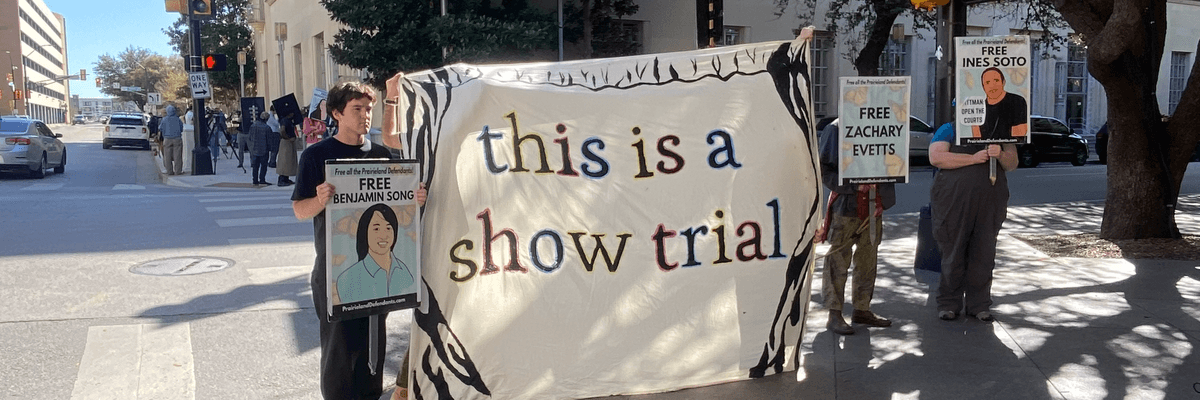
People show support for protesters facing trial for allegedly being part of a nonexistent “North Texas Antifa Cell,” outside the Eldon B. Mahon United States Courthouse in Fort Worth on March 13, 2026.
(Photo: Kevin Krause/The Dallas Morning News via Getty Images
“Now anyone engaged in basic protests with the wrong political beliefs can be labeled a domestic terrorist, when they have no intention of violence,” said one attorney.
Alarm and outrage mounted this week following a federal judge’s lengthy prison sentences for a group of activists falsely accused by the Trump administration of being members of a nonexistent “North Texas Antifa Cell,” with some observers calling the extreme punishments—including 30 years for moving a box of constitutionally protected pamphlets—a test case for criminalizing dissent.
Eight members of the “Prairieview Nine”—part of a larger group of activists who staged a July 4, 2025 protest outside a US Immigration and Customs Enforcement (ICE) detention center in Alvarado, Texas—were sentenced Tuesday in the US District Court for the Northern District of Texas in Fort Worth to between 30-100 years imprisonment.
Benjamin Song, who was convicted of shooting Alvarado Police Lt. Thomas Gross, was sentenced to 100 years for attempted murder of a law enforcement officer and lesser offenses, including discharging a firearm during a violent crime, conspiracy to use and using an explosive, and rioting. Song, a former US Marine, contends that he shot Gross in self-defense after the officer drew his gun first.
The “explosives” in question were fireworks brought to the July 4 protest to show solidarity with people detained by ICE.
Savanna Batten, Zachary Evetts, Autumn Hill, Bradford Morris, and Elizabeth Soto got 50 years each for rioting, providing material support to terrorists, and conspiracy to use and using an explosive.
No paywall. No ads. No billionaire owner. Just you.
Common Dreams is funded exclusively by readers tired of news beholden to corporate interests. Our monthly supporters are the backbone of what makes that possible. Help us reach our Mid-Year Campaign goal of 450 new monthly supporters by July 1.
Maricela Rueda was sentenced to 70 years for rioting, providing material support to terrorists, conspiracy to use and using an explosive, and conspiracy to conceal documents. Those documents were leftist pamphlets protected by the First Amendment.
Rueda’s husband, Daniel “Des” Rolando Sanchez Estrada, was hit with a 30-year prison sentence for conspiracy to conceal documents for moving a box full of the pamphlets after speaking with his wife. He did not attend the protest.
Judge Reed O’Connor, an appointee of former President George W. Bush and a favorite of right-wing judge shoppers, told the court that the lengthy sentences are meant to “send a message to anyone who shares a similar ideology” with the defendants, according to one observer of Tuesday’s proceedings.
The Prairieland sentences were more severe than the longest prison term for the average US murderer or rapist, as well as for the January 6, 2021 Capitol insurrectionists—all of whom were later pardoned by President Donald Trump—as well as for convicted child sex trafficker and Jeffrey Epstein co-conspirator Ghislaine Maxwell.
“What happened on Tuesday, it’s shocking to all of us, devastating to the families, 50- to 100-year sentences,” Sufia Khalid, deputy director of the National Security Criminal Defense Center at the Muslim Legal Fund of America and lawyer to one of the Prairieland defendants, toldDemocracy Now! on Thursday. “Those are essentially life sentences for all of the young people in this case, largely of whom were engaged in nonviolent protest at an ICE detention facility.”
A group of anti-ICE protesters in Texas were sentenced to 30 to 100 years in jail on Tuesday, after federal prosecutors accused them of being an "antifa terror cell."
The activists attended a protest and noise demonstration outside the Prairieland ICE jail in Alvarado, Texas.… pic.twitter.com/QxFMPaGsvj
Khalid noted that the Department of Justice (DOJ) invoked a rarely used “material support for terrorism” statute that “does not require any connection to a domestic terrorist organization or any kind.”
“Any American can be targeted that way now. It does not require ties to antifa or to any domestic terrorist organization,” she said. “That’s a dangerous precedent, and what allowed them to stack these charges so high on Tuesday.”
The DOJ hailed “the first sentencing of defendants affiliated with antifa following… Trump’s executive order designating the group as a domestic terrorist organization in September 2025” in the wake of the assassination of white supremacist influencer Charlie Kirk—which had nothing to do with antifa, a decentralized and leaderless international ideology opposing fascism that’s more of a mindset than a movement.
Later that month, Trump also signed National Security Presidential Memorandum 7 (NSPM-7), a directive titled “Countering Domestic Terrorism and Organized Political Violence,” that focuses exclusively on left-wing activities and mandates a “national strategy to investigate and disrupt networks, entities, and organizations that foment political violence so that law enforcement can intervene in criminal conspiracies before they result in violent political acts.”
Khalid pointed to the pardoned January 6 insurrectionists, who “were involved in rioting, carrying massive arsenals of weapons, lots of discussions ahead of time—that didn’t exist in this case—about targeting law enforcement, wanting to kill members of Congress, [and] actually storming the Capitol.”
“So, we have a massive, unwarranted sentencing disparity here,” she said. “What happened in the court in Fort Worth was unconstitutional and should concern everybody in this country in the direction that it is taking us.”
Mark Osler, a law professor and sentencing expert at the University of St. Thomas in Minneapolis, told The Guardian on Friday that “the 30-year sentence for Estrada is probably the one that for most people will come closest to shocking the conscience, simply because this is an activity that took place after the harm occurred.”
“What happened in the court in Fort Worth was unconstitutional and should concern everybody in this country in the direction that it is taking us.”
Seth Stern, chief of advocacy at the Freedom of the Press Foundation, underscored during a Friday interview in an episode of Fairness and Accuracy in Reporting’s Counterspin podcast titled “Criminalizing Dissent” that Estrada “wasn’t even at the protest.”
“He’s somebody who allegedly transported a box of pamphlets because his wife was at the protest,” Stern said. “And he believed, according to prosecutors, that the box of pamphlets might implicate his wife… so he was concealing evidence.”
“Evidence of what?” he continued. “This wasn’t a how-to manual… They were zines. They said nothing about this protest, about the Prairieland detention facility, about shooting this police officer… So when they say that he concealed evidence by moving these zines, evidence of what? It’s evidence of an ideology. It’s evidence of somebody’s reading habits.”
“And now they’re on the same plane as terrorists, as [Islamic State], according to this administration,” Stern added. “It’s all pretty absurd. But at the end of the day, we have a Constitution that prohibits people from being locked up for what they think, write, or read, as long as they are not inciting imminent violence. So hopefully the appellate courts will reverse these convictions. But the law is only as good as the people who enforce it.”
Jeremy Busby, an incarcerated journalist, wrote on the eve of Estrada’s trial that the “homespun zines at issue contain no plans for any shooting, and under normal circumstances, they would clearly be deemed constitutionally protected speech under the First Amendment.”
“But the government’s concealment theory only makes sense if it views merely having the literature as criminal,” he argued. “Criminalizing possession of literature is a miscarriage of justice, whether in prison or at a protester’s husband’s parents’ house. If the Trump administration is allowed to send Estrada to prison for the crime of possessing literature, members of society at large can be subjected to the same pernicious rules as the incarcerated.”
Amber Lowrey, the sister of Prairieland defendant Savanna Batten—who was sentenced to 50 years behind bars for material support for terrorism and conspiracy to use and using “explosives” (fireworks)—told The Guardian before Batten’s trial that the Trump administration just wants “to make an example of people and silence anyone who… opposes the government.”
“They want to silence dissent, criminalize dissent,” she added.
Trump administration prosecutors have also invoked NSPM-7 in the case of 15 organizers with the groups Direct Action Minnesota and Black Cat Workers, who are accused of impeding the Department of Homeland Security’s anti-immigrant crackdown in Minneapolis, where US citizens Renee Good and Alex Pretti were separately killed earlier this year by ICE and Border Patrol officers.
“We live under a fascist state where ICE agents can murder us with impunity, yet we can go to prison for 50 years for protesting,” socialist commentator and journalist Ryan Knight said Thursday on X. “The unjust sentences of the Prairieland protesters violate the First Amendment and infringe on our rights to fight back against a tyrannical government.”
Our work is licensed under Creative Commons (CC BY-NC-ND 3.0). Feel free to republish and share widely.
Trump Regime Takedown: Every Saturday Saturday, March 7, 2026 12:00 PM 2:00 PM Tesla San Francisco999 Van Ness AvenueSan Francisco, CA, 94109United States (map) Google Calendar ICS Keep democracy alive every Saturday by showing up, taking a stand, and sticking together for the long haul. Standing together is better than standing alone. Let’s get together... Continue reading →
This Sunday’s Town Hall: Announcing This Week’s Progressive Town Hall: Every Sunday at 4pm ET/1pm PT RSVP HERE Join PDA activists online from across the country to discuss the importance of progressives reclaiming the American story from the MAGA right, an issue of heightened importance as we’re now within one... Continue reading →
We protest Heritage Foundation EVERY MONDAY (Join us!!!!) By admin | September 2, 2025 | Uncategorized Cliff Cash Comedy Premiered Jul 26, 2025 Every Monday at The Heritage Foundation 214 Massachusetts Ave. Washington D.C. 4pm protest 6pm pizza Every Friday at Fox News D.C. 400 N. Capitol St. Washington D.C. 4pm protest 6pm pizza We are... Continue reading →
One Million Rising: Strategic Non-Cooperation to Fight Authoritarianism Virtual Event · Hosted by No Kings Time Wednesdays 8 – 9:30pm EDT Location Virtual event Join from anywhere About this event Across the country, authoritarian forces are getting bolder and more dangerous. Trump and his allies are not hiding their agenda: mass deportations,... Continue reading →
THURSDAY, JUNE 29, 2023 AT 2 AM – 4 AM PDT How to create trust in a group? Details Event by Extinction Rebellion Empathy Circles online EMPATHY CAFE Duration: 2 hr Public · Anyone on or off Facebook How to create trust in a group? This is the question that arose in our... Continue reading →
Trump Regime Takedown: Every Saturday Saturday, March 7, 2026 12:00 PM 2:00 PM Tesla San Francisco999 Van Ness AvenueSan Francisco, CA, 94109United States (map) Google Calendar ICS Keep democracy alive every Saturday by showing up, taking a stand, and sticking together for the long haul. Standing together is better than standing alone. Let’s get together... Continue reading →
This Sunday’s Town Hall: Announcing This Week’s Progressive Town Hall: Every Sunday at 4pm ET/1pm PT RSVP HERE Join PDA activists online from across the country to discuss the importance of progressives reclaiming the American story from the MAGA right, an issue of heightened importance as we’re now within one... Continue reading →
We protest Heritage Foundation EVERY MONDAY (Join us!!!!) By admin | September 2, 2025 | Uncategorized Cliff Cash Comedy Premiered Jul 26, 2025 Every Monday at The Heritage Foundation 214 Massachusetts Ave. Washington D.C. 4pm protest 6pm pizza Every Friday at Fox News D.C. 400 N. Capitol St. Washington D.C. 4pm protest 6pm pizza We are... Continue reading →
One Million Rising: Strategic Non-Cooperation to Fight Authoritarianism Virtual Event · Hosted by No Kings Time Wednesdays 8 – 9:30pm EDT Location Virtual event Join from anywhere About this event Across the country, authoritarian forces are getting bolder and more dangerous. Trump and his allies are not hiding their agenda: mass deportations,... Continue reading →
THURSDAY, JUNE 29, 2023 AT 2 AM – 4 AM PDT How to create trust in a group? Details Event by Extinction Rebellion Empathy Circles online EMPATHY CAFE Duration: 2 hr Public · Anyone on or off Facebook How to create trust in a group? This is the question that arose in our... Continue reading →