Trump’s Concentration Camp Build-Out Includes Nearly $40 Billion for Warehouse Conversions

Chester New York Proposed ICE Facility

An empty warehouse is seen in Chester, New York on February 8, 2026. US Immigration and Customs Enforcement proposes a facility at a warehouse roughly two hours from New York City, but many locals and officials have objected to the plan. 

(Photo by Matthew Hoen/NurPhoto via Getty Images)

“Germany’s concentration camps didn’t start as instruments of mass murder, and neither have ours,” wrote talk show host Thom Hartmann recently. “History isn’t whispering its warning: It’s shouting.”

Julia Conley

Feb 13, 2026 (CommonDreams.org)

President Donald Trump’s anti-immigration agenda has supercharged opposition in cities where he has deployed federal agents to conduct raids, and communities in states including New York and Missouri are already working to block the next step the Department of Homeland Security plans to take in its push for mass deportations: acquiring massive warehouses across the country to use as immigrant detention centers.

US immigration and Customs Enforcement documents that were provided to Republican Gov. Kelly Ayotte of New Hampshire—one of the states where ICE aims to acquire a building and retrofit it to house at least 1,000 people at a time—show that the administration plans to spend $38.3 billion on its mass detention plan.

RECOMMENDED…

Immigration Detainees Held At Texas Facility

US Military Helping Trump to Build Massive Network of ‘Concentration Camps,’ Navy Contract Reveals

Trucks carrying aid for Gaza are stuck at the Rafah crossing

US Contractor’s Proposal Exposes Trump Gaza Plan as ‘Vehicle for Mass Exploitation’

It would buy 16 buildings across the country to use as “regional processing centers” that could hold 1,000-1,500 people. Another eight detention centers would hold as many as 10,000 people at a time, with the detainees awaiting deportation.

The Washington Post reported that a review of state budget data showed that the amount of money the White House intends to pour into the project over the next several months is larger than the total annual spending of 22 US states.

“Thirty-eight billion dollars,” said Rep. Seth Moulton (D-Mass.). “That’s what Trump is spending to turn warehouses into human holding facilities. Not on schools. Not on healthcare. Not on veterans. On warehousing humans.”

Moulton also condemned ICE’s claim that the new network of detention facilities will ensure the “safe and humane civil detention” of immigrants.

At least six people died in ICE detention centers in January, and one of the deaths, that of Geraldo Lunas Campos at Camp East Montana in El Paso, Texas, was ruled a homicide.

Medical neglect and abusive treatment—including some that amounts to torture—has been reported at multiple facilities.

ICE has already spent more than $690 million purchasing at least eight warehouses in Maryland, Arizona, Georgia, Texas, Pennsylvania, and Michigan in recent weeks. Documents posted on Ayotte’s website show the agency is pursuing additional acquisitions in New Hampshire, New York, New Jersey, and Georgia.

Communities are already rallying against the plan and questioning whether the small towns ICE has selected have sufficient water and sewer infrastructure to support thousands of people detained in a warehouse.

In New York, Rep. Pat Ryan (D-NY) said last week that 25,000 people in his district have signed a petition opposing the use of a local warehouse to house immigrants and pointed to the “major corruption and graft” evident in the plan to purchase and run the warehouses.

“The site in my district that’s proposed is owned by one of Trump’s multibillionaire donors, who would directly financially benefit from this site,” said Ryan, referring to former Trump adviser Carl Icahn.

As Common Dreams reported Friday, private prison firm GEO Group raked in a record $254 million in profits last year as it secured contracts with the Trump administration to build new ICE facilities across the US.

ICE has attempted to make purchases in Oklahoma City; Kansas City, Missouri; and in Virginia, but those plans have fallen through, with the Kansas City Council passing a five-year ban on new nonmunicipal detention centers after the public learned that DHS was the potential buyer of a warehouse in the city.

Sen. Chris Van Hollen (D-Md.) has also joined his constituents in speaking out against ICE’s $100 million purchase of a warehouse in his state to house at least 1,000 people at a time.

“This administration is spitting in the face of communities from Minneapolis to Maryland and wasting our tax dollars. We won’t back down,” said Van Hollen late last month.

X post: https://x.com/ChrisVanHollen/status/2016243337703903275?ref_src=twsrc%5Etfw%7Ctwcamp%5Etweetembed%7Ctwterm%5E2016243337703903275%7Ctwgr%5Ee0e0013896e05e45629f8b453f17e93701d5c177%7Ctwcon%5Es1_c10&ref_url=https%3A%2F%2Fwww.commondreams.org%2Fnews%2Flist-of-ice-detention-centers

The details of the administration’s planned conversion of warehouses were reported less than two weeks after Pablo Manríquez of Migrant Insider revealed that a US Navy contract originally valued at $10 billion “has ballooned to a staggering $55 billion ceiling to expedite President Donald Trump’s ‘mass deportation’ agenda” and to help build “a sprawling network of migrant detention centers across the US.”

At Common Dreams last week, talk show host and author Thom Hartmann wrote that the warehouses Trump plans to use to hold people—purchased by an agency whose own data shows it has largely been detaining people with no criminal records—are best described as concentration camps like those used in Nazi Germany.

“By the end of his first year, [Adolf] Hitler had around 50,000 people held in his roughly 70 concentration camps, facilities that were often improvised in factories, prisons, castles, and other buildings,” wrote Hartmann. “By comparison, today ICE is holding over 70,000 people in 225 concentration camps across America,” with hopes to “more than double both numbers in the coming months.”

“Germany’s concentration camps didn’t start as instruments of mass murder, and neither have ours; both started as facilities for people the government’s leader said were a problem. And that’s exactly what ICE is building now,” he continued. “History isn’t whispering its warning: It’s shouting.”

Our work is licensed under Creative Commons (CC BY-NC-ND 3.0). Feel free to republish and share widely.

Julia Conley

Julia Conley is a staff writer for Common Dreams.

Full Bio >

San Francisco Teachers End Strike With Fully Funded Family Care

by Ida Mojadad February 13, 2026 (sfpublicpress.org)

The first teacher strike in nearly 50 years motivated pickets not just by teachers, but also the Service Employees International Union, which showed up in support at John O’Connell High School in the Mission District Thursday. Credit: Michael Stoll / San Francisco Public Press

San Francisco public schools and the teachers union reached a tentative agreement early Friday morning, ending a four-day strike that closed schools for the week.

The San Francisco Unified School District agreed to fully fund dependent health care — a key demand of the United Educators of San Francisco — by January 2027, with increases in contributions for eligible workers by July 2026. The union argued that health care, which costs educators up to $1,500 monthly to cover families, contributed to constant teacher turnover, while the district pointed to state oversight of its budget deficit as its main fiscal constraint.

Teachers returned to work on Friday, which was treated as a transition day, and the district’s 49,000 students are scheduled to return next Wednesday following the Presidents Day and Lunar New Year holidays. The last strike, 47 years ago, took six weeks to resolve.

Under the agreement, certificated teachers will receive a 2% raise this year and again next year, and two additional paid work days on the calendar, while classified workers (including paraeducators and instructional aides) will receive the equivalent of an 8.5% raise over two years. The union agreed to pause sabbaticals next year. 

Union leaders first proposed 9% over two years, while the district offered a 4% raise over two years and partially funded family health care, the sticking points for months. The two sides agreed also on sanctuary protections for immigrant students and staff, and worker protections around district use of artificial intelligence.

“By forcing SFUSD to invest in fully funded family healthcare, special education workloads, improved wages, sanctuary and housing protections for San Francisco families, we’ve made important progress towards the schools our students deserve,” said the union’s president, Cassondra Curiel, in a statement. “This contract is a strong foundation for us to continue to build the safe and stable learning environments our students deserve.”

The union pushed for a shift to a workload model for special education basing staffing on varying time needs of students rather than the number of students.  The district agreed to a timely process to appeal caseloads and pledged to spend $2 million next school year to ensure time for compliance duties. It will form a joint committee with budget authority to oversee special education and respond to conditions, according to the tentative agreement.

Support our local in-depth reporting and investigations.

Donate Now!

“This is a monumental tentative agreement with the United Educators of San Francisco,” said Superintendent Maria Su in a statement. “This agreement enhances our efforts to recruit and attract talented educators to work in San Francisco public schools and reflects our commitment to invest in educators. I know it has been a hard week, and I want to extend my heartfelt appreciation to our students and families. We cannot wait to welcome you back to school.”

The district said it was offering a $183 million economic package at a time of state fiscal oversight that required $114 million in cuts to its $1.3 billion budget this year. It must be ratified by United Educators of San Francisco members, who held a victory rally on Friday, and approved by the Board of Education. 

February 5, 2026

Ida Mojadad

Ida Mojadad is an award-winning San Francisco journalist who has reported enterprise, investigative and daily news coverage focused on schools, youth and families. She previously covered housing, health care and city politics, among other topics, for SF Weekly, San Francisco Examiner and San Francisco Chronicle, and edited breaking news at SFGate. While at the San Francisco Standard, she published a series of revelations about hidden school sexual misconduct. Ida is a graduate of San Francisco State University and is a Society of Professional Journalists Northern California chapter board member.More by Ida Mojadad

SF teachers strike, school closures to reach fourth day

Teachers on a citywide strike in front of Mission High School
United Educators of San Francisco members and supporters picket in front of Mission High School in San Francisco on Monday, Feb. 9, 2026. Craig Lee/The Examiner

San Francisco public schools will remain closed Thursday for a fourth straight day as bargaining teams for San Francisco’s public-school district and its teachers union continue negotiating a new two-year contract.

San Francisco Unified School District Superintendent Maria Su said at a Wednesday morning press conference that talks between both parties broke down the previous night when union leaders sent their negotiators home after receiving the district’s counterproposal just after 8:30 p.m. The offer addressed compensation, health-care benefits and special education concerns, Su said.

The United Educators of San Francisco have spent this week picketing after walking off their jobs on Monday for the first time since 1979. District and union representatives have been in negotiations since March, and their contract expired in July.

As talks have stalled, both sides have stressed urgency in coming to a new agreement and getting students back in their classrooms. Su said she was frustrated talks broke down Tuesday night without an agreement.

“Our students and parents and the entire school community and city deserve nothing less,” Su said at her press conference. “We can’t just keep putting forward proposals and not receive a counter. That’s not how this works.”

District and union bargainers remain far apart on health-care benefits. The district has proposed covering 80% of health-care premiums for up to two dependents, while union members are pushing for full coverage for families.

Teacher salaries have also been a point of contention. Union negotiators asked for an 8% raise over two years, while the district has proposed a 6% increase. Both sides are also still trying to come to terms on the recruitment and retention of special-education teachers.

Local and state leaders have stepped in to help smooth points of contention between SFUSD and UESF representatives. Mayor Daniel Lurie and State Superintendent of Public Instruction Tony Thurmond joined talks Tuesday.

“Every day that our children are out of school is really impactful on our children and our working families,” Lurie told reporters Wednesday morning during a breakfast with the San Francisco Chamber of Commerce. “I love our educators. It’s why we need to get them back in the classroom.”

When asked to comment on negotiations stalling, Lurie said he didn’t “want to get into a blame game.”

“That is not my role,” he said. “My role is to make sure that we get both parties to the table.”

Other local unions and San Francisco residents have expressed solidarity with the teachers union. Supporters rallied Wednesday afternoon at Ocean Beach, showing their support for the teachers by making a human banner that called for an end to the strike.

American Federation of Teachers President Randi Weingarten spent this week walking the picket line in solidarity with union members.

Weingarten said her organization’s members are supporting local teachers because what they “are asking for is righteous, because it’s what children and educators need.”

Labor talks are about “fully staffed, stable schools, sustainable working conditions, strong special education services and real protections for immigrant and unhoused students,” she said.

“This fight belongs to all of us,” said Chelsea Fink, a member of Service Employees International Union Local 1021, which is staging a sympathy strike alongside the teachers’ union. “Schools can’t function and students can’t thrive without the educators and staff who keep our schools running every day.”

As the strike has gone on, the distrit has agreed to adopt protections and policies for undocumented students and to support families experiencing housing insecurity by expanding a shelter program. District officials offered a 10% salary increase for paraeducators earlier this week, Su said.

Fink said she will support UESF until its members receive “comprehensive” health-care benefits.

“United, we’re seeing that change is possible,” she said.

Bianca Polovina, the president of International Federation of Professional & Technical Engineers Local 21, said The City has “the means to strengthen our public schools.”

In solidarity with UESF, IFPTE Local 21 is calling “on the school district to make better choices for everyday San Franciscans, not for consultants,” Polovina said. “Fair public education is a right.”

SFUSD’s precarious financial situation has affected negotiations, Su said. The district will face a $102 million budget deficit for the 2026-27 school year and is in the process of moving out of state oversight. But as long as the district is under California’s watch, the state’s fiscal advisers would need to approve any agreement.

“We are on the right path to fiscal solvency, and so we need to be responsible with the deals,” Su told reporters Wednesday.

“Wherever we increase, we’re going to have to take the cut somewhere else. We’re looking at everything really carefully,” Su said. “At the end of the day, I want to make sure that we have schools that really will be able to support our students.”

In a statement, union representatives said they have seen “movement towards an agreement that will bring our students back to classrooms, and made a few important steps on that path. We know there is more work to be done.”

“What comes next is a matter of the district prioritizing classrooms, students and educators,” the union’s statement read. “Our families are watching and waiting.”

Su said she “absolutely” wants to reopen schools.

“I need our kids in the classroom. That is where they belong,” she said. “I cannot reopen schools unless we have staff.”

Whether or not the strike extends into a fifth day Friday, San Francisco’s public schools will be closed Monday and Tuesday due to the President’s Day and Lunar New Year holidays, respectively.

In the meantime, Weingarten said she and other supporters will spend the foreseeable future rallying for educators’ new contract.

“The solidarity is powerful,” she said.

Examiner staff writer Patrick Hoge contributed reporting to this article.

James Salazar

James Salazar

Neighborhoods & Culture Correspondent

Republicans Approve ‘Dystopian’ Voter Suppression Bill That Would Force States to Give Info to DHS

Speaker Johnson Holds Press Conference On House Passage Of SAVE America Act

US House Speaker Mike Johnson (R-La.) speaks during a news conference on February 11, 2026.

 (Photo by Michael M. Santiago/Getty Images)

“The campaign to rig our elections is well underway,” warned one expert.

Jake Johnson

Feb 12, 2026 (CommonDreams.org)

Doing President Donald Trump’s bidding, the Republican-controlled US House on Wednesday approved legislation that would potentially prevent millions of Americans from participating in federal elections by instituting draconian voter ID requirements, mandating documentary proof of citizenship to register to vote, and requiring states to share voter information with the Department of Homeland Security.

The White House-backed legislation, an updated version of the so-called SAVE Act that the House approved in 2024, passed with the support of every Republican who took part in the vote and one Democrat, Rep. Henry Cuellar of Texas—notably the recipient of a pardon from the president.

RECOMMENDED…

GENIUS Act Presser

‘Most Dangerous Attack on Voting Rights Ever’? New GOP Election Bill Sparks Dire Warnings

US Rep. Bryan Steil

‘Our Democracy Depends on Rejecting This Charade’: GOP Pushes Bills to Prevent Millions From Voting

Election experts and watchdog groups said the bill represents a massive assault on the right to vote, with many of its provisions directly in line with what Trump has demanded ahead of the 2026 midterms.

“Congressional Republicans are attempting to commandeer the midterm election cycle and increase voting margins in President Trump’s favor by putting a finger on the scale of our elections and pushing nonsensical, anti-democratic laws to stop voters from casting a ballot,” said Public Citizen co-president Lisa Gilbert. “This overreaching, un-American bill tacks on unnecessary bureaucratic hurdles to vote, all of which would harm voters across the political spectrum.”

The bill is likely dead on arrival in the narrowly divided Senate, with every Democrat and at least one Republican, Lisa Murkowski of Alaska, expected to oppose it.

But its passage through the House with unanimous support from the Republican caucus—whose members claim to be driven by a desire to prevent noncitizens from voting, which is already unlawful, and combat voter fraud, which is virtually nonexistent—alarmed rights advocates.

“This obvious attack on our voting rights is based on completely unfounded claims,” said Alison Gill, director of nominations and democracy at the National Women’s Law Center. “The lawmakers supporting this measure clearly aim to suppress the votes of women, people of color, and LGBTQ+ people in order to rig elections and remain in power.”

“It is already illegal for noncitizens to vote in federal elections, which means that the SAVE Act 2.0 creates a convoluted and dystopian solution to a problem that does not actually exist,” Gill added. “Americans strongly opposed legislation when Congress considered this issue last year, and yet the congressional Republicans are trying to double down on this deceptive policy.”

“The forces that are driving the Trump administration’s anti-voter agenda are also pressuring Congress to pass legislation that would silence millions of Americans.”

Analysts estimate that more than 21 million Americans lack ready access to the documents the Republican legislation would require people to furnish in order to register to vote, such as a passport and a birth certificate. The Brennan Center for Justice notes that the measure “would disenfranchise Americans of all ages and races, but younger voters and voters of color would suffer disproportionately. Likewise, millions of women whose married names aren’t on their birth certificates or passports would face extra steps just to make their voices heard.”

In addition to strict documentary requirements for registration and voting, the bill would force states to conduct frequent purges of their voter rolls and share information with the Department of Homeland Security in a purported effort to verify voters’ citizenship—changes that could disenfranchise many eligible voters. The legislation would also establish criminal penalties for election workers who register voters without the required documentary proof of citizenship.

Bruce Spiva, senior vice president at Campaign Legal Center, noted that the GOP’s renewed voter suppression push “comes as the FBI is seizing ballots from the 2020 election, President Trump is calling for our elections to be ‘nationalized,’ and the US Department of Justice is suing more than 20 states to get access to voters’ private data.”

“This is not a coincidence,” said Spiva. “The forces that are driving the Trump administration’s anti-voter agenda are also pressuring Congress to pass legislation that would silence millions of Americans by making it harder to participate in our elections.”

In an op-ed for the New York Times on Thursday, the Brennan Center’s Sean Morales-Doyle warned that “the campaign to rig our elections is well underway.”

“It will be incumbent on all of us—election officials, advocates, state law enforcement, and voters—to see the administration’s efforts for what they are and to fight back,” wrote Morales-Doyle.

Our work is licensed under Creative Commons (CC BY-NC-ND 3.0). Feel free to republish and share widely.

Jake Johnson

Jake Johnson is a senior editor and staff writer for Common Dreams.

Full Bio >

To Blow Out the GOP in the Midterms, Democrats Have to Develop a Winning Message

AOC, Bernie Sanders, Alexandria Ocasio-Cortez, Fight Oligarchy, rally, Tempe, AZ
Rep. Alexandria Ocasio-Cortez (D-NY) and Sen. Bernie Sanders (I-VT) speaking at a “Fight Oligarchy” rally in Tempe, AZ. Photo credit: Gage Skidmore / Wikimedia (CC BY-SA 2.0)

Elections

Klaus Marre 02/12/26 (whowhatwhy.org)

Democrats can win (relatively fair and free) midterms solely on the weakness of Donald Trump and the GOP. But if they managed to come up with a platform that makes American families believe that they will fight for them, much more is possible.

Politics isn’t a game, so we usually try to stay away from sports analogies. However, with the nation still gripped in football fever, we thought this would be a good time to look at the state of play for Democrats and Republicans as they are heading toward their Super Bowl — the midterm elections on November 3.

Right now, everything is going the Democrats’ way.

Team GOP is in disarray. Its superstar quarterback has lost a step (and a few marbles). However, because he has carried the Republicans to a couple of major victories, nobody dares to say out loud that he has become a liability with his constant fumbles, poor play-calling, off-field controversies, and a focus on personal glory instead of team success.

That is why, instead of Team GOP using its built-in advantages to eke out another win, it is headed for a crushing defeat, especially because all of the intangibles are pointing the Democrats’ way.

To stick with the analogy, Republicans are a passing team; their quarterback likes to just sling the ball around. But they are facing a heavy headwind in all four quarters, and the spectators are making this a home game for their rivals.

Therefore, it’s no wonder that the GOP wants to bribe the refs, use soldiers to keep the Democrats’ fans from the stadium, and maybe invoke the Insurrection Act to take control of the scoreboard.

Well, as you can tell, we have clearly taken this analogy about as far as it can go.

The point is that, as things stand right now, the Democrats are heavily favored to be the big winners this fall.

The most important indicator is that voters are deeply dissatisfied with the direction of the country. The main reason is that an economy that seems to work just fine for the wealthy is leaving most folks behind.

Working families are getting crushed by high prices for everything from groceries to rent and utilities. The jobs market is anemic, and, while Republicans passed a tax cut last year, it mainly benefits the richest Americans and is being paid for by cuts to things like rural health care, Medicaid, and food assistance.

And, instead of focusing on the affordability crisis that regular people are experiencing (or even acknowledging it), Donald Trump, who promised that he would make everything better, is exacerbating it with his tariffs (which are essentially a sales tax on imported goods like inexpensive clothing)… all while claiming that things are going great and the US has entered a golden age.

That might be true for the president’s family, which is engaged in unprecedented levels of grifting, and perhaps for the tech bros who want to replace American workers with robots and artificial intelligence, but it’s at best fool’s gold for everybody who isn’t an “-aire.”  

Adding to the president’s (and the GOP’s) woes is that this discontentment is not limited to the economy.

The immigration issue, which used to be a strength for Republicans, has become a liability as Americans daily witness the brutality of government agents, which has led to the killing of two citizens.

And it’s not just the actions of some masked goons but also the reaction of senior administration officials and GOP lawmakers who are clearly lying to the American people about the horrific cellphone footage they have seen with their own eyes.

In addition, there is the inescapable sense that Trump’s priorities are completely out of step with those of voters. His focus is on picking fights with the rest of the world, building his ballroom, securing the Nobel Peace Prize by whatever means necessary, putting his name on stuff, and making bizarre social media posts.

While the general chaos he introduces might be entertaining when things are going well, it gets old really quickly when they are not. We saw that in his first term when Americans put up with Trump’s antics until the pandemic hit and the country began yearning for a leader rather than a clown.

Finally, the administration is really bungling the Epstein matter, which is the one issue on which it has managed to alienate even some members of its base.

For all of these reasons (and more), the Democrats are heavily favored to win control of the House. But not only that. Nine months out from the midterms, the Senate is very much in play as well. In a fair fight, we believe that, at the very least, they are more likely than not to narrow the GOP’s 53-47 edge in the upper chamber of Congress and may just win it outright.

Now, an astute reader will notice two things.

First of all, there is the reference to a “fair fight.” As we have pointed out repeatedly, Trump and his Republicans are already in the process of trying to rig the midterms, so we already know that the “fairness” of the election is up for grabs.

And polls show that the GOP is facing the kind of shellacking that can’t be gerrymandered away and only a straight-up and very apparent election theft can prevent.

How bad will it be? Well, that depends on the Democrats.

And that is the second thing you may have noticed. All of the above is about Trump’s unpopularity, ineptitude, corruption, etc., and not about the Democrats’ candidates and message.

Or, to briefly go back to our sports analogy, Team Blue isn’t expected to win because its players are good, its strategy is brilliant, or its fans will carry it to victory. Instead, it’s expected to win even though most of its players are old, its playbook is antiquated, and its supporters only bother to show up for the game because they loathe the Red Team so much.

In other words, right now, this election is (once again) all about Trump. And while that looks as though it will be enough for the Republicans to lose it, it would be much better if the Democrats could win it.

But that would require them to pick the best candidates in the upcoming primaries and come up with an actual message that goes beyond, “Trump is really bad.”

For as poorly as the GOP is doing, at least Republicans can always count on their base (apart from when they cover up for pedophiles). That’s not the case for the Democrats. They are extremely unpopular with their own voters because they seem to be so feckless.

While their supporters are literally risking their lives out in the streets, most Democratic office holders can, at best, muster some tweets, angry speeches, and strongly worded letters.

To get their own base back on their side, they have to show they are willing to fight — right now, as a fired-up opposition, and then, if returned to power, by working hard to clean up the messes left by Trump and his self-serving acolytes.

But to really turn the midterms into a blowout, and make it impossible for Trump to steal the election, Democrats have to attract independents and win back working-class families that were seduced by the president’s lies.

And that requires a positive agenda centered around affordability.

What, exactly, is their plan to solve those kitchen table issues that voters are most concerned about? How are they going to stop the decades-long redistribution of wealth from regular Americans to the billionaire class? What will they do about corporate greed? How are they going to fix the social safety net that Republicans are shredding?

Part of their platform also has to be how they are going to curb Trump’s authoritarian ambitions, his attacks on democracy, and his assault on the rule of law.

Finally, they need to better communicate with those voters who supported the president in 2024 but are not firm Republicans, such as disaffected young men and inflation-spooked Hispanics. To do that, the Democrats must find better messengers.

That last part shouldn’t be too difficult because the party actually has many promising talents who would be able to make the case for Democrats much better than the likes of Senate Minority Leader Chuck Schumer (NY), his House counterpart Hakeem Jeffries (NY), or former Vice President Kamala Harris, who recently tried a bit of a poorly conceived online reboot.

Of course, that would mean giving new voices a chance… and that is something that both the Democrats’ old guard and the party’s dominant consultant class are going to fight.

Because they resist new ideas and fresh faces almost as much as they want to resist Trump.

  • Klaus Marre Klaus Marre is a former congressional reporter and current senior editor for US politics for WhoWhatWhy. He writes regularly here, and you can also follow him on Bluesky and Substack.

The occupying army retreats

MEYERSON ON TAP

The occupying army retreats

The announcement of ICE’s withdrawal from Minnesota, like that of the British from Boston 250 years ago, marks a victory for people power.Today’s announcement by Trump border czar Tom Homan that the administration was ending its deployment of ICE and Border Patrol agents in Minnesota encountered two distinct but ultimately complementary reactions from Minnesotans.
Skepticism: “I’ll believe it when I see it,” said Elliott Payne, president of the Minneapolis City Council.
And celebration of Minnesotans’ tenacious resistance: “They thought they could break us, but a love for our neighbors and a resolve to endure can outlast an occupation,” said Minneapolis Mayor Jacob Frey.

By now, the persistence of Twin City residents to demonstrate against the occupation, to line the city’s sidewalks with people recording ICE’s every move with their phones, to patrol neighborhoods warning of the approach of ICE and Border Patrol thugs, and to bring food to their neighbors who fear to leave their homes, all amid weather that was at times subzero, has earned them a page in history books. I daresay it will become the stuff of American legend, inasmuch as our legends generally celebrate American citizens defending democratic values against autocrats, fascists, and totalitarians.
We don’t have a lot of legends about the triumph of such Americans over forces that occupied our cities, however, because we don’t have a lot of cities that have been occupied by such forces. As events would have it, however, the standout example of Americans outlasting and defeating such an occupation is about to have its 250th anniversary. It came in March of 1776, when patriot militias drove British troops out of Boston, who’d occupied that city since 1768 to quell Bostonians’ efforts to establish a modicum of control over their own affairs.
Following the Battles of Lexington and Concord in April 1775, patriot militias—in advance of the formation of an American army—besieged British forces within Boston and neighboring Charlestown, both of which connected to the Massachusetts mainland by narrow necks of land that were easily blockaded. As in Minneapolis, the forces hemming in the British were infuriated civilians, the Massachusetts militia having been joined by militia forces from the other New England colonies. (Only after several months did the Continental Congress establish and enroll them in an American army, which George Washington then arrived to command.) In late 1775 and 1776, the patriot forces managed to bring artillery to the hills surrounding the city from faraway Fort Ticonderoga, in upstate New York, which had the capacity not only to bombard the British forces, but their ships in the harbor as well. With that, the British were compelled to withdraw.

It took seven more years, of course, for all British forces to withdraw from the new nation, and it will likely take today’s patriots at least three more years to end the rule of Mad King Donald and his successors, which has thus far been defined not just by its war on immigrants and people whose skin color makes them look like some immigrants, but also on American cities and suburbs, where immigrants and liberals and Democrats reside. But as was the case during our Revolution, interim victories will hasten that day. On the heels of today’s announced Minnesota withdrawal, congressional Democrats appear poised to block funding for the Homeland Security Department, which is set to run out tomorrow. That could be, and surely should be, an interim victory, too, but many more (and more decisive) victories are required to end the rush to authoritarianism that Trump has engineered. Taking Congress in November’s election, of course, is by far the most important looming battle.
As the siege of Boston continued through 1775 and 1776, the New England militias were joined by militias even from the Southern colonies. I suspect we’ll see a kindred rise in urban and blue-state solidarity today. Yesterday, Los Angeles Mayor Karen Bass ordered L.A.’s police to record the actions of ICE and the Border Patrol, since we can’t rely on the feds recording their own savagery. And in the wake of today’s announced retreat of ICE from Minnesota, Minneapolis Mayor Frey and New York Mayor Zohran Mamdani announced that they’d be meeting to discuss lessons learned—resistance lessons learned—from the experience of Frey’s city, and how they can be applied to New York. That might be the topic for a conclave of America’s mayors should someone have the smarts and credibility to call one.

As Trump is plainly determined to commemorate the 250th anniversary of our Revolution by having an alien force of louts and thugs occupy America’s cities, so those cities should commemorate that anniversary by demonstrating the same kind of patriot resolve that created those American cities—as distinct from subservient colonial cities—250 years ago. Now as then, mad kings and their mercenaries have no place in our democratic republic.


Harold Meyerson
Editor-at-Large

‘What Did These Cuban Children Do to Trump?’: US Embargo Blamed as Infant Mortality Soars

Ariannis César Martínez, a 4-year-old Cuban cancer patient

Ariannis César Martínez, age 4, suffers from kidney cancer. 

(Photo by Cuban Ministry of Health)

“Is there anything worse than a child dying of cancer when it was preventable?” asked one observer.

Brett Wilkins

Feb 12, 2026 (CommonDreams.org)

Infant mortality is on the rise in Cuba as the Trump administration tightens a decadeslong economic embargo on the island nation in hopes of toppling a socialist government that’s outlasted a dozen US presidents.

According to the United Nations Inter-Agency Group for Child Mortality Estimation, infant mortality in Cuba—which plummeted dramatically in the decades after the 1959 triumph of the Cuban Revolution—has increased from 4 to 7.4 per 1,000 live births since 2018, an 85% increase.

RECOMMENDED…

Cuba fuel shortage

Pushing for Regime Change, Trump Accused of ‘Asphyxiating’ Cuba With Fuel Embargo

Miguel Diaz-Canel and Donald Trump

Cuba Condemns Trump Claim That It Poses ‘Extraordinary Threat’ to US

The rise in infant mortality comes amid a deadly surge in mosquito-borne illness, including dengue and chikungunya, that has inundated already struggling hospitals suffering shortages of staff and even basic supplies. Hospitals in Cuba—which in 2015 became the first country in the world to eliminate mother-to-child transmission of HIV and congenital syphilis—are now reliant upon donations and the black market for their needs.

The crisis is particularly dire among children with cancer. Cuba’s free healthcare system—which prioritizes the health of the people instead of industry profits, as in the United States—once boasted a pediatric cancer survival rate of 80%, on par with the world’s wealthy nations. Now that’s down to around 65% as the blockade has forced healthcare providers to modify treatment protocols and medications.

“The situation is very serious at the moment. It was already in terms of acquiring supplies and medicines. But now it is intensifying and complicated with other aspects,” Dr. Forteza Saéz, an oncologist at Havana’s University of Medical Sciences, told La Jornada in an interview on Wednesday.

Dr. Luis Curbelo Alonso, former longtime director of the National Institute of Oncology and Radiology in Havana, told La Jornada: “You have the knowledge, the expertise, the team to face something that can be curable or can be controllable and yet not have the drug. It’s a very lacerating thing as a professional, very cruel.”

X post: https://x.com/ryangrim/status/2021962474124357823?ref_src=twsrc%5Etfw%7Ctwcamp%5Etweetembed%7Ctwterm%5E2021962474124357823%7Ctwgr%5Ea1e777a90552eda6e96ae91df347a69e65a5db3e%7Ctwcon%5Es1_c10&ref_url=https%3A%2F%2Fwww.commondreams.org%2Fnews%2Fcuba-infant-mortality

The situation is also driving Cubans to extreme measures to find treatment. Two-year-old Mía Rey Jiménez and her family left their home in Cardenas, Matanzas last May weeks after the child was diagnosed with metastatic stage 4 neuroblastoma, an extremely aggressive childhood cancer requiring complex treatment.

The family left Cuba to seek treatment in Nicaragua and then Costa Rica, where Jiménez underwent chemotherapy and high-risk surgery. Still left with a tumor in her lung and cancer in her bone marrow, Jiménez’s family sought help from Nicklaus Children’s Hospital in Miami, one of the world’s leading specialized facilities.

The hospital agreed to evaluate Jiménez and estimated her chances of survival with proper care at up to 80%—more than double her prognosis in Costa Rica. However, the humanitarian visa for which Jiménez’s family applied was denied by US authorities due to what they claimed was “lack of evidence,” even though the girl’s father resides legally in the United States.

The family successfully appealed their denial and Jiménez and her mother Liudmila Jiménez Matos arrived in Miami in January.

“I can’t be happier,” Jiménez Matos told Cuba Noticias 360 last month. “My daughter will be treated by doctors who have been waiting for her for a long time. That’s a love for the profession and for saving another life.”

As President Donald Trump tightens the blockade on Cuba following a similar strangulation of Venezuela that ended with last month’s US invasion and kidnapping of Venezuelan President Nicolás Maduro to face dubious “narco-terrorism” charges in the United States, critics are renewing calls to end Washington’s embargo.

Imposed in the early 1960s after a successful revolution that overthrew a brutal US-backed dictatorship and replaced it with a socialist government, the blockade—which accompanied a decadeslong campaign of terrorism by US-based Cuban exiles—has claimed thousands of Cuban lives and cost the country’s economy more than $1 trillion, according to official estimates.

The United Nations General Assembly has overwhelmingly condemned the blockade 33 times.

UN Secretary-General António Guterres warned Wednesday of a potential “collapse” of Cuba’s economy if the US keeps blocking oil from entering the country.

On Thursday, Congresswoman Ilhan Omar (D-Minn.), who visited Cuba in 2024 as part of a delegation of progressive US lawmakers, called the ramped-up embargo, which is now targeting fuel imports, as “cruel and despotic.”

Back in Havana, Cuban doctors vowed to do the best they can for their patients under the harrowing circumstances.

“We will continue to resist,” Dr. Carlos Alberto Martínez, head of the Ministry of Health’s cancer control section, told La Jornada. “We will continue to look for alternatives that allow the sustainability of what has been achieved.”

Our work is licensed under Creative Commons (CC BY-NC-ND 3.0). Feel free to republish and share widely.

Brett Wilkins

Brett Wilkins is a staff writer for Common Dreams.

Full Bio >

Shop in SF’s Inner Richmond Will Screenprint ‘F*ck ICE’ For Free on Items the Public Brings In

11 February 2026/Arts & Entertainment/Leanne Maxwell (SFist.com)

During the general strike on January 30, the folks at Fleetwood Fine Goods in the Inner Richmond began offering free “F*ck ICE” screenprints, which was met with huge success, and they’re continuing to offer the service to anyone who brings in or purchases a garment of their choice.

As SFGate reports, Fleetwood Fine Goods announced the offer on social media the day before the general strike, attracting around 200 people who lined up along Clement Street for free screenprints. In addition to the “F*ck ICE” print, a design with the message, “No One Is Illegal on Stolen Land,” was also available.

Per SFGate, the shop workers decided against closing operations during the general strike and instead dedicated the day to offering free screen printing services to the community. They also limited all sales in the shop to cash-only — to keep any funds from going to banks — and donated the proceeds to El Tecolote and the San Francisco Immigrant Legal Defense Collaborative, per SFGate.

Instagram post: https://www.instagram.com/p/DUH325iDi6z/embed/captioned/?cr=1&v=14&wp=1080&rd=https%3A%2F%2Fsfist.com&rp=%2F2026%2F02%2F11%2Fshop-in-sfs-inner-richmond-will-screenprint-f-ck-ice-on-items-the-public-brings-in-for-free%2F#%7B%22ci%22%3A0%2C%22os%22%3A553.1000000089407%2C%22ls%22%3A398.20000000298023%2C%22le%22%3A550.2000000029802%7D

“We support and stand with the shops who are closed,” the shop wrote on social media. “We love you, Minneapolis. Go support an immigrant-owned small business who can’t afford to close.”

SFGate writes that Fleetwood’s shop sells work from around 150 local artists and artisans in addition to offering custom screenprints on its six-color, four-station press, often referred to as the “octopus.” The free screenprints have enhanced the sense of community that surrounds the shop, which was reflected in a note someone left during the general strike.

“Keeping up with current events lately has been heartbreaking — and then Fleetwood does this and reminds me that I’m part of a community & we are not alone,” the note read, per SFGate. “Thank you for the hope.”

SFGate reports that the store is still offering the two free screenprint designs Tuesday through Thursday, noon to 6 pm. Cotton material is recommended.

Image: Fleetwood Fine Goods

Inside San Francisco’s hollowed-out immigration court, where asylum is ‘essentially over’

A woman with short brown hair, wearing a blue button-up shirt over a white top, smiles at the camera against a plain light background. by Clara-Sophia Daly February 12, 2026 (MissionLocal.org)

A large group of people waits in line outside a building, some standing behind metal barricades; one person holds a sign with text and green graphics.
Protesters and immigrants form a line outside of 630 Sansome St. immigration court in San Francisco. Photo by Sage Rios Mace.

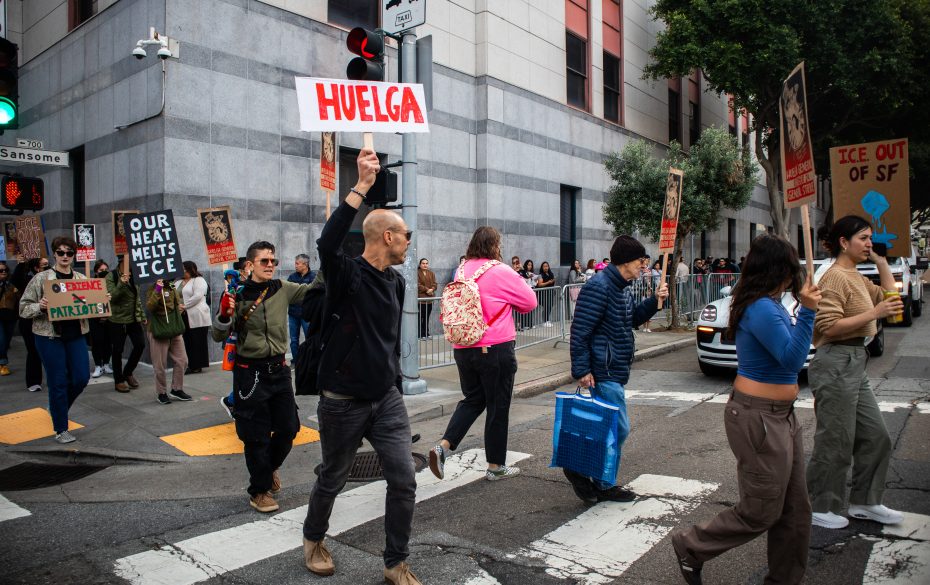
Outside the San Francisco immigration court building at 630 Sansome St., a long line of people carrying manila folders stuffed with documents waited nervously for their check-in appointments last Thursday.

Those waiting outside were in line for their mandatory check-ins with Immigration and Customs Enforcement, appointments that allow federal officials to track the whereabouts and status of those in the immigration system.

Inside, a separate group of people wait to appear before a judge and argue their case to stay in the country.

Mission Local logo, with blue and orange lines on the shape of the Mission District

Want the latest on the Mission and San Francisco? Sign up for our free daily newsletter below.Sign up

Asylum-seekers often wait years before getting inside for their day in court. But today, those court appearances only put them closer to deportation, with little chance of staying in the country.  

“Asylum is essentially over,” said Jesus Ibanez, an immigration attorney representing a client at the Sansome courthouse on Thursday. Instead, Department of Homeland Security attorneys rapidly close out cases, which attorneys say is a way to encourage asylum-seekers to self-deport. 

People stand in line on a city sidewalk near a sign that reads "Protect Our Neighbors, Keep Families Together" in English and Spanish.
Immigrants stand in line outside of the 630 Sansome St. immigration courthouse and a sign reads, “Protect Our Neighbors, Keep Families Together.” Photo by Sage Rios Mace.

San Francisco’s ever-shrinking court

At the Sansome Street courthouse, a single courtroom handles what are called “master-calendar hearings,” the first step in the process, where judges hear multiple cases at once for scheduling.  Those take place on Thursdays and Fridays. 

USF 2/2 - 3/8

The other three days of the week, the courtrooms are deserted: 17 of the 21 judges assigned to San Francisco’s two immigration courts a year ago have been fired since June 2025, and the court’s capacity to hear cases has drastically decreased.

But last Thursday, Judge Frank A. Seminerio, appointed in 2021, sat on the bench, moving through 33 cases. He now splits his time between the city’s two immigration courts, and later in the day went to the courtrooms at 100 Montgomery St., where he would handle another load of cases. 

But in no case is there an actual asylum hearing. 

He once heard full cases and made decisions. Nowadays, cases are pushed through a process known as “pretermit” where federal attorneys ask the court to effectively deny an asylum-seeker their hearing, and instead give them the option to go to a third country and seek asylum there.

Trump attorneys have been seeking removals to Honduras, Ecuador, Uganda and other countries, even when immigrants have never been there before.

This process “denies asylum-seekers a full evidentiary hearing,” explained Jeremiah Johnson, a fired immigration judge who used to work in the city’s courts. Instead, it means immigrants must appear at another hearing to prove they cannot be removed to a safe third country. 

There is a high burden for asylum-seekers to show that they cannot safely go to a third country, or sometimes two, if the federal government offers more than one alternative. If the case is denied, the asylum seeker is “ordered removed” and the case is closed. 

But these countries limit the number of people they accept — in some cases, as few as 240 in a two-year period. Federal attorneys know those countries will not accept the thousands they are seeking to send there.

The effect of their motions is, instead, to put asylum-seekers in limbo awaiting court, or push them to self-deport, according to immigration attorneys. 

San Francisco has had motions to pretermit in at least 737 different cases, when you combine all of 2025 and January 2026. There have been more than 100 third-country removal orders given in San Francisco immigration court, to Honduras, Ecuador, and Guatemala, according to Joseph Gunther and Brandon Marrow, researchers who are studying this across the country.

Protesters chant as they walk around the perimeter of 630 Sansome immigration court on Oct. 24, 2025. Asylum-seekers took photos and videos as they waited in line for their immigration hearings. Photo by Mariana Garcia.

Proving persecution in two, sometimes three countries

Last Thursday, three asylum-seekers were brought to the front of the courtroom and given headphones for simultaneous translation. They were not working, but they informed the translator they could hear fine without the headphones. 

In each case, a “motion to pretermit” was filed by the Department of Homeland Security, and the department offered immigrants the chance to go to Ecuador or Honduras, where the United States has cooperative agreements. 

The respondents, two from Guatemala and the third from Colombia, will now have to show they have suffered persecution not only in their home country, but also in this third country. They were told to send in their evidence a week before their court dates, which were set a few months in the future. 

One respondent raised his hand and asked the judge if he could have more time to gather the evidence.

“It is very hard to get ahold of an attorney and how much they charge,” the man, originally from Colombia, said through the court translator. Lawyers are hard to come by, and scammers target desperate immigrants, offering fraudulent services.

Seminerio denied the request. 

Milli Atkinson, director of the Immigrant Legal Defense Program at the San Francisco Bar Association, is trying to educate clients about “pretermits,” and encouraging them to appeal the eventual order of removal.

“The goal for us is to preserve these issues for appeal,” said Atkinson.

But even filing an appeal to the Board of Immigration Appeals has become more difficult. It is harder to get a fee waiver, and the cost is now roughly $1,030. 

The Board of Immigration Appeals has also announced that it may soon curtail the time period for filing an appeal from 30 days down to 10.

One attorney told Mission Local that these changes have made his own practice economically unfeasible, because he has to charge his clients exorbitant rates to make any money.

Moreover,  the chances of them winning the case are next to zero. He is considering leaving immigration law completely.

“This is just a big clogging up the system for years of people not having any way to move forward on their immigration case,” said Atkinson.

Because of this, many immigrants are making the decision to return to their home country because they do not want to risk being ordered to a third country. Others are sticking it out, and fighting their case.


Mission Local is only using first names of non-citizens to protect their identity.

A group of ten people standing outdoors in a park with a city skyline in the background.

Join the 3,250 readers who keep Mission Local free for all!

Because of you, Mission Local reached and surpassed our $300,000 year-end fundraising goal. All we can say is thank you. 

Thank you for choosing to invest in a local newsroom rooted in San Francisco’s communities — one that listens first and reports deeply. 

If you haven’t yet had a chance to give, it’s not too late to be part of this community. Your contribution today helps sustain the reporting our city relies on all year long.

We’re grateful you’re here — and we’d be honored to have you join our donors.

Donate

Latest on Immigration enforcement

Her partner deported, S.F. mother of four copes with fear and loss in a sanctuary city 

Her partner deported, S.F. mother of four copes with fear and loss in a sanctuary city 

S.F. activists axe Zuckerberg name from General Hospital in favor of ICE victims

S.F. activists axe Zuckerberg name from General Hospital in favor of ICE victims

Photos: S.F. protesters spell out ‘Abolish ICE’ in human banner on Ocean Beach

Photos: S.F. protesters spell out ‘Abolish ICE’ in human banner on Ocean Beach

Clara-Sophia Daly

clarasophia@missionlocal.com

Clara-Sophia Daly is an award-winning journalist who covers immigration for Mission Local. Previously, she reported for the Miami Herald, where she covered education and worked on the investigative team. She graduated with honors from Skidmore College, where she studied International Affairs and Media/Film, and later earned a master’s degree from Columbia Journalism School.

Her reporting portfolio includes investigations into a gymnastics coach who abused his students for more than a decade — work that led to his arrest.

She also covered the privatization of Florida’s public education system, state-funded anti-abortion pregnancy centers, and the deputization of university police officers under federal immigration programs.

A Northern California native, she first joined Mission Local as an intern for a year during the pandemic — and is excited to be back writing stories about immigration.

Got a tip? Email her at clarasophia@missionlocal.comMore by Clara-Sophia Daly