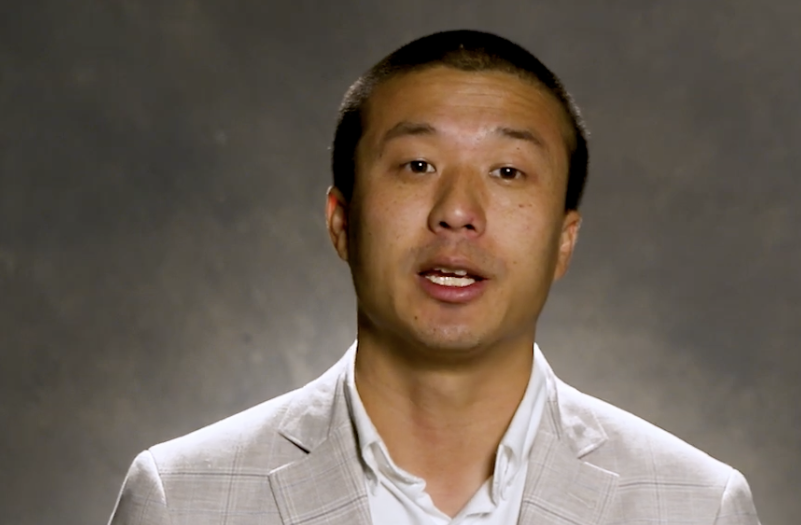
Zohran Mamdani for NYC views Premiered Dec 31, 2025 On December 14th, I sat across from 142 New Yorkers as they shared their concerns, their dreams, the leadership they long for from City Hall. Our campaign was built around listening to the people of New York, and we will govern in the same way. Tomorrow, we get to work. RSVP To join the Inauguration Block Party tomorrow: https://t.co/6QvoGxuRFw Full corrected subtitles will be added shortly after publishing. In the meantime, please use auto-generated subtitles for accessibility needs.
Google AI Overview
Zohran Mamdani speaks several languages, including English, Hindi, Urdu, Spanish, and Arabic, and also uses Bengali (Bangla) in his political communication, showcasing a multilingual approach in his campaigns and governance to connect with diverse New York City communities.
Here’s a breakdown of languages he uses:
English: His primary language for broader communication.
Hindi/Urdu: Used extensively for South Asian communities, often blending them as a single linguistic code.
Spanish: Utilized to engage with the large Hispanic/Latino population, noted for its fluency.
Arabic: Spoken to reach Muslim and Arab communities in New York.
Bengali (Bangla): Also used in his campaign materials and outreach.
NYC Mayor’s Office Streamed live 4 hours ago Mayor Zohran Mamdani Holds A Press Conference to Make An Announcement 85 Clarkson Avenue, Brooklyn, NY 11226
By Peter Hartlaub, Culture CriticUpdated Dec 30, 2022 (SFChronicle.com)
Gift Article
Children play in the calendar pages, phone messages and memos thrown out of high-rise windows in the Financial District on Dec. 31, 1976.Bill Young, Staff / The Chronicle
It was Dec. 31, 1977, and San Francisco’s strangest holiday had arrived: Downtown office workers opened their windows and threw a year’s worth of paper trash onto the street.
More than 15 tons of calendar pages, work memos, faxes, takeout menus and ribbons of waste from computer paper rained from downtown high-rises onto the street below — until sidewalks were no longer visible.
“Just as the snake sheds its old skin, the Financial District shed its 1977 calendar memo pads out of whatever windows it could open and went home early yesterday,” The Chronicle reported the next day. “Lovely festoons of toilet paper and computer tape accented the appointment-pad snowstorm to trim sidewalk trees, wallpaper parked cars and clog crosswalk rain puddles.”
That was near the peak of one of San Francisco’s most poorly aged lost traditions: the last workday of the year in the city, when office workers celebrated by becoming serial litterers.
The calendar pages started flying some time in the late 1920s or early 1930s, after the first wave of skyscrapers was built in the Financial District. Herb Caen was the first to write about the monsoon in the pages of The Chronicle, remarking on it Jan. 1, 1940, just a few months after his beloved column started.
“The most palpable evidence of the death of 1939 could be found Saturday afternoon in the Financial District,” Caen wrote. “For that day, torn leaves from outdated calendars came fluttering down in snowy profusion from the windows of Montgomery and Sansome — an annual custom which, I understand, is peculiar to San Francisco.”
Judging simply by photographs from the Chronicle archive, the tradition’s zenith came sometime in the 1960s, when photos show a steady downpour of paper drifting onto Montgomery Street, nearly covering the outside (but not the inside) of a garbage can that threatened a $250 fine for littering.
Around that time The Chronicle started an annual tradition of sending a reporter and photographer to sift through the calendar pages and report on some of the stranger findings. The notes ranged from curious to titillating to haunting, often saying something about the times.
Aug. 26, 1960:“George called to cancel our date and was I ever grateful!”
Aug. 5, 1964:“Had a long chat long distance with Pete. Guess that situation will finally be straitened out.”
Sept. 15, 1977:“Last night I dreamed I was a tear falling out of a green eye that belonged to a green man who had just landed in a UFO and got his first glimpse at the world. I woke up crying.”
Sept 25, 1977:“VD clinic today.”
April 4, 1978:“Tell Michael THE TRUTH this time.”
The late 1960s and 1970s brought the environmental movement to the Bay Area, but it didn’t reach the Financial District. In interviews through the 1970s, city officials responsible for cleaning the mess remained mostly supportive of the mass littering event.
Department of Public Works Director Myron Tatarian told The Chronicle that residents should just try to enjoy all the trash falling from the skies.
“I can’t help myself. There’s something I really like about this tradition,” Tatarian said. “It’s like a fresh snowfall — it makes us look at the world around us. And at the same time it helps us see ourselves.”
The Chronicle celebrated too. With the tradition often falling during a slow news period a day or two before the New Year, the front page often featured a centerpiece photo of falling papers or children joyfully playing in the refuse like it was snow.
By the mid-1980s, when computer paper and dot matrix printers were adding to the gigantic pile, the haul reached more than 25 tons, with a $25,000 price tag for street cleanup crew overtime. But city officials didn’t openly revolt until early 1987, after a heavy rain made the cleanup particularly frustrating.
“All the calendar pages that people tossed out of their windows have gotten wet, so they’re sticking to the parapets and the ledges of buildings,” Department of Public Works Manager Dick Evans said. “It’ll be awhile before they dry off. Then they’ll blow down into the streets.”
After the 1987 mess the movement grew. Landlords of the Transamerica Pyramid sent a memo to office workers, asking them not to jimmy window locks open and add to the trash. City Hall started a media campaign, asking workers to use recycling bins.
The pleas of city officials were mostly ignored. Downtown workers continued to throw paper out their windows until at least 2003, the last time The Chronicle reported the paper downfall had dwindled to a drizzle.
The tradition apparently ended from a combination of the rise of electronic calendars, and (more importantly) tougher heating, ventilation and air conditioning rules in tall buildings. Many owners of older structures sealed their windows to save on heating bills, and new skyscrapers like Salesforce Tower and 181 Fremont St. didn’t give workers the option to open windows.
In most San Francisco office high-rises in 2022, the only way to throw a year’s worth of recyclables into the street is to put them in a bin and walk down a flight of stairs.
Peter Hartlaub (he/him) is The San Francisco Chronicle’s culture critic. Email: phartlaub@sfchronicle.com Twitter: @PeterHartlaub
Peter Hartlaub is The San Francisco Chronicle’s culture critic and co-founder of Total SF. The Bay Area native, a former Chronicle paperboy, has worked at The Chronicle since 2000. He covers Bay Area culture, co-hosts the Total SF podcast and writes the archive-based Our SF local history column. Hartlaub and columnist Heather Knight co-created the Total SF podcast and event series, engaging with locals to explore and find new ways to celebrate San Francisco and the Bay Area.
CNBC-TV18 Started streaming 87 minutes ago NEW YORK LIVE: Mamdani Swearing In Ceremony | Zohran Mamdani is sworn in by Sen. Bernie Sanders | NYC | N18G New York City Mayor-elect Zohran Mamdani is sworn in by Senator Bernie Sanders in a public ceremony on the steps of New York’s City Hall. The “Inauguration of a New Era,” a citywide celebration marking the beginning of his tenure. Zohran Mamdani will formally assume office as mayor of New York City as the calendar turns to 2026, marking the moment with a pair of swearing-in ceremonies that blend personal history, public spectacle and civic symbolism. His team has planned two distinct events on Thursday: a quiet, private oath just after midnight, followed hours later by a large public ceremony and block party outside City Hall. Together, the ceremonies are intended to reflect both Mamdani’s personal journey and his vision for the city he is about to lead. #zohranmamdani#newyorkcitymayor#zohranmamdanioath#zohranmamdaniswearingin#zohranmamdanispeech#cnbctv18#cnbctv18digital —————————————————————————————————- Zohran Mamdani swearing in, Mamdani sworn in NYC mayor, Zohran Mamdani Quran oath ceremony, first Muslim mayor New York, Mamdani inauguration subway station, Mamdani midnight oath Old City Hall station, New York mayor use Quran oath, Bernie Sanders swears in Mamdani, private midnight swearing-in Mamdani, Mamdani public inauguration City Hall, Zohran Mamdani historic swearing-in using Quran, Mamdani first Muslim and South Asian mayor NYC, Mamdani sworn in at Old City Hall subway station, Zohran Mamdani oath administered by Letitia James, Mamdani public swearing-in by Bernie Sanders, Mamdani block party inauguration Canyon of Heroes, Mamdani rent freeze free buses policies, Mamdani progressive agenda inauguration, New York mayor inauguration 2026, Zohrah Mamdani Quran ceremony NYC mayor.
Associated Press Streamed live 3 hours ago Watch live as New York City Mayor-elect Zohran Mamdani participates in a private swearing-in ceremony at the Old City Hall subway station.
The power went out in the Sunset on Christmas Eve, and then for a fifth time Dec. 27. Neither was as bad as the earlier blackout, but it showed again: PG&E is unable to provide reliable service to the city.
Sup. Alan Wong, who represents the neighborhood, issued a statement that reads:
These repeated outages raise important questions about how our power grid is managed and whether the current system is meeting the needs of San Francisco residents and small businesses. Electricity is a public necessity, and reliability, transparency, and accountability must remain core expectations. In light of this latest outage, I will be asking City departments to evaluate what options may exist to strengthen oversight, reliability, and the long-term resilience of our electric system, including an assessment of practical, fiscal, and operational considerations to better maintain a power grid in the public interest.
That’s a lot of words that fall short of saying: We need to kick PG&E out of City Hall. I followed up, asking if he supports public power, and he told me:
I can bring up the historical context and ask for the fiscal and operational implications to figure out the practicalities of such a move.
Wong is still learning the job (and the role of PG&E in local politics) but like the rest of the newer supes, he’s going to have to get up to speed quickly. Public power is going to be on the agenda in 2026.
Sup. Alan Wong in unhappy with PG&E’S failures in his district.
Natalie Gee, who is running against Wong in D4, told me she supports a municipal takeover of the grid. So does Albert Chow, who is also a candidate in the district, according to his campaign staff.
Sup. Bilal Mahmood, who is also calling for a hearing on the issue, supports a public power system, his office told me. So does fellow “moderate” Matt Dorsey. All of the progressives on the board are going to back the idea. If Wong comes along (and maybe even if he doesn’t) there’s clearly a majority in favor.
While nobody has yet called for a hearing on the next steps to municipalization, when the supes go back into session after the holidays, it’s almost certain to come up—and PG&E will be trying to find a way to delay and pretend that this reliability crisis was just an isolated problem, nothing serious, nothing more to worry about.
I am already hearing PG&E’s talking points on social media: San Francisco can’t even run the buses on time. The city is mismanaged. City worker pensions are too expensive already. How can we run a major public utility?
But there’s another important point here: Many of the public services that San Francisco offers are, by definition, money losers. Muni fares will never cover the cost of operating the system. San Francisco General Hospital will never charge high enough fees to pay its expenses. That’s the point of a “public service.” When local tax money and state and federal support decline, those operations have problems providing their services at the level people want.
Public power systems are different: They make money. So, for the most part, do airports; SFO is widely considered a well-managed operation the functions very well—and the landing fees the airlines pay cover all its costs, and more.
Selling retail electricity in a compact area like San Francisco is very lucrative. That’s why PG&E fights so hard to keep its illegal monopoly. Public power systems in California, and the US, are typically well run, have better reliability than PG&E, and have far lower rates.
Just a few minutes of online research (yeah, ChatGPT is good for a few things) shows:
Silicon Valley Power (Santa Clara), Sacramento Municipal Utility District, and the LA Deparetment of Water and Power offer significantly lower electricity rates than PG&E across residential, commercial, and industrial classes, with SVP and SMUD averaging 36-58% lower than PG&E depending on customer type.
Since 2010, SMUD has also been the highest-scoring utility in California for business customer satisfaction.
The idea that San Francisco can’t run a public power utility is nonsense. In fact, the last time I ran the numbers, which was more than a decade ago, I concluded the city could buy the system for $2.5 billion, pay the interest on the revenue bonds, pay all the salaries and (yes) pensions of all the PG&E workers who would become city workers, cut rates by 20 percent—and clear about $500 million in “profit” a year. Since rates have gone up so much, the profit level is almost certainly higher now.
That money could go, as it does in Sacramento, to lower rates, more reliability by rebuilding aging infrastructure, renewable power projects—and potentially to the General Fund to address the deficit. Public power could fund Muni, and SF General.
(Santa Clara made so much money from its public power system that it used some surplus to help fund the 49ers stadium and entice the team to leave SF. Not a good use of revenue, from my perspective, but you get the point. When the team was planning to leave because SF couldn’t afford and didn’t want to use public money for a new stadium, then-Mayor Gavin Newsom told a department head’s meeting that Santa Clara, thanks to its public power system, had too much available cash to match. Then-Sheriff Mike Hennessey told me he asked Newsom: “Are you saying if we had a public power system, we could keep the 49ers?” The mayor never answered.)
Public power systems are far, far more willing to fund distributed power systems like rooftop solar—because they don’t have to make a profit for shareholders. They run by elected boards or officials, who have to be accountable to the public.
SMUD made a big mistake in the 1970s, and built a nuclear power plant. It was an environmental and financial disaster. So a slate of progressives (backed by the late Tom Hayden) organized, won election to the SMUD board, put the issue to a vote, and shut the dangerous plant down. Now SMUD has one of the most robust renewable energy programs in the nation.
PG&E built a dangerous, expensive nuclear power plant at Diablo Canyon around the same time. It’s driven up our rates, and sits on an active earthquake fault. It’s still operating.
There’s never been a better time to bring the city into compliance with the Raker Act and create a reliable public power system. The major delay at this point is Gov. Gavin Newsom’s Public Utilities Commission.
San Francisco can’t run a public power system without taking over PG&E’s distribution network—the lines, the poles, the meters, the substations. The process for that is well established in law: The city uses eminent domain to take over that property, and pays PG&E fair market value.
The city has filed documents with the CPUC stating that the system is worth between $2.3 billion and $2.8 billion. The idea is that the agency will come up with a final number, and the city can use it in court during the eminent domain filing.
That’s so little money when you consider the revenue.
PG&E’s revenue and expense data is public. The company has about 472,000 residential and commercial customers in SF, and earns about $2,400 a year per customer. That’s $1.1 billion revenue in San Francisco.
After costs, PG&E’s statewide, systemwide profit is about $5 billion a year. San Francisco has about ten percent of PG&E’s customers.
As a dense city, the costs of providing service are the lowest in the system. So at the very worse, San Francisco would be clearing at least $500 million in profit from a public power system; at the very worst, based on today’s rates, the interest on a $3 billion revenue bond (more than the city says the system is worth) would be less than $200 million.
These revenue and cost numbers are way conservative and just based on simple data; San Francisco already has a hydropower dam that costs very little to operate. (I did an in-depth study about 15 years ago that showed far higher profits, but the Bay Guardian website lost much of its content when the paper was shut down so I can’t link to it.)
But the bottom line is: The cost of the system ($2.5 billion? $3 billion?) almost doesn’t matter. The bond payments are so much less than the profit (not revenue; profit, AFTER paying for all the workers and their pensions, and the trucks, and the maintenance) that the city doesn’t need to fight too hard over the details.
The CPUC, frankly, is dragging its feet. The agency keeps asking the city for more data that it doesn’t need. I don’t think Gov. Gavin Newsom wants this to happen on his watch.
It’s not just PG&E campaign money or lobbying: Taking the most profitable territory out of PG&E’s system will have impacts all over the state. The company will argue that it now has to raise rates in Oakland, and Sonoma County, and other places.
That could lead to ratepayer rebellions all over—and since San Francisco showed the solution, other cities and counties might also move to create public power systems. PG&E in ten years could cease to exist as we know it.
That’s not so scary: Northern California has a robust public power infrastructure. SMUD could expand to take many more customers in the northern areas. The East Bay Municipal Utility District could move beyond water and sewers and became a public power agency. The state already has a system ready to go.
Newsom, though, doesn’t like anything that could make his campaign for president harder, and he doesn’t want to offend every private investor-owned utility in the country. (He promised single-payer health care when he was running the first time, but that was empty; he never wanted to cut off access to money from the private insurance industry.)
48 Hills welcomes comments in the form of letters to the editor, which you can submit here. We also invite you to join the conversation on our Facebook, Twitter, and Instagram.
Tim Redmond has been a political and investigative reporter in San Francisco for more than 30 years. He spent much of that time as executive editor of the Bay Guardian. He is the founder of 48hills.
US Air Force personnel prepare an MQ-9 Reaper drone for a mission on the tarmac at Rafael Hernandez Airport in Aguadilla, Puerto Rico on December 27, 2025.
(Photo by Miguel J. Rodriguez Carrillo/AFP via Getty Images)
One expert called the reported drone strike a “violation of Article 2(4) of the UN Charter and the Take Care Clause of the Constitution.”
The US Central Intelligence Agency reportedly carried out a drone strike earlier this month on a port facility inside Venezuela, marking the first time the Trump administration launched an attack within the South American country amid a broader military campaign that observers fear could lead to war.
CNN on Monday was first to report the details of the CIA drone strike, days after President Donald Trumpsuggested in a radio interview that the US recently took out a “big facility” in Venezuela, prompting confusion and alarm. Trump authorized covert CIA action against Venezuela in October.
According to CNN, which cited unnamed sources, the drone strike “targeted a remote dock on the Venezuelan coast that the US government believed was being used by the Venezuelan gang Tren de Aragua to store drugs and move them onto boats for onward shipping.”
To date, the Trump administration has not provided any evidence to support its claim that boats it has illegally bombed in international waters were involved in drug trafficking. No casualties were reported from the drone strike, and the Venezuelan government has not publicly commented on the attack.
“This is an act of war and illegal under both US and international law, let’s just be clear about that,” journalist Mehdi Hasan wrote in response to news of the drone strike.
Our people-powered journalism cannot survive without you
Your support allows Common Dreams to continue covering the stories and amplifying the voices that the corporate media never will. Make a tax-deductible year-end gift to ensure we can sustain the reporting needed to meet the challenges of 2026.
“Seemingly conducted as covert action and then casually disclosed by POTUS while calling into a radio show,” he added.
CNN‘s reporting, later corroborated by the New York Times, came after the Trump administration launched its 30th strike on a vessel in international waters, bringing the death toll from the lawless military campaign to at least 107.
The Timesreported late Monday that “it is not clear” if the drone used in last week’s mission “was owned by the CIA or borrowed from the US military.”
“The Pentagon has stationed several MQ-9 Reaper drones, which carry Hellfire missiles, at bases in Puerto Rico as part of the pressure campaign,” the Times added.
Our work is licensed under Creative Commons (CC BY-NC-ND 3.0). Feel free to republish and share widely.
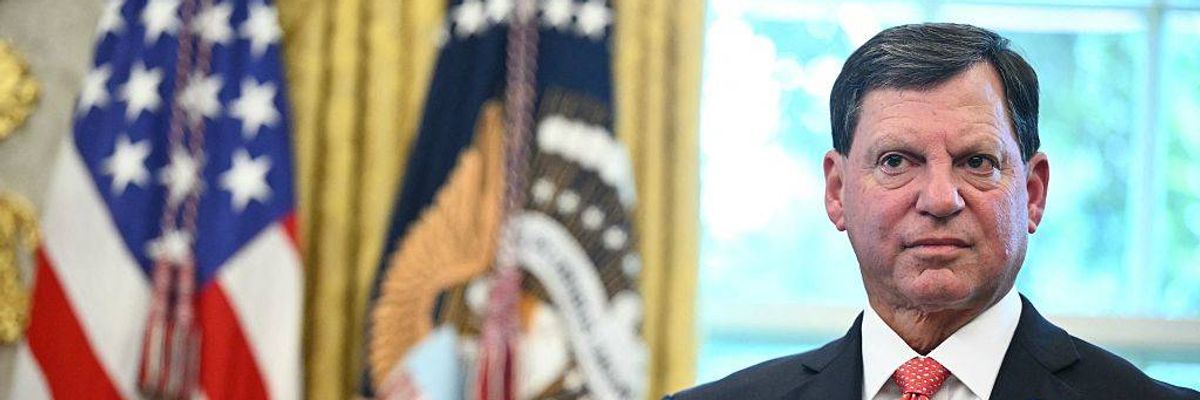
Commissioner of the Social Security Administration Frank Bisignano looks on as US President Donald Trump speaks in the White House in Washington, DC on August 14, 2025.
(Photo by Mandel Ngan/AFP via Getty Images)
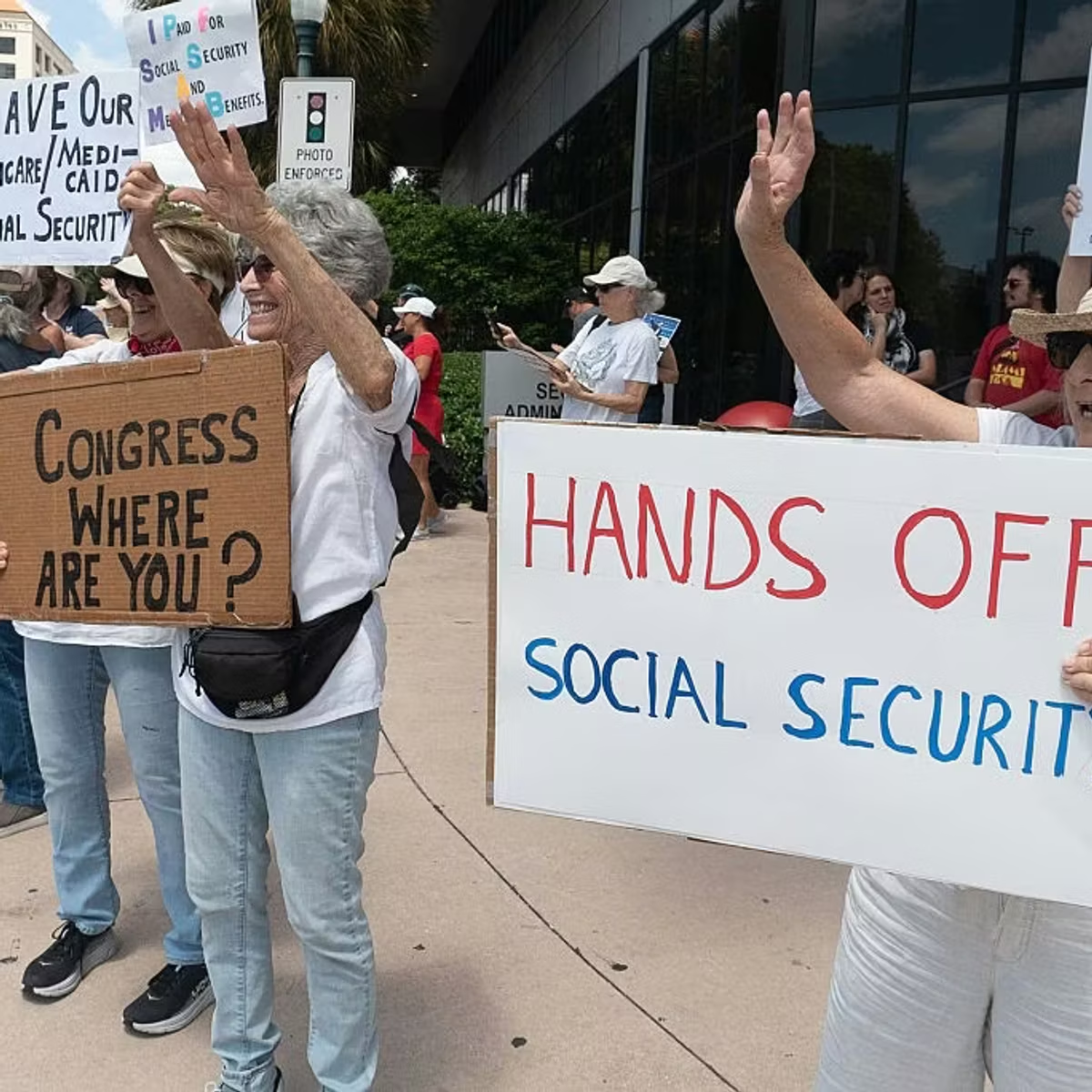
In-depth reporting from the Washington Post found the Social Security Administration is dealing with “record backlogs that have delayed basic services to millions of customers.”
An in-depth report published by the Washington Post on Tuesday offers new details about the damage being done to the Social Security Administration during President Donald Trump’s second term.
The Post, citing both internal documents and interviews with insiders, reported that the Social Security Administration (SSA) is “in turmoil” one year into Trump’s second term, resulting in a customer service system that has “deteriorated.”
The chaos at the SSA started in February when the Trump administrationannounced plans to lay off 7,000 SSA employees, or roughly 12% of the total workforce.
This set off a cascade of events that the Post writes has left the agency with “record backlogs that have delayed basic services to millions of customers,” as the remaining SSA workforce has “struggled to respond to up to 6 million pending cases in its processing centers and 12 million transactions in its field offices.”
The most immediate consequence of the staffing cuts was that call wait times for Social Security beneficiaries surged to an average of roughly two-and-a-half hours, which forced the agency to pull workers employed in other divisions in the department off their jobs.
Our people-powered journalism cannot survive without you
Your support allows Common Dreams to continue covering the stories and amplifying the voices that the corporate media never will. Make a tax-deductible year-end gift to ensure we can sustain the reporting needed to meet the challenges of 2026.
about:blank
However, the Post‘s sources said these employees “were thrown in with minimal training… and found themselves unable to answer much beyond basic questions.”
One longtime SSA employee told the Post that management at the agency “offered minimal training and basically threw [transferred employees] in to sink or swim.”
Although the administration has succeeded in getting call hold times down from their peaks, shuffling so many employees out of their original positions has damaged the SSA in other areas, the Post revealed.
Jordan Harwell, a Montana field office employee who is president of American Federation of Government Employees (AFGE) Local 4012, said that workers in his office no longer have the same time they used to have to process pay stubs, disability claims, and appointment requests because they are constantly manning the phones.
An anonymous employee in an Indiana field office told the Post that she has similarly had to let other work pile up as the administration has emphasized answering phones over everything else.
Among other things, reported the Post, she now has less time to handle “calls from people asking about decisions in their cases, claims filed online, and anyone who tries to submit forms to Social Security—like proof of marriage—through snail mail.”
Also hampering the SSA’s work have been new regulations put in place by Tesla CEO Elon Musk’s Department of Government Efficiency that bar beneficiaries from making changes to their direct deposit information over the phone, instead requiring them to either appear in person at a field office or go online.
The Indiana SSA worker told the Post of a recent case involving a 75-year-old man who recently suffered a major stroke that left him unable to drive to the local field office to verify information needed to change his banking information. The man also said he did not have access to a computer to help him change the information online.
“I had to sit there on the phone and tell this guy, ‘You have to find someone to come in… or, do you have a relative with a computer who can help you or something like that?’” the employee said. “He was just like, ‘No, no, no.’”
Social Security was a regular target for Musk during his tenure working for the Trump administration, and he repeatedly made baseless claims that the entire program was riddled with fraud, even referring to it as “the biggest Ponzi scheme of all time.”
Our work is licensed under Creative Commons (CC BY-NC-ND 3.0). Feel free to republish and share widely.
Public Banking Coalition monthly meetings Next call: Nov 11 Excitement is building for public banking and once a month, PBI hosts an hour-long Public Banking Coalition online meeting to share the excitement and successes. Find out the latest updates on the advances being made all across the country from local advocates themselves... Continue reading →
When you volunteer for Saikat, it’s on us to give you a great experience and a genuine chance to make a difference. We don’t want to waste a second of your time. That’s why we’re always optimizing. And I’m excited to report that this Saturday we talked with 300% more... Continue reading →
This Sunday’s Town Hall: Announcing This Week’s Progressive Town Hall: Every Sunday at 4pm ET/1pm PT RSVP HERE Join PDA activists online from across the country to discuss the importance of progressives reclaiming the American story from the MAGA right, an issue of heightened importance as we’re now within one... Continue reading →
We protest Heritage Foundation EVERY MONDAY (Join us!!!!) By admin | September 2, 2025 | Uncategorized Cliff Cash Comedy Premiered Jul 26, 2025 Every Monday at The Heritage Foundation 214 Massachusetts Ave. Washington D.C. 4pm protest 6pm pizza Every Friday at Fox News D.C. 400 N. Capitol St. Washington D.C. 4pm protest 6pm pizza We are... Continue reading →
January Membership Meeting Join Alice for our first membership meeting of the year! Come vote to confirm and meet the incoming 2026 board (new roster listed at the end of this email). ️Monday, January 12, 2026 6:00–7:00 PM | Doors 5:30 PM 518 Valencia Street (at 16th)This meeting qualifies as a voting event for... Continue reading →
One Million Rising: Strategic Non-Cooperation to Fight Authoritarianism Virtual Event · Hosted by No Kings Time Wednesdays 8 – 9:30pm EDT Location Virtual event Join from anywhere About this event Across the country, authoritarian forces are getting bolder and more dangerous. Trump and his allies are not hiding their agenda: mass deportations,... Continue reading →
THURSDAY, JUNE 29, 2023 AT 2 AM – 4 AM PDT How to create trust in a group? Details Event by Extinction Rebellion Empathy Circles online EMPATHY CAFE Duration: 2 hr Public · Anyone on or off Facebook How to create trust in a group? This is the question that arose in our... Continue reading →
When you volunteer for Saikat, it’s on us to give you a great experience and a genuine chance to make a difference. We don’t want to waste a second of your time. That’s why we’re always optimizing. And I’m excited to report that this Saturday we talked with 300% more... Continue reading →
This Sunday’s Town Hall: Announcing This Week’s Progressive Town Hall: Every Sunday at 4pm ET/1pm PT RSVP HERE Join PDA activists online from across the country to discuss the importance of progressives reclaiming the American story from the MAGA right, an issue of heightened importance as we’re now within one... Continue reading →
https://us06web.zoom.us/j/83499963761?pwd=x6vbYvt5bywKggEjac4QV2vf71MGKc.1 A new world order? More like a New World chaos. Kidnaps and cannons. Dionne quintuplets. Canadian cruelty. Rest in pentapeace. (1) Return to the moon? Well, around it, anyway. No cheese eating yet. Measles, flu, the blues. Weight loss pills and vaccine thrills. Not rid of Covid. Epstein? Epstein... Continue reading →





 When you volunteer for Saikat, it’s on us to give you a great experience and a genuine chance to make a difference. We don’t want to waste a second of your time. That’s why we’re always optimizing. And I’m excited to report that this Saturday we talked with 300% more... Continue readingJan11Sun1:00 pm PDA Progressive Democrats Meeting @ Online via ZoomPDA Progressive Democrats Meeting @ Online via ZoomJan 11 @ 1:00 pm – 3:00 pm
 This Sunday’s Town Hall: Announcing This Week’s Progressive Town Hall: Every Sunday at 4pm ET/1pm PT RSVP HERE Join PDA activists online from across the country to discuss the importance of progressives reclaiming the American story from the MAGA right, an issue of heightened importance as we’re now within one... Continue readingJan12Mon4:00 pm Protest Heritage Foundation @ The Heritage FoundationProtest Heritage Foundation @ The Heritage FoundationJan 12 @ 4:00 pm – 6:00 pmWe protest Heritage Foundation EVERY MONDAY (Join us!!!!) By admin | September 2, 2025 | Uncategorized Cliff Cash Comedy Premiered Jul 26, 2025 Every Monday at The Heritage Foundation 214 Massachusetts Ave. Washington D.C. 4pm protest 6pm pizza Every Friday at Fox News D.C. 400 N. Capitol St. Washington D.C. 4pm protest 6pm pizza We are... Continue reading6:00 pm Allce January membership meeting @ 518 ValenciaAllce January membership meeting @ 518 ValenciaJan 12 @ 6:00 pm – 7:00 pmJanuary Membership Meeting Join Alice for our first membership meeting of the year! Come vote to confirm and meet the incoming 2026 board (new roster listed at the end of this email). ️Monday, January 12, 2026 6:00–7:00 PM | Doors 5:30 PM 518 Valencia Street (at 16th)This meeting qualifies as a voting event for... Continue readingJan14Wed5:00 pm One Million Rising @ Virtual eventOne Million Rising @ Virtual eventJan 14 @ 5:00 pm – 6:30 pm
 One Million Rising: Strategic Non-Cooperation to Fight Authoritarianism Virtual Event · Hosted by No Kings Time Wednesdays 8 – 9:30pm EDT Location Virtual event Join from anywhere About this event Across the country, authoritarian forces are getting bolder and more dangerous. Trump and his allies are not hiding their agenda: mass deportations,... Continue readingJan15Thu10:00 am Extinction Rebellion Empathy Circle @ Online via ZoomExtinction Rebellion Empathy Circle @ Online via ZoomJan 15 @ 10:00 am – 12:00 pm
 THURSDAY, JUNE 29, 2023 AT 2 AM – 4 AM PDT How to create trust in a group? Details Event by Extinction Rebellion Empathy Circles online EMPATHY CAFE Duration: 2 hr Public · Anyone on or off Facebook How to create trust in a group? This is the question that arose in our... Continue readingJan17Sat11:00 am Door knock for Saikat @ Dolores ParkDoor knock for Saikat @ Dolores ParkJan 17 @ 11:00 am – 3:00 pm