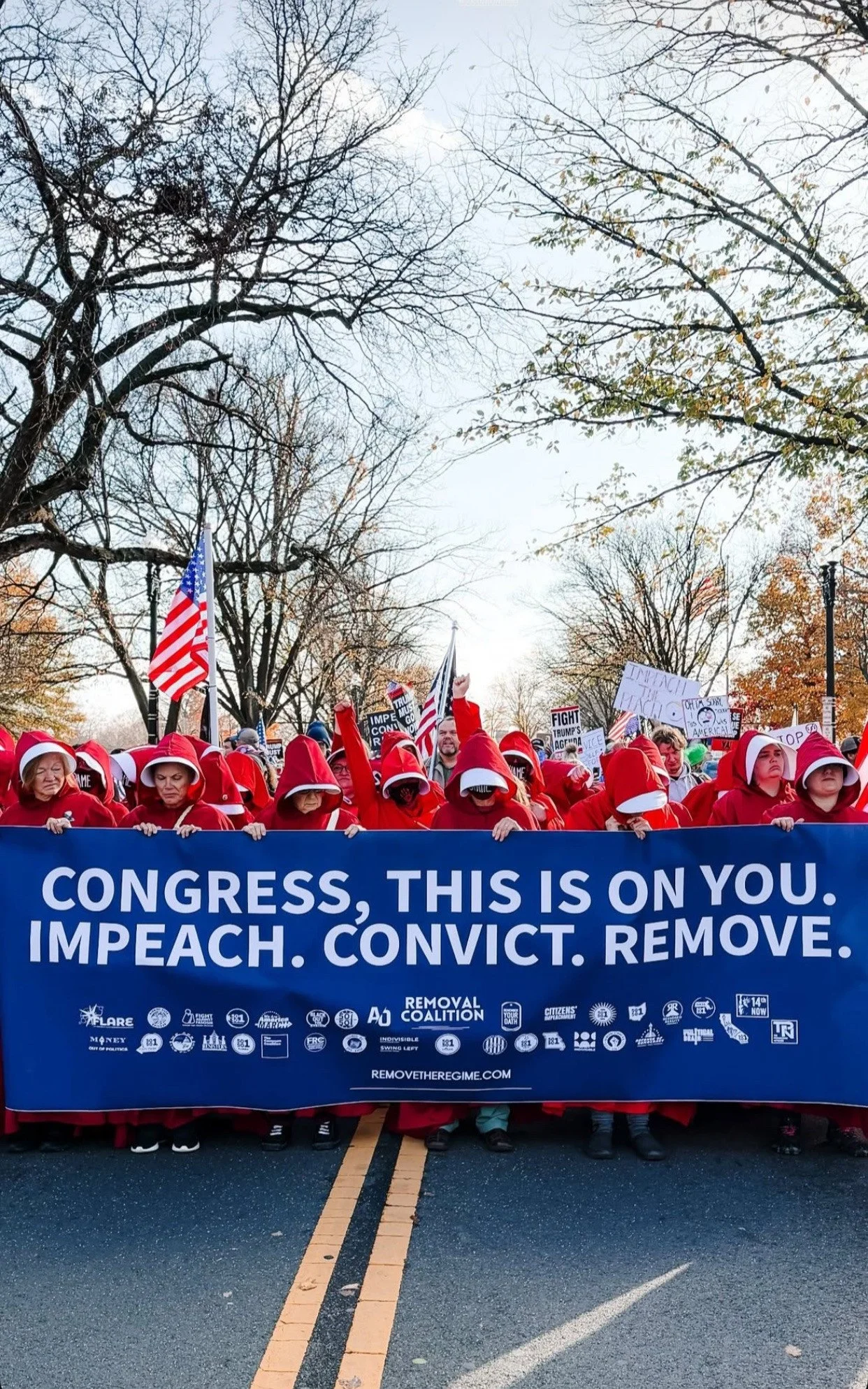
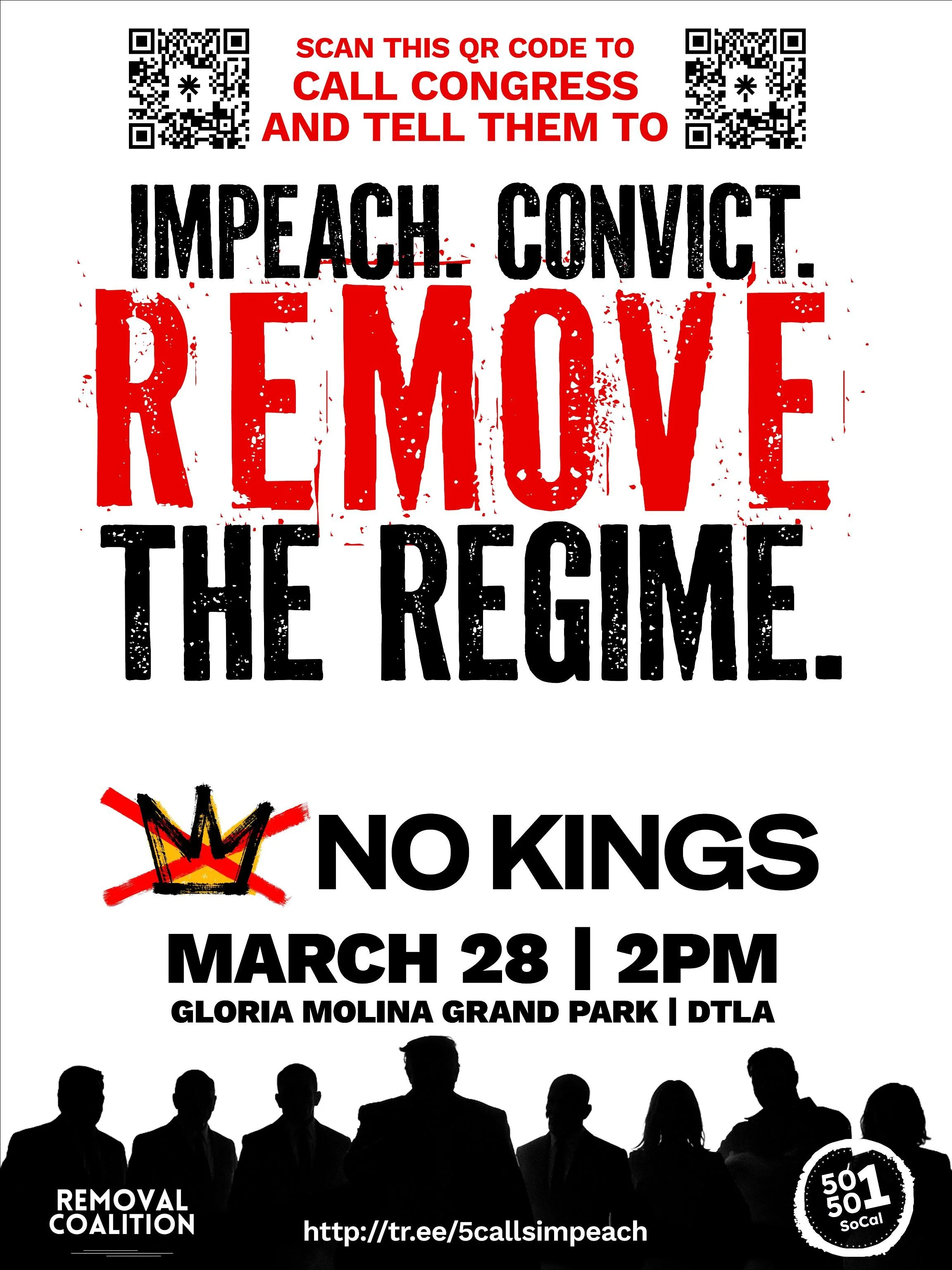
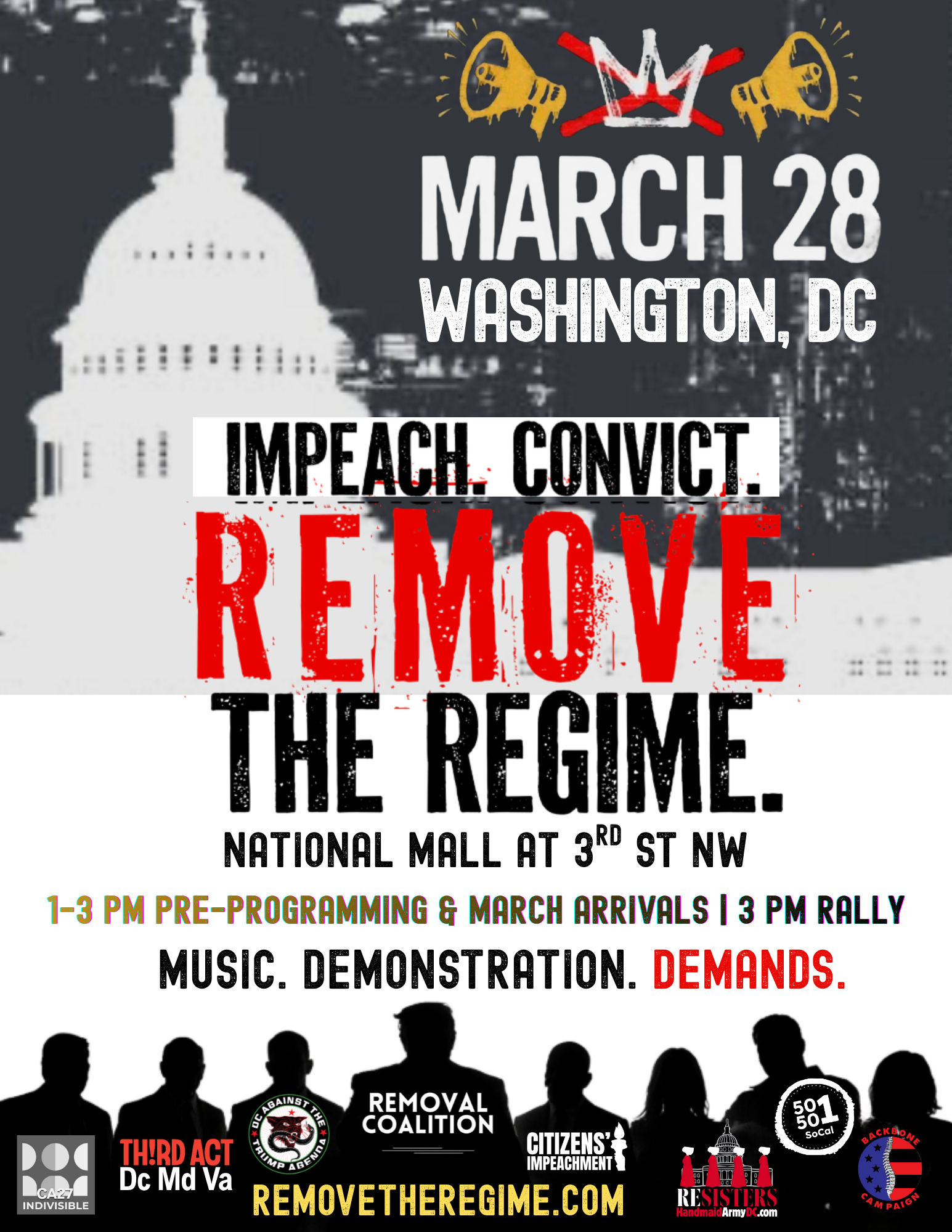
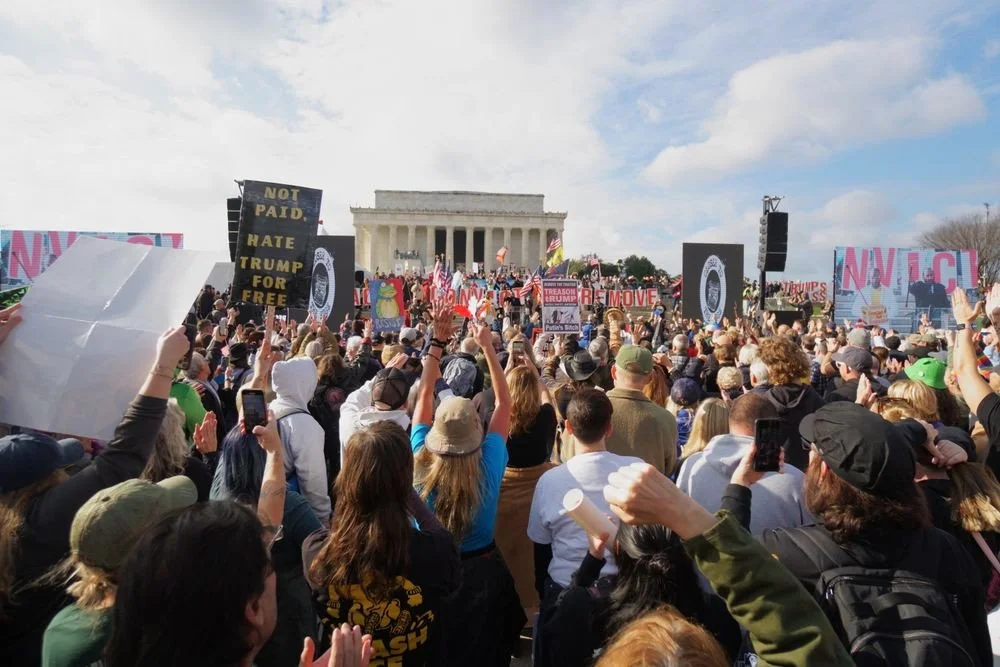
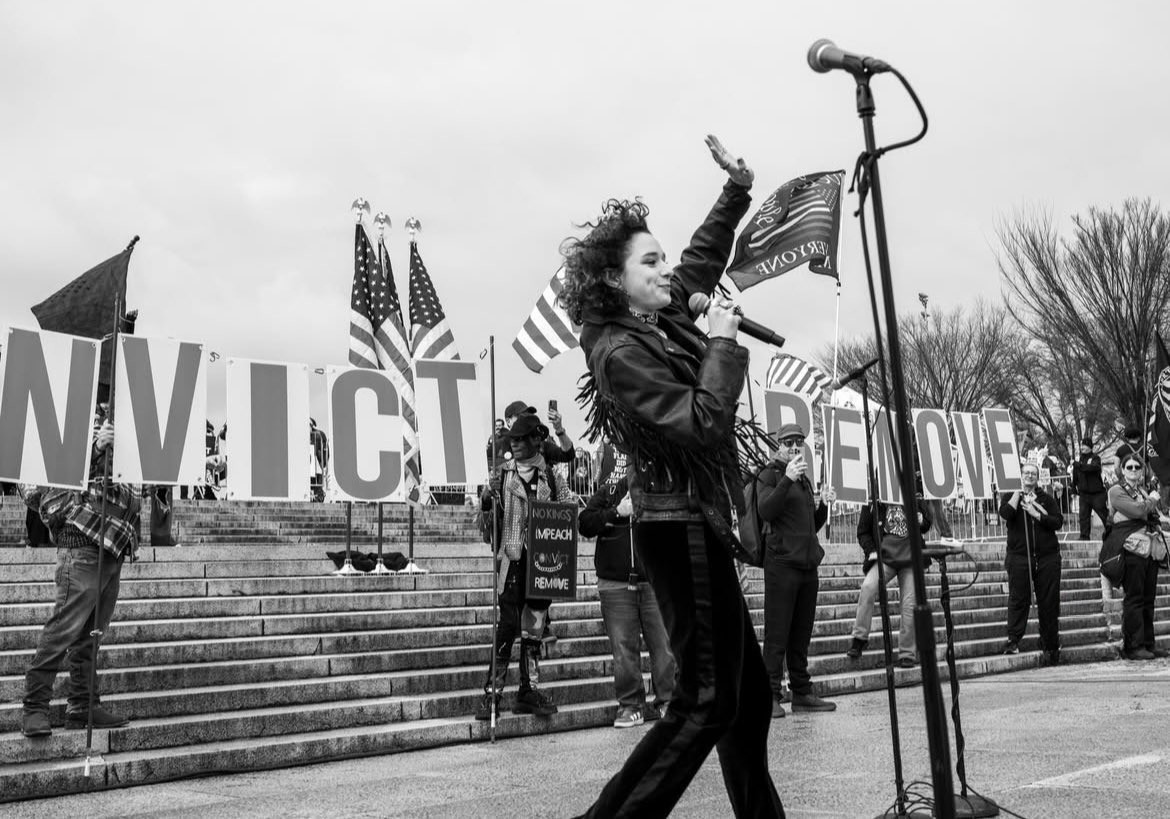
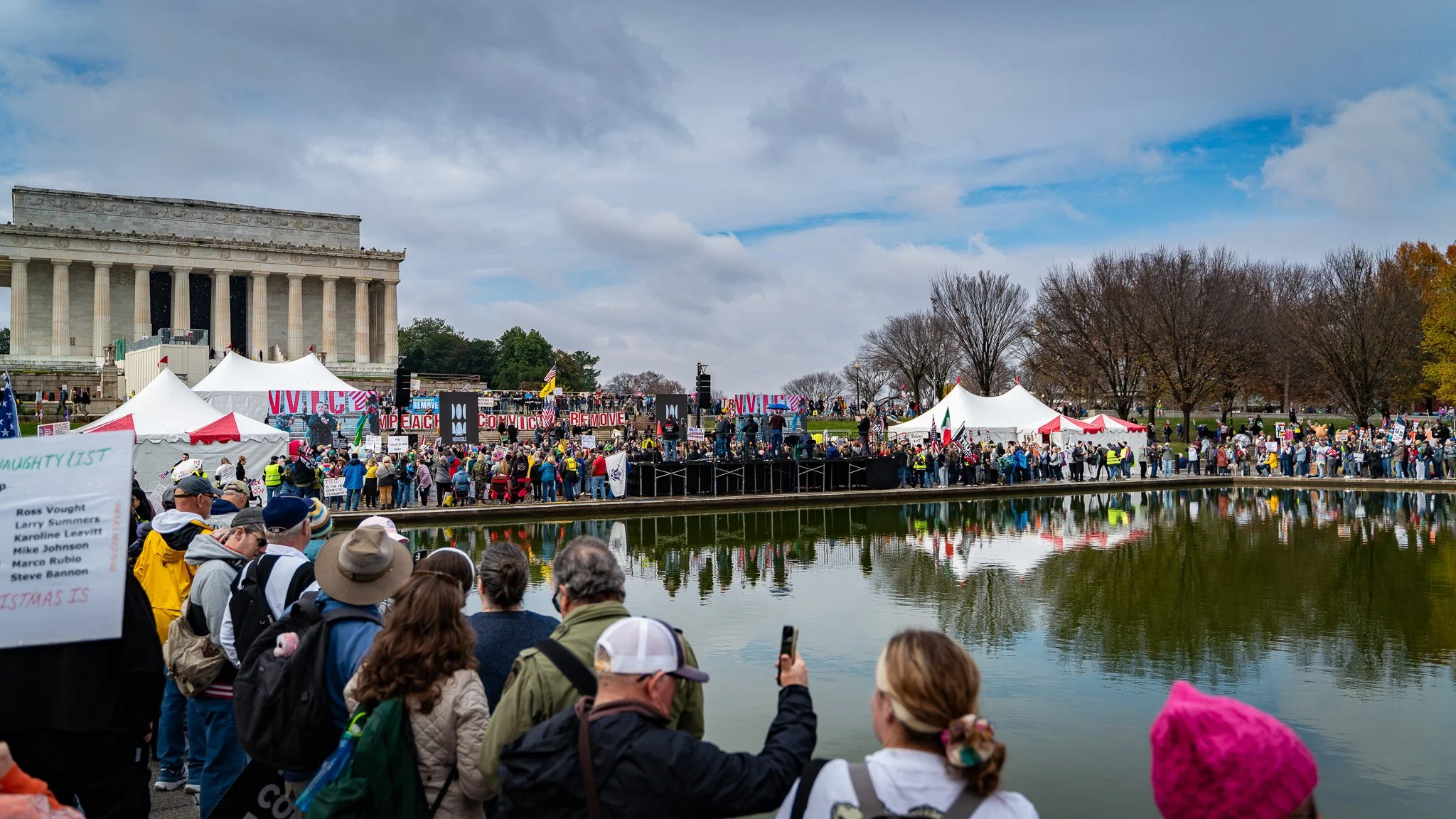
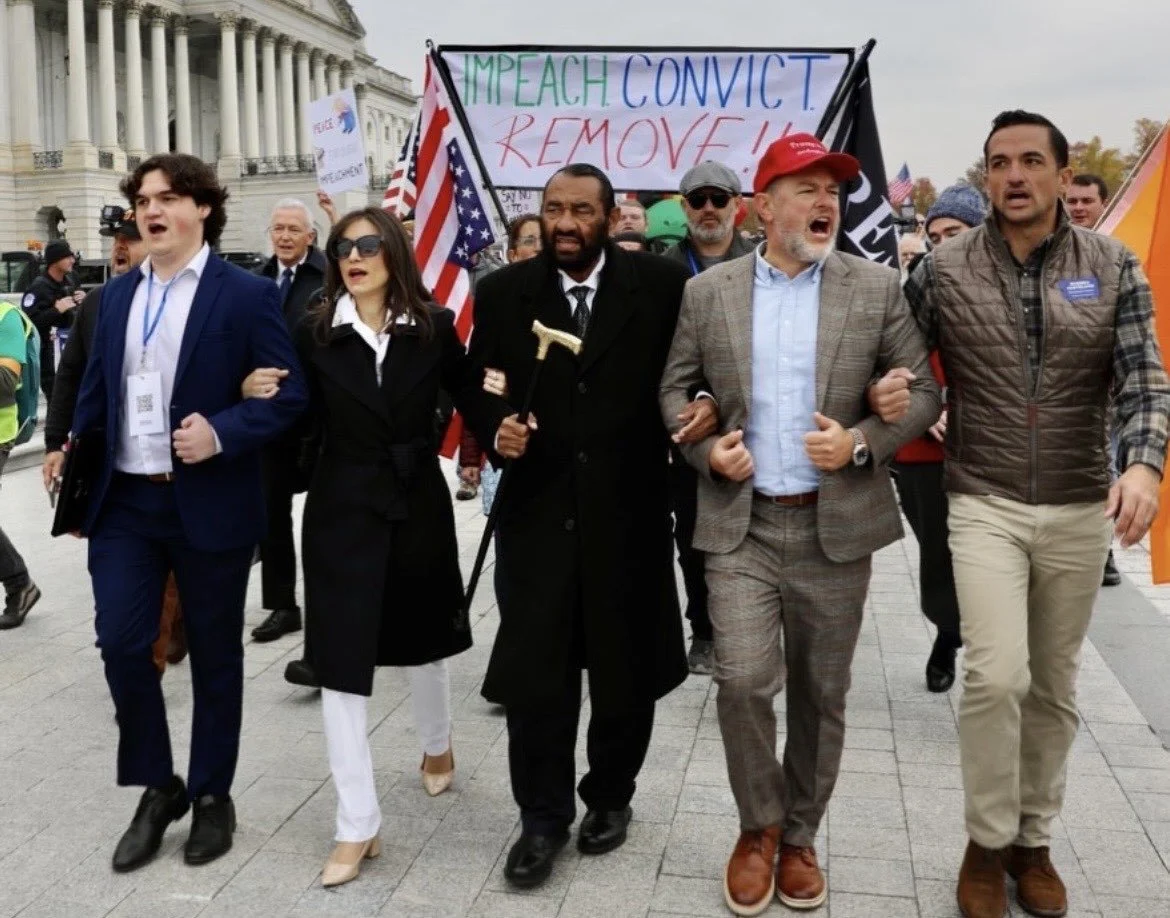
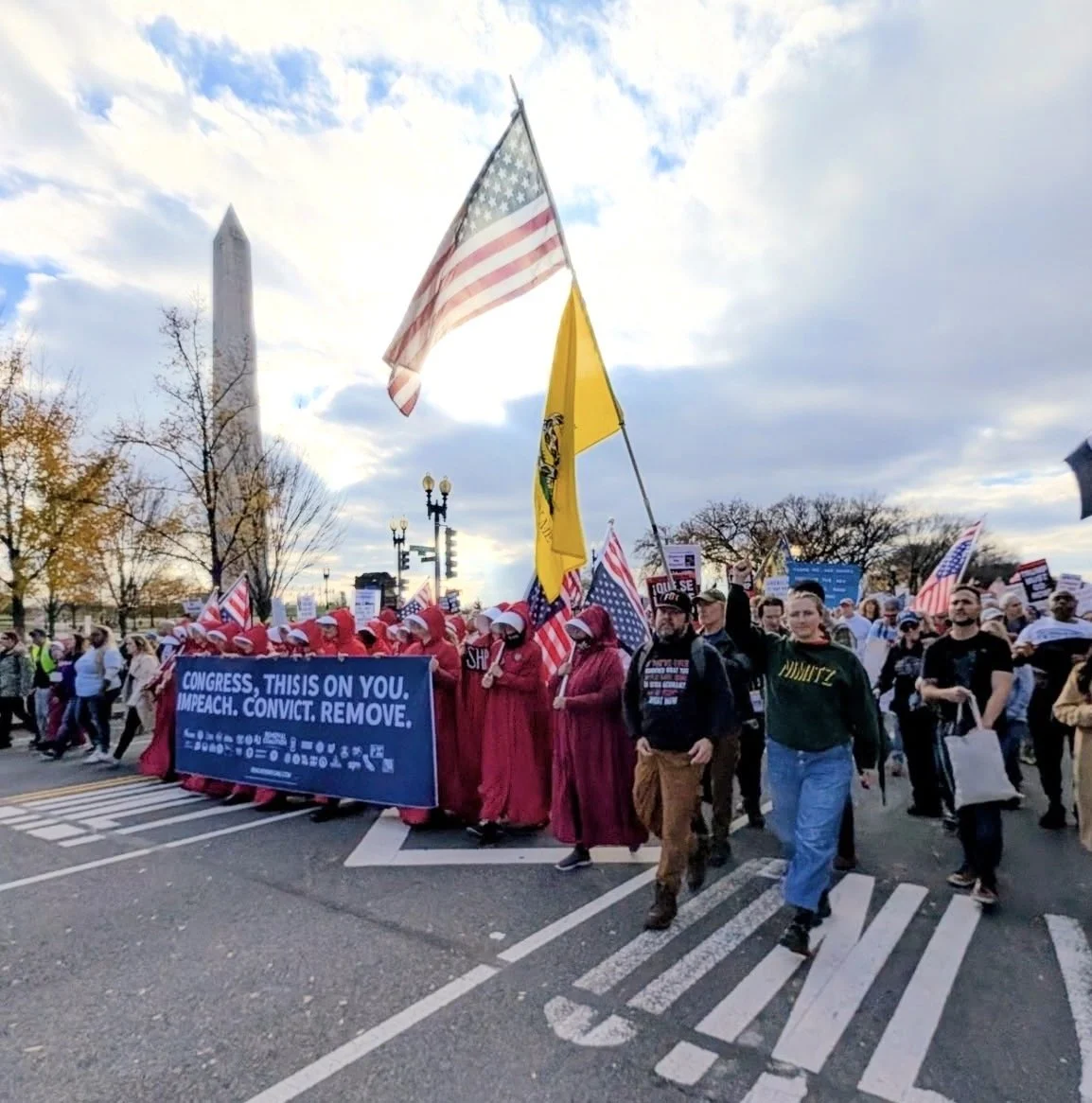
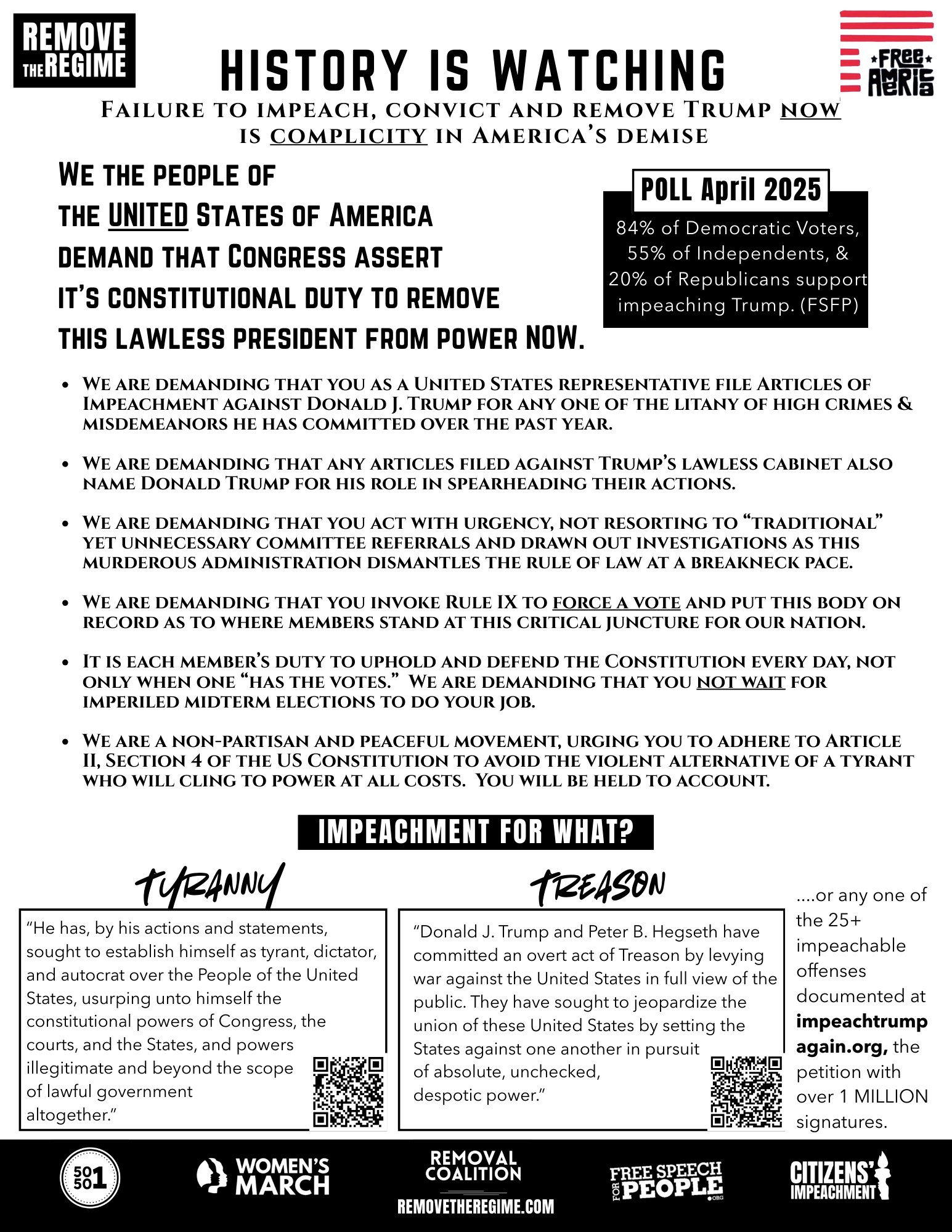
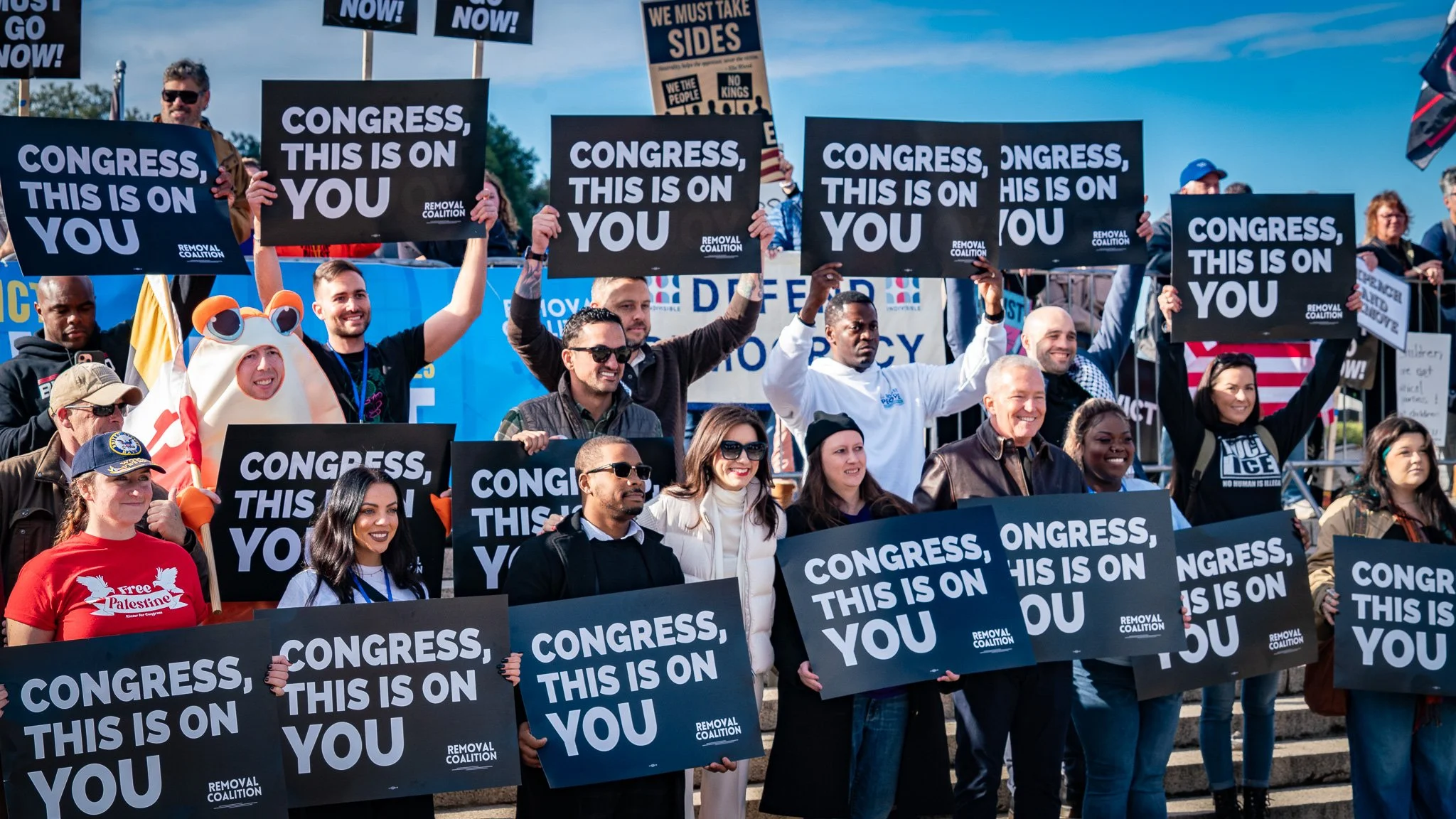
Get ready for No Kings (this Saturday, March 28)! Have you found your closest protest? Told three friends about it? Checked out our trainings and other resources? Great! Now keep spreading the word — on social media, among friends, at a local overpass, or wherever you can. In the face of Trump’s bloody war, ICE terror, Epstein cover-up, efforts to rig elections, and bottomless corruption, No Kings 3 has to be the biggest protest this country has ever seen. See you there!
Tell Congress: DON’T FUND TRUMP’S WAR! The war on Iran has been a disaster since Trump and his cabinet of warmongers and sycophants launched it. As of this writing, thirteen US servicemembers, 1,500 Iranians, and over 1,100 civilians across the region have been killed. That carnage has already cost taxpayers billions of dollars and sent the cost of basic necessities through the roof. Demand that your senators and representative use their power to refuse Trump’s demand for more money, conduct meaningful oversight, keep forcing votes on War Powers Resolutions, and oppose the war publicly.
“As the president becomes more unpopular, his actions will become more extreme, but that doesn’t mean they’re going to be any more successful,” Ari Berman of Mother Jones tells us.
U.S. House Speaker Mike Johnson (R-LA) speaks during a news conference on February 11, 2026 at the U.S. Capitol in Washington, DC. Photo by Michael M. Santiago/Getty Images
Get fearless, uncompromising truth in your inbox. Subscribe to The Real News.
With the public outraged over the US-Israeli war with Iran, the Epstein Files coverup, and a cost-of-living crisis, even President Donald Trump’s base of supporters is fracturing, and Republicans are fixing to get slammed in the upcoming midterm elections. Perhaps that explains why Trump and MAGA Republicans are obsessively focused on attacking voting rights, taking federal control over the electoral system, and preemptively casting doubt on the midterm election results before the elections even happen. TRNN Editor-in-Chief Maximillian Alvarez speaks with Ari Berman, national voting rights correspondent for Mother Jones, about MAGA Republicans’ effort to rig the midterms—and what can be done to stop it.
Studio Production / Post-Production: Cameron Granadino
Transcript
The following is a rushed transcript and may contain errors. A proofread version will be made available as soon as possible.
Maximillian Alvarez:
Welcome everyone to the Real News Network Podcast. I’m Maximillian Alvarez. I’m the editor-in-chief here at The Real News, and it’s so great to have you all with us. Between the federal government’s coverup of the Epstein Files, President Trump’s catastrophic decision to plunge the US into a war with Iran, an economy that is crushing working people while hurling money at billionaire oligarchs and corporations, and the daily litany of rampant and jaw-droppingly blatant corruption throughout the Trump administration. Even Trump’s base of supporters is fracturing, and Republicans are fixing to get slammed in the upcoming midterm elections. And perhaps that explains why Donald Trump and MAGA Republicans are obsessively focused on attacking voter rights, rigging the electoral system, and preemptively casting doubt on the election results before the elections even happen. On Tuesday afternoon, the Senate began debating the Save America Act, which voting rights advocates describe as the worst voter suppression bill that Congress has seriously considered passing.
Renowned journalists and voting rights correspondent Ari Berman writes in Mother Jones. Trump calls the bill his number one priority and claims that it will “guarantee the midterms for Republicans.” Today, I am grateful to be speaking with Ari Berman himself. Ari, thank you so much for joining us on The Real News. I want to start by asking the big blunt question. Many Democrats and Democratic voters have been watching in horror and disbelief what the Second Trump administration is doing and how congressional Republicans are enabling it every step of the way. And they are hopefully expecting to make them pay in the midterms. So as one of the foremost experts on the state of voting rights in America today, what do people need to know about the steps that Trump and Republicans are taking to ensure that that doesn’t happen?
Ari Berman:
Hey, Maximilian. Well, thank you so much for having me. Generally speaking, if you look big picture, what is different now than what the Trump administration or any previous administration has tried to do is the second Trump administration is trying to use the full weight of the federal government to try to interfere in a midterm election. Normally what presidents do in a midterm is they try to make the case for their party, even though they’re not on the ballot. Trump isn’t doing that at all. He’s not trying to make any affirmative case for his party. He is just trying to mess with the mechanics of voting in every way he can. First, he tried to lean on states to gerrymander mid-decade to give Republicans more seats that work to an extent, but Democrats fought back and that is now more of a wash. So now he’s saying he wants to take control of the voting process.
That can mean a number of different things, but basically what it boils down to is the President trying to give himself or his administration the power that it doesn’t actually have because the Constitution gives the President very little power when it comes to voting and elections because the founding father is feared. A king like want to be dictator like Trump trying to control elections. So they gave the power to the states with some oversight with Congress. So there’s really this battle between people’s desire to vote the people they don’t like out of office. The Constitution’s guarantees that states control their own elections. And then what Trump is trying to do, which is to subvert all of that and basically trying to give himself king-like power to rule by fiat to say, “This is how you vote, this is how you can’t vote. This is where vote should be counted.
This is where vote shouldn’t be counted. This is where vote should be thrown out. This is where voting machines should be ceized. This is where mail voting should stop and doing everything he can try to change voting mechanisms to prevent Republicans from losing in
Maximillian Alvarez:
2026.” I want to ask just a quick clarifying question because Trump can make all these pronouncements that he wants, and one of which has been, “We’re going to nationalize the elections.” So I guess for folks who are watching this or listening to this who have heard that, could you just explain a little more what the hell he means by that and what protections are currently in place to prevent that?
Ari Berman:
Well, I’m not exactly sure that he himself knows what that means. I think that’s just something that he would like to do. I mean, I think when he talks about it, he means things like no mail-in ballots, for example, or no electronic voting machines, proof of citizenship to register to vote. Some of the stuff that’s in the SAVE Act, some of the stuff that’s not in the SAVE Act, but he can’t do that by fiat. I mean, he tried to do an executive order already to effectuate some of these policies. For example, to require proof of citizenship to vote in federal elections. That was blocked largely in court because the court said the constitution is very clear that states with oversight from Congress run elections. So time and time again, he is trying to claim powers for himself that he doesn’t have. And my feeling about all of this is don’t give Trump more power than he already has.
I get why people are fearful of these pronouncements, but at the end of the day, they’re just pronouncements. The thing that worries me though are the actions. So things like seizing the ballots in Fulton County, Georgia. I think that’s the kind of thing that he has in mind when he says, nationalize the voting, that his administration basically goes in wherever they don’t want, wherever they’re trying to re-litigate losses in 2020, wherever they’re trying to put more pressure on local officials to bend to their will. That’s where they’re trying to interfere. And the Fulton County thing was really, really unprecedented. The idea that you would go in, use the power of the FBI to seize ballots from an election that took place six years earlier, that you would dispatch the director of national intelligence to watch the raid, that you would put the FBI agents who participated in the raid on the phone with the President of the United States.
I mean, that’s flat out straight out of the Kremlin authoritarian playbook. And so I think that’s the kind of thing that’s unnerving to people. At the end of the day, will Trump be able to take over voting nationally? I don’t think so. Will he be able to take over voting in 15 places, like he said? I think it’s very unlikely, but definitely it’s something that we have to keep monitoring and be concerned about.
Maximillian Alvarez:
And speaking of things we need to be concerned about, let’s focus in on the SAVE Act or the Save America Act, which you’ve previously referred to in your reporting as the Show Us Your Papers Bill. So for folks watching and listening to this, what is the SAVE Act? What will it do if it’s passed into law and how close are we to having it be passed into law?
Ari Berman:
Well, it really has three major parts which are now being expanded into more parts. But essentially the centerpiece of it is this show your papers requirement that you have a passport or a birth certificate to register to vote. That is very burdensome because there’s lots of different data points on this. One data point is 21 million Americans don’t have ready access to their citizenship documents. I would argue that understates the number because unlike a driver’s license, for example, most people do not carry around their passports or their birth certificates with them. A lot of people don’t know where their birth certificate is even if they have one and half of all Americans don’t have a passport. So these are not things that 95% of people have easy access to whenever they’re going to register to vote. They’re not things that you ever needed before. Right now, the way it works is if when you register to vote, you show some form of identification to prove who you are.
The idea that you can just show up and vote with no identification is a lie that doesn’t happen in any actual state, but this is much more burdensome. And then there’s of course groups that have a harder problem. There’s 69 million women that have changed their last name, and therefore their birth certificate has a different name than their other documents. And so they could have a problem registering to vote. You have to show your documentation in person at an election’s office. That means that rural people could have to drive up to eight hours to be able to register to vote. So there are burdens to this law that don’t seem that obvious. Then they have added a national voter ID provision to it. I think just for messaging purposes, so they could say you need an ID to do all of these things. Why don’t you need an ID to vote?
Of course, things like buying liquor, getting on a plane, those are not constitutional rights like voting is, but also before you ever vote, you have to register. And so the registration part is much more burdensome than the voting requirements. Then also the third part of it is requiring states to hand over their voter roles to the Department of Homeland Security, which is very worrisome because basically the Department of Homeland Security has said they’re going to run it through these databases that are not designed for that purpose. They’re going to wrongly flag a lot of Americans, particularly naturalized citizens as non-citizens, and they’re going to purge them from the voter roll. So that is something that a lot of states, even red states are resistant about doing. Then they want to amend the bill in the Senate to essentially ban mail-in voting, which is unpopular even among many Republicans, and then add all these things relating to transgender people playing sports, which of course has absolutely nothing to do with a debate over elections.
So I think that there’s sort of two major problems with this. One is that the bill itself is terrible and it would disenfranchise tens of millions of Americans and many more people would be affected than I think they would expect to. And the second thing is, why is the Senate doing this now? There’s so much other stuff happening right now. I mean, there’s an invasion of Iran that’s going terrible. Gas prices are skyrocketing. The economy is tanking. Over and over, voters say their main concern is the high cost of things, the lack of affordability, inflation. The Senate’s not addressing any of that. They are now spending weeks debating what is essentially a MAGA fever dream from Trump. And so both on the substance and then just the timing and the procedure and the context, everything about this is crazy.
Maximillian Alvarez:
I want to pick up on the MAGA fever dream part real quick because I want to be as good faith and rigorous as we can be. But if anyone is watching this saying like, “Well, we got to protect the integrity of our elections.” I heard that China is trying to interfere or they tried to interfere in the 2020 elections or all these illegal immigrants are voting, yada, yada, yada. Can you just address that head on? Is this based on any real demonstrable problem that we have in this country?
Ari Berman:
No. And then there’s just the fact that this is all just based on a lie, which is that non-citizens are registering in voting in substantial numbers in American elections. And there’s been so much data on this because states routinely audit their voter roles. Utah just audited their voter roles. They looked at 2.1 million registered voters. They found one non-citizen registered and zero non-citizens have voted. When Georgia, North Carolina, big states with millions of voters looked at their voter roles, they came to the same conclusion. Every once in a while, someone ends up improperly on the voter rules through some form or another. Maybe they have green cards, for example, so they have some level of documentation. They don’t realize that they’re not supposed to be able to register. They’re not supposed to be able to cast a ballot.That happens every once in a while, but nowhere near the frequency.
I mean, you’re talking about a handful of cases, not like Ted Cruz is saying that Democrats brought in 12 million people illegally so they could register them to vote. First off, just from a common sense perspective, the people that are here with or without documentation who are immigrants, they’re coming here for a better life. Voting is the last thing that they would be concerned about doing. The idea that if you are here, whether with or without documentation, that you would sacrifice the possibility of becoming a citizen, risk jail time, deportation, just to register and vote. It doesn’t make any rational sense and it’s not backed up by any numbers. But I mean, they’re trying to cause a hysteria so that they can do two things. They can have a hard line immigration agenda. We saw what that led to in Minneapolis, and they can have a hard line voting agenda so they can further Trump’s goal of taking over the voting.
So this whole lie about non-citizens voting, it’s a twofer for them. It’s attempted to accomplish two things, make their base afraid of the changing demographics of the country, and then build support for restrictive, repressive policies that try to make the country more white and try to make the electorate more white. At the end of the day, this is what it’s about. And I think that’s why they haven’t had a whole lot of success in ultimately pushing this forward because it’s not a popular agenda at the end of the day, even if specific parts of what they’re trying to do may be popular.
Maximillian Alvarez:
Well, and it’s just so wild to me as a second generation Mexican American who came of age in the ’90s and early aughts as a deep red conservative. We were a conservative family. I’ve been hearing this crap since I was a kid, that Democrats are bringing in all these illegals to vote for them in elections. And even then when we were on the right, that didn’t make sense to me for all the reasons that you’re saying. But I wanted to hook this back into the third provision in the SAVE Act that you mentioned that would require states to hand over their voter roles, including sensitive personal information to the Department of Homeland Security. And when you mix that in with people like Steve Bannon calling for ICE to surround the polls and stuff like that, it really seems like there’s a MAGA type effort here to use the might of the state to create a mass voter intimidation effect so that even people who can vote legally are afraid to go because they’re worried that doing so will mean that they’re on some database with DHS.
Ari Berman:
For sure. Yeah, absolutely. And that to me is probably the most important part of the bill that hasn’t gotten very much coverage, so I’m glad you brought it up. The Department of Justice has been trying to get these voter rolls. They’ve now sued 29 states to try to get them, and they haven’t gotten very many. Only about 10 states have handed over their information. So the majority of states haven’t done it. A lot of red states haven’t done it because they want to preserve their own security over their own state voter roles. But the interesting thing is that DOJ was basically being somewhat coy about whether they were going to give this information to the Department of Homeland Security. And then the SAFe America Act just flat out said it’s going straight to the Department of Homeland Security, meaning that it has nothing to do with anything related to the integrity of the election because that’s not the role of the Department of Homeland Security.
What the Department of Homeland Security has is this other database, which is also called SAVE very confusingly. And what SAVE does is it’s a database of people, immigrants who have interacted with the federal government. It’s not updated to flag, for example, when someone becomes naturalized. So if you run a bunch of people’s information through that database, what’s going to happen is it’s going to wrongly flag people, particularly naturalized citizens who at one point may not have been citizens as ineligible to vote, and then they’re going to be purged from the voter roles. And so I think that’s really worrisome. It’s very worrisome, A, that the Department of Homeland Security or any part of the government would have a national database of voters, which could be easily hacked, easily weaponized by the likes of Bannon, Stephen Miller, whoever it might be. And then the fact that there’s real real consequences to this.
And being purged is different than having to require documentation because when you have to require documentation, people have to go through hoops to get it, but they know they have to have it. Often if you’re purged, you show up, you don’t even realize that you’ve been removed from the voter rules. Maybe you get a letter, maybe you don’t. So many people don’t open this kind of mail. And if your state doesn’t have, for example, election day registration, you have no recourse to be able to cast a ballot. So I do think that that is a part of the bill that is really, really problematic, that hasn’t gotten enough coverage. And I think it’s yet another reason why the SAVE Act is a really bad piece of legislation.
Maximillian Alvarez:
Well, and let’s not forget, as you yourself have reported in Mother Jones, and as folks may recall, the government in a true gangster style shakedown basically offered Minnesota, the state of Minnesota, a deal where they would reduce the horrific ICE presence in the state in exchange for the state handing over its voting rules. So how much more obvious do we need to get with
Ari Berman:
Their
Maximillian Alvarez:
Intentions here?
Ari Berman:
Exactly. I mean, that was a true shakedown. I mean, they were basically tying a massive operation that led to the deaths of two Americans and widespread chaos to the fact that they were trying to achieve some kind of political objective. And there was a lot of outcry about it. And I think that set the DOJ’s efforts back significantly, including with Republicans who said that these things should not be linked. And not only that, but it led to a lot of concern about ICE being dispatched to the polls. Steve Bannon called for that. The administration has had to walk that back, but I mean, we have no guarantees that that will or won’t happen. And even if they say it won’t happen, I mean, what’s to stop them from changing course and doing it? Now, there are prohibitions on what ICE or other law enforcement can do at the polls.
There are prohibitions against that. The question is, will the Trump administration order those prohibitions? And the things that concern me are not so much what Trump is trying to do months out from the election, which can be litigated, which can be organized. It’s the last minute things that suddenly there’s ICE operations in battleground states or battleground districts in the run up to the election. Suddenly there’s ice at the polls. Suddenly they’re trying to stop mail voting or seize voting machines or doing things that would certainly be challenged in court, but that are difficult to challenge as people are voting or as people go to the polls. And so that’s the kind of thing that I think we should expect the administration to try to do more of as it gets closer to the election. And right now, I think they’re just sort of thinking of, let’s throw everything at the wall to see what sticks, and then we’ll see what we still need to do in the run up to November.
Maximillian Alvarez:
Well, you started to touch on what I wanted to ask you about here in the final question, then I know I got to let you go. But we know, as we said earlier, that Trump is still trying to support the outright lie that the 2020 election was stolen. And as you mentioned, in February, accompanied by National Intelligence Director Tulsi Gabbard, the FBI seizes 700 boxes of ballots and other sensitive materials from election offices in Fulton County, Georgia. So I wanted to just push on that a little bit more and ask you how likely is it that Trump and his administration will take even more extreme measures, like manufacture some national emergency and try to strong arm federal control over the elections anyway, and what can be done to stop them?
Ari Berman:
Well, they’re already talking about doing it. I mean, you already have election deniers that are close to the president drafting executive orders to allow Trump to declare a national emergency based on the lie that China interfered in the election. I mean, who knows? They could pick any country and try to manufacture it, whether it’s Iran, Venezuela, whomever they don’t like at a given day. So I mean, the stuff about 2020 is not just re-litigating the past, it has real ramifications for future elections. And I think absolutely the goal is to try to get Trump to declare a national emergency and therefore believe that you can somehow circumvent judicial review to take control of voting. Again, I think that’s going to be harder for the administration to pull off than they might think that is something that would absolutely be challenged in the courts. I think even the conservative dominate judiciary would be skeptical of that.
Look at the tariff decision, for example. They basically said the president can’t just cite these measures to just unilaterally impose tariffs. There would be even more of a stretch. A lot of the things that they’re actually telling him to cite with the same authority he cited over tariffs. That’s even more of a stretch when it comes to voting because these things have nothing to do with voting. So I think first off, there would be a lot of skepticism of the idea that there was foreign interference in the election. Nothing has proven that, nothing has shown that. And then secondly, it would then be another case of the president trying to usurp the power of the states and the Congress. And so will they try to do it? I think we have to expect that they will in some form or another. Will they succeed? I’m a lot more skeptical of that.
And again, this gets back to our earlier point, which just because the president says he’s doing something doesn’t mean it’s actually going to happen. So when that day comes, and that could happen relatively soon that Trump says, “I’m declaring a national emergency deceased voting machines.” I mean, it’s going to seem very dictatorial. It will be very dictatorial whether or not he can actually assume the powers of a dictator though, that is a more open question.
Maximillian Alvarez:
And just a final kind of question on that, I mean, what are you seeing and hearing on the legislative side to the grassroots organizing side? Anything we can leave viewers and listeners with about who’s taking this threat seriously and what can people watching and listening to this do to prepare for that potential dictatorial reality?
Ari Berman:
Well, ultimately, elections are run at the state level, and that’s even more true in a midterm election when things are so diffuse. And so I think that people should be putting pressure on their state officials, whether it’s their governors, secretary of states, state’s attorney generals, local party, county chairs, things like that, to make sure that they run a smooth election. And I think that even states rights used to be a Republican thing. The Republicans used to be very proud of the fact that states controlled their elections. And to me, that is the biggest saving grace of the midterms is that the states have this authority. And so just making sure that states run elections like they’ve always been run. No one’s asking anyone to do anything different than what has always happened in every election throughout American history, which is make sure that people can vote and make sure that those votes are fairly counted.
It’s the Trump administration that’s trying to subvert that. And so there’s lots of different avenues to try to fight them on this, whether it’s at the local level. In Congress, I mean, quite frankly, Trump has not persuaded Senate Republicans to pass the SAVE Act. He persuaded them to put the SAVE Act up for a debate. That has had certainly a cost. It is allowing a lot of lies to flourish, but it’s not going to pass. And so at the end of the day, Trump is not winning this fight. And I think that’s the important thing for people to note that it may seem like he is because everything is so terrible. But if you look at tangible things that he’s actually been able to do when it comes to voting, I mean, other than seizing the ballots in Fulton County, he hasn’t been very successful.
His executive order has been blocked in court. His number one priority is not going to pass the Senate. He can’t unilaterally change state and local voting laws. And so I get that as the president becomes more unpopular, his actions will become more extreme, but that doesn’t mean they’re going to be any more successful.
Maximillian Alvarez:
Thank you for listening to this episode of the Real News Network Podcast. And thank you to our guest, Ari Berman, National Voting Rights correspondent for Mother Jones. You can find more of Ari’s reporting and the links that we provided in the show notes. Follow him, support Mother Jones. We need their work now more than ever. And if you want to get more coverage and hear more important conversations just like this, then we need you to become a supporter of The Real News Now. Share this podcast with the people in your circles, your friends, family, your coworkers. Sign up for the Real News Newsletter so you never miss a story and go to therealnews.com/donate and become a supporter today. I promise you guys, it really makes a difference. For the Real News Network, this is Maximillian Alvarez signing off from Baltimore. Take care of yourselves and take care of each other.
Editor-in-Chief Ten years ago, I was working 12-hour days as a warehouse temp in Southern California while my family, like millions of others, struggled to stay afloat in the wake of the Great Recession. Eventually, we lost everything, including the house I grew up in. It was in the years that followed, when hope seemed irrevocably lost and help from above seemed impossibly absent, that I realized the life-saving importance of everyday workers coming together, sharing our stories, showing our scars, and reminding one another that we are not alone. Since then, from starting the podcast Working People—where I interview workers about their lives, jobs, dreams, and struggles—to working as Associate Editor at the Chronicle Review and now as Editor-in-Chief at The Real News Network, I have dedicated my life to lifting up the voices and honoring the humanity of our fellow workers.
An employee at the Utah County Election Office puts mail-in ballots into a container to register the vote on November 6, 2018 in Provo, Utah.
(Photo by George Frey/Getty Images)
Mail-in voting “is relied upon by nearly one million Americans serving in the military abroad and nearly 50 million Americans living in the US,” noted one expert.
The US Supreme Court heard oral arguments Monday in a case in which Republicans are trying to ban states from accepting mail-in ballots after Election Day—a development that opponents warned could disenfranchise many of the roughly 50 million Americans who voted by mail in 2024.
Watson v. Republican National Committeechallenges Mississippi’s grace period for accepting mail-in ballots postmarked by Election Day. While most states require mailed ballots to arrive by that date, 14 states provide extra time ranging from days to weeks. Such grace periods allow the votes of people including US troops stationed overseas, Americans living abroad, disabled people, and others to be counted.
The case is partly driven by President Donald Trump’s unfounded assertion that mail-in voting is riddled with fraud. Following Trump’s 2020 election loss, the Cybersecurity and Infrastructure Security Agency—created by the president in 2018—called the contest “the most secure in American history.” Trump promptly fired the head of the agency before leaving office.
Legal experts observing Monday’s oral arguments said that some of the six Republican-appointed justices appeared sympathetic to arguments for restricting mail-in voting.
University of Michigan Law School professor Leah Litman said on Bluesky that Justices Neil Gorsuch, Brett Kavanaugh, and Clarence Thomas “sound like complete MAGA-pilled ‘absentee voting/mail in voting is fraudulent’ brains” who are “open to invalidating state laws allowing vote counting after Election Day—and perhaps more voting forms.”
“They are doing what they often do in these cases with unhinged theories—invent far fetched hypos (could a state allow you to retract your vote, or say your vote is cast when you give your brother a ballot) to distract from what the case is about (is mail-in absentee voting going to be banned),” Litman added.
Slate senior writer Mark Joseph Stern said on Bluesky that Justice Samuel Alito “strongly implied that vote-by-mail, as practiced in most of the country today, is highly susceptible to fraud,” adding that Gorsuch and Thomas “leaned in that direction as well,” while Justices Amy Coney Barrett and John Roberts “are harder to read.”
“SO many questions from the Republican-appointed justices so far having little or nothing to do with the law—they’re venting their evident frustrations about modern election laws that broadly authorize mail voting and fretting that they’re spoiling elections with distrust and fraud,” Stern continued. “Really bad!”
“It’s also pretty clear that the Republican-appointed justices do not understand a great deal about how elections are actually administered,” he added. “Their questions (and especially hypotheticals) are built on weird, paranoid fantasies that do not align with reality.”
Others warned of the high likelihood of voter disenfranchisement should the justices limit mailed ballots.
“Watson v. RNC is a brazen Republican effort to disenfranchise millions of Americans seeking to vote in the midterm elections,” said Court Accountability co-founder Lisa Graves. “Mail-in voting has been part of the American election system since the Civil War, and this method of voting is relied upon by nearly one million Americans serving in the military abroad and nearly 50 million Americans living in the US.”
“Of course, the hyper-partisan Roberts Court is considering using the power of the nation’s highest court–again–to put its thumb on the scale of justice in ways sought by the Republican Party,” Graves continued. “Three Trump appointees on the Supreme Court are poised to join three other Republican appointees to side with the radical ruling of a trio of operatives Trump appointed to the Fifth Circuit.”
Last November, the US Fifth Circuit Court of Appeals in New Orleans struck down a Mississippi law that allowed mailed ballots postmarked by Election Day to be counted as long as they arrive within five business days, setting up the Supreme Court showdown.
“Vote-by-mail is a secure and widely used way to participate in our elections,” Stand Up America executive director Christina Harvey said Monday. “It’s a lifeline for military and overseas voters, voters with disabilities, elderly voters, and rural voters living far from their polling places. Nearly one-third of the votes cast in the 2024 election were cast by mail, proving just how essential this option has become.”
“Watson v. RNC is part of a broader effort to dismantle voting options ahead of this year’s midterms,” Harvey continued. “After pushing congressional Republicans to eliminate vote-by-mail and adopting [United States Postal Service] policy changes that could disqualify ballots sent on time, Donald Trump and his allies are asking the Supreme Court to finish the job.”
“If the court rules in their favor, they’ll be making it easier for politicians to hold onto power without answering to voters,” she added.
Critics allege that disenfranchisement is the point of policies like limiting mail-in voting or requiring voter ID. Republicans have implied—and even admitted outright—that these policies help Republicans win elections. During a 2020 interview, Trump said he opposed expanding mail-in voting, saying such a move would mean the country would “never have a Republican elected… again.”
Last year, Trump signed the Orwellian-named “Preserving and Protecting the Integrity of American Elections” executive order, which critics argued would do just the opposite by making it more difficult for millions of voters to cast their ballots. Among other things, the decree pushes states to require proof of citizenship when voting—a policy that opponents warn disproportionately disenfranchises lower-income individuals, elderly, and adopted people without easy access to their birth certificates and those born at home in rural areas whose birth records were never officially filed.
Congressional Republicans are also pushing the SAVE Act and Make Elections Great Again (MEGA) Act, the latter of which was described by one analyst as the “most dangerous attack on voting rights ever” proposed in Congress. The SAVE Act—which would require anyone registering to vote in federal elections to provide documentary proof of US citizenship—passed in the House last month.
Our work is licensed under Creative Commons (CC BY-NC-ND 3.0). Feel free to republish and share widely.
Karim Abu Nassar is held by his mother after he was reportedly tortured by Israeli occupation forces in Gaza.
(Photo by Osama Al-Khalout/X)
Reports of 1-year-old Karim Abu Nassar being burned with a cigarette and pierced with a nail followed the publication of a United Nations analysis detailing Israel’s “systematic” torture of Palestinians since October 2023.
Israeli soldiers in Gaza allegedly tortured an 18-month-old Palestinian toddler in an effort to force a confession from his father, local and international media outlets reported Monday.
According to Al Jazeera, Karim Abu Nassar was with his father, Osama Abu Nassar, near the al-Maghazi refugee camp in central Gaza on Saturday when they came under Israel Defense Forces fire. Eyewitnesses told Palestine TV that IDF troops ordered the man to leave the child on the ground and advance to a nearby checkpoint, where he was stripped naked and searched.
Witnesses said IDF soldiers then tortured Karim in front of his father to pressure him to confess to something. Journalist Osama Al-Kahlout interviewed the child’s mother, who said the toddler suffered a cigarette burn to one leg and a nail puncture to the other. Al-Kahlout’s video shows wounds on the child’s legs—injuries reportedly confirmed by an unspecified medical authority.
Karim was reportedly released to relatives via the International Committee of the Red Cross after 10 hours of detention. The ICRC has not issued a statement regarding the matter and rarely does so absent an investigation.
The Palestine Chronicle reported that Osama Abu Nassar remains in custody, in a system rife with torture—sometimes deadly—and other abuse.
The IDF has not commented on the alleged incident.
In the United States, the story is being amplified by prominent figures including Congresswoman Rashida Tlaib (D-Mich.) and the Council for American Islamic Relations (CAIR), which issued a statement calling the accusations “revolting.”
“Israel’s use of a nail and cigarette burns to torture a 1-year-old child and force a confession from his father is a revolting moral outrage that demands immediate action from Congress,” the group said. “No child, anywhere in the world, should be subjected to such cruelty, especially with American taxpayer dollars. These actions constitute grave violations of international law and basic human decency.”
“Our nation must end its complicity in these crimes,” CAIR added. “Congress has a responsibility to ensure that American taxpayer dollars are not used to support the torture or slaughter of more children. Every lawmaker with a conscience must vote to end military aid for the out-of-control Israeli regime.”
The US has given Israel hundreds of billions of inflation-adjusted dollars in aid to Israel since the country was established in 1948, including more than $20 billion since October 2023.
Torture has become integral to the domination of and punishment inflicted on men, women, and children—both through custodial abuse and through a relentless campaign of forced displacement, mass killings, deprivation, and the destruction of all means of life to inflict long-term collective pain and suffering. A continuous, territorially pervasive regime of psychological terror is being imposed, designed to break bodies, deprive a people of their dignity, and force them from their land. This is not incidental violence. It is the architecture of settler-colonialism, built on a foundation of dehumanization and maintained by a policy of cruelty and collective torture.
Palestinian victims—including minors—and witnesses, as well as Israeli soldiers, veterans, and medical professionals have described widespread torture and other abuses including rape and sexual assault by male and female soldiers, electrocution, mauling by dogs, beatings, denial of food and water, sleep deprivation, stress positions, and exposure to loud music and temperature extremes.
At least scores of Palestinian detainees have died or been killed in Israeli custody, including one who died after allegedly being sodomized with an electric baton. Many bodies of former Palestinian prisoners returned by Israel have shown signs of torture, execution, and mutilation.
Since the Hamas-led attack of October 2023, Israeli forces have killed or wounded at least 250,000 Palestinians, including more than 65,000 children. Israeli troops have been accused by Palestinians, Western medical volunteers, and their own colleagues of deliberately targeting children with sniper fire and executing them along with their adult relatives during massacres.
A.C. Townley, founder of the Nonpartisan League, speaks to a crowd in Glencoe, Minn., sometime in August 1918. (Courtesy State Historical Society of North Dakota — Item #B0921)
In 1915, a group of North Dakota wheat farmers went to the statehouse in Bismarck to ask their legislature for help. They wanted a state-owned terminal elevator so they could sell their grain without getting fleeced by out-of-state middlemen. A state representative named Treadwell Twitchell reportedly told the farmers crowding the balcony to “go home and slop the hogs.”¹
They did not go home. They built a political movement, won the governorship and both chambers of the legislature, and created a state-owned bank that has now operated continuously for over a century. They asked the only people whose permission mattered: the public. And then they built what they had promised. The bankers said it violated the state constitution and took it to the state Supreme Court. The farmers won. The history books say they won because the court found no constitutional violation, and that’s true, but a court that watched a political movement build a trifecta in three years, pass wildly popular legislation, and open a bank that was already generating revenue for the state had every reason to think carefully before telling those farmers to shut it down.
We’ve spent a decade defending democracy in courts, in state legislatures, in streets, and at ballot boxes. Here’s what we have to show for it. The administration fired more than 300,000 federal workers or drove them to resign rather than carry out orders they considered illegal or unethical, then imposed loyalty tests on everyone who remained.¹³ Seventy thousand people now sit in detention camps.¹⁴ Thousands of armed, masked federal agents operate in American cities without warrants, without oversight, and without accountability, because the GOP turned ICE into a jobs program for its most loyal and most violent followers and gave them carte blanche to cage, beat, and terrorize anyone who looks different or hurts their feelings.¹⁵ Anyone who thinks the midterms or a presidential election will fix this is giving way too much deference to a democracy that has been systematically disassembled over the last thirteen months.
And defense has a structural problem that no amount of effort can fix: someone else picks when and where to attack. We respond. They attack again. We respond again. They only need to break through once. We need to hold the line everywhere, forever.
North Dakota’s farmers figured this out in 1919. Stop defending. Start building. Launch a democracy offensive.
In the early 1900s, North Dakota was, as one historian described it, “a tributary province of Minneapolis-St. Paul.”² Minnesota banks controlled who got credit. Minnesota grain dealers controlled what farmers got paid for their wheat. The railroads controlled what it cost to ship that wheat to market. A North Dakota farmer could grow a good crop, bring it to the elevator, and watch someone from out of state set the price, skim the profit, and hand back whatever was left. Interest rates on farm loans ran as high as twelve percent.³ If a farmer wanted to complain, the political boss of North Dakota, Alexander McKenzie, lived in Saint Paul. The entire state existed to make money for people who didn’t live there.
A.C. Townley, a failed farmer turned political organizer, took the anger that Twitchell had so helpfully ignited and built something with it. He and a farmer named Frank Wood sat up late in a farmhouse near Deering, North Dakota, and scribbled a political platform on a scrap of wrapping paper by the light of a kerosene lamp.⁴ The platform called for state ownership of banks, grain elevators, and flour mills. Townley drove a borrowed Model T across the state signing up members at six dollars a head. The Nonpartisan League was born.
Within three years, the League controlled the governor’s office and both chambers of the legislature. In 1919, they built what they had promised: the Bank of North Dakota, a state-owned bank funded with two million dollars in initial capital, designed to make low-interest loans to farmers and serve as the depository for all state funds.³ They also created a state-owned grain elevator and a state hail insurance program. No feasibility study. No task force convened to determine whether a state-owned bank might theoretically survive judicial review. No blessing sought from the banking interests that controlled the state’s economy. They asked the voters, won the election, and built the bank. The entire platform, written on wrapping paper by lamplight, became law.
The legal challenge came from the outside. A consortium of Minneapolis banks, the same ones that had been profiting off North Dakota farmers for decades, organized a lawsuit and put forty-two North Dakota taxpayers’ names on it. Green v. Frazier argued that the bank violated both the state constitution and the Fourteenth Amendment of the United States Constitution.⁵ North Dakota fought it all the way to the Supreme Court, which affirmed the bank’s constitutionality in 1920.⁵
That bank has now operated continuously for over a century, turning a profit every single year since its founding. In 2024, it held $10.8 billion in assets, posted a net income of $200.4 million, returned $335 million to the state, and carried an S&P credit rating of A+/Stable.⁶ It partners with local banks across the state and administers over $1.1 billion in lending programs for school construction, infrastructure, water projects, and disaster recovery, all without competing with the private banks it was designed to support.⁶ It survived the Great Depression. It survived the farm crisis of the 1980s. It survived the 2008 financial collapse that brought private banks to their knees. It survived because it was built on something real: the needs of actual people, served by an institution that belonged to them.
That’s what offense looks like. You build the thing. You let it start working. It becomes part of people’s lives. And then you fight for it, because fighting for something real beats defending a hypothetical every time.
Now let us talk about Washington state, where good people have been fighting the right fight with the wrong playbook.
Senator Bob Hasegawa, a former Teamster truck driver from Seattle’s Beacon Hill neighborhood, first introduced a public banking bill in 2010 when he was still serving in the state House of Representatives.⁷ He watched Wall Street crash the economy in 2008 and has spent fifteen years trying to build something that would give Washington financial independence from the same banks that caused it. He has introduced or championed public banking legislation in nearly every session since, building coalitions, commissioning business plans, modifying the proposal to address every objection raised in committee. The latest vehicle, Senate Bill 5754, passed the Senate Business, Financial Services and Trade Committee in February 2025 with a 5-1 vote, then stalled in Ways and Means.⁸ The farthest any public banking bill has traveled in Washington was SB 5188, which passed the full Senate in 2018 and died in the House.⁹
Fifteen years of work by serious people who showed up, session after session. That persistence built something real: a legislative record, a coalition, a body of research, and a bill that’s come closer to passing with each attempt. The foundation is there. What needs to change is the strategy for building on it. Because embedded in that fifteen-year process is a pattern worth noticing: every session, the banking lobby kills the bill in committee, and every session the reason changes. First the legal structure wasn’t right. Then the business plan wasn’t finished. Then the fiscal model needed more study. The bill started as a state bank, became a “Washington Investment Trust,” evolved into a “public financial cooperative,” and returned to a state bank with a narrower scope.⁷ Each revision answered the objection that killed the last version. And each time, a new objection appeared, because the real obstacle was never the bill’s design. The real obstacle was bank money. In 2025, the excuse was a multibillion-dollar budget deficit that killed dozens of bills with fiscal impact. But the pattern predates the deficit by a decade, and the deficit will pass. The corporate money, the donor class, and the middlemen who profit off being needless gatekeepers while fleecing consumers without consequence are all permanent fixtures of the landscape. They were here before the deficit and they’ll be here after it.
Ask people who know Washington politics and most will tell you the constitution doesn’t allow it. No court has ever said that. But the banking lobby repeated it enough times that it became the thing everyone knows and nobody checks. You’d be surprised how much of politics works that way.
The constitutional terrain in both states is remarkably similar. North Dakota’s constitution, Article X, Section 18, says: “The state, any county or city may make internal improvements and may engage in any industry, enterprise or business, not prohibited by article XX of the constitution, but neither the state nor any political subdivision thereof shall otherwise loan or give its credit or make donations to or in aid of any individual, association or corporation except for reasonable support of the poor.”¹⁰
Washington’s constitution has Article VIII, Section 5: “The credit of the state shall not, in any manner be given or loaned to, or in aid of, any individual, association, company or corporation.”¹¹ And Article XII, Section 9: “The state shall not in any manner loan its credit, nor shall it subscribe to, or be interested in the stock of any company, association or corporation.”¹²
Both constitutions contain the standard prohibition against states loaning their credit to private entities. The difference is one sentence. North Dakota’s constitution includes an affirmative grant: the state “may engage in any industry, enterprise or business.” Washington’s doesn’t. That’s the gap. One sentence is the distance between a hundred-year-old bank with $10.8 billion in assets and fifteen years of failed legislation.
Or so the conventional wisdom holds. But read Washington’s constitution again. It prohibits the state from loaning its credit to private entities. A state-owned bank that serves as a public depository and partners with local financial institutions isn’t a loan of credit to a private entity. The state would be conducting its own business, managing its own deposits, and reinvesting its own revenue in its own people. Nothing in Washington’s constitution explicitly prohibits that, and why would it? It serves the public interest, and the Bank of North Dakota’s hundred-year track record proves it works. That’s a gap, not a wall.
So why has Washington spent fifteen years treating it like one?
Because the banking lobby shows up every session with reports, fiscal analyses, and constitutional memos. The public doesn’t exactly leave phones ringing off the hook over public banking. So the only detailed case most legislators hear is the case against, and it sounds reasonable, because it’s designed to. Good-faith representatives hear constitutional concerns from well-educated, persuasive people who are often well connected with donors and great at making friends, and it sounds like law. They vote no thinking they’re being responsible. The advocates, being serious people who believe in the process, take the legal objection at face value and redesign the bill to answer it. Next session, the lobby finds a new objection. The bill gets redesigned again. Fifteen years of this.
The obstacle was never the law. It was corporate money operating inside a Democratic trifecta, and the legislators repeating the lobby’s talking points aren’t being cynical. They’re being managed by an industry that knows exactly how to sound like the reasonable voice in the room. If you want to know what controlled opposition looks like, it doesn’t look like a legislator taking an envelope. It looks like a high-dollar donor saying “our state constitution doesn’t allow it” and a state representative saying “darn” and moving on.
The Democratic Party sits at 29 percent favorability. Less than half of Democratic voters approve of their own party’s performance in Congress, while 77 percent of Republicans approve of theirs.¹⁷ Republicans pass the bill and fight it out in court. Their voters love them for it. Democrats tell their voters the courts won’t allow it and ask for another session to study the problem. Their donor class and the corporations behind it keep handing them legitimate-sounding reasons to step in the way, and there’s always a reason not to do something if you really want to find one. Especially when you can throw out any number of hypothetical interpretations of laws that have never seen a day in court, or conjure infinite objections that aren’t wrong but sure as hell aren’t right either. Some of these representatives are friends of mine and I like them, but check yourselves, gang. Bob Hasegawa has been doing the right thing for fifteen years in a state where his party controls everything, and they still won’t let him build the bank. That doesn’t have to stay the case. We back the Hasegawas. We elect more of them. We don’t need lambs. We need lions.
North Dakota’s farmers never played that game. They didn’t try to win the bankers over. They went around them, built the bank, and let the bankers sue. Washington doesn’t need another redesign to satisfy another objection that will be replaced by a different objection next year. Washington needs to build the bank, and the bank is only the beginning.
Here’s what the full democracy offensive looks like.
Every state in the country already negotiates health coverage for its employees. Most of them hand that job to private insurers who skim administrative costs off the top, pay their executives bonuses with public dollars, and call it efficiency. CalPERS, the largest public employee benefits system in the country, still routes California’s tax money through corporate middlemen with higher overhead than a public operation would carry. That’s the gap. A state can build its own insurance pool, cut out the private carriers, negotiate directly with providers and hospitals, and open the pool to the public on a voluntary basis. Someone paying eight hundred dollars a month on the individual market for a plan with a six-thousand-dollar deductible gets access to the same coverage state employees have, at the same rates, through the same provider networks. The constitutional logic mirrors the bank: the state conducting its own business, managing its own risk pool, serving its own people. Once a million families are enrolled, the fight changes. Not because Republicans or the courts suddenly develop a conscience about hurting people, but because politicians who built the thing can look their constituents in the eye and say they delivered something real. They fought for it. They didn’t ask permission or wait for a committee to study it for another decade. That’s what voters want to see: their representatives taking ground, not giving it up. We need politicians who keep pushing the envelope until the Supreme Court’s docket is so full the justices have to choose between doing their jobs and vacationing with oligarchs. Build it, let it become part of people’s lives, and fight like hell to keep it.
Federal prosecutors confirmed that Jeffrey Epstein’s sex trafficking operation harmed more than 1,000 victims.¹⁸ Internal DOJ emails from 2019 show investigators discussing ten co-conspirators, and a 2020 email references a seven-page memo on “co-conspirators we could potentially charge” alongside an 86-page co-conspirator update.¹⁹ Of all those people, only Ghislaine Maxwell was ever charged. In July 2025, the DOJ released a two-page memo declaring it “did not uncover evidence that could predicate an investigation against uncharged third parties” and that no further disclosure would be “appropriate or warranted.”¹⁸ The president himself was a known associate of Epstein; he told New York Magazine in 2002 that Epstein was “a terrific guy” who “likes beautiful women as much as I do, and many of them are on the younger side,”²⁰ and flight logs released under the Epstein Files Transparency Act showed he traveled on Epstein’s plane more times than previously known.¹⁹ The federal government has every reason to make this disappear. A state attorney general doesn’t share those reasons. Sex trafficking, sexual exploitation of minors, and conspiracy are crimes in every state. If any of the conduct documented in those files occurred within a state’s jurisdiction, or if any of the people implicated reside in that state, the attorney general has every legal basis to open an investigation. Dual sovereignty means a state criminal prosecution operates independently of the federal system. The president can’t pardon a state conviction. The attorney general doesn’t answer to the White House. A state can launch an investigative task force, pursue criminal prosecution where the evidence warrants it, and enact financial penalties that pay for the investigation and provide restitution to victims. Some attorneys general could start tomorrow without waiting for a single new law. When a governor looks the public in the eye and says “the federal government won’t investigate the most powerful sex trafficking ring in American history, so we are,” and when a state attorney general announces charges against federal agents and administration officials who obstructed that investigation, the conversation about accountability stops being hypothetical. It becomes real. And real is what scares the people who depend on nobody ever looking.
Right now, a defense company’s executives max out their individual contributions to favored candidates. The company’s PAC writes six-figure checks to super PACs. The company funds trade associations that spend millions on “issue ads” running in the districts of appropriations committee members. A 501(c)(4) that doesn’t disclose its donors runs a parallel campaign. None of it technically coordinated with any candidate, because the law defines coordination so narrowly that everyone involved can keep a straight face. Then the contract gets awarded. The taxpayer pays. The person on the other side of that transaction is a small contractor who doesn’t have a PAC, doesn’t fund a trade association, can’t afford a lobbying operation, and keeps losing bids to the company that can. That person subsidizes their own exclusion every time they pay taxes. A state can end that. Not by restricting anyone’s speech; individual executives keep every First Amendment right to contribute their own money to whatever candidate or cause they choose. But the corporation’s money is a different question. A state that says “if your corporate treasury funds PACs, trade associations, or dark money groups that spend on political campaigns, you don’t get state contracts, state grants, or state tax incentives” isn’t punishing speech. It’s setting the terms for who gets public dollars, something states already do every time they write a procurement rule. Pick one: political influence or public money. Not both.
The most powerful nation on Earth is being run by people who treat the law as an obstacle to route around rather than a constraint to respect. A transnational network of oligarchs and opportunists has captured the federal government and is using it to extract wealth, punish dissent, and consolidate power. The teachers losing funding, the patients losing healthcare, the workers losing protections, the communities losing clean air and water can’t afford to wait for the next election cycle while we run another bill through another committee.
And if anyone believes the system will self-correct, consider who we’re dealing with: a president who incited an insurrection, avoided prison, and pardoned roughly 1,500 of the people who stormed the Capitol.²¹ His party controls 23 state governments outright and is rewriting the election laws in every one of them.¹⁶ They’ve packed the courts that will hear challenges and gutted the institutional safeguards that once made correction possible. If you believe these people won’t break any law necessary to retain power, I have a bridge to sell you.
In every blue state in this country, we can build what those North Dakota farmers built: institutions that serve real people and belong to them. Public banks that keep state revenue circulating in state economies. Health insurance pools that let a million families see a doctor. State attorneys general who investigate the criminal conspiracies the federal government is covering up. Procurement rules that refuse to let corporate money buy its way to the public till. We can build all of this within existing legal frameworks, and where those frameworks are ambiguous, we do what North Dakota did: build first, fight later.
If the courts tell us to stop, we’ll hear them out. And then we’ll weigh what they say against what we owe the people who depend on what we built, against a hundred years of proof that it works, against the track record of a judiciary that granted a president absolute immunity and looked the other way while its own members accepted undisclosed gifts from billionaires with pending cases. The farmers who built the Bank of North Dakota didn’t ask a court for permission. They decided their people needed a bank more than the grain dealers of Minneapolis needed another season of skimming the profits off someone else’s harvest. They built it. The courts caught up.
In 1915, a man in a statehouse told a group of farmers to go home and slop the hogs. They did not go home. They built a bank that has outlived every governor, every legislature, every legal challenge, and every political movement that ever tried to kill it. A hundred and six years later, it holds ten billion dollars and it still belongs to the people of North Dakota.
The model works. It has worked for a hundred and six years. We’re long overdue to build the next one.
Go to TheExistentialistRepublic.com for pro-democracy merch, Soft Secession intro booklet, and my newest book “Toppling Tyrants: A Field Guide to Dismantling American Fascism”
Find free digital version of model legislation, my books, booklets, pamphlets in the store at BuyMeACoffee.com/TheER
References
¹ Coleman, P. K., & Lamb, C. R. (Compilers). (1985). The Nonpartisan League, 1915-1922: An annotated bibliography. Minnesota Historical Society Press; see also The BND Story. (n.d.). The birth of the Nonpartisan League. https://thebndstory.nd.gov/the-early-years/the-nonpartisan-league/
² Nonpartisan League. (n.d.). Encyclopedia of the Great Plains. University of Nebraska-Lincoln. https://plainshumanities.unl.edu/encyclopedia/doc/egp.pd.039.html
³ Bank of North Dakota. (2017). BND operations. https://bnd.nd.gov/about-bnd/bnd-operations/
⁴ The BND Story. (n.d.). The birth of the Nonpartisan League. North Dakota State Government. https://thebndstory.nd.gov/the-early-years/the-nonpartisan-league/
⁵ Green v. Frazier, 253 U.S. 233 (1920).
⁶ Bank of North Dakota. (2025, May 22). Bank of North Dakota releases 2024 annual report. https://bnd.nd.gov/bank-of-north-dakota-releases-2024-annual-report/
⁷ Public Banking Institute. (2018). Persistence wins in Washington State as legislators are just three votes away. https://www.publicbankinginstitute.org/persistence_wins_in_washington_state_as_legislators_are_just_three_votes_away; see also Hasegawa, B. (2025, February 14). Public testimony, public banking. Washington Senate Democrats. https://senatedemocrats.wa.gov/hasegawa/2025/02/14/public-testimony-public-banking/
⁸ Washington State Legislature. (2025). SB 5754: Creating the Washington state public bank. https://app.leg.wa.gov/billsummary/?BillNumber=5754&Year=2025
⁹ Rossi, M. R. (2025, March 7). Public banking advocates look ahead to 2026 after Senate opts not to advance bill. NPI’s Cascadia Advocate.
¹⁰ N.D. Const. art. X, § 18.
¹¹ Wash. Const. art. VIII, § 5.
¹² Wash. Const. art. XII, § 9.
¹³ Kupor, S. (2025, November 26). Office of Personnel Management workforce update. As reported in Federal News Network. https://federalnewsnetwork.com/workforce/2025/11/317000-feds-have-left-the-government-this-year-surpassing-opms-goal/; see also Shapiro, A. (2025, December 18). Mass firings, buyouts and heightened uncertainty led to an exodus of federal workers in 2025. NPR. https://www.npr.org/2025/12/18/nx-s1-5626822/trump-federal-workers-firing-civil-servants
¹⁴ American Immigration Council. (2026, February). New report details ICE’s expanding and increasingly unaccountable detention system. https://www.americanimmigrationcouncil.org/blog/ice-expanding-detention-system/
¹⁵ City of Minneapolis. (2026, January). MN Attorney General, Minneapolis and Saint Paul sue to halt ICE surge into Minnesota. https://www.minneapolismn.gov/news/2026/january/ag-lawsuit/; see also Operation Metro Surge. (2026, February 15). In Encyclopaedia Britannica. https://www.britannica.com/event/2025-26-Minnesota-ICE-Deployment
¹⁶ State government trifectas. (2026, February 17). Ballotpedia. https://ballotpedia.org/State_government_trifectas; see also Election results, 2025: State government trifectas. Ballotpedia. https://ballotpedia.org/Election_results,_2025:_State_government_trifectas
¹⁷ Quinnipiac University Poll. (2025, December 17). Voters give Democrats in Congress a record low job approval. https://poll.qu.edu/poll-release?releaseid=3943; see also Economist/YouGov Poll. (2026, January 23-26). Opinion of congressional Democrats plunges thanks to flagging support within their own party. YouGov. https://today.yougov.com/politics/articles/53956-opinion-of-congressional-democrats-plunges-flagging-support-within-democratic-party-january-23-26-2026-economist-yougov-poll
¹⁸ U.S. Department of Justice & Federal Bureau of Investigation. (2025, July 7). Memorandum re: Exhaustive review of investigative holdings relating to Jeffrey Epstein. As reported in Lucas, R. (2025, July 7). DOJ says no evidence Jeffrey Epstein had a “client list” or blackmailed associates. NPR. https://www.npr.org/2025/07/07/g-s1-76367/doj-jeffrey-epstein-memo
¹⁹ DOJ releases huge set of Epstein files with many mentions of Trump, says more documents to come. (2025, December 23). CBS News. https://www.cbsnews.com/live-updates/epstein-files-released-documents-2025/; see also U.S. Department of Justice, Office of Public Affairs. (2026, January 30). Department of Justice publishes 3.5 million responsive pages in compliance with the Epstein Files Transparency Act. https://www.justice.gov/opa/pr/department-justice-publishes-35-million-responsive-pages-compliance-epstein-files
²⁰ Thomas, L., Jr. (2002, October 28). Jeffrey Epstein: International moneyman of mystery. New York Magazine. https://nymag.com/nymetro/news/people/n_7912/
²¹ Bauder, D., Kunzelman, M., & Tucker, E. (2025, January 21). Trump gave pardons to hundreds of violent Jan. 6 rioters. Here’s what they did. NPR. https://www.npr.org/2025/01/21/nx-s1-5268919/trump-issues-jan-6-pardons-attack-capitol-clemency
Federal immigration agents walk through Terminal 5 at John F. Kennedy International Airport (JFK) in the Queens borough of New York, Monday, March 23, 2026. (AP Photo/Ryan Murphy)
Travelers throughout the country are dealing with endless lines and Immigration and Customs Enforcement agents, who’ve been deployed by President Trump to support TSA agents during the government shutdown. But the agents haven’t been deployed to the Oakland San Francisco Bay Airport.
Never miss a story.Sign up for The Oaklandside’s free daily newsletter.Email
According to CNN, ICE agents have been deployed at 14 airports as of Monday, while the New York Times reports that between 100 and 150 agents have been sent in to help with long security lines. None of the listed airports are in the Bay Area, but several outlets reported that ICE agents appeared to restrain a woman and her daughter inside SFO’s Terminal 3 on Sunday night. SFO officials said federal officers were escorting individuals on an outbound flight.
White House border czar Tom Homan said Monday that residents should expect to see ICE agents at more airports in the future.
The deployment follows weeks of fighting in Congress over a funding package for the Department of Homeland Security. Democrats have refused to fund ICE or Customs and Border Protection without changes to their operations after agents killed two people in Minneapolis. Trump has pushed Republicans in Congress to not accept any deal unless Democrats agree to pass a bill that would make it more difficult for millions of Americans to vote in elections.
Airport spokesperson Kaley Skantz told The Oaklandside that OAK hasn’t been advised of any deployments of ICE agents to the airport at this time, or any other operational changes.
In a statement to The Oaklandside, DHS Acting Assistant Secretary Lauren Bis declined to confirm the locations of officers. “President Trump is taking action to deploy hundreds of ICE officers, who are currently funded by Congress, to airports being adversely impacted,” Bis said in an email. “This will help bolster TSA efforts to keep our skies safe and minimize air travel disruptions.”
As unpaid TSA agents call out of work, airports in some cities have seen nightmarish lines. CNN reported that wait times at Houston hit 270 minutes, while at JFK in New York, it’s over an hour. An airplane crash at one of New York’s other major airports early Monday morning resulted in numerous flight cancellations.
Travelers in Oakland thus far haven’t been impacted. Skaley said that OAK “has not experienced longer than typical TSA passenger lines recently.”
“We continue to recommend that passengers arrive at the airport at least two hours prior to their flight for domestic travel, and at least three hours prior for international,” Kaley said in an email.
Several Reddit users have also reported nothing amiss at OAK.
“I arrived at 8:11am on 3/23 for a flight,” one commenter reported this morning. “No lines at check point. 5 minutes to clear the bags through the scanner. This was for all lines.”
Eli Wolfe reports on City Hall for The Oaklandside. He was previously a senior reporter for San José Spotlight, where he had a beat covering Santa Clara County’s government and transportation. He also worked as an investigative reporter for the Pasadena-based newsroom FairWarning, where he covered labor, consumer protection and transportation issues. He started his journalism career as a freelancer based out of Berkeley. Eli’s stories have appeared in The Atlantic, NBCNews.com, Salon, the San Francisco Chronicle, and elsewhere. Eli graduated from UC Santa Cruz and grew up in San Francisco.More by Eli Wolfe
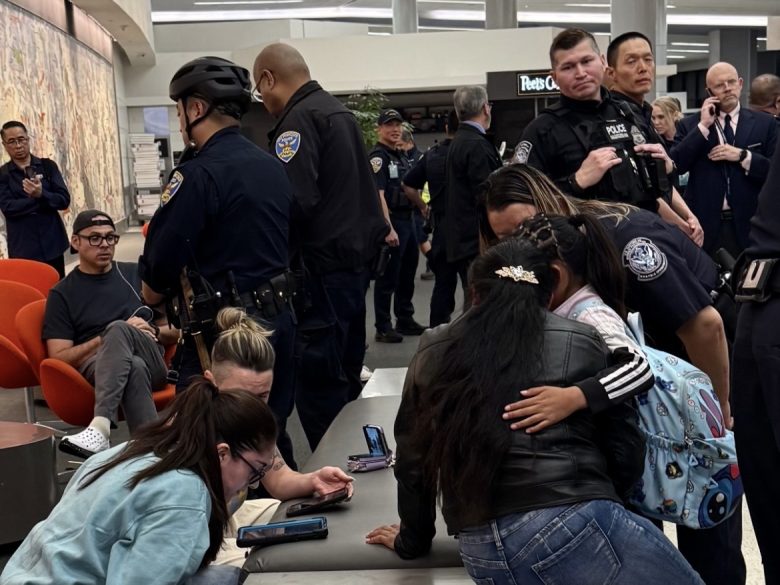
Immigration and Customs Enforcement detain a mother and daughter at San Francisco International Airport on the night of March 22. SFPD officers are on the scene. Photo courtesy of Andrey Ivanov.
Multiple videos posted on social media show two federal immigration officers not in uniform, forcibly handcuffing a woman at San Francisco International Airport Sunday night while her daughter, who appears to be around 10, stands by, crying.
An SFO airport official says they “understand federal officers were transporting two individuals on an outbound flight when this incident occurred.”
The video catches the voices of onlookers asking, “where is your badge?” and, “can I see your badge number sir, what is your name?” as well as the cries of the woman being detained. In the background, another bystander says “this is illegal,” and another person says, “don’t choke her.”
Want the latest on the Mission and San Francisco? Sign up for our free daily newsletter below.Sign up
About a dozen San Francisco Police Department officers are seen standing in a line to form a barrier as the federal immigration agents roll the woman away in an airport wheelchair. The video was posted online late Sunday night.
The video, shared to Instagram by Andrey Ivanov, captures the moment when the woman clings to an airport bench while two agents attempt to forcefully remove her. The first agent pries her fingers off the bench while a second agent helps to push the mother into a chair.
A woman can be heard yelling, “What are you doing? Leave her alone!”
In another video, posted to Reddit by the user Din Jarring, about a dozen SFPD officers form a defensive line around one of the presumed ICE agents as they wheel the woman out of the airport terminal.
Her child walks beside them, holding the hand of the other agent, who says in Spanish, “Vente,” meaning ‘come on.’
One onlooker yells, “This is the face of America, congratulations!”
Another man says, “Are you fucking serious?”
A spokesperson for the San Francisco International Airport confirmed the incident was indeed a federal immigration enforcement issue but that they were not able to verify “who they were, what they were doing or why.”
The spokesperson said SFPD was present, but did not assist nor prevent the enforcement. They also said they believe this was an isolated incident and they have no reason to suspect broader enforcement at SFO.
Officer Robert Rueca from the San Francisco Police Department said that officers responded to a 911 call at approximately 10 p.m. last night. Rueca wrote, “Officers were not involved in the incident, but remained at the scene to maintain public safety.”
Jason Sweeney, a public affairs official with Immigration and Customs Enforcement said by email that ICE will be releasing a statement on the video later in the day on Monday.
San Francisco mayor Daniel Lurie wrote on X that he “found the incident upsetting,” and says that officers “remained at the scene to maintain public safety and were not involved in the incident.”
But in the video, SFPD officers are clearly lined up to act as a barrier so that the unidentified federal immigration officers can conduct their enforcement operation.
Cleaner Streets, Stronger Community
After 5 years of working to fix SF’s litter problem, Clean Streets – a Mission-based, community-funded, litter pickup workforce has funded 1,236 hours of living-wage work and cleaned 617 miles of neighborhood streets. As little as $5 makes a difference. Click here to help us clean the Mission.
47
Meanwhile, Senator Scott Wiener said in a statement, “ICE’s tactics are violent and unacceptable, and they need to stay the hell away from San Francisco and SFO.”
Wiener will be addressing ICE’s conduct today at 11:45 a.m. outside of SFO’s International Terminal.
The state of California has sanctuary policies that preclude local law enforcement from assisting in detaining or arresting persons for immigration purposes.
Although there are certain exceptions to the law, Jordan Wells, a senior staff attorney at the Lawyers Committee For Civil Rights, said that this type of activity does not appear to be one of those exceptions. Some of these exceptions include sharing certain criminal record information, and state prison system cooperation.
The City of San Francisco also has its own sanctuary ordinance that prohibits all city employees, including police, from assisting ICE. The police department’s policies specifically prohibit officers supporting “routine ICE/CBP operations, investigations, or raids.”
Local law enforcement, per the state law, are not permitted to “[u]se agency or department moneys or personnel to investigate, interrogate, detain, detect or arrest persons for immigration enforcement purposes,” which would include aiding in another law enforcement agency taking one of those actions, said Wells.
Milli Atkinson, director of the Immigrant Legal Defense Program at the San Francisco Bar Association, said that the Rapid Response Hotline received multiple calls from people who said that they had witnessed ICE at SFO. Atkinson was unable to provide any further information.
A representative at United States Customs and Border Enforcement at SFO told Mission Local over the phone to contact SFPD, and that a commanding officer would call back to provide more comment. No call was ever received.
The incident at SFO on Sunday coincided with the deployment of ICE officers to airports across the country during the ongoing standoff over Department of Homeland Security funding.
This story is developing and will be updated.
Join the 3,300 readers who keep Mission Local free for all!
Because of you, Mission Local reached and surpassed our $300,000 year-end fundraising goal. All we can say is thank you.
Thank you for choosing to invest in a local newsroom rooted in San Francisco’s communities — one that listens first and reports deeply.
If you haven’t yet had a chance to give, it’s not too late to be part of this community. Your contribution today helps sustain the reporting our city relies on all year long.
We’re grateful you’re here — and we’d be honored to have you join our donors.
Clara-Sophia Daly is an award-winning journalist who covers immigration for Mission Local. Previously, she reported for the Miami Herald, where she covered education and worked on the investigative team. She graduated with honors from Skidmore College, where she studied International Affairs and Media/Film, and later earned a master’s degree from Columbia Journalism School.
Her reporting portfolio includes investigations into a gymnastics coach who abused his students for more than a decade — work that led to his arrest.
She also covered the privatization of Florida’s public education system, state-funded anti-abortion pregnancy centers, and the deputization of university police officers under federal immigration programs.
A Northern California native, she first joined Mission Local as an intern for a year during the pandemic — and is excited to be back writing stories about immigration.
I’m covering immigration for Mission Local and got my start in journalism with El Tecolote. Most recently, I completed a long-term investigation for El Centro de Periodismo Investigativo in San Juan, PR and I am excited to see where journalism takes me next. Off the clock, I can be found rollerblading through Golden Gate Park or reading under the trees with my cat, Mano.More by Sage Ríos Mace
Join us to demand IMPEACH. CONVICT. REMOVE THE REGIME! on No Kings 3 in WASHINGTON, DC & LOS ANGELES!
Regime change starts right here, right now. The illegal Trump administration is now waging a deadly and unconstitutional war on the Middle East as it continues its treasonous “war from within” on the streets of America. We don’t have a second to waste in demanding that Congress remove our regime.
March 28. 2026, dubbed “No Kings 3.0,” is expected to be the largest protest in American history. We can’t afford to squander this opportunity to deliver concrete demands that reverberate around the world and in the halls of Congress. We can’t afford to demand less than what Article II, Section 4 of the US Constitution entitles us to: the immediate impeachment, conviction and removal of Trump, Vance and every lawless member of this cabinet.
The Removal Coalition, in partnership with Citizens’ Impeachment, is calling on organizers around the country to adopt “Impeach. Convict. Remove the Regime” as their protest name and clarion call on March 28, and aim that peaceful yet uncompromising pressure directly on members of Congress who fail to impeach now.
Impeachment is how the Constitution says, “No Kings.” This time we must spell it out!
Does your organization want to give “teeth” to NK3 and host a protest that actually demands change? Join us!
Email (required)
Checkbox We want to join the Removal Coalition We want to name our NK3 Protest “Impeach. Convict. Remove the Regime”
We the People mean business. Our presence is our power, and we’re showing up with firm demands and intend to change history. Remove the Regime is the movement we’ve been waiting for.
On November 22, 2025, tens of thousands of Americans peacefully descended on Washington to demand that this lawless administration come to an END.
Remove the Regime delivered an unwavering mandate: We will no longer tolerate inaction or delay from elected officials as the lawless Trump administration dismantles American democracy. We are calling out their complicity in this demolition unless and until they honor their oath. We are demanding impeachment and removal, and we are demanding it NOW.
About the movement
Remove the Regime was launched by the Removal Coalition and its founder Jessica Denson, in partnership with comedian Cliff Cash and member organizations.
Our true grassroots coalition harnessed the power of top creators to summon the largest ever in-person lobby of Congress for impeachment at the first Remove the Regime on September 2, 2025.
The Removal Coalition sought to focus the energy of nationwide protests on the seat of power in Washington, D.C. with an explicit demand. On November 20-22, we made that vision a reality.
Americans came from all corners of the country to join national heroes, whistleblowers, veterans, pastors, musicians and more in delivering a singular and unmistakable demand to Congress: ”Impeach. Convict. Remove.”
At Remove the Regime, Congressman Al Green made a commitment to file and force a vote on his second articles of impeachment before Christmas. As a direct result of our movement, there was a whopping 77% surge in support for impeachment when Rep. Green followed through with that vote in mid-December.
On the one year anniversary of Trump’s illegal presidency, we took Remove the Regime nationwide, partnering with Free Speech for People, Women’s March, 50501 and Citizens’ Impeachment for a “Walkout” / “Walk-in” to local congressional offices in every state demanding impeachment and removal.
Our movement has been instrumental in mainstreaming the impeachment remedy, resulting in the Democratic Party’s now broad support of impeaching DHS Secretary Noem.
We can and must push harder. We are witnessing a wholesale and murderous dismantling of American democracy, and performative articles filed against cabinet members are not enough.
Call your representatives at the Congressional switchboard: (202) 224-3121. Join us in demanding that more lawmakers file and force votes on articles of impeachment against Donald J. Trump.
IMPEACHMENT LOBBYING GUIDE
Calling your member of Congress or visiting their office on a national impeachment lobby day? You can print out and use this guide for your visit:
Stephan: On January 21, 2010, the Supreme Court issued a ruling: Citizens United v. Federal Election Commission that in effect legalized the bribery of politicians. It was the second step the Republicans carried out to end American democracy. The first step was Republican President Reagan’s tax changes, primarily the Economic Recovery Tax Act of 1981 (ERTA) and the Tax Reform Act of 1986, ostensibly aimed to stimulate the economy by cutting taxes on corporations and high-income individuals but, in fact, its purpose was the creation of an oligarch ruling class. Taken together, these two steps have created the neo-medieval culture that is the United States today. And it couldn’t be more blantant as this report makes clear.
Sergey Brin in Davos, Switzerland, on 19 January 2017. Credit: Ruben Sprich / Reuters
A Google founder has more than doubled his financial contribution to the fight against a proposed wealth tax in California. New filings with the state show that former Alphabet president Sergey Brin donated $25m to a Super Pac dedicated to blocking the tax on top of $20m he had already given.
Brin is not alone among Google’s top brass in upping his financial stake in the campaign against the ballot proposal. The company’s former CEO Eric Schmidt donated $1.02m, adding to a previous $2m contribution.
he tech titans are battling the California Billionaire Tax act, often referred to simply as the billionaire tax. It’s a proposed ballot measure that would require any California resident worth more than $1bn to pay a one-off, 5% tax on their assets to help cover education, food assistance and healthcare pr ograms in the state. It’s sponsored by the Service Employees International Union-United Healthcare Workers West, and is still in the signature-gathering phase.
If the measure reaches the ballot and gains voters’ approval, […]
Seven Days in D.C. (June 28 – July 4) Seven Days in D.C. About Schedule Support Donate Volunteer Merch Auction Washington, D.C. June 28 – July 4, 2026 View the ScheduleTicketsDonateVolunteer A Week of Democracy in Action From June 28 through July 4, organizers from across the country will gather... Continue reading →
Big news: Our Pride Breakfast speaker lineup is coming together. We’re honored to welcome Xavier Becerra, former U.S. Secretary of Health and Human Services, former California Attorney General, and the Democratic nominee for Governor of California, as a keynote speaker at the 29th Annual Alice Pride Breakfast. Throughout his career,... Continue reading →
This Sunday’s Town Hall: Announcing This Week’s Progressive Town Hall: Every Sunday at 4pm ET/1pm PT RSVP HERE Join PDA activists online from across the country to discuss the importance of progressives reclaiming the American story from the MAGA right, an issue of heightened importance as we’re now within one... Continue reading →
Seven Days in D.C. (June 28 – July 4) Seven Days in D.C. About Schedule Support Donate Volunteer Merch Auction Washington, D.C. June 28 – July 4, 2026 View the ScheduleTicketsDonateVolunteer A Week of Democracy in Action From June 28 through July 4, organizers from across the country will gather... Continue reading →
We protest Heritage Foundation EVERY MONDAY (Join us!!!!) By admin | September 2, 2025 | Uncategorized Cliff Cash Comedy Premiered Jul 26, 2025 Every Monday at The Heritage Foundation 214 Massachusetts Ave. Washington D.C. 4pm protest 6pm pizza Every Friday at Fox News D.C. 400 N. Capitol St. Washington D.C. 4pm protest 6pm pizza We are... Continue reading →
Seven Days in D.C. (June 28 – July 4) Seven Days in D.C. About Schedule Support Donate Volunteer Merch Auction Washington, D.C. June 28 – July 4, 2026 View the ScheduleTicketsDonateVolunteer A Week of Democracy in Action From June 28 through July 4, organizers from across the country will gather... Continue reading →
Seven Days in D.C. (June 28 – July 4) Seven Days in D.C. About Schedule Support Donate Volunteer Merch Auction Washington, D.C. June 28 – July 4, 2026 View the ScheduleTicketsDonateVolunteer A Week of Democracy in Action From June 28 through July 4, organizers from across the country will gather... Continue reading →
One Million Rising: Strategic Non-Cooperation to Fight Authoritarianism Virtual Event · Hosted by No Kings Time Wednesdays 8 – 9:30pm EDT Location Virtual event Join from anywhere About this event Across the country, authoritarian forces are getting bolder and more dangerous. Trump and his allies are not hiding their agenda: mass deportations,... Continue reading →
Seven Days in D.C. (June 28 – July 4) Seven Days in D.C. About Schedule Support Donate Volunteer Merch Auction Washington, D.C. June 28 – July 4, 2026 View the ScheduleTicketsDonateVolunteer A Week of Democracy in Action From June 28 through July 4, organizers from across the country will gather... Continue reading →





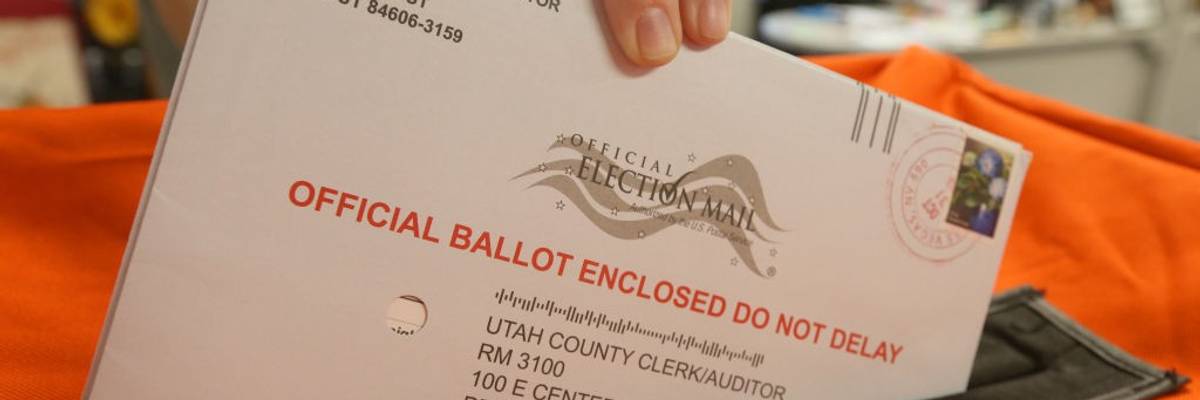
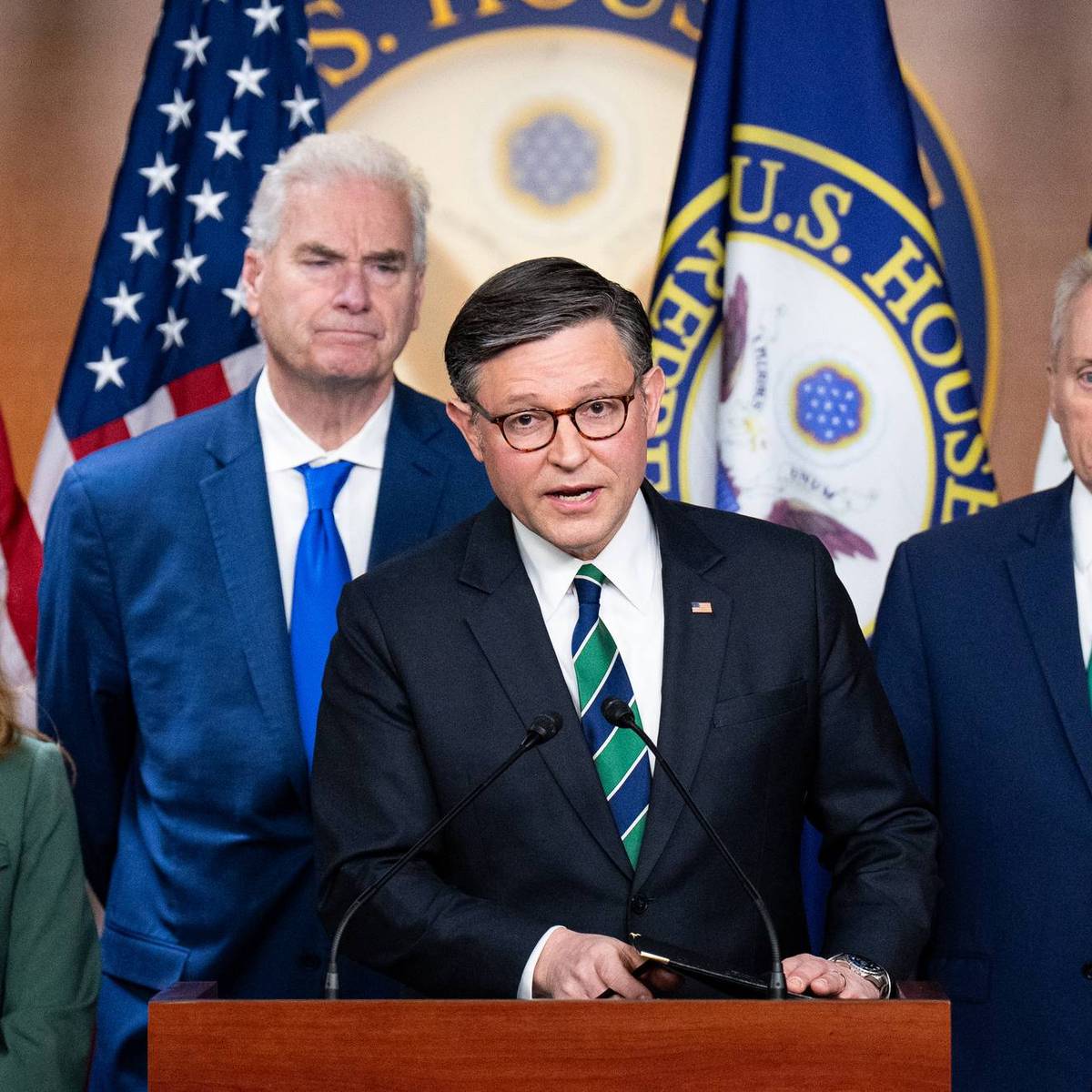


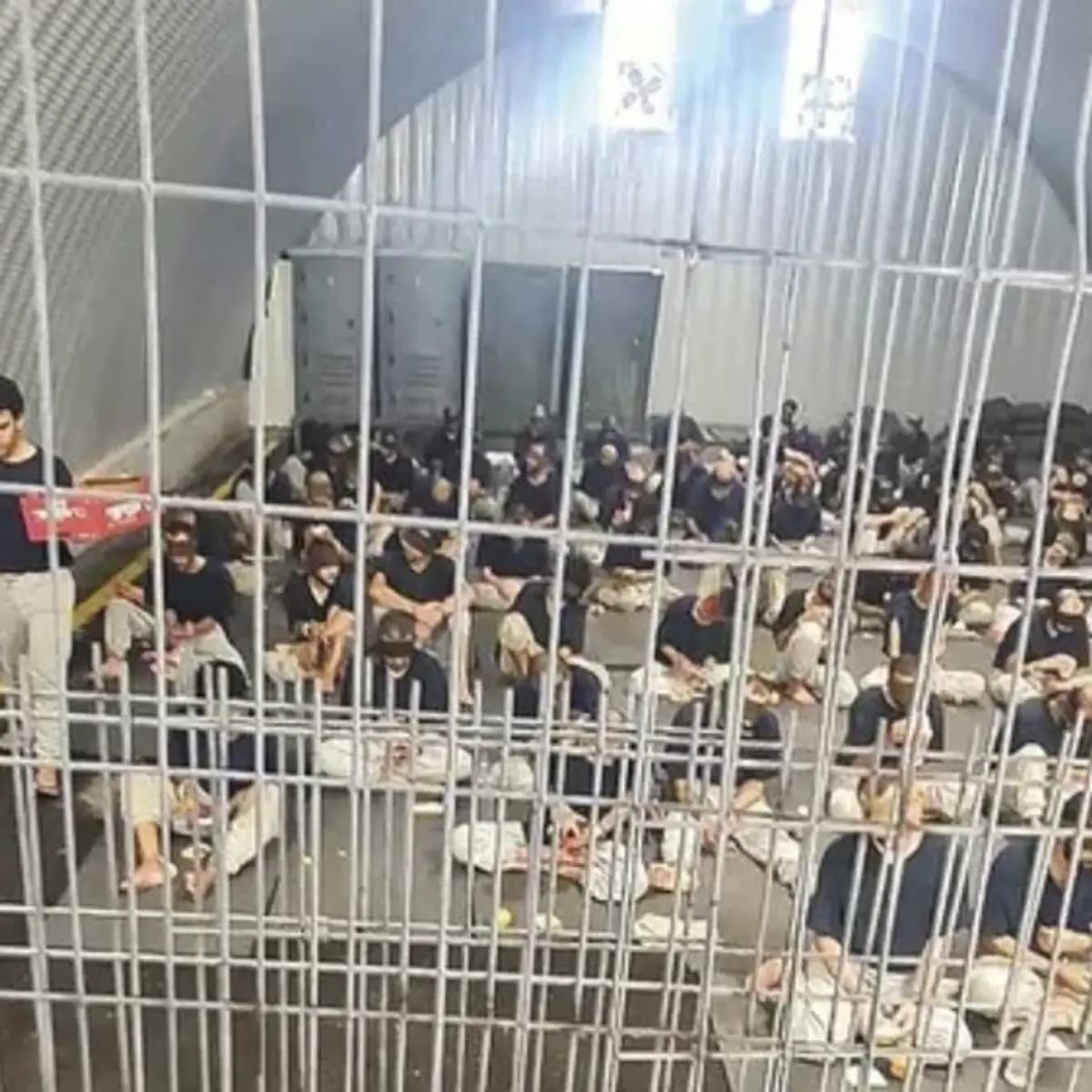

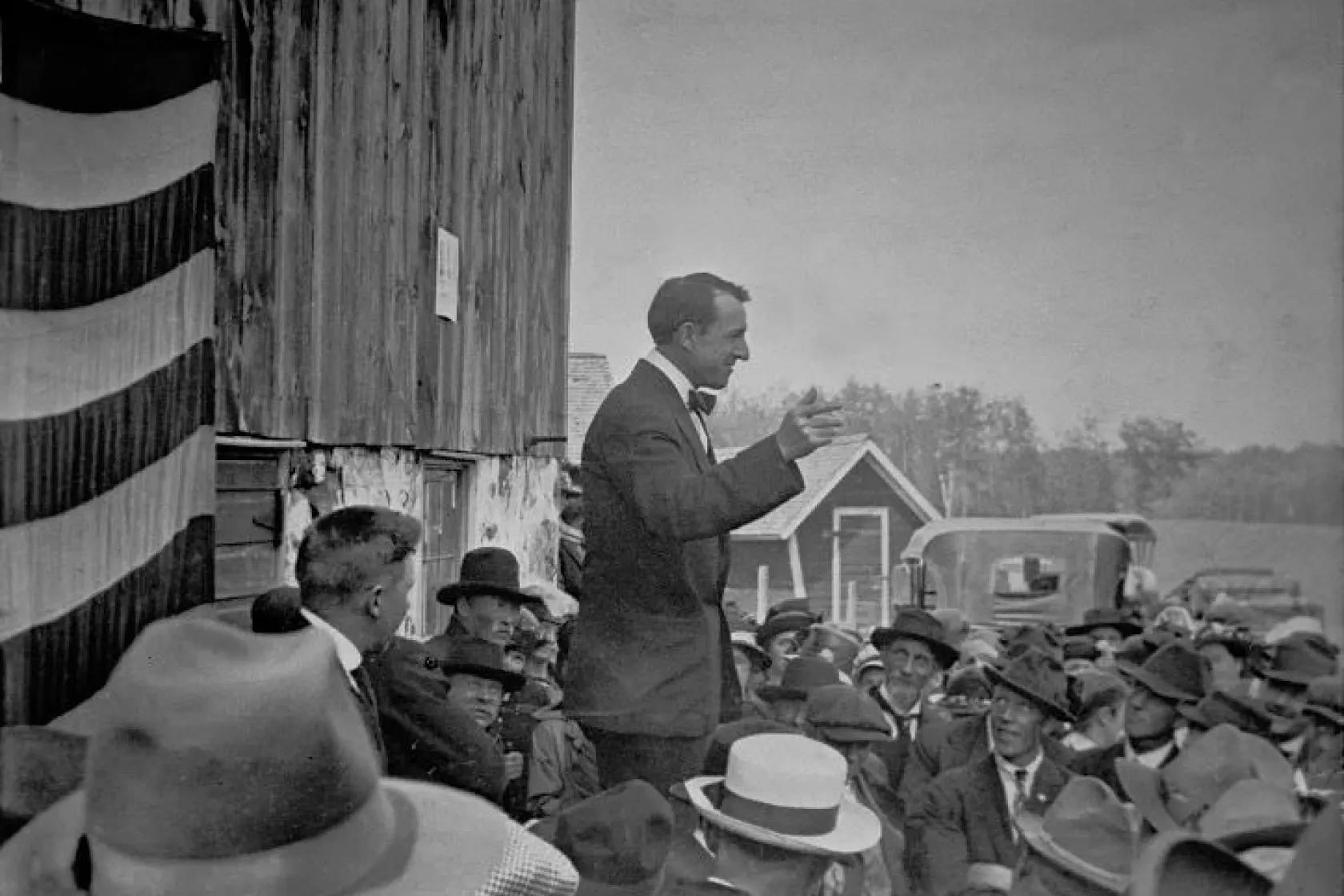
 by
by 

 by
by