

(whowhatwhy.org)


by Randy Shaw on April 13, 2026 (BeyondChron.org)

San Francisco will soon announce plans to “decommission” four city-funded permanent supportive housing sites. The city plans to reveal specifics by April 30 but it appears the Lurie Administration is more focused on scaling back permanent supportive housing than expanding it.
That’s a monumental shift in San Francisco’s homeless strategy.
Since the late 1980’s San Francisco has prioritized providing permanent housing for the unhoused. The Lurie Administration is quietly moving away from this, Its shift in city homeless strategy reflects both economic and ideological factors.
I’ve been involved in running housing programs for the unhoused since 1988. Here’s my thoughts on the city’s new direction.
People are “homeless” who lack permanent homes. That’s why those staying in shelters or moving from sofa to sofa every few days or weeks are “homeless” despite having a temporary roof over their head. Transitional housing only reduces homelessness if residents have the opportunity to transition to a permanent home.
When widespread visible homelessness began in 1982, San Francisco’s Mayor Feinstein saw it as temporary. She refused to invest in permanent affordable housing for the unhoused. The city instead spent hundreds of millions of dollars for the unhoused to stay one to three nights in SRO hotels. The mayor’s hotline hotel program was a disaster.
Feinstein also invested heavily in shelters. As many of us argued to her until she left office in 1988, shelters that fail to lead to permanent exits from homelessness are not reducing the crisis.
Mayor Art Agnos understood that reducing homelessness required providing affordable homes. Agnos backed the closing of the hotline. He shifted to a permanent housing Modified Payment Program (MPP) strategy conceived by the Tenderloin Housing Clinic, which I head. The MPP got permanent housing for the over 1000 people who previously only got short-term hotel stays via the hotline.
Agnos soon confronted a problem every big city mayor has since felt: the lack of federal money for affordable housing. Reagan’s 1981 HUD budget cuts devastated affordable housing funding. HUD has never served anywhere near the percentage of eligible families it helped prior to 1981. Yet the public expects big-city mayors to solve homelessness without the federal funds necessary to do so.
Mayors Brown, Newsom, Lee and Breed all expanded permanent supportive housing (hereafter PSH) through master leasing to nonprofits. Newsom’s voter-backed Care Not Cash brought in millions of dollars for PSH. I laid out the success of this strategy last November. See “Permanent Supportive Housing is a Rousing Success.”
The Lurie Administration does not dispute this success. But it believes it is not economically sustainable.
That’s a tough conclusion to accept. But it’s understandable in the short-term. San Francisco’s PSH strategy provides lifetime rent subsidies to thousands of indigent residents. Since the Board of Supervisors lowered all PSH rents to 30% of a tenant’s income, San Francisco is effectively using general fund money to run a local Section 8 program for thousands.
Lurie took office after Mayor Breed made some ill-advised multi-million-dollar SRO purchases via the state’s Project Homekey. The city patted itself on the back for taking advantage of the state picking up 50% of the cost. But the city vastly overpaid for some of these projects. This includes a former youth hostel at 685 Ellis and the Granada and Gotham Hotels. These huge purchases tied up Prop C money that could have housed hundreds and potentially thousands more through master leasing.
These purchases, combined with the city’s budget deficit and Trump’s attempts to further slash HUD, sharply reduced Lurie’s short-term options. Yet Lurie has kept using 685 Ellis as a shelter despite it being purchased for the express purpose of PSH.
The most economically viable strategy for expanding PSH is step-up housing. Step-up housing moves longterm SRO residents into higher quality SRO’s with less support services, significantly saving costs.
But Prop C funds cannot be used for the formerly homeless (only the currently unhoused). This led the Breed Administration to stop acquiring step-up housing. To revive this effective strategy Mayor Lurie should consider legislation expanding Prop C’s reach.
Lurie ran for mayor vowing to add 1500 shelter beds. I’m glad he abandoned that plan, which would represent a massive misuse of funds. But the mayor sees investing in treatment and shelters as a higher priority than expanding permanent supportive housing.
Treatment is the name of the game in Daniel Lurie’s San Francisco. Everyone supports the city helping addicts recover.
But treatment unconnected to permanent housing does not reduce homelessness. That’s a point often missed. Graduates of the Salvation Army hotel programs that have gotten virtually all of the new SRO money under Lurie are not assured of a permanent place to live when their program ends.
Some graduates of recovery programs find jobs and get housing on their own. But I doubt most can afford market rate housing in expensive San Francisco.
This means taxpayers are investing in treatment for those unlikely to remain in the city. In contrast, the beneficiaries of permanent supportive housing remain San Francisco residents. And they are no longer homeless.
I’ve suggested to the city that they open a permanent-drug free hotel where residents would be limited to two-year stays as at the Salvation Army but would be guaranteed PSH in another building after graduation. This interim housing model would ensure that those receiving funding for treatment get to stay in San Francisco if they choose.
Shelters were designed as short-term, transitional facilities. They are supposed to lead people to permanent housing. If the city is no longer providing shelter residents with exits to housing, the millions spent on navigation centers and shelters is not reducing homelessness.
As one of the earliest advocates for master leasing permanent supportive housing, I never imagined the city would stop expanding it. It’s far and away San Francisco’s best strategy for housing the unhoused.
But what if San Francisco cannot afford further expansion? And what if the public has gotten tired of providing longterm rent subsidies to the unhoused without seeing a meaningful decline in the overall homeless numbers?
I don’t hear the public blaming Mayor Lurie for not housing more unhoused. As the vast majority of sidewalk drug-users now refuse shelters or housing, people don’t blame the mayor for failing to expand housing options.
So what is San Francisco’s homeless strategy in 2026?
To quietly reduce its longtime commitment to expanding PSH while shifting money to treatment. Permanent supportive drug free housing remains on hold until city finances improve.
The Lurie Administration will make it appear that San Francisco is as committed as ever to housing the unhoused—all while stopping PSH’s expansion. And reducing opportunities for the unhoused to become longterm residents of San Francisco.
Randy Shaw is the Editor of Beyond Chron and the Director of San Francisco’s Tenderloin Housing Clinic, which publishes Beyond Chron. Shaw’s new book is the revised and updated, The Tenderloin: Sex, Crime and Resistance in the Heart of San Francisco. His prior books include Generation Priced Out: Who Gets to Live in the New Urban America. The Activist’s Handbook: Winning Social Change in the 21st Century, and Beyond the Fields: Cesar Chavez, the UFW and the Struggle for Justice in the 21st Century.
by Randy Shaw on April 13, 2026 (BeyondChron.org)

Op-ed said SF sidewalks were now clear
Visitor’s Misleading Account of SF
Last week the NY Times featured an op-ed titled, “San Francisco Sobers Up.” The piece credited Mayor Daniel Lurie with transforming the city’s culture. Former President Bill Clinton tweeted the op-ed, calling it “A great in-depth look at the real progress being made in the fight against overdoses and addiction in San Francisco.”
But was German Lopez’s op-ed really an “in-depth look?” Not by an historian or reporter’s standards. In fact, I would describe the op-ed as a powerful work of fiction. Or a highly-skilled example of gaslighting.
For example, the premise of the op-ed is that Lopez found San Francisco much improved from his prior visit. That visit was in 2023, when San Francisco had far more sidewalk drug activities and encampments than when Daniel Lurie took office.
“When I visited San Francisco in 2023, parts of the city looked like open-air drug dens. Users made homes in tents that lined block after block. They bought, sold and smoked fentanyl, crack and meth in public. They used drugs in front of a police station, visibly undeterred by the threat of the law. I once saw four people hunched over, in what’s called the fentanyl fold, along a sidewalk in sight of City Hall. It was a startling vision of what had gone wrong with West Coast progressivism.”
In contrast, during his recent visit Lopez “spotted public drug use much less frequently. Officials didn’t ignore the remaining addicts. Community ambassadors made sure that people didn’t treat sidewalks as campgrounds. I could move through the city without having to walk in the road—something most of American mercifully takes for granted.”
Lopez never identified what neighborhoods he recently visited. He clearly did not walk in the Tenderloin. The Tenderloin has multiple sidewalks where drug activities require people to walk in the street (see above photo from last week). And the city’s most drug-filled intersection is only a block from Tenderloin Police Station.
Lopez could easily have asked members of the Tenderloin Business Coalition whether they thought San Francisco has sobered up. He did not do so. In fact, his portrait of San Francisco ignores the Tenderloin entirely.
Lopez’s op-ed came out the same day as my story on the Lurie Administration’s backing nonprofits handing out drug paraphernalia in the Tenderloin. Does that sound to you like the city is “sobering up?”
Lopez could have argued that the city’s ongoing support for drug handouts to street addicts proves the city has not sobered up. But he ignored the city’s official legal position entirely.
Instead, Lopez claims that “San Francisco still has harm reduction services, such as needle exchanges, but they’re treated as a bridge to treatment, not the end game.”
How does handing out drug paraphernalia to street addicts become a “bridge to treatment”? Lopez neither acknowledges this contradiction nor provides evidence to support his claim. Facts can’t get in the way of his San Francisco is sobering up thesis.
Lopez’s op-ed came soon after Emily Hoeven of the SF Chronicle wrote about ongoing drug activities in SOMA. She offered a very different picture of San Francisco from the New Yorker who visited the city for a few days. Unlike Lopez, Hoeven talked to members of the SOMA West Neighborhood Association who have long complained about sidewalk behavior that contradicts Lopez’s thesis. SOMA West is backing a state complaint about conditions in the neighborhood. Its members do not see SOMA as “sobering up.”
Lopez also apparently ignored the videos of sidewalk drug activities in the Mission that JJ Smith regularly posts on social media. I don’t think those living or working around Mission and 16th would say the area has “sobered up.”
Lopez also ignored Beyond Chron’s ongoing coverage of drug activities on Van Ness near Cathedral Hill. As Sebastian Luke wrote in January 2026, “Many mentally ill and drug users still roam around the Van Ness corridor, leaving residents and businesses to deal with them alone.”
Given his before and after thesis, knowing precisely where the improvement he claims to have witnessed has taken place matters. Last week I sent multiple tweets to Lopez asking where he went in San Francisco. I got no response.
Lopez’s piece came only days after former FOX News host and serial sex harasser Bill O’Reilly did a scathing story on San Francisco. O’Reilly found a city overwhelmed by sidewalk drug activities, not one that sobered up.
I know what O’Reilly reported because people told me. I did not watch his episode because I don’t believe he has any credibility. He and Lopez parachuted into San Francisco and then felt confident promoting broader conclusions about what they saw.
Let’s stop claiming these op-ed and television claims have any substantive rigor. Those who live or work in San Francisco know the realities of city streets.
San Francisco Has Improved
Most agree that San Francisco has improved under Lurie. He’s made people feel better about the city’s direction. But Lurie has yet to meaningfully reduce drug activities in the neighborhoods most beset with these problems when he took office. Most neighborhoods that never suffered from open air drug markets prior to Covid are doing great. But they were also on the rise prior to Lurie taking office.
What Lopez should have reported is that affluent neighborhoods are thriving but that San Francisco still has the most visible open air drug activities of any other major city. The mayor’s commitment to treatment has not changed this.
Lopez states in his bio that “My goal with every story is to uncover the truth, which requires hearing from multiple sides of a major event or issue.” He failed to hear from multiple sides in this op-ed.
Randy Shaw is the Editor of Beyond Chron and the Director of San Francisco’s Tenderloin Housing Clinic, which publishes Beyond Chron. Shaw’s new book is the revised and updated, The Tenderloin: Sex, Crime and Resistance in the Heart of San Francisco. His prior books include Generation Priced Out: Who Gets to Live in the New Urban America. The Activist’s Handbook: Winning Social Change in the 21st Century, and Beyond the Fields: Cesar Chavez, the UFW and the Struggle for Justice in the 21st Century.

US Sen. Bernie Sanders (I-Vt) speaks at a town hall event on February 20, 2026 in Stanford, California.
(Photo by Benjamin Fanjoy/Getty Images)
Apr 13, 2026 (CommonDreams.org)
With members of Congress returning to Washington, DC, Sen. Bernie Sanders on Monday pledged that he will, yet again, force a vote aimed at cutting off the flow of US weapons to Israel over its genocide against Palestinians in the Gaza Strip.
“I will be forcing a vote on legislation to block the sale of nearly half a billion dollars worth of bombs and bulldozers to the Israeli military,” Sanders (I-Vt.) said on social media, taking aim at Israeli Prime Minister Benjamin Netanyahu, who is wanted by the International Criminal Court over the mass slaughter in Gaza.
RECOMMENDED…
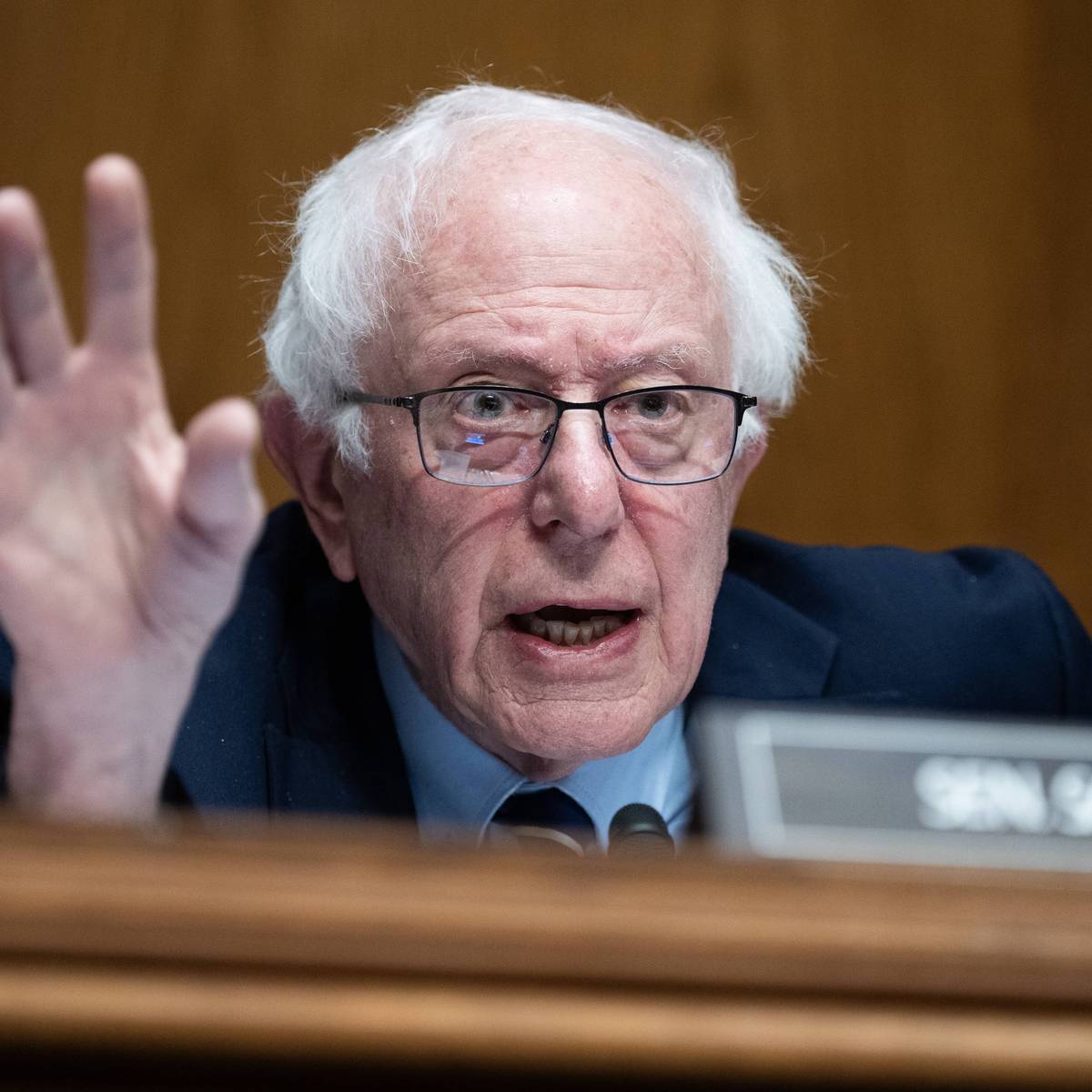

“The extremist Netanyahu government that has committed genocide in Gaza does not need more military support from American taxpayers,” declared Sanders, who has forced multiple votes on measures targeting US arms to Israel since it began bombarding Gaza in retaliation for the Hamas-led October 7, 2023 attack.
The next vote, which could come as soon as Wednesday, follows a similar effort last July, when a majority of the Senate Democratic Caucus backed his resolutions disapproving of the Trump administration’s sale of 1,000-pound bombs, Joint Direct Attack Munition guidance kits, and tens of thousands of assault rifles to the Israeli government. Previous votes had garnered less support.
“The American people do not want to spend billions to starve children in Gaza,” Sanders said last summer, after the resolutions failed. “The Democrats are moving forward on this issue, and I look forward to Republican support in the near future.”
Republicans currently have narrow majorities in both chambers of Congress, though Democrats aim to flip both in the November midterm elections.
According to a Pew Research poll released last week, 60% of US adults have an unfavorable view of Israel, up from 53% last year, and 59% have little or no confidence that Netanyahu will do the right thing regarding world affairs, up from 52% in 2025.
Although much of the world’s attention has been focused on Netanyahu and President Donald Trump’s war on Iran—and Israel’s related assault on Lebanon—in recent weeks, Israeli forces have also continued to kill Palestinians in Gaza, despite an October 2025 ceasefire agreement.
As of Monday, Gaza officials put the death toll at 72,333, with another 172,202 wounded, though global experts have warned the true figures could be far higher. Over 750 deaths and 2,100 injuries have been recorded since the ceasefire took effect, with another 760 bodies recovered during that time.
“At least two children a day have been killed or injured in the six months since the ceasefire for Gaza was agreed,” said Save the Children International CEO Inger Ashing last week, as her group and others released a report marking six months since the deal was reached. “This is not peace for children in Gaza. The ceasefire agreement has not translated into meaningful protection for children or created conditions for recovery.”
Among the children killed was Ritaj Rihan, a 9-year-old girl reportedly shot by Israeli forces in front of her third grade class at Abu Ubaida bin al-Jarrah School in Beit Lahiya last week. The Gaza Ministry of Health said that “it was not an isolated incident, but a direct extension of a systematic policy targeting the Palestinian people.”
Our work is licensed under Creative Commons (CC BY-NC-ND 3.0). Feel free to republish and share widely.
Jessica Corbett is a senior editor and staff writer for Common Dreams.

A person holds a sign reading “impeach, convict, remove” as they rally at Grant Park during the “No Kings” national day of protest in Chicago on March 28, 2026.
(Photo by Kamil Krzaczynski/AFP via Getty Images)
Apr 13, 2026 (CommonDreams.org)
US President Donald Trump’s flurry of increasingly deranged late-night social media posts over the weekend—combined with his continued violent belligerence overseas—prompted fresh calls on Monday for congressional Democrats to immediately force an impeachment vote.
Rep. John Larson (D-Conn.) introduced 13 articles of impeachment against Trump last week, accusing the president of usurping congressional war powers by waging unauthorized assaults on Iran and other nations, illegally deploying National Guard troops in US cities, unlawfully detaining and deporting citizens and immigrants on the basis of their political views, lawlessly dismantling worker- and consumer-protection agencies, and other offenses.
RECOMMENDED…
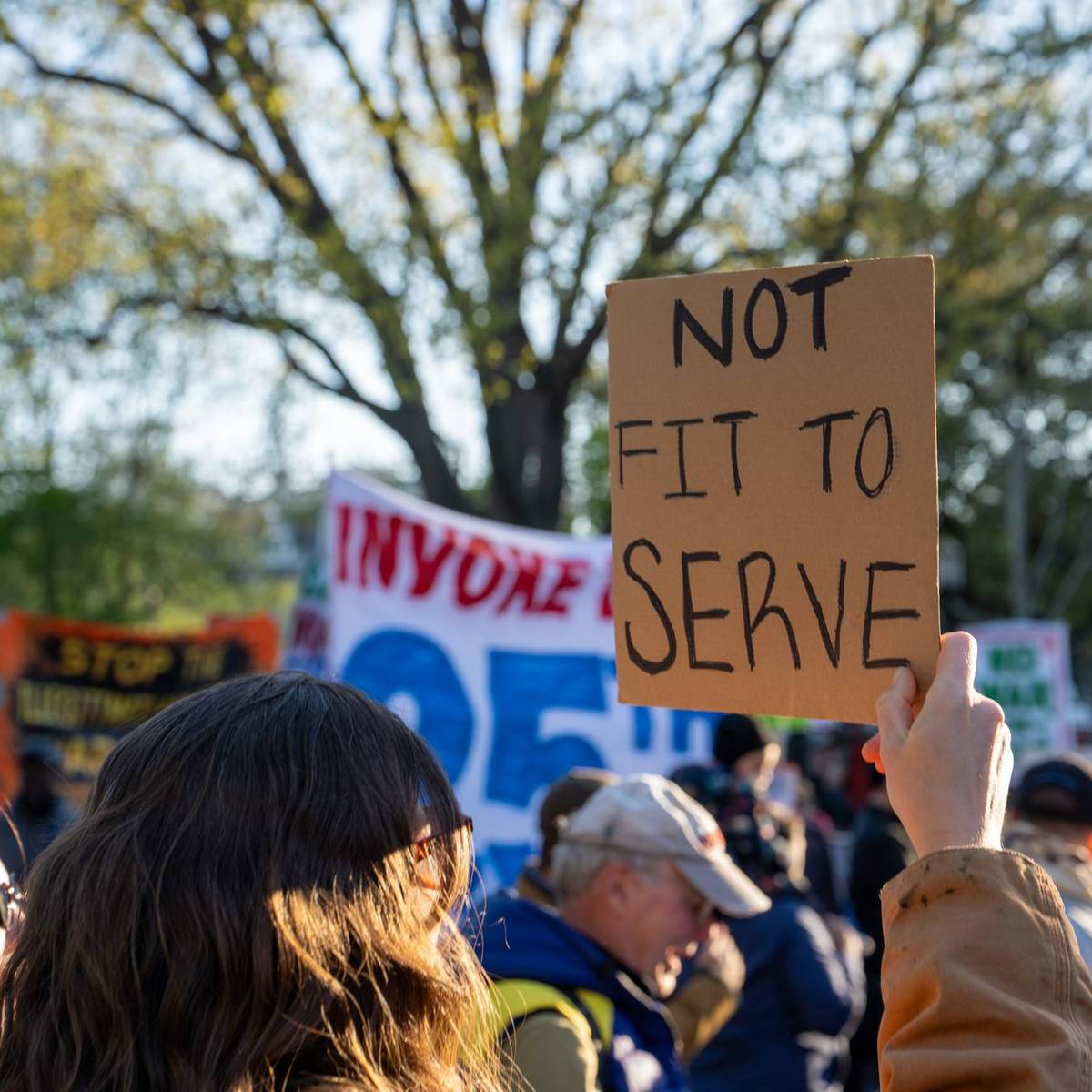
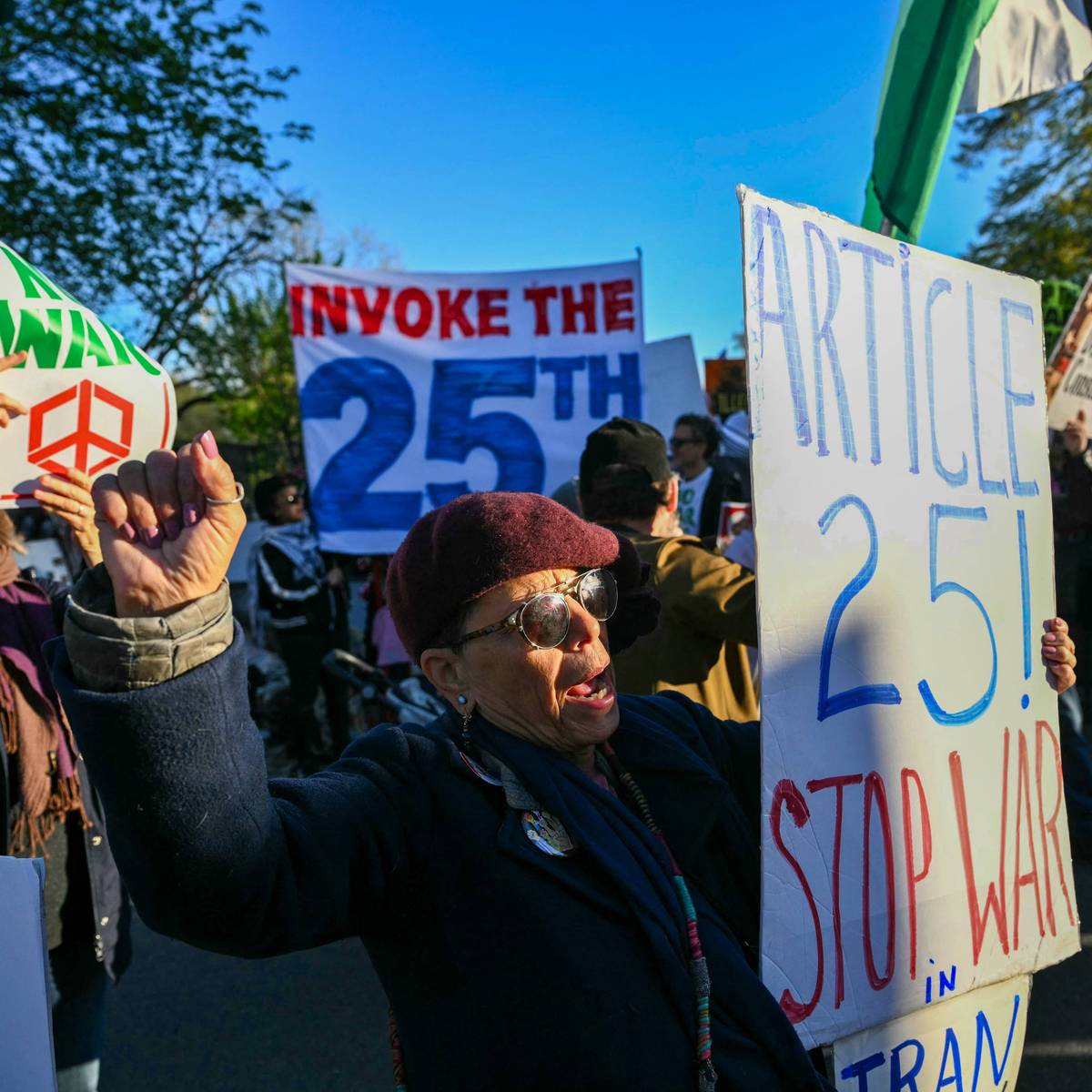
In a statement on Monday, constitutional attorney John Bonifaz applauded Larson for introducing the impeachment articles but said that “we need the congressman to now take the next step and force an immediate floor vote on these articles at this critical hour for our nation.”
“And, Democratic leaders in the Congress should stop standing in the way of such a vote,” said Bonifaz, co-founder and president of Free Speech for People (FSFP). The group’s petition urging the US House to impeach Trump a third time has received more than a million signatures, but the Democratic leadership has so far shown no willingness to push ahead with another impeachment process—which would require some Republican support to be successful.
“Momentum is on the side of action,” FSFP said Monday, warning that “further delay only emboldens the president.”
Bruce Fein, a constitutional scholar who served in the Reagan Justice Department, said Monday that the “impeachment of President Donald Trump is urgent.”
“How can any decent person indulge Mr. Trump’s Hitler-like declaration that ‘a whole civilization will die tonight’ with our tax dollars-paid weapons?” asked Fein, referring to the US president’s genocidal threat against Iran last week.
By one count, more than 85 Democrats in the Republican-controlled US House have called for Trump’s removal via the impeachment process or the 25th Amendment in recent days. Last week, Rep. Jamie Raskin (D-Md.) said he would introduce legislation to establish a commission tasked with removing the president if he is deemed unfit to serve.
“This is plainly out of the realm of normal politics,” said Raskin, the top Democrat on the House Judiciary Committee, urging the White House physician to immediately evaluate Trump’s cognitive fitness. “When the president of the United States threatens to extinguish a civilization on social media, rants about combat missions with children at the Easter Egg Roll, and drops profane tirades on Easter morning, we have indisputably entered the realm of profound medical difficulty and concern.”
Growing calls for Trump’s impeachment and removal came after the president launched into an unhinged social media tirade late Sunday, hours after high-level talks with Iran ended without an agreement to halt the war that the US president and his Israeli counterpart started in late February.
Trump said Sunday that he would impose a naval blockade on the Strait of Hormuz—an illegal act of war—and is reportedly considering a resumption of aerial strikes on Iran.
After the talks concluded, Trump posted a lengthy attack on Pope Leo XIV, a vocal critic of the war on Iran. The president then posted an artificial intelligence-generated image depicting himself as a Jesus-like figure.
“Beyond mentally unstable,” Rep. Yassamin Ansar (D-Ariz.) wrote in response to Trump’s post.
Robert Reich, the former US labor secretary, wrote in a blog post on Monday that “the president of the United States is stark-raving mad.”
“He’s a clear and present danger to America and the world. The American public is beginning to see it,” Reich continued. “We’ve got to do whatever we legally can to remove him from office. The 25th Amendment would be useful if Trump’s Cabinet and key advisers had any integrity, but they don’t. They’re ambitious, unprincipled traitors. Which leaves impeachment.”
Our work is licensed under Creative Commons (CC BY-NC-ND 3.0). Feel free to republish and share widely.
Jake Johnson is a senior editor and staff writer for Common Dreams.

English-only poll puts Scott Wiener, Saikat Chakrabarti far ahead of Connie Chan
 by Yujie Zhou April 13, 2026 (MissionLocal.org)
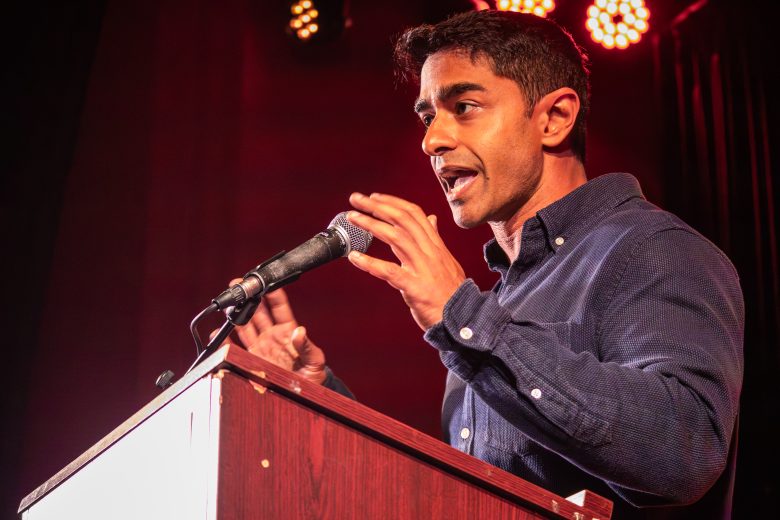
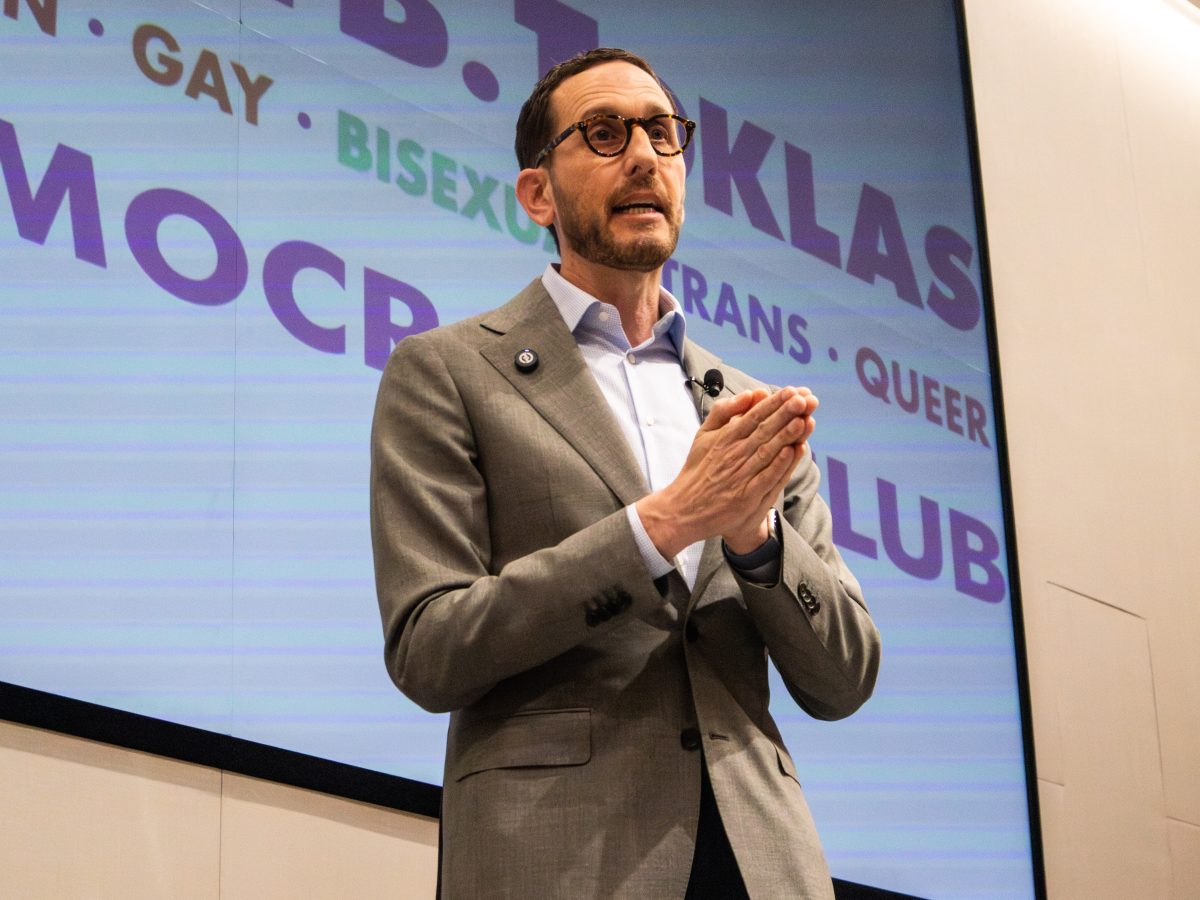
Saikat Chakrabarti is just five percentage points behind frontrunner Sen. Scott Wiener, according to a new poll commissioned and shared by Chakrabarti’s campaign and conducted by Data For Progress.
The poll, which surveyed 537 likely primary voters in California 11th congressional district in English only, found Wiener leading Chakrabarti 33-to-28 heading into June’s primary. The margin of error is four percent. Connie Chan, the District 1 supervisor, polled at 13 percent.
San Francisco political observers have long expected that Wiener will win the June primary election, where only two top candidates can advance to the November general election, regardless of party affiliation. That would leave Chan and Chakrabarti to battle for second place.
Chakrabarti, a former tech engineer and centimillionaire, joined the race to succeed Speaker Emerita Nancy Pelosi with little to no name recognition in San Francisco, compared to the other two leading candidates, Wiener and Chan, both longtime politicians in the city.
But he has quickly spent hundreds of thousands of dollars and is self-funding his campaign to the tune of $1.5 million, seeking to buy that visibility.https://datawrapper.dwcdn.net/cFj9y/1/
The poll, if accurate, shows that strategy is working. Still, there are limitations for Chakrabarti: Wiener holds a commanding lead among Democratic voters — 47 percent of those respondents chose him during a hypothetical primary vs. 26 percent for Chakrabarti. About 63.4 percent of voters in this race are registered as Democrats.

The polling was conducted from April 3 to April 8, 2026 by Data for Progress, a progressive pollster often used by left-of-center campaigns. Nate Silver, the statistician and founder of FiveThirtyEight, gave the pollster a C+ and ranked it as having a slight Democratic bias.
The pollster asked 537 likely voters (who were almost entirely Democrats and Independents) for their views on the congressional race. It surveyed them using online forms and text messaging.
Non-English-speaking voters were excluded from the poll. Those include at least 4.5 percent of the district’s voters who request ballots in Chinese. Monolingual Chinese voters are likely to be part of Chan’s base, though Chakrabarti is spending big to make inroads into that population.
The poll also asked about favorability, and found Chakrabarti had the highest net ratings.
Among the 537 likely voters, 52 percent said they had a favorable opinion of Wiener and 46 percent unfavorable, a difference of six percent. Some 48 percent have favorable opinions of Chakrabarti and 34 percent unfavorable, a 14 percent difference. A full 97 percent of respondents have already heard of Wiener, however, while 18 percent said they “haven’t heard enough to say” about Chakrabarti.
For Chan, 36 percent had a favorable view and 37 percent unfavorable, a negative 1 percent rating, though 27 percent said they hadn’t heard enough to say.
Chakrabarti is an Indian American who made a fortune as an early employee of the payments platform Stripe. He joined Bernie Sanders’ 2016 presidential campaign before launching Justice Democrats to recruit new leaders to run for Congress.
Justice Democrats’ greatest success was helping then-unknown Alexandria Ocasio-Cortez overtake longtime congressman Joe Crowley in the Democratic primary for New York’s 14th Congressional District in 2018. Chakrabarti joined her on Capitol Hill as her chief of staff, but left a few months later, after being criticized on the Hill for publicly disparaging more moderate Democratic lawmakers online.
Chakrabarti’s resignation occurred shortly after a private meeting between Ocasio-Cortez and Pelosi, and was widely perceived at the time as a peace offering between the two lawmakers.
A decade later, Chakrabarti is running to succeed Pelosi.

His campaign has raised $1.77 million as of Dec. 31, 2025, with $1.47 million of that coming from his personal fortune. The next campaign finance filing deadline is April 15.
So far, Chakrabarti’s campaign is running one of the largest paid canvasser operations in San Francisco’s history — well over 250 people — and spending tens of thousands of dollars on ads alone every week.

There are no paywalls at Mission Local. We believe San Francisco deserves critical, high-impact reporting that belongs to all its residents, not just those who can afford it.
But free to read doesn’t mean free to produce. We’re a small, independent newsroom rooted in San Francisco’s communities that only exists because people like you invest in the reporting that our city relies on all year round.
Keep Mission Local free for all by becoming a donor today.

Yujie is a staff reporter covering city hall with a focus on the Asian community. She came on as an intern after graduating from Columbia University’s Graduate School of Journalism and became a full-time staff reporter as a Report for America corps member and has stayed on. Before falling in love with San Francisco, Yujie covered New York City, studied politics through the “street clashes” in Hong Kong, and earned a wine-tasting certificate in two days. She’s proud to be a bilingual journalist. Find her on Signal @Yujie_ZZ.01More by Yujie Zhou
By Anabel Sosa, Senior California politics reporter April 13, 2026 (SFGate.com)
Rep. Eric Swalwell, a Bay Area congressman, is officially resigning from Congress amid allegations of sexual misconduct and assault.
The news broke Friday afternoon that Swalwell, a Democrat who was also a leading candidate for governor of California, had allegedly sexually assaulted one of his former congressional staffers. Three other women also spoke out with their own accounts of Swalwell’s alleged sexual misconduct. Gubernatorial candidates immediately called on Swalwell to drop out of the already crowded race, and members of Congress called on him to resign.
Swalwell immediately responded to those allegations, denying all of them. His lawyer, Elias Dabaie, also sent cease-and-desist letters to some of the women for “false statements accusing Mr. Swalwell of sexual assault and nonconsensual sexual encounters,” as shared on X by Gen-Z for Change Executive Director Cheyenne Hunt, a lawyer and former congressional candidate.
On Sunday, Swalwell dropped out of the governor’s race, and on Monday, after calls for his resignation from Democrats and Republicans, Swalwell decided to step down.
“I am deeply sorry to my family, staff, and constituents for mistakes in judgment I’ve made in my past. I will fight the serious, false allegation made against me. However, I must take responsibility and ownership for the mistakes I did make,” he wrote Monday afternoon on X.
In his short, three-paragraph resignation statement, Swalwell also said that he was aware of the effort to “bring an immediate expulsion vote” against him. He said he believes that expelling anyone from Congress without due process “within days of an allegation being made is wrong” but he also said it was unfair to his constituents for him to be so distracted.
He said he will work with his staff in the coming days to ensure the needs of the constituents of the 14th Congressional District in the East Bay, which includes Dublin, Fremont and Pleasanton, are met.
It’s unclear whether a special election will be called to replace Swalwell. The governor’s office has not responded to requests for comment.
More Politics
— Newsom is touring Southern states. It’s exposing some hurdles in his path to 2028.
— Latest Calif. governor’s poll brings unexpected Democrat to top
— Leading SF tech lab in standoff with Pete Hegseth
— The biggest problem for California Democrats just revealed itself in San Francisco
April 13, 2026
Senior California politics reporter
Anabel Sosa is the senior California politics reporter at SFGATE. She previously covered the statehouse and elections for the Los Angeles Times. She has a masters degree in investigative journalism from UC Berkeley. You can reach her at anabel.sosa@sfgate.com.

(Original Caption) 3/04/1968-Des Moines, Iowa: Mary Beth Tinker and her brother, John, display two black armbands, the objects of the US Supreme Court’s agreement March 4th to hear arguments on how far public schools may go in limiting the wearing of political symbols.
(Photy by Getty Images)
Apr 12, 2026 Common Dreams
Major unions like the National Education Association and American Federation of Teachers, and citizen groups like Indivisible and Public Citizen, are calling for a national May Day strike. It’s a powerful idea, building off of a Minnesota day this past January where people didn’t go to work or school, didn’t shop, and didn’t otherwise participate in ordinary activities. The Minnesota day was spearheaded by major unions, 700 local businesses closed in solidarity, and 75,000-100,000 people marched in the streets.
For the national day, I’d suggest adding one more element: incorporating armbands, like black armbands, so people who are participating can make clear their sympathies. And those who can’t take off from work or school, or who are retired, so have no jobs to leave, can show support as well.
RECOMMENDED…


The armband idea comes from the October 15, 1969 Vietnam Moratorium. They didn’t call it a strike, but it was a similar day of marches, walkouts, teach-ins, and other activities that gave as many ways as possible to participate. Two million participated in the day’s marches, but far more in other activities. New York City’s Council endorsed it. Milwaukee held a funeral procession. Small towns rang church bells to commemorate the dead. The Moratorium took place while President Richard Nixon was threatening North Vietnam with nuclear weapons, and although Nixon said at the time the protests made no difference to him, he later revealed that the breadth of support led him to back off from the threat.
I was in high school in Los Angeles. I wore my black armband to school and my after-school job at a drugstore. My manager told me to take it off. I resisted as politely as I could. As I recall, he finally backed down. Another friend wore his armband at his high school in a mill town north of Seattle. In both cases, the armbands got people talking and thinking. They gave an additional way to participate for those who couldn’t join the walkouts. They reinforced anti-war solidarity. US soldiers in Vietnam even wore armbands as a way of joining the protests, following a full-page New York Times ad signed by 1,366 active service members.
So why not include a call for armbands as part of the May Day strike? It’s true that some people might use them as a substitute for visibly leaving jobs or schools. But if the goal of the movement is to engage people as broadly as possible, as well as to demonstrate power, then the armbands can offer additional options and bring the day of protests into more places. They’re an alternative for retired people who don’t have jobs to walk out of. They’re one more antidote to powerlessness, allowing people to participate step by step. It seems important to add them as part of the day’s organizing.
Our work is licensed under Creative Commons (CC BY-NC-ND 3.0). Feel free to republish and share widely.
Paul Rogat Loeb is the author of “Soul of a Citizen: Living with Conviction in Challenging Times” (2010) and “The Impossible Will Take a Little While: A Citizen’s Guide to Hope in a Time of Fear”, named the #3 political book of 2004 by the History Channel and the American Book Association. See www.paulloeb.org

The daily news can’t adequately convey the administration’s sabotaging of our government, economy, alliances and environment

Work continues on the construction of the ballroom at the White House on 9 December in Washington DC, where the East Wing once stood. Photograph: Pablo Martínez Monsiváis/AP
Sun 12 Apr 2026 (TheGuardian.com)
The United States is being murdered, and it’s an inside job. Every department, every branch, every bureau and function of the federal government is being fatally corrupted or altogether dismantled or disabled. All this is common knowledge, but because it dribbles out in news stories about this specific incident or department, the reports never adequately describe an administration sabotaging the functioning of the federal government and also trashing the global economy, international alliances and relationships, and the national and global environment in ways that will have downstream consequences for decades and perhaps, especially when it comes to climate, centuries.
Across the branches of government, the services that are supposed to protect us – nuclear stockpile monitoring, cybersecurity, counter-terrorism – are being undermined, understaffed or trashed. A different kind of protection that consists of public health, vaccination programs, food safety, clean air and water, social services, civil rights and the rule of law is also under attack. The federal government that serves us is being starved while the federal government that serves the Trump agenda and the oligarchy is glutting itself on taxpayer money, including the grotesque sums dumped on the Department of Homeland Security and the US military now being warped into Pete Hegseth’s twisted vision of a ruthless mercenary force. Hegseth has reportedly stood in the way of promotions for more than a dozen Black and female officers.
It is striking that the Trump team’s constant refrain is that we cannot afford to protect the vulnerable or provide for the people, which is why the richest person in the world, Elon Musk, atop Doge, destroyed USAID last year, which has already resulted in tens of thousands of deaths from starvation and preventable disease. The Iran war is creating a fertilizer crisis in Europe, Africa and Asia that may also result in widespread famine. Meanwhile, the former head of homeland security Kristi Noem spent more than $200m on an ad campaign starring herself before she was fired.
Although there are far worse things about the utterly gratuitous and literally unjustified war on Iran, the fact that it burns through billions a day is striking, given that huge cuts are being made to environmental protection and national parks, and the forest service is being effectively sabotaged, while public lands are being offered up to fossil fuel companies and mining interests. The forest service headquarters are being moved across the country, which will probably cause many resignations, like the similar move of the Bureau of Land Management in Trump’s first term. More than 50 forest service research stations are being cut, meaning more loss of irreplaceable ongoing research, data, facilities and staff.
Trump said in his droning dullard speech last week: “We can’t take care of daycare. We’re a big country … We’re fighting wars … It’s not possible for us to take care of daycare, Medicaid, Medicare, all these individual things.” Your money, our money, our public lands, our kids. Trump even bribed the builders of offshore windfarms almost a billion dollars to stop, just because he has a personal vendetta against the clean energy systems. The US used to lead the world in scientific research, including medical research, which had led to important breakthroughs in disease treatment and health, but all that has been slashed to the bone and beyond. This is murder.
The old aphorism about how long it takes an aircraft carrier to turn around might be why the nation seems relatively stable, and why reactions have been inadequate; the full impact is yet to come. At some point if the ship doesn’t turn around, maybe it will start taking on water or listing badly or hit an iceberg, or perhaps the iceberg has been there all along and is named Donald Trump. He has started a war for no particular reason – the word fun was deployed – that is further undermining the global economy he already badly damaged with his ever-fluctuating tariffs. Enterprises need to be able to plan, and tariffs that triple and melt away and pop up again like his moods undermine the ability to do so. In much the same way, threats that aren’t carried out, talks that never took place, administration actions that the courts reverse become forms of political whiplash, jerking everyone and everything around, a show of force that is also a show of incoherence and inconsistency.
We need to talk about the reconstruction a ravaged and corrupted country has to go through to return to functionality
But the offensiveness may be a distraction from the destructiveness. A whole sector of mainstream media now functions as spirit mediums attempting to interpret Trump’s actions to try to fit them into the context of competent leadership and coherent and consistent agendas. If there was a coherent agenda, it would be a destructive one, a malevolent one. The newly popular slogan “the purpose of a system is what it does” is useful here, because what this system does is weaken, damage, corrupt and harm. The idea that there’s a coherent agenda driven by Vladimir Putin works in the sense that most of what Trump has done is good for the ageing Russian dictator while also bad for the US.
It’s also evident that Trump wanted to come back into office in part to revenge himself on a country that in 2020 had rejected him, the way an ex-partner sometimes becomes a murderous stalker of the woman who dared to escape him, and specifically revenge himself on the individuals and institutions that had prosecuted him for crimes or otherwise thwarted him. Trump at some level knows he’s failing politically, cognitively and physically and wants to take it all down with him, the way that ancient rulers were buried with their slaughtered horses and servants. He’s also, as mortality breathes down his neck, trying to grab some immortality by sticking his name on buildings and park passes and currency.
But trying to understand motives is something of a hobby when the focus needs to be on consequences. We do not need to understand these criminals in order to try to contain and ultimately remove them. They will not last for ever, and we need to think about what happens when they’re gone – to talk about the kind of reconstruction the US will face for the first time since the civil war, the reconstruction a ravaged and corrupted country has to go through to return to functionality. But not to return to the way things were.
It’s the antidemocratic weaknesses in our system that created the vulnerabilities that let this happen – the electoral college and voter suppression that gave Trump a minority victory in 2016, the gerrymandering that has given a minority party majority power in Congress and statehouses, a grotesquely corrupted and unaccountable supreme court and the corrosive influence of the ultra-wealthy in a system that gives them power on a scale that is a direct assault on democracy. We need to imagine a more democratic, more egalitarian, more generous country, one that operates in recognition of an abundance of wealth that should serve all of us – and nature and future generations too – rather than is driven by the moral poverty of billionaires.


