Demonstrators protest outside the White House in Washington, January 8, 2026, against the Immigration and Customs Enforcement agent who fatally shot Renee Nicole Good in Minneapolis. Credit: Jose Luis Magana/AP Photo
By now, most readers have probably seen the horrifying video of ICE agent Jonathan Ross shooting Renee Good, a 37-year-old mother of three, to death. Of all the forensic analyses published, the best one I’ve seen thus far is this one from The New York Times. To my mind, it shows quite clearly that Good was attempting to drive away from the officers, and Ross shooting two out of three shots from a perpendicular position—totally outside of the car’s line of travel—into the driver’s-side window at point-blank range. He never even bothered to put away his cellphone, which was recording the whole time. That cellphone footage was apparently published on Friday, in which Good is seen saying “I’m not mad at you” to Ross just seconds before the shooting, and he calls her a “fucking bitch” after blowing her brains out.
It should be assumed that a cover-up conspiracy is in the works at the highest level. Just listen to DHS Secretary Kristi Noem spew some of the most heinous lies in the history of this administration—and that is saying something—calling a young mother with a glove box full of blood-splattered stuffed animals a “trained” “domestic terrorist” who maliciously attempted to run over ICE agents whose car had gotten stuck in the snow. Vice President Vance claimed, falsely, that all federal law enforcement officers have “absolute immunity” (just like in a police state). The FBI has already stepped in to take control of the investigation—refusing to cooperate with the Minnesota Bureau of Criminal Apprehension, and seizing Good’s car, the shell casings, and other critical evidence.
But that shouldn’t be the end of the story. It is critically important that state and local authorities do all in their power to conduct their own investigation, and bring Ross to trial.
If the above video analysis is correct, law and legal precedent seem to be quite clear. Law enforcement officers are not allowed to kill ordinary civilians to stop them from fleeing. According to the Supreme Court case Tennessee v. Garner, officers cannot use deadly force “unless it is necessary to prevent the escape and the officer has probable cause to believe that the suspect poses a significant threat of death or serious physical injury to the officer or others.”
In particular, as a DHS official told NBC News, ICE officers are trained never to approach a car from the front, as Ross did, and not to shoot at a moving vehicle. This is standard practice for all police departments these days, for obvious reasons. Killing a driver is a not a reliable way to stop a vehicle, and in fact might make it more dangerous—which is exactly what happened in this case. After Ross shot Good, she slumped onto the accelerator pedal, and the car careened down the street and crashed into another car and a utility pole. There were bystanders all over both sides of the road; it’s a miracle nobody was run over or hit by a stray bullet as Ross blasted away with no evident regard for the people directly in his line of fire on the other side of the street.
As my colleague David Dayen wrote last week, despite the “qualified immunity” doctrine that was made up out of whole cloth by the Supreme Court, federal law enforcement officers are not immune from prosecution by state and local authorities, and there have been many cases of that happening. (Two House Democrats have filed legislation to strip qualified immunity from ICE agents, but even they acknowledge that states can criminally prosecute federal officers regardless.)
There is also more than enough evidence to bring Ross in. Indeed, this homicide is probably in the top 0.1 percent of most-documented alleged crimes just in terms of publicly available evidence. There are at least four different video recordings of the incident already published, with a clear view of the critical moment in which Ross fired into the vehicle as it passed by him, and numerous eyewitnesses who could be interviewed. That’s more than enough to clear any bar of reasonable doubt. With some subpoenas, a great deal more could likely be obtained.
It would no doubt be quite difficult to carry out such an investigation with an actively hostile FBI and a U.S. attorney who has apparently barred cooperation with state and local law enforcement. Without the car, gun, and shell casings in particular, it may be difficult to go through the usual court procedures to establish a baseline of what happened. But every attempt still must be made.
To their credit, it does seem like some of the relevant authorities are on the right track. Hennepin County Attorney Mary Moriarty and Minnesota Attorney General Keith Ellison have announced a joint effort to collect and preserve evidence of what happened, clearly with an eye to doing their own investigation.
Elsewhere, David Seligman, who is running for attorney general in Colorado, has promised to put together an ICE Accountability Unit that would prosecute agents who violate the law. The need for accountability is becoming a campaign issue.
Just prior to the writing of this article, more immigration enforcement officers—this time from Customs and Border Protection—shot two more people in Portland, Oregon, luckily not fatally this time. If the first year of Trump’s second term has proved anything, it is that America’s system of immigration enforcement is utterly beyond saving, with a deeply entrenched culture of lawless brutality. ICE and CBP should be scrapped, and the whole immigration system rebuilt from the ground up. Those demands are only going to grow in the wake of incidents like this carried out by a lawless paramilitary force.
You’ve just read one of the stories we published this week because readers like you made it possible.
The Prospect doesn’t answer to advertisers or billionaire owners. We answer to you. That’s not a slogan—it’s how we’re funded, and it’s why we can report without fear or favor.
Independent, reader-supported journalism is rare. We’d like to keep it going. If you believe this kind of reporting should exist and remain free to read we hope you’ll consider chipping in. Every contribution, however modest, makes a real difference.
Ryan Cooper is a senior editor at The American Prospect, and author of How Are You Going to Pay for That?: Smart Answers to the Dumbest Question in Politics. He was previously a national correspondent for The Week. His work has also appeared in The Nation, The New Republic, and Current Affairs. More by Ryan Cooper
Tell your Senators: Rein in ICE NOW. The coalition behind ICE Out For Good is following our historic weekend of action by flooding Congress with calls demanding that they use the upcoming Homeland Security funding bill to rein in ICE. After calling your senators, use this link to call your representative.
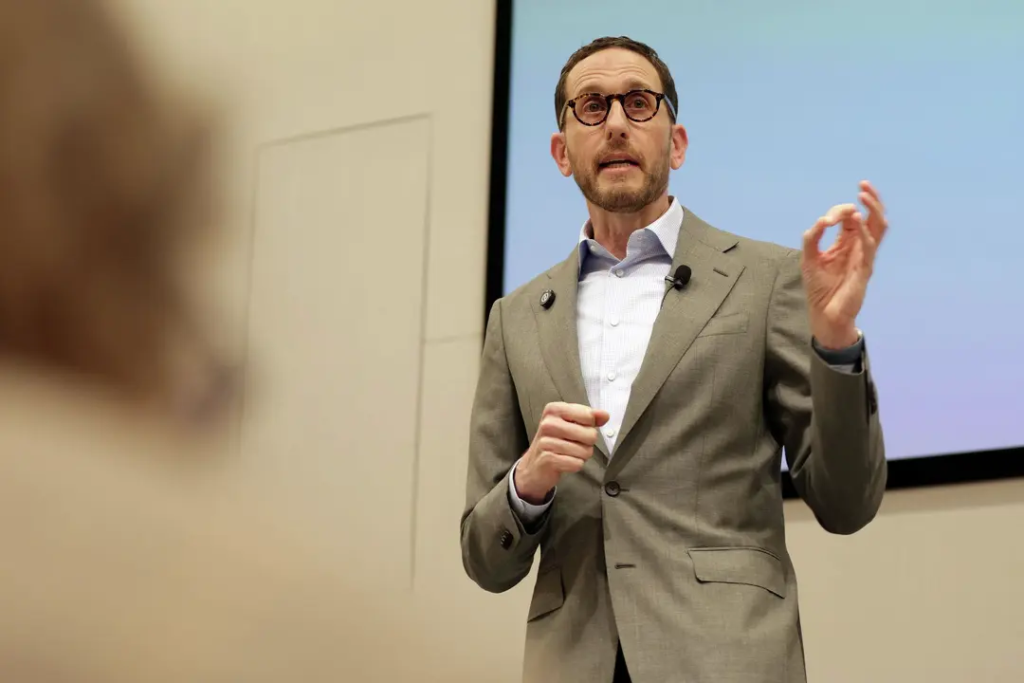
State Sen. Scott Wiener speaks during a Congressional District 11 candidate forum in San Francisco.Scott Strazzante/S.F. Chronicle
Sen. Scott Wiener referred to Israel’s war in Gaza as genocide for the first time Sunday, changing course after he got heckled at the first major congressional candidates forum last week. Wiener is one of three top Democratic candidates vying to replace Speaker Emerita Nancy Pelosi.
“I’ve stopped short of calling it genocide, but I can’t anymore,” Wiener wrote, in part, on X. The post was accompanied by a 90-second video clip.
“For many Jews, associating the word genocide with the Jewish state of Israel is deeply painful and frankly traumatic, but despite that pain and that trauma, we all have eyes … and we all have ears,” he said in the video. “To me, the Israeli government has tried to destroy Gaza and to push Palestinians out, and that qualifies as genocide.”
The Jewish senator noted he previously referenced “total destruction” and “catastrophic levels of death” to describe the war in Gaza.
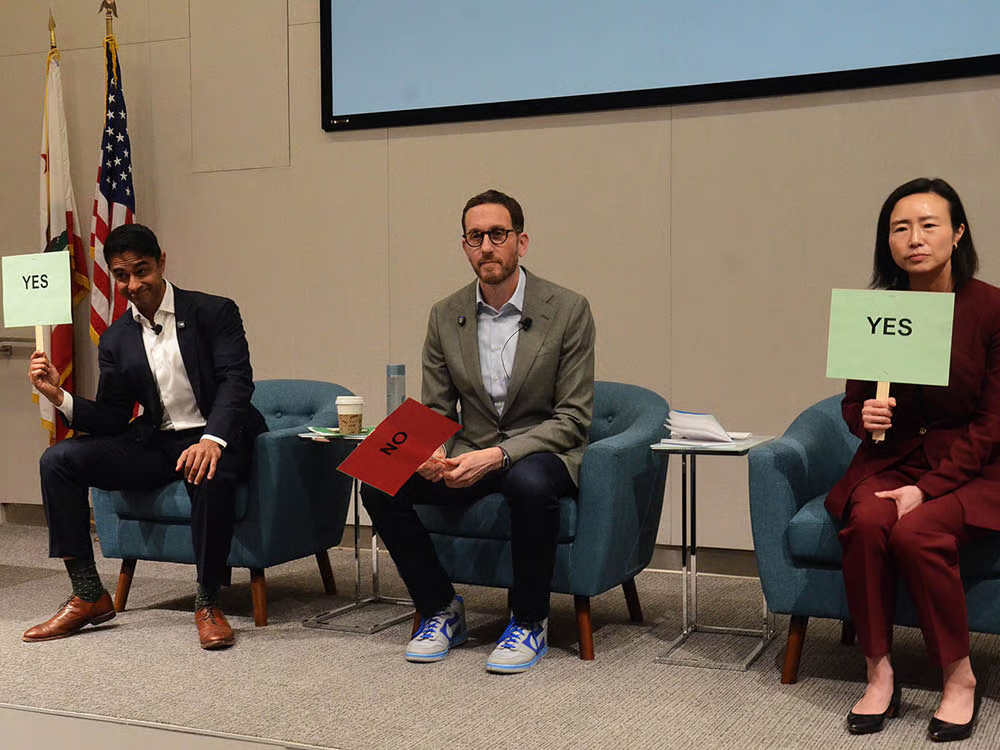
Wiener’s post came after he drew jeers from the audience during a lightning round of questions at last week’s face-off between candidates in the race. The hot-button question was: “Is Israel committing genocide in Gaza?”
Supervisor Connie Chan and former congressional staffer Saikat Chakrabarti held up signs that said, “yes.” Wiener didn’t hold up a “yes” or “no,” telling reporters afterward that his position was more detailed than the format allowed for.
His pivot also came after a profile on him published Sunday in the Atlantic. The story mentioned that he did not characterize the bombings of Gaza as genocide as well as the criticism he drew during the forum.
Chakrabarti criticized Wiener’s change of heart. “Genocide shouldn’t be something you say yes or no to based on the reporter you are talking to or how your poll numbers look,” Chakrabarti said on X. “This is about moral clarity.”
Emily Hyden, Chakrabarti’s campaign manager, elaborated in a statement, saying Wiener referred to the war in Gaza as genocide only “when it looked like it would benefit his political career.”
“That is exactly what’s wrong with opportunist establishment politicians who have failed our party,” Hyden said.
Julie Edwards, spokesperson for Chan’s campaign, echoed the sentiment. “People getting killed didn’t move him, but boos at a forum did. This is about politics, not principle,” Edwards said.
Wiener responded to the other candidates’ comments by saying “major international pronouncements should come from long, thoughtful conversations and deep introspection, not lighting round questions at a forum.”
“That’s what I did here, and that’s how I’ll govern as a member of Congress,” he said, adding that his stance was “the natural progression” of his past comments condemning the war.
David Hernandez covers public safety for the San Francisco Chronicle. Before joining the Chronicle in December 2023, he reported on crime, law enforcement and criminal justice for the San Diego Union-Tribune. A graduate of San Diego State University, he is a member of the National Association of Hispanic Journalists. He was born and raised in Santa Cruz.
Protesters gathered in Grand Lake on Sunday, January 11, at a rally organized by Indivisible. Credit: Jerome Parmer
Crowds in Oakland joined demonstrators across the country on Sunday to protest the Trump administration’s immigration enforcement campaign and the fatal shooting by an Immigration and Customs Enforcement agent of an unarmed woman, Renee Good, in Minneapolis.
Never miss a story.Sign up for The Oaklandside’s free daily newsletter.Email
Sunday’s protests — which took place in more than 1,000 locations, according to NPR — were designed to call out a “broader pattern of unchecked violence and abuse carried out by federal immigration enforcement agencies against vulnerable and innocent people,” said organizers with Indivisible.
In Oakland, protesters rallied at Splash Pad Park, across from the Grand Lake Theater.
One participant, who gave her name as AJ, brought along her two children. All three held handmade signs, the youngest’s a colorful abstraction.
“We are here protesting Trump’s police state jeopardizing the lives and safety of our neighbors in the community,” AJ said. “I am here on behalf of families that are too scared to appear in public to speak out.”
Trump and members of his administration have defended Jonathan Ross, the agent who shot Good, a 37-year-old mother of three, as she was observing ICE operations from her car, calling her a “domestic terrorist” and a “professional agitator.” Democratic officials have pushed back on those characterizations and said video of the shooting does not show that she tried to run over the agent, as the administration has claimed.
AJ brought her two children to Sunday’s protest. Credit: Jerome ParmerDemonstrators filled Splash Pad Park, across from the Grand Lake Theater. Credit: Jerome ParmerThe rally had musical accompaniment. Credit: Jerome ParmerA protester at Sunday’s demonstration, organized by Indivisible. Credit: Jerome ParmerProtesters flood into Splash Pad Park. Credit: Jerome ParmerAttendees at Sunday’s protest. Credit: Jerome Parmer
Natalie Orenstein is a senior reporter covering City Hall, housing and homelessness for The Oaklandside. Her reporting on a flood of eviction cases following the end of the Alameda County pandemic moratorium won recognition from the Society of Professional Reporters NorCal in 2024. Natalie was previously on staff at Berkeleyside, where she covered education, including extensive, award-winning reporting on the legacy of school desegregation in Berkeley Unified. Natalie lives in Oakland, grew up in Berkeley, and has only left her beloved East Bay once, to attend Pomona College.More by Natalie Orenstein
Mr. Edsall contributes a weekly column from Washington, D.C., on politics, demographics and inequality.
President Trump is showing symptoms of an addiction to power, evident in his compulsion to escalate claims of dominion over domestic and international adversaries. The size and scope of his targets for subjugation are spiraling ever upward.
Trump began his second term with his administration clamping down on law firms and universities. More recently he has focused his sights on an entire country, Venezuela, with Cuba, Colombia and Greenland also high on his current list — not to mention his claim to the Western Hemisphere in the 2025 National Security Strategy: “After years of neglect, the United States will reassert and enforce the Monroe Doctrine to restore American pre-eminence in the Western Hemisphere, and to protect our homeland and our access to key geographies throughout the region.”
“This ‘Trump Corollary’ to the Monroe Doctrine,” the report added, “is a common-sense and potent restoration of American power and priorities, consistent with American security interests.”
I asked Manfred Kets de Vries, a professor of leadership development and organizational change at Insead, an international business school, about Trump’s relationship with power.
Kets de Vries replied by email:
It is possible to become addicted to power — particularly for certain character structures. Individuals with pronounced narcissistic, paranoid or psychopathic tendencies are especially vulnerable. For them, power does not merely enable action; it regulates inner states that would otherwise feel unmanageable.
Donald Trump is an extreme illustration of this dynamic. From a psychoanalytic perspective, his narcissism is malignant in the sense that it is organized around a profound inner emptiness.
Malignant narcissism is a combination of narcissism and psychopathology. Because there is little internal capacity for self-soothing or self-valuation, he requires continuous external affirmation to feel real and intact. Power supplies that affirmation. Visibility, dominance and constant stimulation temporarily fill the void.
What makes this tragic and dangerous, Kets de Vries continued, “is that this dynamic is not playing out in the margins of political life but at its center. He is not the dictator of a small, contained state; he is occupying the most powerful position in the world, with consequences for all of us.”
It’s not just Trump. The compulsion to simultaneously project power and demean adversaries pervades the administration.
Stephen Miller, the deputy chief of staff for policy and a homeland security adviser, thrives on assertions of domination.
“We live in a world,” he told CNN’s Jake Tapper on Jan. 5, “in which you can talk all you want about international niceties and everything else, but we live in a world, in the real world, Jake, that is governed by strength, that is governed by force, that is governed by power. These are the iron laws of the world that have existed since the beginning of time.”
Or take Russell Vought, Trump’s director of the Office of Management and Budget. Even before Trump took office, Vought fantasized in speeches about putting career civil servants “in trauma,” making their lives so miserable that “when they wake up in the morning, we want them to not want to go to work because they are increasingly viewed as the villains.”
The advisers do their best, of course, but no one outdoes Trump. “You’ll never take back our country with weakness. You have to show strength, and you have to be strong,” he told crowds gathered on the Ellipse on Jan. 6, 2021.
Sign up for the Opinion Today newsletter Get expert analysis of the news and a guide to the big ideas shaping the world every weekday morning. Get it sent to your inbox.
In fact, Trump routinely outdoes himself.
In July 2019 he claimed to “have the right to do whatever I want as president.” In March last year Trump declared not only that he has the right to do whatever he wants but also that “I run the country and the world.”
In a series of interviews, Susie Wiles, the White House chief of staff, captured Trump’s addictive character, telling Vanity Fair that the president has “an alcoholic’s personality.”
The exercise of authority over others is, for some, an exhilarating experience.
“Power, especially absolute and unchecked power, is intoxicating,” wrote Nayef Al-Rodhan, an honorary fellow of St Antony’s College, Oxford, and the director of the geopolitics and global futures department at the Geneva Center for Security Policy, in a 2014 essay, “The Neurochemistry of Power: Implications for Political Change.”
“Its effects occur at the cellular and neurochemical level,” Al-Rodhan continued.
They are manifested behaviorally in a variety of ways, ranging from heightened cognitive functions to lack of inhibition, poor judgment, extreme narcissism, perverted behavior and gruesome cruelty.
The primary neurochemical involved in the reward of power that is known today is dopamine, the same chemical transmitter responsible for producing a sense of pleasure. Power activates the very same reward circuitry in the brain and creates an addictive “high” in much the same way as drug addiction.
Like addicts, most people in positions of power will seek to maintain the high they get from power, sometimes at all costs.
I asked Ian Robertson, an emeritus professor of psychology at Trinity College in Dublin and the author of “How Confidence Works: The New Science of Self-Belief,” a series of questions in this vein. He answered by email.
How is it possible to become addicted to power?
“Power is a very strong stimulant of the dopamine reward system of the brain — which is the seat of addiction.”
Does the addiction result in a need to keep exercising power in an increasingly domineering fashion?
“Yes, a central component of addiction is increased tolerance — i.e., you need to increase the dose to keep the same effect. It can become an unquenchable appetite.”
What are the personality characteristics that are associated with addiction to power? What needs are met for those addicted to power?
“People (men more than women) with a high need for control and dominance over other people (and a corresponding fear of loss of control). The need for control is one of three basic motivational needs — the others being affiliation and achievement. Having power over other people satisfies this deep need.”
In a Feb. 12 Irish Times article, “A Neuropsychologist’s View on Donald Trump: We’re Seeing the Impact of Power on the Human Brain,” Robertson described the frenzied opening days of the second Trump administration:
Deports manacled immigrants, closes AIDS-prevention programs, starts and stops and restarts a tariffs war, vows to cleanse Gaza of its troublesome inhabitants and demands that all Israeli hostages be released by Hamas by midday on Saturday or he would “let hell break out.”
This activity, Robertson continued,
fuels an aggressive, feel-good state of mind, particularly in dominant, amoral personalities such as Trump’s. It also creates a restless, hyperactive state of mind, which, when combined with a feeling of omnipotence, fosters the delusions that you can snap your fingers and sort every problem.
At the same time, when Trump’s grandiose plans are frustrated, it poses high risks: “When that doesn’t happen — when Gaza or Greenland can’t be bought or U.S. birthright abolished — this ramps up a hyperactive rage at being thwarted and escalates a flurry of even more frenetic and unmeasured responses.”
Virtually all politicians have a strong attraction to power. What distinguishes Trump? When does the appeal of power lead to its abuse?
In response to my inquiries, Adam Galinsky, a professor of leadership and ethics at Columbia Business School, emailed to say that he has developed a concept he calls “the little tyrant, someone who has power but lacks status, i.e., someone who controls resources but feels disrespected. It leads people to mistreat others in a domineering fashion.”
Addiction to power, Galinsky continued, “is partially the result of trying to fill the hole of insecurity left by feeling one is not respected by others. I believe this fits Donald Trump. He has always felt disrespected, and in many ways his entire persona resonates with his base as they feel their hold on society slipping away.”
Trump, Galinsky argued,
represents what researchers call the dark triad of three interconnected, malevolent personality traits: narcissism (grandiosity, self-centeredness), Machiavellianism (manipulation, cynicism) and psychopathy (impulsivity, lack of empathy/remorse).
Trump wants to be seen as the greatest president of all time and makes everything about himself (narcissism), he views the world as only functioning through manipulation and exertion of power (Machiavellianism), and he is impulsive and shows no empathy (psychopathy).
One of the most exhaustive analyses of the adverse consequences of an addiction to power is a 2023 article in the journal Communicative & Integrative Biology, “On Power and Its Corrupting Effects: The Effects of Power on Human Behavior and the Limits of Accountability Systems,” by Tobore Onojighofia Tobore, an independent scholar and medical researcher.
In the paper, Tobore explores the extensive scientific literature on the study of power to show that when power is wielded by abusive politicians or chief executives, the harm can have pervasive consequences.
In an email responding to a series of questions I posed, Tobore wrote:
Trump shows characteristics of a grandiose narcissist lacking in empathy. In the current divided political environment, where checks and balances have become significantly eroded and critical stakeholders, possibly out of fear of bullying, are unable to push back on his behavior, we may be in for more bad behavior from Trump.
Trump’s success in Iran and Venezuela, in Tobore’s view, “is likely to make him emboldened and more risk-prone. There is the possibility of more foreign escapades and increasing talk of a third term.”
I asked Tobore what personality characteristics are associated with addiction to power. He replied with a quotation from his article:
The grandiose narcissist is assertive and extroverted and distinguished by their sense of entitlement, overconfidence, high self-esteem, feelings of personal superiority, self-serving exploitative behavior, impulsivity, a need for admiration and dominance, and aggressive and hostile behavior when threatened or challenged.
Grandiose narcissists are more likely to seek and achieve positions of power in organizations, but they are more likely to abuse their power, pursue their interests at the expense of the organization, disregard expert advice, causing them to make poor decisions.
In his paper, Tobore also cited evidence that among those inclined to abuse power, the exercise of power has similar, if not identical, biological effects to those experienced by addicts:
Power abuse disorder has been coined as a neuropsychiatry condition connected to the addictive behavior of the power wielder. Arguments have been made on the relationship between power addiction and dopaminergic alterations.
Indeed, changes in the dopaminergic system have been implicated in drug addiction, and research on animals suggests that dominance status modulates activity in dopaminergic neural pathways linked with motivation.
Evidence suggests that areas of the brain linked with addiction, including the amygdala and dopaminergic neurons, play a major role in responding to social rank and hierarchy signals. Multiple lines of evidence from animal studies indicate that dopamine D2/D3 receptor density and availability is higher in the basal ganglia, including the nucleus accumbens, of animals with great social dominance compared to their subordinates. Animal studies suggest that following forced loss of social rank, there is a craving for the privileges of status, leading to depressive-like symptoms, which are reversed when social status is reinstated.
If that’s true, then the linkage between dominant power status and the loss of status to variations in hormone levels helps explain both Trump’s obsessive refusal to acknowledge his 2020 defeat and his continuing efforts to criminally charge those who have challenged him.
The appeal of power is itself a healthy and natural phenomenon, according to many of those I contacted. The problem arises when those who acquire power do so to fulfill their narcissistic need to subjugate others and are biologically rewarded when they do so.
Dacher Keltner, a professor of psychology at Berkeley, made the case in an email that “because in our evolutionary history, enjoying elevated power has benefited individuals in terms of reproductive success, the health of their children and kin, and their own individual flourishing.”
But, Keltner wrote, “given individual differences, there will be a small subset of people who compulsively seek out power in every social context and through whatever means necessary to satisfy the need for power — to influence (and often control) others.”
While voicing caution over the use of the word “addicted,” Keltner contended that
the study of addictions like alcohol or porn offers criteria for calling someone addicted to power. I’d state those criteria as:
When someone is compulsively exercising their power, often in inappropriate contexts, when they can’t stop trying to control and rise in power, when it brings about disruptions in social life.
Who is quite likely to go overboard in the pursuit of power?
Keltner said:
We know that people who are prone to addictions, like the addiction to power, are impulsive, they have trouble staying on task, they want intense sensational, gratifying experiences, and they’re prone to antisocial tendencies — fighting with others.
We know those same tendencies predict who will exercise power in a domineering and coercive fashion. So what this tells us is that certain individuals — the impulsive, the angry, the individual who has trouble focusing and staying on task — will gravitate toward exercising power in domineering, as opposed to collaborative, ways.
Addiction to power in the right hands, Keltner contended, can be beneficial:
If you have a strong need, even addiction, for exercising power and are inclined to the more collaborative approach, you will engage in more of that kind of behavior in your exercise of power — of bringing individuals together, building collaborations and alliances, encouraging and strengthening subordinates, etc., and if you are more domineering or coercive by default, that need or addiction to power will amplify those tendencies — undermining others, dehumanizing others, aggression, violence and extraction, weakening allies, hording resources.
Over the past week, it felt as though Trump was even more intensely compelled to publicly announce his determination to dominate everything in sight, and anyone who wants to block him had better watch out.
Perhaps most spectacularly, during a Jan. 7 interview with four Times reporters, Trump was asked if there were any limits on his global powers.
He replied: “Yeah, there is one thing. My own morality. My own mind. It’s the only thing that can stop me.”
“I don’t need international law,” he added.
Trump may think his own morality and his own mind are the only constraints on his otherwise limitless power, but if we are dependent on either — not to mention Trump’s sense of empathy, compassion or sympathy for the underdog — we are in deep trouble. The nation, the Western Hemisphere and the world at large need to figure out how to place restraints on this ethically vacuous president, or we will all suffer continued and ever-worsening damage.
The Times is committed to publishing a diversity of letters to the editor. We’d like to hear what you think about this or any of our articles. Here are some tips. And here’s our email: letters@nytimes.com.
Thomas B. Edsall has been a contributor to the Times Opinion section since 2011. His column on strategic and demographic trends in American politics appears every Tuesday. He previously covered politics for The Washington Post.
America has been invaded by criminals and predators [and landscapers, meat packers, housekeepers, elder care workers and factory and warehouse workers]. We need YOU to get them out.
Beginning in 1943, the War Department published a series of pamphlets for U.S. Army personnel in the European theater of World War II. Titled Army Talks, the series was designed “to help [the personnel] become better-informed men and women and therefore better soldiers.”
On March 24, 1945, the topic for the week was “FASCISM!”
“You are away from home, separated from your families, no longer at a civilian job or at school and many of you are risking your very lives,” the pamphlet explained, “because of a thing called fascism.” But, the publication asked, what is fascism? “Fascism is not the easiest thing to identify and analyze,” it said, “nor, once in power, is it easy to destroy. It is important for our future and that of the world that as many of us as possible understand the causes and practices of fascism, in order to combat it.”
Fascism, the U.S. government document explained, “is government by the few and for the few. The objective is seizure and control of the economic, political, social, and cultural life of the state.” “The people run democratic governments, but fascist governments run the people.”
“The basic principles of democracy stand in the way of their desires; hence—democracy must go! Anyone who is not a member of their inner gang has to do what he’s told. They permit no civil liberties, no equality before the law.” “Fascism treats women as mere breeders. ‘Children, kitchen, and the church,’ was the Nazi slogan for women,” the pamphlet said.
Fascists “make their own rules and change them when they choose…. They maintain themselves in power by use of force combined with propaganda based on primitive ideas of ‘blood’ and ‘race,’ by skillful manipulation of fear and hate, and by false promise of security. The propaganda glorifies war and insists it is smart and ‘realistic’ to be pitiless and violent.”
Fascists understood that “the fundamental principle of democracy—faith in the common sense of the common people—was the direct opposite of the fascist principle of rule by the elite few,” it explained, “[s]o they fought democracy…. They played political, religious, social, and economic groups against each other and seized power while these groups struggled.”
Americans should not be fooled into thinking that fascism could not come to America, the pamphlet warned; after all, “[w]e once laughed Hitler off as a harmless little clown with a funny mustache.” And indeed, the U.S. had experienced “sorry instances of mob sadism, lynchings, vigilantism, terror, and suppression of civil liberties. We have had our hooded gangs, Black Legions, Silver Shirts, and racial and religious bigots. All of them, in the name of Americanism, have used undemocratic methods and doctrines which…can be properly identified as ‘fascist.’”
The War Department thought it was important for Americans to understand the tactics fascists would use to take power in the United States. They would try to gain power “under the guise of ‘super-patriotism’ and ‘super-Americanism.’” And they would use three techniques:
First, they would pit religious, racial, and economic groups against one another to break down national unity. Part of that effort to divide and conquer would be a “well-planned ‘hate campaign’ against minority races, religions, and other groups.”
Second, they would deny any need for international cooperation, because that would fly in the face of their insistence that their supporters were better than everyone else. “In place of international cooperation, the fascists seek to substitute a perverted sort of ultra-nationalism which tells their people that they are the only people in the world who count. With this goes hatred and suspicion toward the people of all other nations.”
Third, fascists would insist that “the world has but two choices—either fascism or communism, and they label as ‘communists’ everyone who refuses to support them.”
It is “vitally important” to learn to spot native fascists, the government said, “even though they adopt names and slogans with popular appeal, drape themselves with the American flag, and attempt to carry out their program in the name of the democracy they are trying to destroy.”
The only way to stop the rise of fascism in the United States, the document said, “is by making our democracy work and by actively cooperating to preserve world peace and security.” In the midst of the insecurity of the modern world, the hatred at the root of fascism “fulfills a triple mission.” By dividing people, it weakens democracy. “By getting men to hate rather than to think,” it prevents them “from seeking the real cause and a democratic solution to the problem.” By falsely promising prosperity, it lures people to embrace its security.
“Fascism thrives on indifference and ignorance,” it warned. Freedom requires “being alert and on guard against the infringement not only of our own freedom but the freedom of every American. If we permit discrimination, prejudice, or hate to rob anyone of his democratic rights, our own freedom and all democracy is threatened.”
A national movement across all races, cultures & classes to strategically and peacefully withdraw our labor & spending. The “system” will hear us – We The People.
We’re not just talking about what’s wrong – we’re building what is right. A civic force that rivals the rigged system.
Multiple DatesBlackout The System: Citizens Assembly – Building Community TogetherSun, Jan 18ZoomCitizens Assemblies are weekly gatherings that equip participants with the skills and confidence to replace corporate systems with local alternatives. This initiative marks the beginning of a cultural shift toward systems that prioritize people over corporations.+3 moreRSVP
About BLACKOUT THE SYSTEM
BLACKOUT THE SYSTEM is a national non-partisan, grassroots movement born from frustration, injustice, and the undeniable truth that the people hold the power – not corrupt governments, not billionaires, and not broken systems. It is not just a one-and-done strike, boycott or protest. It is a long-term solution – a movement that aims to bring about significant and strategic change by uniting individuals to peacefully disrupt the current systems and build new ones.
Our “system” isn’t broken – it’s working as designed. To benefit the wealthiest few and exploit the rest of us. We have to ask: Why are corporations so successful while their employees are not? For decades, productivity, corporate profits and cost of living have soared, while worker wages have relatively stagnated. Most of us are working harder, longer and struggling to make ends meet, while the corporations and billionaires collectively hoard trillions.
With the Citizen’s United Supreme Court ruling in 2010, which allows corporations to contribute an unlimited amount of funds to politicians, they now control policy – not the people – and when this democratic process breaks down – it leaves the door wide open for corruption and authoritarianism.
We have less leisure time so we accepted the conveniences they sold us – all while pocketing more wealth and squeezing out competition – small business. We’re told to look across at “other demographics” being the reason for our hardships, while they keep the flames of division burning so we don’t look UP – AT THEM.
IT’S NOT LEFT VS. RIGHT – IT’S THE TOP VS. ALL THE REST OF US
The injustices we face—rising inequality, exploited labor, stripped rights, and a corrupted democracy—are all symptoms of one disease: Greed.
We oppose the deliberate, engineered division of our country, the hoarding of wealth by corporations and billionaires, and the systematic dismantling of our Constitution.
Our position is clear: We believe in the power of the people and in unifying across all demographics, to strategically and peacefully withdraw our labor, our spending, and our financial support, while building resilient, community-based systems that reclaim our resources, restore justice, and return power to the people.
Challenging times—like economic downturns, natural disasters, and geopolitical conflicts—can create significant hardships. Communities often come together to find solutions, yet accessing necessary resources can be tough. Blackout The System seeks to create a searchable database to consolidate various support systems for easier access.
We need your help! We’re crowdsourcing information on assistance/support resources and mutual aid networks across categories like food, transportation, housing relief, and health services. By gathering these resources, we can strengthen our communities’ preparedness and resilience.
Every single one of us can take action and no action is too small! Learn more about our vision for the path to success and the several ways and levels of engagement open to all of us. Together, we are unstoppable!
UNITY IS COMMUNITY – COMMUNITY IS POWER – AND THE POWER IS WITH THE PEOPLE
We welcome volunteers to help with organizing, leading initiatives, professional services, knowledge/skill sharing, and operational tasks. If you’d like to get more involved, we have a spot for you.
“We were guilty, period.” One former Trump supporter, Pamela Hemphill, refused to be party to Trump’s attempt to downplay the significance of the violent insurrection of the U.S. Capitol which took place five years ago today on January 6, 2021. Hemphill formally rejected Trump’s pardon for her participation in the January 6th Capitol riot, asserting that a pardon “would be a slap in the face to the Capitol police officers, to the rule of law and to our whole nation.”
“The pardons just contribute to their narrative, which is all lies, propaganda,” continued the 72-year-old Hemphill from her home in Idaho. Her principled stance stands in stark contrast to the more than 1,500 other January 6th defendants who eagerly accepted clemency from the Trump administration, even those who assaulted police officers while attacking and ransacking the U.S. Capitol.
In 2021, Hemphill flew from Idaho to Washington D.C. to support Trump’s effort to overturn the results of the 2020 presidential election. Prosecutors said she pushed through police lines three different times as the crowd grew increasingly violent, encouraged fellow rioters to push their way inside the building, and was later seen inside the Capitol Rotunda. Court documents show she had posted on social media before the event, writing “it’s a WAR!” and that she was on her way to Washington. Hemphill pleaded guilty in January 2022 to a count of unlawful parading and was sentenced later that year to a term that included three years of probation. She served 60 days in jail, received 36 months of probation, and was ordered to pay $500 in restitution.
Hemphill’s journey to rejecting Trump began with her growing awareness of how she had been manipulated. “I didn’t realize that brainwashing was happening with Trump in 2016,” she said in an August 2024 interview. “This is how [my family] would talk to me. ‘Pam, you know, the Democrats… are trying to take over. They’re getting more aggressive.’ I tend to believe them. You know, I wasn’t doing my own research.” Hemphill admitted that Trump’s rhetoric on immigration and border security initially attracted her support. Her time in jail led to serious reflection about her actions.
After her release, she began spending time in online groups with other January 6 participants, where she realized “how much disinformation was being spread and how difficult it was to combat falsehoods with the truth.” Now, she says, her participation in January 6th is “like a scar that I have to carry for the rest of my life… It’s gonna be that shame(ful) feeling,” leading her to forever regret that she was “a part of that craziness, that cult.”
The cost of Hemphill’s moral stand has been considerable. She has received death threats since breaking with MAGA and faced persistent online harassment. Her choice to speak up hasn’t been easy, and she’s had to move residences because the movement she once supported has turned against her.
“I’m not going to be bullied by MAGA anymore,” she wrote on social media, noting that Trump supporters have allegedly gone so far as to call her probation officer trying to get her “in trouble” in the wake of her media appearances condemning the riot. Despite these challenges, Hemphill remains committed to honesty about what happened on January 6th, describing it as “the worst day in our history.”
Yet her stand has also drawn unexpected support. Former Vice President Mike Pence — who was inside the Capitol on January 6th when rioters chanted “Hang Mike Pence” and whom Trump criticized for certifying the election results — wrote Hemphill a letter in June expressing admiration for her decision to reject the pardon.
In an era when so many have chosen partisan loyalty over truth, Hemphill’s example offers a reminder that accountability begins with oneself. Out of more than 1,500 pardoned defendants, only two have rejected clemency out of conscience: Hemphill and Navy veteran Jason Riddle of New Hampshire. It’s proof that accountability can still prevail over complicity.
Kudos to Pamela Hemphill for her courage and integrity!
To inspire children and teens with stories of real-life girls and women who stood up for truth and justice throughout history, visit our blog post, “Dissent Is Patriotic: 50 Books About Women Who Fought for Change,” at https://www.amightygirl.com/blog?p=14364
For an excellent book for kids about the events of January 6th and the importance of respecting the electoral process, we recommend “Losing is Democratic: How to Talk to Kids About January 6th” for ages 7 and up at https://bookshop.org/a/8011/9798989493449 (Bookshop) and https://amzn.to/4e6KFbB (Amazon)
For powerful books for tweens and teens about girls living in real-life oppressive societies throughout history where rulers didn’t respect the rule of law, visit our blog post “The Fragility of Freedom: Mighty Girl Books About Life Under Authoritarianism” at https://www.amightygirl.com/blog?p=32426
We protest Heritage Foundation EVERY MONDAY (Join us!!!!) By admin | September 2, 2025 | Uncategorized Cliff Cash Comedy Premiered Jul 26, 2025 Every Monday at The Heritage Foundation 214 Massachusetts Ave. Washington D.C. 4pm protest 6pm pizza Every Friday at Fox News D.C. 400 N. Capitol St. Washington D.C. 4pm protest 6pm pizza We are... Continue reading →
Milk Club Trans Caucus Meeting Date: Tuesday, April 28 Time: 5-7 PM Location and Zoom Link: Meeting info available to members of the Milk Club Trans Caucus. Please reach out to trans@milkclub.org if you would like to join the Milk Club Trans Caucus.
San Francisco Young Democrats meet with SFDems Chair Nancy Tung Wednesday, April 29th | 2pm Location: SC T-160 (third floor of Student Center) Register The San Francisco Young Democrats at SF State are teaming up with SFDems to make sure their voices are heard. Want to get more plugged into San Francisco... Continue reading →
One Million Rising: Strategic Non-Cooperation to Fight Authoritarianism Virtual Event · Hosted by No Kings Time Wednesdays 8 – 9:30pm EDT Location Virtual event Join from anywhere About this event Across the country, authoritarian forces are getting bolder and more dangerous. Trump and his allies are not hiding their agenda: mass deportations,... Continue reading →
THURSDAY, JUNE 29, 2023 AT 2 AM – 4 AM PDT How to create trust in a group? Details Event by Extinction Rebellion Empathy Circles online EMPATHY CAFE Duration: 2 hr Public · Anyone on or off Facebook How to create trust in a group? This is the question that arose in our... Continue reading →


 by Ryan CooperJanuary 12, 2026 (Prospect.org)


 by
by 






 Multiple Dates