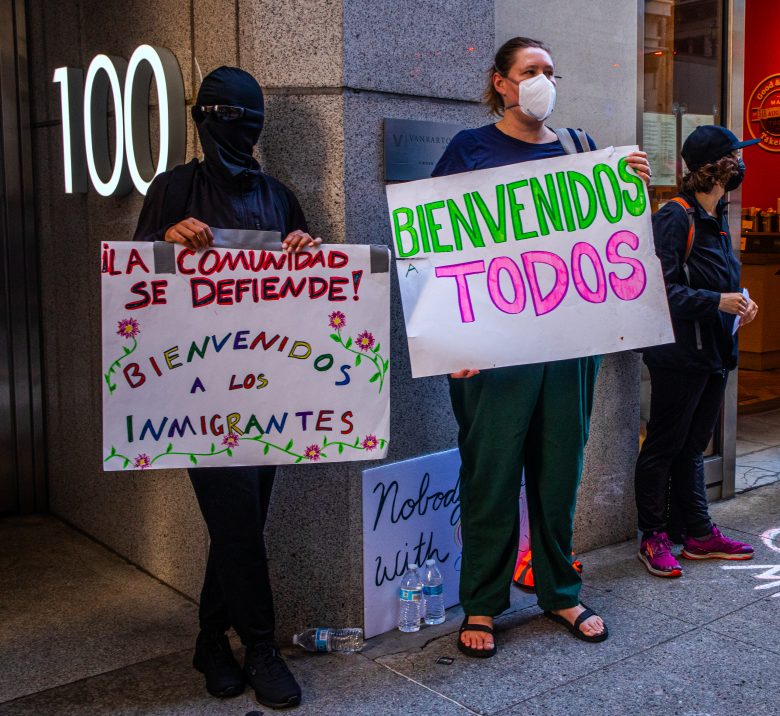
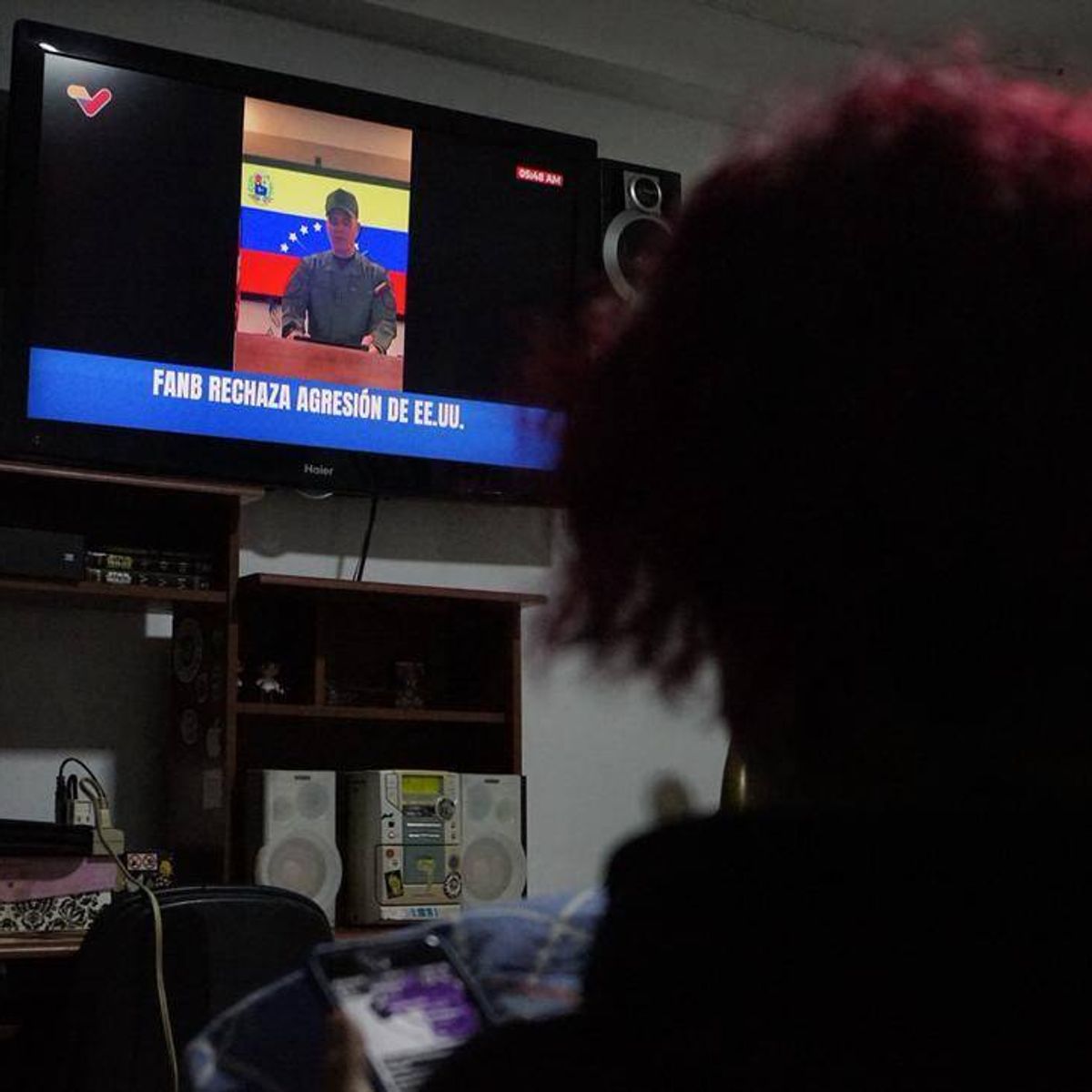
Protesters stand in solidarity with the immigrant community in front of the immigration court on Montgomery St. in San Francisco. Photo by Mariana Garcia.
The San Francisco immigration court building at 100 Montgomery St. is set to close in January 2027, sources close to the court told Mission Local on Tuesday.
Staff have been informed that the immigration court will not renew its lease at the Montgomery location, and that they will be transferred to the Concord immigration court as early as this summer. Courtrooms at San Francisco’s other, smaller location at 630 Sansome St. are expected to remain open, sources told Mission Local.
The Executive Office for Immigration Review, which oversees the country’s immigration courts, did not immediately respond to a request for comment.
Want the latest on the Mission and San Francisco? Sign up for our free daily newsletter below.Sign up
There were 21 judges at San Francisco’s two immigration court locations — with the vast majority at Montgomery Street — in early spring 2025. There will be just four left by the end of January 2026; the Trump administration fired 13 of those judges, and another four were scheduled to retire by the end of the month. There are over 120,000 pending cases in San Francisco’s immigration court backlog, according to the Transactional Records Access Clearinghouse.
Five Concord-based judges have been fired, though two of those judges had not yet started hearing cases when they lost their jobs, according to the National Association of Immigration Judges. Seven are remaining, according to the court’s website.
Both the Sansome and Montgomery courts have been sites of monthly ICE arrests since May 2025, with arrests significantly slowing down in October and November. In 2026, Mission Local has not tracked any ICE arrests.
According to the Executive Office for Immigration Review website, 100 Montgomery’s “operational status” currently remains open.
Join the 3,250 readers who keep Mission Local free for all!
Because of you, Mission Local reached and surpassed our $300,000 year-end fundraising goal. All we can say is thank you.
Thank you for choosing to invest in a local newsroom rooted in San Francisco’s communities — one that listens first and reports deeply.
If you haven’t yet had a chance to give, it’s not too late to be part of this community. Your contribution today helps sustain the reporting our city relies on all year long.
We’re grateful you’re here — and we’d be honored to have you join our donors.
I’m covering immigration. My background includes stints at The Economist in print and podcasting as well as reporting from The Houston Chronicle and elsewhere.More by Margaret Kadifa
Mariana Garcia is a reporting intern covering immigration and graduate of UC Berkeley. Previously, she interned at The Sacramento Bee as a visual journalist, and before that, as a video producer for the Los Angeles Dodgers. When she’s not writing or holding a camera, she enjoys long runs around San Francisco.More by Mariana Garcia
““‘We may not have that many outright Nazis in America, but we have plenty of cowards and bootlickers, and once those fleshy dominoes start tumbling into the Trump camp, the game is up,”
Robert F. Kennedy Jr., President-elect Donald Trump’s pick for secretary of Health and Human Services, has a long history of scathing critiques against Trump, labeling him a “threat to democracy,” a “bully,” and, as recently as July, a “terrible president.”
But Kennedy’s harshest attacks date back to Trump’s rise in 2016, when on his radio show “Ring of Fire,” Kennedy applauded descriptions of Trump’s base as “belligerent idiots” and suggestions that some were “outright Nazis” and “spineless fellow travelers.” Kennedy also likened Trump to historical demagogues like Adolf Hitler and Benito Mussolini, accusing Trump of exploiting societal insecurities and xenophobia to amass power.
After Trump won in 2016, Kennedy concluded in one episode from December of that year that Trump was at least in one way not like Hitler, because, “Hitler was interested in policy.”
A CNN KFile review of Kennedy’s past comments shows they fit a pattern of consistent, broad-based criticism that Kennedy has leveled at Trump over the years.
In 2019, Kennedy argued that Trump had turned his first administration over to corporate lobbyists from industries they were supposed to regulate— industries that Kennedy would actually be able to regulate in some cases if confirmed as Trump’s HHS secretary.
As the head of HHS, Kennedy would oversee vast swathes of the American food and health care industries. The sprawling federal agency has a mandatory proposed budget exceeding $1.7 trillion and oversees key public health initiatives, including the Centers for Disease Control and Prevention (CDC), Food and Drug Administration, the National Institutes of Health (NIH), and Medicare and Medicaid, which together impact the lives of all Americans.
In a statement to CNN, Kennedy expressed pride in serving in Trump’s administration, supported Trump’s vision for the country and said he regrets his past comments about the former president.
“Like many Americans, I allowed myself to believe the mainstream media’s distorted, dystopian portrait of President Trump. I no longer hold this belief and now regret having made those statements,” he said.
Comparing Trump to demagogues
Kennedy’s years of criticism toward Trump began to soften after he was shunned by the Democratic Party during the 2024 primary, prompting him to run as an independent.
Asked in August whether he would ever serve in Trump’s cabinet, Kennedy said, “No.” but weeks later, he ended his campaign and endorsed Trump. Kennedy has since refrained from any public criticism of Trump, aligning himself with the former president on issues like government censorship and public health.
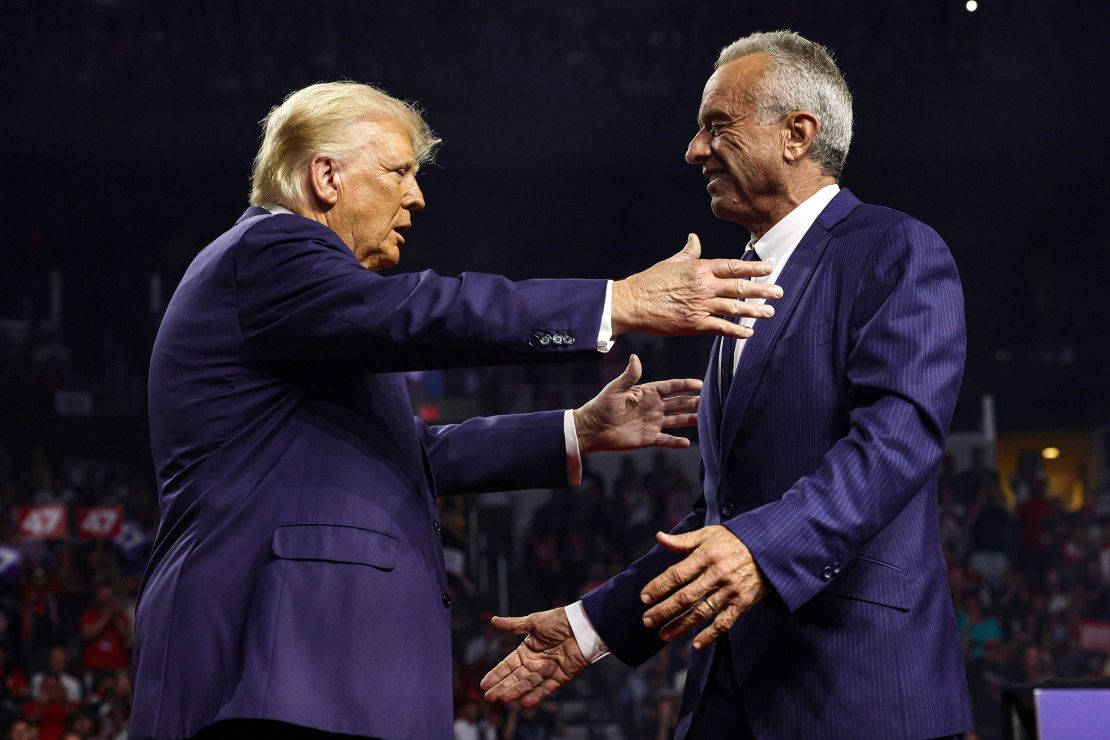
Trump, left, greets Robert F. Kennedy Jr., at a campaign rally in Glendale, Arizona, on August 23. Kennedy had just suspended his independent campaign and threw his support behind Trump. Adriana Zehbrauskas/The New York Times/Redux
But the newly uncovered comments from Kennedy’s radio show underscore the intensity of his past rebukes of Trump, including having leveled charges of racism toward him.
Kennedy repeatedly accused Trump of exploiting fear, bigotry and xenophobia to build a “dangerous” nationalist movement and warned Trump would destroy both the climate and clean water. Kennedy also compared Trump’s supporters to white Americans in the 1970s who, he said, viewed the Civil Rights Movement as a “social demotion.”
In one episode of “Ring of Fire” from December 2016, Kennedy compared Trump’s strategy to historical demagogues who rose during times of crisis.
Drawing comparisons to global crises such as the Great Depression, Kennedy said periods of economic and social instability had often given rise to demagogues who exploit fear, prejudice and insecurity to gain power. He cited figures abroad like Hitler, Francisco Franco and Mussolini, as well as Huey Long and Father Coughlin in the US, as historical parallels.
“And you can see that every statement that Donald Trump makes is fear-based,” Kennedy said on his radio show in December 2016. “Every statement he makes. You know, we have to be fear of the Muslims. We have to be fear of the black people, and particularly the big Black guy Obama, who’s destroying this country, who’s making everybody miserable.”
“And only one person has the genius and the capacity to solve these things. And I’m not gonna tell you how I’m gonna do it. Just trust in me, vote for me and everything will be great again. And of course, that whole thing is like a carnival barker,” Kennedy concluded.
He also compared Trump’s appeal to that of famous segregationist Alabama Gov. George Wallace.
“Wallace’s appeal … was to White middle-class men who had experienced the Civil Rights Movement of the 1960s as a social demotion, and who found their lives in turmoil,” Kennedy said. “And that kind of insecurity, I think, is the target of the summons that Donald Trump has sent out to the American public.”
‘Belligerent idiots’ and ‘Outright Nazis’
In March 2016, Kennedy praised journalist Matt Taibbi’s critique of Trump’s base, reading on-air a passage that harshly condemned Trump and his followers which he called “beautifully” written.
“One of the things that you write so beautifully, and your stuff is so fun to read, but you write about Trump, quote, ‘The way that you build a truly vicious nationalist movement is to wed a relatively small core of belligerent idiots to a much larger group of opportunists and spineless fellow travelers whose primary function is to turn a blind eye to things,’” Kennedy said, reading Taibbi’s own writing back to him.
“‘We may not have that many outright Nazis in America, but we have plenty of cowards and bootlickers, and once those fleshy dominoes start tumbling into the Trump camp, the game is up,’” Kennedy said in finishing the passage Taibbi wrote.
“And, you know, he’s not like Hitler,” Kennedy said. “Hitler had like a plan, you know, Hitler was interested in policy,” Kennedy went on. “I don’t think Trump has any of that. He’s like non compos mentis. He’ll get in there and who knows what will happen.”
Attacked Trump’s views on the environment
Kennedy on his radio show also harshly criticized Trump’s environmental policies, accusing him of promoting reckless climate denialism and prioritizing corporate interests over public health.
On one episode of “Ring of Fire” in December 2016, Kennedy referenced an article by climate scientist Michael Mann and said, “Michael Mann did a great article this week about the 10 worst climate deniers in the world, the most damaging, most destructive. And Donald Trump is number one.”
He accused Trump of pursuing “pollution-based prosperity” by rolling back regulations like the Clean Water Act and withdrawing from the Paris Climate Agreement.
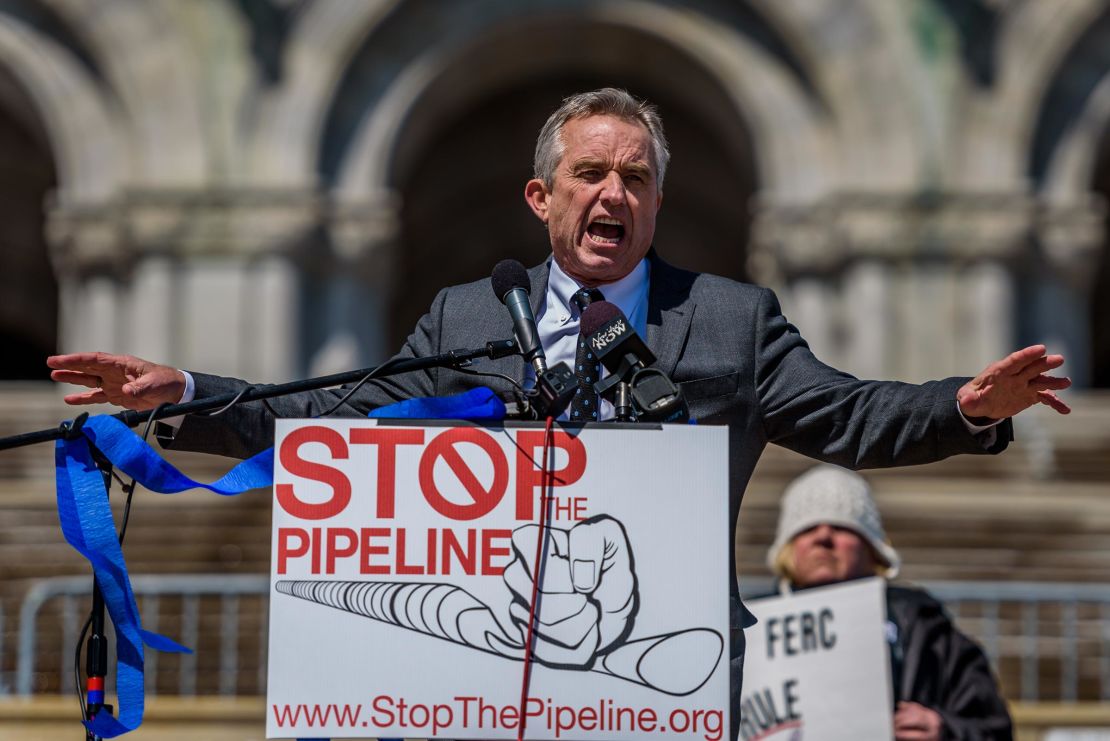
Robert F. Kennedy Jr. speaks during a rally opposing the Constitution Pipeline outside the state Capitol on Tuesday, April 5, 2016, in Albany, New York. Erik McGregor/LightRocket/Getty Images
“Trump isn’t just gonna destroy the climate, but he’s also promised last week when he spoke to the oil industry, the shale gas industry, he promised that he would get rid of the Clean Water Act,” he added. “So he’s just gonna open the floodgates to every kind of pollution … Trump’s prosperity is gonna be pollution-based prosperity.”
Kennedy’s sharp criticisms of Trump extended into 2019, when he compared Trump’s EPA chief Andrew Wheeler to one of the “Four Horsemen of the Apocalypse” and called Trump’s efforts to boost fossil fuel production “despicable,” accusing him of knowingly prioritizing coal, oil and gas over the planet’s future.
Dear friends,If you’re receiving this message, YOU are the resistance. Whether you joined one action or many, thank you for standing with us and saying NO KINGS in 2025. For some of you this may be our first conversation, and we’re grateful you’re here. We are living through a historic turning point. Across the United States, we’ve seen a rapid consolidation of executive power, the hollowing out of essential public services, the erosion of data protections into a growing surveillance state, escalating militarism pushing us toward global conflict, and the rise of authoritarian rule rooted in fear, control, and exclusion. The human cost is staggering. Experts estimate that cuts to USAID alone could result in 14 million preventable deaths by 2030, including 4.5 million children. Just two months into Trump’s second term, Project 2025 was already more than 41% implemented. This was not accidental. It was a deliberate strategy designed to overwhelm, disorient, and evade accountability. As Steve Bannon once put it, the goal was to “flood the zone.” Or, as Nemik warned: “The pace of repression outstrips our ability to understand it… it’s easier to hide behind forty atrocities than a single incident.” But history, and our own recent experience, shows that fear is not inevitable. On October 18, 2025, more than 7 million people took to the streets during the coordinated No Kings protests. Workers. Students. Families. People of every background and belief. The narrative of inevitability is cracking under the weight of a growing people’s movement. 2026: A United FrontHistory is clear: authoritarianism is defeated by broad, nonviolent movements rooted in solidarity across differences. No single organization, tactic, or moment will be enough on its own. What this moment demands is coordination—everywhere, all at once. That’s why our movement includes:Mass mobilizations like Hands Off! and No KingsBoycotts that disrupt profit-driven harm, like We Ain’t Buying ItCommunity defense efforts such as ICE Watch and Know Your Rights trainingsMutual aid that meets real needs right nowElection and democracy protectionDigital organizing that counters technofascist narratives and drives real-world actionDirect action—banner drops, sit-ins, and creative nonviolent disruption Each effort is a thread in the tapestry of resistance. Each role matters. Every person belongs. We take inspiration from those who defeated fascism before us: not through isolation, but through united fronts grounded in courage, coordination, and care. January 20, 2026 — A Line We Draw Together One year into the rise of American technofascism and the start of Trump’s second term, we are making one thing clear: our resistance is growing stronger. On Tuesday, January 20, 2026, 50501 is partnering with Women’s March’s for a Nationwide Free America Walkout. We walk away from fascism. We walk toward a Free America. We fight for a future that belongs to all of us. Everybody in. Nobody out. January 20, 2026 2:00 PM local time (or the time that works best for your community) Nationwide — across the United States After walking out, communities will gather to protest, march, hold sit-ins, deploy banners, host town halls, and take creative nonviolent action together. Find or join a local walkout:https://bit.ly/findawalkout Pledge to walk:https://bit.ly/jan20wewalk Learn more:https://www.freeameri.ca Want to Help Organize?✨ Host a walkout:https://bit.ly/1202026 ✨ Organizer toolkit:https://bit.ly/jan20toolkit ✨ Graphics:https://bit.ly/jan20graphics Looking Ahead2026 will require even more courage, creativity, and deep care for one another. But we’ve already seen what’s possible when ordinary people refuse to give in to fear, and this story is far from over. With gratitude, solidarity, and resolve, Some of your Friends Everywhere (The 50501 Movement Comms Team) ¡El pueblo unido jamás séra vencido! The people united will never be defeated! Learn more about 50501 Movement and connect with your local group.www.FiftyFifty.one
Forbes and The Wall Street Journal are doing a better job than the Chron at covering how a tax on the very rich would impact California. Do we really care if Peter Thiel leaves?
There’s a good chance California voters will be asked next fall to do something that Zohran Mamdani and Bernie Sanders have made the centerpiece of their political campaigns: Tax the rich.
Labor groups are circulating an initiative that would impose a one-time 5 percent tax on fortunes of more than $1 billion. That would bring as much as $100 billion into the state’s coffers.
The Chron is at least covering the Billionaire Tax—although most of the stories are about the poor deprived rich people who have to leave the state to avoid giving up even a tiny slice of their vast fortunes.
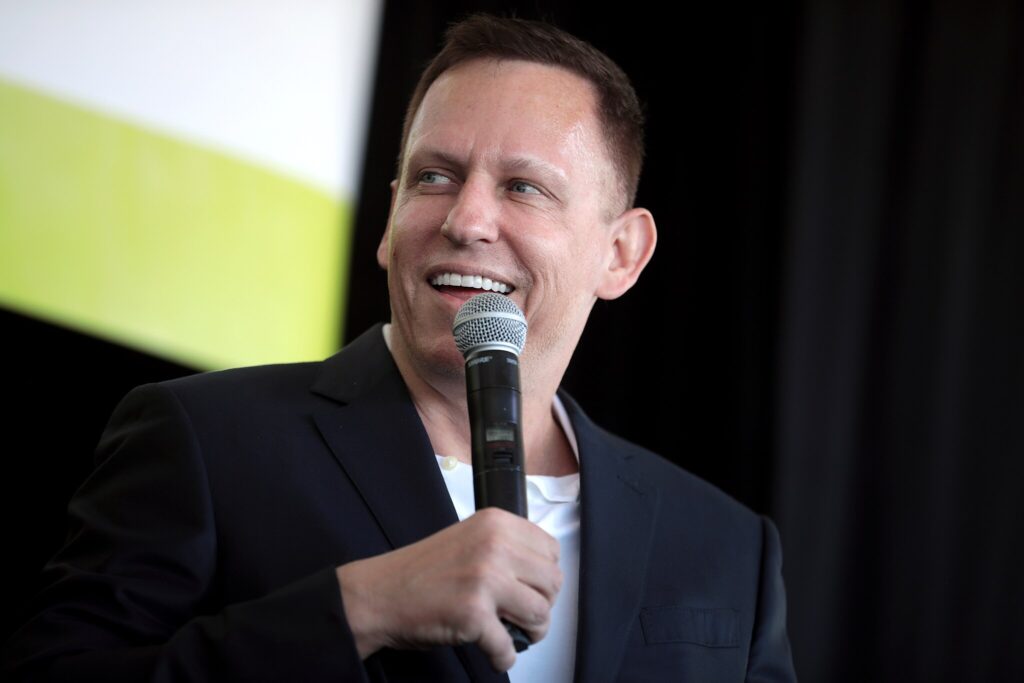
Peter Thiel is headed for Miami. Good luck and good riddance. Photo by Gage Skidmore , Wikimedia Images
I was particularly amused by this Rachel Swan piece, which states that “Taxing the rich to fund social services is not a new idea,” and links to a 2009 story about Sens. Bernie Sanders and Elizabeth Warren offering slightly different versions of a wealth tax.
By 1932, in the depths of the Great Depression, the highest earners were paying a marginal tax rate of 63 percent. Those taxes on the rich funded the New Deal. During World War Two, the top marginal rate was as high as 94 percent, and it stayed at 91 percent until 1963 (under those socialist radicals Harry Truman and Dwight Eisenhower).
That helped build a modern infrastructure for the US—and created a stable middle class.
So no, Rachel: It is not a “new idea.” Instead, by 20th Century standards, allowing the very rich to accumulate the sort of fortunes they have today is a new idea.
Back to the Billionaire Tax.
Labor groups, particularly SEIU-UHW, are pushing this as a way to make up for Trump Administration cuts to health care. The tax is different from an income tax: It is, straight up a wealth tax, a levy on existing fortunes. That’s a key distinction because many very rich people have little in terms of traditional income, the money you make by working. They get rich by already being rich; their fortunes expand through investments that are not taxed as income until those investments are sold.
The New York Times reports that some multi, multi billionaires are threatening to leave California if the measure, which isn’t even on the ballot yet, qualifies. Peter Thiel has already moved to Florida, where he is now registered to vote (like his pal Donald Trump).
Then there’s the beleaguered Larry Page, who lives in Palo Alto and is so terrified of the tax that he may become a refugee, fleeing with his fortune to someplace like Texas.
Let’s put this in perspective:
Since 2024, Larry Page has seen his net worth rise by more than $100 billion. Yes, $100 billion. Most of that is linked to the rise in the price of his Alphabet stock, since he doesn’t really work anymore.
Since stock value is treated by law as an unrealized capital gain, he likely has paid no income taxes at all on that “income,” and will pay none unless he sells some stock. But rich people don’t sell stock: They borrow against the stock, then die, and nobody pays any taxes at all.
If he had to pay the 5 percent tax on his $264 billion today, it would cost him $13.2 billion.
That’s the equivalent of a 13 percent income tax on the money he has made not by working but by already being rich—the same rate that people who make between $11,000 and $47,000 currently pay.
So a low-paid worker who can’t afford rent in SF is already paying more of their income in taxes than Page would. This would be so horribly unfair to him that he will have to flee.
Among the most vocal critics was Garry Tan, president and CEO of the startup accelerator Y Combinator. In a Dec. 26 post on X, Tan dubbed the ballot proposition an effort to “destroy tech in California,” saying that young founders would have to pay millions before they had any liquid assets.
Wow, that just sounds so dastardly: Someone who just became a billionaire when their company went public has a tax liability. Most of us who earn our money by working for a salary have a tax liability every pay period.
Tan should know how this works in reality: Young billionaires who under their stock option rules can’t cash out until six months or a year after the Initial Public Offering don’t wind up living in a closet and eating canned beans while their stock vests: They borrow against that stock and buy mansions and Lamborghinis. They can pay a little tax.
Opponents of California’s proposed 2026 Billionaire Wealth Tax Act repeat a familiar warning: tax the wealthy and they will leave. The claim has rhetorical force; it makes sense on the surface — don’t billionaires make most decisions based only on money? It turns out billionaires aren’t one-dimensional or solely motivated by money. They care about home, long-term personal and business relationships, and some care about improving the lives of the poor and workers.
That there is little to no economic evidence showing that billionaires will move to avoid a small and one-time wealth tax — dedicated to a specific humanitarian cause — is no surprise.
Decades of economic research show that billionaire “flight” is rare, exaggerated, and often confused with tax avoidance through accounting maneuvers rather than physical relocation. That distinction matters. Policymakers who mistake avoidance for exit risk misdesign taxes and leave substantial revenue on the table. The proposed one-time wealth tax in California is exceptionally well-designed.
But maybe Forbes and the Wall Street Journal and Robert Reich and everyone who has every studied the data is wrong, and lots of billionaires will pack up and leave California. That, Newsom worries, will lead to a loss of income tax revenue and even worse budget problems.
That argument assumes that these people with vast fortunes are paying state income taxes. Many of them are not; in fact, many of the richest US residents pay little or no income taxes at all.
The next tech boom doesn’t seem to be happening in Austin. Maybe it’s Miami, which is regularly devastated by hurricanes and likely will underwater in the not-too-distant future (plus: oppressive heat and humidity, giant bugs, and alligators).
Would that really be so bad?
Would most San Francisco residents be better off if the Twitter Tax Break hadn’t set off a boom in this city that drove up rents and home prices and force thousands of workers out of the city?
Would most of us be better off if we were not becoming the AI capital of the country?
Would the city be a better place if some of these greedy, nasty, Trump-supporting tech billionaires decided to leave? (Or should we say: “Bye. Don’t let the door hit you where the good lord split you?”)
I could certainly make that argument.
48 Hills welcomes comments in the form of letters to the editor, which you can submit here. We also invite you to join the conversation on our Facebook, Twitter, and Instagram.
Tim Redmond has been a political and investigative reporter in San Francisco for more than 30 years. He spent much of that time as executive editor of the Bay Guardian. He is the founder of 48hills.
This weekend, Bay Area protesters mobilized against Trump’s illegal invasion of Venezuela, continuing a legacy of local resistance to US imperialism in Latin America.
It’s a long and powerful story.
The San Francisco I saw when I arrived in 1981 was a city seething with protest movements. I worked in the anti-nuclear branch, fighting PG&E and the Diablo Canyon nuclear plant, but many of my friends were involved in Central America solidarity, which became a long, lasting, and effective movement.
The US, under Carter and Reagan, seemed obsessed with fighting “communism” in two small, impoverished countries, El Salvador and Nicaragua. The lessons of Vietnam, where US intervention to fight communism was a terrible failure and the victory of the Viet Cong no threat whatsoever to US interests, was ignored. (Vietnam is still run by the Communist Party, but that nation and the US are now major trading partners and strategic allies, and Vietnam is a huge tourist attraction for Americans.)
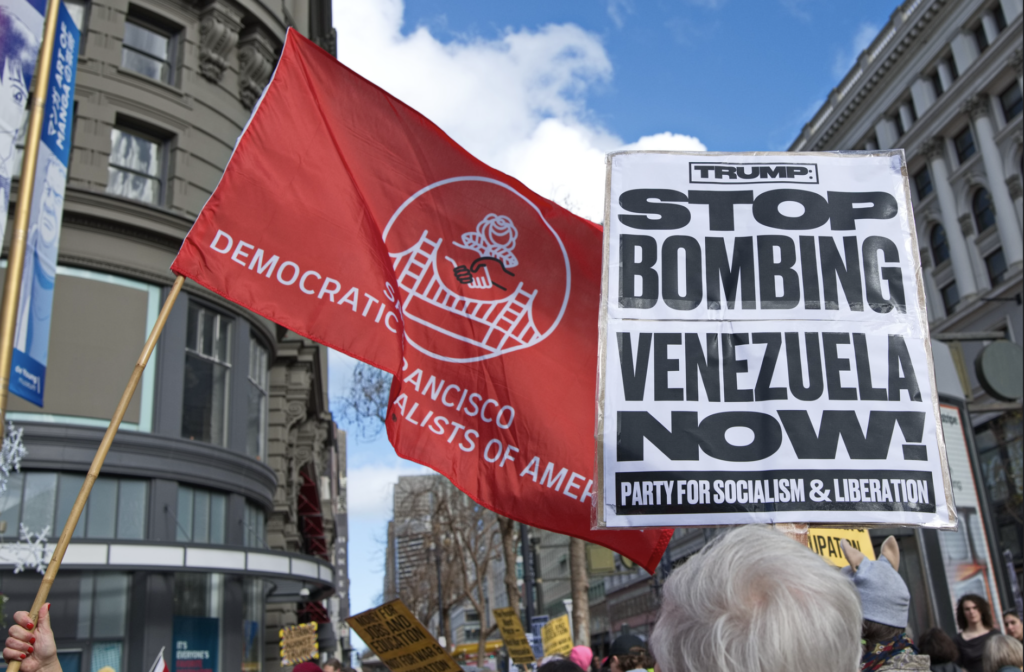
In the streets, and part of a tradition in SF. Photo by Leon Kunstenaar, used with permission
Both countries had a history of US colonialism and brutal dictatorship. Both countries depended largely on agriculture, and in both, a tiny fraction of the population owned almost all the land. In El Salvador, a leftist coalition called the Farabundo Marti National Liberation Front (named after a revolutionary hero of the past) fought to overthrow the dictatorship, which launched a campaign of repression that included US-back death squads who murdered civilians with impunity. They killed the archbishop of San Salvador, Cardinal Oscar Romero. They raped and murdered US nuns. (I believe it was the late Abbie Hoffman who first told me: “US guns kill US nuns.”) And still, Carter and then Reagan gave the government arms and training.
In Nicaragua, the Sandinistas succeeded in 1979 in overthrowing the Somoza dictatorship, and established a functioning leftist government. This, of course, was utterly unacceptable to US business interests in the region and to the Reagan Administration.
In both cases, solidarity groups in the US, many of them based in San Francisco, organized against the US role in Central America. Groups like the Committee in Solidarity with the People of El Salvador, New El Salvador Today, and Casa El Salvador held increasingly large demonstrations. Some activists made the dangerous trip to the Salvadoran countryside to offer support.
Thousands of Salvadorans fleeing the violence wound up in San Francisco, mostly in the Mission, where they were welcomed.
There were San Francisco activists, including the late great Vivian Hallinan, in Managua for the inauguration of President Daniel Ortega after the Sandinistas took power. As the new government was trying to rebuild the war-town country (and redistribute land), the Reagan Administration created and funded a group of counter-revolutionaries called the Contras.
Massive protests against federal spending for the violent Contras, who were guilty of multiple human-rights offenses (and Reagan’s decision to secretly mine the Port of Corinto) led to the Boland Amendment, an act of Congress that banned the CIA from interfering in Nicaragua.
I relate all this history because 400 San Franciscans protested Saturday against Trump’s actions in Venezuela. Not a huge rally—but the first rallies in solidarity with El Salvador and Nicaragua weren’t huge either. But they grew as the brutality, lies, and futility of the Reagan Administration’s actions continued.
That, I suspect, will continue—particularly is Trump goes forward with his plans to “run” a sovereign nation, potentially with US troops on the ground.
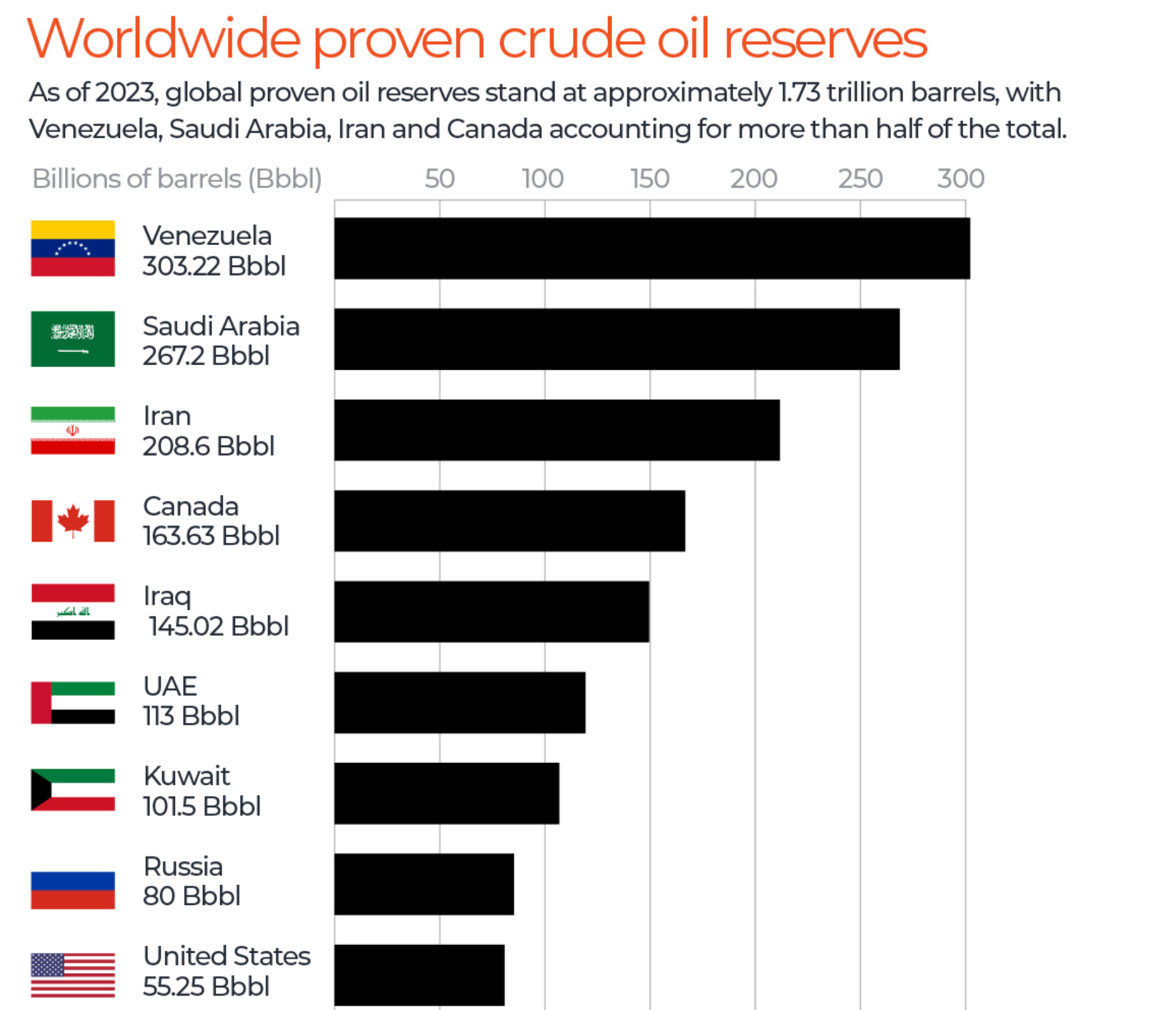
This is not about drugs; it’s all about oil.
Here is some critical background from Stephen Zunes, a professor of politics at USF and an expert on US foreign relations:
The U.S. attack on Venezuela resulted from having an incredibly corrupt and autocratic-minded president using his office to enrich himself and his supporters, deploying the country’s armed forces against his own citizens, abusing the justice system to punish political opponents, and manipulating the electoral process to try to stay in power.
And Venezuelan president Nicolas Maduro was engaged in similar behavior as well.
While there is no denying Maduro’s authoritarian rule, mismanagement, and corruption, that is not why the United States invaded. Furthermore, as with many previous U.S. military interventions, it is based on lies.
First of all, Maduro did not “steal our oil,” as Trump and other U.S. officials have alleged. Even putting aside the question as to whether the United States somehow has the right to another country’s natural resources, Venezuela’s nationalization took place back in the 1970s under the leadership of a pro-U.S. centrist government at a time when dozens of other oil-producing nations were nationalizing their oil companies. Rather than confiscating them without compensation, Venezuela agreed to international arbitration and paid billions of dollars to ExxonMobil, ConocoPhillips, and other U.S. oil companies.
Nor is because of Maduro’s authoritarianism. The United States remains the world’s biggest diplomatic supporter and arms supplier of the world’s dictatorial regimes, many of which are even worse than Venezuela.
More:
Ironically, Venezuela is not a major player in drug trafficking. Despite administration claims to the contrary, they play virtually no role in the manufacturing and smuggling of fentanyl, which is largely made from China and smuggled through Mexico. Venezuela ranks well behind other Latin American countries in cocaine production and is not a major transshipment point of the drug to the United States.
Meanwhile, Zunes says:
The Trump administration has been unable to explain how they will be able to control a country of nearly 30 million people, directly or indirectly. While many Venezuelans, like their counterparts in Iraq, may be celebrating the ouster of an unpopular autocratic ruler, it does not mean they support U.S. control of their country and its natural resources.
Vietnam protests ended the presidency of Lyndon Johnson. The Iran-Contra Scandal deeply damaged the Reagan presidency. I don’t know how far this will go, but the deeper Trump drags this country into an international military quagmire, and the more people are in the streets, the bigger an issue the Democrats will have in the fall.
48 Hills welcomes comments in the form of letters to the editor, which you can submit here. We also invite you to join the conversation on our Facebook, Twitter, and Instagram.
Tim Redmond has been a political and investigative reporter in San Francisco for more than 30 years. He spent much of that time as executive editor of the Bay Guardian. He is the founder of 48hills.
Click here to sign the petition: Tell Congress: Stop Trump’s Illegal War in Venezuela
Click here to send a letter to your Member of Congress: Stop the Illegal War on Venezuela — No Kings. No War.
Call your member of Congress at (202) 224-3121:
Hello, my name is [NAME], and I’m a constituent from [CITY/ZIP]. I’m calling to urge [Senator/Representative ___] to immediately oppose and act to stop the illegal U.S. military operation in Venezuela. This war was launched without congressional authorization and violates the Constitution, international law, and the will of the American people. I’m asking you to reassert Congress’s war powers, demand an immediate halt to U.S. military operations, reject any attempt to seize Venezuela’s oil, and support a peaceful, Venezuelan-led transition of power rooted in diplomacy and the rule of law. No president is a king. No war should be waged without Congress. Thank you.
Support our work by upgrading your subscription or gifting to someone
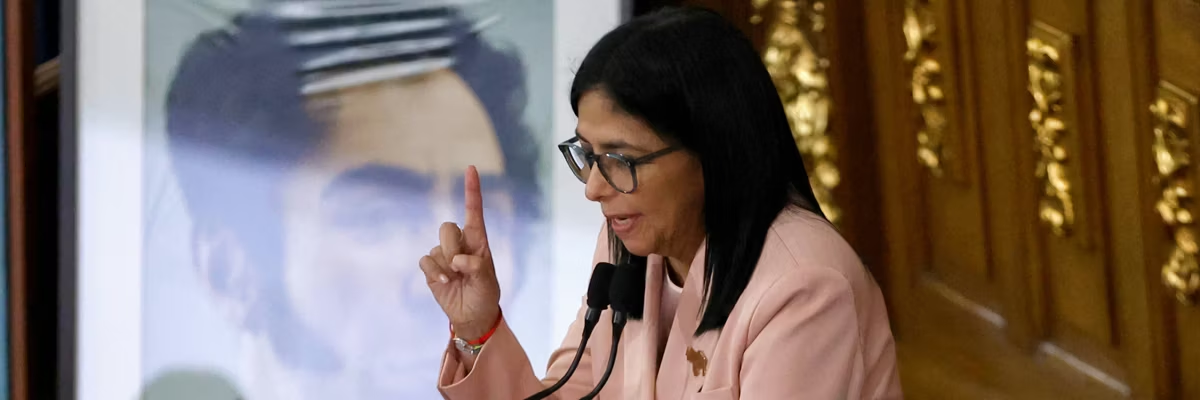
Venezuelan Vice President Delcy Rodriguez speaks during a presentation in Caracas on December 4, 2025.
(Photo by Pedro Mattey/AFP via Getty Images)
“What is being done to Venezuela is barbaric,” said Delcy Rodríguez, who assumed the role of interim president following the US abduction of Nicolás Maduro.
Venezuelan Vice President Delcy Rodríguez, who assumed the role of interim president following the US abduction of Nicolás Maduro, said in a televised address Saturday that “we will never again be a colony of any empire,” defying the Trump administration’s plan to indefinitely control Venezuela’s government and exploit its vast oil reserves.
“We are determined to be free,” declared Rodríguez, who demanded that the US release Maduro from custody and said he is still Venezuela’s president.
“What is being done to Venezuela is barbaric,” she added.
Rodríguez’s defiant remarks came after US President Donald Trump claimed he is “designating various people” to run Venezuela’s government, suggested American troops could be deployed, and threatened a “second wave” of attacks on the country if its political officials don’t bow to the Trump administration’s demands.
Trump also threatened “all political and military figures in Venezuela,” warning that “what happened to Maduro can happen to them.” Maduro is currently detained in Brooklyn and facing fresh US charges.
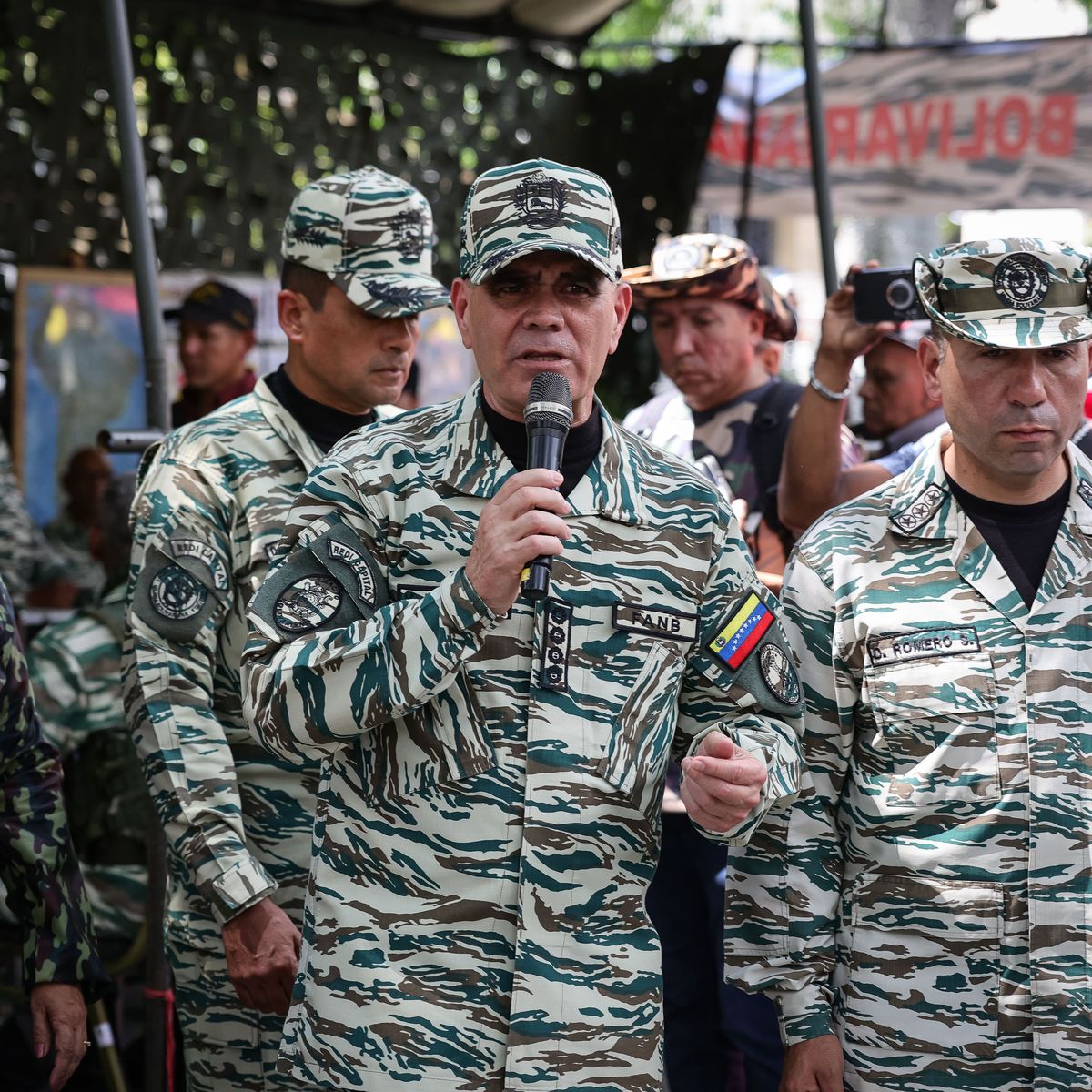
Rodríguez’s public remarks contradicted the US president’s claim that she privately pledged compliance with the Trump administration’s attempts to control Venezuela’s political system and oil infrastructure. The interim president delivered her remarks alongside top Venezuelan officials, including legislative and judicial leaders, Interior Minister Diosdado Cabello, and Defense Minister Vladimir Padrino, a projection of unity in the face of US aggression.
“Doesn’t feel like a nation that is ready to let Donald Trump and Marco Rubio ‘run it,’” said US Sen. Chris Murphy (D-Conn.), who condemned the Trump administration for “starting an illegal war with Venezuela that Americans didn’t ask for and has nothing to do with our security.”
Our work is licensed under Creative Commons (CC BY-NC-ND 3.0). Feel free to republish and share widely.
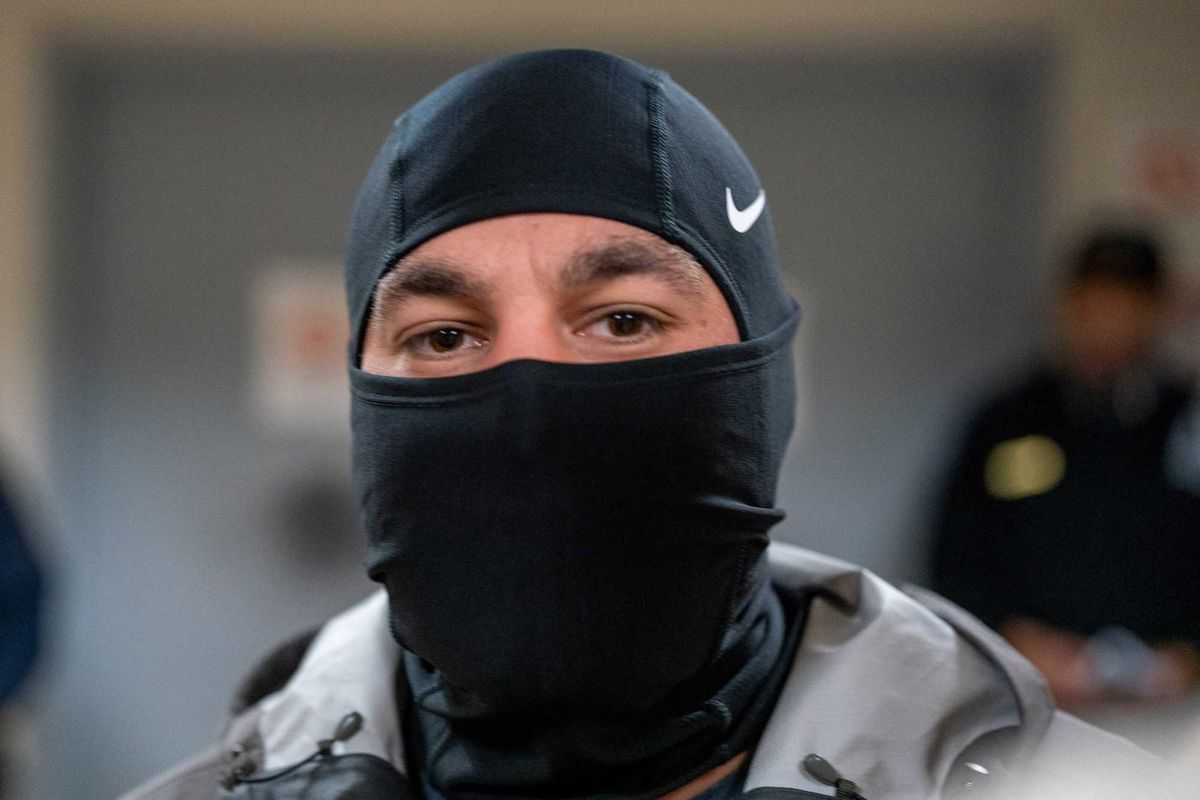
In January, the state of California and its largest county will ban law enforcement officers from covering their faces, with a few exceptions, putting local and state police at odds with masked immigration agents.
The state law gives law enforcement officers a choice: If they cover their faces, they lose the ability to assert “qualified immunity,” the doctrine that protects officers from individual liability for their actions. That means they can be sued for assault, battery, false imprisonment, false arrest or malicious prosecution, and the law adds a clause that says the minimum penalty for committing those offenses while wearing a mask is $10,000.
Assemblymember Mark Gonzalez, a Los Angeles Democrat who co-authored the law, said it was necessary to rein in anonymous federal agents.
“We initially were under the understanding that, oh, they’re only targeting folks who were not citizens,” Gonzalez said, “And then actually over time you learn they don’t give a s— who you are, they’re attacking you no matter what, with no due process.”
The Trump administration has sued to block the bill, and more than a century of federal court precedent is on its side. An 1890 Supreme Court case provides that a state cannot prosecute a federal law enforcement officer acting in the course of their duties.
The Trump administration said in its brief to the U.S. District Court for the Central District of California that forcing agents to reveal their identities would put the agents at risk.
During Immigration and Customs Enforcement “actions, individuals can be heard threatening to doxx and find out who officers and their family members are and where they live,” the administration’s lawyers said in the Nov. 17 brief. “There are even public websites that seek and publish personal information about ICE and other federal officers to harass and threaten them and their families.”
Erwin Chemerinsky, dean of the UC Berkeley School of Law, said the issue may not be as cut-and-dried as one or two Supreme Court cases. He pointed to a 2001 9th Circuit Court of Appeals decision that allowed the case of a federal sniper who killed a woman during the 1992 Ruby Ridge, Idaho, standoff to go to trial.
“It basically says that a federal officer can be criminally prosecuted for unreasonable actions,” Chemerinsky said. “Federal officers, by virtue of being federal officers, do not get immunity from all state civil and criminal laws.”
Brian Marvel, president of an organization that represents California police unions, said the law will make life harder for local cops and county sheriffs’ deputies. The organizations that represent police chiefs, sheriffs, agents in the Attorney General’s office and California Highway Patrol officers opposed the law, too.
“I think that the state has put us in a tenuous position with this battle they’re having with the Trump administration,” said Marvel of the Peace Officers Research Association of California. “We don’t want to be in the middle of this fight. But unfortunately, (with) the desire for higher name recognition and elections in 2026, they decided to create things that are much more political and not geared toward legitimate public safety issues.”
Marvel said another drawback of the law is giving “a false sense of hope to the immigrant community in California” that the law will force federal agents to leave the state.
Los Angeles County supervisors have also approved a local mask ban on law enforcement for unincorporated areas of the county, a measure that will go into effect in mid-January, unless a court decision comes sooner.
Gonzalez noted that masks have played a significant role in recent California history. First,, during the pandemic California temporarily made masks mandatory in public and at work. Then, a couple of years later, a rush of smash-and-grab robberies were harder to solve because the suspects all wore masks. Now, California finds itself in its third back-and-forth over face coverings.
The law provides exemptions for N-95 or medical-grade masks to prevent infection transmission, and permits undercover operatives to wear a mask.
“This is specifically aimed to federal agents because we gotta combat these kidnappings somehow,” Gonzalez said, “and this was our way in.”
If the world does not stand up to Donald Trump now, he will continue to wage military attacks on other countries, kidnap their leaders and steal their resources. History tells us appeasement of an aspiring fascist leader like Trump will only empower him. Will the world learn from history–or will they allow Trump to repeat it?!
Those words may sound over the top, but only because they are being applied to an American President. Put that fact aside for a moment and ask yourself: What would be our reaction if Putin waged a surprise military attack and kidnapped the leader of an oil rich country after he spoke of wanting to take their oil? Is there any doubt the US would be leading the charge to impose sanctions?
Of course not–as we saw with our reaction to Putin’s illegal invasion of Ukraine. And the rationale was the same: If the world did not stand up to Putin, he could very well be like Hitler in 1938 when he annexed Austria and then set his eyes on Czechoslovakia.
Does anyone doubt that Trump who attempted a coup, incited the Jan. 6 terrorist attack and then pardoned his MAGA terrorists is just as dangerous as the fascist leaders and tyrants we have seen in the modern era?!
Now let’s be clear about one thing: Venezuela’s leader Nicolas Maduro is awful. He headed a brutal and oppressive regime. As Human Rights Watch (HRC) documented, since Maduro stole the 2024 election, the Venezuelan government “has killed, tortured, detained, and forcefully disappeared people seeking democratic change.” The head of HRC said earlier this year, “Foreign governments should recommit to supporting the fight for democracy and human rights in Venezuela and press to hold the Maduro government accountable for its atrocities.”
But the way to effectuate change is within the parameters of international law—sanctions, diplomatic pressure, bank freezes, etc. Instead, Trump has turned the United States into a rogue nation by openly and repeatedly violating international law—beginning with murdering people in international waters off the coast of Venezuela.
That is not just my view but also international legal experts and United Nation’s officials. Just last month, I wrote an article that focused on UN High Commissioner for Human Rights Volker Türk’s statement on why the military strikes on fishing boats by Trump are illegal under international law. As the UN official noted, “Under international human rights law, the intentional use of lethal force is only permissible as a last resort against individuals who pose an imminent threat to life.”
Turk continued that based on the “very sparse” information about the ships provided by Trump, “none of the individuals on the targeted boats appeared to pose an imminent threat to the lives of others or otherwise justified the use of lethal armed force against them under international law.” This view is backed up international legal experts.
Every fishing boat targeted was more than 1,500 miles from the US coastline—in other words days away. None were an imminent threat to our nation or citizens. And Trump lied that the ships carried fentanyl. Fentanyl does not come from Venezuela.
Finally, Trump declared two weeks ago that his designs on Venezuela were actually about taking the oil. That is when Trump told reporters about Venezuela, “We had a lot of oil there. As you know they threw our companies out, and we want it back.” He backed that up with a post on social media demanding Venezuela return “to the United States of America all of the Oil, Land, and other Assets that they previously stole from us.” (As fact checkers note, the oil was owned by Venezuela as a natural resource—not by the United States.)
Given the world yawned as Trump murdered more than 100 people in fishing boats, Trump knew he could escalate the military action which led to Saturday’s surprise military attack and kidnapping of Maduro. After the attack, Trump vowed “to run the country” until we can install a leader who lines up with Trump’s views. (I hope the people of Venezuela like higher prices, higher unemployment and Trump’s name being affixed to all their big buildings!)
But Trump—not being able to censor himself given his cognitive slide—also told us that he will be sending in oil companies to take the oil. Trump declared, “We’re going to have our very large United States oil companies, the biggest anywhere in the world, go in, spend billions of dollars, fix the badly broken infrastructure, the oil infrastructure, and start making money for the country.”
These massive, multi-national oil companies are NOT doing a public service. They are going into Venezuela to make billions for their executives and shareholders. This is just as Trump promised during the 2024 campaign when he told the oil oligarchs if they support him with massive campaign donations, they will make even more money when he is the White House. Big oil did exactly what Trump asked so Trump is now rewarding them with access to literally the largest oil reserves in the world.
Few support this military action. A recent Quinnipiac poll found nearly 2/3’s of Americans oppose military action against Venezuela. What percentage support military action? Only 25%. That means even a big chunk of MAGA opposes it. But Trump doesn’t care. This a military campaign to help the oil oligarchs who bankrolled his campaign.
The idea that Trump is bringing Maduro to justice for allowing drugs to come to America is a joke. Just weeks ago, Trump pardoned former Honduran President Juan Orlando Hernandez—a narco-terrorist who was a business associate of the notorious drug dealer El Chapo. As I wrote about, Hernandez was convicted of helping violent drug cartels dump more than 400 tons of cocaine in the United States. Based on the overdose death data, Hernandez was responsible for more American deaths than Bin Laden. That is who Trump pardoned.
Put politics aside for a moment. Think about how the United States of America is now seen on the world stage after Trump waged a surprise military attack upon Venezuela to remove the regime, has vowed to “run” the country until he can find a new leader who will do what he wants and is openly sending in his oil oligarchs to make billions off the nation’s oil?! Is that the America you want to be known for?!
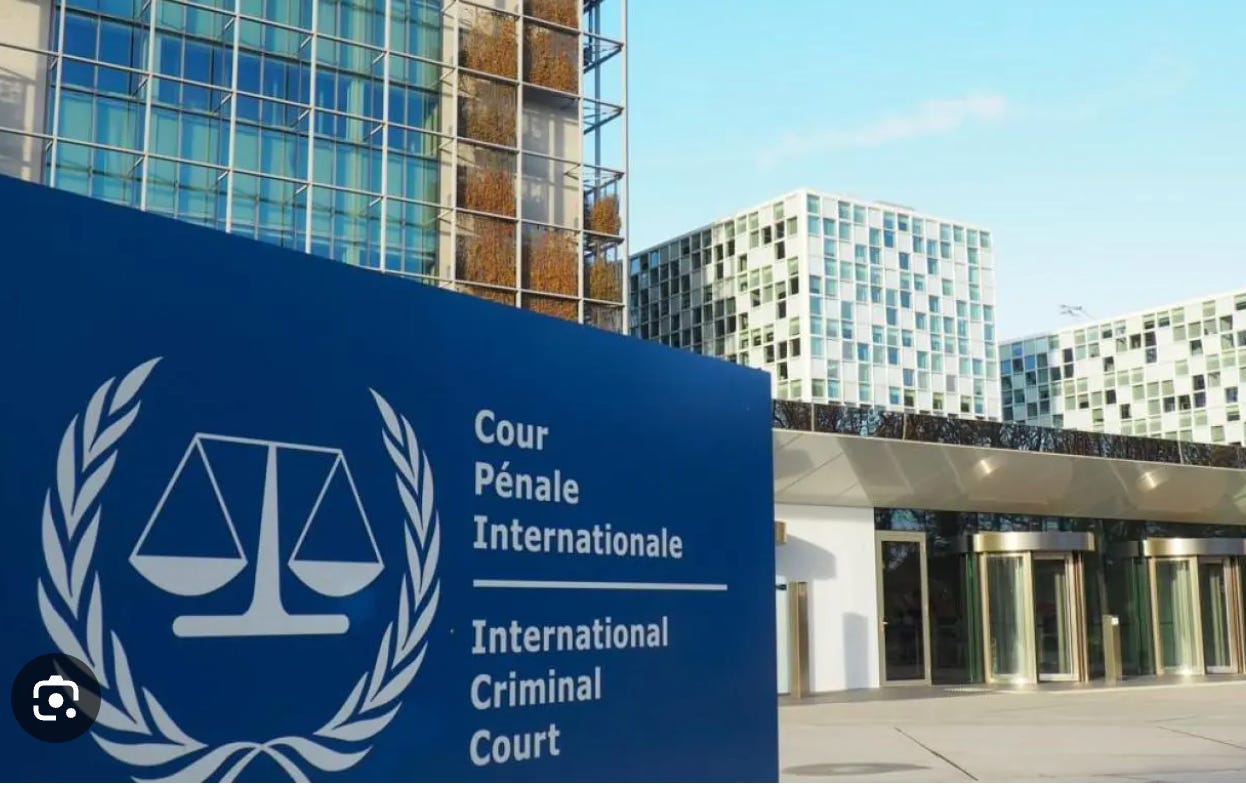
At this point, Democrats in Congress need to do more than just move to impeach Trump. They should be calling for the International Criminal Court (ICC) to investigate Trump for his crimes. And while it’s true that the US is not a member of the ICC, the court still has jurisdiction over a citizen of a non-member country who commits war crimes on the territory of an ICC member country. Venezuela is a member nation of the ICC meaning Trump can be charged for war crimes, crimes against humanity or other crimes he commits on the soil of Venezuela.
Trump is the Putin of the Western hemisphere and should be treated as such including being prosecuted and personally sanctioned—along with his top officials—by other nations.
As we learned with Trump, if there is no punishment for his crimes, he will commit more—meaning he will 100% attack other nations. That is why we must demand Trump be prosecuted at The Hague. Even the threat of that very real prosecution may be enough to deter Trump from more illegal military actions. In any event, we can’t be silent or the world will believe that we all agree with Trump’s illegal actions!
The Dean’s Report by Dean Obeidallah is a reader-supported publication. To receive new posts and support my work, consider becoming a free or paid subscriber.
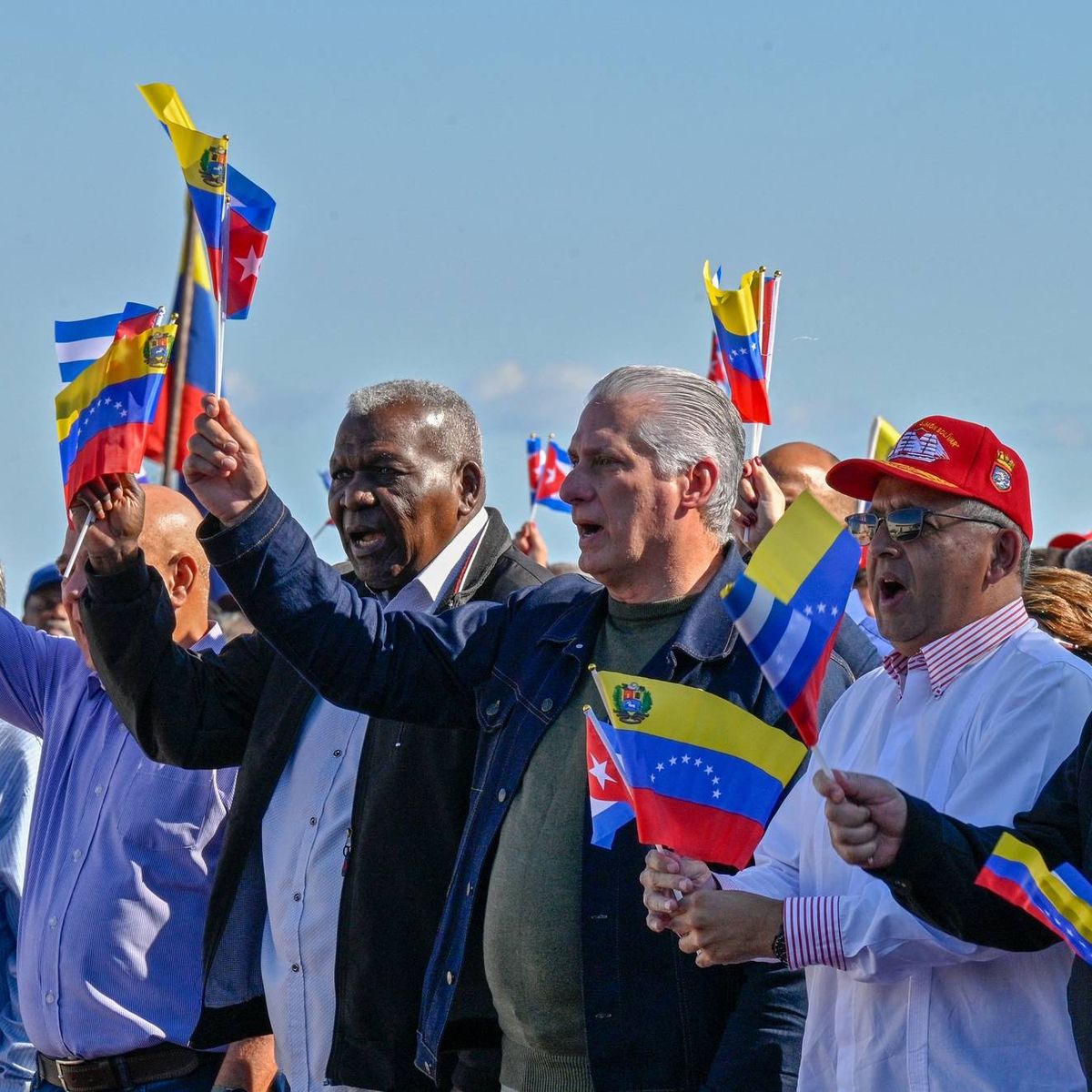
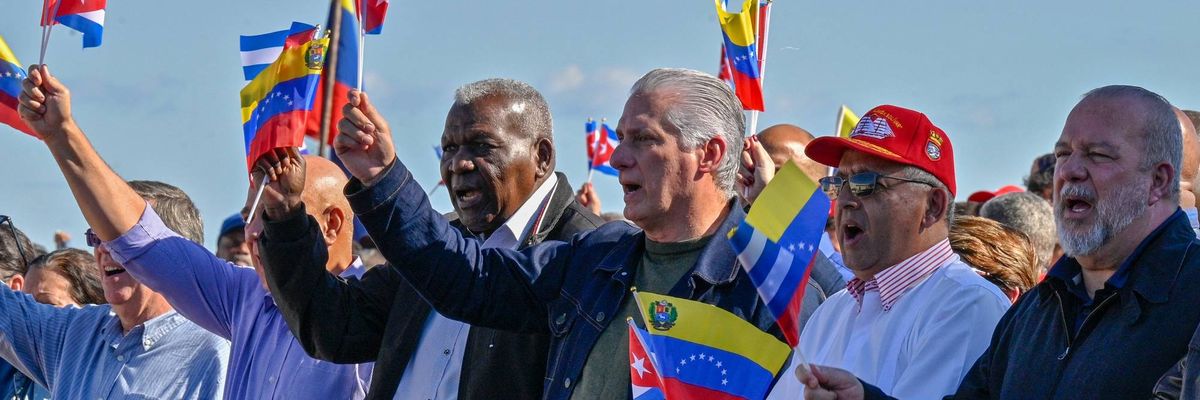
Cuban President Miguel Diaz-Canel waves a Venezuelan national flag in Havana on January 3, 2026.
(Photo by Adalberto Roque/AFP via Getty Images)
“The ‘Trump corollary’ to the Monroe Doctrine—applied in recent hours with violent force over the skies of Caracas—is the single greatest threat to peace and prosperity that the Americas confront today,” said Progressive International.
US President Donald Trump and top administration officials, including Secretary of State Marco Rubio, characterized Saturday’s assault on Venezuela and abduction of the country’s president as a warning shot in the direction of Cuba, Mexico, Colombia, and other Latin American nations.
During a Saturday press conference, Trump openly invoked the Monroe Doctrine—an assertion of US dominance of the Western Hemisphere—and said his campaign of aggression against Venezuela represented the “Donroe Doctrine” in action.
In his unwieldy remarks, Trump called out Colombian President Gustavo Petro by name, accusing him without evidence of “making cocaine and sending it to the United States.”
“So he does have to watch his ass,” the US president said of Petro, who condemned the Trump administration’s Saturday attack on Venezuela as “aggression against the sovereignty of Venezuela and Latin America.”
Petro responded defiantly to the possibility of the US targeting him, writing on social media that he is “not worried at all.”
In a Fox News appearance earlier Saturday, Trump also took aim at the United States’ southern neighbor, declaring ominously that “something’s going to have to be done with Mexico,” which also denounced the attack on Venezuela and abduction of President Nicolás Maduro.
“She is very frightened of the cartels,” Trump said of Mexican President Claudia Sheinbaum. “So we have to do something.”
“This armed attack on Venezuela is not an isolated event. It is the next step in the United States’ campaign of regime change that stretches from Caracas to Havana.”
Rubio, for his part, focused on Cuba—a country whose government he has long sought to topple.
“If I lived in Havana and I was in the government, I’d be concerned, at least a little bit,” Rubio, who was born in Miami to Cuban immigrant parents, said during Saturday’s press conference.
“It is the next step in the United States’ campaign of regime change that stretches from Caracas to Havana—and an attack on the very principle of sovereign equality and the prospects for the Zone of Peace once established by the Community of Latin American and Caribbean States,” the coalition said in a statement. “This renewed declaration of impunity from Washington is a threat to all nations around the world.”
“Trump has clearly articulated the imperial logic of this intervention—to seize control over Venezuela’s natural resources and reassert US domination over the hemisphere,” said Progressive International. “The ‘Trump corollary’ to the Monroe Doctrine—applied in recent hours with violent force over the skies of Caracas—is the single greatest threat to peace and prosperity that the Americas confront today.”
Our work is licensed under Creative Commons (CC BY-NC-ND 3.0). Feel free to republish and share widely.
We protest Heritage Foundation EVERY MONDAY (Join us!!!!) By admin | September 2, 2025 | Uncategorized Cliff Cash Comedy Premiered Jul 26, 2025 Every Monday at The Heritage Foundation 214 Massachusetts Ave. Washington D.C. 4pm protest 6pm pizza Every Friday at Fox News D.C. 400 N. Capitol St. Washington D.C. 4pm protest 6pm pizza We are... Continue reading →
Milk Club Trans Caucus Meeting Date: Tuesday, April 28 Time: 5-7 PM Location and Zoom Link: Meeting info available to members of the Milk Club Trans Caucus. Please reach out to trans@milkclub.org if you would like to join the Milk Club Trans Caucus.
San Francisco Young Democrats meet with SFDems Chair Nancy Tung Wednesday, April 29th | 2pm Location: SC T-160 (third floor of Student Center) Register The San Francisco Young Democrats at SF State are teaming up with SFDems to make sure their voices are heard. Want to get more plugged into San Francisco... Continue reading →
One Million Rising: Strategic Non-Cooperation to Fight Authoritarianism Virtual Event · Hosted by No Kings Time Wednesdays 8 – 9:30pm EDT Location Virtual event Join from anywhere About this event Across the country, authoritarian forces are getting bolder and more dangerous. Trump and his allies are not hiding their agenda: mass deportations,... Continue reading →
THURSDAY, JUNE 29, 2023 AT 2 AM – 4 AM PDT How to create trust in a group? Details Event by Extinction Rebellion Empathy Circles online EMPATHY CAFE Duration: 2 hr Public · Anyone on or off Facebook How to create trust in a group? This is the question that arose in our... Continue reading →


 by Margaret Kadifa and Mariana Garcia January 6, 2026 (MissionLocal.org)