by Randy Shaw on December 15, 2025 (BeyondChron.org)
Mayor Lurie Boosted SF’s Hopes
San Francisco in 2025 was framed around Mayor Lurie’s efforts to promote the city’s “comeback.” He faced multiple obstacles: the nation’s highest downtown office vacancy rate, a dying San Francisco (formerly Westfield) Centre, retail vacancies around Union Square and other neighborhoods, a weak private housing construction market, a struggling tourist economy, and open-air drug markets and sidewalk drug use in multiple communities.
A sharply declining San Francisco economy and huge city budget deficit reflected these problems.
In the face of these challenges Mayor Lurie ended the year with a roughly 70% approval rate. While some criticize him for being overly positive, San Francisco wanted a mayor who could restore hope in the city’s future.
The city has a long way to go. But most believe Lurie got San Francisco back on track. Even his regular critics praised him for stopping Trump from sending the National Guard to San Francisco.
Did SF Come Back?
On October 14 I wrote, “How Real is San Francisco’s Comeback?” I went through the problems listed above and found little actual progress. There has since been some recovery in Union Square. New buyers were found for the Hilton and Parc 55 Hotels. The city used private funds to temporarily fill long vacant stores on Powell Street on Union Square’s border.
The now completely vacant San Francisco Centre has gone back to the lender. This sets up an opportunity for a new owner to invest in a successful operation. I’m told it will not be retail. How about something like Legoland? That would bring people to the area.
Otherwise, Mid-Market most positive sign in 2024—the opening of IKEA and its adjacent Saluhall food court—went backwards in 2025. The food hall lacks customers. Many vendors have left. Saluhall suffers from the huge loss of foot traffic caused by the San Francisco Centre’s closure.
Mid-Market during the day often resembles a ghost town. After midnight it’s a different story. The city’s largest evening open air drug market is at the northwest corner of Sixth Street as it crosses Market. JJ Smith’s drone on December 9 at 6am shows the overhead view of massive public drug activities only a block from the Golden Gate Theater and near upscale hotels. The drug market has recently expanded to also cover the block of Golden Gate Avenue housing St. Anthony’s.
Seeing this huge drug crowd in a prime theater area is shocking when seen for the first time. But it is there nightly.
Mid-Market is included in the funding orbit of the San Francisco Downtown Development Corporation. That could help the historic neighborhood in 2026.
SOMA also failed to come back in 2025. The SOMA West CBD spent over $800,000 on private security guards this year, $600,000 coming from the city. And the Folsom Streetscape Project has badly hurt businesses in the area; the head of the SOMA West CBD believes that street disruption “probably hurts corridor merchants more than the addiction crisis.”
Overall, while many city neighborhoods are doing great, Central City retail corridors are not. It’s a tale of two San Francisco’s, one that City Hall will have to try harder to unite.
Prioritizing Downtown
The mayor helped raise over $60 million in private funds for the newly-created San Francisco Downtown Development Corporation. CEO Shola Olatoye wants downtown to be a “24/7, world-class neighborhood.” Downtown San Francisco has never been such a neighborhood so the SFDDC’s ambitions are high.
Lurie is razar focused on reviving downtown. The city can beautify downtown and ensure public safety but if workers aren’t coming to offices the area’s revenue base will not return.
The mayor has drawn strong support from hotel owners for his efforts to revive San Francisco’s tourist industry. Trump’s attack on international tourism and Canadians in particular didn’t help, but the mayor did all he could to get tourists back. The convention business in 2026 looks good.
The business community has completely bought into Lurie’s vision. We’ll know by the end of 2026 whether this translates into higher downtown occupancy and a resurgent local economy.
San Francisco has seen steadily declining crime numbers. But as Kennedy states, people don’t bother calling the police about drug activities where open-air drug markets “are off the hook.”
Because the city does not count the number of sidewalk drug users, progress must be determined visually. I did not see fewer Tenderloin drug users in 2025. Nor are people seeing fewer drug users in post-midnight Sixth and Market, at 16th and Mission, along parts of Van Ness, and other neighborhoods.
In 2025 I wrote more stories about the city’s failure to close open-air drug markets and stop sidewalk drug use than any other topic.. Mayor Lurie acknowledges the lack of progress. But as I recently wrote, the city can’t continue using the same strategies that haven’t closed drug markets and cleared drug-filled sidewalks in the past and expect different results.
City Hall needs a specific deadline for closing drug markets and clearing drug users from sidewalks. These impacted communities deserve better in 2026.
Homelessness
The debate about homelessness shifted in 2025 as most people using drugs on sidewalks refused shelter or housing. Many now see homelessness as driven by drugs as well as the inability to afford housing.
Permanent drug-free housing addresses both concerns. Despite support from Mayor Lurie and nearly every supervisor, 2025 ends without a single unit of drug-free permanent housing. Or even a single unit where people who have obtained recovery are guaranteed a permanent home upon leaving their drug-free home.
I understand money is tight. But it’s hard continuing to hear city officials promoting a permanent drug-free strategy without funding it.
The Tenderloin
2025 was a disappointing year for the Tenderloin.
Little Saigon is still suffering from the destructive city programs that converted three tourist hotels in the area to shelters with drug users. Too many Tenderloin sidewalks remain drug-filled.
Only blocks patrolled by Urban Alchemy are consistently drug-free. The city could expand the number of drug-free blocks through a partnership between the SFPD and Urban Alchemy, but City Hall has no plans to do so.
It’s harder to get new businesses to open in the Tenderloin when retail vacancies are widely available in more protected neighborhoods. The Tenderloin was excluded from getting any funds from the San Francisco Downtown Development Corporation.
The Tenderloin won a major breakthrough in November when the Police Commission voted 7-0 to reduce and revise the boundaries of Tenderloin Police Station. We had to wait ten years to reverse that radical shift in boundaries that former Chief Suhr rammed through in 2015. Starting in June most Tenderloin officers will again be serving the Tenderloin.
In 2025 my Tenderloin Housing Clinic colleague Pratibha Tekkey became the first Tenderloin-based member of the Police Commission. The combination of a new Police District and Tekkey’s presence on the Commission should help reduce sidewalk drug activities.
2025 also saw the Tenderloin Museum celebrate its 10th Anniversary. It was accompanied by a planned expansion that will triple its size. The expansion will enable the Museum to launch the nation’s first permanent exhibition on the national Indian-American hotel industry, which has deep roots in the Tenderloin.
The 2024 lawsuit filed by Tenderloin families and small businesses continues to fight to stop nonprofits from handing out drug materials to addicts. Unfortunately, City Attorney David Chiu continues to wage an all-out legal fight to keep the flow of drugs going in the Tenderloin.
Politicians all talk about how the Tenderloin is a neighborhood of children. Yet they allow Tenderloin kids to be subjected to sidewalk conditions they would never accept for their own families.
On to 2026
After using 2025 to lay out his foundation for future progress, Mayor Lurie must deliver results in 2026. For many the mayor’s honeymoon ends at the start of his second year. Lurie has shown in many ways—the Family Zoning Plan, permit reforms, small business assistance, efforts to increase police staffing to name a few—that he likes to get stuff done.
San Francisco needs stuff to get done. Let’s hope more stuff gets done to move the city forward in 2026.
<I>Randy Shaw is the Editor of Beyond Chron and the Director of San Francisco’s Tenderloin Housing Clinic, which publishes Beyond Chron. Shaw’s new book is the revised and updated, The Tenderloin: Sex, Crime and Resistance in the Heart of San Francisco. His prior books include Generation Priced Out: Who Gets to Live in the New Urban America. The Activist’s Handbook: Winning Social Change in the 21st Century, and Beyond the Fields: Cesar Chavez, the UFW and the Struggle for Justice in the 21st Century. </I>
by Randy Shaw on December 15, 2025 (BeyondChron.org)
The Power of Resistance
2025 was a memorable year for America. Mostly for bad reasons. We learned that the United States Constitution’s heralded “separation of powers” provides no check on the Supreme Court. The Court freely ignores case precedents and the rule of law, and justices accept free plane flights with donors with cases before them.
We also learned that while “the power to tax is the power to destroy,” the President can unilaterally impose large tariffs. And refuse to spend money on programs funded by Congress.
We also learned that the President’s federal pardon power is unlimited. The President and his family/business allies can even put pardons up for sale.
A long list of uncomfortable truths about America were exposed in 2025. Fortunately, 2025 also showed the ongoing power of resistance.
Open Racism Returns
Racism has afflicted the United States since the first slaves arrived in 1619. But no President in the past century has been as overtly racist as Donald Trump in 2025.
Trump’s description of non-white Somali’s as “garbage” and non-white countries as “s_itholes,” his prioritizing white Afrikaner immigrants, and his promoting a risk to white European culture allegedly caused by non-whites returned U.S. racism to a pre-1960’s level.
2025 further confirmed that while Barack Obama’s election was touted as leading to a post-racial society, it actually revived a political agenda based on white supremacy. Trump defined the 2016 election as America’s last chance to save white culture.
In 2016 and 2024 Trump focused his racist attacks on immigrants, not native-born non-white Americans. But Trump’s racist agenda became more direct and explicit in 2025. Trump’s Supreme Court upheld the stopping of Brown-skinned people without cause. American citizens are routinely stopped by ICE and taken into custody despite having legal identification.
This wasn’t supposed to happen in America. But in 2025 it does.
We learned in 2025 that a President is free to disproportionately fire Black federal employees. And selectively cut programs with a negative disparate impact on non-whites. The government even feels free to bar funding from programs that use any words that support black Americans or non-white immigrants (Head Start was sent a list of nearly 200 words whose inclusion in grant applications would deny funding).
Republicans used to rely on indirect racist appeals. Recall Reagan’s opening his 1980 campaign in a city where three civil rights workers were killed. Or George H. W. Bush’s 1988 Willie Horton ads.
But Trump is the first president in the past century to make racism against Blacks and Latinos central to his agenda. He’s still angry over the government suing his father for racial discrimination in housing. Trump has become so hateful that he recently eliminated free admission days for National Parks on Martin Luther King, Jr Day and Juneteenth—the only Black-focused national holidays.
He replaced the free days with his birthday.
This is not a spoof. It’s true. Unlike politicians like Alabama’s Governor George Wallace, who promoted racism solely for political ends, Trump’s racism goes to the core of who he is.
Since World War 2 Germany teaches its kids about the evils of Nazism and the Holocaust. In contrast, American kids are taught that the Rebels fighting for slavery was “a noble cause.” Trump has prioritized restoring Confederate monuments because his chief goal as President is doing his best to restore the Confederacy.
The Media’s Failure
The other extremely troubling fact we learned about America in 2025 is the failure of legacy media to hold Trump accountable. Instead of using its power to protect democracy, most legacy media is content to report on Trump’s progress undermining it.
Nixon’s resignation after Watergate was said to prove the American system “worked” But the Washington Post that uncovered that scandal is now a Trump-cheering platform for owner Jeff Bezos to curry favor with the President.
CBS was once the icon of television news. From Ed Murrow to Walter Cronkite, CBS was the gold standard for national news. Under the new ownership of Trump ally David Ellison, CBC now operates like Fox News.
A New York Times that endlessly highlighted Hillary Clinton’s private emails and Biden’s poor health looks the other way for Trump. Why? It could be that its editors fear personal violence from Trump backers if they are seen as being “unfair”to the President.
Any day on Bluesky offers dozens of examples of how differently the legacy media treats behavior by Trump and his administration compared to any Democratic presidential team. Its more one-sided favoring Trump’s crowd than any Democrat President has ever seen.
The Power of Resistance
Fortunately, among all the terrible realities of American politics in 2025 there is one major bright spot: the power of resistance remained strong. From New York City to Chicago to Portland to Los Angeles along with too many cities to name, activists fought back against ICE terrorism and stopped the attacks. The No Kings marches were huge as were the Democratic Party turnouts in the November 2025 elections.
This resistance cannot stop every outrage. But Trump and his team now know their days of unprecedented power will soon end. Some Republican elected officials are finally turning against Trump, and even the legacy media is demonstrating a greater willingness to criticize.
It is the power of resistance that sustained America in 2025. And that propels a better future.
<I>Randy Shaw is the Editor of Beyond Chron and the Director of San Francisco’s Tenderloin Housing Clinic, which publishes Beyond Chron. Shaw’s new book is the revised and updated, The Tenderloin: Sex, Crime and Resistance in the Heart of San Francisco. His prior books include Generation Priced Out: Who Gets to Live in the New Urban America. The Activist’s Handbook: Winning Social Change in the 21st Century, and Beyond the Fields: Cesar Chavez, the UFW and the Struggle for Justice in the 21st Century. </I>
by Randy Shaw on December 12, 2025 (BeyondChron.org)
(Editor’s Note: Last Friday night City Hall celebrated the installation of Mayor Edwin M. Lee’s Mayoral Bust. Ed Lee was the best San Francisco mayor of my lifetime. His life was tragically cut short eight years ago. I have reposted my 2017 story on Lee’s legacy. I particularly encourage those unfamiliar with Lee’s enormous accomplishments to read about what he did).
A Remarkable Mayor (Written Following His Death)
I envisioned writing about San Francisco Mayor Ed Lee’s historic legacy—-in December 2019, as his days in office ended. It is with great sadness that I publish this now. I may have written more stories about Mayor Lee’s tenure than anyone, and this is one piece I wish I did not have to write.
Many see Lee’s legacy as his being the city’s first Chinese-American mayor. But Lee’s impact on San Francisco is far more significant for his policy accomplishments.
His historic legacy is primarily in three main areas: housing, the revival of Mid-Market/ Tenderloin, and transitioning San Francisco’s economy into the post-tech era.
Lee took on issues in all areas, such as pushing to build housing on the Westside, that no prior mayor had adequately addressed. He consistently offered a bold approach at odds with media depictions of him as an unambitious city leader.
Building Housing a Priority
Ed Lee was the first mayor in San Francisco history to make building new housing a top priority. His commitment of 5000 new units annually more than doubles the city’s annual approach over the last five decades. Helped by a new generation of YIMBY activists, Lee forever eliminated San Francisco’s historic hostility toward building enough housing to meet rising population and job growth.
I had a chance this fall to sit down with Lee to discuss how he became the first mayor to prioritize tackling the city’s longstanding housing deficit. The interview was for a new book I have coming out from UC Press next fall on how blue cities across the nation can slow if not stop the pricing out of the working and middle-class.
Ed Lee was a visionary in this area. Lee was ahead of his time in recognizing San Francisco desperately needed to build a lot more housing. He also understood that building housing alone was not enough, and had to be accompanied by stronger tenant protections.
Lee signed all of the major tenant protection measures passed by the Board. He invested more money in stopping no-fault evictions than all prior mayors combined.
Critics of Lee’s housing affordability record ignored that the working and middle class was priced out of most San Francisco neighborhoods before Ed Lee took office. They also ignored that housing prices also skyrocketed in Seattle, Denver, Portland, Los Angeles, Austin, New York City, Cambridge and many other cities. It was not a unique San Francisco problem caused by Mayor Ed Lee.
The truth is that what happened to housing prices in San Francisco starting in 2011 was part of a national urban housing crisis. The idea that Mayor Lee could have kept San Francisco, long among the priciest of cities, immune from these price hikes is something out of a fantasy novel. It has no connection to urban reality
With single family home prices and rents on vacant apartments exempt from government regulation, a mayor’s options are limited. The only way Lee could meaningfully address rising prices was by dramatically increasing affordable housing and increasing housing supply overall.
And that’s exactly what he did.
Mayor Ed Lee imposed a more comprehensive affordable housing agenda from 2011-2017 than in any other city. He also brought in more new affordable housing funds than any prior San Francisco mayor.
Recall that San Francisco had three failed affordable housing ballot measures prior to Lee placing a winning $310 million bond on the November 2015 ballot. Why did this bond pass while others failed and one affordable housing measure did not even get 50% on the November 2008 Obama ballot?
Mayoral leadership provided by Ed Lee made the difference.
Lee passed a $1.3 billion housing trust fund for the very poor families living in public housing, a $310 million affordable housing bond, and allocated major general fund dollars to housing homeless people. Think about the above facts when someone tells you that Lee “only cared about housing for the rich.”
Ed Lee will go down in history as San Francisco’s housing mayor.
Homelessness
Ed Lee greatly increased spending to address homelessness. Yet the results, based on encampments and what people see on city sidewalks seem to not reflect either this financial commitment or a sound strategy. But ignored by critics of Lee’s approach to homelessness is how Los Angeles, Portland, Seattle, New York City and other cities saw homelessness rise far more than San Francisco during the Lee years.
Every San Francisco mayor since homelessness reemerged in 1982 —Feinstein, Agnos, Jordan, Brown, Newsom, and Lee— has been criticized for not effectively dealing with homelessness. It should be obvious by now that no mayor can solve homelessness because no city can solve a problem requiring a major federal response.
You can’t evaluate a mayor’s record on homelessness by comparing it to a city outside the United States (in a country that funds affordable and public housing) or to a mythical city within this country; homelessness is a national problem that no city has the space or resources to solve.
That’s why homeless advocates from across the nation held Ed Lee in such high regard. They know what all cities are doing and recognize that San Francisco has the most comprehensive approach. When people say Lee did a “bad” job on homelessness, ask them what city in the United States they are comparing San Francisco to.
Mid-Market/Tenderloin
Until Ed Lee took office, no mayor invested major resources in two great historic neighborhoods that had endured fifty years of hard times. Ed Lee took up the challenge.
Among my saddest feelings about Ed’s death this week is that he did not live to see the fruition of his work in these two neighborhoods. I always thought that he, I, and Office of Economic and Workforce Development (OEWD) staff would take a tour of Mid-Market and the Tenderloin in December 2019 to appreciate all that the mayor’s leadership has achieved.
We will have to take that walk without him. Projects in both neighborhoods encountered unexpected delays due to rising construction costs in 2017, but they will be completed or nearly done by the date Lee was supposed to leave office. By this scorecard Lee fulfilled his goal.
Ed Lee rescued Mid-Market. He invested economic development resources in the Tenderloin, paving the way for the Tenderloin Museum, 826 Valencia, the Black Cat, Onsen Spa, CounterPulse, PianoFight, and neon signs and façade improvement throughout.
Ed graciously did a blurb for the back cover praising my book on the Tenderloin. At virtually every event in Mid-Market or the Tenderloin, Lee would always urge the audience to visit the Tenderloin Museum. He loved the Tenderloin, a neighborhood that did not get a fair shake from prior mayors. Lee matched his love with OEWD staff, and they made a huge difference.
Mayor Lee took such joy in the opening of new Tenderloin businesses. And nothing would have made him happier than when the long overdue Tenderloin streetlight project (adding roughly 100 streetlights) is completed next summer. The Tenderloin is very dark at night due to a lack of streetlights. I asked the mayor to request $3.5 million from CPMC for this project as part of his negotiations for their big new hospital on Van Ness. I figured the mayor would use that number to compromise down to $3 million.
But Lee did not get us $3 million. He got us $4 million. That’s the real Ed Lee. He was a far bolder, innovative and creative thinking mayor than the media has portrayed him.
Thanks to Ed Lee’s leadership, by the end of 2019 we will have a revitalized Mid-Market and safe, healthy, and economically diverse Tenderloin. This is a crucial part of Ed Lee’s historic legacy.
A Prosperous City
One reason some have not appreciated Lee is that he made huge advances look easy.
When he began as mayor, San Francisco unemployment was at near record highs. He soon brought it to record lows.
When Lee started as mayor, tech companies routinely left San Francisco for the South Bay to avoid a payroll tax no other city in California imposed. Ed created a political coalition to get voters to eliminate that tax.
Those thinking that San Francisco would be more affordable had tech not stayed, check out the other blue cities across the nation whose skyrocketing housing prices are not driven by tech. Lee helped make San Francisco the envy of other cities for its prosperity. And he used that prosperity to house homeless people, improve transit, and otherwise improve the city for everyone.
No San Francisco mayor had greater economic success than Ed Lee. This is part of his historic legacy.
A New Type of Leadership
Ed offered a new type of leadership for San Francisco. He did not yell at department heads, threaten staff, or dominate meetings that he attended. For these very reasons some in the media saw him as weak.
But Ed Lee was as strong a mayor as the city has ever had. He did not need to yell or threaten to demonstrate strength. He had no problem being self-deprecating, particularly about his height.
Ed Lee assembled the broadest electoral coalition on behalf of affordable housing in the history of San Francisco. He then won the biggest electoral victories for housing. That does not happen without strong mayoral leadership.
I was with Lee the day after the November 2016 election. Nobody hearing his public commitment to retaining San Francisco as a sanctuary city would have ever called him weak.
Lee was as outspoken against the Trump Administration as any mayor in the country.
Lee’s strength was also shown in his ability to take criticism. When I told the mayor at a small meeting why his D3 supervisor appointment the preceding day of Julie Christiansen instead of Cindy Wu was a colossal mistake and betrayal of Chinatown (Rose Pak insisted I pull no punches), he accepted it. We maintained our ability to work together on issues where we agreed. With other mayors that would have been the last words we spoke.
But Lee had the inner strength to recognize that people who strongly agree on many issues will equally strongly disagree on some—and that you cannot allow what divides you to define your relationship.
Lee did not micro-manage department heads. That’s one of the reasons he was so popular with them—he let good people do their jobs. Sometimes his lack of supervision caused projects to drift, as occurred with Better Markets Streets. But people underestimate the high level of proficiency Lee’s government operated because they are not comparing it to other cities, but rather to a lost city of Atlantis where double-parked trucks do not exist and busses never come late.
Ultimately, Ed Lee laid down the foundation for San Francisco to avoid becoming a city of only the rich and rent subsidized poor. This was his greatest gift to the city, and the core of his legacy.
San Francisco will miss Ed Lee. He has set a very high bar for his successors.
<I>Randy Shaw is the Editor of Beyond Chron and the Director of San Francisco’s Tenderloin Housing Clinic, which publishes Beyond Chron. Shaw’s new book is the revised and updated, The Tenderloin: Sex, Crime and Resistance in the Heart of San Francisco. His prior books include Generation Priced Out: Who Gets to Live in the New Urban America. The Activist’s Handbook: Winning Social Change in the 21st Century, and Beyond the Fields: Cesar Chavez, the UFW and the Struggle for Justice in the 21st Century. </I>
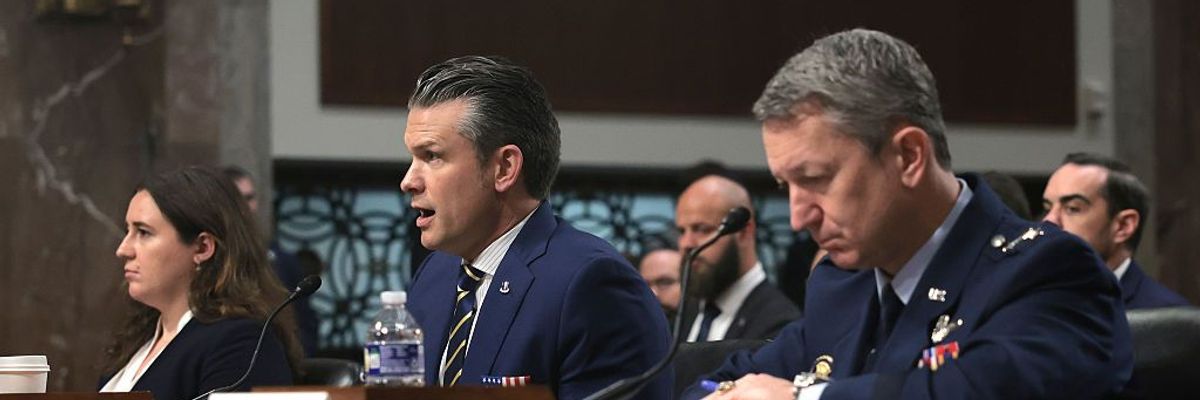
US Secretary of Defense Pete Hegseth and other top military officials testify before the Senate Armed Services Committee on June 18, 2025 in Washington, DC.
(Photo by Kayla Bartkowski/Getty Images)
“This ramping up of the bombing campaign despite increased pressure from Congress signals the administration’s total disregard for the law.”
Human rights groups are demanding that the US Congress intervene to bring an end to President Donald Trump’s boat-bombing spree.
Both Amnesty International and Human Rights Watch (HRW) on Tuesday released statements condemning the Trump administration for launching more military strikes on purported drug trafficking boats, and they called on US lawmakers to assert their powers over American foreign policy to restrain the White House.
Daphne Eviatar, director of security and human rights for Amnesty International USA, argued that the administration does not seem at all deterred by potential congressional probes of its policies, and urged lawmakers to take a more aggressive approach.
“This ramping up of the bombing campaign despite increased pressure from Congress signals the administration’s total disregard for the law,” said Eviatar. “Congress must do everything in its power to rein in this administration’s lawless behavior. Congress must exercise its oversight power to ask how these decisions are made, what intelligence is being used, and what the legal justification the administration is claiming and push back forcefully on these illegal actions.”
Eviatar emphasized that the administration’s killings “amount to extrajudicial executions, a form of murder, in clear violation of both domestic and international law,” while adding that the administration has legal methods at its disposal to intercept suspected drug boats that don’t involve slaughtering everyone onboard.
HRW, meanwhile, released a lengthy analysis breaking down the illegality of the Trump boat strikes, while also demanding Congress use its oversight powers to hold administration officials accountable for lawbreaking.
“Congress should intervene urgently,” the group declared. “The administration’s lethal boat strikes, conducted without a clear legal basis and outside any armed conflict, demand immediate congressional scrutiny.”
HRW also outlined actions that Congress should take, including forcing the White House to release its full legal justification for the bombing campaign, holding public hearings and demanding testimony from top officials, establishing a select committee with subpoena power to investigate the attacks, and setting aside funds to pay out as compensation to the families of the people killed by the strikes.
With Monday’s attacks, the death toll from the administration’s boat-bombing campaign, which began in September, now stands at at least 95 people.
The human rights groups’ calls for great congressional intervention come as the Congressional Progressive Caucus is urging their colleagues to support resolutions aimed at blocking Trump from launching a war with Venezuela without congressional approval.
The first resolution would require Trump to “remove United States Armed Forces from hostilities with any presidentially designated terrorist organization in the Western Hemisphere, unless authorized by a declaration of war or a specific congressional authorization for use of military force.”
A second resolution supported by the caucus “directs the president to remove the use of United States Armed Forces from hostilities within or against Venezuela, unless explicitly authorized by a declaration of war or specific statutory authorization for use of military force.”
Our work is licensed under Creative Commons (CC BY-NC-ND 3.0). Feel free to republish and share widely.
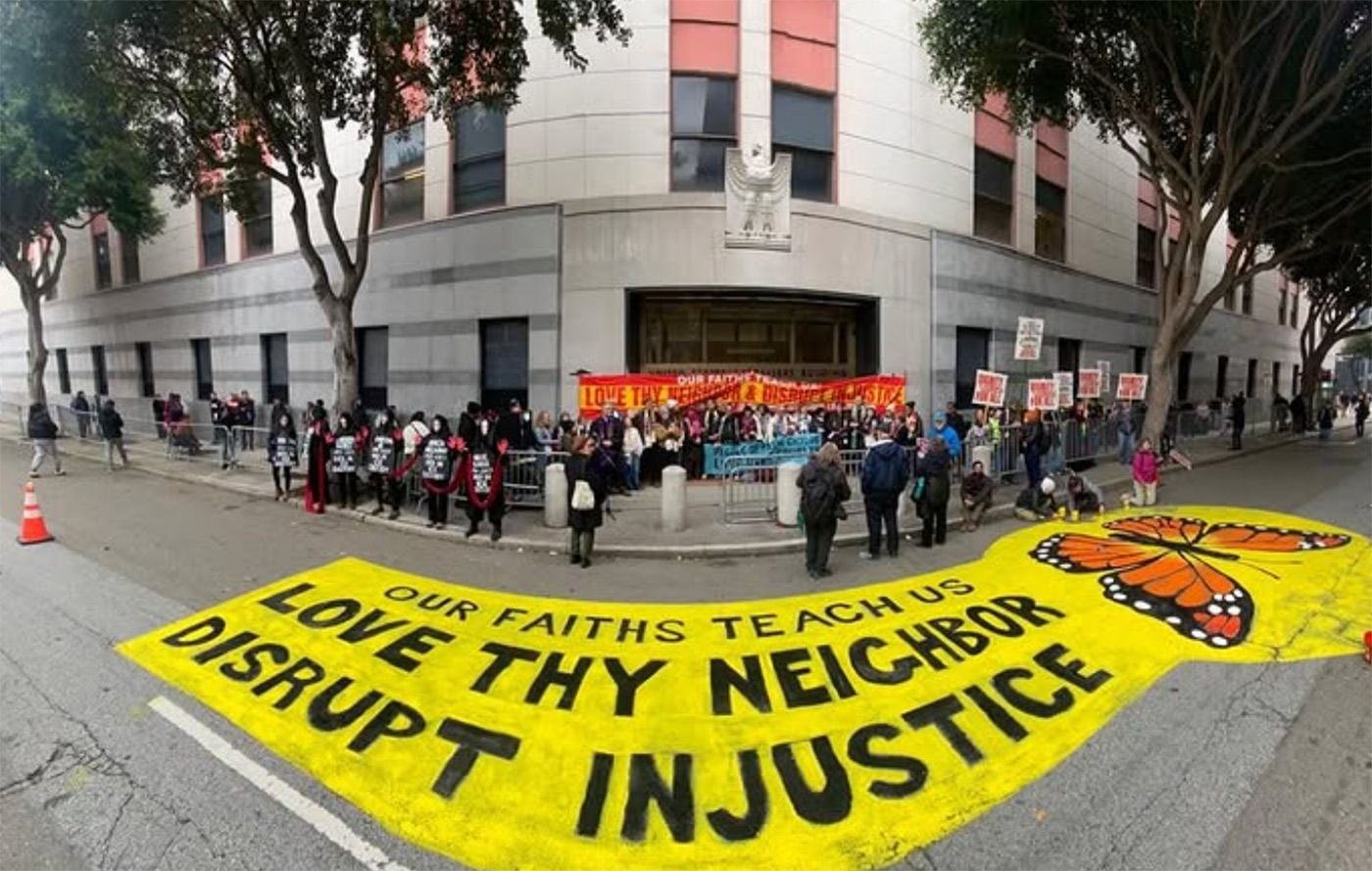
A group of protesters from interfaith groups arrived Tuesday in the predawn hours outside the federal facility at 630 Sansome Street in San Francisco where immigrants arriving for immigration court dates have been summarily swept into detention facilities since May.
There were around 100 protesters gathered as part of the demonstration, as Mission Local reported, in the early morning hours of Tuesday, with some chaining themselves together to prevent ICE agents and others from entering the building at 630 Sansome. Protesters were also blocking the Washington Street entrance to the building.
Some protesters, with white pancake makeup on their faces and red paint on their hands to symbolize blood, were displaying signs in the shape of tombstones naming individuals who all died in ICE custody in 2025, including 39-year-old Ismael Ayala-Uribe, who died in Los Angeles in September. Others carried signs that said “Dignity and Human Rights for All.”
A large banner, held outside the building doors, said, “Our Faiths Teach Us: Love Thy Neighbor and Disrupt Injustice.”
Photo via BayResistance and the Interfaith Movement for Human Integrity/Instagram
As the Chronicle reports, SFPD officers issued an order to disperse just before 10 am, and by 10:30 am, 12 individuals had been arrested.
Officers were reportedly using large metal shears to cut through chains that the protesters had used to link themselves.
Protesters were reportedly chanting “Shame” as faith leaders and other protesters were taken, zip-tied, into the immigration court building by masked federal agents.
“At some point, we as people of faith are being called to not just love our neighbor, but we have to disrupt injustice that’s happening day after day after day,” said Rev. Deborah Lee, co-director of the Interfaith Movement for Human Integrity, speaking to KQED this morning. “We cannot sit idly by and see people being marched into the slaughter of immigration detention across our country.”
630 Sansome Street has been the site of dozens of protests this year, after it became clear that ICE was acting on orders to detain individuals, regardless of the status of their immigration cases.
A federal judge last month ordered ICE to cease holding immigrants at 630 Sansome due to the inhumane conditions reported there, which included unheated rooms without beds, and no access to showers or sanitary supplies.
The New York Times reported that airport security officials around the country are sharing passenger data with federal immigration authorities. Oakland airport is in the dark about whether that’s happening here.
We work for you — and we’re matching your donation 1:1! Our journalists attend city council and school board meetings, follow tips and make the calls to keep you informed on the important issues in Berkeley. Will you chip in today?
The federal agency that handles security at American airports is handing data about all passengers to Immigration and Customs Enforcement as part of an effort to catch and deport people, the New York Times has found. But Oakland airport officials are clueless about whether this is happening to travelers flying through OAK.
The Times reported on Friday that the Transportation Security Administration provides a list to ICE multiple times a week that includes air travelers who will be passing through airports. ICE officials can cross-reference people from the list to the agency’s database of people subject to deportation, then find and arrest them when they arrive for their flights.
This data sharing, which the Times says started in March, is part of the Trump administration’s efforts to engage in a massive deportation campaign. While ICE hasn’t released data on how many people have been arrested or deported due to the TSA’s sharing of passenger manifests, the Times reported that it has led to several high-profile arrests, including that of Any Lucia Lopez Belloza, a 19-year-old college freshman who was arrested at a Boston airport on Nov. 20 and deported to Honduras. The Times found that an ICE office located near Laguna Beach called the Pacific Enforcement Response Center played a central role in Lopez Belloza’s arrest, and the airport program generally, by sending tips to immigration officers around the country.
We asked Oakland airport officials whether this data-sharing practice is underway in Oakland, where tens of thousands of people are expected to fly in and out of the airport for the holidays. We learned they’re in the dark.
“TSA doesn’t share that information with us,” David DeWitt, a spokesperson for the Port of Oakland, which oversees Oakland’s airport, said by email. “Your best bet would be to talk with TSA directly.”
We sent a list of questions to TSA. A spokesperson told us in an email that “This is nothing new.”
“Back in February, Secretary Noem reversed the horrendous Biden-era policy that allowed aliens in our country illegally to jet around our country and do so without identification,” the spokesperson wrote. “Under President Trump, TSA and DHS will no longer tolerate this. This administration is working diligently to ensure that aliens in our country illegally can no longer fly unless it is out of our country to self-deport.”
The disclosures in the Times story may potentially dissuade some people from traveling by air, including to and from Oakland. This would be bad news for the airport, which has been struggling to attract travelers.
The San Francisco Standard reported on Monday that the number of passengers traveling through Oakland for domestic flights between September 2024 and September 2025 declined by 17% compared to the previous year. The decline in the first half of 2025 was the worst of all 93 major U.S. airports, the Standard reported, citing data from a website called LocalsInsider.com. Port officials have blamed this trend on a decrease in business travel.
The Oakland Port Commission changed the name of the airport to draw attention to the city’s proximity to its neighbor to the west. The Oakland City Council also recently killed a labor lawsuit the City Attorney had filed against Southwest, partly out of concern that it would drive the anchor tenant out of Oakland.
“Let’s make the world’s richest man the richest man in town!” urges a new campaign launched Friday by the economic advocacy group Tax Justice Network, borrowing a memorable line from the classic film “It’s a Wonderful Life.”
The group’s global petition emphasizes that SpaceX owner Elon Musk is already the richest person in the world, with a net worth of $508.4 billion—more than double the assets of the planet’s next-richest person, Google co-founder Larry Page.
Tax Justice Network’s (TJN) petition invites Musk to give 44% of his wealth—$223.6 billion—to the children of the world. That amount of money would allow the purchase of a $90 gift card for all 2.4 billion of the planet’s children under the age of 18, and could stop more than 100 million children from going hungry this holiday season.
And Musk would still be the richest person alive, emphasized the group.
The campaign quotes Harry Bailey’s famous line declaring his brother George Bailey, played by Jimmy Stewart, “the richest man in town” in “It’s a Wonderful Life,” after George’s neighbors donate money to save him from financial ruin.
“We’re obviously poking a little fun here but the point is to show how extreme the concentration of wealth has become,” said Alex Cobham, chief executive at TJN. “Depending on where you are in the world, if you earn the average wage, you’d need to work anywhere from 20 times to a thousand times longer than humans have existed to earn as much wealth as Elon Musk has collected.”
The petition notes that TJN and the world’s children “would also settle for a 2% wealth tax on the superrich,” which would allow countries around the world to raise $2 trillion per year if it was applied to the richest 0.5% of people on the planet.
“That’s enough public money to meet most countries’ climate finance needs, and leave billions to spare for local public services,” the group said.
The group pointed to a recent G20report declaring a global “inequality emergency” and last week’s World Inequality Report, which found that fewer than 60,000 multimillionaires—just 0.001% of the world’s population—own three times more wealth than the entire bottom 50% of humanity.
“Within almost every region, the top 1% alone hold more wealth than the bottom 90% combined,” noted TJN.
The petition emphasizes the difference between collected wealth—the kind enjoyed by Musk and other superrich people—and earned wealth. The vast majority of people earn money for what they do, notes TJN. Musk and other billionaires “get paid for what [they] own, so dividends for owning stocks and rent money for owning real estate.”
Billionaires including Musk, Meta CEO Mark Zuckerberg, and Oracle executive Larry Ellison famously take salaries of just $1, but the money that’s made them part of the world’s superrich is their collected wealth, emphasized TJN.
“Earned wealth cannot create billionaires,” said TJN. “Only collected wealth grows fast enough to do so. It’s impossible to earn a billion dollars.”
A ProPublicareport in 2021 detailed how billionaires like Musk and Amazon founder Jeff Bezos paid a collective “true tax rate” of just 3.4% while the median American household made $70,000 and paid a tax rate of 14%.
“This special tax treatment has helped the superrich quadruple their wealth since the 1980s to extreme levels,” said TJN. “Studies directly link this rise in extreme wealth to lower economic productivity, to more households going into debt and to people living shorter lives.”
Musk in the past has pledged to use his extreme wealth to help people around the world—only to renege on his promises. In 2022, he challenged then-World Food Program chief David Beasley to prove, as Beasley had stated, that a small fraction of Musk’s wealth could help address world hunger. He pledged to donate $6 billion by selling his Tesla stock if the WFP could prove the contribution would “solve world hunger.”
The WFP responded with a report detailing how $6 billion could feed 42 million at-risk people and prevent them from going hungry for a year. But Musk didn’t follow through with his pledge, instead donating $5.7 billion of his Tesla shares to his own foundation.
This year, Musk spearheaded a push to slash government spending on foreign aid, with the US Agency for International Development a key target. The cuts have already proven deadly for children in impoverished nations.
Cobham on Monday pointed to research showing that the skyrocketing wealth of the richest 1% of Americans over the past 40 years has not led “to more investments, and instead resulted in dissaving among non-rich households.”
“We now have plenty of evidence showing that extreme wealth shrinks economies, makes people poorer, and threatens democracy,” said Cobham. “The best way to protect people, economies, and planet from the harms of extreme wealth is to end the special tax treatment that collected wealth gets over earned wealth. We must tax extreme wealth more effectively to protect the earner way of life we all rely on. Whether you’re a wealth collector or a wealth earner, we all have an equal responsibility to pitch in our fair share.”
Our work is licensed under Creative Commons (CC BY-NC-ND 3.0). Feel free to republish and share widely.
In Maine, only one of the top two candidates in the Democratic US Senate primary has expressed support for the specific healthcare reform proposal that continues to be treated by the political establishment as radical—but which is supported by not only a sizable majority of Mainers but also most Americans surveyed in several recent polls.
Graham Platner, a veteran and oyster farmer who was a political novice when he launched his campaign in August and has polled well ahead of Gov. Janet Mills in several recent surveys, and a poll that asked Mainers about healthcare on Saturday showed he is in lockstep with many people in the state.
As the advocacy group Maine AllCare reported, the Pan Atlantic 67th Omnibus poll found that 63% of Mainers support Medicare for All, the proposal to transition the US to a system like that of other wealthy countries, with the government expanding the existing Medicare program and guaranteeing health coverage to all.
Those results bolster the findings of More Perfect Union in October, which found 72% of Mainers backing Medicare for All, and of Data for Progress, which found last month that 65% of all Americans—including 78% of Democratic voters—support a “national health insurance program… that would cover all Americans and replace most private health insurance plans.”
Even more recently, a Pew Research survey released last week found that 66% of respondents nationwide said the government should guarantee health coverage.
Platner has spoken out forcefully in support of Medicare for All, saying unequivocally last month that the proposal “is the answer” to numerous healthcare crises including the loss of primary care providers in many parts of the country and skyrocketing healthcare costs.
He made the comments soon after Mills said at a healthcare roundtable that “it is time” for a universal healthcare system, but did not explicitly endorse Medicare for All.
Maine AllCare noted that the latest polling on Medicare for All in the state comes as Maine “is on the verge of a multi-pronged healthcare crisis” due to Republican federal lawmakers’ refusal to extend Affordable Care Act subsidies—which is projected to significantly raise monthly premiums for many Maine families as well as millions of people across the country. People in Maine and other states are also bracing for changes to Medicaid, including eligibility requirements.
Those changes “alongside long-standing affordability and access gaps, are projected to cost Maine billions and trigger deep operating losses in already strained hospitals,” said Maine AllCare.
The group emphasized that that the Republican budget reconciliation law that President Donald Trump signed in July is projected to have a range of economic impacts on Maine, including a $450 million decline in statewide economic output, the loss of 4,300 state jobs, and the loss of $700 million in revenue at the state’s hospitals due to Medicaid cuts.
“Maine needs a sustainable and universal healthcare system now. Poll after poll show people want Medicare for All. Our leaders can let the current health system continue collapsing—harming families, communities, and the economy of our state—or they can meet the moment and fight like hell to enact change that protects both the people and the future of the state,” said David Jolly, a Maine AllCare board member. “That is the work Mainers elected them to do and that is what they must do now.”
Despite the broad popularity of the proposal to expand the Medicare program to everyone in the US—a system that would cost less than the current for-profit health insurance system does, according to numerous studies—supporters, including the 17 cosponsors of the Medicare for All bill in the US Senate and the 110 cosponsors in the US House, continue to face attacks from establishment politicians regarding the cost and feasibility of the proposal.
On Monday, Rep. Ro Khanna (D-Calif.) explained to Fox News anchor Maria Bartiromo how the Affordable Care Act that was passed by the Democratic Party is “not the solution” to the country’s healthcare crisis, because it keeps in place the for-profit health insurance industry.
“The solution, as everyone knows, in my view, who has studied this, is Medicare for All,” said Khanna. “People should have national health insurance. Healthcare is a human right. You should not be subject to these private insurance companies that have 18% admin costs, that are making billions of dollars in profits.”
Sen. Jeff Merkley (D-Ore.) also spoke out in favor of the proposal, pointing to the recent Data for Progress poll that showed 65% of Americans and 78% of Democrats backing Medicare for All.
“Healthcare is a human right. That’s why we need Medicare for All,” said Merkley. “We need to simplify our system and make sure folks can get the care they need, when they need it. And the American people agree!”
Our work is licensed under Creative Commons (CC BY-NC-ND 3.0). Feel free to republish and share widely.
An aerial view shows Palestinians walking through the ruins of destroyed buildings in Jabalia refugee camp, northern Gaza Strip, on February 5, 2025.
(Photo by Khalil Ramzi Alkahlut/Anadolu via Getty Images)
“Wales and Sanger must be stopped from trying to censor the Wikipedia ‘Gaza genocide’ entry that clearly documents Israel’s horrifying crime against humanity.”
More than 40 advocacy groups on Monday called on Wikipedia editors and the Wikimedia board of trustees to reject efforts by the web-based encyclopedia’s co-founders to censor the site’s entry on the Gazagenocide.
After months of internal debate, editors of the Wikipedia article titled “Allegations of genocide in the 2023 Israeli attack on Gaza” renamed the entry “Gaza genocide” in July 2024, reflecting experts’ growing acknowledgement that Israel’s annihilation and siege of the Palestinian exclave met the legal definition of the ultimate crime. The entry also notes that the Gaza genocide is not settled legal fact—an International Court of Justice case on the matter is ongoing—and that numerous experts refute the claim that Israel’s war is genocidal.
The move, and the subsequent addition of Gaza to Wikipedia’s article listing cases of genocide, sparked heated “edit wars” on the community-edited site—which has long been a target of pro-Israeli public relations efforts. In the United States, a pair of House Republicanslaunched an investigation to reveal the identities of the anonymous Wikipedia editors who posted negative facts about Israel.
“Israeli officials and pro-Israel organizations are attempting to hide the horrifying reality… by putting pressure on institutions like Wikipedia to engage in genocide denial.”
Wikipedia co-founders Jimmy Wales and Larry Sanger have intervened in the dispute, with Wales—a self-described “strong supporter of Israel”—publicly stating that the Gaza genocide entry lacked neutrality, failed to meet Wikipedia’s “high standards,” and required “immediate attention” after an editor blocked changes to the article.
“Wales and Sanger are using their roles as Wikipedia founders to bypass the normal editing and review process and introduce their own ideological biases into an entry that has already undergone exhaustive vetting and review by Wikipedia editors, including thousands of edits and comments,” the 42 advocacy groups said in a letter to Wikimedia’s board and site editors.
The letters’ signers include the American Friends Service Committee, Artists Against Apartheid, Brave New Films, CodePink, Council on American Islamic Relations (CAIR), Democracy for the Arab World Now (DAWN), Doctors Against Genocide, MPower Change Action Fund, Peace Action, and United Methodists for Kairos Response.
Since the Hamas-led October 7, 2023 attack, Israel’s retaliatory obliteration and siege on Gaza—for which Israeli Prime Minister Benjamin Netanyahu and former Defense Minister Yoav Gallant are wanted by the International Criminal Court for alleged crimes against humanity and war crimes—have left more than 250,000 Palestinians dead, maimed, or missing. Around 2 million other Palestinians have been forcibly displaced, sickened, or starved in what hunger experts say is an entirely human-caused famine.
“The simple reality is that Israeli officials and pro-Israel organizations are attempting to hide the horrifying reality of Israel’s genocide in Gaza by pretending that there is a substantive debate and by putting pressure on institutions like Wikipedia to engage in genocide denial,” the groups’ letter asserts.
“Wales’ ‘both sides’ framework for denying the Gaza genocide,” the groups warned, “could also be used to legitimize Holocaust denial, denial of the Armenian genocide, or to platform ‘flat-earthers’ who deny the Earth’s spherical shape.”
Our work is licensed under Creative Commons (CC BY-NC-ND 3.0). Feel free to republish and share widely.
Milk Club Trans Caucus Meeting Date: Tuesday, April 28 Time: 5-7 PM Location and Zoom Link: Meeting info available to members of the Milk Club Trans Caucus. Please reach out to trans@milkclub.org if you would like to join the Milk Club Trans Caucus.
San Francisco Young Democrats meet with SFDems Chair Nancy Tung Wednesday, April 29th | 2pm Location: SC T-160 (third floor of Student Center) Register The San Francisco Young Democrats at SF State are teaming up with SFDems to make sure their voices are heard. Want to get more plugged into San Francisco... Continue reading →
One Million Rising: Strategic Non-Cooperation to Fight Authoritarianism Virtual Event · Hosted by No Kings Time Wednesdays 8 – 9:30pm EDT Location Virtual event Join from anywhere About this event Across the country, authoritarian forces are getting bolder and more dangerous. Trump and his allies are not hiding their agenda: mass deportations,... Continue reading →
THURSDAY, JUNE 29, 2023 AT 2 AM – 4 AM PDT How to create trust in a group? Details Event by Extinction Rebellion Empathy Circles online EMPATHY CAFE Duration: 2 hr Public · Anyone on or off Facebook How to create trust in a group? This is the question that arose in our... Continue reading →
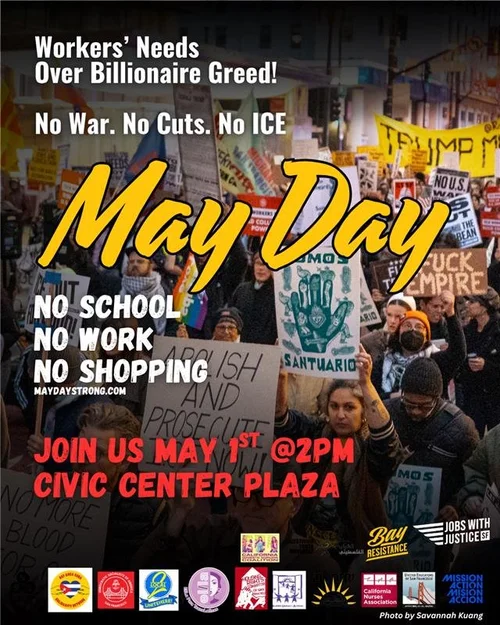
This May 1st, history is calling us into the streets. Our Revolution members are mobilizing for May Day action, joining workers, organizers, union members, students, immigrants, and community allies in a powerful show of solidarity against authoritarianism, corporate greed, and attacks on working people. Across the country, people are rising together... Continue reading →