on Dec 05, 2025 (Schwartzreport at info@schwartzreport.net)
David Edwards, Senior Editor – Raw Story
Stephan: Today two things happened that gave me a very personal sense of what is happening in the United States. I got an email from a reader in government service that it might be a good idea to stop doing SR. Second, even though we live in a very rural area, and our property is at the end of mile long unpaved lane, someone came down and stole our full trash bin. The company that picks up the bins notified us that it was gone when their truck came to pick it up. We do have MAGATs in the area, and this was clearly about going through our trash to see if there was any personal or compromising information. Added to that, is also this: the cost of doing SR keeps going up because there are so many hacking attacks; I have been warned twice not to fly because I would have to go through federal security. I am beginning to feel like we live in Germany in 1933
Credit: David Goodhue / X / screen grab
Federal authorities conducting immigration enforcement in Florida were seen pulling a woman wearing medical scrubs from her vehicle as she shouted that she was a U.S. citizen.
In a video captured by David Goodhue of The Miami Herald on Wednesday, agents with Immigration and Customs Enforcement, Customs and Border Patrol, and U.S Border Patrol could be seen forcing the woman to the ground, where she was handcuffed. The incident reportedly occurred in Key Largo.
“I’m a U.S. citizen, please help me!” the woman yelled. “This is unfair. Why are you doing this to me?”
Agents placed the woman in a patrol vehicle and released her shortly after.
It was not immediately clear why the woman was detained.
“She is visible white and blond, a medical worker, speaks with no accent. This should be a warning sign for MAGAt as they could be preyed by ICE at any time!” Altan Alpa noted on X.
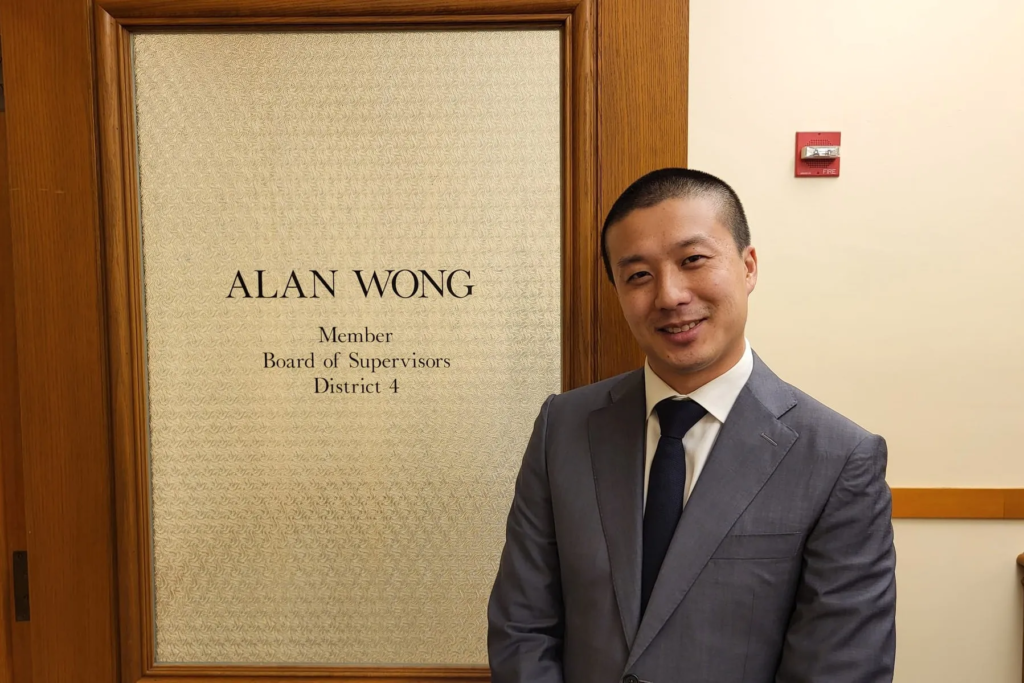
Alan Wong in front of his City Hall offices. | Anne Marie Kristoff/Ingleside Light
December 04 2025 (inglesidelight.com)
Everyday People features the people who make the greater Ingleside neighborhood a special part of San Francisco.
Alan Wong has made the leap from City College of San Francisco’s Board of Trustees to San Francisco’s Board of Supervisors.
The life-long Sunset resident was sworn in as District 4 supervisor on Monday in the wake of the recall of Joel Engardio and resignation of Isabella “Beya” Alcaraz.
“I was born and raised in Sunset and have lived there my entire life,” Wong said. “It’s the community that I love and that I want to serve.”
Wong has diverse experience. He interned for Fiona Ma when she was District 4 supervisor while in high school, worked for Supervisor Gordon Mar, and served as a policy director at the Children’s Council of San Francisco while in the military.
Wong had recently joined the Ocean Avenue Association board of directors and was elected vice chair in November, but has since resigned due to a conflict of interest.
Although he had been in office for just over a day when The Light visited him at City Hall, Wong said he already has priorities identified. Wong wants to work on increasing public safety with a focus on fully staffing the police department and cracking down on the open-air drug markets.
Wong said he wants to rebuild trust in the local government among citizens and small business owners by cutting red tape, streamlining processes and dedicating half of his office staff to constituent services. Finally, he wants to prioritize education and plans to be an advocate and supporter for increasing the child care subsidy to 200% of the area median income. He also intends to remain a partner for City College and be an ally and cheerleader for the city’s public schools.
“Being a supervisor is the greatest honor of my life, and as a veteran, I’m here to serve my community and my country and to put those needs above any partisan interests or politics,” Wong said.
This interview has been edited for length and clarity.
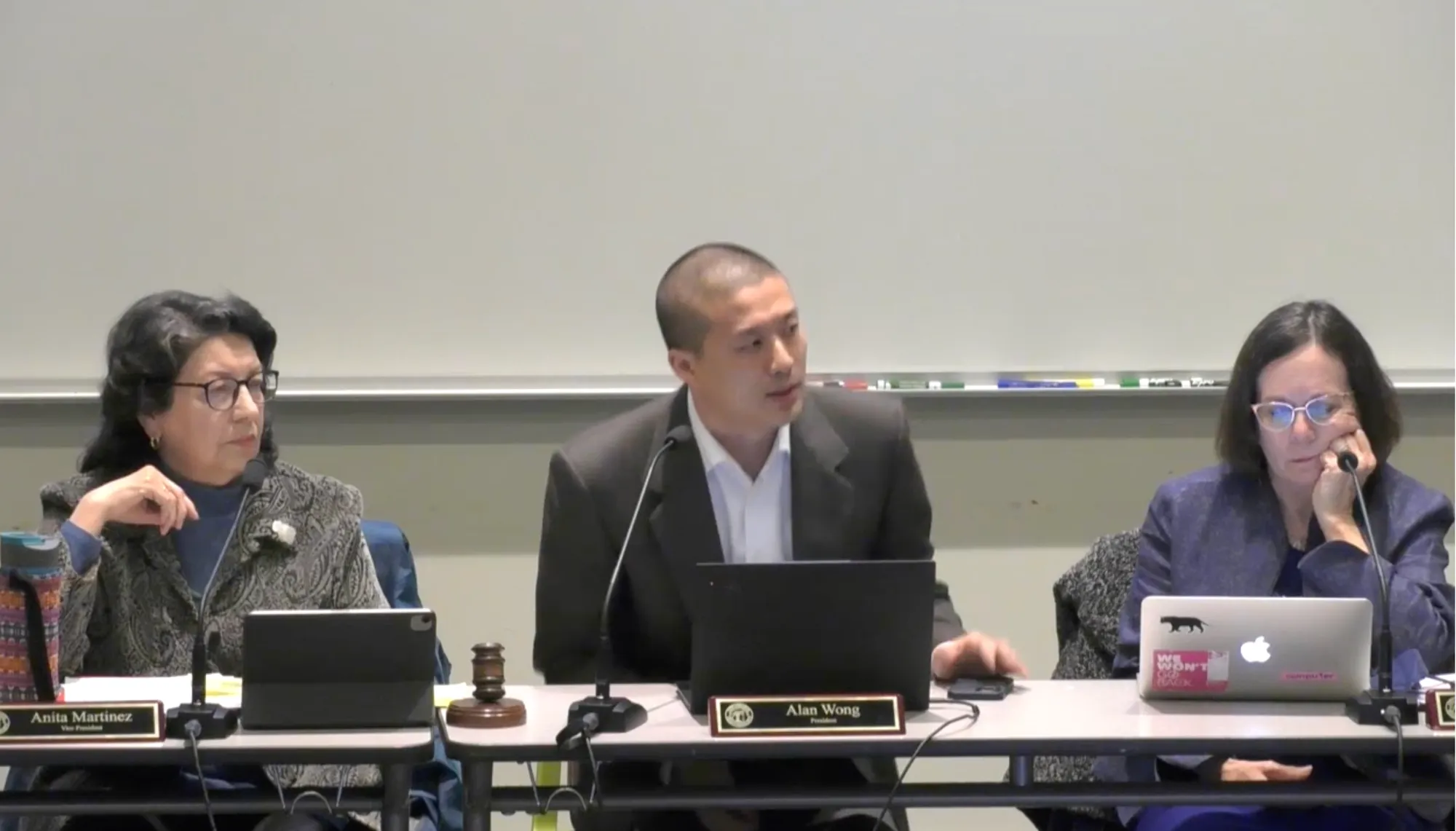
Trustees Anita Wong, Alan Wong and Susan Solomon. | City College of San Francisco
How do you feel about your time on the Board of Trustees? How do you feel about leaving?
On the board of trustees, I felt that I sought balance. I sought to be a person who could play a middle ground on things, and as much as possible, lead the institution toward the direction of long-term financial stability in a way that balances different perspectives, because we have very strong, as you may be paying attention, very strong perspectives on how to handle it. I’ve always sought the middle path, which is to take incremental steps towards that and long-term fiscal sustainability, protecting free City College for our students, ensuring we’re growing our enrollment, and offering the courses that our students need.
For me, it’s bittersweet to leave. I really enjoyed being a leader at City College and having the opportunity to influence the school that’s given my family so much. As you may know, my dad went through the culinary and ESL programs, and that’s how he became a union hotel cook at the Grand Hyatt on Stockton Street, and ultimately supported my family for two decades with those wages. My mother took ESL classes, too. I took City College classes as a teenager, and those extra units that I took helped me graduate from UC San Diego when I was just 19 years old with a bachelor’s degree.
What are some of the things you learned from City College that you are taking with you into this role?
I think being an elected official, there are many soft skills that you need to develop, so I think I’ve been able to go through the training grounds, having in the past worked at City Hall before, and also being a past elected official. It gives me the right blend of experience to start on day one, ready to lead this office, whereas somebody without this experience would probably be struggling.
You went through a new vetting process to be the District 4 supervisor. Do you think a similar process should happen to replace you on the Board of Trustees?
I think that there was an attempt to correct what happened with the previous appointment, and I think my process is very thorough, and ultimately, that decision is up to the mayor’s office to decide.
How does it feel to be the new District 4 supervisor? Was it something you’ve always wanted?
Being able to serve the community in which I was born and raised is the greatest honor of my life. I really think that it’s such a great honor. For me I look forward to being able to serve. I want to bring a public servant’s heart to my work, and as a veteran, I’m here to, I’m always here for my community and my country above any sort of partisan ideology or politics.
Back in the day, I interned in the District 4 office for Fiona Ma as a high school student. So I’m like, maybe someday. It wasn’t like a total, checklist thing where I had to do it, but I’m like, OK, if the opportunity comes up, it’s something that I would like to do to serve my community.
Alan Wong intends to focus on crime, constituent services and education. | Anne Marie Kristoff/Ingleside Light
As you know, the Great Highway is a polarizing topic throughout District 4. How do you feel about it, and how do you plan to address concerns from the community on both sides of the issue?
Firstly, I voted no on Proposition K, and I support the compromise. As a Sunset resident and military officer for the last 20 years, I have been running along the trail for my physical fitness training, and I’ve never had an issue sharing the road. At the same time, as a new District 4 supervisor, I am here to be a leader and to heal. I see my role, in terms of being a leader, as listening to everybody. I will always listen to everybody when making major policy decisions. I will always listen before I act, and I will talk to those who supported the compromise and and I’ll talk to those who supported the closure. I want to listen to everybody before I make any major policy decisions, and in the way that I move forward, I want it to have public trust and legitimacy. I’ll have to figure it out. I will have to make a decision in the future because this is something that people on both ends of this are bringing up, and at the same time, that’s the process that I commit myself to. I know some of the advocacy groups just want you to take one side or another, and that’s not how I conduct and comport myself. I want to be able to listen first before I make any decisions.
Human rights organization Amnesty International is cautioning critics of the Trump administration’s boat-bombing spree against getting bogged down in the precise details of each individual strike if it means losing sight of the bigger picture.
Daphne Eviatar, director for security and human rights for Amnesty International USA, said on Friday that it would be a mistake to merely condemn the Trump administration for launching a double-tap strike aimed at killing shipwrecked survivors of an initial attack, because the entire campaign of bombing vessels based on the suspicion that they are carrying illegal narcotics is unlawful.
“All the strikes so far have been illegal under both domestic and international law,” she said. “All of them constitute murder because none of the victims, whether or not they were smuggling illegal narcotics, posed an imminent threat to life. Congress must take action now to stop the US military from murdering more people in the Caribbean and Eastern Pacific.”
Eviatar said that law enforcement organizations for decades have had the power to intercept suspected drug boats at sea without having to resort to mass killing.
“Intercepting purported drug boats is a law enforcement operation, subject to policing standards derived from international human rights law, which holds that all people have the rights to life and a fair trial, and only allows states to use lethal force when an imminent threat to life exists,” she said. “A state intentionally killing someone outside those circumstances is committing an extrajudicial execution, a form of murder, no matter what crime the person is alleged to have committed.”
The Trump administration’s boat strikes have come under fresh legal scrutiny after the Washington Post revealed last week that the US military had launched a second strike during an operation on September 2 to kill two men who had survived an initial strike on their vessel.
Rep. Jim Himes (D-Conn.), the ranking member of the House Permanent Select Committee on Intelligence, watched video of the September 2 double-tap attack during a classified briefing on Thursday, and he described the footage as “one of the most troubling things I’ve seen in my time in public service.”
Himes told reporters that the video showed the US military firing missiles at two men who had survived an initial attack on their vessel and who were floating in the water while clinging to debris.
“You have two individuals in clear distress, without any means of locomotion, with a destroyed vessel, [who] were killed by the United States,” he said.
The US so far has carried out 22 known strikes on purported drug boats, killing at least 87 people.
Our work is licensed under Creative Commons (CC BY-NC-ND 3.0). Feel free to republish and share widely.
While the story of a Napoleon relative sending exactly 500 prostitutes is likely an exaggerated tale or myth, a
relative of Napoleon III’s government did organize a bizarre lottery scheme that inadvertently resulted in thousands of French men and women, including a disproportionate number of prostitutes, arriving in San Francisco during the Gold Rush.
The Lottery of the Golden Ingots
The event in question was known as the “Lottery of the Golden Ingots” (or Loterie des lingots d’or), a scheme devised in 1850 by the government of Napoleon III, who was Napoleon I’s nephew and the future Emperor of the French.
The Goal: The official purpose of the lottery was to raise funds to send French citizens to California to participate in the Gold Rush and presumably send gold back to France, while also providing a “solution” for dealing with perceived “undesirable” political and criminal elements and the poor in Paris.
The Scheme: Tickets were sold nationally, raising significant funds. The grand prize was a gold brick worth 400,000 francs.
The Result: The scheme led to over 3,000 French men and women disembarking in San Francisco in the early 1850s. Among them were many who could not find other work, and the severe gender imbalance in gold-rush San Francisco at the time (as many as 50 men for every woman in 1849) meant that prostitution was a profitable, albeit often exploitative, occupation. French women, in particular, became a significant part of the city’s prostitution scene, with one part of the city even earning the nickname “Frenchtown”.
So, while no specific relative is known to have individually “sent over 500 prostitutes,” a government plan initiated by Napoleon III did lead to the large-scale migration of thousands of French people to San Francisco, many of whom were women who entered sex work.
The Washington Post’s new editorialists have turned the page over to screeds defending not just laissez-faire capitalism but Bezos himself.Shortly after he installed some longtime Rupert Murdoch polemicists to the top posts at The Washington Post, Jeff Bezos—the paper’s sole owner—also announced that the paper’s editorial pages would no longer feature a diversity of viewpoints, but become instead a megaphone for laissez-faire capitalism. In the months since, the paper has hemorrhaged talent from nearly all its departments, though its news coverage remains sharp and essential reading for anyone interested in current affairs.
The same cannot be said of its editorial pages, where the mass eviction of columnists and editorial writers has laid waste to what once was an essential read as well. To be sure, there’s still a kick in reading George Will’s indictments of the Trumpified Republicans’ failure to live up to Will’s 18th-century standards for governmental adequacy, and Kathleen Parker’s laments over MAGA’s failures to live up to genteel Carolinian decency. But for any readers who were simply anticipating a general carbon copy of The Wall Street Journal’s editorial jihads against regulation and social insurance, the new Bezos-ized Post editorials are also bizarrely personal in a way that the Journal’s commentary is not.
By that, I mean that a large percentage of Post editorials actually read as defenses of Bezos himself; some even seem to have been written by Amazon’s founder. Yes, there are generic, Journal-esque anti-worker rants (in the past month, for instance, calling for the privatization of air traffic controllers and the deunionization of the Department of Veterans Affairs), but what really stands out are the Bezos-specific pieces.
Consider: In just the past three weeks, the Post has run two editorials against wealth taxes: one explaining why Swiss voters were right in rejecting one wealth tax proposal that would have obliterated what the Post called the nation’s “stable and predictable business climate”; the other excoriating a proposed California ballot measure (for which signature gathering has yet to begin) that would impose a one-time wealth tax to enable the state to preserve residents’ Medicaid coverage that was eliminated by Trump’s One Big Beautiful Bill. Neither editorial mentioned that Bezos is the third- or fourth-wealthiest human on the planet and the hit he’d take if wealth taxes were widely adopted.
Or consider an editorial that the Post ran last week on the subject of Black Friday shopping. “Black Friday used to be ugly,” the editorial began, citing out-of-control shoppers mobbing stores and roughing up retail sales workers. “Not a good look for capitalism,” the Post lamented.
“Fortunately,” the Post continued, “things have changed. Now, people don’t expect to see customers shoving each other on Black Friday. In fact, they don’t expect to see them at all. People can shop online, at a discount, from the comfort of their own homes.” In any other paper, Bezos would have to pay for that Amazon ad copy to run in its pages; in the case of this editorial, he prepaid when he bought the paper. Why the editorial editors think such ad copy is suitable for posting as the paper’s own considered opinion is not readily apparent. If Bezos dictated the piece over the phone to them, they might have the decency to say so.
The solicitude that the editorial pages show to Bezos isn’t limited to direct defenses of his wealth and hosannas to his retailer’s moneymaking acumen. Political threats to Bezos’s fortunes have been grist for the Post’s mill as well. In addition to the countless anti-Mamdani editorials they ran—way more, I suspect, than any other paper not based in New York—they also took it upon themselves to go after Katie Wilson, the newly elected socialist mayor of Seattle, Amazon’s historic home base. Wilson had been involved in previous campaigns to raise taxes on that trillion-dollar company, and as the editorial complained, had just successfully campaigned on a platform including raising progressive taxes that would, as the Post put it, “force residents of Seattle to pay for ‘free’ child care and other goodies.” (Why it’s reasonable for taxpayers to fund education and care for children aged 5 through 18 and socialistic for taxpayers to fund education and care for children aged 1 through 4—their most formative and impressionable years—is something that Post editorialists and their ilk invariably fail to explain.)
Wilson’s reasons for favoring free, universal child care had to be personal, the Post insisted. “Who is Wilson?” the Post asked—and answered: “She does not own a car. She lives in a rented 600-square-foot apartment with her husband and two-year-old daughter. By her own account, she depends on checks from her parents back east to cover expenses. To let them off the hook” was the reason she favored free child care, the editorialists concluded.
Coming from an editorial page that prioritizes the personal concerns of the paper’s owner—extolling the company in which he’s the largest shareholder, defending him from the specter of wealth taxes and elected officials who favor such taxes, even if in a city that’s more than 2,700 miles from the paper’s office and reader base—attacking Wilson for being one of the allegedly self-interested poor is, well, rich.
However doctrinaire the Wall Street Journal editorialists may be, at least they don’t view their primary mission to be the defense of Rupert Murdoch. Would the same could be said of the Post and Jeff Bezos.
One more vote, and SFUSD teachers can initiate walkout
by Junyao Yang December 3, 2025 (MissionLocal.org)
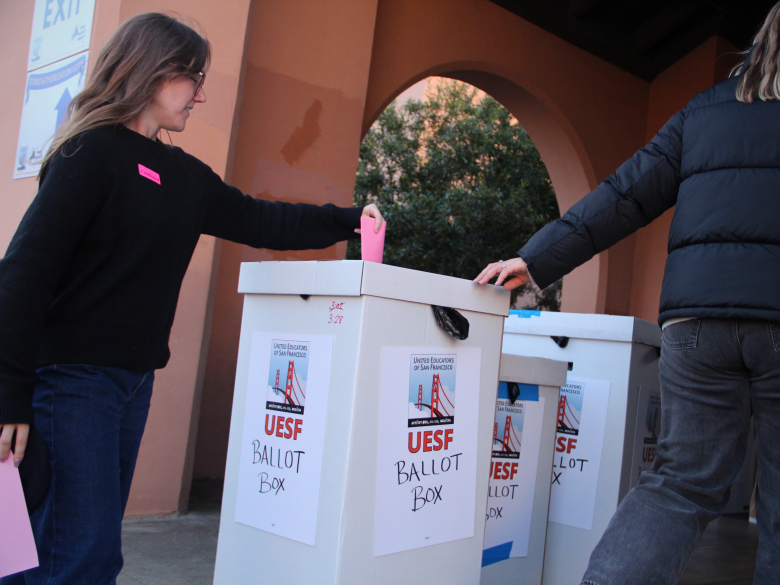
Educators arrive at Balboa High School to cast their ballot on a strike authorization vote. Photo by Junyao Yang on Dec. 3, 2025.
San Francisco public school teachers today voted 99.34 percent to authorize a strike, following nearly nine months of fruitless contract negotiations.
Today’s five-hour session at Balboa High School in the Excelsior is the first of two required votes that will determine if public school teachers go on strike. If that second vote comes to pass and the teachers and district don’t reach a deal, it would be the first San Francisco teacher strike in 46 years.
The tally is 99 percent of those who voted on Wednesday, not of the union’s total 6,500 members.
Want the latest on the Mission and San Francisco? Sign up for our free daily newsletter below.Sign up
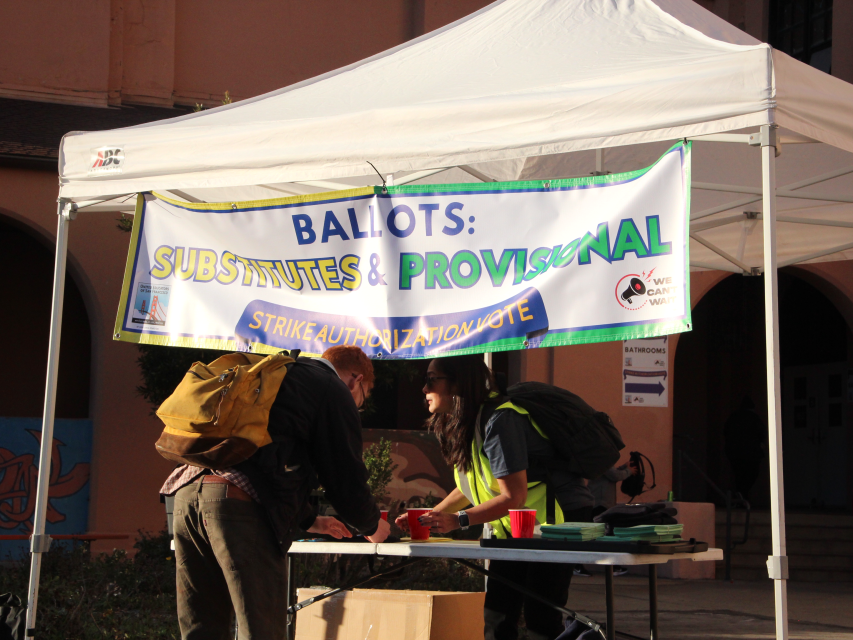
From 2:30 to 7:30 p.m. on Wednesday, educators sporting union sweatshirts trickled in the courtyard at Balboa High School to cast their ballots.
“Make sure to grab a snack before, because once you vote, you’re out of the building,” a volunteer repeatedly announced over a megaphone.
“We’ve realized that the district is not wanting to approach in a serious manner,” said Frank Lara, vice president of the United Educators of San Francisco. “So it’s pushed us to the edge.”
A long, contentious history between SFUSD and teachers
It’s not the first time: Two years ago, eight days after a 97 percent strike authorization vote, the teachers union won a deal that gave them a $9,000 salary increase and an additional 5 percent raise in 2024. It also gave paraeducators a minimum salary of $30 an hour or an 8 percent raise.
“We are following a process with third-party experts to reach a new agreement with the teachers union,” the district wrote in a statement. The district remains committed to “negotiate in good faith” with the union and the state to achieve “a fair agreement that avoids disruption to student services.”
Volunteers at United Educators of San Francisco dance to a camera as educators trickled in to cast their vote. Photo by Junyao Yang on Dec. 3, 2025.
This year’s strike vote, however, came at an especially troubled time for the school district, as it considers significant cuts to fill a $113 million hole in its budget.
According to early budget proposals obtained by Mission Local, the district is already weighing laying off security guards and school counselors and slashing middle-school health programs, among other cuts.
Right now, the state has authority to “override any decision by the San Francisco Board of Education if it believes that decision could compromise the district’s financial stability,” the district wrote. The district is facing another round of major cuts in the 2026-2027 school year, and “difficult decisions are ahead.”
“Balancing the budget is a core step toward exiting state oversight,” the district wrote.
The teachers union, for its part, said many of its demands are low-cost or even no-cost proposals that the district has not responded to since entering into negotiations in March.
The district has a history of over-budgeting and under-spending, according to Ryan Alias, a teacher at Balboa High School who’s on the bargaining team of UESF, which represents over 6,500 educators.
A volunteer holds a blank ballot. Photo by Junyao Yang on Dec. 3, 2025.
“We understand that the district doesn’t have money. We get it.”
And just like that, the time came to vote for or against a strike. It was a swift process, unlike the strike vote two years ago when teachers waited in an hours-long line at the Excelsior schoolyard.
Members who turned out to vote on Wednesday know — better than anyone — that the district is short on cash.
“We understand that the district doesn’t have money. We get it. We live it every day,” said Elaine Harris, who has taught in the district for 10 years. “But this is what we can do to advocate for our students.”
Educators arrive at Balboa High School to cast their ballot on a strike authorization vote. Photo by Junyao Yang on Dec. 3, 2025.
The union is demanding dependent healthcare, pay raises — 14 percent for classified employees and 9 percent for certificated employees over two years — and a special-education workload model that will weigh the time spent on each student, instead of just the number of students served.
Educators also want the district to provide a more robust sanctuary school policy, putting legal legwork into language that can protect both students and staff from federal officials on and around campus.
In October, amid the potential federal deployment and immigration crackdown in San Francisco, educators toldMission Local that they wanted the school district to train school staff on what to do if federal agents try to force their way into schools, and to create safe zones for students.
The union also wants the district to protect and expand current Stay Over programs that provide a sleeping place for unhoused families like the one formerly at Buena Vista Horace Mann K-8 that was relocated to Downtown High School.
During contract negotiations, the union says it sent some 20 proposals to the school district, but “everything we sent was coming back completely rejected or didn’t get responded to,” said Alias.
Educators pose for a photo as they cast their votes. Photo by Junyao Yang on Dec. 3, 2025.
In September, the district presented a “packaged proposal” that would offer a 2 percent salary increase over two years. But the proposal would eliminate benefits such as paid sabbatical leave, class size limits, and prep time for teachers who teach advanced-placement classes or take on extra responsibilities like serving as department heads.
“The only way that they would bargain with us is if we dug the money out of the things that we have already bargained for and won in previous years,” said Alias. “which was a nonstarter for us.”
After the union rejected the district’s proposal, the school district and teachers were officially at an impasse. They entered the next step — mediation — in October, but that mediation was “unproductive,” Alias said.
Teachers’ motivations
Teachers waiting in line to vote had different reasons for showing up and weighing in. Chad Harada, a fifth-grade teacher at Sunnyside Elementary School, said that he was most concerned about class sizes.
He considers himself fortunate to have a larger classroom for his 29 students, said Harada, but he has seen colleagues struggling to fit enough tables into their classrooms, let alone make space for students to meet in small groups.
A kid plays by a sign that reads “We can’t wait for the schools our students deserve” in traditional Chinese. Photo by Junyao Yang on Dec. 3, 2025.
Elaine Harris, who teaches second graders at Jose Ortega Elementary School, showed up to advocate for healthcare coverage for her family.
Harris, who has two kids, will have to pay about $1,500 for her family’s healthcare coverage starting next year.
“We’re worried and anxious for our future as a family to continue to live and work here in the Bay Area,” she said.
Harris and her husband, also a public school teacher, already have had to move to South San Francisco because of the cost of living in the city.
What Harris wants to do, she said, is “just to teach kids, and be able to survive as people, and live as humans that are happy and healthy and thriving.”
The next strike vote — depending on the progress of bargaining — would likely take place in January, if it occurs at all.
“The gloves are off. We have seen their inaction,” Alias said. The teachers say they don’t want to strike, “but there comes a point where we have to put the education of our communities and the experiences of our members to the front.”
Keep Mission Local free by making a tax-deductible donation today!
We have a big year-end goal: $300,000 by Dec. 31.
It’s more important than ever that everyone has access to news that reports, explains and keeps them informed. Paywalls don’t serve anyone.
Your support makes it possible for Mission Local’s content to be forever free — for everyone.
Junyao covers San Francisco’s Westside, from the Richmond to the Sunset. She moved to the Inner Sunset in 2023, after receiving her Master’s degree from UC Berkeley Graduate School of Journalism. You can find her skating at Golden Gate Park or getting a scoop at Hometown Creamery.More by Junyao Yang
Don’t use Spotify’s free version either. You don’t need to delete your account. Just close out your apps and don’t open them again until Spotify stops forcing ICE ads into people’s feeds.
Instead of sharing your Spotify Wrapped this year, share our Wrapped-themed posts calling on others to cancel Spotify. As long as Spotify is willing to take money from ICE, they don’t need (and don’t deserve) free advertising on our social feeds. And there’s no reason you can’t post your own list of top songs/artists on social — maybe alongside a message about why you chose not to stream them on Spotify.
Use this social media moment to have GENTLE, NON-SHAMING conversations with friends about the Spotify boycott. Seriously, no one is going to respond well to judgy DMs when they’re just trying to post something fun about the music they like. So approach with kindness, maybe compliment their music tastes, and then talk about why you’ve decided to stream from other platforms for the time being (one point you can make: Those platforms probably treat their favorite artists much, much better than Spotify does).
Help us track the growth of this economic campaign by taking our one-question survey.
Psychologists have looked at why people love sharing Spotify Wrapped so much, and the answer is pretty straightforward: We do it because it makes us feel like part of a group and because it’s a form of self-expression.
The good news is, standing in solidarity with immigrant communities by promoting a boycott of Spotify accomplishes both of these things too.
The more of us do it, the more we can bring others along with us.
And we’d argue (humbly, as massive music fans ourselves) this kind of activism says more about what kind of person you are than a colorful list of the songs you streamed most this year.
Spotify ends this year’s Wrapped by telling customers, “all of your listening makes you part of something bigger.” Strategically boycotting Spotify until it stops recruiting for ICE makes you part of something bigger, too. And our numbers are growing all the time.
The Board of Supes approved Mayor Lurie’s Rich Family Zoning Plan today after rejecting an amendment that would protect all rent-controlled housing.
The vote was 7-4, with Sups. Connie Chan, Chyanne Chen, Jackie Fielder, and Shamann Walton in opposition.
By the same vote, the supes rejected a Chan amendment that would have removed from the upzoning any existing housing units that are under rent control.
Sup. Connie Chan tried to protect tenants. Her colleagues voted no
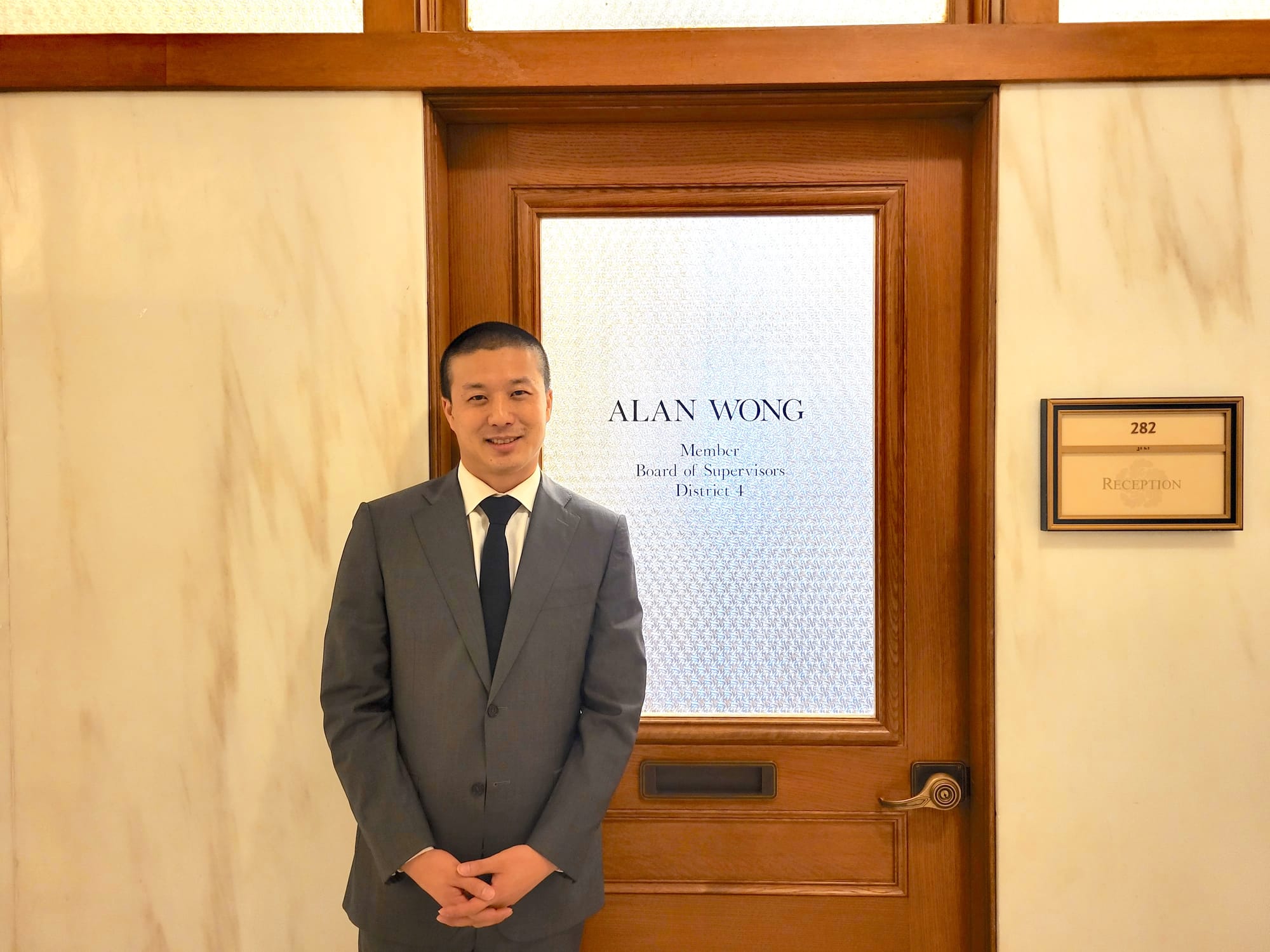
Newly appointed Sup. Alan Wong opposed the amendment and supported the plan.
The vote was no surprise: The conservative pro-development forces control the Board of Supes, and the Land Use and Transportation Committee had already rejected amendments to protect existing housing.
Sup. Bilal Mahmood insisted that the city already protects most housing from demolition, and Principal Planner Lisa Chen told the supes that any demolition requires a conditional use permit that the Planning Commission often rejects. The Eastern Neighborhoods Plan allowed much taller and denser housing, but didn’t lead to a lot of existing housing demolished, Chen said.
But the Eastern Neighborhoods had a lot more places to build tall housing without demolishing existing units. Adding more housing on the Geary, Clement, Judah, and Taraval corridors, where height limits would rise, would almost certainly require some demolitions.
Plus: During the early 1980s, the Residential Builders Association easily got permission to demolish dozens of existing (historic) residential buildings in the Richmond to put up cheaply built and high-profit “builder’s special” apartments that were not under rent control. The rules are tighter now—but there is no ban on destroying housing, just a requirement that the Planning Commission hold a hearing and approve each application.
So I’m not entirely confident in the ability of a developer-friendly Planning Commission to save existing housing.
The discussion at the board made clear that this entire process has been driven not by San Francisco, but by a small number of state legislators, led by Sen. Scott Wiener, who are strongly supported by the real-estate industry and the Yimby organizers.
Several supervisors, led by Bilal Mahmood, argued that if the Rich Family Zoning Plan doesn’t get approved as presented, with no amendments, the state Department of Housing and Community Development could reject the city’s housing plans and usurp all local land-use controls.
Sup. Shamann Walton called that state “bullying,” and said he doesn’t think the administration of Gov. Gavin Newsom “is going to attack San Francisco over arbitrary goals that no county and no city will be able to reach.”
He said that “this is about people who have never built anything trying to set policy for San Francisco.” Walton, who formerly ran Young Community Developers, which builds affordable housing, is the only member of the board who has actually built any housing.
He said the plan is utterly unrealistic: “Not one of these [affordable] units will be built. Not one.”
When Chan introduced her amendment, Sups. Danny Sauter and Stephen Sherrill were both incredibly dismissive, as was Mahmood. They tried to portray her tenant protections as political posturing—and I don’t say these things lightly (or often), but two white guys acting like a woman of color shouldn’t be taken seriously was more than a little offensive.
I’ve spoken to several women at City Hall who were involved in the process, and they agreed with me.
As Fielder noted, almost every group that works with or represents vulnerable communities of color opposed this plan. The supes ignored them; apparently, the supes and the developers know better than the people who will directly feel the impacts.
But the biggest issue here got mangled in a debate that continues to boggle my poor old brain.
Over and over, supervisors like Matt Dorsey, Sauter, Melgar and Mahmood spoke about “affordability,” and the need for more housing to help young people and families stay in San Francisco. Sauter talked about the 8,000 people who applied for affordable housing in his district and didn’t win the lottery. Mahmood even talked about people moving here to escape repression and bigotry.
Nothing, nothing, nothing in the Lurie plan provides affordable housing for those people.
Every statement about affordability is based on a mind-bending faith in the free market today to provide a solution to the affordable housing crisis. Too say this is a fantasy is wildly unfair to fantasies.
The Rich Family Zoning Plan is going to be a political issue this spring. Chan voted and worked with community groups like the Race and Equity in All Planning Coalition and the Anti-Displacement Coalition to modify the proposal to protect tenants and small businesses. Wiener is the author of most of the legislation that is forcing this plan on the city.
Both are running for Congress.
Sup. Alan Wong voted for the plan on his first day in office. He has to appear on the June ballot, and Natalie Gee, who works for Walton, is also running. She told me today:
Yes, we need to build housing, but passing a family-zoning plan without real protections for our rent-controlled homes two units and below is a letdown to so many vulnerable people in San Francisco. In District 4 alone, there are more than 2,200 rent-controlled units occupied by middle and working class families, seniors, and educators that are now at risk of displacement. It’s not what I would have done, but I’m sure that’s why he was appointed. We can grow our housing supply and still protect the people who are already here. That balance is what District 4 deserves, and I’ll always fight for it.
None of this is “posturing.” It’s an honest, and critical, debate about the future of the city. And as the impacts of the Rich Family Zoning plan become more clear, it’s going to be a big deal.
I will make one more point. Several supes, including Melgar and Sauter, talked about the 1978 board vote that set height limits on the west side of town. Melgar even disparaging spoke about people opposing the “Manhattanization of San Francisco.”
I wasn’t here in 1978, but I arrived three years later, and worked for the Bay Guardian, which created that term. Housing was never the issue.
The slow-growth movement that we were a part of was all about limiting new office development. We argued that building tens of millions of square feet of office space would attract tens of thousands of new high-paid workers—and that there was no housing for them. The anti-Manhattanization movement fought every day to force office developers to pay fees for housing for their workers, so the influx wouldn’t displace low-income residents.
“Create a job, build a housing unit” was part of our mantra.
But then-Mayor Dianne Feinstein didn’t want to do anything that would (to use the Yimby word) “constrain” the profits of office developers.
In 1971 and 1973, measures to limit office developers made the ballot and almost passed. Another one was headed for the ballot in 1979, and was likely to win (when even west side conservatives like Sup. Quentin Kopp supported it).
So Feinstein, who was running against Kopp for mayor, and the developers cut a deal with the neighborhoods. The supes would agree to limit height and density on the west side, to undermine the anti-highrise movement.
There were, indeed, Yimbys back then who wanted to protect single-family zoning. But this was not primarily about housing. It was about office creep, about downtown expanding into the neighborhoods (which was normal in Manhattan). The Feinstein deal mollified enough west side voters to defeat Prop. O in 1979.
From the Bay Guardian, 1971. The fear in the neighborhoods was offices, not housing. Cartoon by Louis Dunn.
The end result wasn’t perfect, or even good. But let’s be real about what happened. The organized activists who were fighting “Manhattanization” were always, always, in favor of more affordable housing. In fact, the entire nonprofit affordable housing infrastructure that exists today was born from that same movement, which also fought the racism and displacement of redevelopment.
Same folks who, by legacy, are fighting the Rich Family Housing Plan today.
For the record, Sups. Melgar and Sauter.
48 Hills welcomes comments in the form of letters to the editor, which you can submit here. We also invite you to join the conversation on our Facebook, Twitter, and Instagram.
Tim Redmond has been a political and investigative reporter in San Francisco for more than 30 years. He spent much of that time as executive editor of the Bay Guardian. He is the founder of 48hills.
Stefan Kaiter-Snyder was awarded the November Chris Kindness Award.Sam Clayton | Staff
When an atmospheric river threatened the Berkeley unhoused community with heavy rainfall last November, local activist Stefan Kaiter-Snyder got to work.
In just a few days, Kaiter-Snyder parked a “warming hut” on the corner of Eighth and Harrison, which Kaiter-Snyder stocked with piping hot coffee, snacks, a space heater and clean clothes for the unhoused people at the site.
Hand built by Kaiter-Snyder, the warming hut now rolls out to encampments across the city whenever temperatures drop. The warming hut earned him this month’s Chris Kindness Award, in a press conference Tuesday.
“I kind of cobbled this thing together just to be functional for the first day of use,” Kaiter-Snyder said. “You know, I’ve lived in my car for a long stretch of time … and I think building community with the people who are unhoused out here just speaks to me and it always has.”
The award, created by Haas School of Business lecturer Alan Ross in 2022, recognizes everyday acts of kindness in the Berkeley community. Ross, who teaches business ethics, made the award in an effort to elevate the meaningful ways people support one another.
Ross said he hopes to expand the award beyond Berkeley and is currently fundraising so that more community-serving residents in the broader Bay Area can be recognized for their service.
“We give awards for everything in society, but what really matters, what’s the most important thing to me, is just basic kindness,” Ross said. “So I started noticing more and more as I got older, how much this meant to me … And I thought, why don’t we have an award for it?”
Berkeley community members nominate candidates and vote on the finalists each month. Winners receive $1,000 to use at their discretion. Kaiter-Snyder, staying true to his mission, said his check will go straight toward building the next warming hut. He said he hopes to construct a larger hut with wheelchair access, an awning for shelter and a bookshelf stocked with resource guides for housing and healthcare.
However, volunteers are what the project needs most, Kaiter-Snyder said. “If anybody wants to volunteer and be a barista … anything is good to allow me to take a break from this.”
During cold months, he plans to bring the hut to Eighth and Harrison every Friday morning and encourages anyone interested to join him.
“It’s grown to something I’m really proud of, and we are raising money now to expand to other cities,” Ross said. “But it’s my favorite time of the month when I get to spend time with these incredible people. I mean, who else is out in the rain at (6 a.m.) to help others? And yet, that’s what makes it so special.”
Help Outreach Working Group lift the fog of corporate media. Donate to help us maintain this website and distribute literature on the street.
Milk Club Trans Caucus Meeting Date: Tuesday, April 28 Time: 5-7 PM Location and Zoom Link: Meeting info available to members of the Milk Club Trans Caucus. Please reach out to trans@milkclub.org if you would like to join the Milk Club Trans Caucus.
San Francisco Young Democrats meet with SFDems Chair Nancy Tung Wednesday, April 29th | 2pm Location: SC T-160 (third floor of Student Center) Register The San Francisco Young Democrats at SF State are teaming up with SFDems to make sure their voices are heard. Want to get more plugged into San Francisco... Continue reading →
One Million Rising: Strategic Non-Cooperation to Fight Authoritarianism Virtual Event · Hosted by No Kings Time Wednesdays 8 – 9:30pm EDT Location Virtual event Join from anywhere About this event Across the country, authoritarian forces are getting bolder and more dangerous. Trump and his allies are not hiding their agenda: mass deportations,... Continue reading →
THURSDAY, JUNE 29, 2023 AT 2 AM – 4 AM PDT How to create trust in a group? Details Event by Extinction Rebellion Empathy Circles online EMPATHY CAFE Duration: 2 hr Public · Anyone on or off Facebook How to create trust in a group? This is the question that arose in our... Continue reading →
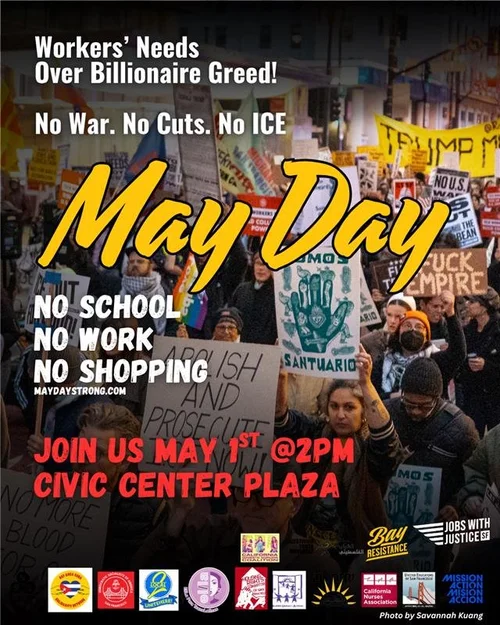
This May 1st, history is calling us into the streets. Our Revolution members are mobilizing for May Day action, joining workers, organizers, union members, students, immigrants, and community allies in a powerful show of solidarity against authoritarianism, corporate greed, and attacks on working people. Across the country, people are rising together... Continue reading →







 by
by