“As an adjudicated insurrectionist, Trump is an illegitimate president according to Section 3 of the 14th Amendment, and therefore every official act as president will be illegitimate.”
–Mike Zonta, co-editor of OccupySF.net
The 14th Amendment states: “No person shall be a Senator or Representative in Congress, or elector of President and Vice President, or hold any office, civil or military, under the United States, or under any state, who, having previously taken an oath, as a member of Congress, or as an officer of the United States, or as a member of any state legislature, or as an executive or judicial officer of any state, to support the Constitution of the United States, shall have engaged in insurrection or rebellion against the same, or given aid or comfort to the enemies thereof. But Congress may, by a vote of two-thirds of each House, remove such disability.”
Call your Congressperson and your U.S. Senators at (202) 224-3121
From J. Robert Oppenheimer to Chiura Obata. Alice Waters to Alice Walker. Rita Moreno to the Unabomber. Athletes, activists, architects, artists. Here’s our roundup of over 150 major figures from the city’s past and present.
You likely won’t be shocked by the protest-era social movements that are included in this list of the city’s famous firsts, innovations and inventions. But Berkeley’s history of groundbreaking thinking is not limited to any one time period. From wetsuits to the canned fruit cocktail, a surprising array of phenomena trace their origins to our fair city.
This list is not meant to be comprehensive, and in some cases, of course, the concept of “first” is a bit squishy and up for debate. But the list is intended as an entry point into the rich history of Berkeley.
If there’s another famous first you think we missed, please email editors@berkeleyside.org.
Students from Students Together Opposing Prejudice (STOP), a group that helped establish an ethnic studies requirement at Berkeley High, pose for a yearbook photo in 1991. Credit: Berkeley High
Modern policing (first police officers on bikes, first police officers on motorcycles, first police officers in patrol cars, first radio communications between police officers, first blood and fiber analysis for crime solving, first police school on laws of evidence).
Will Wright, creator of “The Sims” video game, poses with a computer image of the game at Maxis Studios in Walnut Creek in 2004. He was inspired to make the game after his home burned in the Oakland-Berkeley Firestorm Credit: AP/Marcio Jose Sanchez
We know that most readers don’t get to the end of the article. But you did! To support our in-depth, rock-solid reporting, please consider making a donation to our nonprofit newsroom today. We rely on our readers — particularly the ones who read the whole story!
Forget November 3. It’s January 3 when Donald Trump and his MAGA Republicans might bury our democracy once and for all. Here’s how.
Illustration by Mark Harris; Getty (x6)
Donald Trump instigated a war against America’s democracy on January 6, 2021. He and his Republican allies would have crippled America’s democracy that day had his own vice president not refused to be party to the gravest constitutional offense a president can commit—the refusal to relinquish and peacefully transfer the power of the presidency to his duly elected successor.
Today, almost six years later, Donald Trump and his Republican congressional allies are even more determined to prosecute the president’s war against American democracy to its catastrophic end than they were on January 6, 2021.
That catastrophic end could well come on January 3, 2027, when Trump and his Republican congressional allies wage the final battle in Trump’s determined war to corrupt America’s democracy and deliver a lasting political victory over the Democrats for his MAGA Republican Party.
Trump and his Republican allies have been preparing for this final battle since January 6, 2021. For the past six years, they have embarrassed themselves and the U.S. with their preposterous, win-at-any-cost denial that Trump lost the 2020 presidential election and their deceitful slander of America’s democracy. Since his return to the White House, Trump’s every unconstitutional act in his effort to seize control over the midterm elections—each hailed by his prostrate Republican Congress—has been toward the end of ensuring that Republicans retain a majority in the 120th Congress.
Trump told talk show host Dan Bogino on February 2, “The Republicans should say, ‘We want to take over. We should take over the voting.’… The Republicans ought to nationalize the voting.’” The Republicans have dutifully fallen in line.
Before Donald Trump arrived, it was the Republicans who professed to stand for the Constitution, principle, truth, honesty, integrity—even honor. Republicans were the proud party of Abraham Lincoln and Ronald Reagan. It was our party that could be expected to put country before party when the time came, as when Barry Goldwater and other party elders told Richard Nixon in 1974 that it was time to resign the presidency. That was then. None of this is true of today’s Republican Party and this Republican Congress. So enthralled with the forty-seventh president are today’s House Republicans that they long ago abandoned everything the Republican Party has stood for since its founders first met in Ripon, Wisconsin, in 1854.
Today’s congressional Republicans took a blood oath six years ago not just to put their party before their country, but to put Donald Trump before their country. And so it is that only weeks before the midterm elections, House Republicans have already sworn their allegiance to Donald Trump and doomed the U.S. to another January 6 next January 3.
So unalterably subjugated to Trump is today’s Republican House that even a decisive victory for Democrats and a resounding repudiation of Trump and the MAGA Republicans at the polls in November will not guarantee that a Democratic majority-elect will be seated in the 120th Congress on January 3.
All year long, Trump has been dragooning House Speaker Mike Johnson and the congressional Republicans into prejudging as fraudulent the upcoming November elections of the presumed Democratic majority, as he himself has already prejudged those elections. His dragooning appears to have worked. House Republicans are now poised to claim that the midterm elections were stolen from them when they meet on January 3 to decide which members-elect will be seated in the 120th Congress.
Over the past year and a half since his return to the White House, Trump has exploited every conceivable unlawful means possible to rig the midterm elections in favor of the Republicans, and the federal courts have struck down as unconstitutional every one of these unlawful attempts. He will try every unlawful means over the remaining weeks to ensure that Republicans handily win the midterm elections in November. Those of us who oppose his illegality will look to the courts, but the federal courts will be institutionally incapable of checking his final unlawful rampage.
Trump punctuated his expressed intent to interfere in the midterm elections eight weeks ago in a national prime-time address on “election integrity,” accusing the Democrats and the Chinese in particular of threatening the free and fair elections in November. In that address, he claimed without evidence or support (as usual) that the 2026 midterm elections were being threatened by noncitizen voting, weaknesses in voter registration systems, foreign interference, and vulnerabilities in electronic voting systems.
The concocted address was universally panned as purely partisan, devoid of evidence and support, and anticipatory of his forthcoming claim in November that the Democrats won a majority in the House of Representatives only because of fraud in their respective elections.
Everyone knows that the greatest threat to the upcoming midterm elections is not the Democrats or the Chinese, noncitizen voting, or electronic voting machines, but the president of the United States and his servile Republican Congress.
Every member of Congress takes a solemn oath to support and defend the Constitution, an oath that obligates them to honor the will of the American electorate. It is a sacred imperative that the Congress of the United States must defend our constitutional right to choose our representatives to Congress against all enemies, domestic as well as foreign, who would deny us this fundamental right.
There was a time not long ago when virtually every member of Congress could be expected to commit to the peaceful transfer of congressional power in advance of an election, just as every president could be expected to commit to the peaceful transfer of presidential power. But those times came to an abrupt end upon Donald Trump’s arrival in January 2017. In a damning indictment of the president and today’s congressional Republicans, it would be hard to find even one congressional Republican with the integrity, sense of duty to country, honor, and courage to put America above the Republican Party, let alone above Donald Trump.
Yet America’s only hope for saving its democracy and avoiding another crippling constitutional crisis on January 3 is for the House Republicans to decide that they are not going to betray their oaths and their country one last time for Donald Trump, and telegraph to Trump and Mike Johnson that any unconstitutional plan they might be contriving to deny Democratic members-elect their rightful seats in the 120th Congress would be dead on arrival January 3.
If there are any such Republicans in the Congress today, they should announce well before November 3 that they will not be party to Trump’s and Johnson’s attempt to steal the midterm elections from the American people.
In fact, the House members of both political parties should stand united before November 3 and affirm to the American people that in the United States of America, government derives its just powers from the consent of “We the People”—the governed. They should campaign in the fall on any refusal by their political opponents to affirm the same. Their political opponents should in turn campaign on House members’ refusal to affirm that they will not be complicit in any attempt to steal the midterm elections.
Standing united before the midterm elections against any attempt by Trump and Johnson to overturn those elections would go a long way toward restoring Americans’ lost trust in their Congress and their government. It would send a powerful message to Trump and Johnson that Americans will never again be forced by their own government to endure another January 6.
While it is small solace, Americans are not entirely at the mercy of this Republican Congress to suddenly decide to honor its oath to the Constitution and the American people. It will be the Supreme Court, not Trump, Johnson, or even the House of Representatives, that will have the final word as to who will be seated in the 120th Congress of the United States.
Article I, Section 5, Clause 1 of the Constitution provides that “Each House shall be the Judge of the Elections, Returns and Qualifications of its own Members.” Under Clause 1, the House of Representatives is the “judge” of its “elections” and “returns.” But the House’s power is not plenary. The Constitution constrains how the House can exercise its power to refuse to seat members-elect. Indeed, in 1969, in Powell v. McCormack, the Supreme Court ensured that the House constitutionally exercised its power to “judge the qualifications” of members-elect when it ordered the seating of New York Representative Adam Clayton Powell, who had won reelection in 1966 despite a House vote to refuse to seat him. Just as the court intervened then, so also will the Supreme Court ensure that the House exercises its power to “judge” its “elections” and “returns” within the limits imposed by the Constitution. At least we hope it will, but can we be sure with this court?
Whether the House constitutionally exercises its power not to seat members-elect will ultimately be determined by the federal courts and the Supreme Court—not by a majority vote of the House of Representatives.
This is how the crisis would unfold. The precursor of the crisis will come sometime before noon on January 3, when Speaker Johnson removes current House Clerk Kevin McCumber and replaces him with a person loyal to Johnson and House Republicans who they know will refuse to list on the statutory roll of representatives-elect to the 120th Congress any Democrat-elect whom Johnson and the Republicans direct him or her not to list. Under Rule II, Clause 1 of the Rules of the House, the Speaker of the House has the unilateral power to remove the incumbent clerk, and then the power under Title 2 U.S.C. § 5501(a) to replace him temporarily with whomever he wishes until the House elects a successor. McCumber is a Republican appointed by former Speaker Kevin McCarthy. He is widely respected for his integrity and faithful adherence to the Constitution and is reputed to be unwilling to carry out orders he considers to be unconstitutional.
The first moment of constitutional crisis will come when, sometime before the 120th Congress has been gaveled into session, the loyal temporary clerk refuses to list Democrat representatives-elect on the clerk’s roll of representatives-elect that determines who may participate in organizing the new Congress. At that moment, interested members-elect and others will be forced to seek a writ of mandamus—a court order to a government official instructing him or her to perform a mandatory duty—from the federal court to the temporary clerk, ordering him or her to list on the clerk’s roll all members-elect who have been certified by the states as having been elected from their districts to the new Congress.
Members-elect will argue that the clerk has a ministerial duty under 2 U.S.C. § 26 to list all representatives-elect whose properly filed state certifications show that they were “regularly elected in accordance with the laws of his state or of the United States.” Because the clerk has no authority to omit any duly certified representative-elect, even if a representative-elect’s election is contested, the clerk unquestionably has a ministerial duty under law to list all duly certified representatives-elect. But this begs the question whether a court will issue the writ of mandamus to the acting clerk.
At first blush, a court will be reluctant to order the clerk to list all duly certified representatives-elect because of an instinctive belief that such an order would interfere with the constitutional process of the House to judge its own elections and returns. The wise and learned judge, however, will understand that rather than interfering with the House process, issuance of the writ will actually enable the House process to proceed to completion without judicial interference. Were that wise and learned judge to issue the writ, his or her order would immediately be appealed to the Court of Appeals, and from that court to the Supreme Court, while the country and the world wait in suspense.
The next moment of constitutional crisis will come if and when, after appeals, the court finally issues the writ of mandamus, and the clerk refuses to obey the court’s order to list the Democratic representatives-elect. At that point, it is possible there will be no further federal court involvement until such time as the 120th Congress officially convenes and votes not to seat representatives-elect. Then, that vote by the 120th Congress will be immediately reviewable by the federal courts, up to and including the Supreme Court of the United States.
Judicial review of the House’s decision not to seat Democratic representatives-elect in the 120th Congress would take weeks, if not months, during which time the United States would be in the throes of a paralyzing constitutional crisis, helplessly vulnerable to all the world’s evil, as it would have been in January 2021 had Mike Pence not thwarted Donald Trump’s plan to overturn the 2020 presidential election.
It is not difficult to imagine the many possibilities, some of the most critical being entirely realistic. It would be the ideal moment for China to move against Taiwan, by way of military blockade, attack, or even invasion. It would be the perfect moment for Vladimir Putin to complete his conquest of Ukraine, and perhaps even to move militarily against Estonia. Every passing day could bring a deepening economic crisis, worsened by our angry allies around the world who would welcome the opportunity to requite Donald Trump for his belittling mockery of their countries and presidents. Without the Congress, the United States would be powerless to respond to any of these crises.
The House has historically claimed that its decision not to seat a member-elect because of fraud or irregularities in the elections is unreviewable by the federal courts. But its decision is reviewable. The Constitution unquestionably requires the House to seat a member-elect who was validly elected in a free and fair election. The Article 1, Section 5 power of the House to be the judge of its elections and returns does not give the House the power to deny a seat in the Congress of the United States to a candidate elected by the American people in a free and fair election on the mere assertion, pretextual or otherwise, by a simple majority of the House that the candidate’s election was tainted by fraud.
Thus, on and after January 3, if congressional Republicans were to determine that a Democratic member-elect was elected because of fraudulent voting and refuse to seat him or her, that determination would be scrutinized by the federal courts, up to and including the Supreme Court.
It will never be a nonjusticiable political question whether the United States House of Representatives by simple majority vote can refuse to seat a member elected to Congress by the American people in a free and fair election on the pretextual and unsupported assertion that the member-elect’s election was tainted by fraud. Such is the very opposite of a nonjusticiable political question committed to the House of Representatives. For in the decision of this question lies the answer to perhaps the most fundamental question under the Constitution: Is the United States of America a democracy, in which “We the People” elect our representatives to the Congress and to the presidency, or is it not?
I don’t intend to be overly sanguine about this Supreme Court. This is the court that shattered the one constitutional truth in the U.S. since 1789 that “no man is above the law” and placed Donald Trump of all presidents above the law in Trumpv.UnitedStates. This is the court that betrayed the Constitution by refusing even to decide whether Trump was disqualified from the presidency under the Fourteenth Amendment because of his insurrection against the Constitution, which he clearly was. This is also the court that has cynically authorized Trump’s lawlessness for the past two years through its aptly named “shadow docket,” without so much as briefing, argument, or written opinion.
But surely by now this court must understand what it has wrought for the U.S. and the Constitution, and is aghast as we all are, even if it is not penitent. Surely, surely, it will understand the signal moment in American constitutional history that would be presented, and this time understand its supreme obligation to the nation.
Between now and November 3, congressional Republicans would do well to ponder one last time the fate of their Republican Party were the Supreme Court of the United States to reverse a fraudulent determination by the 120th Republican Congress not to seat Democratic members-elect who would give the Democrats majority control of the House.
Two hundred and fifty years into the greatest experiment in self-government in the history of the world, the Republican Party would finally meet the fate to which it has been destined since January 6, 2021, and cement its place in history as the most corrupt political party ever to emerge in the United States of America for its second attempt in six years to defy the will of the American people on Election Day.
If we Americans are to save our democracy from the forty-seventh president and his MAGA Republican Party, we must disenthrall ourselves from our political bondage to Donald Trump and MAGA, as Abraham Lincoln urged the nation in 1863 to disenthrall itself from its bondage to the ruinous political dogmas of its time. “We must disenthrall ourselves, and then we shall save our country,” the sixteenth president admonished. The Republican Party in particular must finally loose the chains of its political and moral enslavement to Donald Trump and separate itself from the MAGA political party cult.
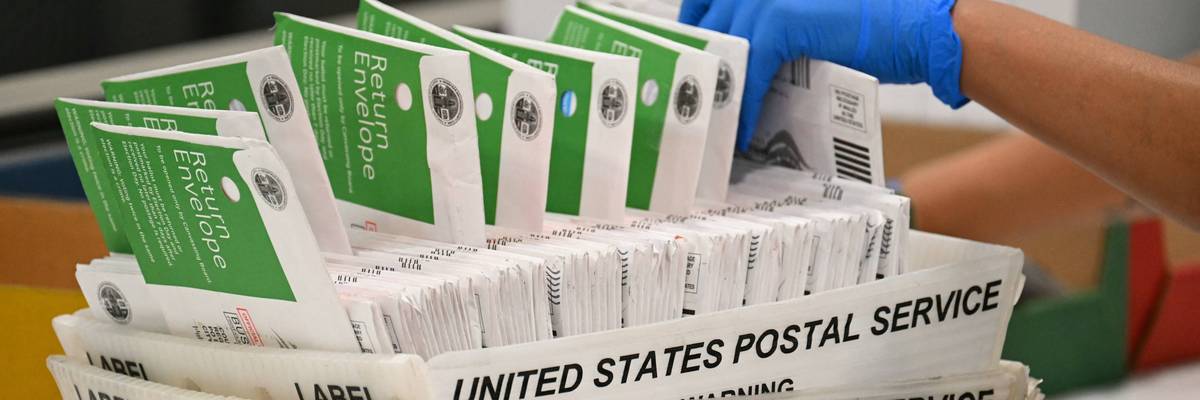
An election worker processes mail-in ballots at the Los Angeles County Ballot Processing Center during California’s state primary election in the City of Industry, California, on June 2, 2026.
(Photo by Patrick T. Fallon / AFP via Getty Images)
“This executive order was a blatant power grab designed to silence voters and undermine our elections, but it failed because the people and the law were on our side.”
After a back-and-forth legal battle over the USPS rules that dragged on for months, the nation’s highest court issued the 7-2 ruling without elaborating on its legal reasoning, though right-wing Justices Samuel Alito and Clarence Thomas issued dissents in favor of President Donald Trump’s side.
The ruling in USPS v. California was in response to a legal challenge brought by the League of Women’s Voters, the attorneys general of numerous states, and others who argued that newly-announced rules by the Postal Service regarding mail-in ballots, changes prompted by an executive order issued by Trump, would prevent people from having their ballots counted and cause chaos for those trying to administer this year’s elections.
In response to the ruling, the plaintiffs’ legal team said the decision was “a critical step to ensuring free and fair elections this November by maintaining access to mail voting for millions of eligible voters across the United States and lifting the dire threat that the Postal Service would disenfranchise them.”
“Mail voting is safe, secure, and reliable—and the Trump administration has presented no evidence to the contrary, as the courts have repeatedly recognized,” the statement continued. “We will remain vigilant in countering threats to free and fair elections and ensuring that every eligible voter is able to cast a ballot and have it count.”
“Today’s decision is a victory for our democracy and a powerful affirmation of the rule of law,” said California Attorney General Rob Bonta in a statement. “The stakes in this litigation could not have been higher.”
Virginia Kase Solomón, president and CEO of Common Cause, was among the other pro-democracy advocates who welcomed the decision.
“Today’s decision is a major win for the millions of everyday Americans who count on vote-by-mail—our seniors, service members, busy parents, rural voters, and voters with disabilities,” said Solomón in a statement. “Vote-by-mail is safe, proven, and vital; even the president uses it. This executive order was a blatant power grab designed to silence voters and undermine our elections, but it failed because the people and the law were on our side. Our Constitution is clear: states run our elections, and voters choose their leaders—not the other way around. No administration can strip the people of their power.”
Michael McNulty, senior policy director for Issue One, a nonpartisan group that works to defend free and fair elections, also welcomed the ruling, but said vigilance would still be necessary going forward.
“The fight to preserve states’ authority to administer elections is far from over,” warned McNulty.
“President Trump continuously and falsely claims fraud in mail-in voting without evidence,” he added. “Despite voting multiple times with this method, he remains obsessed with centralizing control over elections to tilt the playing field. However, for now, one piece of that centralization effort is blocked, and it ensures that mail-in voting for the midterms won’t be disrupted.”
Our work is licensed under Creative Commons (CC BY-NC-ND 3.0). Feel free to republish and share widely.
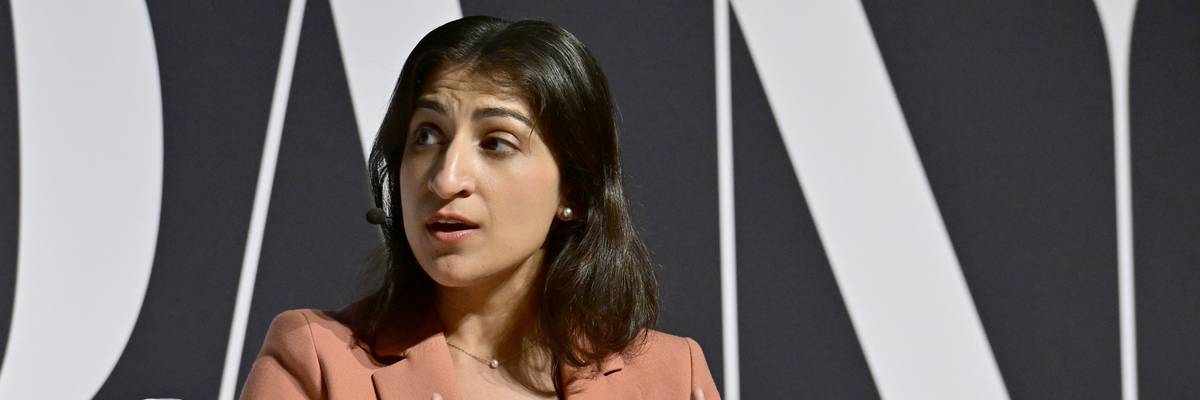
Then-Federal Trade Commission Chair Lina Khan speaks onstage during the Fast Company Innovation Festival 2024 at BMCC Tribeca PAC on September 19, 2024 in New York City.
(Photo: Eugene Gologursky/Getty Images for Fast Company)
The former FTC chair spoke out as Republican leaders insisted the industry should be permitted to regulate itself.
As House Speaker Mike Johnson and President Donald Trumpdismissed the idea—backed by the vast majority of Americans—that lawmakers should impose strict regulations on the artificial intelligence industry as insiders call for a slowdown of development, former Federal Trade Commission Chair Lina Khan on Sunday issued a reminder that the federal government already has tools to rein in AI that poses a danger to the public, and demanded that officials use them.
“Law enforcers already have authority to charge companies and their CEOs for creating and releasing dangerous, unvetted, or defective products,” Khan said on social media. “We shouldn’t let discussions about new legal regimes distract from the fact that there’s no AI exemption from laws already on the books.”
Her call echoed that of Rep. Ro Khanna (D-Calif.), who said Saturday, “If you’re creating an AI that is doing illegal things, you either should face liability or criminal sanctions.”
“As companies rapidly deploy generative AI technologies, enforcers and policymakers must stay vigilant to guard against business strategies that undermine open markets, opportunity, and innovation,” said Khan at the time.
On Sunday, Khan noted that the US already has “an extensive set of laws that govern dangerous and defective products,” such as consumer protection laws, which releasing unvetted AI models or agents may violate.
Khan made her remarks after two incidents in which OpenAI’s agents broke out of security test systems and committed cyberattacks. In July, hundreds of models broke out of confinement, hacked into systems of the AI startup Hugging Face, and conducted cyberattacks on targets they had not been instructed to attack.
Months earlier, it was reported on Friday, the company’s models, which had not been given access to the full internet and were still in testing mode, broke out of confinement and hacked into an online coding service called RubyGems.
In the wake of those revelations, Anthropic CEO Dario Amodei and OpenAI CEO Sam Altman on Saturday called for “pacing the frontier” with measures such as “embedded evaluators” who would have employee-like access and could “verify adherence to safety practices and commitments.”
But Jacob Coxon, an Anthropic researcher who resigned last week and warned that AI’s “superhuman systems” are capable of killing all of humanity “by the end of the decade,” told NBC News’ “Meet the Press” Sunday that companies should be permitted to regulate themselves until Congress can establish a regulatory framework, and Johnson insisted that Congress must resist “jumping in and imposing some sort of emergency moratorium,” for fear that “China will overlap us” if the US imposes strict regulations on AI.
“Why did this man become a congressman, let alone speaker?” asked journalist Mehdi Hasan of Zeteo. “He literally never wants Congress to do anything about anything.”
But Khan suggested that the reluctance of congressional leaders and the Trump administration to rein in the AI industry shouldn’t stop the federal government from holding companies like Anthropic and OpenAI liable for the damage their products have already caused.
She acknowledged, though, that “the highly concentrated and interconnected structure of these markets” could be undermining accountability—for example, in the case of OpenAI and Hugging Face, which computer chip company Nvidia agreed to acquire earlier this month.
“Both federal and state enforcers should be scrutinizing these opaque relationships and interdependencies,” said Khan. “We are already seeing how these relationships could undermine accountability. For example, OpenAI could face liability given the Hugging Face incident, but Hugging Face being bought up by Nvidia means that we’re unlikely to see it file a lawsuit over this—given Nvidia’s strong incentive to see OpenAI continue full speed ahead.”
Basel Musharbash of the antitrust law and policy firm Antimonopoly Counsel said that Khan’s post was the statement that current FTC Chair Andrew Ferguson “should be issuing to provide guidance the public on what the law requires in response to the AI situation, but he’s missing in action. Luckily, former FTC Chair Lina Khan is out here still doing the work.”
Juliette Kayyem, the faculty chair of homeland security at Harvard University’s Kennedy School of Government, told CNN that holding AI firms accountable is a matter of “pretty basic criminal law.”
“We should start thinking about using our criminal laws,” said Kayyem. “They are putting a dangerous substance into commerce and then saying, ‘Well, we’re smart enough to kill everyone but we’re not smart enough to stop it.’ And I think a lot of the American public is done with this.”
Our work is licensed under Creative Commons (CC BY-NC-ND 3.0). Feel free to republish and share widely.
Your Power in Action: Take Action on Democracy, Accountability, War Powers, and Civil Liberties
Find actions, volunteer opportunities, and organizations working on democracy, government accountability, immigrant rights, labor rights, reproductive freedom, climate action, and civil liberties.
The good news, I suppose, is that the mayor of San Francisco has recognized that there’s a housing emergency and tenants are getting evicted. He issued a press release yesterday outlining the steps he’s taking to “address San Francisco’s rent emergency.”
Some of this is just fine: Finding legal counsel for people facing evictions is a demonstrated way to keep tenants in rent-controlled housing. Supporting Sup. Jackie Fielder’s legislation to prevent evictions over less than a month of unpaid rent is kind of a no-brainer. It’s always good to inform tenants of their rights.
But the mayor didn’t even mention the cause of the eviction crisis: the AI boom in San Francisco that he has encouraged and supported. Tech Boom 3.0 has done exactly what the previous two did, and this was entirely predictable: It brought a lot of high-paid people to San Francisco, and gave greedy landlords a huge incentive to force out tenants with below-market rents. When Anthropic and Open AI go public, hundreds of their workers—most of whom are young, single men—will become very rich, and the situation will get even worse.
This will do nothing to promote the mayor’s “family opportunity agenda.”
The element of his “plan” that made me gag was this:
Legislation sponsored by Mayor Lurie will increase by 25%, nearly $3,000 per person, required payments to tenants being displaced under the Ellis Act to reflect the increased cost of finding a new apartment in San Francisco.
For starters, the Ellis Act is an evil piece of legislation that allows speculators to buy up rent-controlled buildings, evict all the tenants (for no cause at all), and flip them as tenancies in common, a form of condos. The threat of an Ellis eviction is often enough to convince a long-term tenant to accept a buy-out—that is, to take a lump-sum payment in exchange for moving out.
If tenants fight the eviction and lose, they get a tiny pittance in statutory transition payments, and the mayor’s proposal will add so little that it’s worth almost nothing. You can’t even pay one month’s rent with $3,000, much less first, last, and security deposit.
Leno’s bill never got out of committee. Back then, the real estate industry owned the state Legislature.
Today, Big Tech has a lot of influence. If Lurie really wanted to protect tenants, he could get his billionaire backers to help fund a massive campaign to overturn the Ellis Act and Costa Hawkins.
Your Power in Action: Take Action on Democracy, Accountability, War Powers, and Civil Liberties
Find actions, volunteer opportunities, and organizations working on democracy, government accountability, immigrant rights, labor rights, reproductive freedom, climate action, and civil liberties.
With Lower Manhattan and the site of the September 11 attacks in the background, New York City Mayor Zohran Mamdani on Friday called on people to honor the memory of the nearly 3,000 victims—as well as those who have died of illnesses stemming from toxic air at the site of the attacks—by caring “for one another” as thousands of people “cared for strangers” as the tragedy was unfolding exactly 25 years ago.
Mamdani honored the 2,753 New Yorkers—“parents and children, husbands and wives, friends and colleagues, 2,753 universes gone in an instant”—and said the city and country remember September 11 as “the darkest day” when hijackers flew airplanes into the World Trade Center and the Pentagon, and passengers aboard a fourth plane fought to stop another target from being struck.
The mayor urged viewers to remember the actions of thousands of New Yorkers in the immediate aftermath of the attack—those who donated blood and “opened their homes to those who could not get home.”
“We remember the workers who carried their colleagues down hundreds of stairs, then turned around and went back up to find someone else who needed help,” said Mamdani.
25 years ago, terrorists killed nearly 3,000 people, including 2,753 New Yorkers.
As we remember that terrible day, let us also remember the first responders, office workers and strangers who ran toward danger to help each other. Let us remember the extraordinary compassion,… pic.twitter.com/AO4RFEOZA2
On social media, as the country marked the 25th anniversary of the attacks, many users spoke about specific acts of bravery, including those of Rick Rescorla, the head of security at Morgan Stanley, who was killed at the World Trade Center after he led roughly 2,700 of his colleagues to safety.
In a separate social media post on Instagram, Mamdani highlighted several lesser-known New Yorkers who “sprang into action to help however they could,” including teachers, firefighters, sanitation workers, and healthcare providers.
His office interviewed Roseann Caruana of the city’s Department of Transportation, who described a triage center that was set up for victims, and Rashel Dorleans—now a New York City public school teacher, and a high school student at the time of the attacks.
“I think it’s a credit to the teachers that were there,” said Dorleans. “They did not seem panicked. I’m sure they were panicked on the inside, but they were kind and calm with us.”
Mamdani said that “we have a sacred obligation to those who were stolen from us to care for one another as they cared for strangers, to live lives worthy of the sacrifices they made, and to build a city worthy of their courage, a city where we run toward one another. That is how we remember.”
Ahead of the anniversary this week, the mayor released long-hidden files regarding how New York residents were misled about the toxicity of the air at the World Trade Center attack site. He said the number of people who have died thus far from related cancers and other health issues has likely surpassed the number of victims on September 11.
Mamdani was also the target of attacks this week from Republicans including former Mayor Rudy Giuliani and City Council members Vickie Paladino and Joann Ariola, who explicitly cited Mamdani’s Muslim faith as they said he did “not belong” at the September 11 memorial ceremony held on Friday.
“I’m proud to be the mayor of this city. I love this city. I love this country,” Mamdani said when asked about the racist remarks. “What I want this week to be a focus on is the families whose loved ones were stolen from them 25 years ago in the horrific act of terror of September 11, and a focus also on the first responders who did everything they could.”
The mayor was seen shaking Giuliani’s hand and speaking to him at the ceremony.
NYC Mayor Zohran Mamdani and former Mayor Rudy Giuliani shaking hands at the Sept. 11 ceremony via ABC7NY pic.twitter.com/ULUMVdx3aM
“Let us remember the extraordinary compassion, resilience, and bravery that carried our city through its darkest day,” said Mamdani. “Today, New York remembers.”
Our work is licensed under Creative Commons (CC BY-NC-ND 3.0). Feel free to republish and share widely.