By J.D. Morris,City Hall Reporter July 21, 2024
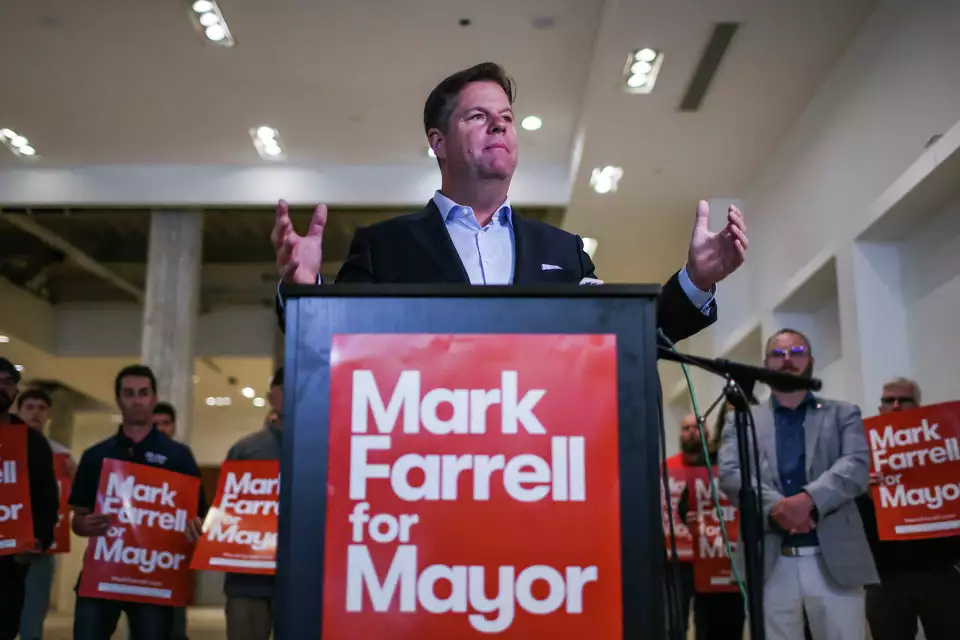
Mayoral candidate Mark Farrell speaks about San Francisco’s economy and how to revive downtown during a news conference Wednesday in a vacant building in Union Square.Gabrielle Lurie/The Chronicle
The contentious race for San Francisco mayor is increasingly being shaped by a core question: How can the city bring back downtown, which has been devastated by the pandemic and is struggling to rebound?
Four years after COVID-19 upended the city’s urban core, the area is still littered with shuttered storefronts, a growing glut of empty office space, financially ailing hotels and people using drugs on the street.
Mayor London Breed has made reviving the beleaguered area, which is crucial to the city’s tourism industry and its global reputation, a central focus of her current administration and her vision for the next four years if she’s reelected this fall. But her leading challengers have lambasted her over the state of the neighborhood, arguing progress has been too slow and scattershot.
The economic health of downtown is inextricably linked to the overall health of San Francisco, which was responsible for 70% of the city’s jobs and most of its tax base before the pandemic. Mayoral candidates, City Hall officials and business leaders all say that restoring the area’s reputation is essential to getting the city’s flailing pandemic recovery on the right track.
“If the downtown is not vibrant and active, the city is in deep trouble,” said Wade Rose, president of the business advocacy group Advance SF. “There’s no combination of economic activity in the neighborhoods that could come within a mile of what is produced by a vibrant downtown.”
In March, Breed set a goal of attracting 30,000 new residents and students downtown by 2030 — a vision that will be difficult to realize. Already, the University of California has said it wouldn’t open a new downtown campus, throwing cold water on Breed’s hopes on that front. Sixty students from 20 historically Black colleges came to study downtown this summer as Breed pushes for the long-term goal of such a college opening a satellite campus in the city.
The mayor’s opponents broadly share her view that the Financial District, Union Square and surrounding areas should be transformed into more diverse 24-hour neighborhoods that include a mix of housing, parks, entertainment spaces and more educational facilities if possible, but their policy proposals also could take many years to see results.
Business groups are worried that none of San Francisco’s leaders is being realistic about the depth of the problem. Rose cautioned that “it’s going to take a long time” to bring downtown back to its former glory because he remained unconvinced that San Francisco’s leaders fully appreciate “what a deep hole the city is in.” Yet, he said it’s “a very good sign” that Breed and her challengers are being vocal about the matter.
“It’s probably the biggest issue facing the city, which is how to revitalize downtown,” Rose said. “There’s no easy or quick fix, but there are fixes. They can be implemented, but the will has to be there. We’re starting to hear that. The mayoral candidates are starting to talk about it, and that’s a great sign. But now it has to be carried through.”
More Reading
Breed gets backing from key S.F. YIMBY group as she touts housing record in mayor’s race
Policing, privilege and a NIMBY dog whistle: 3 takeaways from the latest S.F. mayoral debate
The problems facing downtown are complex and include the loss of office workers, safety concerns, the drug crisis, the shift to online retail, illegal vending, the loss of business conventions and many others. Rose said the city needs to focus first on making sure downtown is perceived as safe, while also pursuing strategies to reduce fees and permitting timelines that might help fill offices and get new housing built.
Mark Farrell, a former supervisor and interim mayor, appeared Wednesday in a vacant commercial space on Post Street to announce his plan to reshape downtown, partly by offering new financing to encourage office-to-housing conversions, creating tax incentives for employers who require their workers to come to the office four days a week, and establishing a government agency to focus on economic development in the urban core.
Farrell, who is also a venture capitalist, blasted Breed’s downtown efforts as he promoted his own.
“Her lack of proactive planning and vision for downtown has our recovery stuck in cement,” Farrell said. “We cannot continue to throw spaghetti against the wall with our economy here in San Francisco. It erodes faith that our city has its act together.”
He pointed to Breed’s support for adding lab space downtown, attracting a new university campus and even possibly converting the former Westfield mall into a soccer stadium — all ideas that have “gone nowhere,” Farrell said.
Breed’s campaign promptly released a point-by-point rebuttal of Farrell’s downtown proposals, arguing that the mayor is already working to advance some of the boldest goals he sought to claim as his own. Breed won voter approval of a March ballot measure intended to make it more profitable for developers to convert offices to housing, and she is supporting state legislation that would authorize a special financing district to fund conversion projects downtown, her campaign said. Experts have warned that conversions remain difficult to pull off financially, and many office buildings aren’t suitable to become housing.
Breed’s campaign also said Farrell was attempting to rip off a project her administration is advancing to overhaul Embarcadero Plaza into a more vibrant park. Farrell released his own concept Wednesday that entailed a similar reimagining of the same plaza.
Breed has already been advancing her vision of turning downtown into a 24-hour neighborhood with more entertainment, nightlife, recreation and housing, campaign spokesperson Joe Arellano said, pointing to legislation and policies she’s enacted as well as her March ballot measure.
“Meanwhile, her opponents are introducing plans that do the exact same things she’s already doing, were passed by her months ago, or are policies that are fake and completely incoherent,” Arellano said in a statement to the Chronicle.
He had particularly sharp criticism for Farrell, who Arellano said was proposing “bureaucratic bloat” that would “grind our downtown recovery to a halt.” Farrell “is only proposing bad ideas or Mayor Breed’s good ideas,” he said.
Another serious mayoral opponent is Board of Supervisors President Aaron Peskin, who has represented much of downtown on and off since the turn of the century. He worked with Breed to pass legislation that seeks to make it easier for developers to replace empty offices with new homes, and he said he’s also been supportive of the planned revamping of Embarcadero Plaza.
Peskin doesn’t want to stop with the plaza. He said he further hopes to create a “string of downtown green spaces” along the shoreline, hoping to build upon the popularity of existing outdoor attractions such as the Embarcadero.
To give people more reasons to go downtown while work-from-home remains popular, Peskin said, the city needs to develop a center for “tech diplomacy” that would bring together consulates, non-governmental organizations, tech companies and research institutions to study and discuss technology issues with worldwide implications. He cited “AI ethics” as an example of one area that could be focused on by the hypothetical facility, which he described as a “think tank, a convening center, a research center.”
“Let’s lead with what San Francisco is known for, and rather than having an us versus them … (mentality), why don’t we embrace tech,” Peskin said. “If we all put our heads together, that could be a very promising, very exciting, economically viable draw for San Francisco.”
He’s not the only mayoral candidate to propose the development of a tech-related center to boost economic activity. Daniel Lurie, a nonprofit founder and Levi Strauss heir running for mayor, said in June that he hoped to set up a “climate innovation hub” in San Francisco. He said his objective would be to encourage green technology companies, researchers and students to co-locate in a downtown space where they would work to develop artificial intelligence technology to combat climate change.
Lurie said in a statement to the Chronicle that he wanted downtown to be “a vibrant, 24/7 neighborhood that is thriving” and said he could accomplish that by fulfilling his plans to crack down on drug markets, expand the homeless shelter system and overhaul the city’s labyrinthine bureaucracy. He also doubted that any of his opponents would be more successful given that they all have recent experience leading a local government he says has only made San Francisco’s problems worse.
“The City Hall insiders I’m running against are talking about what they’ll do in the next four years after failing to get the job done after nearly a decade or more in office,” Lurie said.
One of those insiders, Supervisor Ahsha Safaí, is leaning into his record at City Hall — including on downtown — as he campaigns for mayor. Safaí has written legislation to reduce the transfer tax on housing projects that get financing from union pension funds to kick-start construction. He also sponsored a recently passed city law that authorized the creation of a fund to buy or lease empty downtown buildings that public universities could use for a campus.
Safaí said he’d implement those laws if he’s mayor, and also assign police foot patrols to crime hot spots downtown while pushing the Public Works department to conduct around-the-clock street cleaning.
“The biggest criticism you get about downtown is the cleanliness of the streets,” he said. “The only way you can do that is if you really improve and enhance that department’s work.”
Political consultant Jim Ross said San Francisco’s languishing downtown is a “fundamental issue in the mayor’s race” that will pose a problem for Breed, who must explain to concerned voters why she’s the best choice to bring the urban core back despite having led the city during its decline.
But he said both she and her challengers would have a hard time singlehandedly restoring downtown to its pre-pandemic popularity, given that many factors affecting the area — such as the price a commercial landlord charges for rent — can’t be directly changed by any mayor.
“Mayor Breed gets blamed for a lot of this, but a lot of it is out of any mayor’s control,” Ross said. “None of these challengers, nor the mayor, are going to be able to fix the commercial real estate industry in San Francisco.”
Reach J.D. Morris: jd.morris@sfchronicle.com; Twitter: @thejdmorris
July 21, 2024
CITY HALL REPORTER
J.D. Morris covers San Francisco City Hall, focused on Mayor London Breed. He joined the Chronicle in 2018 to cover energy and spent three years writing mostly about PG&E and California wildfires.Before coming to The Chronicle, he reported on local government for the Santa Rosa Press Democrat, where he was among the journalists awarded a Pulitzer Prize for their coverage of the 2017 North Bay wildfires.He was previously the casino industry reporter for the Las Vegas Sun. Raised in Monterey County and Bakersfield, he has a bachelor’s degree in rhetoric from UC Berkeley.