


By Allison Arieff, Opinion Columnist July 14, 2026
Gift Article (SFChronicle.com)
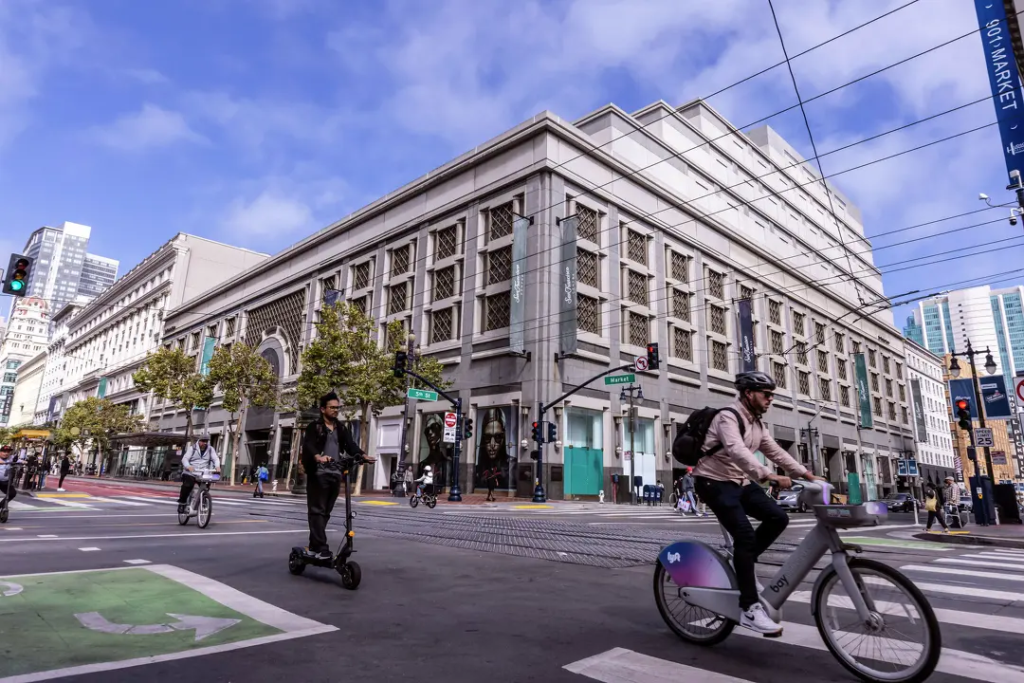
The closed San Francisco Centre mall, pictured in 2025, is a good fit for conversion into a campus for the Ruth Asawa School of the Arts.Carlos Avila Gonzalez/S.F. Chronicle
Last week, a deal to purchase the San Francisco Centre collapsed after the prospective buyers were reportedly unable to renegotiate an existing long-term lease held by the San Francisco Unified School District for a portion of the property.
What happens next for the poster child of San Francisco’s doom-loop era is anyone’s guess.
This is an intimidating site: 1.5 million square feet on more than 5 acres, with an emptiness that casts a pall on a neighborhood finally making strides toward recovery. It’s a big ask to expect a private developer to gamble hundreds of millions on a complicated downtown mall with lease issues and uncertain retail prospects.
But what if we stop looking at the abandoned mall as a real estate headache and start seeing it for what it could become?
I propose that the district’s Ruth Asawa School of the Arts be moved here. It’s an idea no less fanciful than former Mayor London Breed’s to locate a soccer stadium there. In fact, I’d argue that an art school may be the most logical reuse proposal on the table. Not only would the school finally get the arts campus it has promised students for years, but the city would also signal its commitment to rebuilding the local arts community.
Yes, there would be bureaucratic complexities with such a plan. But let’s not get too in the weeds and just think boldly for a minute.
Two public schools existed at the mall’s site in the 1800s: Webster Primary School and Lincoln Grammar School. After the 1906 earthquake and fire destroyed the schools, the land was leased for commercial purposes to support the school district financially. The district still owns a portion of the underlying land, so converting the site back into an educational use makes practical and historical sense.
It also solves a problem the city has failed to solve for decades. The School of the Arts, located on Portola Drive just below Twin Peaks and overlooking Glen Canyon Park, was supposed to be relocated long ago. Over the last 20 years, the district tried to create a new, state-of-the-art campus at 135 Van Ness Ave. But that effort stalled under the weight of seismic problems, historic restrictions and runaway construction costs. The effort was all but abandoned.
That’s a tragedy. Ruth Asawa is an academic jewel of the district. But it has been taken for granted.
My daughter graduated from the school in 2024. She had a great experience studying there with passionate and committed teachers. But the studio space where she and her classmates spent every afternoon was a windowless classroom with no heat and a leaky roof.
The building is crumbling; the school’s programs are underfunded; the dance department has no on-site studio, and students have to be bussed across town to a space for them to practice.
That’s not the kind of space that inspires creativity.
There aren’t a lot of things that fit well on the layout of a former department store, but an arts school is one of them. The giant floor plates of Nordstrom or Bloomingdale’s could become dance studios, black-box theaters, art galleries, recording spaces and classrooms. These stores’ high ceilings and flexible interiors are assets, not obstacles.
Moving the School of the Arts to the former mall would bring students to a central, transit-rich location with quick and easy access to cultural institutions like the Museum of Modern Art, the Warfield theater and Davies Symphony Hall.
Architect Owen Kennerly, principal of Kennerly Architecture, agrees that the School of the Arts would be perfect for the mall site. “You want a hybridized ecosystem here, not a monoculture,” he told me. “There could be a school, housing, arts venues, maybe a tech research component and neighborhood-serving retail. There’s a movie theater there, so it’s already a venue.”
Anders Carpenter, the higher education practice leader at the global design firm Perkins & Will, sees the whole area as an opportunity zone: “The mall, the Mint, the Pickwick Hotel — think about that set of street corners and what that could become.”
Carpenter’s firm has been working on UC School of the Law San Francisco’s Academic Village, a shared, urban campus integrating housing and facilities across multiple universities, and he sees it as a possible model for building out the San Francisco Centre. Perkins + Will transformed the Highland Mall in Austin, Texas, into Austin Community College, where, Carpenter said, “Sears is now the filmmaking department, JCPenney is now computer science, and so on. Malls have good infrastructural connective tissue and common spaces that make a ton of sense for education.”
Mall-to-school conversions aren’t that unusual. Grand Rapids Community College in Michigan converted vacant mall space into a flexible higher-education hub. On the peninsula, the Los Altos School District is turning former retail land into a new school campus. After the 2025 Palisades Fire badly damaged Palisades Charter High School, displacing more than 2,500 students just two days before the beginning of their spring semester, architects at the firm Gensler transformed an old Sears building in Santa Monica into a fully functional, temporary campus — in 30 days.
As Gensler’s managing principal, Randy Howder, told me, “Things happen when they have to happen. There was the collective will.”
As for doing something similar at San Francisco Centre, Howder said, “It’s challenging in a multistory urban site. Harder than, say, a typical suburban shopping mall but still well suited to an urban campus.”
Yet apart from the steel and glass dome, there’s nothing particularly precious about this structure.
“If you go back and look at construction photos from the 1980s, it’s really just a simple steel frame that could be stripped down and converted,” Kennerly said.
Carpenter said the idea of an arts school conversion was on “fertile ground.”
Actually pulling it off, he noted, wouldn’t be easy.
“Who is the entity tying all those things together? That’s one of the big questions.”
Yet there’s no denying that students would be great for the neighborhood. They’d provide daily foot traffic. They need to eat — a lot. And they shop.
A downtown school campus could bring exactly the kind of steady, human-scale activity San Francisco keeps saying it wants.
Meanwhile, School of the Arts’ current 22-acre Portola Drive campus, about the size of nine city blocks, could be redeveloped into housing, yielding potentially 2,000 units in one of the city’s most desirable neighborhoods.
About Opinion
Guest opinions in Open Forum and Insight are produced by writers with expertise, personal experience or original insights on a subject of interest to our readers. Their views do not necessarily reflect the opinion of The Chronicle editorial board, which is committed to providing a diversity of ideas to our readership.
Read more about our transparency and ethics policies
Think of it as a civic trade: move the school to the place where it belongs and unlock housing on land where housing makes sense.
Doesn’t that sound better than a mall?
Allison Arieff is a columnist and editorial writer for the Opinion section.
July 14, 2026
Columnist
Allison Arieff is an Opinion Columnist and Editorial Writer for the San Francisco Chronicle with an emphasis on housing and transportation policy, design and urbanism.
She joined the Chronicle from MIT Technology Review, where she was the Editorial Director of Print. Arieff was previously Editorial Director of the Bay Area urban planning and policy think tank SPUR, and was a regular columnist for New York Times’ Opinion section from 2007-2020, focusing on cities, design and technology. She was the Editor in Chief and founding Senior Editor of the design and architecture magazine Dwell, which won the National Magazine Award for General Excellence during her tenure.


