We Spend Almost a Trillion Yearly on War. That’s Insane.

Cut the military budget in half. Bloated war spending remains a sacred cow for far too many

Eric Blanc Mar 2, 2026 (laborpolitics@substack.com)

Donald Trump is setting Iran and the world on fire. And there’s every reason to think he’ll keep escalating abroad as his regime gets weaker and less popular at home.

But we should be honest: this didn’t start with Trump. For decades, both parties have shared the same basic commitment to U.S. military dominance over the world. Fifty-five percent of House Democrats voted in favor of the most recent US armed forces budget.

Establishment liberals like Chuck Schumer and Hakeem Jeffries prefer a more stable and less erratic version of empire. That’s why their objections about the Iran attack are about process and “strategic clarity,” not a break with the underlying goal of U.S. supremacy. For her part, Kamala Harris on the campaign trail promised to “ensure America always has the strongest, most lethal fighting force in the world.”

What almost never gets seriously questioned in mainstream US politics is the premise itself: that Washington has the right to bomb, invade, or attack any country across the globe whenever it decides it has a sufficiently good reason. There are important exceptions — Bernie Sanders, Alexandria Ocasio-Cortez, James Talarico, and others have taken clearer antiwar stances.

But it’s not enough just to oppose this war on Iran. Nor is it enough to demand an end to US aid to Israel. As long as the United States spends almost $1 trillion a year on the military, there will be overwhelming institutional and political pressure to use that machine, justify that machine, and keep expanding that machine — while insisting that there’s no money at home to make life affordable for working people.

Anti-MAGA forces need to stop treating military-budget cuts like a fringe talking point. In the midterms and in 2028, we should agitate for serious reforms to the US war machine. What’s a reasonable-but-ambitious starting point? Cut the armed forces’ $886 billion budget in half.

That’s not pie in the sky. A military budget of “only” about $443 billion would still leave the United States the biggest military spender in the world. But it could mark a real step away from the strategy and practice of imperialism.

Humanity needs international cooperation, not conflict. The United States’s deepening rivalry with China threatens to push the globe into another catastrophic great-power spiral at precisely the moment we need to confront actual existential questions like climate breakdown and how to develop AI slowly and carefully enough that it doesn’t wreck our livelihoods or human civilization.

And with so many working-class Americans barely hanging on, freeing up roughly $500 billion every year would go a long way toward making life in this country livable again.

We are constantly told that universal childcare is too expensive, housing is too expensive, healthcare is too expensive, public transit is too expensive, climate adaptation is too expensive. One simple solution is to cut the military budget in half.

Image by Golden Cosmos

Better Ways To Spend Half a Trillion Dollars

So many life-changing policies would become possible if America halved its military budget. Here’s what $443 billion yearly could fund if directed fully toward each item:

1. Medicare for All — Most estimates put the net new federal cost at $300-400 billion/year (replacing premiums, copays, and deductibles currently paid privately). $443 billion/year would essentially fund the transition to a single-payer system, covering every person in the country while eliminating out-of-pocket costs.

2. End hunger — Making breakfast and lunch free at every school costs about $20 billion per year. Expanding SNAP and WIC to fully eliminate food insecurity would run another $50-100 billion. $443 billion could end hunger in America and completely transform the school nutrition system with money to spare many times over.

3. Build millions of public housing units — Average cost to build a quality affordable unit is roughly $200,000-$300,000. At $443 billion/year, you could build 1.5 to 2 million new public housing units every single year. The entire estimated national shortage is about 4-7 million units, so you’d close the gap in three to four years and then have an ongoing budget for maintenance, renovation, and continued construction.

4. Cancel all medical debt — Total medical debt in active collection is estimated around $195 billion. You could eliminate every dollar of it in the first year and still have over $240 billion left for other health investments that same year.

5. Cancel all student debt — Total outstanding student debt is roughly $1.8 trillion. You could wipe it all out in about four years, then fund free public college permanently going forward with money to spare.

6. Make public college and trade school free — Total tuition revenue at all public colleges and universities is around $80-90 billion per year. $443 billion covers that almost five times over. You could eliminate tuition, massively expand capacity, and fund living stipends for students.

7. Universal childcare and pre-K — Estimated cost for a universal, high-quality system is roughly $70-100 billion per year. $443 billion would fund a system where every family in America has access to free or near-free childcare from birth through age five, with well-paid unionized staff, and still leave $340+ billion on the table.

8. Green energy transition jobs program — The entire Inflation Reduction Act was about $370 billion in climate spending spread over a decade. $443 billion per year would be roughly twelve times that annual rate. You could retrofit every building in the country, build out renewable energy infrastructure nationwide, and fund union-wage jobs for every displaced fossil fuel worker many times over.

9. National high-speed rail network — California’s single high-speed rail project is estimated around $100 billion. $443 billion/year could build a comprehensive national network connecting every major metro area within a decade, something comparable to what China and Europe have built.

10. Repair all deteriorating infrastructure — The American Society of Civil Engineers estimates the US infrastructure gap, the gap between the amount of money needed for basic infrastructure maintenance versus how much is actually allocated for it, at roughly $2.6 trillion over ten years. $443 billion yearly covers that completely — every bridge, road, dam, water system, school building, and electrical grid — and leaves room for new construction.

11. Universal home and community-based care — There are roughly 800,000 people on Medicaid waiting lists for home care for elderly and disabled people. A comprehensive universal program would cost an estimated $150-200 billion per year. $443 billion fully funds this with well-paid caregivers and eliminates every waitlist in the country.

12. Federal jobs guarantee — Most estimates for a program guaranteeing a $15 per hour job with benefits to anyone who wants one range from $300-500 billion/year depending on uptake. $443 billion lands right in that range, potentially employing 10-15 million people in public works, caregiving, environmental restoration, and community development.

13. Expand and strengthen Social Security — Eliminating the taxable earnings cap is the usual funding mechanism, but $443 billion/year could increase average benefits by roughly 35-40%, lower the retirement age, and extend the trust fund indefinitely. That would lift virtually every senior out of poverty.

14. Community health centers and mental health services — There are currently about 1,400 federally qualified health centers. Estimates suggest we need roughly 8,000-10,000 more to provide universal primary and mental health access. At roughly $5-10 million per center for construction and staffing, $443 billion could build out the entire system in a single year and fund operations for decades.

15. Weatherize and retrofit every home — Average cost to fully weatherize a home is roughly $5,000-$10,000. There are about 35-40 million homes that need it. Total cost: $200-400 billion. $443 billion/year does the entire country in one year, cutting energy bills for tens of millions of families immediately — and reducing carbon emissions.

16. Universal paid family and medical leave — A comprehensive 12-week paid leave program is estimated at roughly $50-75 billion/year. $443 billion funds this nearly six times over. You could offer six months of paid leave and still have hundreds of billions remaining.

17. Fully fund and transform veterans’ care — Veterans Affairs’ (VA) current budget is around $400 billion but is plagued by staffing shortages, long wait times, and crumbling infrastructure, with Congress consistently failing to fund it adequately. $443 billion a year could double VA healthcare staffing, eliminate every wait list, build state-of-the-art facilities in every region, fully fund mental health and suicide prevention programs, end veteran homelessness (roughly 35,000 veterans are unhoused on any given night), and guarantee every veteran world-class care without bureaucratic delays — all while keeping the existing VA public healthcare system rather than privatizing it.

The staggering thing about this list is that even the most expensive items rarely exceed $443 billion individually. You could fund several of them simultaneously with half the military budget. For context, the US spends more on its armed forces than the next nine countries combined.

Peace Is Possible

Even though more Americans want to cut the military budget than expand it — and even though this war on Iran is widely opposed — the military itself as an institution remains remarkably popular. Cutting the military budget in half is ambitious and would be controversial, since so many communities across the US economically rely on supplying goods and services to the military. Why not start with a smaller proposed cut? This is a reasonable question.

My response is, first, that $443 billion a year is still a huge amount of money. Second, there’s a huge amount of fat that can be quickly and easily cut because military spending is rampant with waste, irrationality, and lack of financial accountability. Third, there is strong precedent for a massive military cut: military spending was cut in half from 1945 to 1946 in the wake of World War II. By 1948, the armed forces budget had been cut 89 percent from its wartime total, as factories converted to peacetime use. The same conversion strategy used then — deep Pentagon cuts combined with job guarantees, wage protections, retraining, union-led transition planning, and long-term public contracts for civilian production — can be used to transition us today away from an economy oriented towards destruction, towards one based on producing services and providing goods that humans actually need.

Finally, along the way to our goal of halving the budget, we should also support intermediary military budget cuts like the 10 percent proposed by Bernie Sanders. Realistically, it will probably be through the accretion of such partial steps forward that we’ll achieve our goals. In part, that’s because it will take time to reconfigure and transition the plants currently being used to produce weapons and military goods. But in that process, it’s crucial we keep the public’s eye on the prize of a dramatically different US military.

The problem with modest proposed military budget cuts on their own isn’t just that they don’t free up enough money for domestic programs. It’s also important that we spark a serious national debate about how the United States can begin relating to the world in a way that does not hinge on domination and exploitation.

In 1967, Martin Luther King Jr. noted that the US government was the “greatest purveyor of violence in the world.” That remains true today. But it doesn’t have to remain true tomorrow.


More

  • Wars abroad are inseparable from ICE’s war at home. Sign up here to get involved in the Schools Drop ICE campaign to force our colleges to break their contracts with the corporations propping up ICE.
  • Do you have organizing experience? Please sign up here to become a volunteer organizing coach for Schools Drop ICE! Over a thousand students and faculty have already signed up, so it’s all hands on deck to help them launch powerful campaigns.
  • If you have any research experience and would like to volunteer for Schools Drop ICE, please send an email to schoolsdropice@gmail.com .

‘Enough Is Enough’: Sanders, Khanna Propose Billionaires Tax to Raise $4.4 Trillion

Bernie Sanders Holds Town Hall On AI In Stanford

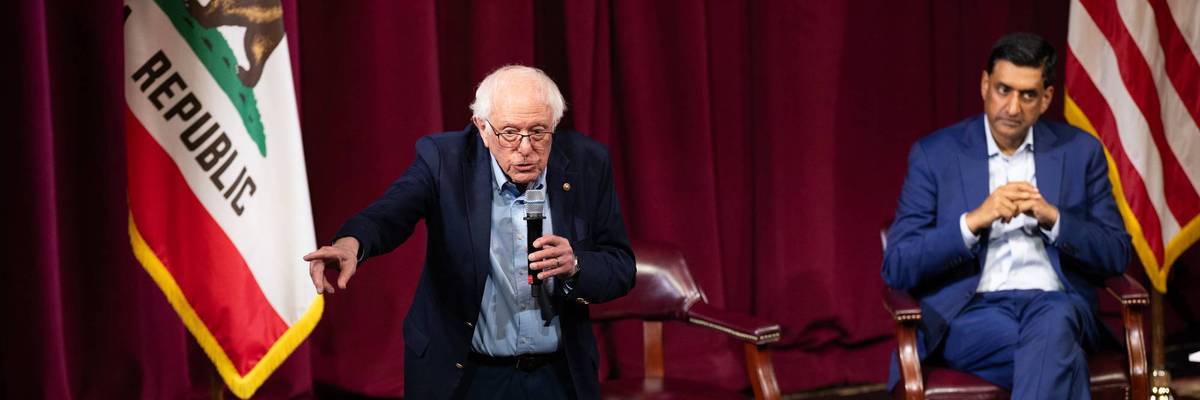
Sen. Bernie Sanders (I-Vt.) speaks next to Rep. Ro Khanna (D-Calif.) at a town hall event on February 20, 2026 in Stanford, California. 

(Photo by Benjamin Fanjoy/Getty Images)

“In a democratic society, we cannot tolerate 60% of our people living paycheck to paycheck—struggling to pay for housing, food, and healthcare—while 938 billionaires have become $1.5 trillion richer.”

Julia Conley

Mar 02, 2026 (CommonDreams.org)

The US economy has reached a breaking point, suggested Sen. Bernie Sanders on Monday as he and Rep. Ro Khanna introduced legislation to force billionaires pay their fair share in taxes.

“We can no longer tolerate a corrupt tax code that enables billionaires to pay a lower tax rate than the average worker,” said Sanders (I-Vt.) “In a democratic society, we cannot tolerate 60% of our people living paycheck to paycheck—struggling to pay for housing, food, and healthcare—while 938 billionaires have become $1.5 trillion richer. We cannot continue a trend in which, over the past 50 years, $79 trillion in wealth in our country has been redistributed from the bottom 90% to the top 1%. Enough is enough. Billionaires cannot have it all.”

RECOMMENDED…

SANDERSAOC

Sanders to Rally for Billionaire Tax in California as Crypto Industry Joins Newsom in Opposition

Progressives-Mobilize-in-Los-Angeles

‘It Should Be Common Sense’: Sanders to Headline Billionaire Tax Campaign Kickoff in California

The taxes of fewer than 1,000 people in the US would be impacted by the Make Billionaires Pay Their Fair Share Act, but just a 5% annual wealth tax on those households would be able to raise an estimated $4.4 trillion in revenue over the next decade, said Sanders’ office—a fact that underscores the immense wealth of the 938 billionaires who would be targeted by the bill.

Those 938 people have a collective net worth of $8.2 trillion, and Sanders and Khanna (D-Calif.) pointed out how the immense fortunes of some high-profile billionaires would be affected by the bill.

According to the lawmakers, Tesla CEO and President Donald Trump ally Elon Musk, whose $833 billion net worth makes him richer than the bottom 53% of US households, would owe $42 billion in taxes—an unfathomable amount to the vast majority of Americans, but a comparatively tiny tax bill for Musk, who would be left with about $792 billion.

Meta CEO Mark Zuckerberg and Amazon founder Jeff Bezos would each owe just $11 billion compared to their $220 billion and $218 billion net worth.

The wealth of billionaires has risen rapidly in recent years, increasing by about 20% in 2025, according to Americans for Tax Fairness.

“We have a deep economic divide in this country. On one side, places like Silicon Valley are generating extreme wealth. On the other side, families are struggling to cover the cost of healthcare, housing, and basic needs,” said Khanna. “We can tax billionaires a modest amount to make sure everyone has a fair chance while keeping our innovative engine. That is why I am proud to join Sen. Bernie Sanders to lead the Make Billionaires Pay Their Fair Share Act.”

With the revenue collected from the wealth tax, said Sanders and Khanna, the federal government would:

  • Provide a $3,000 direct payment to every man, woman, and child in a household making $150,000 or less;
  • Reverse the $1.1 trillion in Medicaid and Affordable Care Act cuts in Trump’s One Big Beautiful Bill Act, which are estimated to cause more than 50,000 unnecessary deaths;
  • Expand Medicare to cover dental, vision, and hearing care for millions of seniors;
  • Build, rehabilitate, and preserve over 7 million affordable homes to eliminate the affordable housing gap and end homelessness;
  • Ensure no family pays more than 7% of their income on childcare;
  • Establish a $60,000 minimum annual salary for every public school teacher in America; and
  • Expand Medicaid home health care for seniors and people with disabilities.

Khanna and Sanders emphasized that “no one who has a net worth of less than $1 billion would pay a penny more in taxes under this bill.”

Emmanuel Saez and Gabriel Zucman, economists at University of California, Berkeley, released an analysis Monday that found the bill “would raise approximately $4.4 trillion over a decade and close the gap between wealth growth for billionaires and income growth for the average American family that has existed since the early 1980s.”

X post: https://x.com/gabriel_zucman/status/2028520845841453078?ref_src=twsrc%5Etfw%7Ctwcamp%5Etweetembed%7Ctwterm%5E2028520845841453078%7Ctwgr%5E59b786746e94e60234a04639e8054c9e4002b08d%7Ctwcon%5Es1_c10&ref_url=https%3A%2F%2Fwww.commondreams.org%2Fnews%2Fbernie-sanders-billionaire

“Democracies become oligarchies when wealth becomes too concentrated,” said the economists. “The US has now reached an unprecedented level of top wealth concentration. US billionaire wealth has exploded in recent years, more than doubling since 2019. A billionaire wealth tax is the most direct policy tool to curb the growing concentration of wealth among the billionaire class in the United States.”

“Combining top wealth taxation with policies to rebuild middle class economic security,” said Saez and Zucman, “is what the United States needs to ensure vibrant and equitable growth for the future.”

As Jeff Stein wrote at the Washington Post, the proposal of a wealth tax—which is supported by roughly two-thirds of Americans, according to polls—could become a litmus test in the 2028 presidential election, in which Khanna has been named as a potential candidate.

California Gov. Gavin Newsom has also been named as a possible Democratic contender and has expressed vehement opposition to a billionaire tax that’s been proposed in his state, putting him at odds with about 90% of Democratic voters there and three-quarters of all Californians.

Sanders—who supports the California measure—said that “it is time to enact a wealth tax on billionaires and use this revenue to address some of the major crises facing working families, the children, the elderly, the sick, and the most vulnerable.”

“At a time of unprecedented income and wealth inequality,” he said, “this legislation demands that the billionaire class in America finally pay their fair share of taxes so that we can create an economy that works for all of us, not just the 1%.”

Our work is licensed under Creative Commons (CC BY-NC-ND 3.0). Feel free to republish and share widely.

Julia Conley

Julia Conley is a staff writer for Common Dreams.

Full Bio >

Will Others Follow? Spain Denies Use of Its Bases to US Military for Iran Attacks

Will Others Follow? Spain Denies Use of Its Bases to US Military for Iran Attacks

Spanish Prime Minister Pedro Sánchez holds a press conference at the end of a special European Summit in Brussels, Belgium, on January 23, 2026.

 (Photo by Jonathan Raa/NurPhoto via Getty Images)

“Europe should close all of the US bases on its soil,” said one US foreign policy critic.

Brad Reed

Mar 02, 2026 (CommonDreams.org)

The Spanish government has blocked the US military from using its bases to launch attacks on Iran, forcing American aircraft to leave the country.

Speaking at the annual Mobile World Congress conference in Barcelona on Sunday, Spanish Prime Minister Pedro Sánchez denounced that US war on Iran, which was completely unprovoked.

RECOMMENDED…

image shoes US military planes headed to the midde east

‘The Tankers Just Keep Coming’: US Military Movements Spike Fears of Imminent Attack on Iran

U.S.-Israel War Against Iran

‘Unlike the United States,’ Says Security Chief, Iran ‘Has Prepared Itself for a Long War’

“Remember that one can be against a hateful regime, as is the case with the Iranian regime,” Sánchez said, “and at the same time be against a military intervention that is unjustified, dangerous, and outside international law. That one should be against a war initiated without authorization from the US Congress or the UN Security Council.”

According to a Monday report in the Guardian, Spanish Foreign Minister José Manuel Albares emphasized after Sánchez’s speech that Spanish military bases will not be used “for anything that is not in the agreement [with the US], nor for anything that isn’t covered by the UN charter.”

In the wake of the Spanish government’s announcement, anti-war campaigners demanded that other European nations take similar stances.

“Europe should close all of the US bases on its soil,” wrote David Adler, co-general coordinator of Progressive International. “There can be no ‘strategic autonomy’ while the United States maintains the ability to commit wanton violence from imperial installations on European territory.”

Alex Soros, chairman of Open Society Foundations, said that more nations should follow in Spain’s footsteps in trying to curb US aggression.

“Why aren’t more Europeans standing up to an illegal war!” Soros wrote. “Same with Canada! They make nice speeches at conferences, but do little. Spain is becoming the leader of the free world!”

Clare Daly, an Irish former member of European Parliament, encouraged her country to do its part to deny the US a base for airstrikes.

“Spain has denied the US military any use of its territory to carry out unlawful acts of aggression against Iran,” Daly wrote. “Yesterday [Human Rights Organization] Shannonwatch documented two US Air Force Hercules C-130H aircraft landing at Shannon Airport. Is the government going to do anything to uphold Ireland’s international responsibilities?”

Alan McLeod, senior staff writer at MintPress News, quipped that the Spanish government “continues to provide more resistance to Trump’s agenda than all Democrats combined.”

Our work is licensed under Creative Commons (CC BY-NC-ND 3.0). Feel free to republish and share widely.

Brad Reed

Brad Reed is a staff writer for Common Dreams.

Full Bio >

Call Grows to Impeach Trump, ‘The Most Dangerous Man on the Planet’

Anti-Trump demonstration in Turkey after US Attack on Iran

Protestors stand on an image depicting US President Donald Trump during a gathering to protest against the US and Israel attack of Iran and the killing of the Supreme leader in front of the US Embassy in Ankara on March 1, 2026. 

(Photo by Adem Altan/AFP via Getty Images)

“Trump’s illegal war on Iran and the rule of law,” said one pair of campaigners, “establish an intolerable pattern of egregious abuses of power, directly threatening our constitutional order, our safety, and our way of life.”

Jon Queally

Mar 02, 2026 (CommonDreams.org)

After the unprovoked bombing of Iran over the weekend by the United States and Israel—strikes that included the unlawful assassination of Iranian Supreme Leader Ali Hosseini Khamenei—the call for US President Donald Trump to be impeached and removed from office has grown as the straightest path to hold the US leader to account for the attacks which policy and human rights experts have condemned as a serious war crime.

With a regional war in the Middle East that was already boiling from Gaza to Lebanon and from Syria to Yemen now exploding in the wake of the US-Israeli attacks on Iran, Globe and Mail columnist Debra Thompson on Sunday called Trump “the most dangerous man on the planet.”

RECOMMENDED…

maga hat on fire

Three-Time Trump Voter Calls C-SPAN to Apologize for ‘Supporting This Rotten, Rotten Man’

US-POLITICS-CONGRESS-DEMOCRATS

As Trump Marches US Toward Iran War, Critics Ask: Where’s the ‘Pushback’ From Dems and Media?

“Rather than ending wars,” Thompson notes, “Trump has initiated military action eight times, carrying out attacks in seven countries (Syria, Iraq, Iran, Nigeria, Yemen, Somalia, and Venezuela) in 2025.” Such a pattern of violence and warmongering should make clear that failure to restrain Trump has only emboldened him.

“The recurring danger in this latest presidential aggression is that there are no guardrails, no constraints, and no post-hoc justification,” writes Thomson, “other than that Mr. Trump is the President of the United States and can do whatever he wants.”

But American presidents cannot simply do whatever they want. According to a Reuters/Ipsos poll out Sunday, less than 25% support the president’s aggression against Iran. In the first wave of the US military attack, an Iranian school for girls was bombed, killing over 108 civilians, mostly children.

While some congressional lawmakers are pushing for a vote this week on a War Powers Resolution to curtail US military operations against Iran, others are demanding more robust action from Congress to bring Trump’s war-making to an end.

“Under Article I, Section 8 of the U.S. Constitution, only Congress has the power to declare war, as well as to raise and support armies, provide and maintain a navy, and fund and regulate the military,” declared novelist and political activists Stephen King on Saturday. “Impeach the SOB.”

X post: https://x.com/matthewstoller/status/2027718896917078209?ref_src=twsrc%5Etfw%7Ctwcamp%5Etweetembed%7Ctwterm%5E2027718896917078209%7Ctwgr%5Edac196f7e6f6f708487bea45573b75a01053640a%7Ctwcon%5Es1_c10&ref_url=https%3A%2F%2Fwww.commondreams.org%2Fnews%2Fimpeach-trump-iran-war

Mike Hersh and Alan Minsky, respectively the communications director and executive director of the Progressive Democrats of America, argued in a Sunday op-ed for Common Dreams that “Trump’s illegal, unconstitutional war on Iran is not only a moral and humanitarian disaster, but also a profound constitutional crisis.”

According to Hersh and Minsky:

Trump’s illegal war on Iran and the rule of law establish an intolerable pattern of egregious abuses of power, directly threatening our constitutional order, our safety, and our way of life. These intertwined crises cry out for an immediate, decisive response by the Congress and the US public.

Therefore, PDA demands that all members of Congress, Democrats, Republicans, and Independents alike, uphold their oath of office to defend our constitutional republic. The Constitution offers one and only one remedy when President a repeatedly breaks the law and arrogantly refuses to abide by the limits on the power clearly laid out in the Constitution. That remedy is impeachment, followed by removal from office.

Matt Duss, executive vice president for the Center for International Policy, said that US lawmakers, as well as the American people they represent, “must also be ready to hold the president and his administration accountable for this breach of US and international law.”

“The failure to hold past presidents liable for war crimes and related violations of our own laws has helped lead to this dangerous moment, with a seemingly unrestrained president endangering millions of lives with impunity,” warned Duss. “The forever wars and the imperial presidency must finally come to an end.”

Our work is licensed under Creative Commons (CC BY-NC-ND 3.0). Feel free to republish and share widely.

Jon Queally

Jon Queally is managing editor of Common Dreams.

Full Bio >

Your weekly to-dos

  1. Tonight: Join MoveOn’s emergency mass call – Iran in Focus: Stop Trump’s War (7pm ET/4pm PT). Indivisible and several other national partners are co-hosting MoveOn’s mass, movement-wide call to discuss what’s at stake, map out next steps, and launch a nationwide push to tell every elected official: no more endless wars. We’ll hear from activists, foreign policy experts, and Members of Congress calling for immediate de-escalation in Iran and demanding immediate action to keep Trump in check.
  2. Call your senatorscall your representative, and email them all: They must stop Trump’s war! The Constitution is clear: Congress holds the power to declare war. Trump’s reckless and unconstitutional Iran escalation has already led to the deaths of, as of this writing, six US servicemembers and hundreds of Iranians civilians. Americans didn’t ask for this war and we absolutely don’t support it. Members of Congress must use every lever in their toolbox to put an immediate end to it. Let all your Members of Congress know: We won’t accept anything less.
  3. Tell Congress: Halt the ICE terror machine. GOP lawmakers have been quick to exploit Trump’s war as an excuse to insist Democrats drop their opposition to new funding for ICE and Border Patrol (details, below). Use our call scripts and email tool to contact your Members of Congress and demand that they refuse to expand Trump’s capacity to terrorize our communities just because he decided to bomb Iran. Demand serious guardrails be placed on those agencies as a bare minimum for any DHS funding deal.
  4. Register for the ICE Out for Good Funding Fight weekly phonebank. On Tuesday (1pm ET/10am PT), we’ll be calling voters in key states to encourage them to call their Members of Congress and urge them to hold the line and demand that ICE’s terror tactics be stopped for good.
  5. Find your March 28 No Kings Day event. March 28 was already set to go down in history as America’s biggest single-day protest ever, but Trump’s war has made it even more urgent that we turn out in numbers too great to ignore. There are nearly 2000 events registered! If you don’t find anything within an hour of your home, consider hosting an event yourself

UPDATE: REPUBLICANS’ DHS SHUTDOWN

Today is Day 17 of the GOP’s DHS shutdown — a shutdown that happened only because Republicans aren’t willing to hold ICE and Border Patrol to the same sort of standards as law enforcement — and now the GOP wants to use Trump’s war to get Democrats to cave and let them shovel billions more into those agencies’ coffers.

So far, Dems have stood firm, refusing to vote on the Republicans’ DHS funding bill. Democrats have even put forward a bill that would fund every part of DHS other than ICE, Border Patrol, and Kristi Noem’s office. But no, the GOP would rather let their shutdown drag on and keep ICE unaccountable.

Americans have been clear: No more ICE terror, and no more wars. Indivisibles in particular have made sure Democrats hold the line on DHS, making a record-breaking number of calls to Congress — but the fight really isn’t over. We need to keep up the pressure and make sure elected officials know their constituents are still watching closely.

That means more calls, more emails, more rallies at their offices — more making your voice heard above the noise of the ICE machine.

The longer the shutdown lasts, the more time skittish Democrats will have to back away from our demands. Let them know what you think!

Trump Administration Still Used Anthropic’s Claude In Iran Strikes, Hours After Trump Banned Anthropic

2 March 2026/Business & Tech/Joe Kukura (SFist.com)

Despite Trump calling SF’s Anthropic a “Radical Left AI company run by people who have no idea what the real World is all about” and banning government use of their AI tool Claude, the administration still had to use Claude in its Iran attacks.

This past Friday afternoon and evening saw an insane set of news events play out for both the SF tech industry and global events. Early in the afternoon, President Trump declared he was severing all government ties with San Francisco-based AI company Anthropic after the company raised concerns that its tools could be used for AI-based mass murder and domestic surveillance.

By 7 pm Friday, Anthropic’s SF rival OpenAI stepped in and said they would gladly take the contracts. And by 8 pm Friday night, the US was launching military attacks on Iran.  

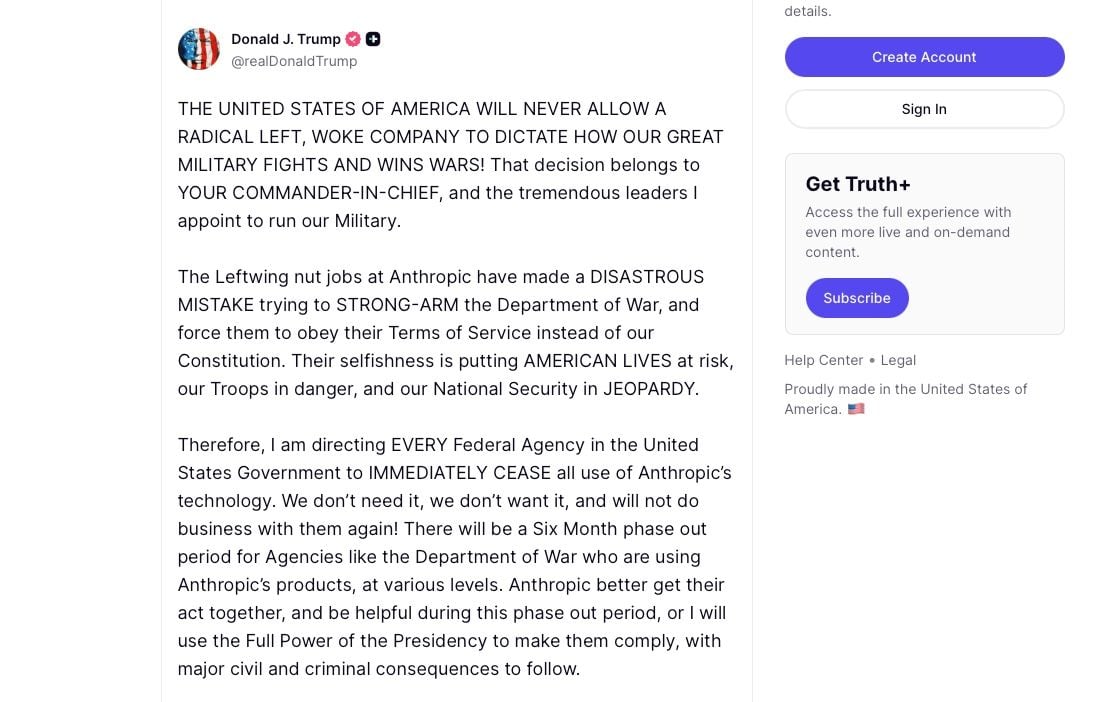
Image: via Truth Social

When the Trump administration banned all government use of Anthropic and its well regarded tool Claude, Trump declared on Truth Social that “Leftwing nut jobs at Anthropic have made a DISASTROUS MISTAKE trying to STRONG-ARM the Department of War,” and that “I am directing EVERY Federal Agency in the United States Government to IMMEDIATELY CEASE all use of Anthropic’s technology. We don’t need it, we don’t want it, and will not do business with them again!”

That is all quite hilarious when considered in the context that the US military still used Anthropic’s Claude tool anyway in this weekend’s attacks on Iran, according to a report in the Sunday Wall Street Journal. That Journal article is behind a paywall, but the same information was also reported in a free article at Axios separately at about that same time.

The Journal’s reporting says the Pentagon used Claude in the Iran attacks to select targets, conduct theoretical battlefield simulations, and for general intelligence assessments. According to Axios, despite Trump’s bans and tantrums, “The Pentagon still sees Anthropic’s Claude as superior to other models.”

And maybe getting banned by the Trump administration is good for business. As a separate Axios report points out, the Trump ban sent Anthropic’s Claude to the number one most downloaded app in the Apple App Store over the weekend, a position it still held as of Monday morning.  

Related: Pentagon Trying to Force SF-Based Anthropic to Weaken AI Security for Killing Purposes, Anthropic Not Backing Down [SFist]

Image: CHONGQING, CHINA – DECEMBER 29: In this photo illustration, a person holds a smartphone displaying the logo of “Claude,” an AI language model by Anthropic, with the company’s logo visible in the background, illustrating the rapid development and adoption of generative AI technologies, on December 29, 2024 in Chongqing, China. Artificial Intelligence (AI) has become a cornerstone of China’s strategic ambitions, with the government aiming to establish the country as a global leader in AI by 2030. (Photo illustration by Cheng Xin/Getty Images)

NAACP-US.org/noICE

AED | United Arab Emirates DirhamAFN | Afghan AfghaniALL | Albanian LekAMD | Armenian DramANG | Netherlands Antillean GuilderAOA | Angolan KwanzaARS | Argentine PesoAUD | Australian DollarAWG | Aruban FlorinAZN | Azerbaijani ManatBAM | Bosnia-Herzegovina Convertible MarkBBD | Barbados DollarBDT | Bangladeshi TakaBGN | Bulgarian LevBHD | Bahraini DinarBIF | Burundian FrancBMD | Bermudian DollarBND | Brunei DollarBOB | Bolivian BolivianoBRL | Brazilian RealBSD | Bahamian DollarBTN | Bhutanese NgultrumBWP | Botswanan PulaBZD | Belize DollarCAD | Canadian DollarCDF | Congolese FrancCHF | Swiss FrancCLF | Unidad de FomentoCLP | Chilean PesoCNH | Chinese YuanCNY | Chinese YuanCOP | Colombian PesoCRC | Costa Rican ColónCUC | Cuban Convertible PesoCUP | Cuban PesoCVE | Cape Verdean EscudoCZK | Czech Republic KorunaDJF | Djiboutian FrancDKK | Danish KroneDOP | Dominican PesoDZD | Algerian DinarEGP | Egyptian PoundERN | Eritrean NakfaETB | Ethiopian BirrEUR | EuroFJD | Fiji DollarFKP | Falkland Islands PoundGBP | British Pound SterlingGEL | Georgian LariGGP | Guernsey PoundGHS | Ghanaian CediGIP | Gibraltar PoundGMD | Gambian DalasiGNF | Guinean FrancGTQ | Guatemalan QuetzalGYD | Guyanese DollarHKD | Hong Kong DollarHNL | Honduran LempiraHTG | Haitian GourdeHUF | Hungarian ForintIDR | Indonesian RupiahILS | Israeli New SheqelIMP | Isle of Man PoundINR | Indian RupeeIQD | Iraqi DinarIRR | Iranian RialISK | Icelandic KrónaJEP | Jersey PoundJMD | Jamaican DollarJOD | Jordanian DinarJPY | Japanese YenKES | Kenyan ShillingKGS | Kyrgyzstani SomKHR | Cambodian RielKMF | Comorian FrancKPW | North Korean WonKRW | South Korean WonKWD | Kuwaiti DinarKYD | Caymanian DollarKZT | Kazakhstani TengeLAK | Lao KipLBP | Lebanese PoundLKR | Sri Lankan RupeeLRD | Liberian DollarLSL | Basotho LotiLYD | Libyan DinarMAD | Moroccan DirhamMDL | Moldovan LeuMGA | Malagasy AriaryMKD | Macedonian DenarMMK | Myanma KyatMNT | Mongolian TögrögMOP | Macanese PatacaMUR | Mauritian RupeeMVR | Maldivian RufiyaaMWK | Malawian KwachaMXN | Mexican PesoMYR | Malaysian RinggitMZN | Mozambican MeticalNAD | Namibian DollarNGN | Nigerian NairaNIO | Nicaraguan CórdobaNOK | Norwegian KroneNPR | Nepalese RupeeNZD | New Zealand DollarOMR | Omani RialPAB | Panamanian BalboaPEN | Peruvian Nuevo SolPGK | Papua New Guinean KinaPHP | Philippine PesoPKR | Pakistani RupeePLN | Polish ZlotyPYG | Paraguayan GuaraniQAR | Qatari RialRON | Romanian LeuRSD | Serbian DinarRUB | Russian RubleRWF | Rwandan FrancSAR | Saudi RiyalSBD | Solomon Islands DollarSCR | Seychelles RupeeSDG | Sudanese PoundSEK | Swedish KronaSGD | Singapore DollarSHP | Saint Helena PoundSLL | Sierra Leonean LeoneSOS | Somali ShillingSRD | Surinamese DollarSSP | South Sudanese PoundSTD | São Tomé and Príncipe DobraSVC | Salvadoran ColónSYP | Syrian PoundSZL | Swazi LilangeniTHB | Thai BahtTJS | Tajikistani SomoniTMT | Turkmenistan ManatTND | Tunisian DinarTOP | Tongan PaʻangaTRY | Turkish LiraTTD | Trinidad and Tobago DollarTWD | New Taiwan DollarTZS | Tanzanian ShillingUAH | Ukrainian HryvniaUGX | Ugandan ShillingUSD | US DollarUYU | Uruguayan PesoUZS | Uzbekistan SomVND | Vietnamese DongVUV | Vanuatu VatuWST | Samoan TalaXAF | CFA Franc BEACXCD | East Caribbean DollarXDR | Special Drawing RightsXOF | CFA Franc BCEAOXPF | CFP FrancYER | Yemeni RialZAR | South African RandZWL | Zimbabwean Dollar

Give any amount to help cover shipping, and we’ll send you the NAACP No ICE magnet today!

NAACP is the counter-offensive to defend American democracy on every front, and we will always stand with those targeted and terrorized.

We are fighting against an all-out assault on our safety and freedoms. Now we have a target on our back. To remain effective advocates for Americans across the country, we need your support today!

❤️ Make an Impact Today!

Give once Monthly Choose an amount to donate One-time $25 $50 Suggested $100 $200 $300 $500

$USD Choose an amount

{{ Non-profit name }} is a 501(c)3 tax-exempt organization, and your donation is tax deductible within the guidelines of U.S. law.

Activity

Add a comment…

Melissa Hutchinson 4m4 minutes ago

Donated $100.00 to No ICE Magnet by Mail.0

L Hinkel 8m8 minutes ago

Donated $100.00 to No ICE Magnet by Mail and generously covered the fees.0

Ricardo Graham 16m16 minutes ago

Donated $100.00 to No ICE Magnet by Mail and generously covered the fees.0

James Wittenberg 29m29 minutes ago

Donated $25.00 to No ICE Magnet by Mail and generously covered the fees.0CommentShow more

Why Your Support Matters

The NAACP is fighting against an all-out assault on our safety and freedoms. Now we have a target on our back. If we are to remain effective advocates for Americans across the country, we need your support today!

FUEL THE FIGHT TO PROTECT BLACK COMMUNITIES!Share

Frequently asked questions

Is my donation secure?

Do I get a receipt?

How is my personal data handled?

Is my donation tax-deductable?

NAACP Empowerment Programs, Inc.
4805 Mt. Hope Drive
Baltimore, MD 21215 USPrivacy Policy

Donor Supportdevelopment@naacpnet.org

Copyright © 2026 • All rights reserved • Privacy Notice • Terms of Service

Go to: https://naacp-us.org.noICE

‘We reject this’: Hundreds in S.F. march against U.S.-Israeli attacks on Iran

By Lucy Hodgman, Staff Writer Feb 28, 2026 (SFChronicle.com)

Gift Article

Jim Martinez, left, and hundreds of other protesters outside the Speaker Nancy Pelosi Federal Building in San Francisco rally Saturday against the attacks on Iran by the United States and Israel.Manuel Orbegozo/For the S.F. Chronicle

Less than 24 hours after the United States and Israel launched a wave of missile strikes against Iran, hundreds of protesters blocked off a downtown San Francisco street Saturday to demonstrate against escalation abroad. 

Tensions between the U.S. and Iran have risen sharply in recent weeks, culminating in President Donald Trump’s Saturday announcement that the latest attacks had killed Iranian Supreme Leader Ayatollah Ali Khamenei. Democratic Party leaders, while also sharply critical of Khamenei’s regime, were quick to condemn the intervention as an illegal overstep.

Iranian American demonstrator Yasmine Mortazavi said she had been anxiously reading the news morning and night, waiting for “something like this to happen.” Mortazavi is a member of the Party for Socialism and Liberation, which joined the overnight, multigroup scramble to organize the protest after news of the airstrikes broke. 

“Today is the day the war started,” Mortazavi said. “I don’t think I was completely shocked, but I’ve felt a little bit numb.”

Protesters in San Francisco march against the United States and Israel attacks on Iran

Protesters march down Market Street in San Francisco on Saturday in response to the U.S. attacks on Iran.Manuel Orbegozo / For the S.F. Chronicle

She added that the size and diversity of Saturday’s protest was a testament to Americans’ general opposition to war abroad. The protesters outside the Speaker Nancy Pelosi Federal Building included young children in strollers, older couples and college students. They waved Palestinian flags and passed out literature for local political candidates, chanting “Bombing Iran is a crime” and “No boots on the ground, no bombs in the air.” 

Dina Saadeh, an organizer with the Palestinian Youth Movement, told the Chronicle that organizers selected the federal building as the site of the demonstration so their voices would be better heard by lawmakers, both in Washington, D.C., and at home in the Bay Area. 

“We’re sending a clear message to our elected officials, even the political elite here in S.F.,” Saadeh said. “We reject the rampant imperialism that they serve to gain from. … People here are engineering a better world simply by showing up and saying, ‘We reject this.’”

A broadly anti-Trump sentiment loomed over the event: Many protesters carried “ICE out” signs, and one man wore an oversize Trump mask and carried a sign reading “War is peace.” But demonstrators were also wary of Democratic leaders, who they said had failed to condemn the Israeli government more strongly amid its ongoing conflict in Gaza. 

As they marched from the federal building down Market Street, protesters stopped to boo and chant “shame” outside the Golden Gate Theater, where California Gov. Gavin Newsom appeared that night for a discussion of his new memoir. Newsom, who has long been floated as a likely 2028 presidential candidate, condemned the airstrikes and said in a statement that Trump is “putting Americans at risk abroad because he is unpopular at home.”

Edward Hasbrouck, 66, attended Saturday’s demonstration with the same “Don’t invade Iran” poster he took to protests in the wake of the 1979 Iranian Revolution, in which the U.S.-back shah was overthrown and replaced with an Islamic ayatollah. The marker-drawn poster has been in Hasbrouck’s basement for decades, he said — and the fact that he’s had to break it out regularly over the years proves to him that the issue goes beyond either major political party.

“Getting rid of Trump isn’t going to be enough,” Hasbrouck said. “We’re still going to need a peace movement, and we still need to be here to get the Democrats to recognize that war is not popular. Part of their opposition should be taking a stand for peace.”

Feb 28, 2026

Lucy Hodgman

Staff writer

Lucy Hodgman is a Hearst Fellow on the Climate Team at the San Francisco Chronicle, covering seismic building issues, homeowners insurance and breaking energy and environment news. She previously covered politics for the Times Union, in Albany, New York, and breaking news for Politico and the Sacramento Bee. 

Originally from Brooklyn, Lucy graduated from Yale University with a degree in English. Reach her at lucy.hodgman@hearst.com.

Block’s massive cuts stoke fears about AI’s effects on employment

A year of scandals forced a shift in values for the tech industry (copy)
In a post on social-media site X, Block CEO Jack Dorsey — seen in 2021 — attributed layoffs announced this week to the company’s adoption and use of artificial-intelligence tools.Alfonso Duran © 2021 The New York Times Company

In announcing mass layoffs this week, Block seemingly validated a fear many people have been facing lately — that artificial intelligence is going to replace human workers. 

The Oakland-based financial-services company said Thursday it plans to cut more than 40% of its 10,000-plus workers. In a letter to shareholders, CEO Jack Dorsey pointed directly at AI as the reason for the cuts. 

AI-powered tools are increasingly useful, Dorsey said. Using those tools, he said, smaller teams of employees than in the past can do better and more productive work — and over the coming year, a “majority of companies” are likely to make the same discovery and follow Blox’s lead. 

“I don’t think we’re early to this realization,” Dorsey said. “I think most companies are late.”

At least since OpenAI released ChatGPT in late 2022 and demonstrated the power of generative AI systems, tech CEOs, social commentators, politicians and others have been predicting that mass adoption of the technology will lead to massive job losses.

To date, though, the evidence has been mixed at best. Unemployment is up among recent college graduates — particularly those who studied computer science, a trend some analysts have attributed to AI displacing entry-level workers.

While companies have been linking job cuts they were making to to AI, the standard line for many — including companies such as Pinterest and Amazon — was that they were cutting staff to invest in AI, not using the technology to replace workers.

One of the few companies that explicitly said it was replacing workers with AI — online banking company Klarna, which took aim at its customer-service staff — quickly walked that back after seeing the quality of its customer interactions decline.

Meanwhile, a study by a University of Chicago researcher found AI had no effect on pay or hours worked among people in Denmark working in what were considered to be vulnerable professions. 

But the layoffs at Block could indicate things are about to change — and that AI might soon have a much more pronounced effect on employment.

Formerly named Square — the brand name it still uses for its popular point-of-sale system — San Francisco-based Block is well known for its payment card readers used by small merchants. The company went fully remote during the COVID-19 pandemic and designated an office in Oakland as its headquarters purely for regulatory purposes.

As of the end of last year, it had 10,205 employees, according to its latest annual report. While 2,472 of its workers were based outside the U.S., it’s unclear how many are still in San Francisco or the Bay Area.

Block announced Thursday it plans to cut more than 4,000 of its global employees. The company didn’t say how many of those affected by the cuts are based locally. As of Friday morning, the state Employment Development Department had not received any layoff notifications from Block regarding cuts in San Francisco or elsewhere in California.

In a post on the social-media platform X, Dorsey wrote that he was making the cuts was because “something has changed.” The AI tools the company is using and developing have “fundamentally” altered “what it means to build and run a company. and that’s accelerating rapidly,” he wrote. 

Block representatives did not respond to an email seeking comment about the cuts.

But there’s reason to be skeptical about Dorsey’s claims.

The cuts came as Block reported that its sales were flat last year and its profit fell by more than half to $1.3 billion. They also came as its stock price had declined 16% over the preceding year. 

Dorsey, though, insisted the cuts were not in response to financial pressures. 

“We’re not making this decision because we’re in trouble,” he wrote in his post on X. “Our business is strong … we continue to serve more and more customers.”

Dorsey and Block also did not disclose what positions the company is cutting or whether the layoffs are focused on particular departments. That makes it impossible to know from the outside whether the company sees the technology gaining traction with specific kinds of tasks or workloads.

The capabilities of AI software-coding tools appear to have jumped significantly in recent months, said James Landay, a professor in Stanford’s computer-science department and the co-director of the Stanford Institute for Human-Centered AI. Some startups and founders have shown they can use new AI tools to quickly create prototypes and become more productive, he said. 

But many companies have found they can’t just easily plug in AI and improve productivity or replace workers, Landay said. Instead, he said, many are discovering that they have to spend a lot of time and effort to redesign their roles and processes to accommodate the technology — and even then, success isn’t certain.

“We don’t really know which of these things are going to work and which ones are going to be digitization-AI failures as they find it harder to replace people than they thought,” he said. 

In his X post, Dorsey himself seemed to suggest that Block wasn’t entirely certain how its move to replace AI with workers will turn out, Landay said. In the post, Dorsey acknowledged that the move came with “risk” and that Block might have “gotten some of [the cuts] wrong. 

He also announced fairly generous severance packages that include a base of 20 weeks’ pay plus an additional week for each year of service at the company.

“It almost feels like they’re cutting way deeper than they need to, and then they’re going to see, ‘Where did we mess up?’ and then bring people back,” Landay said. 

If you have a tip about tech, startups or the venture industry, contact Troy Wolverton at twolverton@sfexaminer.com or via text or Signal at (415) 515-5594.