What do Paul Pelosi, Jimmy Buffett, Conan O’Brien, Michael Bloomberg, and Eric Schmidt have in common? They were all members of the ultra-secretive, men-only Bohemian Grove society as recently as 2023.
We know this because independent journalist Daniel Boguslaw obtained the Bohemian Grove camp membership list for that year and published it Wednesday on Substack(opens in new tab). In doing so, Boguslaw joins the rarified ranks of reporters who have succeeded in shedding light on the world’s most secretive redwood grove. Reached for comment, one club member confirmed it is a real membership list from 2023.
Since the 1980s, journalists have been trying to get inside the Bohemian Grove campground in Monte Rio in Sonoma County by posing as waiters, lost hikers, and guests. San Francisco-based magazine Mother Jones was the first to succeed, publishing an inside scoop(opens in new tab) in 1981 that described the club as the place where “men who make decisions that affect us all gather quietly.” Alex Jones famously managed to film a ceremony at the grove that fueled conspiracy theories for decades. Vanity Fair reporter Alex Shoumatoff was arrested(opens in new tab) after posing as a member in 2008. And in 2018, Outside magazine reporter Chris Colin was threatened by Bohemian Grove security(opens in new tab) simply for kayaking up to the high water line of the compound’s beach along the Russian River.
Boguslaw didn’t pull any of those tricks. He obtained the list in 2024 by pestering a San Francisco club member.
“I went to this person’s office for a week straight,” Boguslaw said. He had driven to the Bay Area from Massachusetts after getting his hands on a 2017 attendance list, he said, and stayed in a Tenderloin single-room-occupancy hotel while he hounded the local member.
Weeks passed, and he found longer-term lodging in West Oakland. One night, while he was drinking at Eli’s Mile High Club, a courier appeared with two manila envelopes.
Inside was the 2023 camp membership list. This does not necessarily represent the full membership to the club, which meets at a building in San Francisco. Bohemian Club spokesperson Sam Singer said the club is private and does not disclose its list of members or guests.
Boguslaw’s story was supposed to run in The Intercept, but the outlet got cold feet, he said. The Intercept did not respond to a request for comment.
“They spiked it in this really stupid way,” he said. “They were so freaked out.”
This, too, has a long tradition. In 1991, People magazine reportedly killed(opens in new tab) a story about Bohemian Grove by San Francisco bureau chief Dirk Mathison, who had hiked into the secretive compound. He was recognized by an executive from Time Warner, the magazine’s parent company, who promptly axed his story.
Boguslaw isn’t worried about blowback. “I’m confident in my reporting, and I’d like to see them try to fuck with me,” he said.
The 2023 camp membership list (published below) contains around 2,200 people, many of whom are not well known. As far as celebrities go, you’ve got Florida man Jimmy Buffett, documentarian Ken Burns, and the actor Jim Belushi. Henry Kissinger, to absolutely no one’s surprise, was a member. Then there are the famously rich people: Mike Bloomberg and Charles Koch, in particular.
But most members are rich people you’ve never heard of, politicians you’ve maybe seen on CSPAN, and a smattering of scientists and cultural figures thrown in to make good on the “Bohemian” part of the group’s name. Perhaps unsurprising for a boys club filled with powerful American elites, the most common first names to appear are John (128 times), Robert (115), William (85), James (84), and David (75).
Here, we highlight the Bohemian Grove members with the strongest San Francisco ties, broken down by industry. There are notably fewer tech industry people than one might have expected. This is a list of old money and power. The names are divided into “camps,” which a source tells us are like fraternities; people in the same camp party together during visits to the compound.
We reached out to some of these people for comment; none responded. It’s against the rules of the club to discuss members, their guests or any club-related activities with the press. But if you’re on this list and want to share your thoughts on this leak, please get in touch.
Politics
Carlos Bea(Tarry Town), judge at the U.S. Court of Appeals for the Ninth Circuit, based in San Francisco.
Paul Pelosi(Stowaway), venture capitalist and husband of Rep. Nancy Pelosi; longtime San Francisco resident and businessman.
Bobby Inman(Hillside), retired four-star admiral and former NSA director; significant ties to the Bay Area defense and intelligence community.
Edwin Meese III(Cave Man), U.S. attorney general under Reagan; fellow at Stanford’s Hoover Institution.
Sam Singer (Interlude), president of PR and crisis communications firm Singer Associates; has represented clients including Garry Tan, Chevron, BART, and, we learned today, the Bohemian Club.
Tech
Eric Schmidt(Aviary), former Google CEO and executive chairman of Alphabet; CEO of aerospace manufacturing company Relativity Space. Among the richest people in the world.
Brook H. Byers(Hill Billies), senior partner at Kleiner Perkins; early Silicon Valley investor in biotech companies and longtime Stanford University benefactor.
Business and Finance
Riley and Gary Bechtel (Mandalay and Care Less), billionaire heirs to the Bechtel fortune who party in different camps while at the Grove, apparently.
Tim and William Draper (Hill Billies and Hualapai), father-and-son investors, who also party in different camps in El Rio.
A message from The Standard:
Subscribe to The Daily
Because “I saw a TikTok” doesn’t always cut it. Dozens of stories, delivered every day.Sign up now
Robert, John, and William Fisher (Hill Billies, Midway, Owl’s Nest),brothers whose parents, Doris and Donald, founded Gap Inc. in San Francisco in 1969. They also party separately at camp.
Richard Kovacevich (Mandalay), former CEO and chairman of Wells Fargo & Company, headquartered in San Francisco.
Charles Johnson (Mandalay), cofounder and former chairman of Franklin Templeton Investments, headquartered in San Mateo.
Rupert Johnson Jr. (Owl’s Nest), vice chairman of Franklin Templeton Investments, based in San Mateo.
Haig Mardikian (Cave Man),real-estate-investingson of chef-turned-developer George Mardikian.
Mario Rosati (Tie Binders), senior partner at Silicon Valley law firm Wilson Sonsini Goodrich & Rosati.
Media and the arts
Charles Desmarais (Dragon), former SF Chronicle art critic and former San Francisco Art Institute president.
John Berggruen(Uplifters), owner of Berggruen Gallery in San Francisco.
Nion McEvoy (Poison Oak), CEO of Chronicle Books in San Francisco.
Peter Steinhart (Shoestring), San Francisco-based naturalist and writer for Audubon Magazine.
Food and wine
Robert Michael Mondavi Jr. and Michael Mondavi (Santa Barbara and Midway), sons of Robert Mondavi, whose namesake Napa winery helped transform California wine into a global powerhouse.
John Haig Mardikian (Cave Man),grandson ofson of chef-turned-developer George Mardikian.
Science
Karl Deisseroth (Silverado Squatters), Stanford neuroscientist best known for his work on optogenetics.
Robert Tjian (Hill Billies), former president of the Howard Hughes Medical Institute; biochemist and professor at UC Berkeley.
Stanley Prusiner(Silverado Squatters), Nobel Prize-winning neurologist who discovered prions; director of the Institute for Neurodegenerative Diseases at UCSF.
Alexei Filippenko(Sundodgers), astronomer and distinguished professor at UC Berkeley.
David Patterson (Sons of Toil), pioneering computer scientist and professor emeritus at UC Berkeley; Turing Award winner and Google distinguished engineer.
As The Standard continues to go through the leaked list, we will update our story with other notable Bay Area figures. Probably their names will be John, David, or Robert.
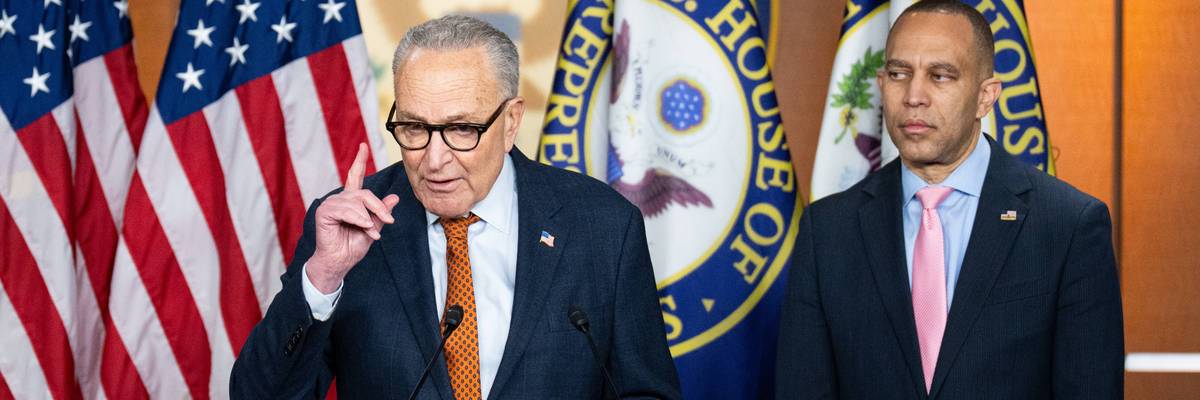
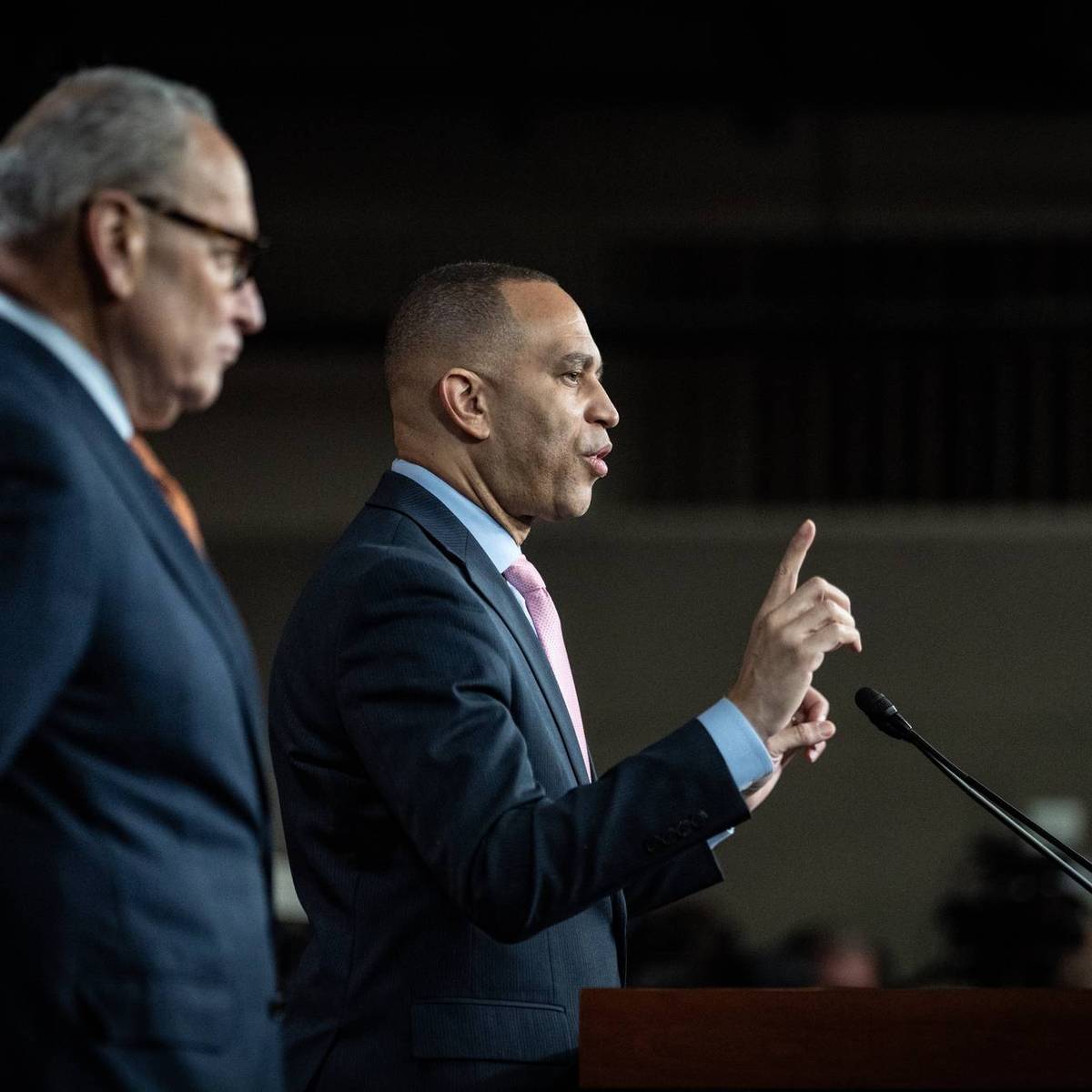
Senate Minority Leader Chuck Schumer (D-NY) and House Minority Leader Hakeem Jeffries (D-NY) held a joint news conference on January 8, 2026.
(Photo by Bill Clark/CQ-Roll Call, Inc. via Getty Images)
“As we plunge headlong into another catastrophic war, Sen. Schumer and Rep. Jeffries’ throat-clearing and process critique only serves Trump and the war machine.”
The top Democrats in the US Congress, Senate Minority Leader Chuck Schumer and House Minority Leader Hakeem Jeffries, faced backlash on Saturday over what critics described as tepid, equivocal responses to President Donald Trump’s illegal assault on Iran—and for slowwalking efforts to prevent the war before the bombing began.
While both Democratic leaders chided Trump for failing to seek congressional authorization and not adequately briefing lawmakers on the details of Saturday’s attacks, neither offered a full-throated condemnation of a military assault that has killed hundreds so far, including dozens of children, and hurled the Middle East into chaos.
Schumer (D-NY)—who infamously worked to defeat the 2015 nuclear deal that Trump later abandoned during his first White House term, setting the stage for the current crisis—said he “implored” US Secretary of State Marco Rubio to “be straight with Congress and the American people about the objectives of these strikes and what comes next.”
“Iran must never be allowed to attain a nuclear weapon,” he added, “but the American people do not want another endless and costly war in the Middle East when there are so many problems at home.”
Jeffries (D-NY), a beneficiary of AIPAC campaign cash, said in his response to the massive US-Israeli assault that “Iran is a bad actor and must be aggressively confronted for its human rights violations, nuclear ambitions, support of terrorism, and the threat it poses to our allies like Israel and Jordan in the region.”
“The Trump administration must explain itself to the American people and Congress immediately, provide an ironclad justification for this act of war, clearly define the national security objective, and articulate a plan to avoid another costly, prolonged military quagmire in the Middle East,” said Jeffries.
The Democratic leaders’ responses bolstered the view that their objections to Trump’s attack on Iran are based on procedure, not opposition to war.
Claire Valdez, a New York state assemblymember who is running for Congress, said that “as we plunge headlong into another catastrophic war, Sen. Schumer and Rep. Jeffries’ throat-clearing and process critique only serves Trump and the war machine.”
“Democrats should speak clearly and with one voice: no war,” Valdez added.
Schumer and Jeffries both committed to swiftly forcing votes on War Powers resolutions in their respective chambers. But reporting last week by Aída Chávez of Capital & Empire indicated that top Democrats worked behind the scenes to slow momentum behind the resolutions, helping ensure they did not come to a vote before Trump launched the war.
“The preferred outcome of many AIPAC-aligned Senate Democrats, according to a senior foreign policy aide to Senate Democratic Leader Chuck Schumer, is that Trump acts unilaterally, weakening Iran while absorbing the domestic backlash ahead of the midterms,” Chávez wrote.
The top Democrats’ responses to Saturday’s US-Israeli attacks on Iran, which Trump said would continue “uninterrupted” even after the killing of the nation’s supreme leader, contrasted sharply with statements of rank-and-file congressional Democrats—and even some members of leadership—who condemned the president for shredding the Constitution and driving the US into another deadly war that the American public opposes.
Rep. Alexandria Ocasio-Cortez (D-NY), who has been floated as a possible 2028 challenger to Schumer, said Saturday that “the American people are once again dragged into a war they did not want by a president who does not care about the long-term consequences of his actions.”
“This war is unlawful. It is unnecessary. And it will be catastrophic,” said Ocasio-Cortez. “This is a deliberate choice of aggression when diplomacy and security were within reach. Stop lying to the American people. Violence begets violence. We learned this lesson in Iraq. We learned this lesson in Afghanistan. And we are about to learn it again in Iran. Bombs have yet to create enduring democracies in the region, and this will be no different.”
Rep. Rashida Tlaib (D-Mich.), a vice chair of the Congressional Progressive Caucus, was more blunt.
“Congress must stop the bloodshed by immediately reconvening to exert its war powers and stop this deranged president,” she said. “But let’s be clear: Warmongering politicians from both parties support this illegal war, and it will take a mass anti-war movement to stop it.”
Our work is licensed under Creative Commons (CC BY-NC-ND 3.0). Feel free to republish and share widely.
Donald Trump delivers the State of the Union address at the Capitol on Feb. 24, 2026, in Washington, D.C. Photo: Kenny Holston-Pool/Getty Images
Days before embarking America on another foreign war, Donald Trump spent more than 90 minutes speaking endlessly about America being back during his State of the Union, leveling racist accusations of Somali American fraud, and expounding on the beauty of America’s raid to arrest Nicolás Maduro in Caracas. It was a master class in testing the attention span of Americans hoping to hear anything at all about the danger that has loomed in the background now for months: the threat of armed conflict with Iran. Those who made it to the finale — and who have conscious memories of the George W. Bush years — would have noticed a similar tenor to the State of the Union in 2003, the one which paved the way for the justification of the invasion of Iraq less than two months later.
In that speech, Bush outlined the alleged threat of Iraqi weapons of mass destruction, the myriad ways in which Iraq had supposedly deceived international investigators, and the staggering human rights abuses committed by Saddam Hussein against his own countrymen. Secretary of State Colin Powell, the president boasted, would soon outline to the United Nations the threat the United States, and indeed the world, was up against in Baghdad.
However, while many of the claims made by Bush were spurious at best and outright deceptions at worst, the claims Trump made in his speech were even less believable — and much more scattershot. Trump claimed that Iran would “soon” have intercontinental ballistic missiles that would “reach the United States of America,” that more than 32,000 Iranians had been killed in recent protests (NGOs estimated the number to be much lower, and an Iranian human rights group put the death toll at 6,488), and that the Iranian military had somehow killed “millions,” somewhere in history, with roadside bombs it pioneered. Perhaps most plainly false of all, Trump contended he just wanted the Iranians to say “those secret words, ‘We will never have a nuclear weapon,’” despite Iranian officials constantly making such insistences.
Before the U.S. and Israeli military launched strikes Saturday, the specter of an Iranian war has become something of a national miasma, the build-up having gone on now so long that its cause is imperceptible, yet perhaps everything at once. The build-up to the Iraq War was similarly argued under many causes, with Saddam’s authoritarian governance very much part of the discussion, but the aftermath of 9/11 and the supposed threat Iraq posed to the homeland was chief among them — the fire that led Americans to line up front and center behind the cause. While Iran has been on the wish list for American neoconservatives and foreign policy wonks for decades, this escalation has happened over a much shorter time frame, much more suddenly, and much more obvious in how the government is desperately in search of a compelling cause.
Stretching back into December, the cards were being laid out. Benjamin Netanyahu had made plans to meet with Trump at the White House to discuss what he saw as the threat posed by Iran’s conventional ballistic missile program, seeking a green light to initiate another devastating war, with hoped-for American support. Israel’s reasoning was not based on Iranian human rights abuses or about threats to the American homeland, but threats to Israel and “U.S. interests,” according to NBC News. Netanyahu had wanted a post-war situation similar to Lebanon’s, where Israel has been able to continue striking that country daily with Hezbollah unable to respond. Iran still retained deterrent military capacity to prevent this from happening. A greater threat, however nonexistent, needed to be communicated.
The rollout of news stories to back up Netanyahu’s claim was well-telegraphed, with reports suddenly emerging in the Israeli press that Iran was planning to use an imminent military exercise as a diversion to strike Israel. At the same time that Netanyahu was meeting with Trump, reports again suddenly emerged that Iran was seeking to develop and purchase “biological and chemical warheads” for its missiles, eerily echoing the false claims Powell made before the U.N. about Iraq.
As attention shifted to the burgeoning protests in Iran, suddenly the United States and Israel had a much stronger casus belli: supporting anti-government demonstrators to overthrow the government. Only a few days after the protests began, Trump promised the “United States of America will come to their rescue” if the Iranian government killed protesters, “which is their custom.” As the death toll mounted, far exceeding the toll of previous protest movements, the threats of intervention continued but never actually materialized. Western officials brought in Starlink satellites to keep protesters connected (SpaceX’s CEO Elon Musk has joked that he supports Secretary of State Marco Rubio becoming the shah of Iran), and unnamed foreign intelligence agencies allegedly brought in firearms used to kill over 200 members of government security forces. Yet Trump continued to promise that he was planning something, saying “help is on the way,” and demanding protesters “take over institutions” even as protests dissipated.
The specter of an Iranian war has become something of a national miasma, the build-up having gone on now so long that its cause is imperceptible, yet everything at once.
Trump wanted war, as did Netanyahu, but there was no conception of when it should happen, for what cause it should exactly be waged, and what would even be done. There was want, but there was no will, and there was no way. Everything had to be cobbled together in the background, sometimes to seemingly even get Trump on board with the plan he himself put into motion.
Reports of considering strikes on “symbolic military targets” were followed by Trump commending Iran for supposedly halting hundreds of planned executions. Declarations of an “armada” being sent to Iran’s shores were accompanied by demands to stop killing protesters, even though the protests had ceased days earlier. More reports poured in of plans for special ops raids and strikes to assassinate Supreme Leader Ayatollah Ali Khamenei (and perhaps also his son), with reports of imminent attacks being just as suddenly thrown out as more and more military assets moved in to allow for greater and greater operations, a build-up not seen since Bush’s full-scale invasion of Iraq 23 years ago.
With attacks underway, the plan now seems to revolve around a complete decapitation of the Islamic Republic’s leadership and the overthrow of the entire system via the air — followed by a populist uprising Trump hopes will topple the regime. “When we are finished, take over your government. It will be yours to take,” Trump said in a video address. “This will be probably your only chance for generations.”
The campaign of airstrikes comes only hours after the United States insisted it wanted to have a civil diplomatic conversation.
Two Iranian women walk past an anti-U.S. mural on the wall of the former U.S. Embassy in downtown Tehran on Feb. 26, 2026, the final day of Iran–U.S. talks in Geneva. Photo: Morteza Nikoubazl/NurPhoto via Getty Images
As with the diplomatic talks that preceded Iran’s war with Israel in June, these negotiations are set up to fail, and the scope of demands is now far wider and even more contradictory. Reports emanating from the discussions seem to oscillate between a willingness to resurrect some version of the Obama-era nuclear deal and a demand for what amounts to complete capitulation — with Rubio demanding restrictions on ballistic missile range and ending of support to Hamas and Hezbollah; Israel demanding the full dismantling of said ballistic missile arsenal; and Trump plainly stating “no nuclear weapons, no missiles, no this, no that, all the different things you’d want.”
There is also no consensus about what the threat from Iran is even supposed to be in the American imagination. Trump’s accusation of near-imminent ICBM production is a recent invention, clearly meant to steer things in a familiar, concrete direction. But the Trump administration cannot seem to agree on whether or not Iran is even developing its nuclear program at all — with Rubio telling reporters there is no enrichment happening, even as special envoy Steve Witkoff told Fox News that Iran was merely “a week away from having industrial-grade bomb-making material.”
Bush administration officials infamously claimed they did not want “the smoking gun” to be “a mushroom cloud,” but officials had always kept that estimate in months — the way the threat of Iran making a nuclear bomb has often been phrased as “months away” for the better part of two decades. Now, the threat is somehow both days away and barely off the ground.
While opposition figures like Reza Pahlavi, the son of the late shah, as well as Mojahedin-e-Khalq leader Maryam Rajavi, have jostled for the attention of Trump’s circle, there seems to be little attention paid to their efforts, with the president dismissing Pahlavi as “very nice, but I don’t know how he’d play within his own country.” Those who remember Ahmed Chalabi and the motley crew of Iraqi opposition cronies may rest easy, as there seems to be little care at all about what would even come next. Sen. Lindsey Graham, one of the brewing war’s strongest supporters, scorned the idea of even considering the day after in an interview with an Emirati newspaper, saying: “You gotta quit saying we. It’s not we, it’s them. It’s not my job to construct a new Iran. It’s my job to give them the opportunity to construct a new Iran.”
We’re independent of corporate interests — and powered by members. Join us.
The feeling at home, despite oversaturation in the media, could not be more different than it was before Iraq. Just before the bombs fell, 64 percent of the country supported the invasion; more than two decades later, only 21 percent of Americans currently favor an attack on Iran, with only 40 percent of Republicans supporting it. The Trump administration is apparently so concerned about the optics of the scenario they have walked themselves into that, according to reporting from Politico, officials were hoping Israel would attack Iran first, leading Iran to attack American troops, thereby rallying the country behind the war effort after the fact.
There is no consensus about what the threat from Iran is even supposed to be in the American imagination.
One would think that such a drive toward an unpopular war-in-the-making would galvanize Democrats, but so far, anti-war voices have been limited. Lawmakers like Rep. Ro Khanna have found themselves drowned out by demands from Democratic leaders that the Trump administration simply provide a clear explanation, apparently seeking to avoid the embarrassment of pundits and politicians after the disaster of Iraq, who blamed their initial support on buying the Bush administration’s flimsy case.
It is an unshakeable belief that consistency of logic is the primary issue with a war to cement Israel’s military hegemony, one that may cost thousands of lives. While some prominent progressives like Sen. Bernie Sanders attempted to hamper Trump’s funding to execute the war without congressional approval in June, Sanders has not made any public comments on the march to war in over a month, and other progressives like Sen. Elizabeth Warren, who have also supported anti-war initiatives, were seen applauding as Trump railed against Iran this week at the State of the Union.
The world is now watching a devastating war rage with no real reasoning, already no end in sight, and its chief belligerent making promises it cannot keep to a population it will surely massacre in the process. Unpopularity has not stopped the Trump administration before, whether it be in Venezuela or in Minneapolis, but the United States finds itself in a uniquely baffling position, where its opposition party, much like how it goes in Israel, instead begs for a better execution of the government’s evil plan.Share
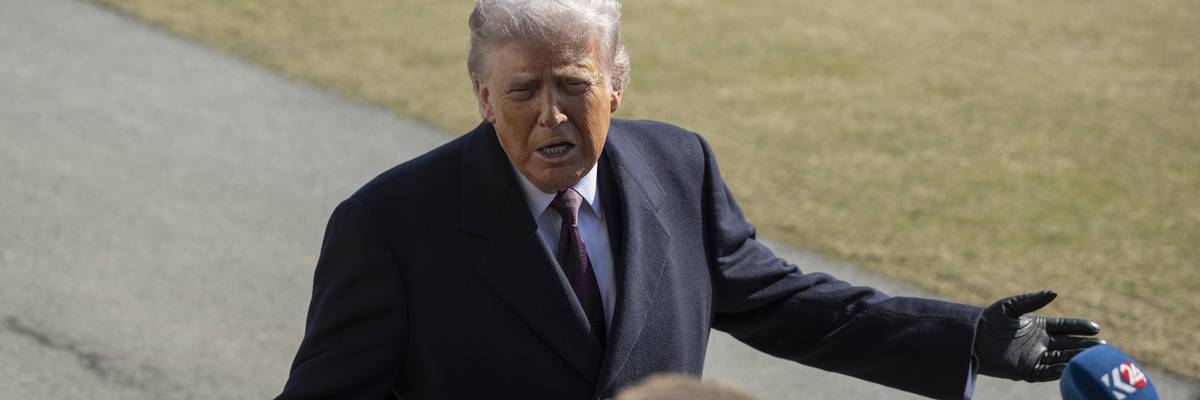
US President Donald Trump speaks to the press before he departs the White House in Washington, DC en route to Corpus Christi, Texas on February 27, 2026.
(Photo by Celal Gunes/Anadolu via Getty Images)
“Trump ran on an explicitly anti-interventionist platform when he ran for president,” noted one critic. “He lied to the American people.”
As the world braces for a possible US war on Iran and people in Venezuela, Nigeria, and Yemen still reel from recent US attacks, President Donald Trump—the self-proclaimed “peace president” who has bombed more countries than any other American administration—said Friday that the United States may launch a “friendly takeover” of Cuba.
“The Cuban government is talking with us, they’re in a big deal of trouble, as you know,” Trump told reporters outside the White House before departing for Texas. “They have no money. They have no anything right now. But they’re talking to us, and maybe we’ll have a friendly takeover of Cuba.”
“We could very well end up having a friendly takeover of Cuba,” he added.
BREAKING: Trump floats a “friendly takeover” of Cuba while he pushes the U.S. closer to war in Iran. Trump ran on an explicitly anti-interventionist platform when he ran for president. He lied to the American people. pic.twitter.com/zs58bXb7Mw
— Trump Lie Tracker (Commentary Account) (@MAGALieTracker) February 27, 2026
Cuban Deputy Foreign Minister Carlos Fernández de Cossío posted on social media Friday that “the US maintains its fuel embargo against Cuba in full force, and its impact as a form of collective punishment is unwavering.”
“Nothing announced in recent days changes this reality,” he added. “The possibility of conditional sales to the private sector already existed and does not alleviate the impact on the Cuban population.”
Trump’s comments sparked criticism on social media, with one X user writing: “A ‘friendly takeover’ is an interesting phrase in international diplomacy. If the US is discussing Cuba’s future, I’m sure [Russian President] Vladimir Putin is suddenly very interested in the definition of friendly’ too.”
University of North Texas, Dallas political science professor Orlando Pérez said on X that “more often than not, [Trump’s] mouth is his worst enemy.”
“This BS plays into the hands of hard-liners on both sides of the Florida Straits and reduces chances of a negotiated deal,” he added. “Why would anyone in Cuba agree to a deal that leads to a US ‘takeover’?”
Meanwhile, dozens of civil society groups on Friday sent a letter to Congress urging lawmakers “to press the Trump administration to reverse its aggressive policy towards Cuba.”
“Instead, Congress should call on the administration to expand humanitarian relief, support political and economic engagement, and foster a more vibrant private sector that can deliver a better quality of life for the Cuban people,” added the groups, which include Alianza Americas, American Friends Service Committee, CodePink, Demand Progress, Peace Action, Presbyterian Church USA, RootsAction, United Church of Christ, and Win Without War.
Trump’s remarks Friday came in response to a question from NBC News senior White House correspondent Gabe Gutierrez regarding Wednesday’s incident in which Cuban maritime defense forces killed four men and captured six others during a shootout with a Florida-registered speedboat allegedly carrying weapons intended for what Havana called “an infiltration for terrorist purposes.” South Florida has long been a base for right-wing Cuban exiles who have launched numerous terror attacks against the Cuban people and international tourists on the island, including by speedboat strafings.
Trump did not clarify his comments, seemingly suggesting that moves to topple Cuba’s socialist government—which has outlasted a dozen US presidents—could be freshly afoot. Since Cubans overthrew a brutal US-backed dictatorship in 1959, the United States or allied exile forces tried to assassinate former Cuban President Fidel Castro hundreds of times, backed an ill-fated invasion at Bay of Pigs, served as a base for perpetrators of some of the hemisphere’s worst terror attacks, and even hatched a plan to detonate a nuclear bomb high above the island to convince its people that the return of Jesus Christ was nigh and the only thing standing in the way of the so-called “Second Coming” was Castro.
A 64-year US economic embargo on Cuba, which Trump recently worsened by cutting off fuel, has been a leading force crippling Cuba’s economy and is now being blamed for a soaring infant mortality on the island.
Friday’s remarks by Trump came as Iranians and people across the Middle East and beyond are bracing for a possible US attack on Iran—the second in as many years—and less than than two months after the president ordered the bombing and invasion of Venezuela during an operation that ended with Venezuelan President Nicolás Maduro abducted and jailed in United States, where he is expected to face trial for dubious narco-trafficking charges.
If the US strikes Cuba, it will be the 11th country attacked during Trump’s two terms in office. The president—who says he deserves a Nobel Peace Prize—has ordered attacks on Afghanistan, Iran, Iraq, Libya, Nigeria, Pakistan, Somalia, Syria, Venezuela, and Yemen, and has bombed dozens of boats allegedly transporting drugs in international waters in the Caribbean Sea and Pacific Ocean.
Our work is licensed under Creative Commons (CC BY-NC-ND 3.0). Feel free to republish and share widely.
The United States has welcomed refugees fleeing persecution under the same law for 45 years, following a tradition dating back to World War II. Through an orderly process, applicants for refugee status undergo extensive federal vetting before arriving. A year after entering the US, they can apply for a green card, and barring any issues, receive one. But late last year, the administration quietly changed the rules.
People protected by the laws are suddenly subject to arrest and detainment.
On January 9, the Department of Homeland Security and U.S. Citizenship and Immigration Services began putting its changes to work, seeking out and detaining lawful refugees who have broken no laws and followed DHS’ processes to the letter. One moment they were law-abiding refugees, the next many were arrested, shackled, and interrogated. DHS calls it Operation Post-Admission Refugee Reverification and Integrity Strengthening (PARRIS), and its first targets are some 5,600 lawful refugees in Minnesota. Nationwide, the new rule means some 100,000 refugees could be locked up—and alongside another, even broader, change initiated by the Trump administration, it suggests that the government’s plan to fill the warehouses it is buying and converting to detention centers rest on ignoring the laws that control its operations.
On January 28, John Tunheim, a federal district judge in Minneapolis, ordered DHS to stop detaining refugees under the new policy in Minnesota as the case proceeds, finding it is likely illegal. It is also a particular brand of authoritarian. The idea of the dual state, developed by Jewish-German labor lawyer Ernst Fraenkel in the 1930s to explain the legal system of the Third Reich, describes an authoritarian state divided into two realms: the normative state and the prerogative state. In the former, the rules are followed and the laws upheld. In the latter, the state simply imposes its will, and no law or right or freedom can protect its victims. Frankel described how most Germans in the 1930s lived in the normative state where life and commerce continued to feel normal, while Jews, political dissidents, and other disfavored groups were in the prerogative state, subject to the violent recriminations of the regime. The regime is able to accomplish the goals of the prerogative state because most people lived in the normal of the normative state.
The Trump administration’s treatment of refugees and other immigrants echoes the dual-state model. People who were protected by the laws are suddenly subject to arrest and detainment, possibly for a long time. The scaffolding of their rights is collapsing, and they are now subject to the dark underbelly of Trump’s lawless detention regime.
“ICE is the face of a prerogative state, emerging or actual,” Evan Bernick, a constitutional law professor at Northern Illinois University College of Law, explained to me last year. “It swoops in, it ignores safeguards, you can’t escape it.”
Courts in a burgeoning dual state are left to either push back or validate an unlawful policy. To justify the PARRIS detentions, DHS lawyerspoint to a section of the 1980 Refugee Act which allows them to take refugees into custody in order to assess their eligibility for a green card. In a new memo released this month to bolster its case, DHS claims that that is an open-ended authority to detain refugees for days, months, or even years as they are vetted again. In his initial order, Tunheim disagreed: “On the plain reading of these statutes, the Court concludes that none of these provisions authorize the prolonged detention” of the plaintiffs. The authority the government cites, Tunheim found, simply isn’t there.
Tunheim also found the government’s argument would lead to absurd results. Because the law “makes refugees ineligible for adjustment [to lawful permanent resident status] until one year after entry, Defendants’ interpretation would subject every refugee to detention, unless USCIS conducted the inspection and examination precisely at the one-year mark,” he wrote. “That outcome is nonsensical and would cause many unadjusted refugees to celebrate their one-year anniversary in this country in a jail cell.” This is obviously not what the law requires. But the administration is asking the courts to apply the judicial stamp of approval to its cruel and absurd policy anyway.
This is not the first instance in which the administration has announced new interpretations of decades-old statutes in order to fill its new detention facilities. In a tortured reinterpretation of a 1996 immigration law, the Trump administration announced in July that anyone who entered the country without permission, no matter how long ago, must be detained without bond for as long as it takes for the government to get their removal order—a process that can take years. As with the new refugee policy, the detention policy makes a hash of the statute. It dares the courts—which have almost uniformly ruled that a bond hearing is required—to interpret a law in a nonsensical and gratuitously cruel fashion. As of early January, some 300 federal judges had found the policy illegal; only around 30 have agreed with the government.
This month, the Fifth Circuit Court of Appeals upheld the administration’s July policy. Suddenly, people who at any point entered the country without permission are subject to months or years of detention if they are in the three states within the circuit: Texas, Louisiana, and Mississippi. In these states, the grounds for release in federal court have now shrunk considerably. Moreover, engaging a lawyer to file a case is a tall order for the millions of people who could be locked up under the policy.
The Fifth Circuit decision came from a three-judge panel in the nation’s most reactionary appeals court, which Trump appointees have turned into a proving ground for far-right and MAGA-aligned priorities. “Congress did not secretly require two million noncitizens to be detained without bond,” Judge Dana Douglas, a Biden appointee on the circuit, wrote in dissent, “when nothing like this had ever been done before, and the whole history of American immigration law suggested it would not be.” Indeed, her colleagues’ ruling didn’t just change the law but, for millions of people now at risk of detainment without bond, effectively nullified it.
To attain detention numbers, the administration must suddenly claim that their own rules no longer apply.
Douglas also hinted at the slippery authoritarian slope of the government’s policy, the way in which it will pull more and more people, and eventually citizens, into its lawless vortex: “With only a little imagination, the government’s and the majority’s reading means that anyone present in this country at any time must carry the precise kinds of identification they would otherwise have only carried to the border for international travel, lest they be mistaken for an inadmissible noncitizen,” she wrote. “The majority seems to be unable to imagine what it might mean to be detained within the United States without the appropriate proof of admissibility, and, without a bond hearing, to require the services of a federal habeas corpus lawyer to show that one is entitled to release and deserves to see the outside of a detention center again.”
A key facet of a dual state is that the normative state is not truly safe. At any moment, one can fall from its protections into the prerogative zone. Racial minorities are certainly more likely to lose their rights in a system that will slowly suck more people into its lawless operations.
In the short term, the decision will incentivize the government to whisk people to the 5th Circuit as soon as they are apprehended, beyond the reach of all the district court judges around the country who have found the policy illegal. But at some point—and it may be soon—the Supreme Court will have to decide whether to help the administration push millions into its growing network of concentration camps, or whether it will call out a blatantly illegal policy. As Bernick warned, “A Supreme Court that gets out of the way” of ICE, “where the state is at its most brutal, and tries to manage everything else as normal, is a dual state Supreme Court.”
Trump campaigned for president on deporting violent wrong-doers. But as both of these new detention programs demonstrate, the administration’s ambition to fill warehouses with millions of humans can only be achieved by locking up people without criminal records. As of November, just five percent of ICE detainees had committed a violent crime. To attain their numbers, the administration must suddenly claim that their own rules no longer apply.
The effect of the mandatory detention policy now sanctioned by the 5th Circuit is to detain people who could otherwise be allowed freedom while removal proceedings take place. According to a brief submitted in the case by the American Immigration Council, a legal and advocacy group, tens of thousands have likely already been the victims of this new policy in recent months. These include people without any criminal history and adults who have been in the US a long time and have deep ties to their community, including children whom they care for and support.
DHS is detaining people who are coming in for immigration appointments, meaning they are specifically targeting people who are already following government orders. This alsoincludes Dreamers, people brought here as children who gave their information to the government in exchange for lawful presence in the country. The government is likewise locking up young people who had assurances against deportation because they crossed the border alone or were abused or abandoned by their parents. Suddenly, all these groups who entered into an agreement of protection from deportation with the government—what is called “deferred action”—are being locked up despite the government’s own rules to the contrary.
Suddenly deprived of the protection of the law, the immigrants and refugees whose detention has been ushered in by these new DHS policies do not enter a civilized detention program, but one that operates with life-threatening cruelty. Accounts from inside detention centers detail conditions of torture. People are fed little, and what they do receive is often moldy, or seems, as a detainee in New Jersey described it in a lawsuit, “identical to cat food.” People with serious health conditions are denied medications. At a detention center in Dilley, Texas, children enter healthy, then soon fall ill, and then are denied care. In Illinois, a woman was detained two weeks after giving birth via cesarean section; while her newborn daughter was away in a hospital NICU, she slept on a bench without access to a breast pump or pain medication. A Cuban man detained at a tent camp in El Paso died in what ICE claimed was “medical distress” but the county medical examiner determined was homicide.
These conditions are so dangerous that people give up and agree to leave the country rather than waste away, making the torture a form of coercion forcing people to give up their legal rights. “People are being deprived of due process already because detention is so coercive,” says Rebecca Cassler, an attorney at the American Immigration Council. “You don’t have access to a lawyer. In many cases, your family might not know where you are for a couple weeks. You’re not getting enough food, you’re not getting medical attention.”
Dual states are characterized by “systematically a domain of lawlessness and systematically a domain of lawfulness,” explains Aziz Huq, a University of Chicago constitutional law professor writing a book about the theory. “You only get that when you have a multiplicity of measures that move people across the line from the world of legality to the world of lawlessness.”
“People are being deprived of due process already.”
It seems clear that, whether or not Trump will fully achieve this, his administration is trying to create a domain of lawlessness around immigration enforcement. ICE ignores constitutional constraints as a matter of policy, operating as a thuggish paramilitary force. The Trump administration wants to trap more and more people in its immigration enforcement apparatus—and keep them there. A Supreme Court that has allowed this legal black hole to expand is aiding in such a state’s creation. And almost certainly, the nation’s highest court will be asked to decide the fate of Trump’s new mandatory detention policy, and likely its novel refugee policy as well.
The Supreme Court has already stepped in to essentially pause constitutional protections that have gotten in the way of the administration’s immigration crackdown. Last June, it allowed the government to proceed with deporting immigrants with final removal orders to so-called “third countries”—a country that is not their home country or another designated in the removal order—even though the law requires a different outcome and the Constitution requires due process, allowing the immigrants to object that they might be tortured in the new country. On Wednesday, a district court judge in Massachusetts issued a ruling against the policy, which means it will wind its way back to the Supreme Court in the coming months. But he stayed the ruling pending appeal, meaning people can still be sent to third countries without an opportunity to object, and where they are likely to be imprisoned, tortured, killed, or returned to their home country for a similar fate.
And last September, the Supreme Court allowed ICE to continue a policy of racial profiling in its detention sweeps and stops, even though the court has repeatedly ruled against the use of race in government policy. Notably, the decision expanded ICE’s terror to US citizens and others people lawfully present, based solely on how they look or talk.
These policies, alongside the new mandatory detention policies, track Trump’s attempts to carve certain disfavored groups out of the protection of the law since his first day back in office. On January 20, 2025, he issued an executive order denying citizenship to certain people born on US soil, despite the clear language of the Constitution’s birthright citizenship clause. In the face of more than a century of near-unanimous consensus, the administration simply declared that the law wasn’t what it said.
On April 1, the highest court will hear arguments over that executive order, which attempts to revoke birthright citizenship for thousands by fiat; to take a class of people clearly entitled to all the protections of citizenship and turn them into a stateless underclass. As Trump attempts to ethnically cleanse the nation through a lawless detention and deportation regime, the birthright citizenship case is one especially high profile test, among many more to come, of what the administration will be allowed to get away with. The contours of a dual state are coming into view, one in which anyone targeted by Trump’s deportation and detention program have no rights that can save them.
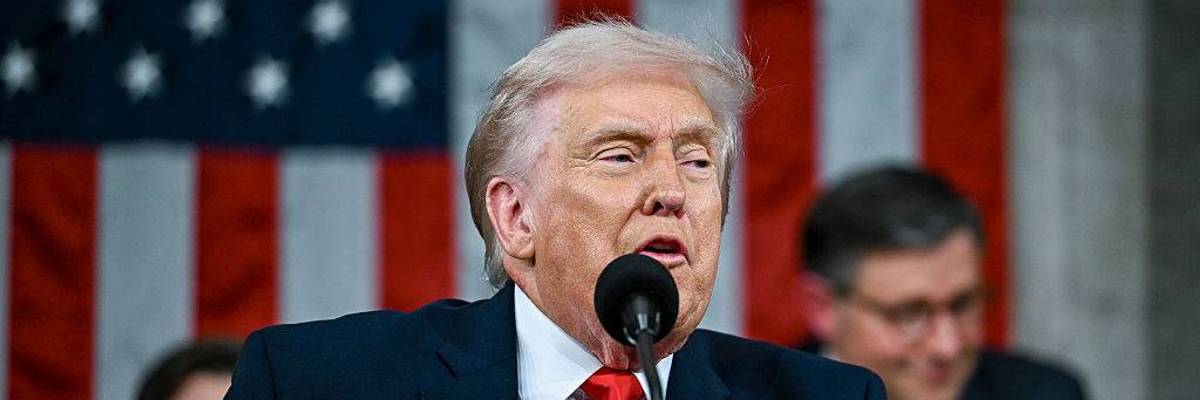
President Donald Trump delivers the State of the Union address during a joint session of Congress in the House Chamber at the Capitol on February 24, 2026 in Washington, DC.
(Photo by Kenny Holston-Pool/Getty Images)
“This is a plot to interfere with the will of voters and undermine both the rule of law and public confidence in our elections,” said Sen. Mark Warner.
A group of right-wing activists is crafting an executive order that would let President Donald Trump unilaterally ban mail-in ballots and voting machines ahead of the 2026 midterm elections.
The Washington Postreported on Thursday that the order being drafted by Trump allies would give him “extraordinary power over voting,” even though the US Constitution explicitly gives individual states the powers to run their own elections.
An advocate for the order, Florida attorney Peter Ticktin, acknowledged in an interview with the Post that the Constitution does not give the president any role in shaping elections, but he said Trump needed to act to prevent China from supposedly interfering with American elections.
“Under the Constitution, it’s the legislatures and states that really control how a state conducts its elections, and the president doesn’t have any power to do that,” Ticktin said. “But here we have a situation where the president is aware that there are foreign interests that are interfering in our election processes. That causes a national emergency where the president has to be able to deal with it.”
The activists drafting the emergency order said that they are working in coordination with the White House, although the extent of any cooperation isn’t clear.
However, the Post pointed to some evidence that the White House really is on board with such a strategy, such as the Trump administration’s efforts to investigate his 2020 election loss to former President Joe Biden, which the president has long baselessly claimed was due to foreign interference from a number of nations, including China and Venezuela.
As the Post noted, “a 2021 intelligence review concluded that China considered efforts to influence the election but did not go through with them.”
Additionally, Trump has publicly stated numerous times that he wants to completely do away with mail-in ballots and voting machines, both of which he has baselessly claimed are riddled with fraud.
Sen. Mark Warner (D-Va.), the ranking member of the Senate Intelligence Committee, said that the draft order was simply an attempt by the president’s allies to block democratic accountability in future elections.
“We’ve been raising the alarm for weeks about President Trump’s attacks on our elections and now we’re seeing reports that outline how they may be planning to do it,” Warner told the Post. “This is a plot to interfere with the will of voters and undermine both the rule of law and public confidence in our elections.”
Government watchdog Citizens for Responsibility and Ethics in Washington (CREW) said that the drafted order was plainly unconstitutional and would fail in court.
“The Constitution gives states power over election law with oversight from Congress,” CREW wrote in a social media post. “Notice who’s missing? The president. Trump may try to cook up a sham national emergency to try to seize control of elections but it won’t stand up to scrutiny.”
MS NOW national security contributor Marc Polymeropoulos called the draft order “batshit authoritarianism” and cautioned that “this crazy shit is possible as Trump knows Congress is all but lost at this point in a free election.”
“To save himself,” Polymeropoulos added, “anything is possible.”
Democratic Illinois Gov. JB Pritzker pointed to the Post report and warned, “Donald Trump’s plan to steal the 2026 midterm elections is already underway.”
Rep. Rosa De Lauro (D-Conn.) accused Trump of “setting the stage to steal the midterm elections and set fire to our democracy,” while vowing that Democrats would “fight for our democracy and safeguard the right to vote.”
Our work is licensed under Creative Commons (CC BY-NC-ND 3.0). Feel free to republish and share widely.
Trump’s State of the Union address delivered grandstanding and grievance politics, but few concrete solutions for Americans facing healthcare crises, economic instability, and ever-widening inequality.
US President Donald Trump delivers the State of the Union address in the House Chamber of the US Capitol in Washington, DC, on February 24, 2026. Photo by ANDREW CABALLERO-REYNOLDS / AFP via Getty Images
…or sign up to get the latest TRNN stories in your inbox!
Trump’s State of the Union address delivered grandstanding and grievance politics, but few concrete solutions for Americans facing healthcare crises, economic instability, and ever-widening inequality. While mainstream media commentators fixated on the spectacle, Epstein survivors in attendance were essentially ignored, and key claims on immigration and economic policy went largely unexamined.
Credits:
Written by: Stephen Janis
Produced by: Taya Graham, Stephen Janis
Studio / Post-Production: Cameron Granadino
Transcript
The following is a rushed transcript and may contain errors. A proofread version will be made available as soon as possible.
Taya Graham:
Okay. You might have watched President Donald Trump’s state of the Union and found it difficult to reconcile with what’s actually happening in your life. He said we were in a new golden age, but it doesn’t feel like it for most of us. He said the economy is the strongest ever, but perhaps your actual experience doesn’t jive with that assessment. Well, you’re not wrong and we’re going to prove it. Myself, along with my reporting partner, Stephen Janis, are going to break down what Trump’s speech was missing, mainly the perspective of the people actually living with the consequences of his policies. So we’re going to give you the people’s state of the union breakdown and you won’t want to miss it.
Hello, my name is Taya Graham and welcome to The Inequality Watch, the show where we break down the historic wealth imbalance that defines this country and hold the people who are making it worse accountable. Today we’re going to talk about the state of the union or perhaps more accurately, the state of the oligarchy address, which President Trump gave on Tuesday. Like all things related to the current president, it’s been controversial and of course touted by mainstream media and conservatives for its political acumen. But of course, all the people celebrating Trump’s requim for democracy live inside the bubble of elitism and abundance. Like the Zuckerbergs and Bezos who sat on his inauguration stage, they are costated by wealth, stowed away inside a safe and snug insulated abode created by excess that makes them incapable of understanding the real world suffering and struggle that the rest of us live with.
Raise your hand if you have over $5,000 worth of debt. $10,000. More. Okay, maybe it’s just me. So in order to put the state of the oligarchy in its proper place, we’re going to react to some key clips from the speech and provide the people’s perspective on what was said. Or another way to put it, we’re going to reveal the distortions of the truth the mainstream media won’t tell you and take them and this administration to task by holding them accountable. Imagine that. I mean, right Stephen, people deserve a say in all of this.
Stephen Janis:
Yeah, no, it’s always amazing to me when I watch these speeches. To me, it becomes like a mirror on the elite. People like us who are middle class people watch it like a forest fire and they’re sitting there saying, “Oh, there’s some good things here and he had some great moments and this is really going to define the midterms while he’s literally depicting a reality that is destroying people’s lives. And I am always amazed how the pundit class rises to the occasion and gives him plotteds for things they doesn’t
Taya Graham:
Deserve.” Exactly. I mean, the biggest cause of personal bankruptcy in the US are actually healthcare bills and the Obamacare tax credits which help people fund their own insurance have expired, raising the costs substantially. And guess what? Congress has done nothing. In a recent report declared that simply buying a car will set you back about $50,000. That’s a record price. And don’t even think about trying to buy a house. The point is things are great for the ultra rich, not so much for the rest of us. And that speech made it crystal clear. So let’s break it down. Okay, Steven, are you ready? I’m ready. Here’s our first clip, the topic of the moment and why we’re here today, because apparently we’re living in a new golden age, or at least that’s what our president says.
Speaker 3:
You’ve seen nothing yet. We’re going to do better and better and better. This is the golden age of America. But tonight, after just one year, I can say with dignity and pride that we have achieved a transformation like no one has ever seen before and a turnaround for the ages. It is indeed a turnaround for the ages.
Taya Graham:
All right. So there is no doubt that this has been a golden age for billionaires. I mean, and especially for President Trump. I mean, the president himself and his family have pocketed $4 billion from crypto sales alone. And the Trump organization, his private real estate conglomerate is still owned by Donald Trump and consists of his hotels, his golf courses, his resorts, and other businesses. And according to the corporate listings, Donald Trump is the owner of the Trump organization, which has about 250 companies and assets around the world. And he’s actually suing the federal government for $10 billion for the illegal release of his tax returns, which essentially means he’ll be able to settle with himself. As Mel Brooks said, it’s good to be the king. But I think it’s worth noting that while the stock market is up, the top 1% of households own 54% of that wealth and the top 10%, 94%.
So it’s golden for some, but what about the rest of us, Stephen?
Stephen Janis:
Well, yeah, the golden age started with one of the worst years of job creation in the history of this country since 2003. Only about 173,000, 183,000 jobs. So there was no job creation and over a million people got laid off. So it’s been really bad for the average worker, the average person. You got AI looping over us saying it’s going to destroy 40 to 50% of white collar jobs. He didn’t address that. And as we’ve said before, buying a car is now more expensive than it’s ever been. And housing also has gone up in price. So really what you’re talking about here is a very, very bad, bad situation for the middle class. It’s the golden age for Trump, but not the golden age for the people. And I think it’s important to make that point. I mean, think about that. They didn’t create any jobs.
I don’t know why they didn’t make it into his script or his speech, but that’s really essential to the wellbeing of Americans and it just didn’t make the cut.
Taya Graham:
Steven, I have to ask you something about tax cuts because for your average middle class folks, your taxes are between 15 to 24 or 25% because you get your income tax and then there’s payroll tax. And so that ends up being a huge chunk. But people who are multimillionaires and billionaires, somehow they don’t seem to pay quite as much of their income. Maybe you could explain how those unrealized gains work and why billionaires just don’t seem to have to pay any taxes. Well,
Stephen Janis:
This is a very controversial topic, but as you have your assets appreciate, most billionaires and wealthy people have assets that appreciate. That’s where a lot of their wealth comes from.
Speaker 4:
It
Stephen Janis:
Doesn’t get taxed until you sell it. And there’s been a proposal in California to actually tax people on those inflated assets. And that’s why the stock market thing is important. Your stock market account keeps going up and up, but you’re not paying taxes on it. Now, some people say it would be impossible to execute, but the point is you can keep getting richer while our wages stay the same. And we pay on our wages right away. We don’t get to hold them or let them appreciate or whatever. So basically, yeah, that’s a big deal. I mean, the wealth that is concentrating and held does not get taxed. Meanwhile, our wages get taxed right away taken right out of our paycheck.
Taya Graham:
You know what? I think a really great example of this, just to make it crystal clear for folks, Elon Musk, he does not take a salary. He gets a salary of $0 a year. Jeff Bezos, when he was pulling a salary, took $80,000 a year. And yet how are they able to be the wealthiest people on the planet? Can you imagine how you don’t get taxed on $0 a year, but they take loans against their money, they pay the interest. I mean, it’s just the way they do it with these low interest loans is that they just can live off these unrealized gains. They can live off their assets without ever having to sell them. It’s something that we can’t even comprehend. Now, let’s go a little bit deeper into healthcare. Now, it hasn’t been on the radar of the elites since the Obamacare tax credits expired, but let’s listen to what President Trump had to say, and then we’ll come right back.
Speaker 3:
I’m also confronting one of the biggest ripoffs of our times, the crushing costs of healthcare caused by you. Since the passage of the Unaffordable Care Act, sometimes referred to as Obamacare, big insurance company has gotten rich. It was meant for the insurance companies, not for the people. With our government giving them hundreds and hundreds of billions of dollars a year as their stock prices soared, 1,120, 1,400, and even 1,700%, like nothing else. That’s why I introduced the great healthcare plan. I want to stop all payments to big insurance companies and instead give that money directly to the people so they can buy their own healthcare, which will be better healthcare
Taya Graham:
At a much lower cost. Okay, Steven, you have some pretty passionate thoughts on this subject. What do you think about this healthcare proposal?
Stephen Janis:
Well, first, before I address the proposal, there’s one thing that really, really annoys me. We talk about health insurance. It’s a misnomer. Insurance is a risk pooling for an anomalous event. Healthcare is not something that’s anomalous. We use it all the time. We use it regularly. So you can’t say we’re pooling our health insurance to pay someone’s healthcare. We really have a system that makes no sense, doesn’t address the problem at hand. Trump’s answer to this crisis is to put out a plan where he’s going to kind of alter Obamacare a little bit to create what’s called skinny plans or catastrophic healthcare, where you pay huge deductibles, 15,000 for an individual, 30,000, and then get maybe 80% of coverage of catastrophic. But the day-to-day healthcare that we need is not being covered. And I want to say this about this particular subject and the way Trump raised it.
Americans deal with the reality that no other country really around the world deals with, and that is that any of us can go broke because our healthcare is not coverage. Personal bankruptcies are almost all involving healthcare bills. We walk around in a reality defined by the inability to pay for our own healthcare and the lack of solutions in our leadership. So in other words, any of us at any time could be subject to a disease that would make us broke. And that is really, really something that defines reality. People stay in bad jobs because they need healthcare. They stay in bad relationship because they need healthcare. There’s no universal right to healthcare in this country. And I think it defines us psychologically. It defines how we think. And to see Trump just casually say, “Yeah, I got this plan,” with no details. And obviously, really, in many ways, kicking people off coverage like Medicaid and Medicare, excuse me, Medicaid specifically through the Big Bad Beautiful Bill, excuse me for calling it the bad beautiful bill, really, really defines our lives in ways that I don’t think we talk about enough to you.
Taya Graham:
Steven, that’s such an excellent point because it really does trap people trapped in bad jobs, trapped in bad relationships because they desperately need their healthcare. And of course, the Congressional Budget Office has estimated that the big, beautiful bill will cause 10 to 11 million Americans to lose healthcare by 2034 due to the cuts to Medicaid and Obamacare. And all of this to give a huge tax break to the richest Americans, which of course, again, is more bad news for us and more good news for the richest 1%. Now, the next oligarch versus the people moment came in what has been the portion of the speech most heavily touted by pundits from both sides as being defining, a moment of political theater that really seemed to impress the pundit class. Let’s watch.
Speaker 3:
So tonight I’m inviting every legislature to join with my administration and reaffirming a fundamental principle. If you agree with this statement, then stand up and show your support. The first duty of the American government is to protect American citizens, not illegal aliens.
Taya Graham:
So it’s interesting that this would be Trump’s big moment, given what has happened with ICE in the past couple of months. I mean, ICE has been actively killing Americans and violating constitutional rights at a rapid pace. So I have to ask you, Steven, do you think it’s really the big win Republicans think it is?
Stephen Janis:
Well, I mean, if Trump wants to produce the next triumph of will, yeah, it’s a big win. But in reality, in reality, what it is is another example of him crushing dissent, oversimplifying a very complex policy, and also completely flying over his own faults and what his administration has done with this particular problem. Because as you point out, ICE has been killing Americans. So ICE is not protecting anybody in that sense. ICE is not protecting the people who protested and exercise their First Amendment rights, throwing them all around, putting their hands on them, beating them up. I mean, from the get- go, this idea that we have to somehow bend to his will by standing up to a simplified statement that he said that doesn’t reflect the current realities of the policy is just absolutely stunning to me. But what was more stunning was the pundits and the CNN commentators were like, “Wow, great, great us Nazi salute you guys had to give there to President Trump.” I mean, it’s really, really disturbing that our democracy is completely devoid of dissent the minute Trump stands up and says something provocative.
And they think this is going to get them the midterms, but I don’t think so because people can see the reality. And the reality is that what he said makes no sense. It’s completely contradicting the policy on the ground and that’s the problem. Why should people have to stand up and bend to Trump no matter what he says? Why can’t we dissent in the people’s house? That’s the problem.
Taya Graham:
And Steven, you make such an excellent point. The death of Renee, Nicole Goode, the death of Alex Pretty, and even the death of Kevin Porter. They were all Americans killed by ICE. And there’s actually another report of an American killed by ISA also did not receive a lot of attention like Kevin Porter’s death on New Year’s Eve. Ruben Ray Martinez died in March 2025 on some Padre Island during a traffic stop. Now Ice says he drove at an officer. We’ve heard that before. But a witness who was with him at the time disputed that account. However, let’s be clear, he wasn’t committing a crime and he was not an immigrant. He had pulled up to a checkpoint and still ended up dead. So to your point, President Trump and ICE are not protecting Americans. They are in fact killing them and violating their rights. Now, Stephen, we’re going to pivot here and discuss something that Trump failed to mention at all, and that’s the Epstein scandal.
Just before his speech, survivors gathered in the Canon office building next to Capitol Hill to call on Trump and the Department of Justice to acknowledge them and to unredact documents that have hidden the identities of the co-conspirators of Epstein. Their point is we aren’t going away. Now, we were there to listen to the survivors and I have extended clips of exclusive interviews we personally conducted and I will link those in the comments below for people to watch. But first, let’s listen to Epstein’s survivor, Lisa Phillips, discuss why she will not give up.
Speaker 5:
I always get emotional because every time I look at my survivor sisters behind me, I’m reminded that they represent at least 200 victims. I don’t want you guys to forget that. So when I stand here, I do not stand alone. I represent hundreds of faceless, nameless survivors. Some I have had the honor of knowing and supporting over the last few years, young women and girls who were never given a voice. My survivor sisters and I have come to Capitol Hill many times this past year, as you know, and we will keep coming back again and again until all the Epstein files have been released because accountability is impossible without full transparency. Those of us who live through the horrors of Epstein world have always known this was never just a story about one powerful man. It was never just a crisis of wealth and privilege in America.
It is and always has been a global crisis of corruption.
Speaker 4:
He is going to know that looking back at him will be numerous survivors of Epstein’s abuse and that he is facilitating the single largest coverup in modern American history.
Taya Graham:
You know, one thing I have personally witnessed being on Capitol Hill covering the Epstein survivors is that it certainly seems like they are not giving up and something that you didn’t see at the rest of the Lisa Phillips clip. And this is also something that Theresa Helm told me herself directly, which is that these women are going to Europe to tell them what they have learned, to tell them what they have uncovered, to tell them what they have experienced, what other survivors have told them, Lisa Phillips, as she had said in a previous press conference, that she was compiling her own Epstein list and receiving information from other survivors who did not want to come forward publicly. And because the American government isn’t criminally charging anyone, arresting anyone, they’re going to Europe to give them this information. So no matter what the Department of Justice throws at them or what President Trump says, these women have stood tall, they’ve taken the heat and they’ve refused to back down and they’re going to keep pushing until they get some kind of justice.
But Stephen, there was also some breaking news about the ongoing controversy surrounding the Epstein files. Can you tell us a little bit about it?
Stephen Janis:
Yes, Teya. Some files that were turned over in the trial of Ghislaine Maxwell who received 20 years for being a co-conspirator with Jeffrey Epstein showed missing files of 302 reports that had cited Donald Trump for abusing a minor. So this has been a big, big scandal because those documents, for some reason, they violated the law and did not include them in the entirety of the disclosure. So it’s just another example of the Justice Department redacting or not including documents that are critical to this. And the law, the Epstein Transparency Act was absolutely specific that all documents had to be turned over. So this is just another example of, it looks like the Department of Justice covering up for President Trump who was cited in the 302 reports that were submitted to the FBI.
Taya Graham:
And the FBI has been redacting these files since last March, even before the Epstein Transparency Act was passed. So we can only imagine what we are actually missing and what won’t be released. We actually co-wrote a piece about how the Epstein scandal might be the one that Trump can’t shake. And that seems to be true so far. We talked about how it was the fact that victims not backing down could be his downfall, their courage and their resolve. I mean, they are literally flesh and blood examples of our unequal justice system and our historic wealth inequality in general that created it. What do you think about that in the light of recent revelations and the survivor’s persistence?
Stephen Janis:
Yeah. I mean, I think we’ve always said that in many ways inequality seems intangible. You talk about these numbers like a trillion dollars here, a trillion dollars there, and it doesn’t really seem to add up in a way that’s personal, but this is really personal until you’ve done great coverage of the survivors and really highlighted their stories and no person can watch them without saying they are victims of an unequal justice system that literally exempts the rich, literally exempts the powerful. There’s no other conclusion, but now you see specific victims of all … And those victims are children. So I think this, yes, will continue to haunt Trump. I don’t think you can duck it. And I think it really is like a marker of inequality in this country where you have a criminal justice system that literally sells exemptions to wealthy people.
Taya Graham:
Steven, that is such an excellent point. And I just really want to highlight something you said. These were women and children that were victims of this abuse and trafficking, and that just cannot be ignored. These were children that were abused and sold off to the highest bidder. And those co-conspirators, those predators, those perpetrators, those who aided and abetted this, they deserve to see their day in court for the sake of the victims and to make sure that the Epstein class can’t get away with this again. Now, Steven, is there anything you want to add before we sign off?
Stephen Janis:
I think I want to talk again about how the pundits interpreted Trump’s attempt to get Congress to bend the knee to whatever he said. Trump really likes to regulate our bodies. Trump really likes to regulate people. He likes to make sure that we have papers. I mean, American citizens, for the first time in my memory, in my lifetime, American citizens have had to literally have papers to prove that they’re American citizens or they get thrown in jail. He’s trying to come up with some idea where you have to have a birth certificate to get a bank account or have a birth certificate to vote. I mean, they’re really, really … The conservatives say we’re a world of freedom and we don’t believe in overregulation and too much government. Well, they become exactly the opposite. It’s more and more about regulating how we think, how we feel, how we move through the world.
There’s this idea of investigating left organizations as terrorists. It’s ongoing. And so that one moment where he says, “Stand up and support what I say, regardless of what you know about what’s actually going on. ” To me, it was shockingly fascist and shockingly authoritarian and yet the pundit class was like, that’s his moment. He’s going to win the midterms because of this. This is going to be the best thing he ever did. How insane are these people? I mean, how rich and costuded and in the bubble, as you said, do you have to be to think this is a great moment in American Democratic history? When you stomp out dissent and when you take away people’s right to vote and when you take away our free movement through society, what you have left is nothing more than an authoritarian regime. And I just find it stunning and really offensive that people found this to be such a great moment.
Taya Graham:
And Steven, you make such an excellent point. I mean, who thought the party of Ronald Reagan would end up being the big government party? Being
Stephen Janis:
Big government.
Taya Graham:
And to see our mainstream media sit there and just try to be as neutral as possible, saying they’re just calling balls and strikes and how great this was, it’s just incredibly disappointing.
Stephen Janis:
Yeah. Sometimes you just have to call something out for what it is. And those punitives don’t have to be neutral. They’re getting paid by either party to be sort of propagandist, but to me, they lack insight and intelligence. That’s the problem, not the problem that they don’t have enough money or enough access to the mainstream media. They have all that. They just don’t have intelligence.
Taya Graham:
Well, I think that’s it for the people’s state of the union breakdown. And as always, Steven and I will continue to report from Capitol Hill and around the country wherever we’re needed to expose the underbelly of America’s destructive concentration of wealth. And remember, if you do have a tip about a story we should cover, you can reach out to me. You can email me at par@therealnews.com, or you can reach out to me directly at Facebook and Instagram at Thea Graham. I’ll post the information below in the comments for you. My name is Taya Graham, that’s Stephen Janis. We’re your inequality watchdogs reporting for you.
Iranian drone hitting the headquarters of the Fifth Fleet in Bahrain. Iran’s Fars news agency said the country was targeting Al Udeid Air Base in Qatar, Ali Al Salem Air Base in Kuwait, Al Dhafra Air Base in the UAE and the US Fifth Fleet naval base in Bahrain. Bahrain confirmed that the headquarters of the Fifth Fleet had been hit.
Israel and the United States have struck Iran. In the last hour, large clouds of smoke could be seen billowing from areas in central Tehran. The site of impact in the downtown area appeared to be in close proximity to Iranian government buildings. A US official confirmed that the United States is participating in the strikes, and that the US is coordinating with Israel in launching the attack.
The United States and its proxy military base of Israel are openly and brazenly attacking a sovereign nation’s capital. They are doing so in an attempt to ignite a regional war that would multiply the suffering of the Iranian people and the people of the wider region. The US and Israel continue to demonstrate that the real threats to the Middle East are Zionism and imperialism.
This escalation would not be possible without the military cargo being sent from the US to the Zionist entity. The only way to curb US imperialism worldwide is through a people’s arms embargo.
From the belly of the beast, we say: Hands off Iran, hands off our region! Arms embargo now!
Democratic Socialists of America — This morning, our membership reached 100,000! At 100k, we are the largest socialist organization in the US in the last century. Join us today, we have a world to win.
Trump Regime Takedown: Every Saturday Saturday, March 7, 2026 12:00 PM 2:00 PM Tesla San Francisco999 Van Ness AvenueSan Francisco, CA, 94109United States (map) Google Calendar ICS Keep democracy alive every Saturday by showing up, taking a stand, and sticking together for the long haul. Standing together is better than standing alone. Let’s get together... Continue reading →
This Sunday’s Town Hall: Announcing This Week’s Progressive Town Hall: Every Sunday at 4pm ET/1pm PT RSVP HERE Join PDA activists online from across the country to discuss the importance of progressives reclaiming the American story from the MAGA right, an issue of heightened importance as we’re now within one... Continue reading →
We protest Heritage Foundation EVERY MONDAY (Join us!!!!) By admin | September 2, 2025 | Uncategorized Cliff Cash Comedy Premiered Jul 26, 2025 Every Monday at The Heritage Foundation 214 Massachusetts Ave. Washington D.C. 4pm protest 6pm pizza Every Friday at Fox News D.C. 400 N. Capitol St. Washington D.C. 4pm protest 6pm pizza We are... Continue reading →
One Million Rising: Strategic Non-Cooperation to Fight Authoritarianism Virtual Event · Hosted by No Kings Time Wednesdays 8 – 9:30pm EDT Location Virtual event Join from anywhere About this event Across the country, authoritarian forces are getting bolder and more dangerous. Trump and his allies are not hiding their agenda: mass deportations,... Continue reading →
THURSDAY, JUNE 29, 2023 AT 2 AM – 4 AM PDT How to create trust in a group? Details Event by Extinction Rebellion Empathy Circles online EMPATHY CAFE Duration: 2 hr Public · Anyone on or off Facebook How to create trust in a group? This is the question that arose in our... Continue reading →
Trump Regime Takedown: Every Saturday Saturday, March 7, 2026 12:00 PM 2:00 PM Tesla San Francisco999 Van Ness AvenueSan Francisco, CA, 94109United States (map) Google Calendar ICS Keep democracy alive every Saturday by showing up, taking a stand, and sticking together for the long haul. Standing together is better than standing alone. Let’s get together... Continue reading →
This Sunday’s Town Hall: Announcing This Week’s Progressive Town Hall: Every Sunday at 4pm ET/1pm PT RSVP HERE Join PDA activists online from across the country to discuss the importance of progressives reclaiming the American story from the MAGA right, an issue of heightened importance as we’re now within one... Continue reading →
We protest Heritage Foundation EVERY MONDAY (Join us!!!!) By admin | September 2, 2025 | Uncategorized Cliff Cash Comedy Premiered Jul 26, 2025 Every Monday at The Heritage Foundation 214 Massachusetts Ave. Washington D.C. 4pm protest 6pm pizza Every Friday at Fox News D.C. 400 N. Capitol St. Washington D.C. 4pm protest 6pm pizza We are... Continue reading →
One Million Rising: Strategic Non-Cooperation to Fight Authoritarianism Virtual Event · Hosted by No Kings Time Wednesdays 8 – 9:30pm EDT Location Virtual event Join from anywhere About this event Across the country, authoritarian forces are getting bolder and more dangerous. Trump and his allies are not hiding their agenda: mass deportations,... Continue reading →
THURSDAY, JUNE 29, 2023 AT 2 AM – 4 AM PDT How to create trust in a group? Details Event by Extinction Rebellion Empathy Circles online EMPATHY CAFE Duration: 2 hr Public · Anyone on or off Facebook How to create trust in a group? This is the question that arose in our... Continue reading →