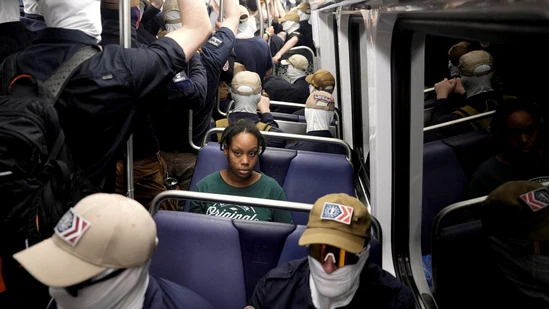
(Courtesy of Gwyllm Llwydd)

Posted in Inequality Watch
Trump’s State of the Union address delivered grandstanding and grievance politics, but few concrete solutions for Americans facing healthcare crises, economic instability, and ever-widening inequality.
by Taya Graham and Stephen Janis February 27, 2026 (therealnews.com)
US President Donald Trump delivers the State of the Union address in the House Chamber of the US Capitol in Washington, DC, on February 24, 2026. Photo by ANDREW CABALLERO-REYNOLDS / AFP via Getty Images
Trump’s State of the Union address delivered grandstanding and grievance politics, but few concrete solutions for Americans facing healthcare crises, economic instability, and ever-widening inequality. While mainstream media commentators fixated on the spectacle, Epstein survivors in attendance were essentially ignored, and key claims on immigration and economic policy went largely unexamined.
Credits:
Transcript
The following is a rushed transcript and may contain errors. A proofread version will be made available as soon as possible.
Taya Graham:
Okay. You might have watched President Donald Trump’s state of the Union and found it difficult to reconcile with what’s actually happening in your life. He said we were in a new golden age, but it doesn’t feel like it for most of us. He said the economy is the strongest ever, but perhaps your actual experience doesn’t jive with that assessment. Well, you’re not wrong and we’re going to prove it. Myself, along with my reporting partner, Stephen Janis, are going to break down what Trump’s speech was missing, mainly the perspective of the people actually living with the consequences of his policies. So we’re going to give you the people’s state of the union breakdown and you won’t want to miss it.
Hello, my name is Taya Graham and welcome to The Inequality Watch, the show where we break down the historic wealth imbalance that defines this country and hold the people who are making it worse accountable. Today we’re going to talk about the state of the union or perhaps more accurately, the state of the oligarchy address, which President Trump gave on Tuesday. Like all things related to the current president, it’s been controversial and of course touted by mainstream media and conservatives for its political acumen. But of course, all the people celebrating Trump’s requim for democracy live inside the bubble of elitism and abundance. Like the Zuckerbergs and Bezos who sat on his inauguration stage, they are costated by wealth, stowed away inside a safe and snug insulated abode created by excess that makes them incapable of understanding the real world suffering and struggle that the rest of us live with.
Raise your hand if you have over $5,000 worth of debt. $10,000. More. Okay, maybe it’s just me. So in order to put the state of the oligarchy in its proper place, we’re going to react to some key clips from the speech and provide the people’s perspective on what was said. Or another way to put it, we’re going to reveal the distortions of the truth the mainstream media won’t tell you and take them and this administration to task by holding them accountable. Imagine that. I mean, right Stephen, people deserve a say in all of this.
Stephen Janis:
Yeah, no, it’s always amazing to me when I watch these speeches. To me, it becomes like a mirror on the elite. People like us who are middle class people watch it like a forest fire and they’re sitting there saying, “Oh, there’s some good things here and he had some great moments and this is really going to define the midterms while he’s literally depicting a reality that is destroying people’s lives. And I am always amazed how the pundit class rises to the occasion and gives him plotteds for things they doesn’t
Taya Graham:
Deserve.” Exactly. I mean, the biggest cause of personal bankruptcy in the US are actually healthcare bills and the Obamacare tax credits which help people fund their own insurance have expired, raising the costs substantially. And guess what? Congress has done nothing. In a recent report declared that simply buying a car will set you back about $50,000. That’s a record price. And don’t even think about trying to buy a house. The point is things are great for the ultra rich, not so much for the rest of us. And that speech made it crystal clear. So let’s break it down. Okay, Steven, are you ready? I’m ready. Here’s our first clip, the topic of the moment and why we’re here today, because apparently we’re living in a new golden age, or at least that’s what our president says.
Speaker 3:
You’ve seen nothing yet. We’re going to do better and better and better. This is the golden age of America. But tonight, after just one year, I can say with dignity and pride that we have achieved a transformation like no one has ever seen before and a turnaround for the ages. It is indeed a turnaround for the ages.
Taya Graham:
All right. So there is no doubt that this has been a golden age for billionaires. I mean, and especially for President Trump. I mean, the president himself and his family have pocketed $4 billion from crypto sales alone. And the Trump organization, his private real estate conglomerate is still owned by Donald Trump and consists of his hotels, his golf courses, his resorts, and other businesses. And according to the corporate listings, Donald Trump is the owner of the Trump organization, which has about 250 companies and assets around the world. And he’s actually suing the federal government for $10 billion for the illegal release of his tax returns, which essentially means he’ll be able to settle with himself. As Mel Brooks said, it’s good to be the king. But I think it’s worth noting that while the stock market is up, the top 1% of households own 54% of that wealth and the top 10%, 94%.
So it’s golden for some, but what about the rest of us, Stephen?
Stephen Janis:
Well, yeah, the golden age started with one of the worst years of job creation in the history of this country since 2003. Only about 173,000, 183,000 jobs. So there was no job creation and over a million people got laid off. So it’s been really bad for the average worker, the average person. You got AI looping over us saying it’s going to destroy 40 to 50% of white collar jobs. He didn’t address that. And as we’ve said before, buying a car is now more expensive than it’s ever been. And housing also has gone up in price. So really what you’re talking about here is a very, very bad, bad situation for the middle class. It’s the golden age for Trump, but not the golden age for the people. And I think it’s important to make that point. I mean, think about that. They didn’t create any jobs.
I don’t know why they didn’t make it into his script or his speech, but that’s really essential to the wellbeing of Americans and it just didn’t make the cut.
Taya Graham:
Steven, I have to ask you something about tax cuts because for your average middle class folks, your taxes are between 15 to 24 or 25% because you get your income tax and then there’s payroll tax. And so that ends up being a huge chunk. But people who are multimillionaires and billionaires, somehow they don’t seem to pay quite as much of their income. Maybe you could explain how those unrealized gains work and why billionaires just don’t seem to have to pay any taxes. Well,
Stephen Janis:
This is a very controversial topic, but as you have your assets appreciate, most billionaires and wealthy people have assets that appreciate. That’s where a lot of their wealth comes from.
Speaker 4:
It
Stephen Janis:
Doesn’t get taxed until you sell it. And there’s been a proposal in California to actually tax people on those inflated assets. And that’s why the stock market thing is important. Your stock market account keeps going up and up, but you’re not paying taxes on it. Now, some people say it would be impossible to execute, but the point is you can keep getting richer while our wages stay the same. And we pay on our wages right away. We don’t get to hold them or let them appreciate or whatever. So basically, yeah, that’s a big deal. I mean, the wealth that is concentrating and held does not get taxed. Meanwhile, our wages get taxed right away taken right out of our paycheck.
Taya Graham:
You know what? I think a really great example of this, just to make it crystal clear for folks, Elon Musk, he does not take a salary. He gets a salary of $0 a year. Jeff Bezos, when he was pulling a salary, took $80,000 a year. And yet how are they able to be the wealthiest people on the planet? Can you imagine how you don’t get taxed on $0 a year, but they take loans against their money, they pay the interest. I mean, it’s just the way they do it with these low interest loans is that they just can live off these unrealized gains. They can live off their assets without ever having to sell them. It’s something that we can’t even comprehend. Now, let’s go a little bit deeper into healthcare. Now, it hasn’t been on the radar of the elites since the Obamacare tax credits expired, but let’s listen to what President Trump had to say, and then we’ll come right back.
Speaker 3:
I’m also confronting one of the biggest ripoffs of our times, the crushing costs of healthcare caused by you. Since the passage of the Unaffordable Care Act, sometimes referred to as Obamacare, big insurance company has gotten rich. It was meant for the insurance companies, not for the people. With our government giving them hundreds and hundreds of billions of dollars a year as their stock prices soared, 1,120, 1,400, and even 1,700%, like nothing else. That’s why I introduced the great healthcare plan. I want to stop all payments to big insurance companies and instead give that money directly to the people so they can buy their own healthcare, which will be better healthcare
Taya Graham:
At a much lower cost. Okay, Steven, you have some pretty passionate thoughts on this subject. What do you think about this healthcare proposal?
Stephen Janis:
Well, first, before I address the proposal, there’s one thing that really, really annoys me. We talk about health insurance. It’s a misnomer. Insurance is a risk pooling for an anomalous event. Healthcare is not something that’s anomalous. We use it all the time. We use it regularly. So you can’t say we’re pooling our health insurance to pay someone’s healthcare. We really have a system that makes no sense, doesn’t address the problem at hand. Trump’s answer to this crisis is to put out a plan where he’s going to kind of alter Obamacare a little bit to create what’s called skinny plans or catastrophic healthcare, where you pay huge deductibles, 15,000 for an individual, 30,000, and then get maybe 80% of coverage of catastrophic. But the day-to-day healthcare that we need is not being covered. And I want to say this about this particular subject and the way Trump raised it.
Americans deal with the reality that no other country really around the world deals with, and that is that any of us can go broke because our healthcare is not coverage. Personal bankruptcies are almost all involving healthcare bills. We walk around in a reality defined by the inability to pay for our own healthcare and the lack of solutions in our leadership. So in other words, any of us at any time could be subject to a disease that would make us broke. And that is really, really something that defines reality. People stay in bad jobs because they need healthcare. They stay in bad relationship because they need healthcare. There’s no universal right to healthcare in this country. And I think it defines us psychologically. It defines how we think. And to see Trump just casually say, “Yeah, I got this plan,” with no details. And obviously, really, in many ways, kicking people off coverage like Medicaid and Medicare, excuse me, Medicaid specifically through the Big Bad Beautiful Bill, excuse me for calling it the bad beautiful bill, really, really defines our lives in ways that I don’t think we talk about enough to you.
Taya Graham:
Steven, that’s such an excellent point because it really does trap people trapped in bad jobs, trapped in bad relationships because they desperately need their healthcare. And of course, the Congressional Budget Office has estimated that the big, beautiful bill will cause 10 to 11 million Americans to lose healthcare by 2034 due to the cuts to Medicaid and Obamacare. And all of this to give a huge tax break to the richest Americans, which of course, again, is more bad news for us and more good news for the richest 1%. Now, the next oligarch versus the people moment came in what has been the portion of the speech most heavily touted by pundits from both sides as being defining, a moment of political theater that really seemed to impress the pundit class. Let’s watch.
Speaker 3:
So tonight I’m inviting every legislature to join with my administration and reaffirming a fundamental principle. If you agree with this statement, then stand up and show your support. The first duty of the American government is to protect American citizens, not illegal aliens.
Taya Graham:
So it’s interesting that this would be Trump’s big moment, given what has happened with ICE in the past couple of months. I mean, ICE has been actively killing Americans and violating constitutional rights at a rapid pace. So I have to ask you, Steven, do you think it’s really the big win Republicans think it is?
Stephen Janis:
Well, I mean, if Trump wants to produce the next triumph of will, yeah, it’s a big win. But in reality, in reality, what it is is another example of him crushing dissent, oversimplifying a very complex policy, and also completely flying over his own faults and what his administration has done with this particular problem. Because as you point out, ICE has been killing Americans. So ICE is not protecting anybody in that sense. ICE is not protecting the people who protested and exercise their First Amendment rights, throwing them all around, putting their hands on them, beating them up. I mean, from the get- go, this idea that we have to somehow bend to his will by standing up to a simplified statement that he said that doesn’t reflect the current realities of the policy is just absolutely stunning to me. But what was more stunning was the pundits and the CNN commentators were like, “Wow, great, great us Nazi salute you guys had to give there to President Trump.” I mean, it’s really, really disturbing that our democracy is completely devoid of dissent the minute Trump stands up and says something provocative.
And they think this is going to get them the midterms, but I don’t think so because people can see the reality. And the reality is that what he said makes no sense. It’s completely contradicting the policy on the ground and that’s the problem. Why should people have to stand up and bend to Trump no matter what he says? Why can’t we dissent in the people’s house? That’s the problem.
Taya Graham:
And Steven, you make such an excellent point. The death of Renee, Nicole Goode, the death of Alex Pretty, and even the death of Kevin Porter. They were all Americans killed by ICE. And there’s actually another report of an American killed by ISA also did not receive a lot of attention like Kevin Porter’s death on New Year’s Eve. Ruben Ray Martinez died in March 2025 on some Padre Island during a traffic stop. Now Ice says he drove at an officer. We’ve heard that before. But a witness who was with him at the time disputed that account. However, let’s be clear, he wasn’t committing a crime and he was not an immigrant. He had pulled up to a checkpoint and still ended up dead. So to your point, President Trump and ICE are not protecting Americans. They are in fact killing them and violating their rights. Now, Stephen, we’re going to pivot here and discuss something that Trump failed to mention at all, and that’s the Epstein scandal.
Just before his speech, survivors gathered in the Canon office building next to Capitol Hill to call on Trump and the Department of Justice to acknowledge them and to unredact documents that have hidden the identities of the co-conspirators of Epstein. Their point is we aren’t going away. Now, we were there to listen to the survivors and I have extended clips of exclusive interviews we personally conducted and I will link those in the comments below for people to watch. But first, let’s listen to Epstein’s survivor, Lisa Phillips, discuss why she will not give up.
Speaker 5:
I always get emotional because every time I look at my survivor sisters behind me, I’m reminded that they represent at least 200 victims. I don’t want you guys to forget that. So when I stand here, I do not stand alone. I represent hundreds of faceless, nameless survivors. Some I have had the honor of knowing and supporting over the last few years, young women and girls who were never given a voice. My survivor sisters and I have come to Capitol Hill many times this past year, as you know, and we will keep coming back again and again until all the Epstein files have been released because accountability is impossible without full transparency. Those of us who live through the horrors of Epstein world have always known this was never just a story about one powerful man. It was never just a crisis of wealth and privilege in America.
It is and always has been a global crisis of corruption.
Speaker 4:
He is going to know that looking back at him will be numerous survivors of Epstein’s abuse and that he is facilitating the single largest coverup in modern American history.
Taya Graham:
You know, one thing I have personally witnessed being on Capitol Hill covering the Epstein survivors is that it certainly seems like they are not giving up and something that you didn’t see at the rest of the Lisa Phillips clip. And this is also something that Theresa Helm told me herself directly, which is that these women are going to Europe to tell them what they have learned, to tell them what they have uncovered, to tell them what they have experienced, what other survivors have told them, Lisa Phillips, as she had said in a previous press conference, that she was compiling her own Epstein list and receiving information from other survivors who did not want to come forward publicly. And because the American government isn’t criminally charging anyone, arresting anyone, they’re going to Europe to give them this information. So no matter what the Department of Justice throws at them or what President Trump says, these women have stood tall, they’ve taken the heat and they’ve refused to back down and they’re going to keep pushing until they get some kind of justice.
But Stephen, there was also some breaking news about the ongoing controversy surrounding the Epstein files. Can you tell us a little bit about it?
Stephen Janis:
Yes, Teya. Some files that were turned over in the trial of Ghislaine Maxwell who received 20 years for being a co-conspirator with Jeffrey Epstein showed missing files of 302 reports that had cited Donald Trump for abusing a minor. So this has been a big, big scandal because those documents, for some reason, they violated the law and did not include them in the entirety of the disclosure. So it’s just another example of the Justice Department redacting or not including documents that are critical to this. And the law, the Epstein Transparency Act was absolutely specific that all documents had to be turned over. So this is just another example of, it looks like the Department of Justice covering up for President Trump who was cited in the 302 reports that were submitted to the FBI.
Taya Graham:
And the FBI has been redacting these files since last March, even before the Epstein Transparency Act was passed. So we can only imagine what we are actually missing and what won’t be released. We actually co-wrote a piece about how the Epstein scandal might be the one that Trump can’t shake. And that seems to be true so far. We talked about how it was the fact that victims not backing down could be his downfall, their courage and their resolve. I mean, they are literally flesh and blood examples of our unequal justice system and our historic wealth inequality in general that created it. What do you think about that in the light of recent revelations and the survivor’s persistence?
Stephen Janis:
Yeah. I mean, I think we’ve always said that in many ways inequality seems intangible. You talk about these numbers like a trillion dollars here, a trillion dollars there, and it doesn’t really seem to add up in a way that’s personal, but this is really personal until you’ve done great coverage of the survivors and really highlighted their stories and no person can watch them without saying they are victims of an unequal justice system that literally exempts the rich, literally exempts the powerful. There’s no other conclusion, but now you see specific victims of all … And those victims are children. So I think this, yes, will continue to haunt Trump. I don’t think you can duck it. And I think it really is like a marker of inequality in this country where you have a criminal justice system that literally sells exemptions to wealthy people.
Taya Graham:
Steven, that is such an excellent point. And I just really want to highlight something you said. These were women and children that were victims of this abuse and trafficking, and that just cannot be ignored. These were children that were abused and sold off to the highest bidder. And those co-conspirators, those predators, those perpetrators, those who aided and abetted this, they deserve to see their day in court for the sake of the victims and to make sure that the Epstein class can’t get away with this again. Now, Steven, is there anything you want to add before we sign off?
Stephen Janis:
I think I want to talk again about how the pundits interpreted Trump’s attempt to get Congress to bend the knee to whatever he said. Trump really likes to regulate our bodies. Trump really likes to regulate people. He likes to make sure that we have papers. I mean, American citizens, for the first time in my memory, in my lifetime, American citizens have had to literally have papers to prove that they’re American citizens or they get thrown in jail. He’s trying to come up with some idea where you have to have a birth certificate to get a bank account or have a birth certificate to vote. I mean, they’re really, really … The conservatives say we’re a world of freedom and we don’t believe in overregulation and too much government. Well, they become exactly the opposite. It’s more and more about regulating how we think, how we feel, how we move through the world.
There’s this idea of investigating left organizations as terrorists. It’s ongoing. And so that one moment where he says, “Stand up and support what I say, regardless of what you know about what’s actually going on. ” To me, it was shockingly fascist and shockingly authoritarian and yet the pundit class was like, that’s his moment. He’s going to win the midterms because of this. This is going to be the best thing he ever did. How insane are these people? I mean, how rich and costuded and in the bubble, as you said, do you have to be to think this is a great moment in American Democratic history? When you stomp out dissent and when you take away people’s right to vote and when you take away our free movement through society, what you have left is nothing more than an authoritarian regime. And I just find it stunning and really offensive that people found this to be such a great moment.
Taya Graham:
And Steven, you make such an excellent point. I mean, who thought the party of Ronald Reagan would end up being the big government party? Being
Stephen Janis:
Big government.
Taya Graham:
And to see our mainstream media sit there and just try to be as neutral as possible, saying they’re just calling balls and strikes and how great this was, it’s just incredibly disappointing.
Stephen Janis:
Yeah. Sometimes you just have to call something out for what it is. And those punitives don’t have to be neutral. They’re getting paid by either party to be sort of propagandist, but to me, they lack insight and intelligence. That’s the problem, not the problem that they don’t have enough money or enough access to the mainstream media. They have all that. They just don’t have intelligence.
Taya Graham:
Well, I think that’s it for the people’s state of the union breakdown. And as always, Steven and I will continue to report from Capitol Hill and around the country wherever we’re needed to expose the underbelly of America’s destructive concentration of wealth. And remember, if you do have a tip about a story we should cover, you can reach out to me. You can email me at par@therealnews.com, or you can reach out to me directly at Facebook and Instagram at Thea Graham. I’ll post the information below in the comments for you. My name is Taya Graham, that’s Stephen Janis. We’re your inequality watchdogs reporting for you.
By Adrienne Fong
The US&Israel have attacked Iran – EMERGENCY DEMOS – in SF and beyond.
GI HOTLINE (877) 477-4497
– Share this number to people who know active duty service members
Article:
201 killed in US-Israeli attacks on Iran – state media: Live Updates – February 28, 2026
201 killed in US-Israeli attacks on Iran – state media: Live Updates — RT World News
Iranian drone hitting the headquarters of the Fifth Fleet in Bahrain.
Iran’s Fars news agency said the country was targeting Al Udeid Air Base in Qatar, Ali Al Salem Air Base in Kuwait, Al Dhafra Air Base in the UAE and the US Fifth Fleet naval base in Bahrain.
Bahrain confirmed that the headquarters of the Fifth Fleet had been hit.
https://www.instagram.com/p/DVTaZCHAFj6/
From Greg Stoker (U.S. Veteran) on Instagram:
Another war for the parasite class. Send to anyone banging the war drums for this insanity.
https://www.instagram.com/p/DVT0wA1gTu6/
From Josie G. Wade (former US military intelligence officer and now U.S. veteran):
What is your red line?
https://www.instagram.com/p/DVT1sPXjX58/
BAY AREA: HANDS OFF IRAN!
RALLY AGAINT US-ISRAELI AGGRESSION!
Saturday, Feb 28 | 3 PM
SF Federal Building, 90 7th St,
San Francisco
List of protest in other areas from ANSWER:
Emergency protests against war on Iran in cities across U.S. – ANSWER Coalition
Israel and the United States have struck Iran. In the last hour, large clouds of smoke could be seen billowing from areas in central Tehran. The site of impact in the downtown area appeared to be in close proximity to Iranian government buildings. A US official confirmed that the United States is participating in the strikes, and that the US is coordinating with Israel in launching the attack.
The United States and its proxy military base of Israel are openly and brazenly attacking a sovereign nation’s capital. They are doing so in an attempt to ignite a regional war that would multiply the suffering of the Iranian people and the people of the wider region. The US and Israel continue to demonstrate that the real threats to the Middle East are Zionism and imperialism.
This escalation would not be possible without the military cargo being sent from the US to the Zionist entity. The only way to curb US imperialism worldwide is through a people’s arms embargo.
From the belly of the beast, we say: Hands off Iran, hands off our region! Arms embargo now!

Join the 100,000 members-strong Democratic Socialists of America to fight for a better world today.
Join DSA: https://dsausa.org/join


Sodosenrpt6ut u l 1a4e9:rt0m3A347f07gl11uuF1rb3ta7iMu5ayu9uh ·
Democratic Socialists of America — This morning, our membership reached 100,000! At 100k, we are the largest socialist organization in the US in the last century. Join us today, we have a world to win.
portraits taken by @noelle.png
by BAR Editorial Board Wednesday, February 25, 2026 (ebar.com)

San Francisco Ballet in Aszure Barton and Sam Shepherd’s “Mere Mortals.” Photo Chris Hardy via Kennedy Center
Attendance has tanked. Performers have canceled in droves. The John F. Kennedy Center for the Performing Arts in Washington, D.C. is a shell of its former self. Last year, President Donald Trump purged the center’s board, got himself elected chair by a friendly new board, and installed MAGA faithful Ric Grenell, a gay man who lacks gay sensibilities, as interim president. More recently, Trump ordered his name installed on the storied arts venue in an allegedly illegal move to rename it. Yet, the San Francisco Ballet is moving forward with its scheduled performances of “Mere Mortals” at the Kennedy Center in late May. The ballet should do the right thing and cancel those shows. A change.org petition with over 7,400 signatories urges the ballet to withdraw.
“As a devoted San Francisco resident and an ardent supporter of the San Francisco Ballet, it pains me to address something that could tarnish the name and spirit of an institution I hold dear,” Daniel Detorie wrote in the petition he started. “The decision to host a San Francisco Ballet performance at the Kennedy Center in May 2026, following a significant transformation of the venue due to a takeover influenced by policies reminiscent of the Trump administration, has stirred substantial concern among patrons, artists, and citizens alike.
“The Kennedy Center has always stood as a bastion for artistic freedom and diverse cultural expression,” Detorie continues. “However, recent developments suggest a shift towards ideologies and an atmosphere that may compromise this reputation. Donald Trump’s policies during his presidency often clashed with the values of inclusivity and equal representation. Undoubtedly, his influence on cultural institutions may carry forward principles that contradict the very essence of what the San Francisco Ballet represents – unity, diversity, and creativity without borders.”
Over at 48 Hills, critic Charles Lewis III offers some backstory, “Trump’s hostile takeover of the Kennedy Center has led some of the country’s biggest artists – many of whom normally mute their politics – to publicly take a stand. Philip Glass, Patti LuPone, Stephen Schwartz, Lin-Manuel Miranda, and the current Broadway cast of ‘Les Miz’ are just a few of the major names who would rather roll naked over broken glass than kiss the ring.”
Much like San Francisco Travel omitted LGBTQ content from its Tournament of Roses Parade float back in January – the purpose of which was to promote the city, which has a vibrant queer community – the San Francisco Ballet risks damaging its global reputation by performing at a venue that, in the last year, has rid itself of any semblance of promoting artistic excellence. What was constructed as a living memorial to President John F. Kennedy following his assassination is now hollowed out. That will quite literally happen in July, when Trump said the venue will close for two years for renovations.
Meanwhile, Kennedy Center leadership is adrift. The New York Times reported in late January that Kevin Couch, who was brought on as senior vice president of artistic programming, left the post less than two weeks after his hiring was announced.
Curiously, the San Francisco Ballet itself has remained mum. It did not respond to a request for comment when the San Francisco Chronicle wrote a story in early January about Detorie’s petition. Lewis reported that the ballet board has held at least one meeting about the issue, but hasn’t announced anything. Our own emails to the ballet seeking comment have gone unanswered.
Part of being a San Francisco cultural institution means standing up for the city’s values. Lewis recalled that the Ukrainian flag was projected onto the War Memorial Building at the ballet’s 2022 opening gala. (This week marked the fourth anniversary of Russia’s deadly war with Ukraine, which shows no signs of abating despite Trump’s promise during the 2024 campaign that he would end it within 24 hours of taking office.) The San Francisco Ballet has long been LGBTQ-friendly, including its stunning galas. Yet, the Trump administration is working overtime to erase transgender people, deny gender-affirming health care to trans youth, and recently removed the rainbow flag from the Stonewall National Monument in New York City. Trump and his administration have violently gone after immigrants, killing two U.S. citizens in Minnesota, including a lesbian mom, in the process, and Trump has revoked policies to fight climate change, among many other terrible policies. He wants to federalize elections. His zeal to implement tariffs flies in the face of a U.S. Supreme Court ruling against him last week. These actions and plans of his go against everything San Francisco, and its cultural institutions, stand for.
If the San Francisco Ballet goes ahead with the performances, it will leave an impression of supporting the president, since he is in complete control of the Kennedy Center. That, in turn, means backing his policies, as Detorie pointed out.
“This isn’t just about art,” he writes. “It’s about preserving principles that ensure our performing arts remain an unbiased reflection of our diverse society. Allowing the San Francisco Ballet to perform there under such a shadow may inadvertently suggest an endorsement of these divisive policies. This risks alienating the devoted followers of the ballet and undermines the core missions these cultural exhibits strive to achieve.”
The San Francisco Ballet must do the right thing and cancel its Kennedy Center performances.


3. How to Bring Authoritarians to Justice
Brazil did something that few democracies achieve: It convicted a former president of attempting a coup. How did the country’s courts hold would-be autocrat Jair Bolsonaro accountable when so many other coup plotters go unpunished?
By Luciano Da Ros and Manoel Gehrke
By Anabel Sosa, Senior California Politics Reporter (SFGate.com)

FILE: U.S. Rep. Katie Porter speaks during a news conference in Washington, DC. Porter, a Democrat and former U.S. congressmember, is running for governor of California.Alex Wong/Getty Images
Five candidates for governor of California are in a tie at the top, according to a new poll from the Public Policy Institute of California.
After the weekend’s state Democratic Party convention ended without any official candidate endorsement, it left some questions around who the Democratic front-runner is. The latest poll about the race reflects a similar confusion.
“Right now, there is no clear favorite,” Mark Baldassare, the lead pollster at PPIC, told SFGATE in a phone call.
The most surprising change is that voter support for Katie Porter, a Democrat and former U.S. congressmember, has resurged after her numbers began to drop in the polls. She now is the top polling Democrat, with 13% of likely support, according to PPIC’s findings.
“California voters are fired up to elect a progressive candidate who will deliver single payer health care, stand up to Donald Trump, billionaires, and special interests, and tackle California’s cost crisis,” said Peter Opitz, a campaign spokesperson, in a statement to SFGATE about the new poll.
PPIC surveyed only likely voters in California about the governor’s race. Republican Steve Hilton, a British-born former Fox News contributor, remains the top choice overall, with 14% of likely support. Hilton was once virtually unknown in California — and to many, is still an unknown name. He is just one percentage point ahead of Porter.
Chad Bianco, a Republican and Riverside County sheriff, is in the third spot with 12%; Rep. Eric Swalwell, a Democrat, is in fourth with 11%; and trailing behind in fifth is billionaire Tom Steyer, a Democrat, with 10%.
Baldassare, who has been conducting surveys since 1998, said he attributes Porter’s lead to voters who are thinking about “what they knew” and “what they know now” about candidates.
While Porter doesn’t currently hold public office, he said he thinks voters are aware she was in Congress and formerly ran for U.S. Senate, which gives her credibility and name recognition.
He also said the two Republican candidates are in the lead because Republican voters are picking only between those two candidates, whereas Democrats have a larger pool to pick from. Baldassare said the next PPIC poll, expected in the spring, will paint a much clearer picture because presumably the candidate pool will have winnowed.
Baldassare said that the most notable difference in these returns compared with their last poll in November is that Swalwell and Steyer had not announced their bids at that time and therefore were not accounted for. This week’s release is the first from PPIC to include the two of them, although Baldassare also pointed out that this survey was done right around the time Matt Mahan, the mayor of San Jose, jumped into the race.
“This is somebody who is in elected office now and will have resources, apparently, to get known as Steyer has,” Baldassare said. “I will be looking for our next poll to see where Matt Mahan fits into this.”
Mahan announced his bid at the end of January, and within a week, he had raised $7 million for his campaign. That money largely came from the tech industry, as Mahan has quickly emerged as the favorite of that powerful and deep-pocketed group. A separate political committee funded by some Silicon Valley execs paid for a Super Bowl ad for Mahan.
Steyer, who has used $40 million of his own money to fund his campaign, continues to climb in the polls. When he announced his bid in mid-November, he had 4% support, according to Emerson College. Last week in the same poll, he rose to 9%; in the PPIC poll, he has now made it to the double digits. Swalwell, on the other hand, who was leading in the Emerson Poll with 12% support in December and 14% in February, is down a few percentage points in the PPIC poll.
Another important factor to consider, Baldassare pointed out, is the support that some of the candidates have from voters who are not registered to a party –– also known as no party preference, or NPPs. Porter has support from 15% of NPPs, Hilton has 11%, and Steyer 11%. And 16% are undecided.
The PPIC poll surveyed just over 1,000 likely voters in California from Feb. 3 to Feb. 11. The responses were collected online in both English and Spanish. The margin of error for the results among likely voters is 3.9 percentage points.
More Politics
— California city freezes rent for all of 2026. It could be permanent.
— Marin Republicans say ‘dead’ people are voting. The county says they’re alive.
— Google’s Sergey Brin and other tech elite have a new favorite to replace Newsom
— High-speed rail chief arrested hours after governor’s press conference
Feb 26, 2026
Senior California Politics Reporter
Anabel Sosa is the senior California politics reporter at SFGATE. She previously covered the statehouse and elections for the Los Angeles Times. She has a master’s degree in investigative journalism from UC Berkeley. You can reach her at anabel.sosa@sfgate.com.
ChatGPT:
This case isn’t about employment rights (like Groff v. DeJoy) but about whether people can sue the Postal Service when mail isn’t delivered — and it originated with allegations tied to racial discrimination against a Black landlord and her tenants.

President Donald Trump delivers the State of the Union address during a joint session of Congress in the House Chamber at the Capitol on February 24, 2026 in Washington, DC.
(Photo by Kenny Holston-Pool/Getty Images)
Feb 26, 2026 (CommonDreams.org)
A group of right-wing activists is crafting an executive order that would let President Donald Trump unilaterally ban mail-in ballots and voting machines ahead of the 2026 midterm elections.
The Washington Post reported on Thursday that the order being drafted by Trump allies would give him “extraordinary power over voting,” even though the US Constitution explicitly gives individual states the powers to run their own elections.
RECOMMENDED…


An advocate for the order, Florida attorney Peter Ticktin, acknowledged in an interview with the Post that the Constitution does not give the president any role in shaping elections, but he said Trump needed to act to prevent China from supposedly interfering with American elections.
“Under the Constitution, it’s the legislatures and states that really control how a state conducts its elections, and the president doesn’t have any power to do that,” Ticktin said. “But here we have a situation where the president is aware that there are foreign interests that are interfering in our election processes. That causes a national emergency where the president has to be able to deal with it.”
The activists drafting the emergency order said that they are working in coordination with the White House, although the extent of any cooperation isn’t clear.
However, the Post pointed to some evidence that the White House really is on board with such a strategy, such as the Trump administration’s efforts to investigate his 2020 election loss to former President Joe Biden, which the president has long baselessly claimed was due to foreign interference from a number of nations, including China and Venezuela.
As the Post noted, “a 2021 intelligence review concluded that China considered efforts to influence the election but did not go through with them.”
Additionally, Trump has publicly stated numerous times that he wants to completely do away with mail-in ballots and voting machines, both of which he has baselessly claimed are riddled with fraud.
Sen. Mark Warner (D-Va.), the ranking member of the Senate Intelligence Committee, said that the draft order was simply an attempt by the president’s allies to block democratic accountability in future elections.
“We’ve been raising the alarm for weeks about President Trump’s attacks on our elections and now we’re seeing reports that outline how they may be planning to do it,” Warner told the Post. “This is a plot to interfere with the will of voters and undermine both the rule of law and public confidence in our elections.”
Government watchdog Citizens for Responsibility and Ethics in Washington (CREW) said that the drafted order was plainly unconstitutional and would fail in court.
“The Constitution gives states power over election law with oversight from Congress,” CREW wrote in a social media post. “Notice who’s missing? The president. Trump may try to cook up a sham national emergency to try to seize control of elections but it won’t stand up to scrutiny.”
MS NOW national security contributor Marc Polymeropoulos called the draft order “batshit authoritarianism” and cautioned that “this crazy shit is possible as Trump knows Congress is all but lost at this point in a free election.”
“To save himself,” Polymeropoulos added, “anything is possible.”
Democratic Illinois Gov. JB Pritzker pointed to the Post report and warned, “Donald Trump’s plan to steal the 2026 midterm elections is already underway.”
Rep. Rosa De Lauro (D-Conn.) accused Trump of “setting the stage to steal the midterm elections and set fire to our democracy,” while vowing that Democrats would “fight for our democracy and safeguard the right to vote.”
Our work is licensed under Creative Commons (CC BY-NC-ND 3.0). Feel free to republish and share widely.
Brad Reed is a staff writer for Common Dreams.
| Christopher Armitage Feb 25, 2026 |

Image from Jim Nichols, The Progressive
Find any of our books an democracy merch at TheExistentialistRepublic.com. Get them and every guide, booklet, and piece of model legislation for free at BuyMeACoffee.com/TheER.
Check the temperature, the water is boiling and we need to jump out.
I originally put this information together to drop into MAGA comment sections, to send to friends who voted for Trump but “aren’t political,” and to send to representatives who may not be acting with the urgency needed. A subscriber asked if I’d share it with all of you too. Every fact is sourced, every link works. I labeled the original file “The Fax Machine.” If you do one thing with it, I would suggest sharing it in any online space and encouraging people to take a look at the scope and urgency of where we are today.
But first: what we do about it. We have drafted four pieces of model legislation that use powers states already have to prosecute corruption immune from presidential pardon, protect their own tax revenue, and build systems that function whether the federal government cooperates or not. The most urgent is the Child Sex Trafficking Investigation and Accountability Act, which gives every state independent power to investigate and prosecute trafficking connected to the Epstein files. A governor can authorize it by executive order. In some states, the attorney general can act now. In every state, a representative can introduce it tomorrow. Find yours at openstates.org/find_your_legislator and tell them to pass it. Then share this with someone who will do the same.
Here are 198 reasons why.
Those are the 198 reasons to pass these oppositional laws. Civil litigation has won real victories in court, but civil suits cannot match the speed or scale of what we just read. Authoritarians are not afraid of injunctions. They are afraid of handcuffs.
The four model laws and legislator lookup tool help you influence the process. Three countries opened Epstein investigations the day those files dropped. Not one American state has matched them. Find your legislators. Tell them to pass these laws. And send this to someone who will do the same.
Buy any of the books and democracy merch at TheExistentialistRepublic.com. Get them and every guide, booklet, and piece of model legislation for free at BuyMeACoffee.com/TheER.