Voting taking place in San Diego County during the 2024 Election. Photo: Michael Ho Wai Lee / SOPA Images/Sipa USA)(Sipa via AP Images
10 Questions to ask now of Chuck Schumer, Hakeem Jeffries, your senators, your representatives, you legislators, your governors, you secretaries of state and other government officials:
1) If the administration seeks to thwart or delay the mid-term elections, including declaring some sort of emergency, what have you already done to prepare?
2) If Republicans in Congress stand aside and allow the administration to seek to thwart or delay the mid-term elections, what have you already done to meet the challenge?
3) If ICE or other federal authorities attempt to interfere or take positions at polling places, what have you already done to prepare to counter?
4) If federal officials attempt to interfere or disrupt ballot counting, what plans do you have in place to deal with them?
5) If federal officials attempt to seize ballots or ballot boxes, what measures have you already taken to protect them?
6) If federal, state or local officials challenge vote counts, what measures have you taken to insure their validity?
7) If armed, violent mobs attempt to disrupt or interfere with any part of the election process, what plans do you have in place to deal with them?
8) If Republicans in Congress refuse to accept election results, what have you done to prepare?
9) If the President refuses to accept the election results and attempts to bar the new Congress from convening, what are you plans to proceed?
10) If the President orders the military or other armed federal agencies to arrest members of Congress or bar them from taking office, what are your plans to protect the legislative branch?
“FREEDOM OF THE PRESS IS NOT JUST IMPORTANT TO DEMOCRACY, IT IS DEMOCRACY.” – Walter Cronkite. CLICK HERE to donate in support of our free and independent voice
David CrookDavid Crook is co-founder of DCReport. David invented, launched and edited “The Wall Street Journal Sunday” — the largest- circulation business print publication in U.S. history. He tweets at @davidcrooknyc. You can write him at dcrook@dcreport.org.View all posts
The day after Zohran Mamdani won election as the mayor of New York, I started getting texts that had about the same message: How come New York gets Mamdani and AOC, and we get Daniel Lurie and Scott Wiener?
Well, we might not have Scott Wiener in Congress. The race with Sup. Connie Chan is close. But a lot of the local news media, including most recently the SF Standard, are asking: Why are the socialists winning in New York, but not in supposedly progressive San Francisco?
Gabriel Greschler has some valid observations: New York is much bigger and more economically diverse. When you get priced out of Manhattan be gentrification you can move to Brooklyn or Queens or the Bronx. Here, you have to leave town; you don’t vote here any more.
Three tech booms have driven tens of thousands of working-class people out of San Francisco. As longtime political observer and activist Calvin Welch likes to say, “who lives here, votes here.”
Also, California has this rotten top-two primary system. If the Democratic Party primary chose the party’s candidate, then Jane Kim, not Wiener, would be in the state Senate; she beat him in June, 2016.
And big money has a bigger impact in a smaller market.
In New York, data shows, college educated voters tend to support socialism. In San Francisco, thanks to (conservative) city leaders thinking for 30 years that a tech-based economy was San Francisco’s future, a lot of young, educated residents support getting really rich off a tech IPO.
All of that is true, but let’s take a moment to look at something else that happened this week. A democratic socialist organizer, Anya Worley Ziegman, and a labor and community-based People’s Budget Coalition, forced the mayor to back down from $28.5 million worth of budget cuts to critical services.
She did it with massive mobilizations, bringing together the city’s biggest labor unions, neighborhood groups, LGBTG+ groups, and community-based nonprofits. She won the support of Chan—and made it impossible for the other supes to stand with the mayor’s cuts.
I don’t know how this translates into electoral victories in the fall, or if it does. But as Welch has told me many times, “it’s good to know you’ve got it on the ground.”
48 Hills welcomes comments in the form of letters to the editor, which you can submit here. We also invite you to join the conversation on our Facebook, Twitter, and Instagram.
Tim Redmond has been a political and investigative reporter in San Francisco for more than 30 years. He spent much of that time as executive editor of the Bay Guardian. He is the founder of 48hills.
Upon the former House Speaker’s retirement from Congress, Nancy Pelosi and the University of California, Berkeley, will establish the Nancy Pelosi Institute for Representative Democracy, a nonpartisan organization “dedicated to strengthening American democracy.” What do you think?
“May it last long and never yield to younger, newer institutes.”Ruth Wodehouse, Ham Glazer
“If it’s named after a woman, it’s already partisan.”Erik Rostai, Unemployed
“And the best part is, she’s doing it anonymously.”Tyler Seabrooke, Text Aligner
The misleading panic attack on the part of the right and the center in the face of the Democratic left’s recent electoral victoriesIn the past week, candidates backed by the Democratic Socialists of America (DSA) won nine out of the ten state and federal primaries contested in New York, including upsets in two congressional districts. Pennsylvania Democrats chose socialist Chris Rabb as the party’s candidate for the state’s Third Congressional District. Democratic socialist Janeese Lewis George will almost certainly become the next mayor of Washington, D.C. In Colorado, DSA-backed Melat Kiros won the primary for the First Congressional District, unseating 15-term incumbent Rep. Diana DeGette.
These and other gains have led to borderline hysterical commentaries from the center and right, many of them self-interested, all of them misleading.
According to a Wall Street Journal editorial, “Traditional Democrats are now facing a hostile takeover from the socialist left, and so far few are willing to put up a fight.” This is false. Corporate Democrats are fighting, with millions of dollars in super PAC ads; they’re just losing. They have only money. Democratic socialists have committed activists as ground troops.
Many commentators are also alarmed that the success of the economic left is often linked to a critique both of Israel’s policies of ethnic cleansing in Gaza and the West Bank and of the excessive influence of AIPAC in domestic policies, often in bed with the corporate right and dark-money PACs. These critiques invariably raise the specter of antisemitism.
The Jewish Insider newsletter warned, “The Colorado results suggest that, far from being contained to a few scattered congressional districts in New York City, the momentum for far-left, anti-Israel candidates is only growing within the Democratic Party, especially within urban population centers.” I have yet to read any such critique which candidly acknowledges that the backlash might have something to do with Israel’s appalling behavior.
Even more nuanced commentaries get it partly wrong. Paul Krugman writes in a recent Substack post: “The fact is that very few Americans—even among politicians who call themselves ‘democratic socialists’—are really socialists. What many, I’d say a majority, of Americans support is what Europeans call social democracy—an ideology that is OK with living in a mostly market-driven economic system in which some people make much more money than others, but one that advocates policies to tame markets and inequality with progressive taxation, safety net programs, and regulations.”
Since his liberation from the timorously censorial New York Times, Krugman has become an indispensable source of insight on all things economic. But here Krugman is partly off because he doesn’t pay enough attention to the politics.
Social democracy is indeed popular throughout the West. Large majorities of people like universal health care, social retirement programs, good public transit, progressive taxation, and the rest of the “safety net” package. But social democracy is politically weak, and on the defensive, everywhere, because capitalists have too much wealth and power and use their power to destroy the social democratic compromise with capitalism.
That’s why the shrewdest progressives have long understood that social transfers and regulatory strategies are not enough to keep capital contained. You need a good dose of socialist public ownership as well, combined with social movements like trade unions.
Franklin Roosevelt understood this. The original Fannie Mae, The Federal National Mortgage Association, which made home mortgages more plentiful, was a public institution. The Reconstruction Finance Corporation was a public investment bank. Social Security is not just a government-sponsored and -guaranteed system of retirement. It is frankly socialist. Capitalist financial institutions play no role in it whatsoever.
Krugman writes that socialism seems to be on the rise “because right-wing propagandists continually smear social democratic policies as socialist, trying to make popular, mainstream policy ideas sound extreme.” While the right does try to smear progressives as communists, I don’t think Krugman gets that quite right. As young people personally experience the ravages of American capitalism, socialism is on the rise because it is being transformed from a bad word into a good word. According to Gallup, 66 percent of self-identified Democrats have a positive image of socialism, while only 42 percent feel that way about capitalism. The younger the voter and the further removed from memories of the Cold War, the more approval of socialism increases.
That doesn’t mean socialism is a good word everywhere. In more traditionally conservative areas of the country, such as Georgia or Texas, pocketbook progressives will not call themselves socialists, and the right will try to use the presence of more explicit socialists in the Democratic Party to tar candidates like Jon Ossoff or James Talarico as closet socialists. But ultimately, voter revulsion against the excesses of capitalism and the articulation of compelling alternatives matter more than the label.
The corporate right called FDR every name in the book. He wore the slurs as a badge, and the people knew whose side he was on.
Palestinians mourn an infant who was killed by an Israeli airstrike in Deir al-Balah on January 9, 2025.
(Photo by Ali Jadallah/Anadolu via Getty Images)
“We could die at any moment. I hope the war stops for us,” said one 14-year-old Palestinian girl in Gaza. “I would like to live with love, peace, and an easy life.”
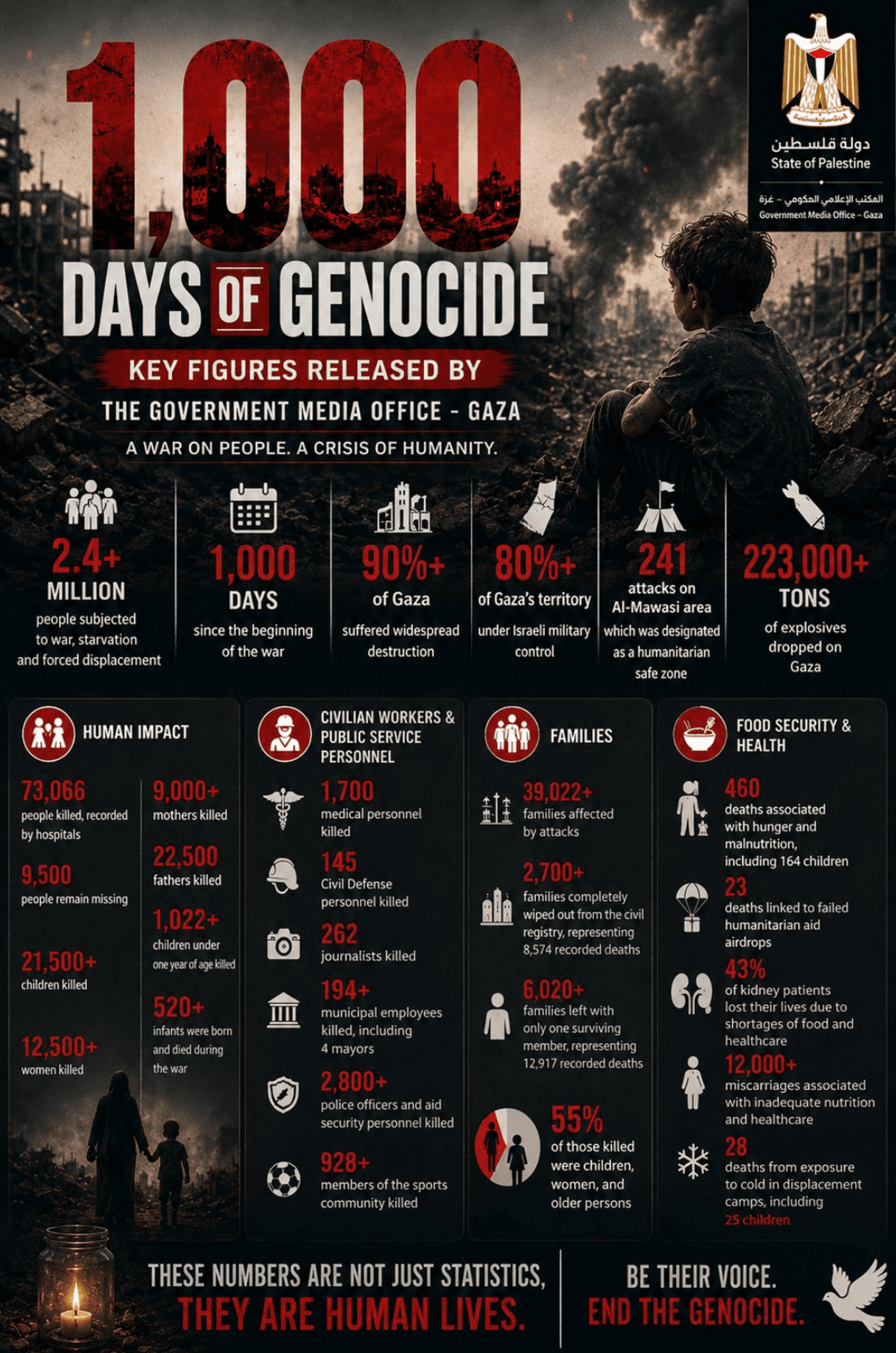
Over 21,500 children—1,022 of them babies—are among the more than 73,000 Palestinians killed by Israel since it launched the US-backed genocidal war on Gaza 1,000 days ago, including hundreds of minors slain since a one-way ceasefire took effect nine months ago, Gaza’s Government Media Office said Thursday.
In updated figures, the GMO said that at least 73,066 Palestinians have been killed since Israel began its war and siege on the Gaza Strip on October 7, 2023. A separate analysis published in mid-April by UN Women found that at least 38,000 women and girls were killed between October 2023 and December 2025.
The GMO said Thursday that at least 173,514 others—including more than 44,500 children—have been wounded, and 9,500 Palestinians are still missing and presumed dead and buried beneath the rubble of bombed-out buildings in the coastal strip, more than 90% of which has been destroyed and 80% of which is under Israeli control, according to officials.
“Every day for the past 1,000 days, the world has failed 1 million children in Gaza by not intervening to stop the killing and maiming of children,” Ahmad Ahendawi, regional director at the charity Save the Children, said Thursday. “As their young, fragile bodies were blown to bits and pieces by bombs and missiles, the world sold those same weapons to the government of Israel [and]… continued trade agreements with the government of Israel.”
Early in the war, UNICEF called Gaza “the world’s most dangerous place to be a child.”
Classified Israel Defense Forces (IDF) data leaked last August suggested that 5 in 6 Palestinians, or 83%, killed during the war’s first 19 months were civilians. Experts attribute the high civilian death toll to Israel’s use of artificial intelligence in target selection, its dropping of 1,000- and 2,000-pound bombs—many of them supplied by the US—in densely populated urban zones, and relaxed rules of engagement allowing for an unlimited number of noncombatant casualties in airstrikes targeting a single Hamas operative, no matter how low-ranking.
Last month, a United Nations commission of inquiry found that 30% of those killed by Israel in Gaza have been minors, and that “the deliberate targeting of children is one of the key elements establishing genocidal intent of the Israeli authorities and security forces to destroy the Palestinian group, in whole or in part, in Gaza.”
IDF troops have admitted to witnessing alleged war crimes, including indiscriminate murder of women and children. Doctors and other international volunteers who worked in Gaza’s besieged hospitals during the genocide have reported the apparently deliberate targeting of Palestinian civilians, including children shot in the head and chest by Israeli snipers.
Palestinian survivors and witnesses have also accused IDF troops of summarily executing women and children.
“Every day for the past 1,000 days, the world has failed 1 million children in Gaza.”
The new GMO figures note 460 deaths from malnutrition—164 of them children—and 28 Palestinians, mostly children, who perished from hypothermia in camps housing many of the approximately 2 million people forcibly displaced by the war.
According to figures published last month by UNICEF, more than 1,000 Palestinians, including at least 265 children, have been killed by Israeli bombs and bullets since the October 2025 ceasefire took effect. UNICEF called the purported truce a “cruel and deadly illusion.”
All this in retaliation for the Hamas-led attack in which approximately 1,200 Israelis and foreign nationals were killed—some by so-called “friendly fire” and under the fratricidal Hannibal Directive—and 251 others abducted.
In the aftermath of the deadliest attack on Israel in its 75-year history, Israeli Prime Minister Benjamin Netanyahu—who is wanted by the International Criminal Court (ICC) in The Hague for alleged war crimes and crimes against humanity in Gaza, including murder and forced starvation—exhorted Israelis to “remember what Amalek has done to you.”
According to the Hebrew Bible, the nation of Amalek was an ancient archenemy of the Israelites whose total extermination—“man and woman, infant and suckling”—was commanded by the Abrahamic deity figure God.
Numerous Israeli leaders made similarly genocidal statements, including Israeli President Isaac Herzog, who asserted that there are no innocent people in Gaza, former Defense Minister Yoav Gallant—who is also wanted by the ICC for ordering the “complete siege” of Gaza blamed for fueling deadly famine and disease—and the influential far-right politician Moshe Feiglin.
“Every child in Gaza is the enemy,” Feiglin said last year. “We need to occupy Gaza and settle it, and not a single Gazan child will be left there.”
According to the new GMO figures, 39,022 families in Gaza have suffered Israeli massacres, with more than 2,700 families entirely wiped out and another 6,020 left with only a single surviving member. More than 58,800 children have been orphaned, including 2,700 who lost both parents, while 26,370 women are now widows.
In 2024, Save the Children published a report detailing how Israel’s onslaught has caused the “complete psychological destruction” of Gazan children. A subsequent study found that nearly all children in the embattled Palestinian enclave believed that their deaths were imminent—and nearly half of them said they wanted to die.
“We could die at any moment. I hope the war stops for us,” a 14-year-old girl identified as Amani told Save the Children in a report published Thursday.
“I hope the war stops so that I can continue my education in Gaza and live my rights as a human like any girl in other countries,” she added. “I would like to live with love, peace, and an easy life.”
Our work is licensed under Creative Commons (CC BY-NC-ND 3.0). Feel free to republish and share widely.
The jury in the trial of seven protesters who shut down the Golden Gate Bridge in April 2024 returned to deliberations Monday and on Thursday morning they reportedly told the judge they remain deadlocked on two counts.
Disagreement on the jury in the trial of the so-called Golden Gate Seven may go back quite a while. The jurors began deliberating three weeks ago and had been let out on an extended break, returning to deliberations Monday, and after three full days of deliberation they told the judge they can not get to a verdict on two counts, as the Chronicle reports.
The seven were charged with both felony and misdemeanor crimes, including conspiracy and false imprisonment, and the jury is reportedly deadlocked on one count of felony conspiracy and one count of trespassing.
Per the Chronicle, Superior Court Judge Teresa Caffese instructed the jury to return to deliberations Thursday morning, and after an hour, they came back saying they remained deadlocked. It’s now unclear where things stand.
Update: As ABC 7 reports, jurors convicted the seven protesters on three misdemeanor counts: false imprisonment, obstruction of a thoroughfare, and unlawful assembly. Defendants Conrad de Jesus, Rocky Chau, Sarah Ferrell, River Allen, Em Tillotson, and Bhavika Anandpura, who all chained themselves across the roadway, received guilty verdicts on all three counts. Sara Cantor, who described herself as a police liaison, was convicted on those three counts as well as on one count of refusal to disperse.
Judge Caffese declared a mistrial on the remaining two counts, with the jury deadlocked 11-1 for not guilty on the trespassing count, and 10-2 for guilty on the felony conspiracy charge — which could have come with sentences of up to 15 years.
A total of 26 protesters took part in the Tax Day “Stop the World for Gaza” demonstration on April 15, 2024, with part of the group forming a human chain and employing the “sleeping dragon” technique — in which their arms were linked inside of plastic tubes, making it more difficult for law enforcement to cut them apart without injury.
A judge dismissed most of the charges against the group, originally known as the GG26 or Golden Gate 26, in November 2024, tossing about 75% of the charges that were mostly misdemeanors.
After charges were reduced and ultimately dismissed for 18 of the group, another with a felony charge saw the charge dismissed for lack of evidence, and the remaining seven went to trial in May. Protesters and supporters were reportedly gathered at the court to hear a potential verdict this week.
The New York Times last month covered the trial, noting that the prosecution of the protesters was indicative of the city’s centrist tack of recent years — when in past decades, in liberal San Francisco, it would have been unthinkable to so aggressively prosecute people peacefully protesting for a cause.
But from the beginning, District Attorney Brooke Jenkins has emphasized the widespread impacts that the protest had, halting traffic in both directions on the bridge for four hours, causing children to have to “defecate in bags” and causing drivers to dehydrate in the cars with little or no water.
One woman, Novato resident Regina Schneider, testified at the trial explaining that the protest caused her to miss an important oncology appointment in SF.
She told the Times, “A lot of us are horrified by things that are happening in Gaza, Ukraine, Iran, all around the world. You do not adversely impact the lives of thousands of people to make your point.”
Pope Leo XIV, center, speaks with Anthropic co-founder Christopher Olah, right, and theologian Anna Rowlands on May 25 during the presentation of his first encyclical.Alessandra Tarantino/Associated Press
On the morning of May 25, Pope Leo XIV released “Magnifica humanitas: On Safeguarding the Human Person in the Time of Artificial Intelligence,” his sweeping first encyclical.
By 5 a.m., Dr. Mark Shiffman, a professor of philosophy at Saint Patrick’s Seminary in Menlo Park and the founding director of the Institute for Philosophy, Technology, and Politics, was already awake and reading it.
In San Francisco, he wasn’t alone. I’ve spent the last month in conversation about this document and the questions swirling around it — most notably, what AI means for our humanity.
What I’ve found is a faith community that was already deep in this discussion before the encyclical landed — and a city with a particular reason to take it seriously.
San Francisco has always been a city of believers. It was built around missions, shaped by parishes, its hills dotted with steeples. It attracted the optimistic toting nothing more than gold pans and hope.
Eventually, tech became the dominant faith, with its own missionaries and orthodoxies — and its own conviction that this time, we’ve found the thing that will save us.
Now the actual Catholic Church has something to say about that — and people here are listening differently than they might anywhere else.
Eleven of the country’s top 20 AI companies are headquartered in The City. The people building this technology drop their kids off at our preschools, drive our streets, fill our pews. When the Pope speaks about AI, San Francisco is the room where it’s happening.
“This is a unifying issue where we have this responsibility to speak out because we are talking about the nature of humanity,” said Michael Pappas, the executive director of the San Francisco Interfaith Council.
What’s striking, when talking to faith leaders across traditions, is how long they’ve already been having this conversation.
Rabbi Sarah Parris of Congregation Emanu-El preached about AI at High Holidays three years ago. Her commute to temple along Stanyan, regularly snarled by Cruise vehicles navigating their training routes, had become its own philosophical provocation. What does it mean to share a road with something that drives “perfectly,” yet somehow wrong?
Now she’s planning a full conference at Emanu-El in January: sessions on AI and Jewish ethics, AI and medicine, and AI and online antisemitism, with space built in for congregants who work in tech to actually talk to each other.
“No single person can answer these ethical questions,” Parris told me. “It is only by being in conversation and in community, with the right ethical text in front of you, that progress can be made.”
That’s what the encyclical clarified, even for those already engaged. Shiffman described it as giving people a map. Before “Magnifica Humanitas,” graduate students wanting to explore the implications of AI on warfare couldn’t find their footing.
“Now people know: Of I want to address this question, I’m either agreeing with this or disagreeing with this, or pushing it forward,” he said.
In honor of the country’s 250th anniversary, The City will launch fireworks from the Golden Gate Bridge, host block parties and stage a two-day jazz festival
Taking place across two art museums, “Limitless” will bring guest speakers to The City for engaging conversations
That guidance from the Vatican is welcomed by teachers having to adapt quickly to how AI is shaping young minds. Sharon McCarthy Allen, the principal at St. Stephen School, described AI as a blessing and a curse.
“We have to be sure that we are upholding the dignity of each human being, specifically when it comes to our children and educating them,” she said. “AI is not going to help them with critical-thinking skills. We don’t want AI to take away their creativity.”
Not everyone in the pews is on board with that framing. At a tech industry party in the weeks after the encyclical’s release, I found myself in conversation with a practicing Catholic who works in AI, someone whose faith and professional life sit in direct proximity to everything the Pope was writing about.
His read: Leo got it wrong. AI, he told me emphatically, is going to solve everything. Suffering itself would become optional.
I asked whether he’d read Aldous Huxley’s “Brave New World.” He had not.
It felt like a parable of the moment — the gap between the people building this technology and the centuries of moral philosophy that exist specifically to ask what we lose when we eliminate struggle, imperfection and the friction of being human.
That question is exactly what Shiffman and his colleagues are trained for, and what Parris explored in her 2023 sermon, drawing on Jewish tradition’s insight that imperfection isn’t a bug in the human design, it’s a feature.
“There is value in the learning, growing, and changing that we all do each day,” she said during the sermon.
At the Vatican ceremony, Anthropic co-founder Chris Olah made a striking admission: that AI labs, including his own, operate inside incentives that sometimes conflict with doing the right thing.
“No matter how sincerely any of us intend to do the right thing — and I believe many of us do — we will always be influenced by those incentives,” he said.
He invited external moral pressure — voices the market can’t bend.
San Francisco’s faith communities are volunteering for exactly that. Sometimes this city ships things before they’re fully baked. The implications of AI, however, might be too consequential to accommodate that startup worldview.
“The question isn’t about what AI takes away from humanity by doing it better than we do,” Parris said in 2023. “The question is about how we can continue to be who we are alongside AI.”
Fourth-generation San Franciscan Ali Wunderman is an award-winning travel, food and culture writer. She lives in Nob Hill with her two rescue dogs and can often be found at John’s Grill enjoying a dirty martini.
The CEO of the software company Salesforce, Marc Benioff, attends the 55th annual meeting of the World Economic Forum in Davos, Switzerland on January 23, 2025.
(Photo by Halil Sagirkaya/Anadolu via Getty Images)
The commission’s upcoming first meeting will focus on “strengthening AI infrastructure, accelerating AI’s impact on health, education, food security, and disaster response, and ensuring trust and safety,” said its CEO co-chair.
A week after United Nations Secretary-General António Guterres called onartificial intelligence companies to “come clean” about the full costs of power-sucking data centers, and as a UN panel on Wednesday released a report detailing the risks and impacts of AI, Axios revealed the creation of a related commission that’s full of Big Tech executives.
“The UN and its International Telecommunication Union (ITU) are convening the AI for Good Global Commission, which will hold its first meeting on July 8 in Geneva, Switzerland,” according to the outlet. It will be co-chaired by Salesforce CEO Marc Benioff and Rwandan President Paul Kagame, with other tech and policy leaders joining as members.
So far, Axios reported, they include ITU Secretary-General Doreen Bogdan-Martin, Estonian President Alar Karis, Amazon CEO Andy Jassy, Anthropic co-founder Jack Clark, Cohere co-founder Aidan Gomez, Microsoft president Brad Smith, Nvidia founder and CEO Jensen Huang, and AI and tech policymakers from Kazakhstan, Namibia, Nigeria, Saudi Arabia, and Singapore.
“AI is the most profound technological transition in history. And our values have to guide every step, because responsibility is the core of AI ethics,” Benioff said. The commission will bring together “the people who build AI, deploy it, shape policy, and represent communities.”
He added that “our inaugural meeting will focus on where this group is uniquely positioned to act together: strengthening AI infrastructure, accelerating AI’s impact on health, education, food security, and disaster response, and ensuring trust and safety.”
However, given recent polls showing that the public has limited confidence in large technology companies, opposes constructing data centers for artificial intelligence in their local area, is wary of AI’s impact on daily life, and has concerns about politicians having a “cozy relationship” with Big Tech, the commission may be met with skepticism or even backlash.
Established with a UN resolution last August, the panel is the first global scientific body on AI—and, as Guterres said in a statement about its new report, “the panel is intended to help the world separate fact from fakes, and science from slop.”
“We are looking to them to provide an authoritative reference point at a moment when reliable, unbiased understanding of AI has never been more critical,” the UN chief explained. “I am pleased to say that they have delivered a down payment on that commitment—in record time.”
The panel’s co-chair, Canadian computer scientist Yoshua Bengio, noted that “AI capabilities are outpacing both scientific understanding and governments’ ability to adapt. With growing evidence of deceptive AI behavior, science currently cannot guarantee that as capabilities continue to increase, AI will not cause catastrophic harm, either on its own or due to malicious users.”
“To act effectively, global policymakers must understand these systems,” he asserted. “This panel provides exactly that: a rigorous, shared scientific foundation to guide our collective way forward.”
The report discusses AI’s recent advances and expected trajectories; societal applications, from agriculture to education to healthcare; economic implications; security and environmental concerns; impacts on democracy, human rights, and information; potential harms to child safety and culture; and governance of the rapidly developing technology.
“The technology is transformative, but if the world keeps moving along this trajectory, humanity will fail to realize the gains it promises. The risks—to societies, to security, and to our species—are too high, and the forces driving AI forward are not the forces that will deliver its benefits,” said Maria Ressa, a panel’s co-chair and Nobel Peace Prize-winning Filipino-American journalist.
Guterres, whose term ends this year, similarly stressed the need for urgent action on a global scale. He said that the “single lesson” he wanted to highlight from the multifaceted report is that “the more AI advances without shared rules, the less say governments and people will have in the outcome. So my message to governments is simple: Do not wait.”
“Next week in Geneva, the first Global Dialogue on AI Governance will begin to turn science into shared action—with every nation at the same table,” he said. “I look forward to joining member states there to help carry this work forward. And soon, I will set out proposals to help countries build the capacity to adequately deal with this technology—and share in its rewards.”
Guterres’ Wednesday comments came after he publicly took aim at artificial intelligence companies last week, proposing the AI Environmental Transparency Initiative during London Climate Action Week, as the second heatwave in as many months scorched the United Kingdom and various other European countries, killing at least hundreds of people.
“I am calling on every major AI company to measure and publicly disclose the full environmental impact of its systems—carbon, water, and land footprints—and to commit to power every data center with renewable energy by 2030,” he declared. “No more hidden costs. No more shifting the burden onto those least able to bear it.”
Our work is licensed under Creative Commons (CC BY-NC-ND 3.0). Feel free to republish and share widely.
Israeli Prime Minister Benjamin Netanyahu speaks at a news conference in Jerusalem on June 15, 2026.
(Photo by Ronen Zvulun/Pool/AFP via Getty Images)
“It should be a no-brainer: Our tax dollars should not fund a genocide,” said Democratic Rep. Ilhan Omar, who supports an amendment to cut off $3.3 billion in military aid to Israel.
Israeli Prime Minister Benjamin Netanyahu on Tuesday compared US aid to “welfare” and said he wants it to end, remarks that came as top Democrats in the US House of Representatives expressed opposition to an amendment that would cut off $3.3 billion in American military assistance to Israel.
“I want to stop American aid,” Netanyahu said during a televised event in Israel on Tuesday, saying he wants the US aid phaseout to begin this year. “We can finance ourselves.”
In recent weeks, amid growing US public backlash against continued military aid to Israel as its military commits atrocities in Gaza and throughout the Middle East, Netanyahu has signaled a desire to “shift the framework” of the US-Israeli relationship “from aid to partnership,” as the prime minister put it in a June 1 letter to US Rep. Marlin Stutzman (R-Ind.).
“Israel deeply appreciates the financial component of the military aid the United States has generously provided us over the years,” Netanyahu wrote in the letter. “The time has now arrived for us to move from aid recipient to partner.”
Netanyahu’s stated vision aligns with legislative text included in annual US defense policy legislation, which would deepen integration of the American and Israeli militaries. Earlier this week, the Republican-controlled House Rules Committee refused to allow a floor vote on an amendment by Reps. Thomas Massie (R-Ky.) and Ro Khanna (D-Calif.) that proposed stripping the integration measure from the bill, which is currently moving through Congress.
But the rules panel is allowing a full House vote on a separate Massie-led amendment that would prevent any US State Department or national security appropriations from being “obligated or expended for Israel” in the coming fiscal year. The amendment would specifically cut off the $3.3 billion in assistance Israel is slated to receive via the Foreign Military Financing Program in 2027.
Massie’s proposal has spotlighted a consequential rift in the House Democratic caucus, even as an overwhelming majority of Democratic voters support ending US aid to the Israeli government.
Prominent progressives—including Reps. Greg Casar (D-Texas), Alexandria Ocasio-Cortez (D-NY), and Ilhan Omar (D-Minn.)—have said they plan to vote yes on the amendment, which could come to a vote next week.
“It should be a no-brainer: Our tax dollars should not fund a genocide,” Omar, the deputy chair of the Congressional Progressive Caucus, said Tuesday. “We cannot continue to be complicit in Israel’s crimes against humanity.”
But top Democrats, including the ranking members of key committees, are opposed to the Massie amendment, which is unlikely to get through the Republican-controlled House. Few Republicans are expected to support Massie’s proposal.
“I don’t want Israel to be without what they need,” Rep. Gregory Meeks (D-NY), the top Democrat on the House Foreign Affairs Committee, told Jewish Insider earlier this week, following a closed-door House Democratic caucus meeting.
Rep. Adam Smith (D-Wash.), the top Democrat on the House Armed Services Committee, said he is “against” the Massie proposal because it would cut off “all aid for Israel.”
“I don’t think there’s support for it,” Smith added, “but we’ll see.”
The Hill reported that the House Democratic leadership told caucus members during Tuesday’s private meeting to “vote according to their conscience” on the amendment, as some members expressed concerns about the proposal’s broad scope and the process by which it is being brought to a vote.
Casar, the chair of the Congressional Progressive Caucus, acknowledged earlier this week that—if passed—the amendment “may cut off both military weapons (~$3.3 billion) and some diplomatic funding (~$50 million).”
“While I would prefer to vote on an amendment that stripped just military funding,” Casar wrote on social media, “I think opposing the billions in military funding is what’s most important here.”
Speaking to MS NOW earlier this week, Casar said that “it’s really important for members to recognize that, while a relatively very small amount of diplomatic funding could be implicated on the amendment… virtually all of the money is military financing that the Israeli military has used to buy fighter planes and attack helicopters.”
“You’re going to see a growing number of Democrats come out against sending more money for weapons for Netanyahu’s military,” Casar predicted. “In the past, it was just a very, very small number. You could count on maybe one or two hands how many members of Congress would vote against sending the Israeli military money for more weapons.”
Our work is licensed under Creative Commons (CC BY-NC-ND 3.0). Feel free to republish and share widely.
Anthropic — led by CEO and co-founder Dario Amodei — closed a $13 billion venture-funding deal in September, the largest in the quarter and one of the largest ever.Jeff Chiu/Associated Press
When it comes to artificial intelligence, President Donald Trump’s second administration has taken a decidedly antiregulatory stance — until this month.
But in recent weeks — in the wake of San Francisco-based Anthropic warning that its newest model, Mythos, represents a dangerous cybersecurity threat — Trump’s administration seems to have embraced the need to control the technology.
The administration’s moves — including what amounts to a ban on Anthropic’s Mythos and a preclearance regime for OpenAI — go well beyond anything the Biden administration put in place.
“It’s certainly a landmark about-face in the attitude that the [Trump] administration has about AI,” said Anthony Aguirre, CEO of the Future of Life Institute, a nonprofit focusing on trying to prevent AI from causing large-scale harm.
The Mythos ban in particular, he said, is a “180-degree shift in how they’re treating AI.”
But regulatory and security experts are dubious about the rationale, legality and effectiveness of the administration’s recent moves to constrain the technology, particularly the ban on Mythos.
“My problem is not so much that they’ve changed their minds,” said Alan Rozenshtein, a law professor at the University of Minnesota law school, “it’s just that I have no confidence in the policymaking apparatus of this administration.”
While the administration might have been acting out of real concern about the model’s cybersecurity implications, it has given little public justification for its move, there doesn’t seem to be a coherent process undergirding it, and there’s reason to believe it might have been driven as much by animosity toward Anthropic as anything else, those experts told The Examiner.
Because of the importance of AI technology and its implications on society and the economy, it’s no surprise that the Trump administration has changed its mind about regulating it, said Alan Rozenshtein, a law professor at the University of Minnesota law school who focuses on technology policy.
“My problem is not so much that they’ve changed their minds,” Rozenshtein said. “It’s just that I have no confidence in the policymaking apparatus of this administration.”
Then, on June 9, administration officials held a secret meeting with AI companies — pointedly not including Anthropic — about developing a process for reviewing cutting-edge AI models before they’ve been released, according to The Information.
That same day, Anthropic publicly released a version of Mythos called Fable 5 to which it had added safeguards. It made available to select organizations a more capable version called Mythos 5.
Sam Altman, CEO of Anthropic’s cross-town rival OpenAI, told employees Wednesday the company would initially provide limited access to its newest model, GPT 5.6, in response to a request from the administration, The Information reported.
Commerce Secretary Howard Lutnick had warned Altman earlier in the week to get sign-off from other government agencies before releasing the model, according to the report.
The reason many regulatory and security experts are doubtful about the rationale for the Mythos ban is that it came mere months after Anthropic got into a dispute with the administration over the use of its models by the military. The company tried to forbid its technology from being used for domestic surveillance or fully autonomous weapons.
Soon after Anthropic released its Mythos preview and announced the model had found a collection of previously undiscovered vulnerabilities, security researchers elsewhere said they’d found that other models that were already available, including OpenAI’s GPT 5.5, had similar or even greater capabilities.
But the administration didn’t seek to block those models — although it did later seek to limit the release of more advanced OpenAI models.
A 50-cent hike is going into effect as part of a five-year toll program first approved in March 2024 to help address a financial shortfall
“Pretty sure this government is mad at Anthropic and this is, like, the hammer they found,” said Bruce Schneier, a renowned cybersecurity expert who is a lecturer at Harvard’s Kennedy School. “I don’t think we can read any policy into the administration.”
“Pretty sure this government is mad at Anthropic and this is, like, the hammer they found,” said Bruce Schneier, a cybersecurity expert and lecturer at the Harvard Kennedy School.
Experts also questioned the legality of the export controls the administration slapped on the Mythos models.
In his letter to Anthropic announcing the export controls, Lutnick cited a collection of laws and regulations seemingly giving him the authority to take that step. But some of the rules he cited appear irrelevant in this case, and he declined to name other regulations that might have given him clearer authority in the matter, said Bahrad Sokhansanj, a senior research scholar at the Institute for Law & AI, a nonpartisan think tank.
Commerce Secretary Howard Lutnick, right and President Donald Trump — seen in the Oval Office on June 11 — have both played roles in the White House’s dustup with Anthropic.Jacquelyn Martin/AP Photo
One big objection to the use of an export control to block Mythos is that there’s good reason to think that such measures aren’t applicable in this case, the experts said.
For nearly two decades, the Bureau of Industry and Security, which oversees such controls, has taken the position that digital services accessed in the cloud don’t involve exporting the underlying software or technology, so access to them can’t be blocked with export controls.
Mythos and other closed-source artificial-intelligence models are essentially cloud-based services. Consumers interact with them via web interfaces or apps. Businesses tap into them using application programming interfaces. Data is sent to the models via those APIs, and the models return responses, but the underlying technology is never transferred.
There’s a bill in Congress now that would extend export controls to cover APIs, suggesting that Congress doesn’t believe the BIS currently has that power, Rozenshtein said.
“It’s not clear even under what authority this export control is being issued,” he said.
Additionally, the regulations cited by Lutnick typically require investigations and detailed findings, which the administration seems to have skipped over entirely, Sokhansanj said. Also, before putting in place severe measures such as the one they took, officials are supposed to explore whether there are less-restrictive options that would involve less harm to American companies, he said.
“There’s no indication they went through any of this kind of analysis, and there’s no way they could have, because this stuff takes time,” Sokhansanj said.
But even if the move to slap export controls on the Mythos models was warranted and legal, at least some of the experts doubted their effectiveness. Other models that appear to be just as capable at finding and exploiting computer vulnerabilities as the Mythos ones are already available, the experts said.
Even if the Mythos models have some capabilities that go beyond other current models, AI development in this area is proceeding so rapidly that other models will likely obtain those capabilities within months, they said.
“If the goal is a safety one … I don’t know if it will actually be helpful,” said Elizaeth Seger, a senior policy advisor at the Tony Blair Institute, a U.K.-based public-policy think tank, of the export controls.
“It’s really only a matter of time before we start seeing equivalent capabilities that are made openly available on global markets for anyone to use and build off of,” she said.
AI technology does pose real dangers, the experts said. The U.S. government should be taking them seriously and taking steps to protect the public, they said. But many of the experts said that doing so would likely involve Congress writing laws and a democratic process of figuring out the appropriate regulations, rather than the reactive, seemingly one-off process the Trump administration is following.
AI technology does pose real dangers, the experts said. The U.S. government should be taking them seriously and taking steps to protect the public.
A big part of the problem with the way the administration has gone about AI regulation is that there’s no transparency, said Amos Toh, a senior counsel at the Brennan Center for Justice, a left-leaning policy think tank at New York University’s law school. Ideally, there would be a publicly determined and disclosed process for testing new models, evaluating the risks they pose and deciding how to mitigate those risks, he said.
“All of these questions need to be sorted out — and not behind closed doors,” Toh said.
The Trump administration now seems to have dropped its laissez-faire, pro-AI industry approach. Pressure from the public and increasing risks from AI models will likely push it and Congress to go farther down the road toward regulation, some of the experts said.
The public has become very skeptical of AI technology and overwhelmingly supports regulating it, Aguirre said. The questions that remain are what form regulation will take, whether the process will remain ad hoc and, in the end, how effective it will be.
“I think ultimately, public concern about this is not going to go away,” Aguirre said.
If you have a tip about tech, startups or the venture industry, contact Troy Wolverton at twolverton@sfexaminer.com or via text or Signal at (415) 515-5594.
Help Outreach Working Group lift the fog of corporate media. Donate to help us maintain this website and distribute literature on the street.
Trump Regime Takedown: Every Saturday Saturday, March 7, 2026 12:00 PM 2:00 PM Tesla San Francisco999 Van Ness AvenueSan Francisco, CA, 94109United States (map) Google Calendar ICS Keep democracy alive every Saturday by showing up, taking a stand, and sticking together for the long haul. Standing together is better than standing alone. Let’s get together... Continue reading →
This Sunday’s Town Hall: Announcing This Week’s Progressive Town Hall: Every Sunday at 4pm ET/1pm PT RSVP HERE Join PDA activists online from across the country to discuss the importance of progressives reclaiming the American story from the MAGA right, an issue of heightened importance as we’re now within one... Continue reading →
We protest Heritage Foundation EVERY MONDAY (Join us!!!!) By admin | September 2, 2025 | Uncategorized Cliff Cash Comedy Premiered Jul 26, 2025 Every Monday at The Heritage Foundation 214 Massachusetts Ave. Washington D.C. 4pm protest 6pm pizza Every Friday at Fox News D.C. 400 N. Capitol St. Washington D.C. 4pm protest 6pm pizza We are... Continue reading →
One Million Rising: Strategic Non-Cooperation to Fight Authoritarianism Virtual Event · Hosted by No Kings Time Wednesdays 8 – 9:30pm EDT Location Virtual event Join from anywhere About this event Across the country, authoritarian forces are getting bolder and more dangerous. Trump and his allies are not hiding their agenda: mass deportations,... Continue reading →
THURSDAY, JUNE 29, 2023 AT 2 AM – 4 AM PDT How to create trust in a group? Details Event by Extinction Rebellion Empathy Circles online EMPATHY CAFE Duration: 2 hr Public · Anyone on or off Facebook How to create trust in a group? This is the question that arose in our... Continue reading →
Trump Regime Takedown: Every Saturday Saturday, March 7, 2026 12:00 PM 2:00 PM Tesla San Francisco999 Van Ness AvenueSan Francisco, CA, 94109United States (map) Google Calendar ICS Keep democracy alive every Saturday by showing up, taking a stand, and sticking together for the long haul. Standing together is better than standing alone. Let’s get together... Continue reading →
This Sunday’s Town Hall: Announcing This Week’s Progressive Town Hall: Every Sunday at 4pm ET/1pm PT RSVP HERE Join PDA activists online from across the country to discuss the importance of progressives reclaiming the American story from the MAGA right, an issue of heightened importance as we’re now within one... Continue reading →
We protest Heritage Foundation EVERY MONDAY (Join us!!!!) By admin | September 2, 2025 | Uncategorized Cliff Cash Comedy Premiered Jul 26, 2025 Every Monday at The Heritage Foundation 214 Massachusetts Ave. Washington D.C. 4pm protest 6pm pizza Every Friday at Fox News D.C. 400 N. Capitol St. Washington D.C. 4pm protest 6pm pizza We are... Continue reading →
One Million Rising: Strategic Non-Cooperation to Fight Authoritarianism Virtual Event · Hosted by No Kings Time Wednesdays 8 – 9:30pm EDT Location Virtual event Join from anywhere About this event Across the country, authoritarian forces are getting bolder and more dangerous. Trump and his allies are not hiding their agenda: mass deportations,... Continue reading →
THURSDAY, JUNE 29, 2023 AT 2 AM – 4 AM PDT How to create trust in a group? Details Event by Extinction Rebellion Empathy Circles online EMPATHY CAFE Duration: 2 hr Public · Anyone on or off Facebook How to create trust in a group? This is the question that arose in our... Continue reading →


 By David Crook July 2, 2026 (dcreport.org)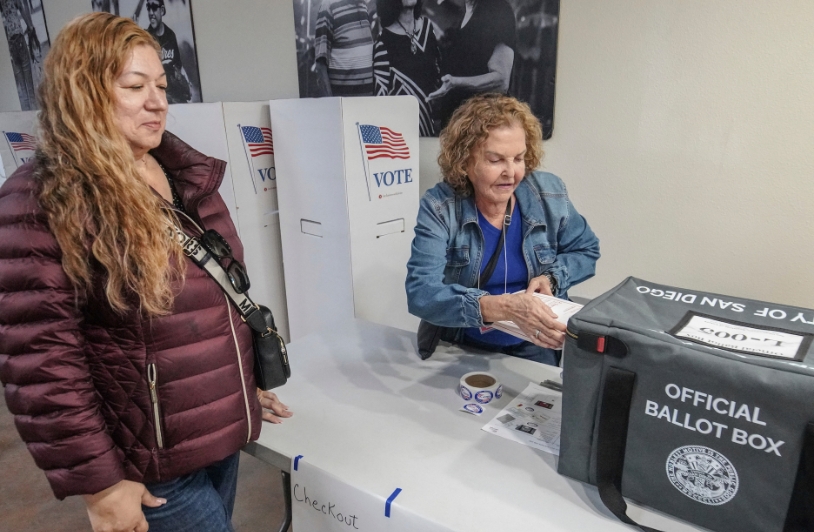


 Robert Kuttner